Disclosure: Some links in this post are affiliate links. As an Amazon Associate I earn from qualifying purchases, at no extra cost to you. Learn more
Specs are compiled from manufacturer listings and verified buyer reviews and can change over time — please confirm the key details on the product page before buying.
Cutting metal is not a patience problem — it is a leverage and heat problem. Push a light tool into thick steel and you get a wandering cut, a screaming blade and a burr you spend ten minutes filing. The picks below split into two honest camps: bench-mounted shears that trade muscle for clean, cold edges, and powered cutters that trade bulk for speed on sheet goods and pipe. Match the tool to the metal you actually cut most, and the job gets quiet.
This guide is built by comparing the manufacturers’ published specifications and the patterns across verified customer reviews, so you get each pick’s real strengths and trade-offs instead of marketing spin.
Every entry here is sorted by what it does best: bench shears for shop work, grinders for versatility, cordless shears for roof and duct panels, and a metal-cutting saw for straight, burr-free fabrication lines. A bench shear you must bolt down; a grinder you must feed carefully — knowing which constraint you can live with is most of the choice. Here is the practical shortlist for the Best Cutting Tool for Metal.
Top Picks


How To Choose The Best Cutting Tool for Metal
The first question is not which tool is strongest — it is what shape your metal arrives in. Flat sheet, round rod, square bar and pipe all behave differently under a blade, and the wrong cutter turns a five-minute job into a wrestling match. Answer the material question first and the tool picks itself.
Match the tool to the shape of your metal
A bench shear is built for flat plate and bar stock. It pins the work down and brings a straight blade through it, so the cut stays square and the edge needs little cleanup. A grinder works anywhere you can reach, but you steer it by hand, so a straight line is on you. A metal-cutting circular saw with a TCT blade is the only one of the three that gives you a guided, straight cut across a wide sheet without a burr to chase.
Read the capacity rating, not the motor badge
Capacity is written in real units — blade length in inches, maximum sheet thickness, rod diameter, or gauge for sheet steel. A lower gauge number means thicker metal, so 18-gauge is heavier stock than 20-gauge. Buy for the thickest metal you genuinely cut, and check whether the rating is for mild steel or stainless, because stainless is harder on an edge.
Decide between corded, cordless and pure muscle
Your power source decides how you work before the blade ever touches metal. A manual shear never runs flat and never needs a battery, but it needs a solid bench to bolt to. A corded grinder runs all day off a wall socket and gives you the highest spindle speed (how fast the disc spins) of the three. A cordless shear frees you on a roof or in a duct run, but many are sold as bare tools — meaning no battery in the box — so you need the right battery platform already in your kit. That one detail changes what you actually spend.
Think about the edge you have to live with
Heat is the quiet enemy of a clean cut. An abrasive disc grinds its way through and leaves a hardened, burred edge that needs dressing before it welds or paints. A shear or a toothed blade slices the metal instead, which keeps the edge workable straight off the tool. If your cut feeds straight into a weld, that difference matters more than raw speed.
Side-by-Side Comparison
| Model | Best For | Power Source | Max Cutting Capacity | Weight | Amazon |
|---|---|---|---|---|---|
| KAKA INDUSTRIAL HS-5 Bench Shear★ Best Overall | Bench-mounted plate and bar | Manual lever | 6 mm steel, 5 in blade | 22 pounds | Amazon |
| DCK 4-1/2-Inch Angle GrinderMost Versatile | All-round cutting and grinding | Corded, 6.7 Amp | 11,800 RPM, 4-1/2 in discs | 3.5 pounds | Amazon |
| Cordless Sheet Cutter (DeWalt 20V) | Flat sheet on the go | Cordless, bare tool | 20-gauge stainless, 18-gauge sheet | 3.34 pounds | Amazon |
| Cordless Sheet Metal Cutter (Milwaukee 18V) | Milwaukee battery owners | Cordless, bare tool | 20-gauge stainless, 18-gauge sheet | 3.7 pounds | Amazon |
| AOBEN Cordless Angle Grinder | Battery grinder kit out of one case | Cordless, 21V kit | 9,500 RPM, 4-1/2 in discs | — | Amazon |
| VEVOR Hand Plate Shear 8″ | Thick plate and rod, fixed bench | Manual lever | 1/4 in sheet, 1/2 in rod | 38 pounds | Amazon |
| Evolution S210CCS Metal Cutting Saw | Straight, burr-free plate cuts | Corded, high torque | 1/2 in steel, 3 in depth | — | Amazon |
Detailed Reviews
1. KAKA INDUSTRIAL HS-5 Manual Metal Bench Shear
Our pick — 4.5+★ from 300+ verified ratings; the strongest balance of quality and price.
The shear that turns a loud, sparking job into a quiet one-handed squeeze.
If your metal comes as flat plate, bar or round stock and you cut it in the same spot every time, this is the calmest way to do it. A 5-inch straight blade in high carbon steel (a hard, wear-resistant steel that holds an edge) slices through metal instead of grinding it away. The result is a cold, clean cut with no sparks, no burnt paint and no burr to file down before you weld.
The leverage is what sells it: a long steel handle gives you the mechanical advantage to push the blade through plate without leaning your whole body weight into it. The arched top blade keeps the cut moving through the whole stroke instead of stalling halfway. An adjustable hold-down clamps the work so it cannot climb up the blade mid-cut. It is rated for 6 mm steel with a 5-inch blade, so it slices plate that hand snips cannot touch. It weighs 22 pounds — 6.6 times the 3.34 pounds of the DeWalt-compatible cordless shear above — and that mass is exactly why it cuts so steadily.
Buyers rate the cut quality highest, with durability close behind. One long-time buyer of the same line put real numbers on it: “KAKA 12″ shear cut 0.23″ 4130 chromoly with no resistance; 0.90″ chromoly needed more force (grip handle end) but no blade dulling/damage.” That is thick, hard chrome-moly steel (a tough steel alloy) taking a clean edge with no damage to the blade.
What earns it first place
- Cold, burr-free cuts in plate, flat bar and round stock without sparks or heat damage.
- The long handle and arched top blade carry the cut through the stroke with far less effort.
- Adjustable hold-down keeps the work pinned so the line stays square.
- Blade is high carbon steel — wear-resistant enough to keep an edge across repeat jobs.
What to plan for
- It must be bolted to a bench or stand — a loose shear is a fight, not a tool.
- Adjusting the blade gap takes some fiddling, and the manual is thin on guidance here.
- At 22 pounds of steel it wants a permanent home, not a spot in a rolling cart.
Ideal for: anyone who cuts flat plate, bar or rod at a fixed bench and wants dead-straight, spoiler-free edges.
Plan around this: budget for a solid mounting point — the lever does the work only once the shear is locked down.
2. DCK 4-1/2-Inch Angle Grinder, 6.7 Amp
One small grinder that cuts pipe, dresses welds and strips rust without changing machines.
The DCK runs a 6.7-amp motor (the current draw that sets its real working power) up to 11,800 RPM — the top spindle speed of any cutting tool in this group. High speed is what lets a thin abrasive disc bite through steel instead of skating over it. It handles 4-1/2-inch discs with a 7/8-inch arbor and a 5/8″-11 UNC spindle, which is the common fitting, so wheels are easy to find.
The ergonomics punch above its size. At 3.5 pounds it stays manageable for longer sessions, and the grip measures 7 inches around so it sits in your hand without fighting back. A spindle lock makes wheel swaps quick, and a slide switch with lock-on keeps the tool running without you holding the trigger the whole time. A two-position side handle lets you find a control angle that works for your cut.
Reviewers praise the grinder’s build quality first and its power second. It ships with real working stock, not just one disc — 2 grinding wheels, 2 cutting wheels and 2 flap wheels, plus two separate guards and a spanner. The recurring note in the feedback is durability, and it is honestly mixed: treat it as a solid general-purpose grinder rather than an industrial workhorse you can abuse all day. Two guards is generous at this level — belt or disc grinders that come with nothing worth using are the norm.
Where it shines: cutting iron pipe, slicing tile for a backsplash or knocking rust off a frame are all one tool. The 11,800 RPM and 6.7 amp motor mean it does not labour on light sheet, and the twin guards cover you on both cutting and grinding setups.
The honest catch: an abrasive disc cuts fast but leaves a heated, burred edge, so plan on a cleanup pass if the cut feeds straight into a weld. It is also a corded tool — you need a socket at the end of the lead.
Right call for: the generalist who cuts pipe one minute and cleans up a weld the next, all from one small tool.
Look elsewhere if: you need to work where there is no wall socket, or you want burr-free edges straight off the cut.
3. Cordless Sheet Cutter Compatible with DeWalt 20V Battery

Featherweight panel shear that lets a DeWalt owner cut metal roofing up on the ladder.
Here is the lightest way into cordless metal cutting at 3.34 pounds — a fraction of the bench shear’s 22 pounds. The idea is simple: if you already own DeWalt 20V Max batteries, you slide one in and cut sheet where it hangs instead of dragging it to a bench. The brushless motor (a motor with no carbon brushes to wear out) spins to 2300 RPM and is rated up to 800W, with 221 ft-lbs of torque behind the blade.
The capacity is aimed squarely at sheet goods: up to 20-gauge stainless steel and 18-gauge sheet metal, with an 18-gauge number meaning fairly thin stock. The 360° adjustable cutting head lets you set the angle by hand with the included wrench for straight, curved or angled runs, and a safety lock plus forward and reverse keeps the blade under control. It is a bare tool, so the battery is not in the box.
What buyers report most is simply that it functions — it does the flat-metal job it promises, quickly and cleanly, and reviewers call out clean cuts without distorting the panel. The one honest limit sits in the fine print: this shear is not suitable for wave-shaped metal sheets because the blade can jam. Consistent forward pressure along a marked line is what keeps the cut clean on thicker stock.
Smart pairing: a DeWalt 20V owner who cuts flat sheet, duct or roofing panels on site gets the whole tool without buying another battery platform.
skip it if: your metal is corrugated or wavy, or you do not already own DeWalt 20V packs — a bare tool with no battery is a paperweight.
The match: existing DeWalt 20V batteries and flat sheet metal you would rather cut in place than carry.
The trade-off: it is not built for wavy sheets and it ships without a battery, so it only makes sense inside the DeWalt platform.
4. Cordless Sheet Metal Cutter

The same panel-cutting formula, tuned for the red battery pack already in your truck.
This is the Milwaukee 18V / M18 sibling of the DeWalt cutter above, and the specs mostly walk in step. A brushless motor (a motor without carbon brushes, so it runs cooler and lasts longer) spins at 2300 RPM (revolutions per minute), with up to 800W of power and 221 ft-lbs of torque (twisting force). It carries the same 20-gauge stainless and 18-gauge sheet ratings — thin sheet metal that snips handle easily. Where it edges ahead is torque on the Milwaukee platform, listed at a maximum of 300 N·m.
The 360° pivoting head adjusts by hand with the included wrench, so you can set it for straight, curved or angled work. It handles iron sheets, metal roofing, wire mesh and other flat metal components. A safety lock and forward and reverse controls keep things predictable, and the chamfered grip is built for long sessions rather than one quick cut.
The functionality is the headline here — flat metal goes through quickly, and it leaves clean cuts without distorting the panel. The same caveat carries over from its DeWalt twin: it is not made for wave-shaped sheet and can jam on it, and it is a bare tool with no battery in the box. The Milwaukee M18 platform is what makes this worth picking over the DeWalt version, not a difference in cutting muscle.
Why choose this one: you are already invested in Milwaukee M18 packs (48-11-1820, 48-11-1840, 48-11-1850 and similar), so this drops straight into your kit with no new charger to buy.
Worth knowing: it lists a 20V spec while being built for the 18V M18 line, and it shares the flat-sheet-only limit — corrugated and wavy metal is out.
Built for: the Milwaukee M18 household that wants a panel cutter without adding another battery system.
Not for: anyone starting from zero on batteries, or cutting anything but flat sheet.
5. AOBEN Cordless Angle Grinder, 21V Kit
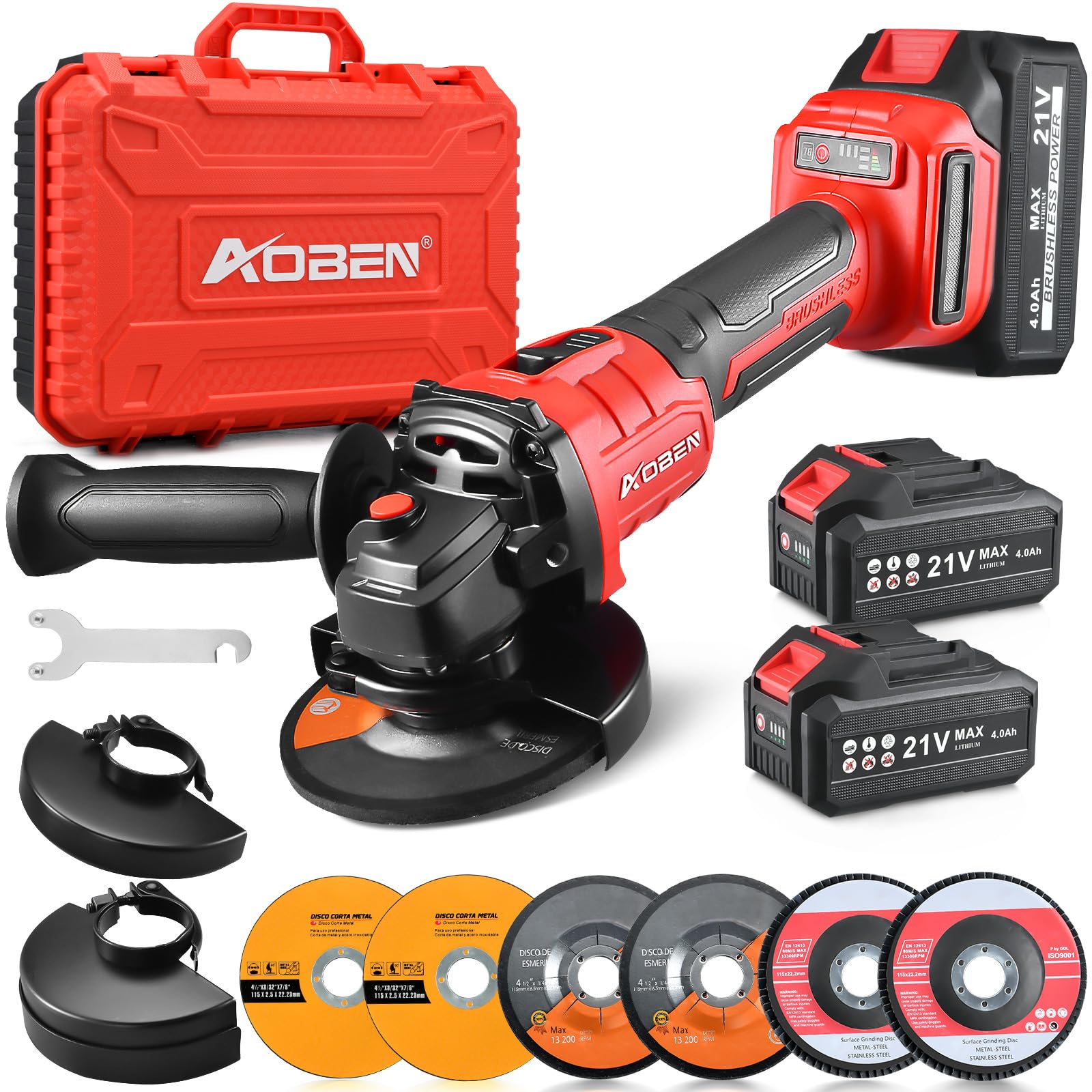
Two batteries, one case, and three speeds — the grinder you grab when the outlet is behind a fence.
This is the only grinder here that ships as a complete cordless kit, so you can start cutting the day it arrives. In the case you get two 21V 4.0Ah li-ion battery packs (4.0Ah is the capacity rating, so you can swap one in as the other recharges) plus a charger. The brushless motor tops out at 9,500 RPM, a step below the 11,800 RPM of the corded DCK above — that is the honest trade-off for cutting the cord. Three speeds let you dial back for surface prep and open it up for cutting.
It takes the standard 4-1/2-inch discs on a 7/8-inch arbor and 5/8″-11 spindle. The spindle lock makes wheel changes quick, and the auxiliary handle plus two guards (a regular one and a half-covered one) keep sparks and chips off you. The case holds grinder, batteries, charger, handle, guards, two cutting wheels, two grinding wheels, two sanding wheels and a wrench — a full starting setup rather than one disc in a box.
Reviewers rank build quality first, power second and battery capacity third, and note it is light to hold and travels well for home and remote jobs. Battery life and durability are the mixed part of the story: the runtime depends on how hard you push it, and a heavy-duty workload will empty a pack faster than light work. The smart chip in the tool will also cut power if it senses overload or overheating — let it recover rather than fighting it.
Strong points
- Two 21V 4.0Ah batteries and a charger in the case — a working kit, not a bare tool.
- Brushless motor rated to 9,500 RPM with three selectable speeds.
- Portable for site work with no wall socket in reach.
- Two guards, a side handle and six wheels cover cutting, grinding and sanding.
Things to weigh
- Battery runtime is mixed — plan around heavier jobs draining a pack quicker.
- Top speed sits under the corded grinder, so abrasive cuts run a little slower.
- Overload protection pauses the tool on hard jobs, which takes a moment of patience.
If you are untethered: this is the kit for metalwork where a cable will not reach — two batteries keep you cutting while one charges.
Bear in mind: a corded grinder still wins on sustained power, so for a long bench session the wall-powered option is the harder worker.
6. VEVOR Hand Plate Shear 8″

Thirty-eight pounds of steel frame built to bite through quarter-inch plate without flinching.
Where the KAKA shear tops out at 6 mm, this 8-inch VEVOR is rated for 1/4-inch sheet steel, 2-3/4″ x 1/4″ flat steel and 1/2″ rod steel. The long lever arm carries a compensating spring so the handle returns and the leverage stays with you through the cut. The blade is T10 high carbon steel, and the frame is a solid steel build meant to hold the work firm while the blade comes through.
At 38 pounds it is the heaviest tool in this guide — heavier even than the 22-pound KAKA — and it needs a bench to live on. That frame weight is the point: a compact metal frame with an internal adjustable clamp holds the stock steady so it cannot shift, and the cut runs straight and smooth. It can be bolted onto a workbench for exactly that reason.
Reviewers credit the shear performance first and build quality second — this thing cuts. Reviewers report it slicing through 1/8-inch mild steel with edges described as extremely clean, and one buyer says it saved them from dragging out a diamond saw. The honest split is in durability and weight, which draw mixed feedback — some call it heavy-duty while others find the construction or alignment lacking. Treat it as a capable plate cutter that rewards a solid mount, not a tool to haul around.
Its argument: nothing here cuts heavier plate and rod with cold, burr-free edges. Quarter-inch sheet, 2-3/4″ x 1/4″ flat and 1/2″ rod all fall inside its rating.
Its cost: that 38-pound frame wants a bolted-down bench, and the alignment and fit of some units is less than perfect out of the crate, so check the blade tracking when it arrives.
For the heavy shop: thick plate and round rod that would stall a lighter shear, cut cold and square on a fixed bench.
Weigh the trade: 38 pounds is not portable, and a bench mount is not optional if you want clean cuts.
7. Evolution S210CCS Metal Cutting Circular Saw

A toothed steel blade that leaves a cut ready to weld with no sparks and no burr to chase.
Most metal saws grind their way through and leave a heated, burred edge. This one uses a tungsten carbide tipped (TCT) blade — a steel blade with carbide teeth bolted to the tips — to slice the metal instead. The result is a workable cut in mild steel with no heat, no sparks and no burrs, ready for welding or a repeat pass straight off the saw.
The 8-1/4-inch blade with 50 teeth runs with a high-torque motor rated to cut through 1/2-inch thick steel plate. A 3-inch cutting depth and a full-length parallel edge guide keep straight and plunge cuts on line, and an LED cutline light shows you exactly where the teeth will land. An electronic blade brake stops the disc quickly, and the steel base with clear sightlines keeps the tool flat and controlled.
Reviewers praise the cut quality first and cutting performance second. Reviewers report it going through 3/16-inch sheet steel like butter and leaving a cleaner edge than the DCK grinder’s abrasive discs on the same flat material. It is not heavy to handle, which is a real surprise for a saw this size. Value, durability and chip collection draw mixed notes — the integrated chip collector is a handy idea, but it is a convenience, not a reason to buy.
Why it leads on edge quality
- TCT blade cuts mild steel with no heat, no sparks and no burrs.
- High-torque motor rated for 1/2-inch plate, with 3-inch depth for roofing and framing.
- Parallel edge guide and LED cutline light hold a straight line across a wide sheet.
- Electronic blade brake and safety trigger lock keep it controlled.
The caveats
- Durability draws mixed feedback — treat it as a capable saw, not an indestructible one.
- The chip collector is more convenience than essential for most cuts.
- This is a corded, heavy-duty tool — it wants a socket and a stable surface.
The pick for: fabrication, welding prep and repeat straight cuts where a burr-free edge saves you a finishing step.
Think twice if: you only cut the odd pipe — the grinders here reach into tighter spaces and shapes this saw never will.
Know the Specs
Cutting capacity and gauge numbers
Capacity tells you the thickest metal a tool will take, and it is written in real units: blade length, maximum sheet thickness, rod diameter or gauge. Remember that a lower gauge number means thicker steel — so 18-gauge stock is heavier than 20-gauge. A bench shear rated for 6 mm cuts differently than one rated for 1/4-inch plate, so buy for the heaviest metal you actually cut and leave a little headroom.
RPM, torque and heat
RPM is how fast the spindle spins, and higher speed helps an abrasive disc bite rather than skate. Torque is the twisting force behind the blade, which matters on thicker or harder stock. Heat is the hidden variable: an abrasive disc cuts fast but leaves a heated, burred edge, while a shear or a TCT blade slices the metal and keeps it cold and workable. If your cut feeds straight into a weld, edge quality beats raw speed.
Bare tool versus kit
A bare tool means the battery is not in the box — you supply one from a platform you already own. That makes a cordless shear a smart buy for someone already on DeWalt 20V or Milwaukee M18 packs, and a poor one for anyone starting from scratch. A kit, by contrast, includes the batteries and charger, so you can run it the day it arrives, but it locks you into that brand’s packs.
Bench mounting and stability
Manual shears rely on leverage and a fixed workholding point. A heavy shear needs to be bolted to a solid bench or stand — a loose one fights you and cuts crookedly. The steel frame weight is what keeps the tool stable while the blade travels through plate. Plan the mounting spot before you buy; it decides whether a bench shear becomes your favourite tool or a shelf ornament.
Common Questions
Will a bench shear cut stainless steel or just mild steel?
What does bare tool mean on a cordless metal shear?
Can an angle grinder cut metal without leaving a burr?
How thick a plate will the Evolution S210CCS saw cut?
Do I need to bolt a bench shear down to use it?
Is a cordless shear strong enough to cut metal roofing?
What is the difference between 18-gauge and 20-gauge sheet metal?
How many discs come with the DCK and AOBEN grinders?
Which is better for a straight line across steel sheet: a grinder or a metal-cutting saw?
Why does a cordless grinder slow or stop mid-cut?
The Bottom Line
For most people cutting metal at home or in a small shop, the smartest buy on this list is the KAKA INDUSTRIAL HS-5 bench shear — a cold, burr-free cut (no rough edge left behind) in plate, bar and rod from a high-carbon blade with real leverage behind it. It is the crowd favorite here, at 4.5+ stars across 300+ owners, and that rating rests on the cut quality. If you want one small tool that cuts pipe, cleans welds and strips rust without a bench, grab the DCK angle grinder. Already on Milwaukee M18 batteries and cutting flat sheet on site? The Milwaukee-compatible cordless shear drops straight into your kit. And when a burr-free straight cut across steel plate or roofing decides the job, the Evolution S210CCS is the one to reach for.
How we choose
We do not accept paid placement. Every pick is matched to a real buyer and a real use-case; we do not hands-on test units.
Sources
Specifications: manufacturer listings and product documentation. Review insights: verified customer reviews, as of October 2026. Pricing: not shown on this page (it changes often); check the current price via the retailer link.
As an Amazon Associate, Aappliancez earns from qualifying purchases. This does not affect which products we feature.