Disclosure: Some links in this post are affiliate links. As an Amazon Associate I earn from qualifying purchases, at no extra cost to you. Learn more
Specs are compiled from manufacturer listings and verified buyer reviews and can change over time — please confirm the key details on the product page before buying.
If your last custom shirt cracked down the middle after two washes, the film was never the real problem — the ink-to-fabric bond was. Getting a print to survive the laundry pile means matching the right transfer sheet, the right powder, and the right peel timing for the fabric you own. This shortlist separates the sheets and powders that bond properly from the ones that crack, so you can buy once and stop reprinting.
This guide is built by comparing the manufacturers’ published specifications and the patterns across verified customer reviews, so you get each pick’s real strengths and trade-offs instead of marketing spin.
A transfer sheet is a delivery vehicle: it carries your ink, holds the powder, and hands the whole thing to the fabric under heat. Read the peel type and the sheet count before you read anything else — those two decide how fast you work and how long your blanks last. A good sheet will make your printer look better than it is, which is why the picks below, the custom dtf transfers shortlist, cover both sheet formats and the loose powder that finishes the job.
Top Picks

How To Choose The Best Custom DTF Transfers
The first decision is not which brand — it is which format fits your printer. A sheet pack feeds through a tray like ordinary paper. A roll feeds continuously and gives you room for longer designs. Pick the wrong format and a perfectly good sheet sits in the box, unusable on your printer.
Sheet pack or roll, depending on your printer
Sheet packs suit desktop inkjets and sublimation printers that pull one page at a time, and they are easier to store and count. A roll, like the 13-inch by 65.6-foot CenDale roll, is built for roll-enabled DTF printers and lets you cut the film to whatever size the artwork needs. If your printer has no roll feeder, a roll is wasted on you.
Hot peel versus cold peel, and why it changes your day
Hot peel means you pull the carrier away while the transfer is still warm, so you can stack the next shirt immediately. Cold peel means you let it cool first, which some people find gives a cleaner release on darker fabric. A sheet that does both, like the Printium 100-sheet pack, keeps your options open when a job changes mid-run.
Film never works alone
DTF film carries the ink, but the hot-melt adhesive powder is what actually glues the design to the cotton. Buy film without powder and you have a sheet that prints beautifully and refuses to transfer. Budget for a powder tub alongside your first film order, or start with a kit that includes both.
Side-by-Side Comparison
| Model | Best For | Sheet Count | Format | Peel Type | Amazon |
|---|---|---|---|---|---|
| TECKWRAP Printable Heat Transfer Paper★ Best Overall | First-timers on a home inkjet | 15 | 8.3″ x 11.7″ sheets | Cold peel | Amazon |
| CenDale DTF Sublimation KitBest Starter Kit | Starting from zero with film plus powder | 30 | A4 starter kit | Hot & cold peel | Amazon |
| CenDale DTF Transfer Film Roll | Long designs on a roll-fed printer | — | 13″ x 65.6 ft roll | Hot & cold peel | Amazon |
| Yamation DTF Powder | Refilling powder without rebuying film | — | 1000g tub | — | Amazon |
| Printium DTF Transfer Film Sheets | Daily print volume and bulk blanks | 100 | A4 sheets | Hot & cold peel | Amazon |
Detailed Reviews
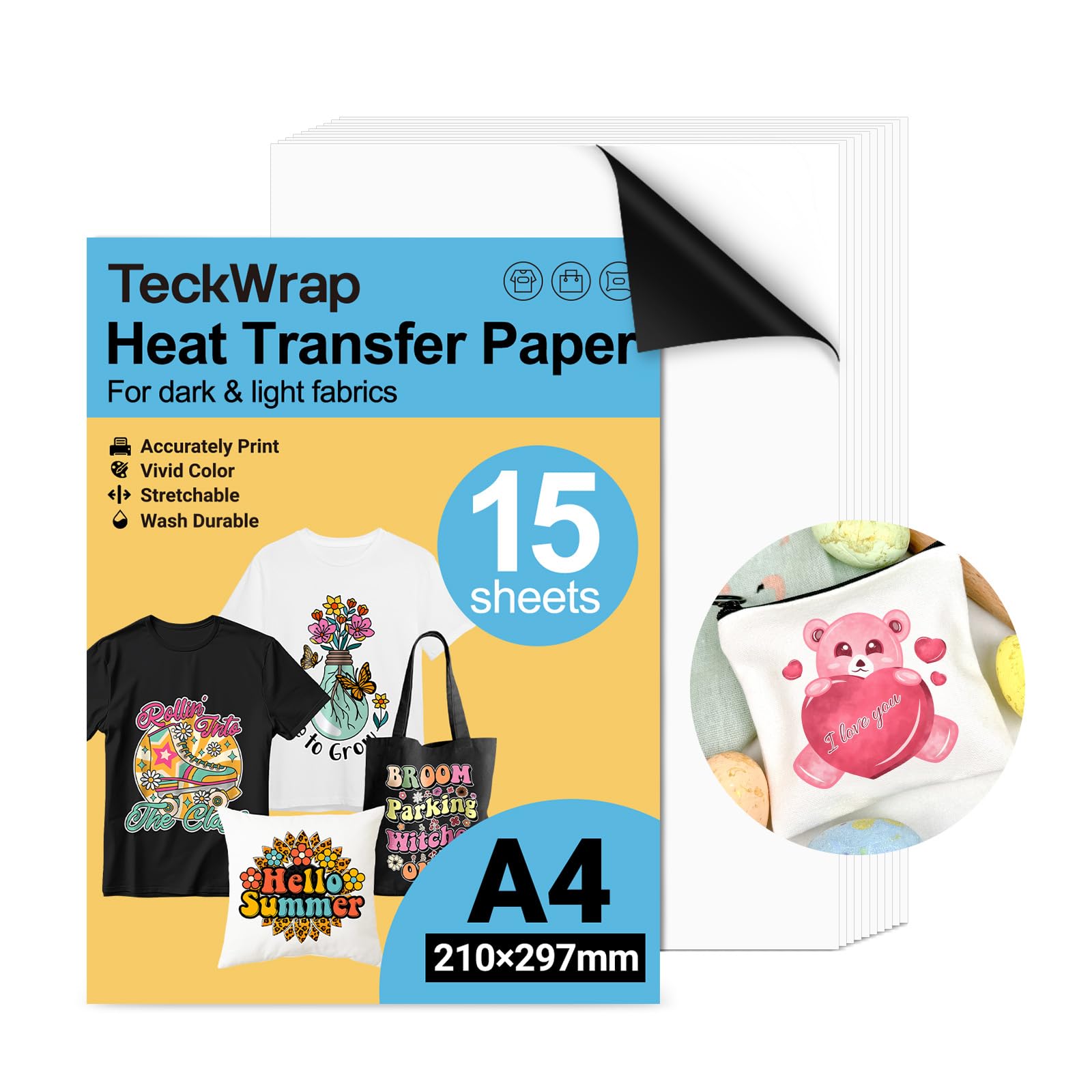
1. TECKWRAP Printable Heat Transfer Paper for T-Shirts
Our pick — 4.5+★ from 650+ verified ratings; the strongest balance of quality and price.
Fifteen sheets that turn an ordinary inkjet into a shirt-printing station.
This is the pack for the person who already owns an inkjet and wants a printed photo on a shirt this weekend — no DTF printer, no powder tub, no new machine. The paper runs 8.3 by 11.7 inches, letter size, so it feeds through the same tray as your everyday printer paper. That is the whole pitch: ordinary hardware, a professional-looking result.
What wins people over is the print itself. Colors come out rich rather than washed, and the matte white finish reads clean on both light and dark fabric. The pack also includes one sheet of reusable parchment paper and two heat transfer masks, and those masks earn their place — you line the design up once instead of eyeballing it on a dark tee. Press settings are published plainly: 310 to 330°F for 15 to 20 seconds, applied cold peel.
The honest split is durability. Wash performance and color hold draw genuinely mixed feedback, and the recurring note is that fading and bleeding creep in unless you wash inside out on low heat. One buyer also opened the second envelope to find mask sheets where paper should have been, so eyeball the contents before you start a big job. Buyers report it plainly too: “Worked great. Took my printed picture to a tshirt shop who used the heat press to transfer photo.” Follow the inside-out, low-heat wash care and the print holds its color far longer.
What earns its place
- Works with pigment or dye inkjet printers from HP, Canon, Epson and Brother — no sublimation ink needed
- Masks included, which makes dark-fabric alignment far less nerve-wracking
- Thin, soft hand-feel compared with the plastic-like stiffness of older transfer papers
Where it asks patience
- Wash durability and color hold return mixed signals — inside-out, low heat is not optional
- Clear instructions are thin on the ground; expect to look up press settings on your own
- No mirroring required, but miss the parchment cover and you will scorch a print
Reach for this if: you own an inkjet, you want photos on shirts and bags, and you are fine pressing cold peel.
Think twice if: you need a sheet that shrugs off hot industrial washing without fading.
2. CenDale DTF Sublimation Kit — 30 Sheets Plus Powder
Thirty sheets with the powder already in the box — nothing missing, nothing to hunt down.
Buying film alone is the classic beginner mistake, because the film prints and then refuses to stick. This kit closes that gap with 30 A4 sheets at 8.3 by 11.7 inches, plus 14 ounces (400 grams) of medium-particle powder, a parchment sheet, and a roll of sensor stickers that help the printer pull the film cleanly. As a comparison point, the TECKWRAP pack ships 15 sheets — this one doubles that count and adds the adhesive on top.
The sheets themselves are built for smooth feeding. A matte, anti-static coating holds the ink and stops stray powder clinging to bare film, and the glossy reverse with an anti-slip layer keeps the sheet moving through the printer instead of jamming. The powder is a medium grind in the 80 to 200 micron range, which bonds firmly once it melts. Buyers rate the value highly, and the included instructions walk a first-timer through the powder-and-press sequence step by step. As owners put it: “CanDale is the only brand dtf film I will use in my 8550!”
The catch is the learning curve, not the product. Cure time and heat settings take trial and error, and powder residue gets messy if you do not press cleanly — plan on ventilation and a wipe-down. Note the important limit on the sublimation route: because there is no white ink in that workflow, only white fabrics are compatible. Dark shirts need the full DTF process with white ink.
What the box gives you: 30 sheets plus 14 ounces of powder is enough for serious experimentation before you commit to a roll, and the sensor stickers are a small detail that saves real frustration on stubborn printers.
The powder ratio note: the tub likely outlasts the film, so one kit ends as a film-only reorder — not a flaw, just worth knowing when you plan your next purchase.
Good fit for: anyone starting DTF from scratch who wants one order to cover film, powder, and parchment.
Not the one if: you print on black and dark garments through a sublimation printer.
3. CenDale DTF Transfer Film Roll — 13″ x 65.6ft

Thirteen inches wide and 65.6 feet long — artwork that outgrows a sheet tray.
Full-back prints, banner-length graphics, and designs that run past the edge of A4 all need width, and this roll supplies it at 13 inches across 65.6 feet of film. It is a premium A3+ format at 330mm wide, so you cut to the size the artwork demands instead of shrinking the art to fit a page. You get matte double-sided film with five coating layers for ink absorption, and an anti-slip glossy reverse so the roll feeds without grabbing.
Hot and cold peel both work here, and hot peel is the reason several regulars keep coming back — pull while warm and you skip the cooling wait before the next press. Suggested settings are published on the pack: 266 to 320°F for 10 to 15 seconds. The film also handles cotton, leather, nylon, denim, polyester and blends with no color restriction, so light and dark fabrics both work.
Here is the part that needs saying clearly. Quality and printability readings swing hard in both directions — for every run of clean, bright prints there is a stretch where the film presses oily and leaves ink residue behind. The roll also arrives with a scratch risk that more than one buyer found off-putting. Customer service does replace faulty batches, which softens the blow but does not erase a wasted afternoon. One requirement is absolute: this is film only. You need a DTF printer, DTF ink and DTF powder to go with it.
Who the roll is built for: roll-fed DTF printers running wide or long artwork where an A4 sheet would force a design compromise.
The scratch caveat: treat the roll gently in storage and check the surface before a big run — a scored section prints a visible defect straight onto the garment.
Pick it when: your printer has a roll feeder and your designs regularly run wider than letter size.
Leave it on the shelf if: you only have a tray-fed printer or you expect the film to carry powder with it.
4. Yamation DTF Powder — 1000g White Hot Melt Adhesive
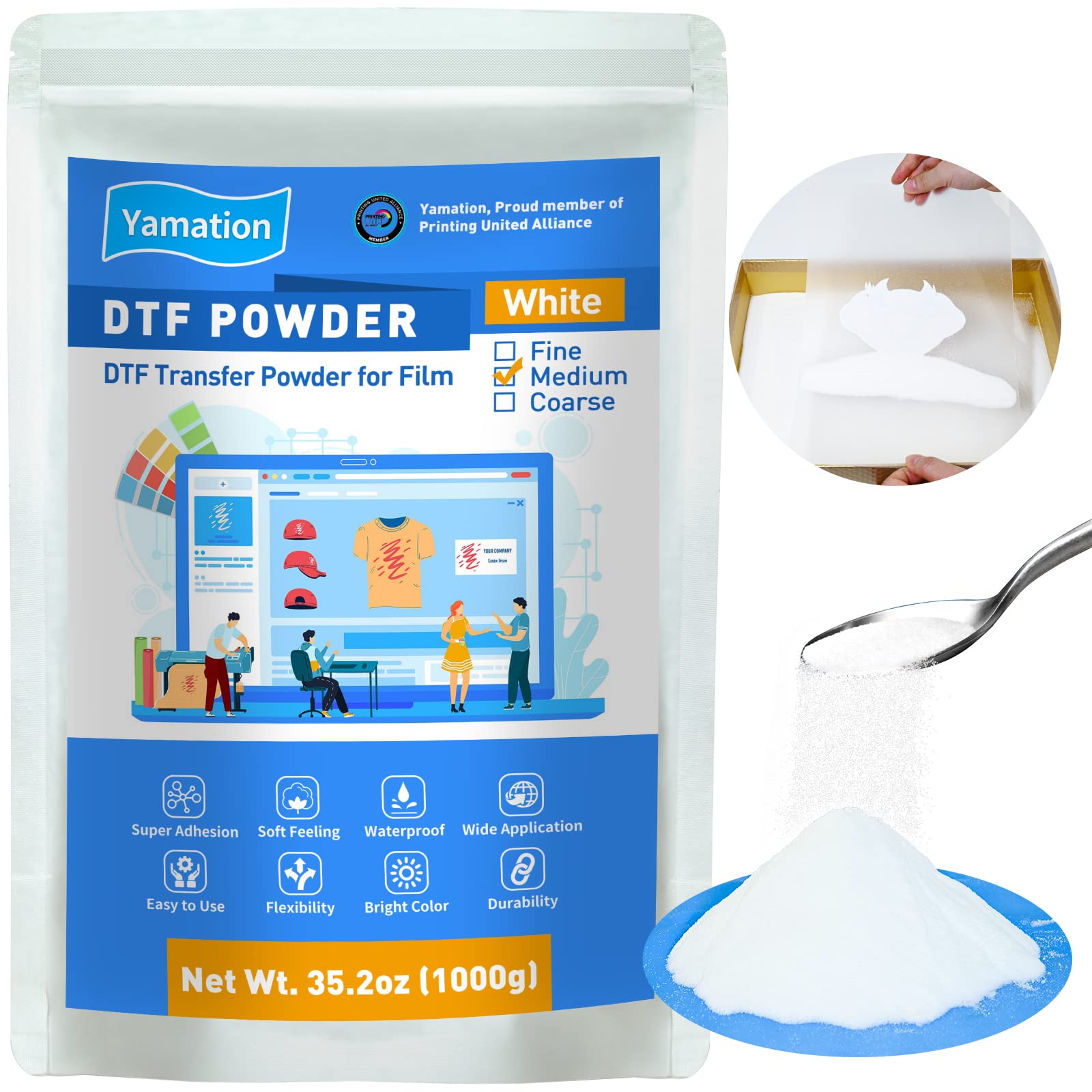
A two-point-two-pound tub of the step everyone forgets until their first print peels.
Powder is the adhesive layer, and its job is simple: melt into the ink, grip the fabric, and stay flexible so the print bends with the shirt instead of cracking. Yamation makes it from TPU (thermoplastic polyurethane — the stretchy plastic that gives a transfer its give), and that is why a print through this powder feels soft rather than stiff. The tub holds 1000 grams, or 2.2 pounds, which is a serious refill quantity rather than a sample.
The anti-static formula is the detail that saves shirts. Powder should cling only to the wet printed areas, and the anti-static charge keeps stray granules off the blank film, which is what produces the white halo around a design that ruins an otherwise good press. It also works across cotton, polyester, blends and the popular sublimation-to-DTF method. Melt is smooth and even at lower temperatures, which cuts the odds of scorching a blank you already invested in.
Owners reorder for the smooth melt and soft finished press, with the 1000g tub’s cost per gram close behind. It shakes out fine, melts without the harsh chemical smell some powders carry, and the resulting press sits thinner on the shirt. The consistency is the honest wobble — some tubs run smooth while others arrive with visible lint and dust mixed through, and a few buyers found it slower to melt than expected. Sift it into a clean container on arrival and you sidestep most of that.
Why it earns repeat orders
- 1000g tub means far fewer reorders than a starter-size pouch
- TPU base keeps the finished print stretchy and soft rather than board-stiff
- Anti-static formula fights the white-edge halo that wastes blanks
Worth checking on arrival
- Consistency varies between tubs — some arrive with lint or dust mixed in
- Melt speed draws mixed reports; give it a full cure rather than rushing the press
- It is powder only, so pair it with film you already trust
Best for: anyone already running film who wants a large, soft-finishing powder supply without changing brands.
Skip the tub if: you have not yet bought film — start with a kit that includes both.
5. Printium DTF Transfer Film Sheets A4 — 100 Sheets
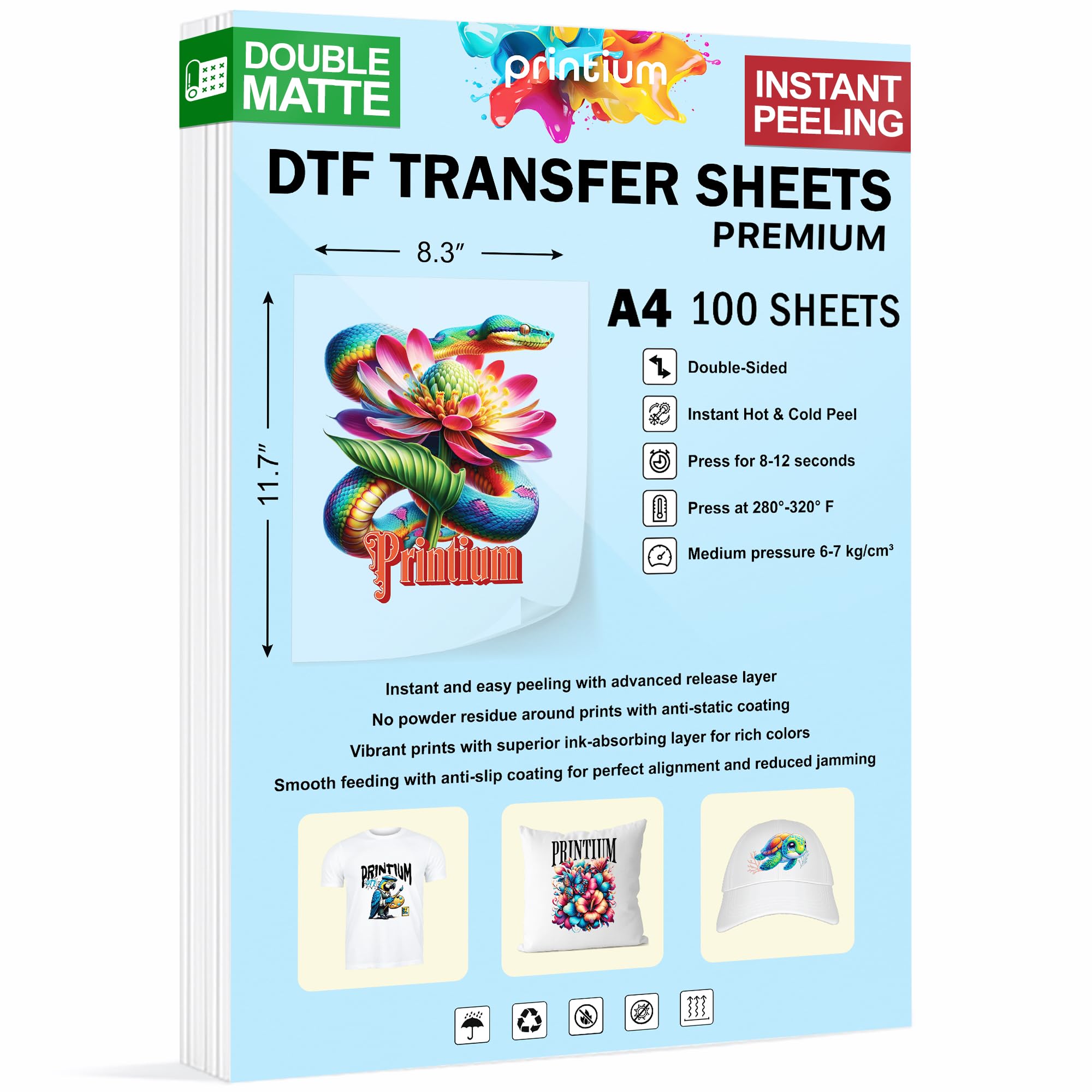
One hundred A4 sheets for the printer that never really stops running.
Volume is the point. One hundred sheets at 8.3 by 11.7 inches means you stop rationing film for test prints, and the ten-sheet difference between this and a smaller pack adds up across a week of orders. The film itself is double matte PET with an anti-static coating, so powder clings to the design and not the bare surface, and detail stays sharp through the press.
Compatibility is unusually broad for a sheet pack. The listing names I3200, XP600, TX800, 4720, DX5, DX7, 5113, 1430 and I1600 printheads, plus ET8550, ET8500, XP15000, L1800, L805, L800, P800, P700, R1390 and R2400 machines — a long list, but worth a glance if you run an Epson desktop. Hot and cold peel both work, so you can pull warm for speed or cool for a controlled release on a tricky fabric.
The critical warning sits in the listing for a reason: this is film only, and hot-melt DTF powder is sold separately. Without powder the design will not transfer, and that single missing step catches a lot of first orders. Beyond that, results are bright and wash-resistant on cotton, polyester, spandex, denim, canvas and blends, with the print staying sharp rather than muddy.
The volume argument: a hundred sheets suits daily desktop production and sample runs, and the anti-static coating keeps fine lettering crisp on small orders.
The missing piece: no powder in the box — budget for a tub alongside, or your first press produces nothing.
Worth it for: steady desktop output where a fifteen-sheet pack runs out before the week does.
Look elsewhere if: you want a single order that covers every supply, powder included.
Know the Specs
Sheet count and format
Sheet count tells you how many prints you can attempt before reordering, and format tells you whether the film fits your printer. A4 measures 8.3 by 11.7 inches, which suits desktop printers and standard shirt graphics. A roll format like 13 inches wide suits wider artwork and roll-fed machines. Match the format to your printer first — a roll is useless on a tray-fed machine.
Peel timing
Hot peel means pulling the carrier while the transfer is still warm, which speeds up production because you do not wait for it to cool. Cold peel means letting it cool first, which some people find gives a cleaner release. Sheets that do both give you flexibility when a job changes fabric partway through.
Anti-static coating
Static is what makes powder stick where it should not, leaving a white halo around the design. An anti-static coating on the film keeps loose granules off the unprinted areas, and the same idea in a powder stops it clinging to bare film. Together they keep powder off unprinted areas and save the blank from a haloed, wasted press.
Powder particle size and cure
Powder melts into the ink and bonds to the fabric, and particle size affects how it flows. A medium grind in the 80 to 200 micron range bonds firmly once melted. Cure time matters just as much: press too quickly and the powder has not fully melted, which shows up as a stiff or peeling print later.
Common Questions
Can I use DTF transfer film with a normal inkjet printer?
Do I really need DTF powder to make a transfer work?
What temperature should I press DTF film at?
Why did my DTF print come out oily or with leftover ink on the film?
Will hot peel film work on dark cotton shirts?
How long will a printed DTF transfer last in the wash?
How many shirts will one tub of powder cover?
Can I cut DTF film with a Cricut machine?
Does the film need to be mirrored before printing?
Why does my design get a white halo around the edges?
The Bottom Line
For most people printing at home, the custom dtf transfers winner is the TECKWRAP Printable Heat Transfer Paper because it turns a standard inkjet into a shirt printer with no powder and no new machine — just press cold peel and follow the wash care. If you are starting DTF properly and want film plus adhesive in one order, grab the CenDale DTF Sublimation Kit and learn on its 30 sheets. And for wide or long artwork on a roll-fed machine, the CenDale DTF Transfer Film Roll is the one to reach for. Whichever film you pick, add a 1000g powder tub to the same order so you are not caught short mid-project.
How we choose
We do not accept paid placement. Every pick is matched to a real buyer and a real use-case; we do not hands-on test units.
Sources
Specifications: manufacturer listings and product documentation. Review insights: verified customer reviews, as of October 2026. Pricing: not shown on this page (it changes often); check the current price via the retailer link.
As an Amazon Associate, Aappliancez earns from qualifying purchases. This does not affect which products we feature.