Disclosure: Some links in this post are affiliate links. As an Amazon Associate I earn from qualifying purchases, at no extra cost to you. Learn more
Specs are compiled from manufacturer listings and verified buyer reviews and can change over time — please confirm the key details on the product page before buying.
If your cucumber vines are running weak, dropping blossoms, or handing you small bitter fruit, the problem is usually food — not luck. Cucumbers are hungry, fast-growing plants that need steady nutrition through the whole season, and the right cucumber fertilizer keeps vines vigorous and fruit coming for weeks longer. Below you get five proven picks, sorted by what each one actually does best, so you can match one to your garden in a couple of minutes.
This guide is built by comparing the manufacturers’ published specifications and the patterns across verified customer reviews, so you get each pick’s real strengths and trade-offs instead of marketing spin.
Some picks are granular and slow-release, others are liquid and fast-acting, and the NPK numbers differ enough to matter for fruiting versus leafy growth. That is why this walkthrough of the best cucumber fertilizer focuses on matching a formula to your stage of growth.
Top Picks

How To Choose The Best Cucumber Fertilizer
Picking a cucumber fertilizer is really a question of timing and form. A vine that is still building leaves and tendrils wants nitrogen. A vine that is setting and swelling fruit wants phosphorus and potassium more than it wants more greenery. Get that balance roughly right and cucumbers reward you with a long picking window instead of a two-week flash.
Read the NPK ratio first
The three numbers on the bag are nitrogen, phosphorus, and potassium, always in that order — the percentage of each nutrient by weight. Nitrogen (the first number) drives leafy growth and vine length. Phosphorus (the middle number) supports root development and flowering. Potassium (the last number) helps fruit fill out and the plant handle stress. A balanced ratio feeds steadily all season, while a high-phosphorus blend leans into fruiting.
Granular or liquid — pick by how fast you need a response
Granules are dry pellets you scratch into the soil around the plant’s drip line (the circle of ground under the spread of the leaves), and they release slowly as you water. Liquid concentrates get diluted in a watering can and reach the roots quickly, which suits a vine that is already yellowing or stalled. Many gardeners keep a granular feed for the season and a liquid for rescue moments.
Look for calcium and soil-supporting ingredients
Calcium matters on fruiting crops because blossom end rot — the sunken dark patch on the bottom of a fruit — is tied to calcium movement in the plant. Ingredients like mycorrhizal fungi (beneficial fungi that partner with roots) and fish meal feed the soil biology alongside the plant. If you garden organically, look for a stated organic approval rather than assuming one.
Side-by-Side Comparison
| Model | Best For | NPK Ratio | Form | Package Size | Amazon |
|---|---|---|---|---|---|
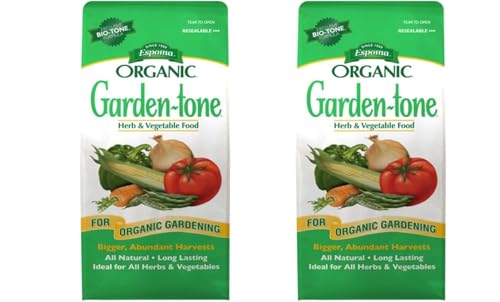
| Espoma Organic Garden-Tone★ Best Overall | All-season garden feeding | 3-4-4 | Granules | 4 lb per bag (2-pack) | Amazon |
| Leaves & Soul Cucumber Liquid 5-1-5Fastest Acting | Fast rescue of weak vines | 5-1-5 | Liquid concentrate | 8 fl oz | Amazon |
| Cz Garden 5-10-10 Tomato & Vegetable | Fruiting-stage feeding | 5-10-10 | Granules | 4 lb | Amazon |
| FoxFarm Happy Frog Tomato & Vegetable | Heavy-feeding vines and berries | 5-7-3 | Granules | 4 lb | Amazon |
| Down to Earth Organic Bio-Fish 7-7-2 | Building soil fertility long-term | 7-7-2 | Granules | 5 lb | Amazon |
Detailed Reviews
1. Espoma Organic Garden-Tone 4 lb Bag 2-Pack
Our pick — 4.5+★ from 900+ verified ratings; the strongest balance of quality and price.
Two bags, no mixing, and one monthly scoop that keeps the whole vegetable bed fed.
The easiest place to start is a granular feed you can’t really get wrong, and this Espoma blend is that product. The 3-4-4 on the bag means 3% nitrogen for steady vine and leaf growth, 4% phosphorus for roots and flowering, and 4% potassium for fruit — a near-even split that suits cucumbers across the season rather than only at one stage. It also carries 5% calcium, the nutrient tied to keeping fruit bottoms firm instead of sunken and dark.
What wins people over is the ingredient quality, and the payoff shows up in the growing season itself. In ground beds and large pots alike, flowers keep coming later into the year than the gardener expected and vegetables keep producing when they normally quit. One zone 10b gardener reported blooms pushing into early September, where they used to die in late July, plus 400 lbs of tomatoes and 100 lbs of carrots off an urban plot. That is a lot of productivity from a scoop-and-water routine.
The catch is the smell. It is a natural-organic blend of the finest ingredients with no sludges or fillers, and that honesty has an aroma. Scratch it into the soil at the drip line and water well, and it settles fast. You get two 4 lb bags here, 64 ounces each, so you are set for months of monthly feeding without a reorder. The Down to Earth pick has the larger review base — 900+ owners to Espoma’s 700+ — but both hold the same 4.5+ star score, and Espoma’s balanced ratio is the more forgiving starting point for cucumbers.
Why gardeners keep rebuying it
- Even 3-4-4 ratio feeds vine, root, and fruit at once
- 5% calcium included — no separate supplement to buy
- Ready to use granular form with no mixing or measuring jugs
- Two 4 lb bags per order, roughly 64 ounces each
What to plan around
- Distinct organic odor until it is worked into the soil
- Monthly reapplication through the season, not a one-time dose
Buy this if: you want one bag that handles a mixed vegetable bed without studying ratios.
Think twice if: odour-sensitive neighbours share a fence line with your beds.
2. Leaves & Soul Cucumber Fertilizer Liquid 5-1-5, 8 oz
The one to reach for when the vine has stalled and you want an answer this week.
When a cucumber vine goes pale or just sits there, granules are too slow a conversation. This is a liquid concentrate built on a 5-1-5 ratio — 5% nitrogen to push growth back on, 1% phosphorus, and 5% potassium to help the vine carry fruit — and you dilute it into water so the roots take it up quickly. An 8 oz bottle of concentrate goes a long way because every feed is a small measured pour rather than a scoop.
The recovery stories are the reason this bottle earns its place. One grower at 8,000 ft who had lost three seasons of cucumbers started picking daily after introducing it. Another watched a weak vine with spotted leaves and yellowing fruit recover and set a personal-best cucumber, with eight more on the same plant. Fruit that comes off a well-fed vine also tends to eat better — that same gardener found the flesh mild and the skin free of bitterness.
Here is the honest limit: this is a marketing-narrow formula. Peel back the label and the 5-1-5 inside is the same type of blend sold for tomatoes, peppers, and zucchini, so don’t expect cucumber-only magic. It also ships as a liquid in a bottle, and an occasional unit arrives with a leak in the bag. Treat it as your quick-response tool, not your season-long base feed.
Where it earns the shelf space: a fast, diluted liquid feed is the right tool for a mid-season slump, and this one is sized for containers and small beds rather than acreage.
Set your expectation: the cucumber branding on the front is cosmetic — the nutrition is a standard 5-1-5 vegetable feed in a small, leak-prone bottle.
Reach for this if: your vines are already planted, already struggling, and you need nutrition into the roots fast.
Look elsewhere if: you want a single product to carry a large bed from spring through autumn.
3. Cz Garden 5-10-10 Tomato & Vegetable Fertilizer 4 lb Pouch

High-phosphorus granules built for the moment your vines stop flowering and start filling fruit.
The middle number is the story here. A 5-10-10 ratio doubles down on phosphorus and potassium relative to nitrogen — 5% nitrogen, 10% phosphorus, 10% potassium — which pushes a plant toward flowering and fruit set instead of more leaf. It also carries 2% iron plus micronutrients, and the granules are dosed at one to two tablespoons per plant, so a 4 lb pouch covers a serious number of vines.
Effectiveness is what this one is known for, and the fruiting-stage performance is the specific reason. Gardeners feeding every two weeks while fruit swells report huge tomatoes on green-leaved plants, peppers and squash following along, and no scorch when the label directions are followed. It is a straightforward granular product with visible coloured beads that show you where you have already fed — a small thing that saves a lot of guesswork.
Two things a buyer should weigh. The bag is smaller than the weight suggests, and a few gardeners find the value only fair once they see how much volume they get. Plant response is also not universal — most beds thrive, a few don’t. That gap is normal for any fertilizer and says more about soil and watering than the blend. As a one-bag-per-year option for the fruiting half of the season, it holds up well.
What it does well
- 5-10-10 ratio leans hard into flowering and fruit fill
- 2% iron plus micronutrients in the same bag
- Resealable heavy-duty pouch keeps the rest dry between feeds
- Colored beads show where you have applied
Where it falls short
- Small bag volume for the stated weight
- Not a formula for the leafy early growth phase
Best matched to: a gardener already seeing flowers and small fruit who wants that fruit to fill out.
Hold off if: your seedlings are still building their first true leaves and need nitrogen more than phosphorus.
4. FoxFarm Happy Frog Tomato & Vegetable Fertilizer 5-7-3, 4 lb

Calcium and root-boosting fungi in one bag, aimed squarely at vines that carry heavy fruit.
Cucumbers are vigorous feeders, and this blend is formulated for exactly that appetite. The 5-7-3 ratio — 5% nitrogen, 7% phosphorus, 3% potassium — supports both the leafy build-up and the flowering push, so it carries a vine through the vegetative and flowering stages without a formula switch. Calcium is included specifically to help prevent blossom end rot, the sunken patch that ruins otherwise perfect cucumbers.
The mycorrhizal fungi are the other half of the pitch: these beneficial fungi partner with roots and may improve how efficiently the plant takes up nutrients and water. Gardeners who mix it into outdoor pot soil at season start and top-dress monthly report a tomato plant going from about a foot tall to 5.5 ft in six weeks. Zucchini that had stalled threw new blooms after a single application. That is a strong record for a 4 lb bag.
Two caveats, both minor. It smells funky — normal for an organic blend, and the sturdy bag keeps that smell contained in storage. And the bag size draws mixed feelings; heavy feeders burn through 4 lb faster than expected. Dosing is roughly half a cup monthly per plant, so follow the label rather than free-pouring. Compared with the Espoma pick above, this one trades a little evenness for a calcium-plus-fungi package aimed at fruit quality.
The honest read: the calcium and mycorrhizal fungi are real additions you would otherwise buy separately, and they suit a cucumber bed headed into heavy fruiting.
The trade-off to accept: an organic aroma in the bag and a 4 lb size that a large garden will outgrow.
Pick it when: fruit quality and blossom end rot are your worries, not just green growth.
Weigh the alternative if: you garden on a big scale and would rather buy one large bag than several small ones.
5. Down to Earth Organic Bio-Fish 7-7-2, 5 lb

Marine meal that feeds the soil as much as the vine, in the biggest bag of the five.
This is the pick for a gardener who thinks about soil, not just about dosing. The 7-7-2 ratio delivers equal parts nitrogen and phosphorus — 7% each — for vegetative growth and root development, plus 2% potassium for resilience and bloom support. The nutrients come from fish meal and fish bone meal, marine sources that feed soil biology and build long-term fertility rather than just topping up the plant for a few weeks.
It is OMRI Listed, meaning it is approved for certified organic systems, and it works across raised beds, garden rows, containers, and landscape plantings. Quality is the thing this one is known for, and the visible results back it up — gardens described as lush, Japanese maples responding well, and one 25-year gardener who has fed living-soil beds with the same brand season after season. At 5 lb it is also the largest bag on this list.
What you pay for that nutrition is a smell. Fish meal carries a mild fishy odour, so plan to cover it with soil rather than leave it sitting on the surface. That surface scent can tempt pets into digging, which is worth knowing if a dog shares your yard. Use it sparingly and only during the growing season, and the drawbacks stay small. Unlike the liquid concentrate above, this is a slow, soil-first feed rather than a fast rescue.
One quotable line: the Down to Earth Bio-Fish 7-7-2 feeds your soil’s biology with marine meal in a 5 lb bag, so beds get stronger as the season goes rather than just greener.
The honest limit: mild fishy odor and pet-attracting surface scent mean it needs to be worked under the soil, and it acts slowly rather than overnight.
Choose it for: rebuilding tired beds and feeding a whole garden from the soil up.
Leave it on the shelf if: you need a fix for a vine that is failing this week.
Know the Specs
The NPK Ratio
Those three numbers are the percentage of nitrogen, phosphorus, and potassium in the bag, in that order. Nitrogen builds leaves and vine length, phosphorus supports roots and flowering, and potassium helps fruit fill out and the plant handle stress. A near-even ratio like 3-4-4 or 7-7-2 feeds steadily all season, while a high-phosphorus blend like 5-10-10 leans into flowering and fruit set. Match the ratio to what your vine is doing right now, not to what the label picture shows.
Granular vs Liquid Form
Granules are dry and release slowly as you water, which makes them a low-effort base feed you apply monthly around the drip line. Liquids are diluted in a watering can and reach the roots within days, which suits a struggling vine you want to turn around quickly. An 8 fl oz concentrate and a 4 lb bag are very different quantities of food — the liquid is a rescue tool, the bag is a season-long supply. Many gardeners run both.
Calcium and Blossom End Rot
Blossom end rot is the sunken dark patch on the bottom of a fruit, and it is tied to how the plant moves calcium. A fertilizer that includes calcium, such as the 5% in Garden-Tone or the calcium in Happy Frog, gives the plant a steady supply as fruit develops. It is not a cure-all — watering consistency matters just as much — but choosing a blend with calcium removes one variable from the equation.
Organic Approval and Soil Biology
“Organic Input Material” and “OMRI Listed” are statements that a product meets the requirements for organic production, and both appear in this list. Ingredients like fish meal, fish bone meal, and mycorrhizal fungi feed the soil’s living community alongside the plant, which pays off over a season. Organic blends often carry a natural odor; that is the trade-off for the ingredient list, and working the granules into the soil handles it.
Common Questions
How often should I fertilize cucumber plants?
Is 5-10-10 good for cucumbers?
Can I use tomato fertilizer on cucumber plants?
Why do my cucumbers turn yellow and drop before they grow?
Should I choose granular or liquid cucumber fertilizer?
What does OMRI Listed mean on a fertilizer bag?
Does calcium fertilizer stop blossom end rot on cucumbers?
How much fertilizer does one cucumber plant need?
Why does organic cucumber fertilizer smell so strong?
Will a fish-based fertilizer attract pets to my garden?
The Bottom Line
For most gardeners, the best cucumber fertilizer is the Espoma Organic Garden-Tone because its 3-4-4 ratio feeds vine, root, and fruit at once, includes 5% calcium, and arrives as two 4 lb bags you can use all season without measuring a thing. If your vines are already planted and struggling, the Leaves & Soul Liquid 5-1-5 reaches the roots fast. And for rebuilding tired soil season after season, the Down to Earth Bio-Fish 7-7-2 is the largest bag and the most soil-focused pick here — a solid finalist if you want one bag that does the most work beneath the surface.
How we choose
We do not accept paid placement. Every pick is matched to a real buyer and a real use-case; we do not hands-on test units.
Sources
Specifications: manufacturer listings and product documentation. Review insights: verified customer reviews, as of October 2026. Pricing: not shown on this page (it changes often); check the current price via the retailer link.
As an Amazon Associate, Aappliancez earns from qualifying purchases. This does not affect which products we feature.