Disclosure: Some links in this post are affiliate links. As an Amazon Associate I earn from qualifying purchases, at no extra cost to you. Learn more
Specs are compiled from manufacturer listings and verified buyer reviews and can change over time — please confirm the key details on the product page before buying.
Leaning on crutches for months rather than weeks turns the armpit-and-wrist ache of a hospital-issued pair into something that shapes your whole day. The picks below are built for that longer haul: forearm cuffs that hold your arm steady, padding you can keep clean, springs that soak up the jolt of each step, and frames rated to carry real adult weight. You will get a clear answer on which pair suits a tall heavy user, which suits a lighter traveler, and which suits someone who just needs steadier balance around the house.
This guide is built by comparing the manufacturers’ published specifications and the patterns across verified customer reviews, so you get each pick’s real strengths and trade-offs instead of marketing spin.
Long-term use changes what matters. A crutch you grip for six weeks can get away with thin foam; one you grip for six months cannot. Below you will find the weight ratings, cuff diameters, and adjustability ranges that decide whether a pair actually fits your body — and the honest limits of each. The right pair of crutches for long term use should stay silent, hold a steady line, and go unnoticed under your hands through a full day.
Top Picks

How To Choose The Best Crutches for Long Term Use
Buying crutches for a few days is easy — almost anything with rubber on the bottom will do. Buying for months is a different job. You are choosing a tool your hands, forearms, and shoulders will meet thousands of times, so the details you would ignore for a week become the details that decide whether you keep using them.
Underarm or forearm — pick the style around your body, not the label
Underarm crutches put the load into your ribs and armpits, which gets sore fast when you are on them all day. Forearm crutches wrap a cuff around your forearm and put the weight through your hand and arm instead. For long-term use, most people end up preferring the forearm style because it frees your hands and avoids armpit pressure. The trade-off is balance: an underarm pair often feels more planted, while a forearm pair asks a little more of your coordination.
Check the cuff and grip size against your own arm
The cuff is the plastic or padded ring that circles your forearm. If it is too small, it pinches a muscled arm within a short walk; too large and your arm rattles inside it. Look for a stated cuff diameter and compare it to your own forearm. A pad you can remove and wash also matters more than it sounds when you are using the same pair every day for months.
Match the weight rating to the person, with room to spare
Every pair lists a maximum user weight, and that number is a hard ceiling, not a suggestion. A heavier user leaning on a frame rated well below their weight will feel flex and creak, which erodes confidence exactly when you need it. Choose a rating comfortably above the user’s weight.
Decide if you want springs under your hands
Spring-loaded tips compress on each step and take the hard jolt out of your wrist, elbow, and shoulder. They help most on long walks and hard floors. The catch is feel and upkeep: springs change how the crutch lands, they can develop noise over time, and some users find they add a little effort rather than remove it. If you want the simplest possible tool, a rigid tip is more predictable.
Side-by-Side Comparison
| Model | Best For | Style | Max User Weight | Height Range | Amazon |
|---|---|---|---|---|---|
| PEPE Mobility Folding Crutches★ Best Overall | Everyday all-round use and travel | Forearm, open cuff | 220 lb | 32.5″–38.5″ handle | Amazon |
| Drive Medical Bariatric Heavy DutyHeavyweight Hauler | Tall, heavy users who need a high ceiling | Underarm | 500 lb | Fits 70″–78″ | Amazon |
| KMINA Forearm Crutches | Budget-friendly balance work and stairs | Forearm, open cuff | 275 lb | 11 adjustments | Amazon |
| Days Forearm Crutches | Freeing your hands with rotating cuffs | Forearm, turning cuff | 300 lb | 26.25″–37.25″ | Amazon |
| York Nordic Spring Cushion | Shock absorption plus travel packing | Underarm, spring | 250 lb | 4’7″–6’6″ | Amazon |
| in-Motion Ergonomic Crutches | Full-time users covering long distances | Underarm, spring assist | 350 lb | Fits 4’8″–5’9″ | Amazon |
| Walk Easy Model 495 | Quiet, tight build with ergonomic grips | Forearm, anatomic grip | 300 lb | 5’–6’5″ | Amazon |
Detailed Reviews
1. PEPE Mobility Folding Crutches for Adults, Open Cuff
Our pick — 4.5+★ from 1,500+ verified ratings; the strongest balance of quality and price.
Folds to 22.4 inches, so it disappears into a suitcase instead of decorating your hallway.
What makes this the pick for most people is the low effort it demands: 1.3 lb per crutch and a fold that takes seconds. Each crutch weighs in at just 1.3 lb, so a pair adds very little to your arms over a long day of walking. The handle height adjusts across 7 settings from 32.5″ to 38.5″, which the maker maps to users roughly 5’4″ to 6’3″. And when you are done, it splits into two sections and packs down to 22.4 inches — short enough for a car footwell, a closet shelf, or a suitcase.
What wins people over most is the folding joint: buyers report it stays tight after a year instead of turning into a wobbly knee. As buyers put it: “I h a very used for almost a year and they have held up well. Folding part hasn’t worn out at all. Tightness hold and dont loosen up at all comfortable on arms”. That is the exact quality you want from a long-term foldable — a hinge that stays tight rather than turning into a wobbly knee.
Here is the honest limit. Several users also note it runs short for taller people, and the light 1.3 lb frame — while a blessing on your arms — gives up some of the planted, rigid feel a heavier steel pair has. It is also less stable than a fixed underarm crutch, which is the normal trade for the forearm style. If you want a pair that travels easily and stays tight, this is the one; if you need a very high weight ceiling, keep reading.
Where it earns its place
- Folds to 22.4 inches for bags, cars, and closets
- Only 1.3 lb per crutch, so your arms tire slower
- 7 height settings covering roughly 5’4″ to 6’3″
- Folding joint holds its tightness over a year of use
Where it asks you to compromise
- 220 lb weight ceiling is the lowest of the forearm picks here
- Runs short for taller users
- Forearm style is less planted than an underarm pair
Grab this pair if: you want one set that works at home, in the car, and on a plane without wrestling a long metal frame.
Look elsewhere if: you are close to or above 220 lb — the Drive Bariatric or in-Motion pair carries far more.
2. Drive Medical Bariatric Crutches Tall Adult
Built for the body that standard crutches quietly fail — up to 500 lb, tall frames, extra-large tips.
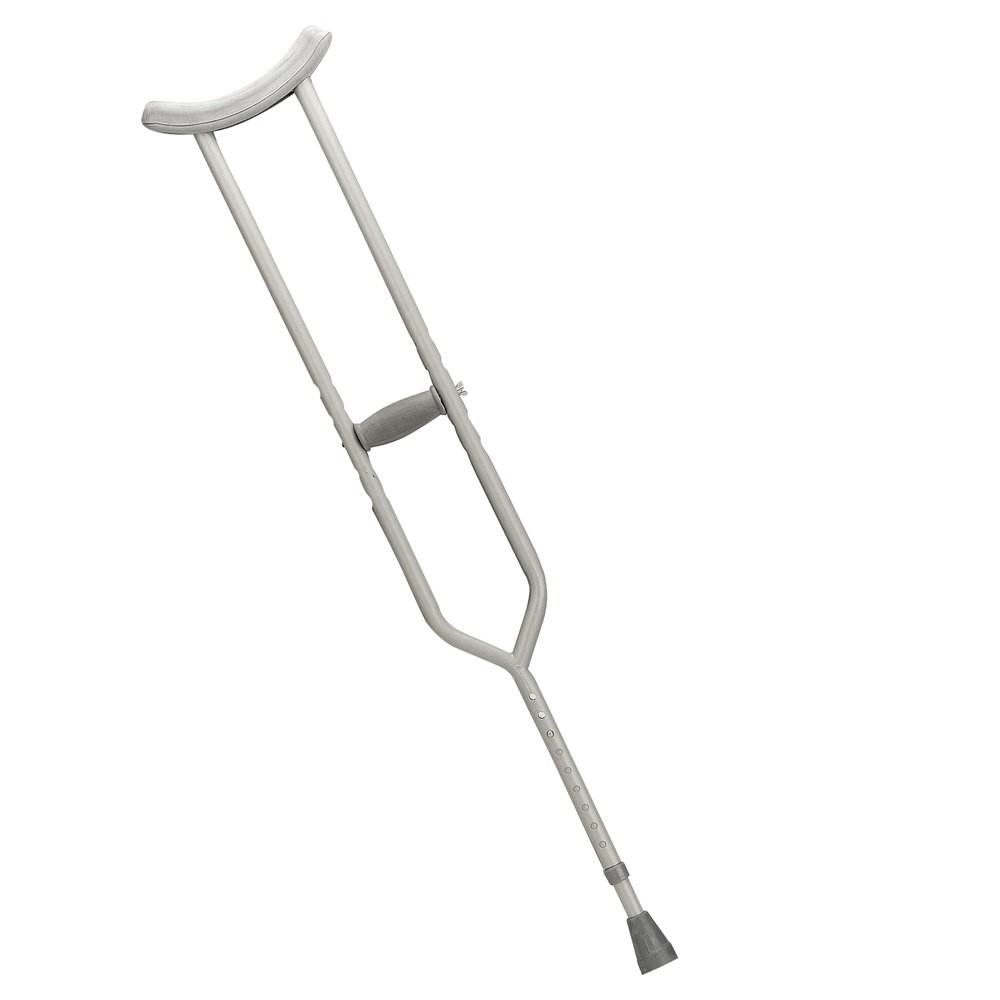
This pair earns its spot on one number: a steel underarm frame rated to 500 lb of support, the highest ceiling in this whole list. For a heavy or tall user, that rating is the entire point. Push-buttons adjust the legs to fit users from 70 to 78 inches, and the handle height spans 55 to 63 inches, so a tall frame lines up with your body. The underarm tops are vinyl-coated and contoured, so they sit against your ribs rather than dig in. The tips are extra-large and non-skid (grippy rubber feet), which matters when you plant a lot of weight through them.
What earns the most praise is build quality — this is a genuinely solid, well-constructed pair that feels like it will take full body weight without flinching. As the review pages sum it up: “My husband is 6’4 & 350lbs & the standard crutches weren’t going to cut it. These are pretty heavy, but worth it. It gave him the confidence to put full weight on them.” That confidence is what a 500 lb steel frame actually buys you. When the frame does not flex under you, you stop bracing against it and put your full weight down.
The catch is weight and height, and both are real. This pair is heavy in the hand — noticeably burdened next to a 1.3 lb aluminum folder — and the tall sizing means it simply will not suit shorter users. The rubber feet are a wear item too; heavy long-term use eats through a tip and you will want spares on hand rather than waiting for a replacement. If you are tall and carry serious weight, none of that outweighs a 500 lb frame. If you are 5’6″ and 150 lb, this is more tool than you need.
Tall and heavy is the target: a 70-to-78-inch fit range and a 500 lb rating make this the only pick here that clearly suits very large adults on a long recovery.
Know your wear item: the extra-large rubber tips deliver grip but do wear, so plan on fresh tips if you are on them daily for months.
Best matched to: tall, heavier adults who feel standard crutches bow or creak under them.
Probably overkill if: you are of average height and weight, where a lighter forearm pair is far easier to carry.
3. KMINA Forearm Crutches for Adults, Open Cuff

Eleven height settings and removable pads — the budget pair you can actually keep clean.
For a forearm pair, 11 height regulations is a genuinely wide spread, and that range is what lets you dial the handle to your exact arm length instead of settling for close enough. The frame is aluminum and rated to 275 lb, which beats the PEPE folder’s 220 lb by 25% — useful headroom if you are a mid-size adult. The grips and forearm cuffs are padded, and those pads pop off to wash and swap, which is a real advantage when one pair serves you every day for months.
The value side shows up in owner reviews: sturdy, better than the price suggests, and an easy step off a walker. Moving from a walker to forearm crutches is a common long-term path, and this pair handles that transition well because the cuffs give you balance support without the full footprint of a walker. It is also handier on stairs than an underarm pair, since your hands are free of the top bar.
Now the trade-off, stated plainly. This is not a more stable crutch than an underarm pair — it asks more of your balance and your grip. Owners also report the hand grips benefit from extra padding for longer stretches, and the adjustment clips are fiddly to remove (and easy to lose if you do). Durability at the very high end is the open question; it is built and priced as a lighter-duty tool rather than a years-long workhorse. For a first forearm pair or a temporary-to-medium-term recovery, that is a fair deal.
Why it competes
- 11 height settings for a precise arm-length fit
- 275 lb rating gives mid-size adults headroom
- Washable, interchangeable grip pads
- Easier than an underarm crutch on stairs
The honest trade-offs
- Grips want extra padding for very long days
- Adjustment clips are awkward to remove and easy to misplace
- Less planted than an underarm frame
Reach for it if: you are stepping off a walker or want your first forearm pair without spending big.
Think twice if: you need the maximum stability of an underarm crutch or years of hard daily service.
4. Days Forearm Crutches, Adult Size, Turning Arm Cuffs

Rotating arm cuffs let you grab a door handle without dropping your crutches.
The feature that separates this pair is the turning arm cuff. Because the cuff pivots, you can rotate your arm out and use your hand for a moment — a door, a cup, a rail — without letting go of the crutch. For anyone living alone on a long recovery, opening a door without dropping a crutch adds up fast. The frame is rated to 300 lb, adjusts from 26.25″ to 37.25″, and the cuffs take a maximum diameter of 3.5″ with 9.75″ between cuff and handle. Contoured hand grips round out the comfort side.
Build quality is where this pair is strongest, and it shows most in the arm bands — strong without being stiff and unyielding. Owners mention the crutches run quiet with no rattles, and customers note they give more control than an underarm pair. There is also a real use past injury: as a balance aid for someone with nerve-related walking difficulty, or for an elderly parent who will not carry a cane that can be dropped, because a forearm cuff stays on the arm.
The fit is the part to check carefully. A fixed 3.5″ cuff is comfortable on a petite or average forearm but tight on a muscular one — that is the single most common limit people hit. If your arm is on the larger side, a cuff you can swap for a different size is the safer bet. Wet tips on smooth floors also want a wipe before you trust them. Beyond those, this is a solid, quiet pair.
The quiet-build detail: owners repeatedly land on the same word — silent.
Measure your arm first: the 3.5″ cuff is the deciding spec here; it fits average arms and pinches muscled ones.
Great for: people who need to use their hands mid-walk and anyone who wants a stable, silent balance aid.
Not the fit for: heavy-built arms that need a larger or swappable cuff diameter.
5. York Nordic Spring Cushion Crutches
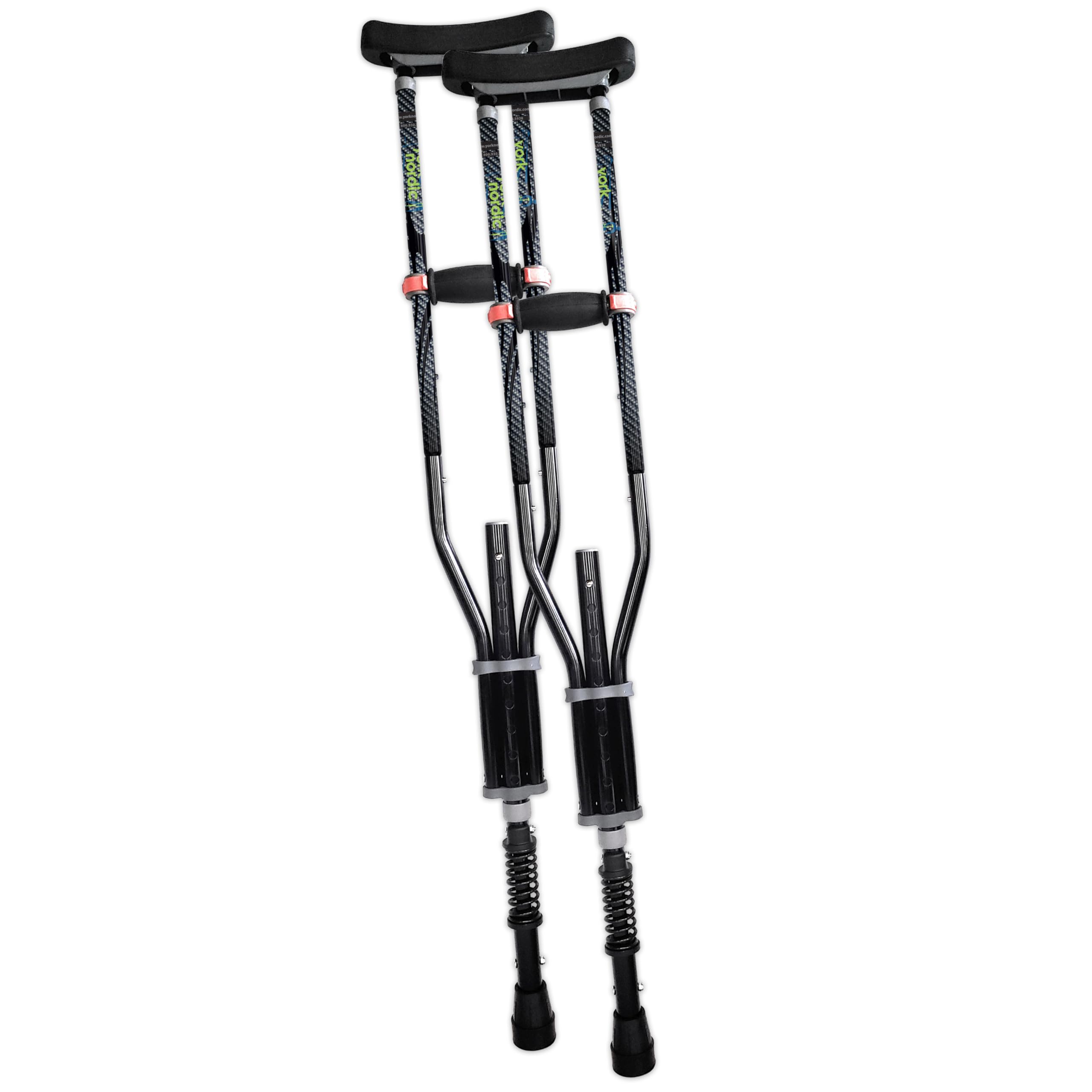
Springs under the hands take the jolt out of a long walk, and it still shrinks into a bag.
Spring cushioning is the reason to pick this pair. The lower section compresses on each step and soaks up the jarring that normally travels up your wrist and shoulder, which is exactly the fatigue that builds over a long recovery. It is built from aircraft-grade aluminum with flip-lock height adjustment, fits heights 4’7″ to 6’6″, carries up to 250 lb, and breaks down to just 22 inches for travel. There are over 20 colors and patterns, so you are not stuck with hospital tan.
Aimed at sports injuries and travel, it lands well in both roles. Owners consistently call it the most comfortable set they have used, and the spring is the star of the feedback — the softening on each footfall reads as the whole point of the premium over a plain crutch. Breaking into three sections for a suitcase is a genuine convenience.
The honest catch is that spring-loaded crutches take adjustment and a little care. They land differently from a rigid pair, so give yourself a few days to adapt. Long-term durability is the other question mark — the build is quality, but springs and pads are wear items, and the company’s response to a worn pad has been to send replacements quickly, which is worth knowing. It also runs on the heavier side in the hand. Treat the springs as a comfort feature that needs occasional attention, not a forever-set-and-forget part.
What makes it different
- Spring-loaded feet soften each step’s impact
- Breaks into three sections and packs to 22 inches
- Fits a broad 4’7″ to 6’6″ height span
- Over 20 color and pattern choices
What to plan for
- Springs change the walking feel — allow adapt time
- Pads and springs are wear items needing care
- On the heavier side in the hand
- 250 lb limit rules out heavier users
Suit yourself to it if: jarring footfalls are what tire you out and you also want a pair that travels.
Pass if: you want a totally rigid, low-maintenance crutch or weigh over 250 lb.
6. in-Motion Crutches for Adults, Ergonomic Spring Assist
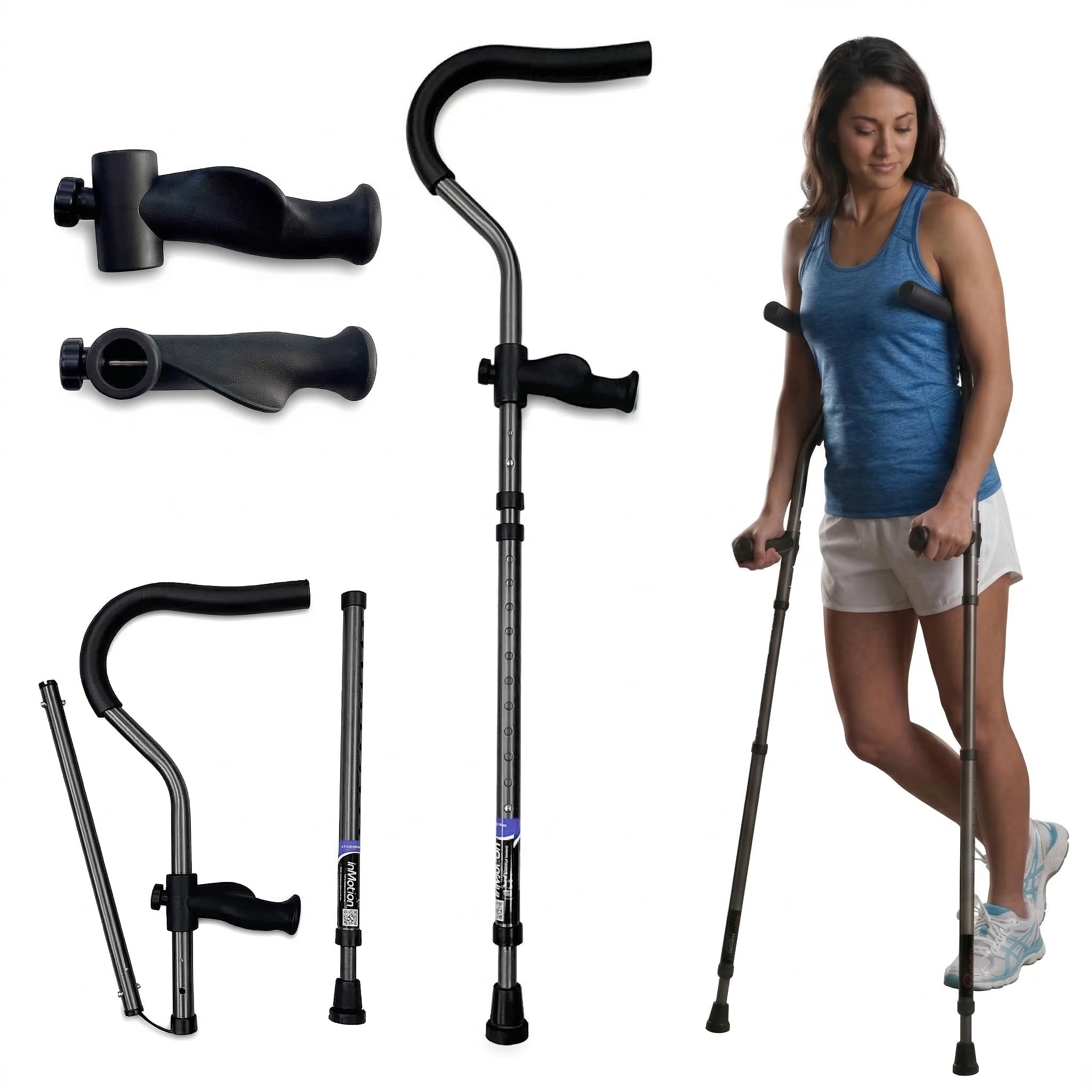
Angled left/right grips and pivoting tips, built for people who log serious miles on crutches.
This is the pair for someone who is on crutches every day, not for a few weeks. The curved left/right hand grips are shaped to keep your wrist in its natural line, so the kink that causes wrist and nerve strain on a straight hospital grip is designed out. The lower spring soaks up impact and returns some energy forward, and the articulating tips pivot to keep contact on hardwood, carpet, grass, and gravel. It carries up to 350 lb, and each crutch weighs 2.6 lb. This short size fits users 4’8″ to 5’9″, so measure floor-to-underarm (42″ to 52″) before ordering.
Build quality is where this model makes its case, and the stability is the second pillar — owners describe it as planted and secure even on rough ground, and many keep coming back to it after other pairs. The foldability without losing your height setting is a small luxury when you stow it daily. It is also the pick here for full-time, long-distance users; that is who it is designed around.
Set your expectations on two things. The ergonomic grips are left/right specific and the cuffs install a particular way, so the first day is an adjustment while your body learns the new feel — that is by design, not a defect. And the spring system rewards a little maintenance: a spray of lubricant keeps it quiet, and tips are a wear item on heavy use. It is also heavier than a basic crutch. For a daily long-term user, that upkeep buys real comfort.
Designed for the long haul: left/right ergonomic grips plus a 350 lb rating make this the most purposeful full-time pick in this list.
Budget your first day: the grips and cuffs are handed and install one way — plan on a learning curve before it feels natural.
Made for you if: crutches are your everyday mobility for months and you cover real distance on them.
skip it if: you need a light, low-fuss pair for a short recovery — the springs and setup add effort.
7. Walk Easy Adult Forearm Crutches, Anatomic Grip Model 495

A tight, silent, no-rattle build with an anatomic grip that takes the stress off your wrist.
This is the craftsmanship pick. The anatomic hand grip, a 3¾” cuff, and a 4½” grip give you a shaped hold rather than a straight bar, and the whole assembly is dialed so tightly it runs silent. It adjusts from a 28.5″ to 40.3″ grip-to-floor height and a 9.2″ to 11.0″ grip-to-cuff span, fits users roughly 5′ to 6’5″, and carries up to 300 lb. Sold as a pair with a 1-year limited warranty.
The silent build is the recurring theme in owner reviews — no rattles, even after months of daily use. Owners describe it as solid as a rock and note the ergonomic angles and proportions feel considered rather than generic — the kind of detail you notice most on day 90, when a rattly pair would have driven you up a wall. It is also lightweight, which keeps arm fatigue down over a long day.
The honest limits here are size and price. The forearm cuff comes in one diameter, so if your arm is small the cuff may feel loose and if it is very large it may pinch — a swappable-cuff pair gives you more room. But if quiet, tight, and well-proportioned is what you want in a pair you will use every day, this delivers it.
Sold on silence: a tight, no-rattle assembly with ergonomic grips is what separates this from a cheaper forearm pair.
One cuff size: the diameter is fixed, so check your forearm before you commit.
Best for: buyers who value a precise, quiet, well-built forearm crutch for daily use.
Consider size first if: your forearm sits well outside an average 3¾” cuff.
Know the Specs
Weight capacity
This is the maximum weight the frame is rated to carry, and it is a hard limit, not a target. A 500 lb rating suits a large adult; a 220 lb rating is fine for a lighter one. Going over the ceiling is what makes a frame flex and creak, which erodes the confidence you need to put full weight down. Pick a rating well above the user’s weight, especially for long-term use.
Forearm cuff diameter
The cuff wraps your forearm and is what keeps a forearm crutch on your arm. A fixed 3.5″ or 3¾” cuff fits an average arm but pinches a heavily muscled one. If you can swap cuffs, or the pair includes two sizes, you get a more forgiving fit — worth checking before you order, because cuff comfort is what makes daily use bearable.
Spring-loaded tips
Springs compress on each step and reduce the jolt that travels up your wrist, elbow, and shoulder — a real help over long walks and hard floors. The trade is feel and upkeep: springs change how the crutch lands, need time to adapt to, and can develop noise over time. A rigid tip is more predictable and simpler to maintain.
Adjustability range
More height settings let you dial in an exact fit rather than settling for close enough — 7, 11, or 4-position ranges each cover a different spread. Match the range to your height, and check the maker’s mapping. Too tall and you strain your shoulder; too short and you stoop. Measure before ordering.
Common Questions
Are forearm crutches better than underarm crutches for long-term use?
How do I know my crutch is the right height?
Can rubber crutch tips wear out, and how often?
Do spring-loaded crutches actually help, or do they waste effort?
What weight capacity do I need if I am a large or tall adult?
Will a forearm crutch fit a muscular arm?
Can I take folding crutches on a plane?
How much maintenance do spring crutches need?
Can I use a single forearm crutch instead of a pair?
The Bottom Line
For most people buying crutches for long term use, the PEPE Mobility folder is the winner because it does everything a long recovery needs: a light 1.3 lb frame, 7 height settings, and a 22.4-inch fold that lets it vanish into a car or a suitcase. If you are tall and carry serious weight, reach for the Drive Medical bariatric pair, with its 500 lb rating and 70-to-78-inch fit. And if jarring footfalls are what tire you out, the York Nordic spring pair softens every step. One honest note: the PEPE’s 220 lb ceiling is the lowest among the forearm picks, so if you are a mid-to-heavy user, the KMINA pair’s 275 lb rating gives you more room.
How we choose
We do not accept paid placement. Every pick is matched to a real buyer and a real use-case; we do not hands-on test units.
Sources
Specifications: manufacturer listings and product documentation. Review insights: verified customer reviews, as of October 2026. Pricing: not shown on this page (it changes often); check the current price via the retailer link.
As an Amazon Associate, Aappliancez earns from qualifying purchases. This does not affect which products we feature.