Disclosure: Some links in this post are affiliate links. As an Amazon Associate I earn from qualifying purchases, at no extra cost to you. Learn more
Specs are compiled from manufacturer listings and verified buyer reviews and can change over time — please confirm the key details on the product page before buying.
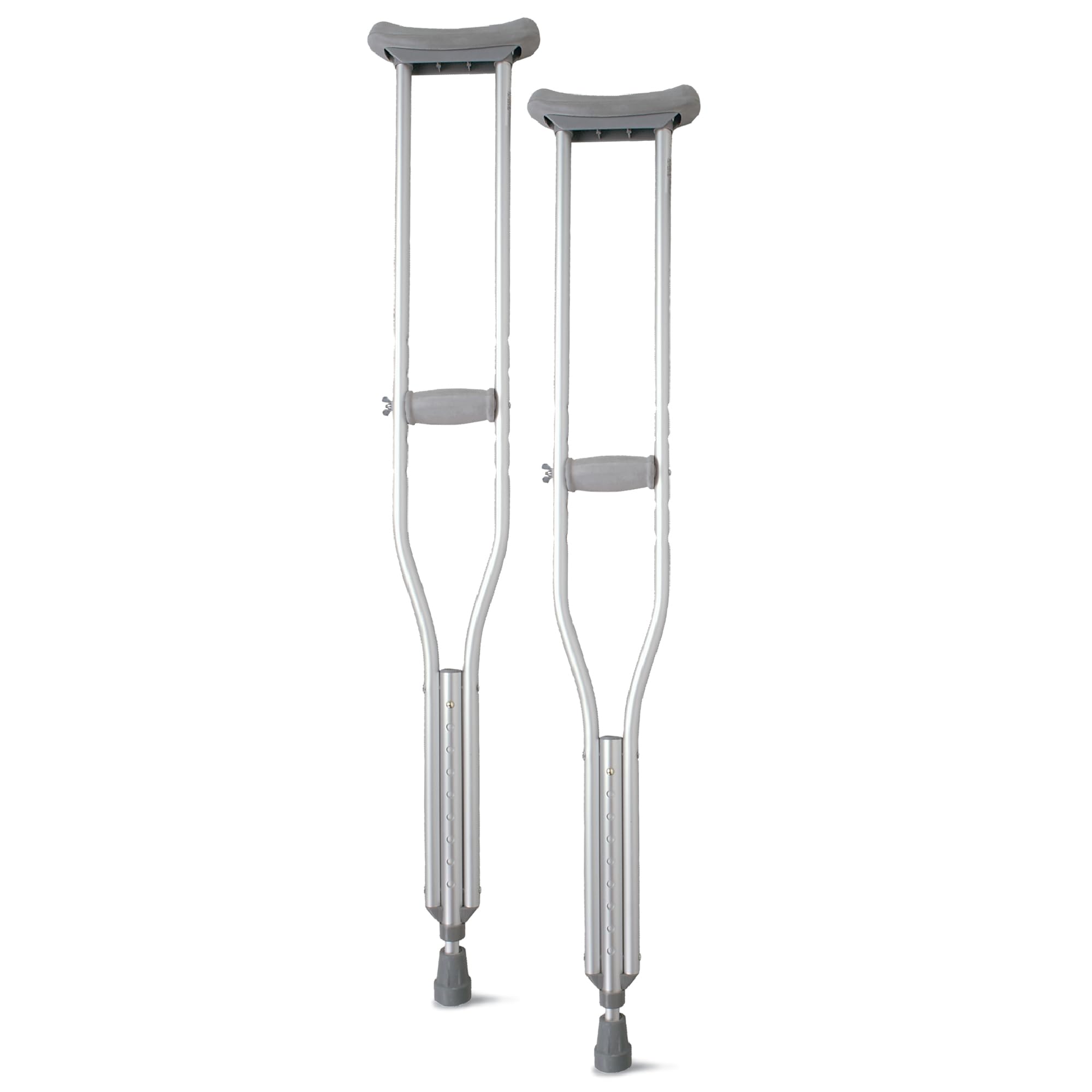
The 3 a.m. bathroom trip after knee surgery is where a badly fitted crutch turns into a fall. For most knee-surgery recoveries, forearm crutches with a cuff around the lower arm are the better fit. They push the load through your hands and forearms instead of jamming a pad into your armpit. Underarm crutches still win one job — keeping the operated leg completely off the floor — so both styles make this list.
This guide is built by comparing the manufacturers’ published specifications and the patterns across verified customer reviews, so you get each pick’s real strengths and trade-offs instead of marketing spin.
Two numbers decide whether a pair actually holds you up: the weight capacity (the most weight the frame is rated to carry) and the height range (the body heights the crutches adjust to). Tip quality is the third. Every pick below is checked against all three. Here is the honest shortlist of the crutches for knee surgery that get the fundamentals right.
Top Picks

How To Choose Crutches for Knee Surgery
Your surgeon’s weight-bearing instructions decide almost everything: full non-weight-bearing means underarm, partial weight-bearing means forearm. If your surgeon has told you to keep the operated leg completely off the ground, you need an underarm pair with a firm armpit pad and a wide base. If you may rest some weight on the leg, a forearm pair frees your hands and spares your shoulders over weeks of recovery.
Start with your height, not the brand
Every pair here states a height range in feet and inches, and that range is the first thing to check. A crutch set too short forces you to stoop; too tall and you cannot push down through the handle. Underarm models list a body-height range — the Medline pair fits 5’2″ to 5’10”, for example. Forearm models list an adjustable arm-length span plus a matching body-height range. Measure yourself in shoes before you order, because an inch of shoe changes where the cuff sits on your forearm.
Read the weight capacity as a hard ceiling
The capacity figure in pounds is a hard ceiling, not a suggestion. Your arms take a large share of your body weight on every step, and that load lands suddenly when you misjudge a stair. Pairs on this list range from a 220 lb ceiling on the lighter forearm models up to 350 lbs on the McKesson underarm pair. If you are close to a listed ceiling, size up to the next model rather than hoping the margin holds.
Check the tips before anything else wears out
Rubber tips fail first on almost every crutch, so inspect them before any other part wears out. A worn tip on a tiled bathroom floor is the real hazard of recovery. Look for slip-resistant rubber with some thickness behind it. A few pairs here ship with tips that need replacing quickly, which is worth knowing before you are mid-recovery and out of patience.
Side-by-Side Comparison
| Model | Best For | Style | Weight Capacity | Fits Height | Amazon |
|---|---|---|---|---|---|
| Medline Aluminum Crutches★ Best Overall | Everyday recovery on a budget | Underarm | 300 lbs | 5’2″ – 5’10” | Amazon |
| Vive Adjustable CrutchesBest Sizing Range | Three size options in one line | Underarm | 300 lbs | Youth, adult, tall up to 6’6″ | Amazon |
| McKesson Underarm Crutches | Taller and heavier users | Underarm | 350 lbs | 5’10” – 6’6″ | Amazon |
| First Medical Forearm Crutches | Folding travel pair | Forearm, open cuff | — | 4’11” – 6’1″ | Amazon |
| HEALTHBAZAAR Forearm Crutches | Hands-free standing and storage | Forearm, magnetic grip | — | 5’0″ – 6’5″ | Amazon |
| WONDSIGHIN Forearm Crutches | Lightest pair to pack | Forearm, strapped cuff | 220 lb | 61″ – 78″ | Amazon |
| Carehofu 3-Angle Crutches | Adjustable forearm angle | Forearm, 3-angle elbow | 220 lbs | 5’5″ – 6’3″ | Amazon |
Detailed Reviews
1. Medline Aluminum Crutches
Our pick — 4.0+★ from 550+ verified ratings; the strongest balance of quality and price.
The default choice for a knee-recovery household: cheap enough to keep as a spare, sturdy enough for a 300 lb ceiling.
The Medline pair takes first place on its 300 lb weight capacity — 80 lbs more headroom than the WONDSIGHIN forearm pair’s 220 lb ceiling, so a heavier user has real margin instead of guesswork. It also fits the widest slice of knee-surgery recoveries, and the crowd agrees: 4.0+ stars across 550+ ratings is the strongest review standing on this list.
Height is where this pair does its quiet work. The push-button adjuster moves the frame in 1-inch increments, so you can dial in a true fit rather than an approximate one. The stated range covers 5’2″ to 5’10” — the space most adult and older-child recoveries sit inside. Owners praise how simple it is to lock to your own height, how stable it feels under the arms, and how light it is to carry up stairs and through school hallways. At 4.8 lbs it is heavier than the Vive pair’s 3.4 lb frame, so budget for that lift on every step.
The honest catch is the rubber under the frame. The bottom pads are known to wear down fairly quickly, and buyers report the bottom rubber can break away after weeks of indoor use. That turns a stable crutch into a slippery one. Treat the tips as a wear item you may need to replace, and the pair is very hard to fault. Do not lean your full weight on a worn footpad, and check them before every walk.
grows with kids
- Adjusts in 1-inch steps, so you can dial in a true fit rather than an approximate one
- 300 lb weight capacity comfortably covers most adults and older children
- Padded armpit cushions reduce underarm pressure on long recovery days
- Slip-resistant feet and stair deflectors add traction on stairs and hallway floors
basic rubber tips
- Rubber tips wear down fairly quickly and may need replacing mid-recovery
- Stated height measurements can run short, so measure in shoes first
- Underarm style loads the armpit rather than the hands, which suits off-leg recoveries only
family budget pick: your surgeon wants the operated knee fully off the floor and you want one dependable, wallet-friendly pair to cover the whole recovery.
heavy daily use: you are under 5’2″ or over 5’10” — the stated height range simply will not reach you.
2. Vive Crutches
Three body-height bands in one line, so a short teenager and a 6’6″ adult can both find their fit.
The Vive pair earns its spot on a sizing ladder no other pick here matches: youth covers 4’6″ to 5’2″, adult covers 5’2″ to 5’10”, and tall covers 5’10” to 6’6″. That last band reaches 8 inches higher than the Medline pair’s stated 5’10” ceiling. So a tall knee-surgery patient stops getting handed crutches that force a stoop. Two independent adjusters — one for overall height, one for the hand grip — let you set the handle where your palm naturally falls.
Owners describe a frame that arrives already assembled and adjusts to height in a minute, so you are not hunting for a screwdriver on day one. The 300 lb weight capacity matches the Medline figure, and the frame sits at 3.4 lbs, which is light to lift through a doorway. Non-slip rubber tips under each shaft do the traction work on tile and hallway floors.
The one recurring gripe is the hand grip opening. It is narrow, and a bigger hand may feel cramped on a long day. That is fine for a short post-op stretch, less pleasant if you are on them for six weeks. Wide hands and thick fingers will notice it first.
sold as a pair: the three-band sizing ladder is the reason to pick this over a single-range underarm pair — you can match your own body height before checkout instead of after.
pricey per unit: the grip width. It suits smaller to average hands best, and a large-handed user is better served by a forearm model with a wider handle.
long-term recovery: you fall between the size bands most brands ignore — a shorter teen or a genuinely tall adult.
short-term sprains: you have wide hands or thick fingers, since that narrow grip will be the first thing you notice.
3. McKesson Aluminum Adjustable Underarm Crutches

The heavy-duty underarm option for bigger frames — if its rubber holds up, which is the open question.
A rated 350 lbs puts the McKesson pair on this list — 50 lbs above the Medline pair’s 300 lb figure, and that margin is the whole point. The height range is built for the tall end too: 5’10” to 6’6″, with a 0.75-inch aluminum shaft running through each frame. Padding is synthetic rubber rather than latex, which suits anyone watching for a latex sensitivity at the armpit and hand contact points.
Where it gives ground is rubber and hardware. The tips are the recurring problem — they disintegrate quickly enough that replacement is needed almost immediately, and the grips are narrow and not designed to be swapped out. A small pin that lets the clip swing open can work loose and go missing. And on the load question, plenty of heavier users find the creaking starts early rather than at the rated ceiling.
None of that makes it a bad buy for a tall, heavier user who needs the extra 50 lbs of headroom over the Medline pair and a latex-free build. It makes it a pair you check over on arrival and re-tip before you rely on it.
tall adult frame: tall, heavier users who need the 350 lb rating and latex-free padding, and who are willing to inspect the tips on day one.
petite teenagers: you want a pair that needs nothing done to it straight from the box — the tips and grips ask for attention early.
4. Forearm Crutches Open Cuff

Collapses to 21.26 inches, so it rides in a car trunk instead of rattling around the back seat.
Folding to 21.26 inches is what wins this pair its place: short enough for a car trunk, a closet corner or most 20-inch-plus suitcases. Height adjusts through 10 levels from 36.6 inches to 45.3 inches, which covers users from 4’11” to 6’1″. That lower end reaches 3 inches below the Vive youth band’s 5’2″, so a smaller adult has a real option here.
The frame is aluminum at 2.43 lbs, with textured rubber footpads for grip on indoor surfaces and reflective strips for visibility in dim hallways. The cuff is open and strap-free, and the maker states plainly that this offers less stability than a strapped cuff model. The maker also says it is intended for normal arm strength and minor mobility needs — not for weak arms, disabilities or severe injuries.
That open cuff is also the practical limit for knee surgery. Owners who still have some use of the bad leg find it great. If that leg needs to stay completely off the ground, a forearm crutch without a strap is the wrong tool. Reach for a strapped cuff or an underarm pair for a full non-weight-bearing recovery.
folds into case: folding to 21.26 inches and weighing 2.43 lbs is a genuinely different proposition from a rigid underarm pair that will not fit in a boot.
frequent travelers: you have partial use of the operated leg and want a pair that stows in the car between errands.
weak grip hands: your leg must be fully off the floor — the strap-free cuff is not built for that job.
5. HEALTHBAZAAR Forearm Crutches

Two features you will not find anywhere else on this list: a magnetic grip and a 90° rotating elbow rest.
This is the most feature-heavy set here, and the magnetic grips are why. Magnets built into the end of each handgrip let the two crutches clip together, so they lean against a wall without sliding. The elbow rest rotates through 90° so your arm can move naturally while you hug someone or pick up a coffee. Height adjusts steplessly from 38 inches to 48 inches, matching users from 5’0″ to 6’5″ — the widest body-height band in this guide, 2 inches wider at the top than the Carehofu pair’s 6’3″ ceiling.
Where the design gets tested is the details. The magnetic grips are a clever touch, but the hand grip is wide, and a small-handed user finds it oversized enough to strain the wrist. The folding joint can develop a wobble on one side over months of use. And the frame sits heavier in the hand than owners expect from a foldable set.
Build quality is what people come back to — a solid, heavy-grade frame with a shock-absorbing base. Its multi-layered rubber tips and anti-slip ridges handle uneven ground well. It suits a larger-handed user who wants the crutch to stay on their arm between tasks. Smaller hands should look to a strapped cuff pair with a narrower grip instead.
commuters on transit: taller users with larger hands who want the magnetic grip and rotating elbow rest for daily errands.
quick trial runs: small hands — an oversized grip that causes wrist strain makes the clever features irrelevant.
6. Forearm Crutches with Cushion
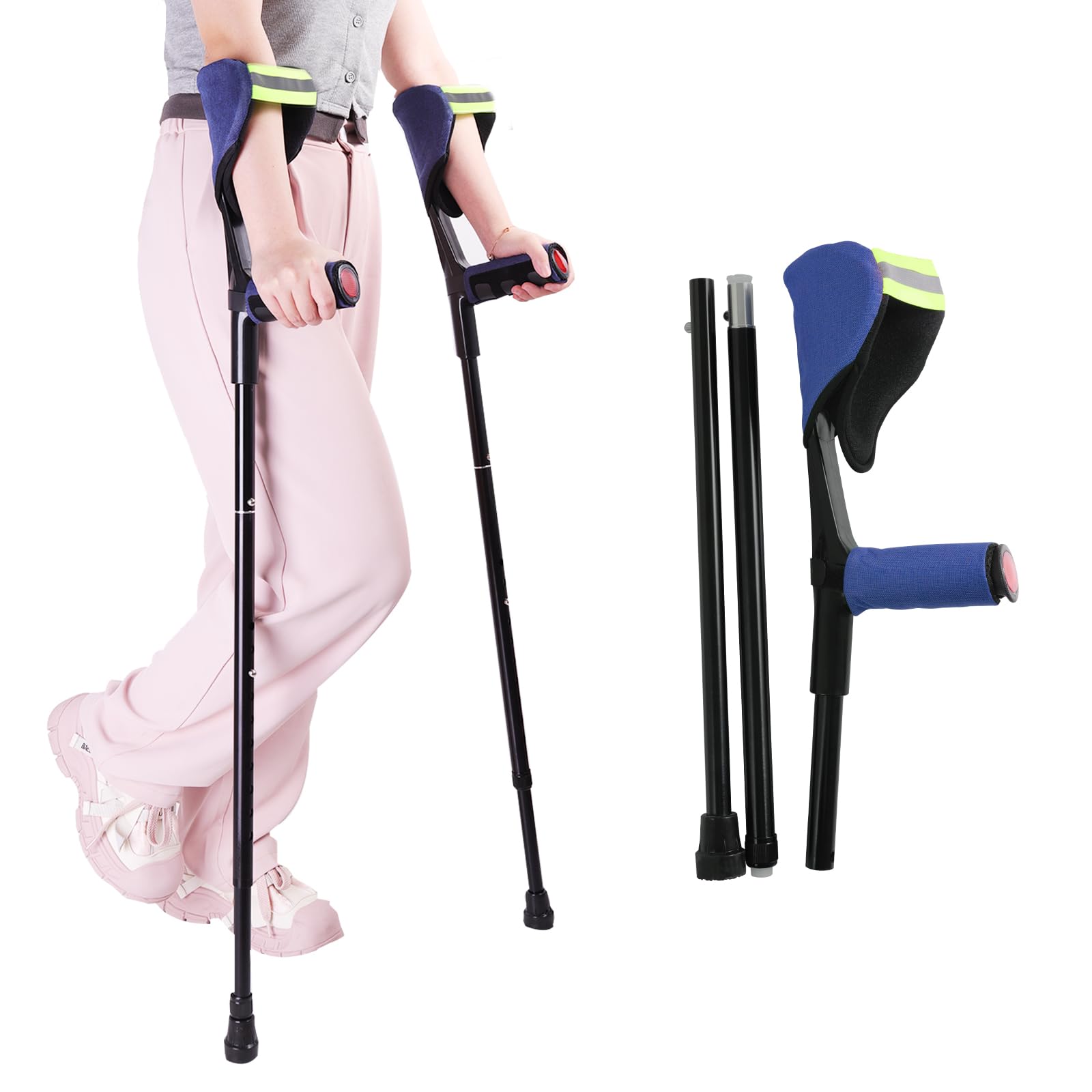
The travel-first set: a one-touch button breaks it down to roughly 18.5 inches for a suitcase.
At a stated 1.06 lb, these are the lightest crutches in this guide by a wide margin — 3.74 lbs lighter than the Medline underarm frame’s 4.8 lbs. A recovery that includes air travel or daily trips out of the house feels very different with this pair. Press the one-touch button and the frame disassembles to about 18.5 inches, short enough for a suitcase or a large bag.
Height adjusts across 10 settings from 39.4 inches to 47.7 inches, matching users between 61 inches and 78 inches tall, with locking clamps that hold the joints firm. The cuff wraps the forearm so weight spreads across several points rather than one palm — helpful if your grip strength is down after weeks on crutches. The widened footpad carries multi-circle textures, and reflective panels add visibility in low light.
Two honest limits. Capacity is listed at up to 220 lb, the same ceiling as the Carehofu pair and well under the underarm models’ 300 to 350 lb ratings, so a heavier user should look elsewhere. And at the bottom of its height range the fit gets tight — a 5-foot user finds it just barely short enough, though it sits right when wearing shoes.
cushioned hand grips: 1.06 lb and an 18.5-inch folded length is a genuinely packable set, not just a smaller crutch.
bulky when folded: a 220 lb ceiling rules it out for heavier users no matter how much they like the fold.
long walks outside: you are recovering at home and on the road, and you want a pair that disappears into a suitcase.
tight car trunks: you are near or above 220 lb, where the underarm models give you real headroom.
7. 3-Angle Adjustable Forearm Crutches
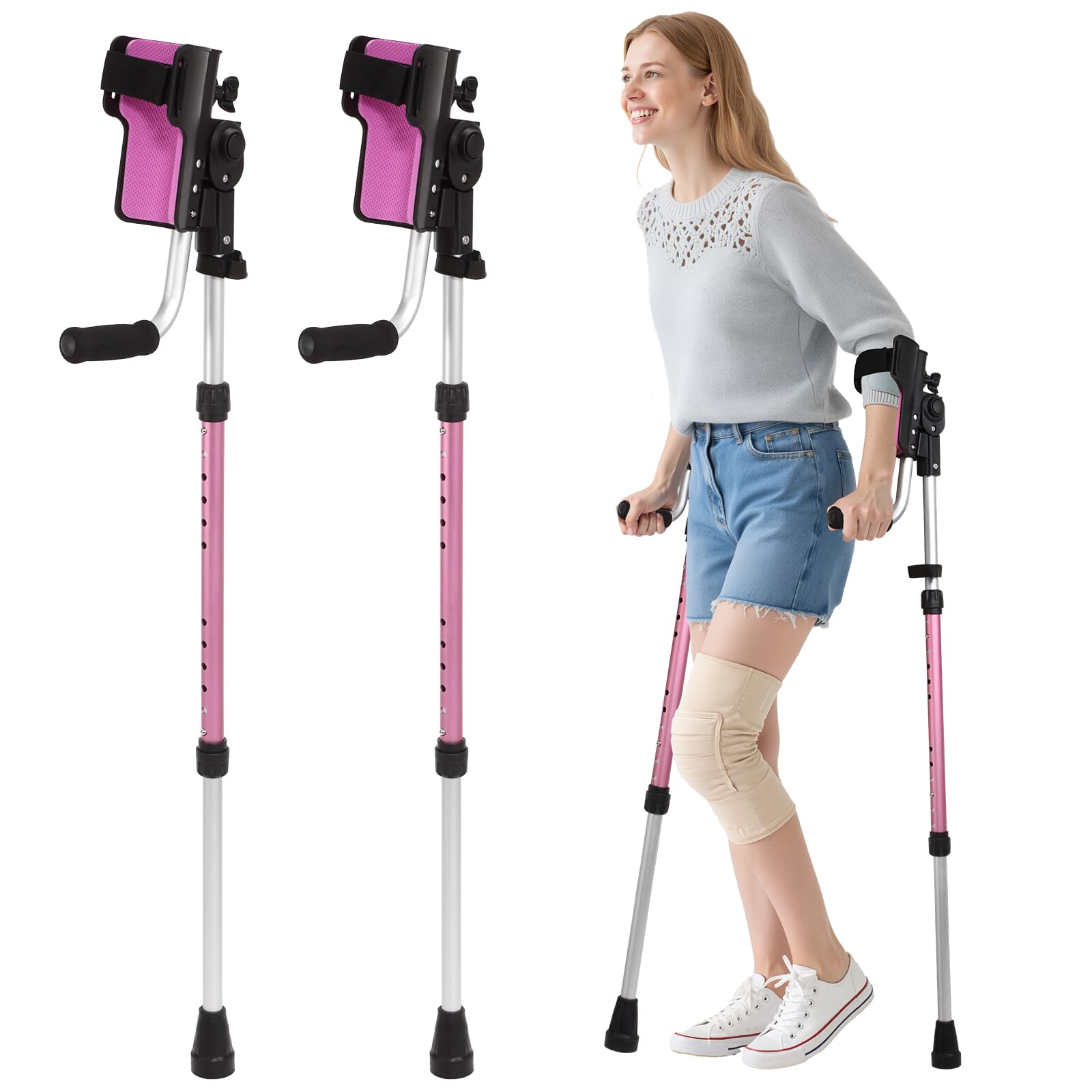
An elbow pad you can lock at three angles — the most tunable pair here for a long rehab.
Three angle stops are why this set earns its place: 10° for a natural walking posture, 45° for rehab stability, and 90° for support while you stand in one place. Owners describe that 90° setting as the difference-maker during long stretches on your feet, since it lets you lean through the elbow pad instead of gripping. The pad itself is EVA foam (a soft, springy foam), which cushions pressure points and absorbs some of the bounce.
Eleven height settings run from a body range of 5’5″ to 6’3″, locked with push-button spring pins, on an aluminum alloy frame rated to 220 lbs. Owners praise the build — the crutches are described as sturdy, foldable for a car trunk, and light enough to carry on a flight. Grip strength is another factor in their favour: users with wrist problems report them as comfortable and convenient where standard crutches were not.
The recurring issue is the forearm strap, which can pop out of its slot and needs to be pushed back through. Also check the top of the height range carefully: the stated ceiling is 6’3″, but taller-adjacent users find the frame runs short in practice. If you are close to that ceiling, take the underarm route instead.
custom arm fit: a long rehab and wrist trouble make the 90° elbow-lean setting worth the extra tuning.
lightweight seekers: you are near 6’3″ — the frame is known to run short at the top of its stated range.
Know the Specs
Weight capacity in pounds
The number stamped on the frame is the most you should ever put through it. Your arms carry a big share of your body weight on every step, and a misjudged stair loads them suddenly. Pairs in this guide range from 220 lbs on the lighter forearm models to 350 lbs on the McKesson underarm set. If you are close to the ceiling, size up to the next model rather than assuming the margin will hold.
Height range in feet and inches
This is the fit check, and it comes in two forms. Underarm crutches list your standing height — the Medline pair fits 5’2″ to 5’10”. Forearm crutches list an adjustable arm length plus a matching body range, and the gap between the two is where a bad fit hides. The Carehofu pair states 5’5″ to 6’3″, yet taller-adjacent users find the frame short in practice. Measure yourself in the shoes you will walk in before ordering.
Forearm cuff vs armpit pad
An underarm pad transfers load into the armpit. That is the right tool when the operated leg must stay fully off the floor. A forearm cuff spreads weight through the lower arm and hand, freeing you to carry a mug or open a door. The trade-off is grip strength and hand size — a narrow or oversized handle makes a cuff pair hard to use for weeks on end.
Rubber tips and base design
The tip is the first part to wear, and a worn tip on tile is the real fall risk. Look for slip-resistant rubber with thickness behind it. Shock-absorbing multi-layered tips and wide anti-slip bases handle uneven ground better than a thin standard foot. Pairs that ship with weak tips will need replacing mid-recovery — worth knowing before you are already on them.
Common Questions
Are forearm crutches or underarm crutches better after knee surgery?
How do I match a crutch height range to my own height?
Can I use a forearm crutch if my knee needs to stay completely off the ground?
Why do the rubber tips wear out so fast on some crutches?
How much weight can these crutches actually support?
Do folding crutches wobble more than rigid ones?
Is a forearm crutch easier on the hands than an underarm crutch?
How long should I expect a pair of crutches to last through recovery?
Can I fly with folding forearm crutches?
What is the difference between the 10, 45 and 90 degree elbow settings?
The Bottom Line
For most knee-surgery recoveries, the underarm pair worth starting with is the Medline Aluminum Crutches — 300 lbs of capacity, 1-inch adjustment steps and a height range that fits most adults. It is also backed by the strongest review standing in this guide at 4.0+ stars across hundreds of ratings. If you have partial use of the leg and want to free your hands, the folding First Medical Forearm Crutches pack to 21.26 inches and get you out the door. And for tall or heavier users who need the highest rating here, the McKesson pair reaches 350 lbs with latex-free padding.
The one nudge worth making: check the rubber tips on arrival and keep a spare set, whichever pair you choose — it is the single part most likely to fail first.
How we choose
We do not accept paid placement. Every pick is matched to a real buyer and a real use-case; we do not hands-on test units.
Sources
Specifications: manufacturer listings and product documentation. Review insights: verified customer reviews, as of October 2026. Pricing: not shown on this page (it changes often); check the current price via the retailer link.
As an Amazon Associate, Aappliancez earns from qualifying purchases. This does not affect which products we feature.