Disclosure: Some links in this post are affiliate links. As an Amazon Associate I earn from qualifying purchases, at no extra cost to you. Learn more
Specs are compiled from manufacturer listings and verified buyer reviews and can change over time — please confirm the key details on the product page before buying.
If you want the short answer: silicone is the ingredient that actually does the heavy lifting on scars, and everything else — oils, serums, herbal balms — is support work. A raised red scar and a dark flat mark need different products, and picking the wrong one wastes months of daily rubbing. This comparison splits the list by what each product is genuinely built for, so you can match one to your scar instead of guessing.
This guide is built by comparing the manufacturers’ published specifications and the patterns across verified customer reviews, so you get each pick’s real strengths and trade-offs instead of marketing spin.
Below you will find the difference between silicone gels, silicone sheets, herbal balms and brightening serums explained in plain words, plus the honest trade-offs nobody puts on the label. Every pick here is a real option worth owning — the trick is choosing the right one for your scar type, and this guide to the best cream to stop scarring walks you through exactly that.
Top Picks


How To Choose The Best Cream to Stop Scarring
Most buyers go wrong by treating every scar as the same problem. A raised, thick, reddish scar sitting above the skin is a collagen problem, and silicone — applied as a gel or a sheet — is the ingredient that addresses it. A flat brown or red mark left behind after acne or a healed cut is a pigment problem, and that is where brightening serums and nourishing body oils come in. Two different jobs, two different products.
Match the product to the scar, not the other way round
If your scar is still raised and firm, start with a silicone product. If your scar is flat and darker than the skin around it, you want a brightening or nourishing formula instead. Using a body oil on a thick keloid, or a silicone gel on flat pigmentation, is the single most common reason people give up after a month and decide nothing works.
The second thing to check is how often the label wants you applying it. Some silicone gels ask for two or three applications a day. Cicatricure Advanced asks for four. That is a real daily commitment, and it is worth being honest with yourself about whether you will actually keep it up, because consistency is what moves a scar.
Tube size decides whether you finish the job
A scar routine runs for months, not days. A 0.21 oz tube used twice daily on a surgical scar empties far faster than a 1.65 oz tube. ScarAway’s sheets last 7-10 days per sheet and a box covers roughly five to six weeks of a larger scar. If you stop halfway because the tube ran dry, the scar rarely gets the full window of treatment.
Sun exposure is the quiet saboteur
Fresh scar tissue darkens more readily in sunlight than the skin around it, which is why several picks here pair silicone with sunscreen habits. NewGel+ UV is the only product on this list that builds broad-spectrum SPF 30 mineral sunscreen directly into the scar cream, which matters for scars on your face, hands and arms.
Side-by-Side Comparison
| Model | Best For | Type | Size | Key Ingredient | Amazon |
|---|---|---|---|---|---|
| Bio-Oil Skincare Body Oil Serum★ Best Overall | Stretch marks and uneven tone | Body oil | 6.7 fl oz | Vitamin E, Chamomile, Lavender | Amazon |
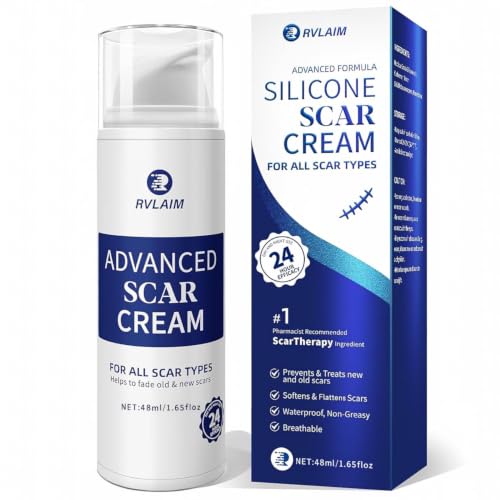
| Rvlaim Silicone Scar GelBest Value | Surgical and C-section scars | Silicone gel | 1.65 oz | Silicone | Amazon |
| Motherlove C-Section CreamGentlest Formula | Postpartum incision care | Herbal balm | 1 oz | Olive oil, Beeswax, Shea, Calendula | Amazon |
| ScarMD Silicone Scar Gel | Small, precise scar areas | Silicone gel | 0.21 oz | 100% silicone | Amazon |
| EnaSkin Dark Spot Corrector Serum | Dark spots and post-acne marks | Brightening serum | — | Niacinamide, Hyaluronic Acid | Amazon |
| Rejûvaskin RejûvaSil Silicone Scar Gel | Facial and pediatric scars | Silicone gel | 10 mL | 97% silicone, Vitamin C, Emu Oil | Amazon |
| Cicatricure Advanced Scar Gel | Fast, frequent daily application | Scar gel | 1 oz, pack of 2 | Regenerare Complex | Amazon |
| ScarAway Scar Fabric Sheets | Large surgical and burn scars | Silicone sheets | 1.5 x 3 in, 8 ct | Medical-grade silicone | Amazon |
| NewGel+ UV Silicone Scar Cream SPF 30 | Sun-exposed scars | Silicone cream + SPF | 0.5 oz | Medical-grade silicone, Zinc Oxide | Amazon |
| Skinuva Scar Cream | Small facial and biopsy scars | Growth-factor cream | 0.5 oz | Silicone, Growth Factors, Hyaluronic Acid | Amazon |
| iS CLINICAL Reparative Moisture Emulsion | Dry, dull skin alongside scar care | Face moisturizer | — | Hyaluronic Acid | Amazon |
Detailed Reviews
1. Bio-Oil Skincare Body Oil Serum
Our pick — over 4.5★ from 55,000+ verified ratings; the strongest balance of quality and price.
The big-bottle workhorse for stretch marks — a nightly ritual that lasts a whole trimester.
This is the crowd favorite on the whole list, sitting at 4.7 stars across 55,000+ owners, and what wins people over is the scent — a light, short-lived lavender-and-chamomile smell that fades fast enough not to clash with anything else you wear. Its Vitamin E, Chamomile and Lavender Oil blend is stated by the brand to improve the appearance of stretch marks and uneven tone. You get 6.7 fl oz of it, which is a genuinely enormous bottle next to the silicone gels further down this list. Weighing in at 6.7 ounces, it is roughly 2.3 times the weight of the Rvlaim silicone gel at 2.89 ounces, and that gap is the point — this is the bottle you can use morning and night for months without watching it drain.
Moisture is where this earns its keep. It is non-comedogenic, so it will not clog pores, and it absorbs without leaving a greasy film — the kind of texture that makes a nightly belly routine actually tolerable. What buyers report really stands out is the stamina: a large bottle runs about three months of regular use, and one owner used it from the second trimester through six weeks postpartum and finished with no stretch marks, though she honestly admitted she could not tell whether that was the oil or her genetics. That is the right way to read every stretch-mark product on this page — the oil supports the skin, it does not guarantee the outcome.
Here is the trade-off worth knowing before you commit. A handful of users pick up a strong, industrial-oil note rather than the pleasant scent the majority describe, so if you are sensitive to smell, do not build your whole routine around this one scent profile. It is also a body oil, not a silicone gel, so it does the work of softening and moisturizing skin rather than flattening a raised scar. Think of it as the foundation layer of a stretch-mark and dry-skin routine, not a replacement for silicone on a thick surgical scar.
What Buyers Keep Coming Back For
- 6.7 fl oz bottle lasts roughly three months of daily use, so you finish the routine you started
- Non-comedogenic and fast-absorbing — no greasy residue left on sheets or clothes
- Vegan, paraben-free and cruelty-free, and gentle enough that sensitive-skin users report no reaction
- Pairs directly with silicone sheets or gels, since it can go on underneath them
Where It Falls Short Of A Silicone Gel
- The scent divides people — most love it, a few find it heavy and synthetic
- It is a nourishing oil, so it will not flatten a raised or thickened scar
- Not designed for the face; this is a body and stretch-mark product
Reach for this if: you are managing stretch marks, dry winter skin or overall uneven tone across a large body area and want one bottle that survives months of daily use.
Look elsewhere if: your scar is raised and firm — that job belongs to a silicone gel or sheet, not a body oil.
2. Rvlaim Silicone Scar Gel
A pump-dispenser silicone gel that turns a twice-daily scar routine into a five-second job.
The headline number here is volume. At 1.65 oz, this tube holds a little under eight times the product of the ScarMD silicone gel at 0.21 oz — 1.65 oz versus 0.21 oz, and if you have priced silicone gels you know that difference decides whether you finish three months of treatment or run dry in three weeks. The formula is a silicone gel that forms a breathable moisture barrier over the scar, and the brand says it helps soften the look of raised, thickened and textured scars with consistent daily use. It is aimed at surgical scars, C-sections, acne marks and burns, and it works on new and older scars alike.
The most-praised thing about it is what it does to the scar itself — buyers consistently describe scars getting lighter and softer to the touch with steady use, and the silky, fast-drying texture comes up again and again because it leaves no sticky residue and no greasy feel. The pump dispenser is the quiet hero: it meters out a small amount per use so a 1.65 oz tube stretches a long way, and it works one-handed on a knee or hip. One buyer treating a knee surgery scar started at four and a half weeks post-op, applied it twice daily for six weeks, and watched the top 1.5 inches of the scar recede — she also credited the silicone layer for cutting down how much her clothing irritated the area, and said she was reordering. That is a genuinely useful detail: the barrier does double duty, protecting sensitive new skin from fabric rub. It sits at 4.3 stars across 500+ ratings, and the value story holds up against the smaller, pricier tubes in this lineup.
The honest caveat is speed. Silicone works on the scar’s texture over weeks, not days, and the recurring gripe from the few who were less impressed is exactly that — minimal visible change early on. Improvement here is gradual and cumulative. Give it the full stretch of daily use before you judge it, and pair it with sun protection, because a fresh scar darkens easily in sunlight.
The volume argument: a 1.65 oz pump bottle at a mid-range price is the most cost-effective way to run a full silicone gel course on this list — most silicone options here are far smaller and cost more per ounce.
Best for: anyone committed to a twice-daily silicone routine on a surgical, C-section or injury scar who does not want to rebuy every few weeks.
Think twice if: you want overnight results — silicone is a patience ingredient, and the early weeks look almost identical to day one.
3. Motherlove C-Section Cream (1 oz)
An all-organic balm for the woman who wants to know every single ingredient on her incision.
Founded by the ingredient list, not the marketing: extra virgin olive oil, beeswax, shea butter, calendula flower, marshmallow root, rosehips, St. John’s wort flower, yarrow herb and rosemary leaf. All organic. Nothing else. If you have been squinting at labels trying to work out what is actually going into a healing incision, that sentence is the entire pitch — there is no petroleum, no lanolin, no parabens, no phthalates and no synthetic filler anywhere in it. It carries Leaping Bunny certification as cruelty free, and it is made in the USA with imported ingredients.
Texturally it is a balm rather than a cream — buttery, smooth and slow-melting, closer to a salve you massage in than a lotion you spread. The thing everyone raves about is the moisture: it keeps the incision skin hydrated, which is what buyers credit for reducing the itchiness and stinging that makes new scar tissue so distracting. It can also be layered under a belly band, a silicone sheet or C-section underwear, so it slots into whatever postpartum routine you already have. One mother put it well — she had no idea whether it changed her scar, but it helped her get used to looking at and touching the area, which was startling to her at first, and it never stained her clothes.
Two things to weigh honestly. The 1 oz jar is small for a product used three times a day, and more than one buyer has opened the jar to find an unexpected air bubble eating into the fill, so the value is a fair question rather than an open-and-shut one. Second, it is a nourishing balm, not a silicone gel — it supports skin repair and comfort, and it will not flatten a raised scar on its own. It pairs beautifully with a silicone sheet for exactly that reason.
Why it earns its spot: at 4.5 stars across 1,000+ ratings, this is the most trusted postpartum-specific balm here, and it is the one you can read the label of and understand every word.
One practical note: unlike the silicone-heavy picks above, this is a pure maintenance-and-comfort product for closed incisions. Use it under a silicone sheet, not instead of one, if your goal is a flatter scar.
Pick this if: you are postpartum, want organic ingredients you can verify, and value comfort around the incision as much as the appearance of the mark.
skip it if: you want a single product doing the flattening work — this is the support layer, and a silicone gel is the one doing the structural work.
4. ScarMD Silicone Scar Gel
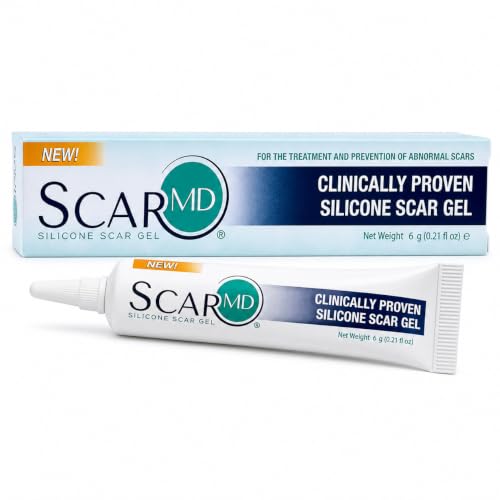
A roller-tip silicone gel built for surgeons’ incisions, biopsy sites and other small, specific spots.
What sets this one apart is the delivery, not the formula. The tube carries a 3-ball massage roller head that releases the gel as you roll it, which lets you apply one-handed and stimulates the skin as you go — handy for anyone treating a spot they cannot easily see, like a jawline or the back of a shoulder. The gel itself is 100% pure silicone, with no silica nanoparticles, and the brand says it is made in the USA with premium medical-grade silicone. It is aimed broadly: C-section scars, surgical scars, keloids, burns, stretch marks, abrasions, and both new and old scars. That is a lot of claims from a very small tube.
And the tube is genuinely small. At 0.21 oz, it holds a fraction of the Rvlaim gel’s 1.65 oz, so this is a precise-application product rather than a generous one — the word from buyers who like it is that a little goes far, but you are still dealing with a limited supply. Where it performs, it performs on incisions: the praise clusters around its ability to head off scarring on new cuts and make them barely noticeable, and a buyer treating a nose-job scar with three months of use reported visible improvement in how the scar looked. A separate user who had a basal cell carcinoma removed from her face and applied it for five weeks described a significant reduction in potential scarring and planned to keep going for another six weeks.
Be honest about what you are buying. The size is the recurring friction point, and one buyer flatly said they could not tell whether it was working — note, since silicone asks for commitment and small tubes run out. It sits at 4.2 stars across 300+ ratings, the lowest of the silicone gels here, though still solidly in the positive range. If you have a small, visible scar and want pinpoint control, the roller earns its keep; if you have a long C-section incision to cover, budget for multiple tubes.
The precise-application edge: the integrated 3-ball roller spreads the gel evenly, saves waste and works one-handed — genuinely useful for a scar you cannot hold still and see at the same time.
Worth it for: small, awkwardly placed scars — a biopsy site, a mole removal, a short surgical line — where precise dosing matters more than volume.
Not the pick if: you are covering a long incision, because a 0.21 oz tube empties quickly under twice-daily use.
5. EnaSkin Dark Spot Corrector & Remover Serum
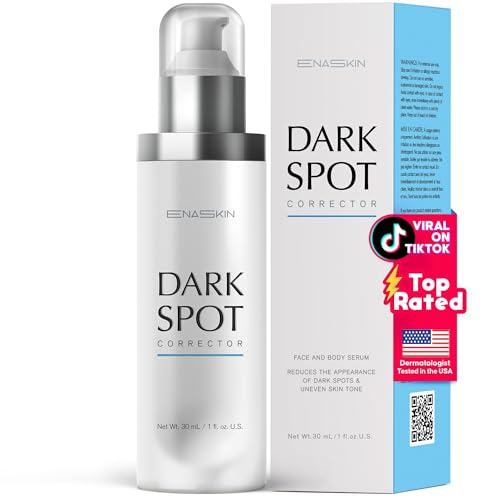
The one for flat brown marks rather than raised scars — pigment work, done gently.
If your scar has healed into a flat, darker patch of skin rather than a raised ridge, this is the product type you want, and this serum takes a deliberately softer route than a silicone gel. Instead of strong acids, it uses a biomimetic Renewal Peptide designed to mimic the skin’s own natural shedding, lifting away pigmented surface cells without the redness, flaking or sun sensitivity that AHAs can leave behind. It is formulated without hydroquinone, parabens, mineral oil or SLS, and it is non-comedogenic, so daily morning and night use will not clog pores. For visible results the label is refreshingly specific: a more radiant look by around week 2, more even tone and smoother texture by week 4, and visibly faded dark spots, post-acne marks and sun spots over 8 to 12 weeks.
The hydration load here is heavier than you would expect from a spot corrector — five types of Hyaluronic Acid for multi-depth moisture, plus Oat Beta-Glucan, Ectoine, Ergothioneine and Carnosine to calm stressed skin and support the moisture barrier. With 4.0 stars across 25,000+ ratings, this is among the most widely used products on the list, and the dominant buyer experience is dark spots visibly fading and skin looking brighter and more even, without irritation on sensitive skin types. One long-term user ran three bottles over seven months at two dime-sized pumps per application, saw improvement at 30 days, and found some spots fully gone with no return even after skipping days — his one caveat was a sticky residue that takes about 15 minutes to dry down. Another buyer using it through the summer saw the lighter sun spots on her face and hands gone within a week, and her skin smoother on top of it, which she had not expected.
The recurring honest limitation is not the formula, it is the target. There is an application habit to respect — apply moisturizer first, follow instructions, and wear sunscreen during the day, because sun exposure undoes pigment work. Buyers who wore sunblock in their makeup saw results on the face but slower progress on bare hands, which tells you everything about how much daylight matters here.
What Makes It Stand Out
- Acid-free approach means no sting and no flaking — genuinely usable on sensitive skin, twice a day
- 5 types of Hyaluronic Acid plus a barrier-support blend, so it treats and moisturizes in one step
- Clear timeline from the label: radiant look around week 2, even tone by week 4, faded spots over 8-12 weeks
- Lightweight, fast-absorbing and non-greasy, so it layers under sunscreen without pilling
What To Know Before You Buy
- The residue is tacky for roughly 15 minutes before it dries down
- It targets flat discoloration, so it will not flatten a raised scar
- Results depend on sunscreen discipline — skip the SPF and the spots can persist
The pick for you if: your marks are flat and dark — acne leftovers, sun spots, old healed pigmentation — and acids have burned you before.
Keep shopping if: your scar is thick and improve, which is silicone territory, not pigment territory.
6. Rejûvaskin RejûvaSil Silicone Scar Gel
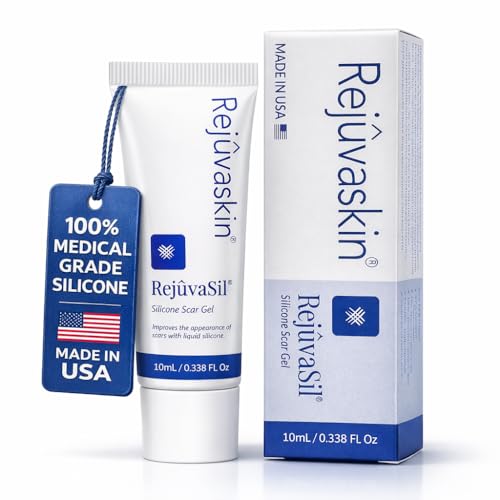
A clear, invisible silicone gel that goes under makeup on a facial scar without a trace.
The number that defines this one is 97% — that is the proportion of liquid silicone in the formula, and it is the reason the gel works on raised, thickened scarring rather than just sitting on top of it. That high-silicone layer regulates collagen production, the environment a hypertrophic scar or keloid needs to soften and flatten. The rest of the blend is doing cosmetic and comfort work: Vitamin C to help brighten discoloration and even out scar tone, Squalane to soothe, and Emu Oil, all aimed at scars on the face and body.
What makes it genuinely usable on your face is the texture. It is clear, odorless and non-greasy, dries quickly, and is water-resistant, so it forms a thin invisible barrier you can wear comfortably under makeup or sunscreen. It is also hypoallergenic and free from fragrances and parabens, which is what lets the brand position it for sensitive skin and pediatric scars as well. The praise clusters on how effective it is — 30 buyers single that out, making it the most-praised trait here — with the silky, smooth feel right behind it. One buyer saw a chemical burn from hair removal cream heal fast under nightly use over several weeks, with skin tone evening out and texture smoothing; another, treating a dark surgical scar on a doctor’s recommendation, found it eased the itching and smoothed the whole incision.
Now the catch, and it is the same catch that runs through this list: the tube. Ten milliliters is a travel-size bottle in practice, and at this price point that is a real consideration for anyone planning months of twice-daily application to a large area. Buyers are candid that the small size is the trade-off for a high-quality, silky formula. Budget for a repeat purchase if your scar is bigger than a coin.
The invisible-barrier case: water-resistant, fragrance-free and makeup-friendly, this is the silicone gel on this list best suited to a face you have to go out in public with.
Who it suits best: facial incisions, acne scarring and smaller body scars.
Best for: visible facial scarring where being able to apply makeup over the gel without it balling up matters as much as the silicone itself.
Not ideal if: you want one tube to cover a large scar through a full treatment course.
7. Cicatricure Advanced Scar Gel

Two full jars of lightweight gel — enough to actually finish the four-times-daily schedule it asks for.
At 4.6 stars across 400+ ratings, this is the highest-rated scar gel on the list, and the win is the quantity: a pack of two 1 oz jars gives you roughly 2 oz total, which is more than either of the premium tubes further down and enough to keep up with a demanding routine. And this one does ask a lot — the label calls for application four times per day, which is the heaviest schedule on this page. Two jars makes that realistic in a way a single small tube does not. The formula, built around a Regenerare Complex and hydrating agents, is designed to improve the appearance of non-keloid and hypertrophic scars and stretch marks, and it is lightweight and non-greasy so it absorbs fast enough to reapply in the middle of a workday.
The recurring experience is speed of comfort plus gradual smoothing. Buyers describe the gel feeling pleasant on the scar, and one used it on a closed head scar for weeks and found it less red and smoother, though not gone. Another noticed a difference in her own skin about a week in. What is consistent across the reviews is volume of use — the people who get results are the people who applied it often. If you can manage four times a day, this product gives you the supply to make it to the finish line.
The caution is expectation-setting. This is not a miracle tube, and buyers using it are honest about that — it works best on recent scars with consistent, patient use, and it enhances the result rather than erasing the mark. One buyer treating a head scar noted it faded the redness and smoothed the texture but did not remove the scar entirely. Applied to a two-year-old raised keloid, it will be a much slower story.
Why This One Earns Its Keep
- Pack of 2 gives roughly 2 oz total — enough for the four-times-daily schedule without running dry
- Lightweight, non-greasy and fast-absorbing, so frequent reapplication is not a chore
- Bland scent profile means it does not clash with anything else in the routine
- Suitable for both adults and kids, for surgical, acne, burn and injury scars
What To Manage Your Expectations On
- Four applications daily is a real commitment — the results follow the frequency
- It softens and lightens rather than erasing — one buyer’s head scar faded but did not vanish
- Best on recent scars; older ones respond far more slowly
The right buy for: a scar you can treat frequently through the day and a routine you can actually maintain with two jars in the drawer.
Reconsider if: you can only manage once a day — this formula rewards frequency, and once-daily use leaves much of its benefit on the table.
8. ScarAway Scar Fabric Sheets

Wearable silicone sheets that keep working all day instead of being reapplied four times.
There is a fundamental difference between a gel you apply and a sheet you wear, and it shows up here in texture. The sheets are soft and flexible fabric with pure silicone on the inside, water-resistant and self-adhesive, and each one holds up for 7-10 days of continuous wear if you care for it. That is the appeal: instead of counting applications, you stick one on in the morning and forget it. The medical-grade silicone is stated to soften, flatten and fade scars, and the sheets are positioned for both treatment and prevention of hypertrophic and keloid scars. Each sheet measures 1.5 x 3 inches, and there are 8 in the box.
What buyers consistently rave about is the sheer utility on larger scars. The soft, flexible fabric takes to curves and moves with the body, and the water resistance means a shower actually improves the adhesion rather than loosening it. Someone managing breast surgery scarring found them comfortable and non-irritating and reported that the fabric flexed with movement. Another with a burn scar wore them diligently for months and saw a meaningful reduction in redness, though the scar never fully disappeared — that is an honest and typical outcome for silicone sheets. One used them starting around six weeks post-op on a surgical scar and saw visible improvement on each fresh application.
The friction is adhesion and cost. A recurring note is that the sheets can slip on certain spots, particularly the neck and other tight curves, and that pairing them with a bandage wrap or surgical tape solves it — one buyer also found they can tangle during removal, so keeping a wrap handy for bed is worth doing. The bigger consideration is the price of longevity: soft sheets eventually lose their edge on a large scar, and buyers treating a bigger area need several sheets and multiple boxes over time. Considered as months of continuous coverage rather than a single purchase, it is a fair deal; considered as a one-box solution, it is not.
The wear-and-forget advantage: one sheet covers a scar for 7-10 days without any daily application, making this the least demanding routine on the entire list — ideal for anyone whose scar is on a part of the body they can comfortably leave covered.
Choose the sheets if: your scar is long or wide, you want continuous coverage with zero daily fuss, and you can keep the area bandaged when needed.
Prefer a gel if: your scar is on the neck or a tight-moving joint where adhesion tends to fail, or you cannot stay bandaged at work.
9. NewGel+ UV Silicone Scar Cream
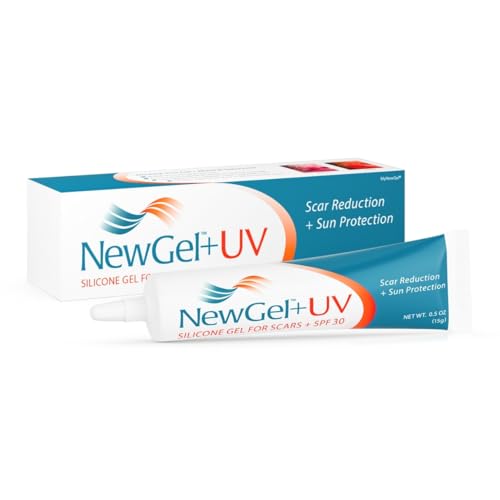
Silicone and sunscreen in one tube — the only pick here that protects a scar from the sun as it heals.
The distinguishing feature is a single ingredient: Zinc Oxide. This is 100% medical-grade silicone with a broad-spectrum SPF 30 mineral sunscreen built into the formula, which addresses the one thing that quietly ruins scar treatment — sun exposure darkening fresh scar tissue. For a scar on your face, hands, arms or anywhere the sun reaches, that pairing saves you a step every single morning. It is designed for all scar types, old and new, and specifically for scars exposed to daylight, with the stated goal of helping prevent the darkening that UV causes. It is scentless, non-toxic and non-irritating, formulated with no parabens, fragrance or preservatives, and it is non-comedogenic and gluten-free, made in the USA.
At 4.6 stars across nearly 500 ratings, the results speak for themselves. Effectiveness is the most-praised trait, with 42 buyers calling it out, and sun protection and quality right behind. The texture is what surprises people — it goes on smooth rather than tacky like many silicone products, and it sets well enough that concealer or makeup layers over it, with the slight zinc opaqueness easily masked by foundation. The results on facial scars are the standout: one buyer who had a dog bite on her lip applied it daily and saw the collagen flattening and the scar lightening with massage, describing it as about half better and lasting a long time. A separate buyer treating a facial dermatology scar twice daily for three weeks reported the redness gone and the scar flattening.
The honest limitation is the tube. At 0.5 oz it is small, the second item on this list flagged for size, and for twice-daily application to a large scar you will be reordering sooner than you would like. Note that the sun protection also means zinc, which leaves a faint tint — easy to mask on the face, but worth knowing if you use it on a broad, contoured area without makeup over it.
Why it beats a plain silicone gel for some buyers: it folds sun protection and silicone into one application, so a facial or hand scar gets its daily SPF without a second product and with no chance of forgetting.
The size reality: 0.5 oz goes fast under twice-daily use, so factor in a repeat purchase for anything larger than a face or hand scar. Treat it as one step in a scheduled daily ritual rather than an occasional dab.
Best for: facial, hand and arm scars in daylight where the scar darkening risk is real and layering SPF separately is a hassle you know you will not keep up.
Not the best fit if: your scar is large, hidden under clothing, or you dislike any tint — a plain silicone gel plus your own sunscreen works fine there.
10. Skinuva® Scar Cream for Face & Body (0.5 oz)

The premium formula with growth factors, built for scars under an inch on the face.
Skinuva’s pitch rests on one claim you will not see on any other pick here: it is formulated with selective Growth Factors, and the manufacturer states it is 73% more effective than regular silicone cream at improving scar appearance. Those are the brand’s own clinical figures, not an independent test, so weigh them as marketing with a real formula behind it. What is concrete: the formula combines silicone with hyaluronic acid, aloe, centella asiatica and vitamin C, and it is fragrance-free and non-greasy, absorbing fast without residue. The smallest size, 0.5 oz, is designed specifically for small scars under 1 inch — biopsies, skin cancer removals, arthroscopic incisions, laparoscopic incisions.
With 4.5 stars across 800+ ratings, the reviews back up the smoothing story. Buyers describe scars becoming less visible and, in one case, settling into a thin line with no bumps or discoloration. One user had a three-year-old, half-inch-deep shingles scar above the nose treated for six months and reported the mark had almost completely disappeared, with plans to continue. Another, a few weeks out from surgery and using both the cream and a scar tape, saw a scar that was no longer red and angry but fading and tapering. The recommended schedule is twice a day on clean, dry skin for at least 3-6 months, starting 2-3 weeks after a procedure or once the incision has closed, with sunscreen and cosmetics allowed over the top.
Be clear-eyed about the trade-off before you commit. This is the priciest per-tube option here, and value is the single most-raised friction point — buyers love the results but note the cost, and a handful of reviews mention some skin irritation, so patch-test if your skin is reactive. At 0.5 oz, the tube is small by design because it targets scars under an inch; size it correctly and it makes sense, size it wrong and you will burn through it fast.
The Case For Going Premium
- Growth-factor formula is unique on this list, paired with hyaluronic acid, aloe, centella asiatica and vitamin C
- Sized precisely for scars under 1 inch — biopsies, mohs, laparoscopic and arthroscopic incisions
- Fragrance-free and non-greasy, absorbing fast with no residue and safe to layer cosmetics over
- Clear schedule: twice daily for at least 3-6 months, starting 2-3 weeks after the procedure
What You Are Paying For And What It Costs You
- The premium price is the most-discussed drawback, and the 0.5 oz tube is deliberately small
- A few users report some skin irritation, so patch-test on reactive skin
- Results hinge on the full 3-6 month course — a hurried two-week trial tells you nothing
Where it wins: a small, visible facial scar from a biopsy or minor procedure, where a physician-developed growth-factor formula is worth the premium.
Where it does not fit: a longer or larger scar will exhaust the 0.5 oz tube long before the 3-6 month course is done.
11. iS CLINICAL Reparative Moisture Emulsion
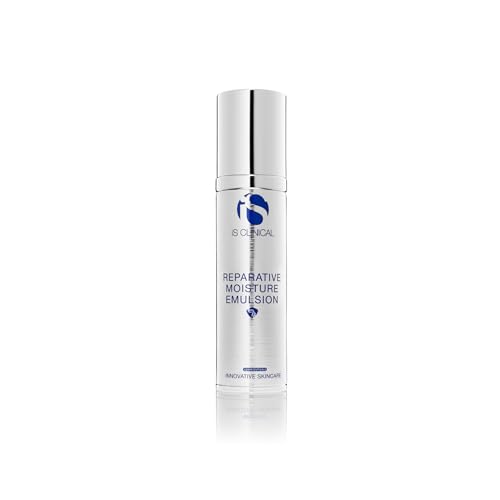
Not a scar treatment — the daily moisturizer you run underneath one to keep facial skin smooth.
Be clear on what this is. Listed here because the guide’s job is honesty as much as ranking — this is a face moisturizer built on Hyaluronic Acid, and its three stated benefits are smoothing and hydrating skin, helping reduce the appearance of fine lines and wrinkles, and providing penetrating and surface hydration. It is not a silicone scar gel and it will not flatten a surgical scar. What it does offer is the healthy, well-moisturized base layer that scar creams and sunscreen sit on top of, and for a facial scar routine, a moisturizer that a reactive face tolerates is worth having. At 4.6 stars across 500+ ratings, the buy-in is real.
The texture is the reason buyers keep reordering. It is lightweight and non-greasy, goes on smooth, and has no odor, which matters when you are layering it under a scar treatment. The moisturizing is the trait buyers rave about, with 37 callouts, and a little goes a long way. One buyer with sensitive, acne-prone skin used it through a winter with no trouble at all and found it healed a blemish almost overnight. Another, a decade-long user, reports skin that draws comments that she looks years younger, with no Botox in the routine. A 45-year-old with a history of breakouts reported smoother, more vibrant skin and no new breakouts despite using it morning and night.
The trade-off is the one you have already guessed from the brand. This is the top of the price ladder here, and value is the mixed point in the reviews — some swear it is worth it, others find it steep. Opinions on how long a bottle lasts are also split. If a facial scar routine already has your budget stretched, a plainer moisturizer does the supporting job just fine; if you want the base layer to feel as good as the treatment on top of it, this is the one buyers keep coming back to.
The supporting-player case: a non-greasy, odorless, lightweight hydrator that layers cleanly under a scar gel or sunscreen — the unglamorous step that keeps facial skin calm while everything else does the scar work.
Suits you if: you are running a facial scar routine and want a moisturizer that pairs under silicone and SPF without pilling or congestion.
Not for you if: a raised or pigmented scar is your actual target — your budget is better spent on silicone or a brightening serum than on a moisturizer.
Know the Specs
Silicone vs. Oil vs. Serum — Which Ingredient Does What
Medical-grade silicone — the ingredient in gels and sheets like Rvlaim, ScarMD, Rejûvaskin, ScarAway and NewGel+ — works by forming a breathable layer over a raised scar, which softens collagen and helps flatten a thickened ridge. Body oils and balms, like Bio-Oil and Motherlove, nourish and moisturize skin rather than flattening a ridge, which is why they suit stretch marks and overall skin tone. Brightening serums built on niacinamide or peptides, like EnaSkin, target flat dark marks and pigmentation rather than raised tissue. Matching the ingredient to the scar type is the single biggest factor in whether the product works for you.
Tube Size And Application Frequency
Scar products are used for months, not days, so the size of the container and how often the label asks you to apply it decides the real cost of the course. A 0.21 oz tube treated twice daily empties far faster than a 1.65 oz bottle, which is why small silicone gels tend to need repeat purchases. Silicone sheets change the calculation again — one sheet holds up for 7-10 days, so an 8-count box covers weeks of continuous coverage. A gel applied four times a day, like Cicatricure, only stays affordable if you have enough product to sustain the frequency.
Common Questions
Should I use a silicone gel or a body oil on my stretch marks?
How long before a scar cream shows results?
Can I use a scar sheet and a scar cream together?
Do SPF scar products actually matter for a healing scar?
How much scar gel do I actually need for a C-section scar?
Are scar creams safe to use on a child’s scar or a burn scar?
Does silicone gel work on old scars or only fresh ones?
Why does the same scar cream cost so much more in a small tube?
Can a face moisturizer help with a scar at all?
Will a scar cream stop my scar from forming in the first place?
The Bottom Line
For most buyers, the cream to stop scarring that will serve the widest range of scars is the Bio-Oil Skincare Body Oil Serum, which covers stretch marks, uneven tone and dry skin across a large area with a 6.7 fl oz bottle that lasts about three months of daily use. If you want to flatten a raised surgical, C-section or injury scar rather than nourish the skin around it, reach for the Rvlaim Silicone Scar Gel — its 1.65 oz pump bottle versus ScarMD’s 0.21 oz lets you complete the full twice-daily course without a repeat order. And for a small facial scar in daylight, the NewGel+ UV Silicone Scar Cream SPF 30 is the one to reach for, since it folds silicone and broad-spectrum SPF 30 into a single morning step.
Two more worth flagging, since they fit so many buyers: Motherlove C-Section Cream is the pick for postpartum mothers who want to read every organic ingredient, and EnaSkin Dark Spot Corrector Serum is the right tool for flat dark marks rather than raised scars. The one honest nudge: whatever you choose, the results follow consistency, so pick the product whose routine you will actually keep up daily — the ingredient matters, but the follow-through matters more. Silicone softens, flattens and lightens scars only when you finish the full course.
How we choose
We do not accept paid placement. Every pick is matched to a real buyer and a real use-case; we do not hands-on test units.
Sources
Specifications: manufacturer listings and product documentation. Review insights: verified customer reviews, as of October 2026. Pricing: not shown on this page (it changes often); check the current price via the retailer link.
As an Amazon Associate, Aappliancez earns from qualifying purchases. This does not affect which products we feature.