Disclosure: Some links in this post are affiliate links. As an Amazon Associate I earn from qualifying purchases, at no extra cost to you. Learn more
Specs are compiled from manufacturer listings and verified buyer reviews and can change over time — please confirm the key details on the product page before buying.
If you have a scar from an operation, you want one thing: for it to fade into a thin, flat line you stop noticing. That is exactly what the picks below are built to do. Some are creams you rub in twice a day, others are silicone sheets you wear over the incision, and the right choice depends on where the scar sits and how new it is.
This guide is built by comparing the manufacturers’ published specifications and the patterns across verified customer reviews, so you get each pick’s real strengths and trade-offs instead of marketing spin.
Start with where your scar is on the healing timeline, since that decides whether a serum, a cream, or a sheet suits you best. Below you will find honest picks for the cream for surgery scars that owners actually keep re-buying.
Top Picks
How To Choose The Best Cream for Surgery Scars
Your scar cream only works if it fits your scar. Three things decide that: how your scar looks right now, where on your body it sits, and how willing you are to apply something every day. Sort those three and the right product almost picks itself.
Match the product to your scar type
A raised, bumpy scar behaves differently from a flat or sunken one. Silicone works by holding moisture against the skin and helping to regulate collagen (the protein that builds scar tissue), which is why it is the ingredient most scar products lean on. For a thick keloid or a hypertrophic (raised) scar, a silicone-based gel or sheet is usually the better fit. For a scar that is mostly about color and discoloration, a serum with brightening ingredients can do more work.
Creams, gels, or sheets: pick by where the scar lives
If your scar is on a joint, a face, or any spot where you want to wear makeup or sunscreen over it, a cream or gel that absorbs and dries clear is easier to live with. If your scar is flat against your body, like a C-section line or a burn scar, a reusable silicone sheet can stay put for days and cover a wider area. The trade-off is that sheets need room to lie flat, while a cream follows the shape of any scar.
Commit to the timeline
Scar care is a months-long routine, not a weekend fix. The manufacturers here recommend starting once the incision has fully closed, usually a couple of weeks after surgery, and applying twice a day. Give any of these picks a real chance by using it consistently for several weeks before you judge it.
Side-by-Side Comparison
| Model | Best For | Format | Key Ingredient | Size & Use | Amazon |
|---|---|---|---|---|---|
| Skinuva Scar Cream★ Best Overall | Surgical scars 1-6 inches | Fragrance-free cream | Silicone + selective growth factors | 1 oz, twice daily | Amazon |
| Mederma Scar SerumBest Value | Old scars and discoloration | Fast-absorbing serum | Niacinamide + hyaluronic acid + vitamin E | 1 Fl Oz, twice daily | Amazon |
| Rejûvaskin RejûvaSil Silicone Scar Gel | Face, keloids, and sensitive skin | Clear quick-dry gel | 97% liquid silicone + vitamin C + squalane | 10 mL, twice daily | Amazon |
| ScarAway Scar Fabric Sheets | Covering and protecting scars | Reusable fabric sheet | Medical-grade silicone | 1.5x3in, 8 Ct | Amazon |
| ScarAway C-Section Scar Sheets | C-section and long incision lines | Ultra-thin breathable sheet | Medical-grade silicone | 1.5x7in, 4 Ct | Amazon |
Detailed Reviews
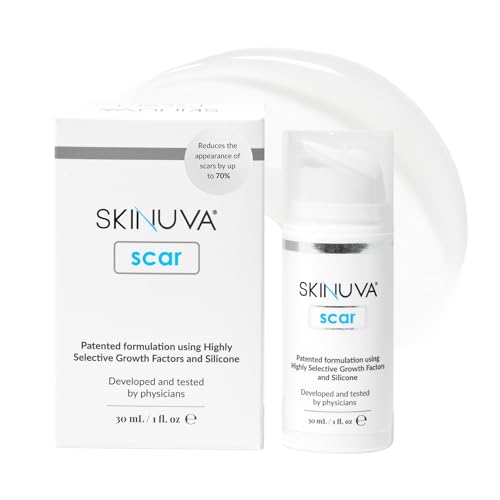
1. Skinuva® Scar Cream for Face & Body (1 oz)
Our pick — 4.5★ from 850+ verified ratings; the strongest balance of quality and price.
A doctor-formulated silicone cream with selective growth factors for fresh surgical scars.
This is the pick for a fresh surgical scar between 1 and 6 inches — eyelid surgery, a breast augmentation, a foot procedure, a C-section, or a hernia repair. Skinuva is the only cream here built around selective growth factors, which are signaling proteins the body uses to rebuild skin. The maker positions those growth factors as something that helps calm redness, even out pigmentation, and encourage the collagen production you want for a scar that heals flat.
What makes this formula stand out is what is in it: silicone cream plus hyaluronic acid (a moisture-holding ingredient), aloe, centella asiatica (a soothing botanical), and vitamin C. It goes on fragrance-free and non-greasy, and it sinks in without a tacky film, so you can layer sunscreen or makeup straight over it. The maker says to start two to three weeks post-op, once the incision has closed, then apply morning and night for three to six months.
The honest trade-off is the price. It costs more than basic silicone creams, and that is the recurring hesitation — the results can be worth it, but you are paying for a premium formula and most buyers want to be sure before committing. Buyers also report steady progress: one long-term user of five months post-surgery calls the results great, and another describes a scar that is “no longer red and angry, but fading and tapering.” A third buyer who worked it into a three-year-old shingles scar above the nose saw the mark almost disappear after six months.
What wins people over
- Selective growth factors plus silicone in one formula for post-op and injury scars
- Fragrance-free and non-greasy, so makeup and sunscreen glide over it
- Suited to medium scars across eyelid, breast, foot, C-section, and hernia surgery
- Smooth texture that buyers describe as pleasant to apply
Where it asks patience
- Priced above basic silicone options
- Needs twice-daily use for 3-6 months to see the full picture
- Some sensitive-skin buyers notice irritation, so patch-test first
Reach for this if: you have a new-to-medium surgical scar and want a fragrance-free cream with growth factors and silicone at once.
Money matters more than formula: if budget is tight, the Mederma serum below delivers solid fading for far less.
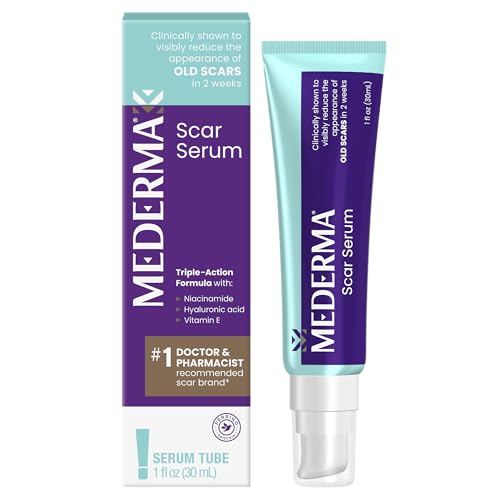
2. Mederma Scar Serum
The serum built for scars you have carried around for months or years.
If your scar has already healed over and gone quiet, this is the one to start with. Mederma targets old scars and discoloration specifically, leaning on a triple-action formula of vitamin E, hyaluronic acid, and niacinamide (a form of vitamin B3 used to brighten and even out tone). The maker says to apply it twice daily for eight weeks on scars six months or older, with early changes possible in two weeks. It comes right out of the bottle as a fast-absorbing serum, and buyers appreciate that it is not greasy and does not leave a heavy film.
For a scar that is mostly about color — a dark line that stands out against surrounding skin — this format does more visible work than a plastic-type sheet can. Buyers report the serum softening and fading scars, and one case describes a scar clearing up entirely within about three weeks. The formula also smooths texture, which is why owners on longer-term scar routines keep it around. Compared with the Skinuva cream above, it is the more affordable way to keep a daily habit going for months.
Set your expectations on the timeline, though. Several buyers notice nothing in the first week or two and need to give it more time — the honest picture is gradual, not overnight. One aspect that surfaces in the reviews is that where the sheet-style products cover a scar and protect it from rubbing, a serum does neither, so a raised or protruding scar may want silicone coverage instead.
Where it earns its keep: the balance of price and a lightweight, non-greasy serum that is easy to massage in twice a day.
One catch to weigh: old scars take patience, and you will not see much until you are several weeks deep.
The budget-conscious pick: ideal if your scar is six months or older and you mainly want fading and a more even tone.
Look elsewhere if: your scar is still recent or raised, where a silicone sheet holds more of an edge.
3. Rejûvaskin RejûvaSil Silicone Scar Gel, 10 mL
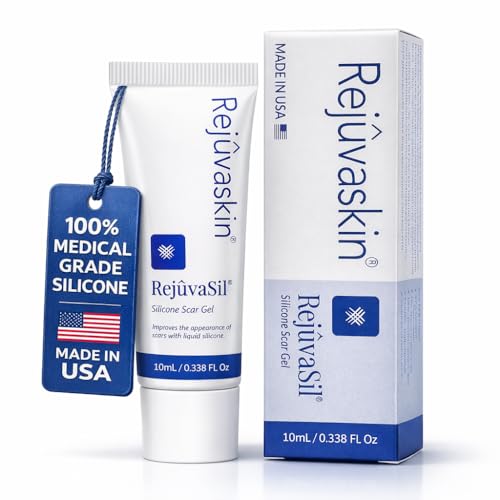
A clear, quick-drying silicone gel that hides on facial scars and disappears under makeup.
Here is the one for a scar you cannot cover with a sheet — across a cheek, a forehead, or any spot that has to look normal in daylight. RejûvaSil is 97% liquid silicone, which is the ingredient doctors lean on to help regulate collagen and soften raised tissue. It is designed to flatten hypertrophic scars (raised scars that stay within the wound boundary) and keloids (which spill past it), and to bring the height down while smoothing texture. Vitamin C and squalane round it out to brighten discoloration and calm irritated skin.
The texture is the selling point. It goes on clear, odorless, and non-greasy, dries fast, and is water-resistant, so it forms a thin invisible layer you can wear under makeup or sunscreen. It is also non-comedogenic (won’t clog pores) and free of fragrance and parabens, which is why it turns up for facial scars and for kids. What owners mention backs this up — the gel helps with the itch that often comes with a healing incision and leaves the whole line smoother. It is also genuinely tiny: at 0.71 ounces, it weighs just a fraction of the Skinuva cream’s 2.65-ounce jar.
That small size is the one thing to go in knowing. Several buyers call out how quickly a 10 mL tube runs out, and for a big area that means restocking sooner than you would like. There is also the cost-per-milliliter question that comes with any premium silicone gel. Neither is a deal-breaker if you are treating a small facial or pediatric scar, but it is the reason this one is the wrong fit for a long C-section line.
The facial-scar answer: for acne scars, keloids, burns, and sensitive or pediatric skin, this gel’s clear, silky finish slips under makeup unnoticed.
Built for delicate spots: choose it for facial, burn, or child-size scars where visibility and a gentle formula matter most.
Skip if coverage is the goal: for a long flat incision, a wider silicone sheet protects and stretches further per box.
4. ScarAway Scar Fabric Sheets

Sheets that keep a healing scar covered, cushioned, and out of clothing’s way.
If part of your problem is friction — a waistband, a bra strap, a seatbelt rubbing a fresh incision — these self-adhesive silicone sheets solve two jobs at once. They cover the scar, cushion it, and, because they are medical-grade silicone, work the same moisture-and-collagen angle as a gel. The set ships as eight 1.5×3-inch sheets, so you have a spare on hand rather than waiting on a reorder. Each sheet is water-resistant and can be reused, running for about 7 to 10 days of coverage. The maker lists results at 4 to 8 weeks of consistent wear on both new wounds and older scars.
Buyers use these up and down the body — burn scars, wrist scars, post-surgical lines, even an old bump. The repeated note is protection: the sheet keeps clothing off the scar and reduces how visible it is, and one case describes a scar fading to a thin white line. The other side of the same coin is adhesion. Stickiness divides opinion, and the sheets do not hold everywhere — across a neck that moves constantly, a couple of owners found they needed surgical tape or a wrap to keep them in place. That is a fit issue for tricky locations, not a flaw for a flat, stationary scar.
On duration, a long-run user of several months on a burn scar saw real redness reduction but not full clearing, and stresses that results come slowly and only with consistent wear. Worth noting: these sheets are lighter per square inch than their thickest rivals, but they do not drape downward the way a stretchier sheet can, so choose the size to fit your scar cleanly.
Right for the moving, rubbing spot: a burn, wrist, or post-surgical scar that needs protection and a cushion under clothes.
Turn away if it has to cling on curved skin: a neck or shoulder scar may need tape to hold these in place.
5. ScarAway C-Section Scar Sheets
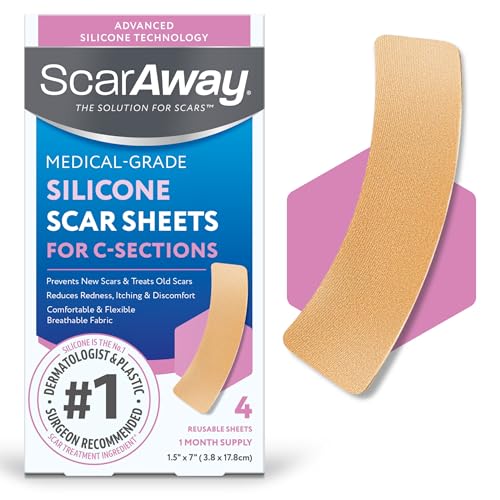
The long, tan sheet shaped to run the full width of a C-section line.
At 1.5×7 inches each, these strips are cut long enough to lie flat across a C-section scar or another wide horizontal incision without piecing several sheets together. They are made from medical-grade silicone on an ultra-thin breathable fabric, so they contour to the body and peel off delicate skin gently. Like the other sheet format, they hydrate and soften as they cover, and The maker lists results at 4 to 8 weeks of consistent wear, and each box holds four reusable sheets.
What wins people over on this one is the fabric build. Buyers compare it against thinner silicone strips and come away preferring this version — a thicker sheet, stronger hold, and a fabric exterior that does not tug when you take it off. It stays on through the day, and the wearers who keep at it see the scar look lighter and less inflamed within a week or so. It is also reusable and washable: you remove it daily, rinse the sheet, clean and dry the skin, then reapply, which is the routine that keeps the adhesive alive.
Two things to weigh before you commit. First, sizing: four strips go quickly if your scar is long or you replace them often, and the recurring gripe is the cost of staying stocked. Second, edges can start curling toward the end of the sheet’s usable life — a few owners notice that some don’t hold for the full stretch. Both are manageable, but plan for restocking across a months-long scar routine.
Compared with the smaller ScarAway fabric sheets above, this tan version is the one to pick when width — not just coverage — is the deciding factor.
The wide-line specialist: a flexible, ultra-thin sheet that stays put over a C-section or mastectomy scar and comes off without pulling.
Made for long incisions: the right call for a C-section or any wide, flat scar that needs full-width coverage.
Not for raised spots: if your goal is flattening a bumpy keloid, a gel you can press directly into the tissue reaches further.
Know the Specs
Format: Cream, Serum, Gel, or Sheet
Format decides how a product fits your day. A cream or gel absorbs and dries clear, so it disappears under makeup and suits the face and moving areas. A serum is a lighter liquid built for smooth absorption and even coverage over wide scars. A sheet sits on top, holds moisture against the scar, and — unlike creams — protects against rubbing, but it needs a flat area and washing between wears. Match the format to where your scar is, then to your willingness to reapply daily.
Key Ingredient and What It Does
Silicone appears across nearly every pick here because it works by trapping moisture and helping to regulate collagen (the tissue that builds a scar). Beyond that, formulas diverge: hyaluronic acid draws in water to hydrate, niacinamide and vitamin C work to even out discoloration, and growth factors are signaling proteins the maker uses to support calmer healing. Knowing which ingredient drives your concern — height, color, or texture — is how you narrow the list.
Common Questions
When can I start using a cream on a surgical scar?
Are silicone sheets better than a cream for surgery scars?
How long do I have to use it before I see fading?
Can these products work on keloid or raised scars?
Is silicone safe for sensitive or pediatric skin?
Can I wear makeup or sunscreen over a scar cream?
How do I reuse the silicone sheets and keep them sticking?
Do I need a separate product for an old scar versus a new one?
The Bottom Line
For most people facing a fresh surgical scar, the cream for surgery scars to start with is the Skinuva Scar Cream, because its silicone-plus-growth-factor formula is the most complete option for a new incision and it layers cleanly under sunscreen or makeup. If you are treating an older scar and want to keep costs down, the Mederma Scar Serum is the sensible routine-builder. For a facial, keloid, or pediatric scar where you need something invisible, reach for the RejûvaSil Silicone Scar Gel. And if your scar is a wide, flat line — a C-section especially — the ScarAway C-Section Scar Sheets cover the most ground per wear. Whichever you choose, give it weeks of consistent use before judging it; that patience is what turns a raised red line into a scar you stop thinking about.
How we choose
We do not accept paid placement. Every pick is matched to a real buyer and a real use-case; we do not hands-on test units.
Sources
Specifications: manufacturer listings and product documentation. Review insights: verified customer reviews, as of October 2026. Pricing: not shown on this page (it changes often); check the current price via the retailer link.
As an Amazon Associate, Aappliancez earns from qualifying purchases. This does not affect which products we feature.