Disclosure: Some links in this post are affiliate links. As an Amazon Associate I earn from qualifying purchases, at no extra cost to you. Learn more
Specs are compiled from manufacturer listings and verified buyer reviews and can change over time — please confirm the key details on the product page before buying.
Those tiny dark dots on your legs after shaving are not dirt and not a shaving mistake — they are hair follicles that have plugged up with dead skin and keratin, and no amount of extra shaving will clear them. What actually works is a body product with a real exfoliating acid in it: glycolic, salicylic, lactic, or urea. The five picks below all carry one of those, and each suits a different leg, a different skin type, and a different level of patience.
This guide is built by comparing the manufacturers’ published specifications and the patterns across verified customer reviews, so you get each pick’s real strengths and trade-offs instead of marketing spin.
You will see how each acid strength behaves on bumpy legs, which formula suits sensitive skin, and how fast you can expect a smoother surface. Every pick here is a body product with a named active ingredient, so you can match the formula to your skin instead of guessing — the full breakdown of the cream for strawberry legs options starts right below.
Top Picks


How To Choose The Best Cream For Strawberry Legs
Strawberry legs are simply dark, pinprick-sized dots where a hair follicle has trapped dead skin, oil, or pigment. To clear them you need two things at once: something that dissolves that trapped layer (an acid or urea) and something that keeps the skin barrier fed (shea butter, glycerin, ceramides, or an oil). Pick a formula that does both, and you stop fighting your legs every time you shave.
Match the active ingredient to your skin, not the label
Glycolic acid is an AHA — an alpha hydroxy acid that works on the skin’s surface and loosens the top layer of dead cells. It suits legs that feel rough and look dull. Salicylic acid is a BHA, a beta hydroxy acid that gets down into the pore itself, which is why it fits bumpy arms and legs. Lactic acid is a gentler AHA that also holds moisture, and urea is a humectant that softens built-up keratin. If your skin stings easily, start with the gentler of these.
Check the strength and the frequency before you buy
A 10% glycolic lotion, a 12% lactic lotion, and a 20% urea cream are three very different levels of intensity. Stronger is not automatically better — it just means you use it less often. Naturium’s 10% glycolic lotion is built for two to three uses a week in the evening, while Amlactin’s 12% lactic lotion is made for daily use on dry, flaky skin. Read the directions on the bottle and treat them as the ceiling, not a suggestion.
Know when sun protection is non-negotiable
AHAs make your skin more sensitive to the sun, and dark spots on the legs can darken further if you skip protection. Any AHA body lotion should come with a sunscreen habit — and if you use one, apply it at night and cover up or use SPF on exposed legs during the day. This is the single most-skipped step and the one that undoes the most progress.
Side-by-Side Comparison
| Model | Best For | Key Active | Size | Best Time to Use | Amazon |
|---|---|---|---|---|---|
| Bio-Oil Skincare Body Oil Serum★ Best Overall | All-over moisture and scar fading | Vitamin E & A blend | 6.7 oz | After shower | Amazon |
| Naturium The Smoother Glycolic Acid 10% Body LotionTop Performer | Rough texture and dark spots | 10% Glycolic Acid | 8 fl oz | Evening, 2-3x weekly | Amazon |
| CeraVe Salicylic Acid Lotion | Bumpy legs and arms | Salicylic & Lactic Acid | 8 oz | Daily | Amazon |
| Cetaphil Rough & Bumpy Cream | Stubborn keratin bumps | 20% Urea | 8 oz | Daily, or bedtime under socks | Amazon |
| Amlactin Daily Nourish Body Lotion | Dry, flaky legs | 12% Lactic Acid | 14.1 oz | Daily, post-shower | Amazon |
Detailed Reviews
1. Bio-Oil Skincare Body Oil Serum
Our pick — 4.5+★ from 180,500+ verified ratings; the strongest balance of quality and price.
The fast-absorbing body oil that turns parched, post-shave legs silky instead of greasy
If your legs are dry, tight, and dotted with old shaving marks rather than raised bumps, this is the one to start with. Bio-Oil is a body oil rather than an acid lotion, so it does not exfoliate — instead it floods the skin with moisture and helps fade the look of scars, stretch marks, and uneven tone over time. That is exactly the job for legs that feel rough because they are dry, not because they are plugged.
What wins people over is how light it feels for an oil. The 6.7 oz bottle holds a fast-absorbing formula that sinks in without a greasy film or clogged pores, which is rare for something this rich. Buyers who were worried about the oily feel report the opposite — it goes on silky and dries down clean, and a small amount covers a whole leg, so one bottle stretches a long way. One buyer recovering from surgery said it brought their extremely dry skin back to normal.
The catch is the strength-to-format trade: as an oil it softens and seals in moisture but does not dissolve the dead-skin plug inside a follicle the way an acid does. So if your dots are dark and follicle-bound, you will want to pair it with one of the acid lotions below rather than rely on it alone. It also carries a mild lavender-and-chamomile scent, which most people love and a few sensitive noses notice. Bottom line — the nicest everyday moisturizer on this list, best used as the comfort layer around a real exfoliant.
What earns its keep
- Absorbs fast with no greasy residue, so you can dress right after
- Vitamin E, Chamomile Oil, and Lavender Oil nourish dry, sensitive skin
- Vegan, paraben-free, cruelty-free, and non-comedogenic
- One 6.7 oz bottle lasts because a little goes a long way
Where it stops short
- No exfoliating acid, so it softens but does not clear follicle dots on its own
- Best results come when layered with an acid lotion, which is an extra step
Reach for this if: your legs feel dry and rough and you want a daily moisturizer that sinks in fast and helps fade old marks.
Pair it instead if: your goal is clearing dark follicle dots — use an acid lotion for that job and this as the comfort layer.
2. Naturium The Smoother Glycolic Acid 10% Body Lotion
A 10% glycolic body lotion that resurfaces dull, rough legs while shea butter keeps them soft
The most useful number here is the 10% glycolic acid — an AHA that loosens the top layer of dead skin so rough texture and uneven tone smooth out over repeated use. Naturium pairs that with shea butter so the exfoliation does not leave you ashy, and the 8 fl oz bottle is built for a body routine, not a face one. It is the pick for legs that feel like sandpaper and look dull rather than dotted.
Where it earns its place is the balance: strong enough to actually resurface, gentle enough that people with sensitive skin report no irritation when they follow the directions. The label is clear about those directions — apply two to three times a week in the evening, use sunscreen, and limit sun exposure while using it and for a week afterward. Stick to that rhythm and the texture work happens without a sting. One regular user after five applications found elbow and leg bumps nearly gone and skin noticeably softer.
It runs a little thicker than the CeraVe lotion here, so it takes a moment longer to rub in — a fair trade for the shea-butter richness. The mild, mostly unscented formula keeps it inoffensive on the nose. Given how concentrated the acid is, this is not a product to slather on daily without checking your skin’s reaction first, and it is not for anyone who will not commit to the sunscreen step. Use it as directed and it is the strongest texture-smoother in this group.
The sunscreen is the deal: AHAs increase sun sensitivity, and the bottle tells you plainly to use SPF and limit exposure while using it and for a week after. Skip that and you can trade rough legs for darker spots.
How it feels: a rich, shea-butter lotion that spreads easily and leaves legs soft rather than slick, with only a faint natural scent.
Best for the sandpaper-leg crowd: rough, dull legs that need real resurfacing two or three nights a week.
Think twice if: you want a daily no-thought moisturizer — this one demands a sunscreen habit and a limited schedule.
3. CeraVe Salicylic Acid Lotion

A salicylic acid lotion with three ceramides that clears bumpy legs and arms without stripping the skin barrier
What separates this from the oil above is the acid itself: salicylic acid is a BHA, a beta hydroxy acid that slips into the pore and dissolves the plug causing a bump, rather than just smoothing the surface. CeraVe adds lactic acid for extra exfoliation, hyaluronic acid to hold moisture, and niacinamide to calm skin — a genuinely loaded formula for rough, bumpy legs and upper arms. The 8 oz pump bottle makes daily use easy.
The reason it is a go-to for strawberry legs is the ceramides. Three essential ceramides (1, 3, 6-II) help restore and maintain the skin’s natural barrier while the acids work, so you are not trading smoothness for dryness. Owners with rough patches and arm bumps report smoother texture in under two weeks with no irritation, and the lightweight lotion absorbs fast enough to dress right after. It is fragrance-free and non-comedogenic, which suits sensitive skin that reacts to perfumed body products.
Its honest limit is pace — this is a gentle daily formula, not a fast-acting strong acid, so stubborn, deeply plugged follicles take consistency rather than a single application. Compared with the richer Naturium, it spreads lighter and dries quicker, which many people prefer for daytime wear. If your skin is very reactive, this is the safer first acid to try. The one thing it will not do is replace the sun habit — but a daily gentle exfoliator this easy to apply earns its spot in the routine.
Pick this when: you want a fragrance-free, dermatologist-developed exfoliator you can use every day on bumpy legs and arms.
Look elsewhere for: instant results — this works gradually and rewards patience over a couple of weeks.
4. Cetaphil Rough & Bumpy Cream

A 20% urea cream for the bumps that glycolic and salicylic acid have already failed to clear
The number to fix on is the 20% urea — a humectant that dissolves built-up keratin, the hard protein that clogs follicles and forms those stubborn bumps. That is a different mechanism from the acids, which is why this cream is the pick for legs that shrugged off a glycolic or salicylic lotion already. Cetaphil pairs the urea with glycerin for 48-hour hydration and a fragrance-free, hypoallergenic formula, so the exfoliation and the moisture arrive together.
Owners with keratosis pilaris say it cleared bumps that AHAs, salicylic acid, and scrubbing had not, with visible shrinking within a week. The 8 oz tube is large and long-lasting, and because the cream is thick it doubles as an overnight treatment under socks. Cetaphil’s label claims a smoother surface after one use and virtually bump-free skin after a month of daily application.
Where it shines: urea at 20% goes after keratin directly, so hard, plugged bumps that resisted acids respond to it — and the 48-hour hydration means your legs do not tighten up while they smooth out.
The texture note: thick and slightly chalky by design; work it in fully or wear it overnight, and give sensitive skin a patch test first.
Choose it for: stubborn, hard bumps and keratosis pilaris that lighter acid lotions have not budged.
Patch-test first if: your skin stings easily — the strong urea that does the work can tingle on reactive legs.
5. Amlactin Daily Nourish Body Lotion
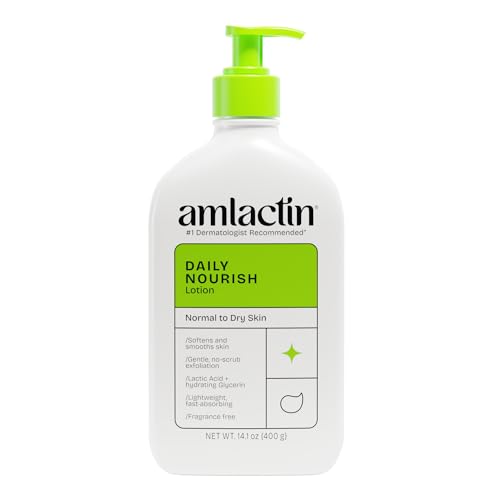
A daily 12% lactic acid lotion in a big 14.1 oz pump bottle that clears flakes and smooths legs
For the biggest bottle on this list, look at the 14.1 oz pump — it holds a 12% lactic acid formula that exfoliates gently while it moisturizes, so one product replaces both an exfoliator and a daily lotion. Lactic acid is an AHA that also draws in moisture, which makes it friendlier to dry skin than a straight glycolic. That combination is why it suits legs that are both flaky and dotted rather than just one or the other.
Dry, sensitive legs that flaked even in black leggings came away smooth after a week of daily post-shower use. The formula is cruelty-free, dye-free, paraben-free, phthalate-free, and fragrance-free, and it is pH balanced for dry to rough skin. The pump dispenser keeps application mess-free, which matters when you are putting this on every day. For anyone whose strawberry legs sit on top of generally dry, scaly skin, this does double duty.
The recurring gripe is the smell — lactic acid has a faint yogurt-like scent that some notice and others barely register, and it fades within about an hour for most people. If you are sensitive to that, apply it at night. It also takes a bit of rubbing in, and a few find it slightly greasy right after application. But for the price tier and the 14.1 oz size, it is the most economical way to keep lactic acid in your daily routine.
Reasons it earns the value title
- 12% lactic acid exfoliates and hydrates in one daily step
- Large 14.1 oz pump bottle keeps the whole routine stocked
- Fragrance-free and pH balanced for dry to rough skin
- Cleared flaking on dry, sensitive legs within a week of use
What you trade for it
- The natural lactic-acid scent is noticeable to some before it fades
- Takes more rubbing in than the lighter CeraVe lotion, and feels slightly greasy at first
Great fit for: dry, flaky legs that need both exfoliation and moisture in one everyday step.
Consider another pick if: you cannot tolerate a noticeable scent — the lactic smell, though brief, is part of the deal here.
Know the Specs
AHA vs BHA vs Urea
AHAs like glycolic and lactic acid work on the skin’s surface and loosen the top layer of dead cells — good for dull, rough texture. BHAs like salicylic acid get inside the pore and dissolve the plug that forms a bump — good for dark, follicle-bound dots. Urea dissolves built-up keratin directly. Pick by the look of your legs: dull and rough leans AHA, dotted and bumpy leans BHA or urea.
Strength and Frequency
Percentage tells you intensity, not quality. A 10% glycolic lotion is used two to three times a week, a 12% lactic lotion daily, and a 20% urea cream once or twice a day for stubborn bumps. Stronger formulas demand shorter, spaced-out use. Follow the label directions exactly and build up slowly — more product does not mean faster results, only more irritation risk.
Common Questions
What actually are strawberry legs and will a cream fix them?
Should I pick a glycolic or salicylic acid cream for my legs?
How often can I use a 10% glycolic acid body lotion?
Does urea cream work if glycolic and salicylic acid failed?
Can I use a body oil and an acid lotion together on my legs?
Will an exfoliating body lotion make my legs more sensitive to the sun?
Can I shave while using a glycolic acid body lotion?
How long until I see smoother legs from an exfoliating cream?
Is a fragrance-free body lotion better for bumpy legs?
Can I use these leg creams on my face?
The Bottom Line
For the best all-around starting point, the Bio-Oil Skincare Body Oil Serum wins because it turns rough, dry legs soft and absorbs fast enough to actually use every day. If your bumper is dark follicle dots and dull texture, reach for the Naturium The Smoother Glycolic Acid 10% Body Lotion and commit to the sunscreen step. For hard, plugged bumps that shrug off acids, the Cetaphil Rough & Bumpy Cream is the stronger tool. And if your legs are simply dry and flaky, the Amlactin Daily Nourish Body Lotion does the most work per application for a budget-tier price — a smart daily habit to build before you chase a stronger acid.
How we choose
We do not accept paid placement. Every pick is matched to a real buyer and a real use-case; we do not hands-on test units.
Sources
Specifications: manufacturer listings and product documentation. Review insights: verified customer reviews, as of October 2026. Pricing: not shown on this page (it changes often); check the current price via the retailer link.
As an Amazon Associate, Aappliancez earns from qualifying purchases. This does not affect which products we feature.