Disclosure: Some links in this post are affiliate links. As an Amazon Associate I earn from qualifying purchases, at no extra cost to you. Learn more
Specs are compiled from manufacturer listings and verified buyer reviews and can change over time — please confirm the key details on the product page before buying.
Which crawl space vent cover is worth buying? The one that matches your opening size and your goal — sealed plates for an encapsulated crawl space, screened vents for airflow you still want to keep, and automatic vents that open and close themselves. Measure the bare hole with the old vent removed before you shop, because a cover sized to the old grille’s outside dimensions will not fit.
This guide is built by comparing the manufacturers’ published specifications and the patterns across verified customer reviews, so you get each pick’s real strengths and trade-offs instead of marketing spin.
Each pick below was chosen for a specific job, so the right answer depends on whether you are blocking air or moving it. Here is how the leading crawl space vent covers differ on size, mesh, and sealing.
Top Picks


How To Choose The Best Crawl Space Vent Covers
Most wrong vent covers get bought the same way: you measure the vent you can see, not the hole behind it. Size your cover by its rough opening (the actual hole in the foundation wall). A good cover overlaps that hole on every side, so water and pests have no gap to slip through.
Measure the rough opening, not the old cover
Pull the old vent and measure the bare hole in both directions. A cover listed at 5 x 14 inches, for example, is built to fit rough openings from 4.5 to 6.5 inches high and 13 to 14.5 inches long, so one part covers a range of older homes. Some designs also fit slightly smaller holes once you snap out a spacer tab. That spacer tab is why one 5 x 14 inch vent can replace several different originals around one house.
Decide if you want airflow or a full seal
Screened and louvered vents keep air moving through the crawl space while blocking pests. A solid plate does the opposite — it blocks outdoor air, moisture, and humidity completely, which is the goal when you have encapsulated and conditioned the space. Pick a screened or louvered vent for a vented crawl space and a solid plate for an encapsulated one — mixing the two defeats both jobs.
Check the mesh material against your climate
For most inland homes, galvanized steel mesh (steel dipped in a zinc coating to resist rust) gives you sturdy protection at a budget price. Live within about 5 miles of the coast or a body of water? Salt air eats through galvanized mesh over time — that is the manufacturer’s own guidance. That is why copper and stainless mesh options exist for coastal builds.
Side-by-Side Comparison
| Model | Best For | Fit / Opening | Airflow Type | Material | Amazon |
|---|---|---|---|---|---|
| EZRvent FV100-8H Easy Replacement Vent★ Best Overall | Replacing old foundation and garage vents fast | 5 x 14 in (fits 4.5–6.25 in H, 13–14.5 in L) | Screened airflow | Galvanized steel mesh, polypropylene frame | Amazon |
| Vent Systems 16″ x 8″ Galvanized Metal Air Vent CoverBest for Exhaust Runs | Wall and ceiling exhaust or supply grilles | Fits openings up to 14.37 x 6.38 in | Louvered with built-in mesh | Galvanized metal, UV-stabilised coating | Amazon |
| 8″ x 16″ Automatic Foundation Vent | Hands-off seasonal crawl space ventilation | Standard 8 x 16 in openings | Auto-opening louvered | Aluminum and plastic | Amazon |
| Recessed Crawl Space Vent Cover | Sealing an encapsulated crawl space | 8 in H x 16 in W foundation openings | Fully solid, no airflow | UV-stabilized ABS plastic | Amazon |
| 12 x 12 Inch Steel 2-Way Air Vent Cover | Adjustable room-level airflow control | 12 x 12 in duct opening (13-3/4 x 13-3/4 in overall) | Adjustable multi-shutter damper | Steel with white powder finish | Amazon |
Detailed Reviews
1. EZRvent FV100-8H Easy Replacement Vent
Our pick — 4.5+★ from 300+ verified ratings; the strongest balance of quality and price.
The one-part fix for old foundation holes nobody wants to rebuild.
If your weathered vent no longer matches anything on a shelf, the EZRvent FV100-8H earns its spot by covering many hole sizes with one part. Its 5 x 14 inch size spans rough openings from 4.5 to 6.5 inches high and 13 to 14.5 inches long, so one model fits a spread of older foundation holes. Snap out the spacer tab and it also fits 5 x 13 and 4.5 x 13 inch openings. That means you can replace several mismatched originals in a single afternoon.
Installation is the headline, and it is the thing that wins people over. Two mounting screws come in the box, and the cover seats from outside under two minutes — no stucco or siding removal, no crawling into the space. The frame is UV-stabilized automotive/marine-grade polypropylene, which resists corrosion and impact and holds up better outdoors than typical PVC or ABS. The recessed picture-frame shadow box design gives a cleaner finish than the flat grilles it replaces, so a plain white vent actually looks intentional against the siding.
Pest blocking is where the mesh earns its keep. The galvanized steel mesh runs at a heavier.023 pitch, roughly 1/8 inch — tighter than most generic vents — which keeps out rats, mice, bees, snakes, skunks, raccoons, and opossums, and holds up to swarming bees and wasps. That tighter.023 pitch is also part of why it meets insurance and building codes where flimsier grilles fall short. Weighing 8.3 ounces, it is light enough to hold in one hand while you drive the screws.
Weave in the size math and one honest limit. Unlike the 8 x 16 automatic vent further down, this cover does not open and close on its own — it is a fixed screened vent for homes that want steady airflow. And if you live within about 5 miles of the coast or a body of water, the galvanized mesh is outside its rust-through warranty, so plan on the manufacturer’s copper or 316 stainless option instead. Buyers report the real-world pace: “I replaced 8 vents on my 70 yr old home, all in different states, took an hour TOTAL for all 8, and they all look amazing.”
What earns it the top spot
- One 5 x 14 inch part fits rough openings from 4.5 to 6.5 inches high and 13 to 14.5 inches long
- Two included screws and an outside install under two minutes — no siding removal
- Heavier.023 pitch galvanized mesh blocks rats, mice, bees, snakes, and raccoons
- UV-stabilized polypropylene frame resists corrosion and impact
- Recessed shadow box frame looks cleaner than flat generic grilles
Where it asks you to plan ahead
- Fixed screened vent, so it does not open or close with the seasons
- Galvanized mesh carries coastal exclusions within about 5 miles of salt water
- Costs more than a plain store-bought grille
Reach for this if: you are replacing old foundation or garage vents and want the job done in an afternoon with a part that fits several hole sizes.
Look elsewhere if: you live near the coast and want the mesh covered under warranty — the copper or 316 stainless version is the one to order.
2. Vent Systems 16″ x 8″ Galvanized Metal Air Vent Cover
A louvered metal grille that keeps dust and debris out of your duct.
For a garage, bathroom, or workshop wall where you still want air moving, this louvered grille does the job with a built-in mesh screen behind the blades. The screen is the part that matters: it stops dust and debris while holding steady airflow, so your duct stays cleaner for longer. Unlike the sealed ABS plate later on, this one is designed to breathe — it is an exhaust and supply cover, not a blocker.
Fit is the whole game with this grille: it covers holes up to 14.37 x 6.38 inches, with screw holes spaced 15.24 x 7.20 inches apart. It fits vent holes up to 14.37 x 6.38 inches, while the grate itself measures 15.75 x 7.87 inches overall. The screw hole spacing is 15.24 x 7.20 inches, and the pre-drilled holes are 0.16 inch — small enough that you will want to match the screw gauge. Measure the opening before you order, not the old grille, because a cover that looks right can still miss the holes.
The build is galvanized metal with a UV-stabilised coating that fights rust, fading, and corrosion through constant use and outdoor weather. Buyers rate the quality highly, and the look holds up — a clean galvanized finish blends into a garage or utility wall without drawing attention. What owners mention loudest is the missing hardware: the listing spells out that screws are not included, and that shows up in the reviews more than anything else. As one buyer summed it up: “Had to buy a pack of 100 screws when I only needed 18.” Budget an extra trip to the hardware store and the install is quick.
Straight trade: quality and airflow control are why this one is here, and the pre-drilled holes make wall or ceiling mounting fast once you have your screws.
The one snag: no screws in the box, and some find the sturdiness mixed compared with heavier grilles — fine for a room vent, less so if you expect it to take a knock.
Go with this one when: you are covering a bathroom, kitchen, garage, or workshop duct opening and want mesh plus louvers in a metal grille.
Pass it by if: you are sealing a crawl space for good — this one vents air by design, so choose a solid plate instead.
3. 8″ x 16″ Automatic Foundation Vent

Opens at 70°F, closes at 40°F, and never asks you for a thing.
If you have ever forgotten to open the vents in spring and remembered in November, this is your vent. It replaces a standard manual vent in a 8 x 16 inch opening and handles the seasonal switch on its own, opening fully at roughly 70°F and closing at roughly 40°F. It runs on a bi-metal coil under a protective cover, so there is no electricity, no wiring, and no battery to remember.
The payoff is real for the space itself. Closing at 40°F retains heat and lowers the risk of frozen pipes, while opening at 70°F keeps the crawl space ventilated through the hot months. The vent provides 57 square inches of net free ventilating area, so it moves real air rather than just looking the part. The 1.96-pound unit uses hi-density polyethylene with long-life, corrosion-free metal parts and a stainless steel compression spring.
You need no special tools to install it. Knock out the old vent with a hammer, clear mortar as needed to open the hole to 8 x 16 inches, set one side in first, and thread the adjustable screws until they sit snug against the side walls. Wear gloves while you work. Customers note the mechanism is honest: most units behave exactly as advertised. But the occasional one stays open at low exterior temperatures — crawl space air can run warmer than the outside reading, which may be the reason. Two of ten in one buyer’s batch did not close as wanted, so test each vent before you screw it down.
Why it earns a spot: automatic 70°F open and 40°F close is genuine set-and-forget ventilation, and the 57 square inches of net free area is enough to matter.
Test before you commit: drop each vent in a freezer, then take it outside — the few that hang open at cold temps will show themselves before installation.
Worth grabbing if: you want seasonal ventilation without a manual to-do list and your foundation has standard 8 x 16 inch openings.
Think twice if: you are sealing a crawl space for conditioning — an automatic vent is built to open, not to block.
4. Recessed Crawl Space Vent Cover

A solid plate that closes your foundation vents for good.
This is not a vent — it is the opposite, and that is the entire point. The recessed cover is completely solid, with no louvers, no mesh, and no ventilation of any kind. It seals standard 8 inch high by 16 inch wide foundation openings to keep outdoor air, moisture, and humidity out of an encapsulated, conditioned crawl space. If your plan is encapsulation, this is the part that finishes the job once the vents stop serving a purpose.
The flange overlap is what you are buying: a 7 x 15 inch cavity inside a 10 x 18 inch flange that covers the opening on every side. The inside cavity is 7 x 15 inches, and the outside flange is 10 x 18 inches so it overlaps the opening on every side. The recessed body drops into the foundation opening while the flange sits flush against the exterior wall — and because it mounts from outside, you never have to crawl into the space to install it. Measure your rough opening first; this is the one measurement that decides whether it drops in or fights you. A few buyers also find the shallow recess forgiving on holes that run a little oversized, and the plastic can be trimmed where siding crowds the edge.
The material holds up in the damp strip right outside a crawl space: UV-stabilized ABS plastic that will not rust, rot, or warp, and it takes plastic-adherent paint so you can match your foundation or siding. Secure it with construction adhesive, Tapcon screws, or both, then run a bead of caulk around the perimeter for a full weatherproof seal. Functionality is what wins people over most here, and the sealing job is why — buyers who caulked the edges report a solid, waterproof result that shuts the crawl space off completely.
What it does best: a fully solid, 10 x 18 inch flanged plate that blocks air and moisture and installs from outside in minutes.
The trade-off: no airflow means it is the wrong part for any crawl space that still needs venting — and you will need adhesive, screws, and caulk that are not part of the purchase.
Choose it when: you have encapsulated and conditioned the crawl space and want the foundation vents sealed tight against humidity.
Leave it on the shelf if: your crawl space still depends on airflow to stay dry — sealing it here would trap the moisture you are trying to lose.
5. 12 x 12 Inch Steel 2-Way Air Vent Cover
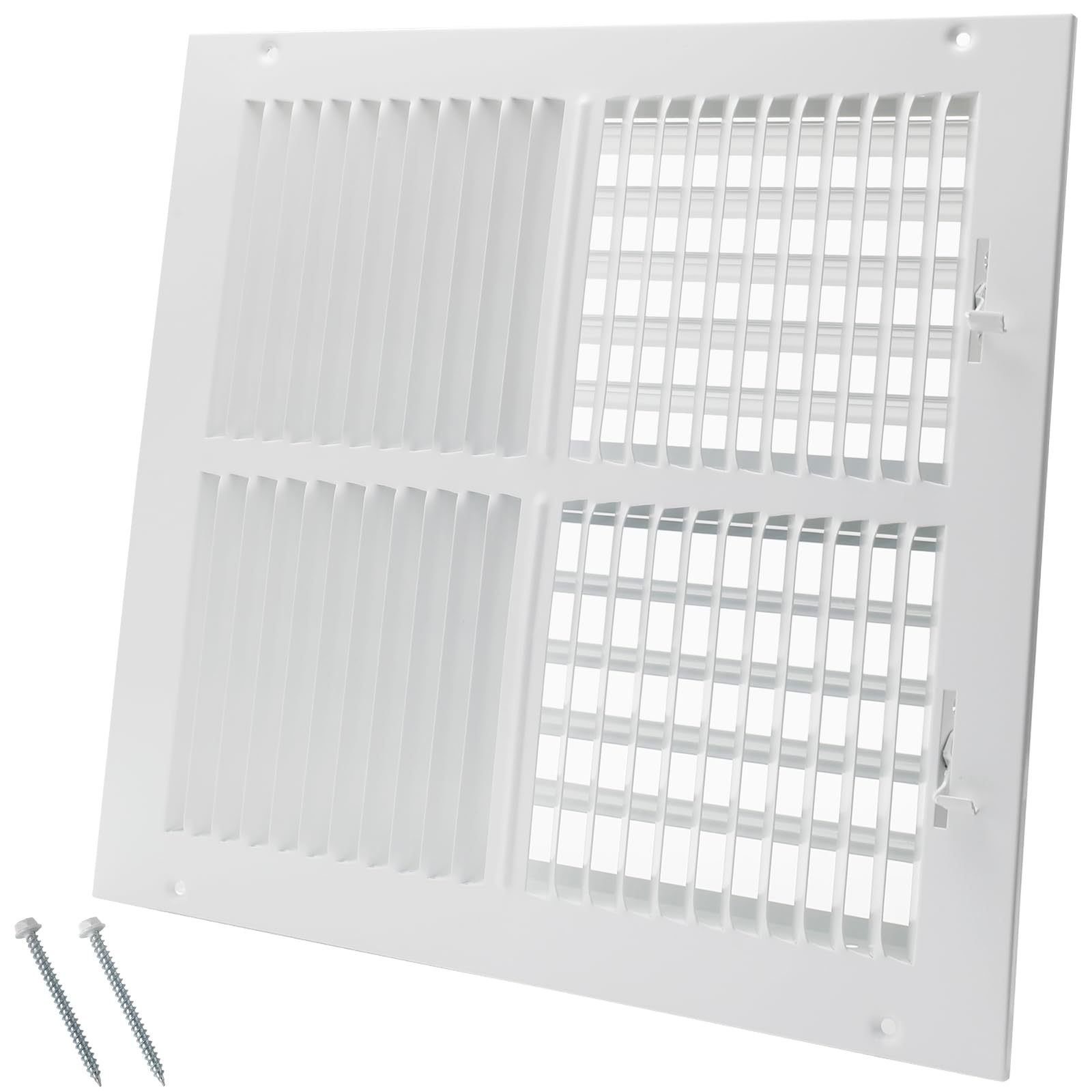
Turn the airflow up, down, or off from one adjustable grille.
For a room where the air is either too much or not enough, this steel register puts you in charge. It covers a 12 x 12 inch duct opening with overall dimensions of 13-3/4 x 13-3/4 inches, and the multi-shutter damper lets you adjust the blades vertically or block the airflow completely. The white powder finish over rustproof steel resists heat and cold without warping, so it holds its shape through seasons of use.
Fit does the heavy lifting in the reviews, and it is worth measuring your duct rather than your old grille. People replacing vents from 1980s walls in particular report a clean match. The perimeter around the duct opening is a little larger than some, which helps hide rough edges when you swap an old grille out. Airflow direction and volume both change noticeably once it is in, and it runs quietly — buyers describe it as a strong, clean replacement that makes no noise and looks nice.
Here is where it differs from the louvered Vent Systems grille above: this one is adjustable and sized in inches rather than fractions, so you fine-tune the airflow rather than just let it pass. The catch is in the details. The included screws run about an inch too long for shallow framing, so some swap in their own. And while the quality and fit earn high marks, durability is a mixed note — a few describe it as flimsy next to heavier grilles. The damper also opens less wide than some old vents, which could cut airflow in a small bathroom if your system was already tight.
The case for the adjustable register
- Multi-shutter damper adjusts airflow vertically or shuts it off completely
- 12 x 12 inch duct opening with a 13-3/4 x 13-3/4 inch overall face
- Rustproof steel with a white powder finish that resists heat and cold
- Quiet operation with a clean, minimal look that blends into a room
Where it falls a little short
- Included screws run about an inch too long for shallow framing
- Damper opens less wide than some old vents, which can trim airflow
- Durability draws mixed feedback compared with heavier grilles
Pick it up if: you want to dial airflow up or down from the wall or ceiling and need a clean 12 x 12 inch fit.
skip it if: your duct is oversized and you would rather close the gap with a larger face than adjust the blades.
Know the Specs
Rough Opening vs Overall Size
The rough opening is the bare hole in the foundation or wall — the number that decides whether a cover fits. Overall size is the outside footprint of the part, and a good cover overlaps the hole on every side with its flange so water and pests have no path in. A vent listed at 5 x 14 inches, for example, fits a range of rough openings rather than a single exact hole. Always measure the hole with the old vent removed, and check the seller’s stated fit range before you buy.
Net Free Ventilating Area
Mesh and louvers both cut down how much air actually passes through, so auto vents publish a net free area figure — the automatic foundation vent here lists 57 square inches. That number tells you how much real ventilation you get once the blades and screen are in the way. Too little venting for the size of the space and the crawl space holds moisture; too much in a conditioned build and you lose the energy you paid for. Match the net free area to what the space actually needs.
Mesh Pitch and Pest Exclusion
Mesh pitch is the spacing between the wires in a screen. Tighter spacing keeps smaller pests out and holds up to swarming insects — the EZRvent mesh runs at a heavier.023 pitch, about 1/8 inch. Galvanized steel is the budget-friendly choice for inland homes, but salt air near the coast eats through it over time, which is why copper and stainless mesh versions exist for coastal builds.
Damper and Louvre Types
A louvered grille uses fixed angled blades to direct air and a built-in screen to catch dust. A multi-shutter damper adds adjustable blades so you can control volume and even shut the airflow off. A solid plate has neither — it blocks air entirely for encapsulation. Knowing which of the three your space needs prevents buying a vent that works against your plan.
Common Questions
How do I measure my crawl space vent opening for a cover?
Will a solid vent cover stop all airflow into my crawl space?
How does an automatic foundation vent open and close without power?
Can I use a galvanized mesh vent near the ocean?
Do vent covers come with mounting screws?
What is net free ventilating area and why does it matter?
What size rough opening does the EZRvent FV100-8H fit?
Should I seal my foundation vents or leave them open?
Can I adjust how much air comes through a vent cover?
Are crawl space vent covers hard to install yourself?
The Bottom Line
For most homes replacing tired foundation or garage vents, the winner is the EZRvent FV100-8H. One part spans a range of rough openings and installs from outside with two screws in under two minutes — a real home upgrade without siding work. Want the seasonal switch handled for you? The 8″ x 16″ Automatic Foundation Vent opens near 70°F and closes near 40°F on its own. For an encapsulated crawl space, the Recessed Crawl Space Vent Cover blocks air and moisture completely. Start with your rough-opening measurement — 4.5 to 6.5 inches high and 13 to 14.5 inches long for the EZRvent, 8 x 16 inches for the automatic vent and the solid plate.
How we choose
We do not accept paid placement. Every pick is matched to a real buyer and a real use-case; we do not hands-on test units.
Sources
Specifications: manufacturer listings and product documentation. Review insights: verified customer reviews, as of October 2026. Pricing: not shown on this page (it changes often); check the current price via the retailer link.
As an Amazon Associate, Aappliancez earns from qualifying purchases. This does not affect which products we feature.