Disclosure: Some links in this post are affiliate links. As an Amazon Associate I earn from qualifying purchases, at no extra cost to you. Learn more
Specs are compiled from manufacturer listings and verified buyer reviews and can change over time — please confirm the key details on the product page before buying.
If you wake up to a mask that smells like last night’s breath or a hose that never quite dries, you are in the right place. The best CPAP cleaning machine takes the two worst chores of sleep therapy — scrubbing and waiting for gear to dry — and shrinks them into a few button pushes. This guide covers seven machines that do it, from ultrasonic tanks to heated dryers to portable ozone boxes, so you can match one to the way you actually live. The short answer: buy the machine that solves your real bottleneck. If your trouble is wet tubing, a dryer wins. If your trouble is grime inside the hose wall, an ultrasonic tank wins. If you want something small enough to travel with, a foldable ozone box wins. The reviews below sort out which is which.
This guide is built by comparing the manufacturers’ published specifications and the patterns across verified customer reviews, so you get each pick’s real strengths and trade-offs instead of marketing spin.
You will see how drying time, tank size, and technology type change your nightly routine long before you notice any cleaning result. The best CPAP cleaning machine fits the routine you will actually keep up with.
Top Picks

How To Choose The Best CPAP Cleaning Machine
Every machine in this category does one of two jobs: it washes your gear, or it dries it. A few try to do both. Picking the right one starts with knowing which half of your routine is currently the pain.
Cleaning versus drying — pick your bottleneck first
Cleaning machines fall into three families. Ultrasonic tanks fill with water and use vibrating sound energy to knock debris off surfaces. Ozone and UV boxes seal your gear in a chamber while light or gas does the work. Heated dryers push warm air through the hose until it is bone dry. If you already wash your gear in the sink but the hose stays wet for a day, a dryer is your answer. If the inside of the hose builds up film you cannot reach with a brush, a tank or a box is the fix. Deciding this first prevents a wrong purchase.
How much gear has to fit
Think about everything you clean on a normal night: the mask cushion, the headgear, the short hose, the water chamber, and sometimes filters. A machine’s usable space decides how much of that fits in one cycle. Small tanks handle a mask and a short hose at most. Larger boxes hold a mask, hose, and a few loose parts together. If you own two CPAP setups or clean for a partner, capacity becomes the deciding factor and a small tank will frustrate you quickly.
Drying speed and what it changes
A wet hose is where the musty smell begins. Warm airflow brings a hose back to use in about an hour, while air drying can take most of a day. That gap matters: a hose dry in an hour keeps a nightly routine realistic. A faster dry usually means a bigger unit with more airflow, so weigh speed against where the machine will physically sit.
Side-by-Side Comparison
| Model | Best For | Cleaning Method | Usable Capacity | Typical Cycle Time | Amazon |
|---|---|---|---|---|---|
| The Hurricane CPAP Equipment Dryer★ Best Overall | Fast nightly drying | Heated airflow | Hoses plus loose parts | 30–60 min | Amazon |
| CPAP Cleaning and Drying KitMost Complete Kit | Complete at-home kit | Manual wash plus air dryer | 9 L basin, 2 hoses | 30–45 min per hose | Amazon |
| UV Sanitizer Box, 12L Ozone Portable Sanitizing and Cleaning Machine | Travel and small parts | 185nm UV with ozone | 12 L | 5/15/30 min | Amazon |
| Sani Bot D3 Sleep Gear Cleaning, 3 Liter Tank | Deep ultrasonic cleaning | Patented ultrasonic | 3 L | — | Amazon |
| iSonic Ultrasonic CPAP Deep Cleaner (Small) P4821-CPAP | Value ultrasonic cleaning | 60W ultrasonic | 2.6 Qt / 2.5 L | — | Amazon |
| iSonic Ultrasonic CPAP Deep Cleaner (Small) P4821-CPAP, Beige | Repeat ultrasonic buyer | 60W ultrasonic | 2.6 Qt / 2.5 L | — | Amazon |
| Sani Bot D3 Sleep Gear Cleaning, 6 Liter Tank | Bigger ultrasonic loads | Ultrasonic | 6 L | — | Amazon |
Detailed Reviews
1. The Hurricane CPAP Equipment Dryer
Our pick — over 4.5★ from 600+ verified ratings; the strongest balance of quality and price.
The one machine that turns wet tubing into a dry hose before you get into bed.
If the part of your routine that drags is the waiting — hose hanging over the shower rod, mask still beaded with water at bedtime — this is the machine to look at first. It is a heated dryer built around a dedicated drying port for CPAP hoses, and it pulls about an hour for a hose and mask together on a typical run. Owners describe the same scene over and over: rinse everything after dinner, load it, and it is dry and ready by the time the lights go out. The stainless steel basket lets you toss in loose pieces alongside the hose, and a water collection tray catches the drips so the unit does not puddle on your counter.
What wins people over here is drying speed and the routine change it creates. Owners talk about the drying convenience more than any other trait, and the recurring theme in the reviews is that the machine simply makes you clean your gear more often because it is no longer a chore. It fits both heated and standard tubes, and the hose port can be daisy-chained if you want to push air through a second hose. The overall build quality draws consistent praise as well — this is a heavy, 10.45-pound unit that sits still instead of dancing around on the counter when the blower kicks on.
Before you buy, know the trade-off: this machine is big. The package measures 18 x 16 x 15 inches, so it needs a permanent spot on a dresser or bathroom counter, not a cabinet shelf. Buyers report the timer can drift a few minutes and the lid vibrates while running, which matches the noise some owners mention. As one buyer reports: “Dries CPAP hose/masks in 1hr; simplifies cleaning routine, encourages regular cleaning.” It does not clean anything on its own — this is the dry stage, so you still wash by hand or pair it with a tank.
What it nails
- A full hose and mask dry in roughly an hour, so nightly washing stays realistic
- Dedicated hose drying port plus a stainless steel basket for loose parts
- Water collection tray keeps the counter dry underneath
- Fits heated and standard tubes, and two hoses can be daisy-chained
Where it asks for space
- Its 18 x 16 x 15 inch package needs a permanent spot, not a storage bin
- Runs noisy enough that a light sleeper in the room will notice
- Dries only — it does not wash, sanitize, or clean anything
Reach for this if: you want your CPAP gear dry and ready every single night without hanging hoses around the bathroom.
Look elsewhere if: you are short on counter space or you need a machine that actually cleans the gear as well as drying it.
2. CPAP Cleaning and Drying Kit
One box that covers the whole wash-to-dry routine, no separate supplies to hunt down.
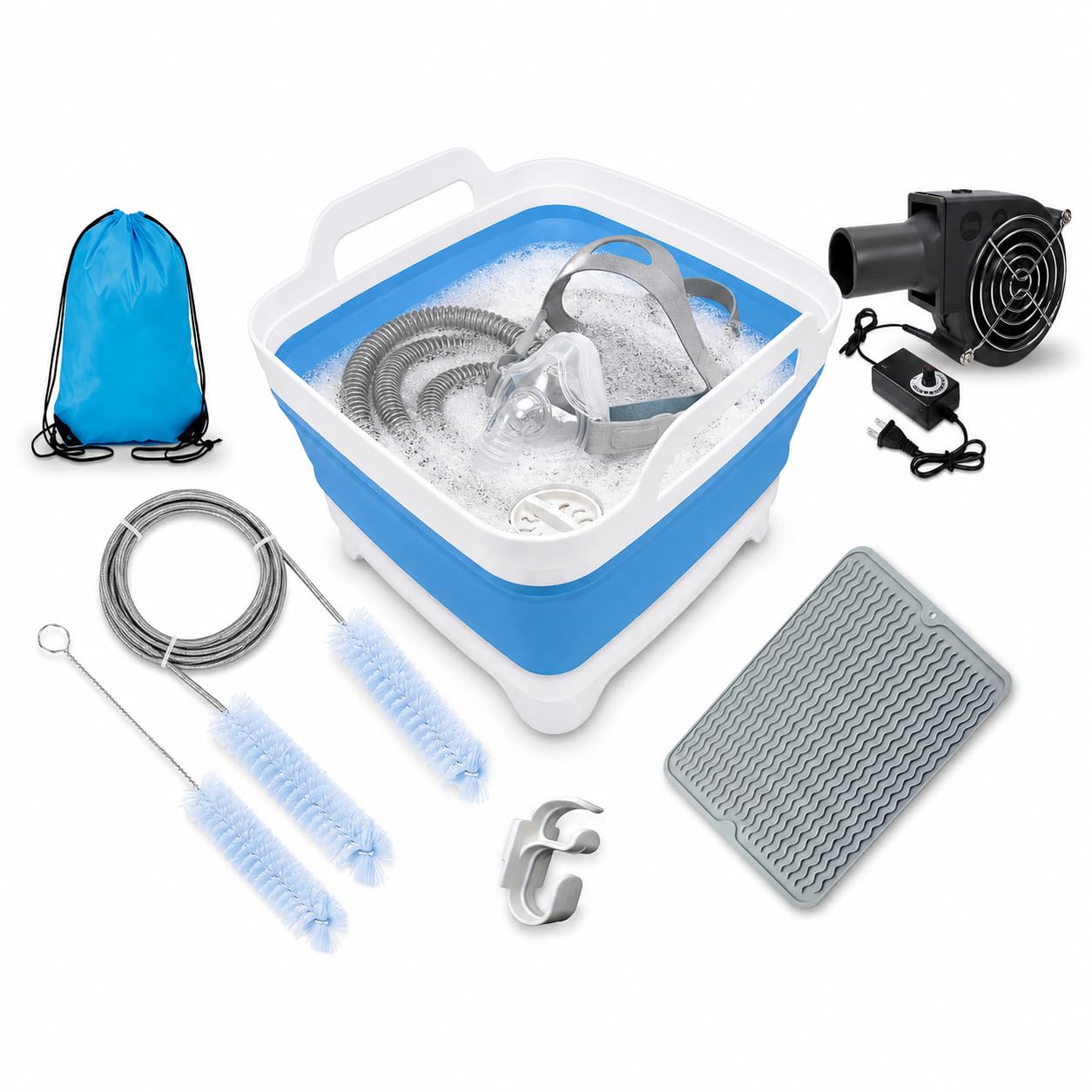
If you are starting from scratch and want everything in one order, this is the kit that delivers it. You get a 9 L collapsible wash basin, a 2.0 m hose brush, a 10-speed hose dryer, a thick silicone drying mat, a hanging hook, a 210D drawstring bag, a Straight Adapter, and a Y Adapter. The basin folds flat once you are done, which matters if you live somewhere with limited counter or closet space. Owners who came from a sink-and-brush routine describe the upgrade as making cleaning a lot less hassle, mostly because there is no scavenging for a separate tub and towel every night.
The dryer side uses room-temperature airflow with ten speeds, and a single standard hose typically finishes in about 30 to 45 minutes once you shake out the excess water. That is a meaningful contrast with the Hurricane above — no heating element here, just moving air, which keeps things simpler and quieter. Fit the Straight Adapter for one hose or the Y Adapter to run two at once, though airflow gets shared and the pair will take longer. The silicone mat is where you lay the mask and small parts to dry while the hose runs, so the whole cycle happens in one place.
Two things to know going in. The included dryer has no built-in timer — you switch the airflow and come back when it is done — though a compatible Timer Controller can be added later with its own 1H, 2H, and 4H auto shut-off. And the kit is a washer-plus-air-dryer, not a sanitizer: no heating element, no ozone, no UV. One buyer’s order arrived with the hose dryer missing and had to be returned, which is worth mentioning as a rare miss, not a pattern. If you want a timer from day one or a powered cleaning cycle, another pick on this list fits better.
Best thing about it: everything needed for wash-to-dry arrives together — basin, brushes, mat, adapters, and bag — so there is no second trip to gather supplies.
The trade-off: the dryer moves room-temperature air only, so it is a wash-and-dry system rather than a sanitizer, and you handle the timer question yourself or add the upgrade.
Great for: a first CPAP cleaning setup where you want the full toolkit in a single order and value a basin that folds away.
Not for: someone who wants automatic shut-off and a heated or powered cleaning cycle from the start.
3. UV Sanitizer Box

A foldable 12 L box that packs into a bag and runs a cycle in 15 minutes.
Portability is the main draw here. This is a sealed box rather than a sink or a tank: it uses UV blue light at a 185nm wavelength (a type of ultraviolet light) to generate ozone (a gas that sanitizes) and runs a fully enclosed cycle in 15 minutes, with a 3-speed timer letting you pick 5, 15, or 30 minutes before it shuts off on its own. It folds down and carries by an adjustable strap, so it works as a travel companion as easily as a bedside unit. There is a viewing window so you can watch the cycle without opening the box — a good thing, since the manufacturer warns against direct eye and skin exposure to the UV light.
The interior is genuinely roomy for something this portable: a 12 L chamber that the maker describes as holding up to 12 bottles at once, plus your mask, towel, or phone. That size is the trait owners single out as the standout. At 3.31 pounds and roughly 12 x 9 x 4 inches packed, it is the smallest item on this list and the only one you would genuinely toss in a carry-on. Owners describe an easy setup and a light, no-fuss routine — load it, run the timer, and it stops by itself.
The honest caveat is around verification. Because this is a sealed ozone box, you cannot see the work happening, and the reviews split on how confident owners feel about the result. One buyer got a cycle that ran clean with no ozone smell and was left uncertain whether the unit was doing anything at all; another reported the opposite, smelling a clear difference after a run. The ozone smell also lingers on the mask if you do not air it out afterward, and the collapsible lid and sides do not seal as solidly as a rigid box. Treat this as a convenient sanitizing and storage box for small items, not a replacement for washing a visibly soiled hose.
What stands out: at 3.31 pounds and a 12 L chamber, it is the only pick here that folds flat and travels — a real advantage over the Hurricane’s 18 x 16 x 15 inch frame for anyone who moves between homes.
The catch to plan around: the cycle is fully enclosed, so the ozone smell stays on your gear until you air it out, and the soft-sided lid does not seal the way a rigid chamber does.
Pick this one for: travel weeks, small parts, and quick 15-minute cycles on a mask or a phone.
Think twice if: you want visible proof of cleaning, a rock-solid seal, or a machine that scrubs a heavily soiled hose.
4. Sani Bot D3 Sleep Gear Cleaning, 3 Liter Tank

An ultrasonic tank that works at the film inside the hose wall, not just what you can see.
Here is the difference between a dryer and a real cleaner. This unit fills a 3 liter tank with water and a cleansing tablet, then uses patented ultrasonic transducers to create millions of microscopic bubbles that scrub away grime at the surface. Where a manual brush only reaches what it can touch, those bubbles reach into layers and crevices — the exact areas a hose brush cannot get to. It arrives with 60 cleansing tablets, so you have months of cycles before you need to restock, and it physically removes the oils and buildup rather than wiping the top layer.
Owners describe the results in flattering terms. The cleaning performance is the trait that draws the most compliments, and the recurring remark is that the gear comes out looking and feeling squeaky clean. For anyone who has ever shined a light down a hose and seen a coating they could not reach, that physical removal is the whole point — a dryer removes moisture, this removes the film. It weighs 6 pounds and measures 17 x 11 x 10 inches, so it is a countertop unit rather than a travel piece.
Two practical considerations before you commit. Unlike the Hurricane above, this machine does not dry at all — you run a cycle, then hang the gear or dry it separately, so the two are complements rather than competitors. And it is a water-based unit, which means emptying and rinsing the tank after each use, plus keeping the tablets stocked. If your routine thrives on one-button simplicity, the UV box is the lighter path. If you want the deepest clean you can measure, this is the pick.
Why it earns its spot: the ultrasonic action reaches into layers and crevices that a brush physically cannot touch, and 60 included tablets mean you are set for a long stretch of cycles.
What to plan for: it cleans but does not dry, and every cycle means filling, emptying, and rinsing a 3 liter tank.
Best fit: owners who want the deepest possible clean and do not mind a water-and-tablet routine.
Wrong choice if: your real problem is slow drying or you want a machine that runs dry and hands-free from a single button.
5. iSonic Ultrasonic CPAP Deep Cleaner (Small) P4821-CPAP, 2.6Qt/2.5L
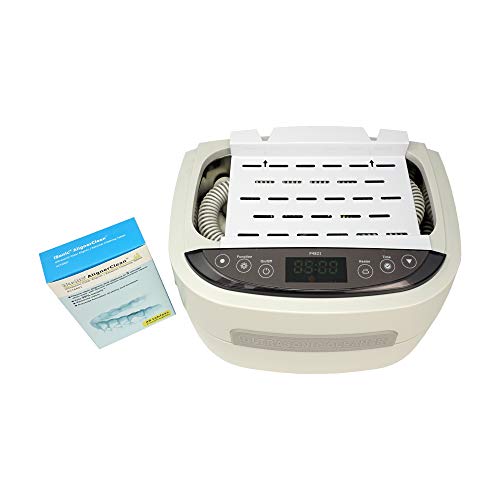
A hard-tank ultrasonic cleaner with real time-and-temperature dials and a 2.5 L basin.
If you want ultrasonic cleaning with more control than a sealed box gives you, this is the balance. It runs a powerful 60W ultrasonic stack transducer (a device that turns electricity into sound waves), and the tank measures 9.6″ x 5.9″ x 3″ — sized to take a short hose and a mask together. The system generates cavitation, which is the technical name for millions of tiny bubbles that implode against surfaces and dislodge debris from inside crevices and the hose. This is the same physical mechanism the Sani Bot above uses, but here you get precise time and temperature controls you set yourself instead of a preset cycle.
The reviews keep coming back to how much surfaces improve. Effectiveness is the trait owners mention most, and the recurring note is that masks and hoses come out completely clean rather than just rinsed. A dental worker who bought it for CPAP gear reported fitting a hose, mask, attachments, and adapter into the tank at once — using distilled water and removing the water tank first, based on other reviews — and described the plastic coming out noticeably shinier than manual cleaning ever managed. It also does double duty: alongside CPAP equipment, owners use it for other small items, which is where it pulls ahead of a dedicated drying unit.
The fit question is the one to weigh honestly. The chamber is a 2.5 L basin, and while most owners find their CPAP equipment fits, a few who expected to fit more have found it tighter than they wanted — one reviewer plainly put it, “The chamber is small.” Masks with large headgear or an unusually long hose may need disassembly or two passes, so check your gear’s dimensions against the 9.6″ x 5.9″ x 3″ tank before ordering. The included tablets carry a minty scent a few find off-putting, though you can simply use a different cleaner. To dry, the maker advises hanging to drip or using a blow dryer on a moderate setting. Weighing the 8-pound build and its controls against the smaller sealed boxes, it is the most capable ultrasonic option at a friendly value.
What you gain: 60W of ultrasonic action with dials for time and temperature, a basin sized for a short hose and mask, and a build quality that holds up over repeat cycles.
Where it asks for care: a 2.5 L chamber can be a squeeze for larger masks or long hoses, and it does not dry — so you still need to hang the gear or blow-dry it afterward.
Suits you if: you want precise control and proven ultrasonic cleaning at a sensible value, and your mask and short hose fit a 2.5 L basin.
Keep looking if: you clean long hoses, oversized headgear, or more than one CPAP setup at a time.
6. iSonic Ultrasonic CPAP Deep Cleaner (Small) P4821-CPAP, 2.6Qt/2.5L
A separate listing of the same iSonic tank — worth knowing so you do not order twice.
Two Amazon listings exist for the same iSonic P4821-CPAP deep cleaner, and since you may land on either while shopping, it belongs on the list. Everything from the entry above carries over: the same 60W ultrasonic stack transducer, the same 2.6 Qt / 2.5 L tank at 9.6″ x 5.9″ x 3″, the same 8-pound build, and the same instruction to hang the hose to drip or blow-dry it on a moderate setting afterward. If you have already decided on the iSonic, either listing gives you the same machine — just check the price and availability on the page you land on.
The review picture is identical as well. Effectiveness earns the strongest praise, with owners consistently reporting that a mask and short hose come out completely clean, and the versatility note holds — it works for denture tablets, small parts, and other items beyond CPAP gear. One buyer whose mask connection had melted reported that the machine ran too hot for their preference, a reminder that this is a heated water tank and not a gentle rinse. Another found the included minty tablets unpleasant and simply switched to a different cleaner, which is an easy fix.
The same sizing caution applies. This is a small tank built for a short hose and a mask, and one buyer whose mask did not fit comfortably called the chamber small. If you run a long hose or large headgear, measure first. Treat this listing as interchangeable with the pick above: same cleaner, same results, worth knowing the two exist so you do not end up ordering a duplicate.
What carries over
- Same 60W ultrasonic action and 2.6 Qt / 2.5 L basin as the entry above
- Fits a short hose and mask together for a complete clean in one run
- Includes a cleaning tablet, with denture tablets as a proven substitute
- Sturdy 8-pound body with precise controls you set manually
What to watch
- It is a second listing of the same machine — easy to order twice by mistake
- The small tank leaves larger masks and long hoses tight on space
- The chamber runs hot, and the supplied tablets have a minty scent some dislike
Choose this listing if: it is the one you found first and the price and availability look right — it is the same reliable iSonic tank.
Before you commit: confirm which iSonic page you are on so you do not end up with two of the same cleaner.
7. Sani Bot D3 Sleep Gear Cleaning, 6 Liter Tank
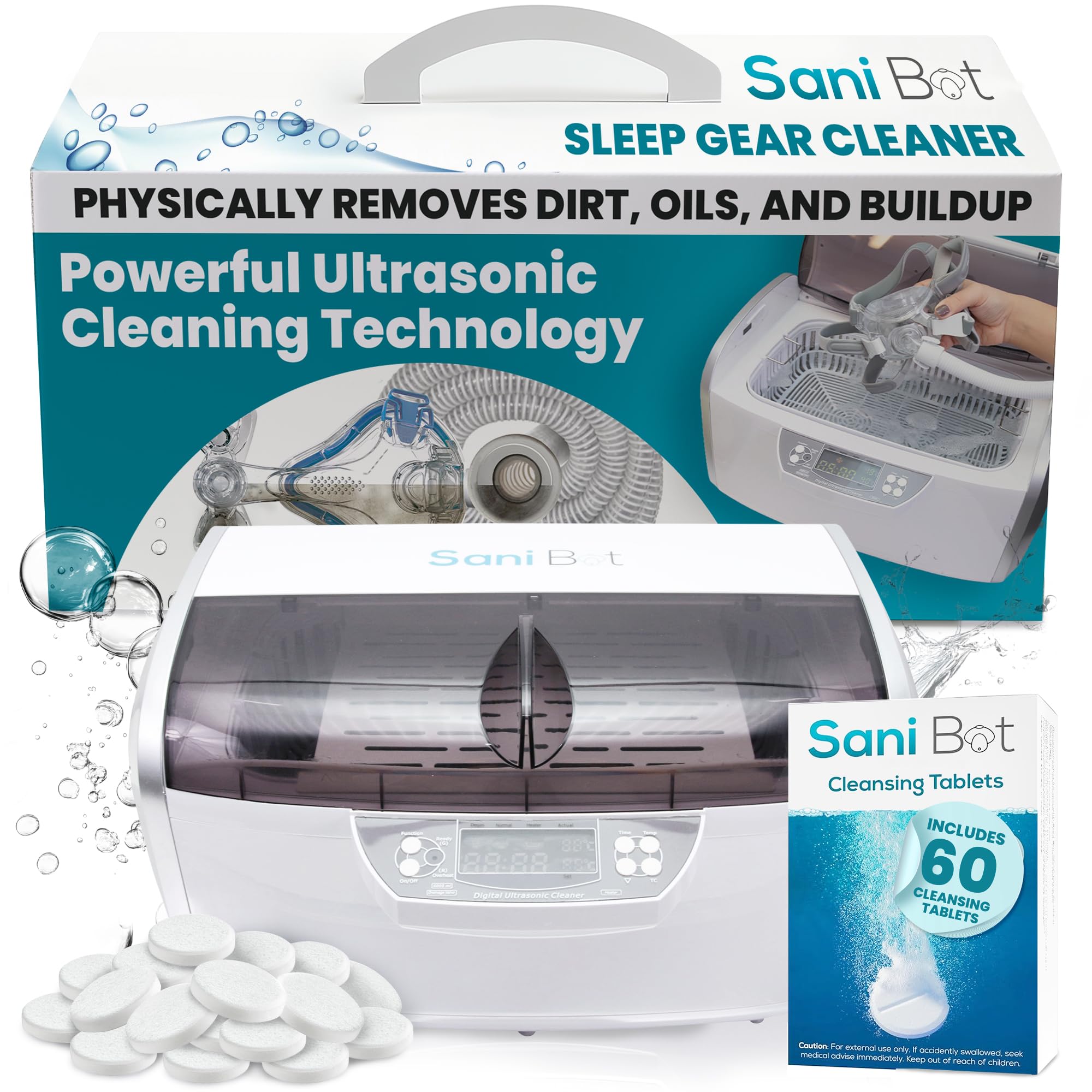
The larger Sani Bot tank — more room for gear, and a bigger footprint to match.
Same technology as the 3 liter Sani Bot, doubled in capacity. This version runs a 6 liter tank that uses ultrasonic action to create microscopic bubbles and scrub away buildup from every layer and crevice, so a mask, hose, and loose parts can go in together instead of in separate batches. It also ships with 60 cleansing tablets. The company’s pitch is the same across both: where a manual wipe only touches surface grime, the ultrasonic transducers physically remove what is caked on. If your cleaning cycle is being cut short because the tank is too small, this is the version to step up to.
Owners describe the routine change warmly. The strong suit is the cleaning itself, and the recurring remark is that masks and hoses come out looking brand new. One reviewer noted the machine requires a bit more work than manual cleaning, but considered a sanitized hose and mask worth the prep, run, and rinse time. Others describe the learning curve as manageable and the payoff as a nightly clean that feels easy once learned. The 6 liter capacity is what separates it from the entry model — fewer cycles, less dividing of parts.
Two considerations before buying. Second, there is owner feedback worth knowing: a buyer who used it for six months reported the submersion plate’s coating bubbling and peeling and got no helpful response from the company, which is a soft spot on the support side; another had trouble registering the warranty. That is not a universal experience, but if flawless support matters to you, weigh it. Like the 3 liter version, this one cleans but does not dry.
Why the larger tank earns its keep: a 6 liter basin lets a mask, hose, and small parts go in together, and 60 tablets come included so you are not restocking right away.
The honest caveats: it is a 16.8-pound, 20.2 x 14 x 12.6 inch machine that needs dedicated space, it does not dry, and a few longer-term owners found support slow when something went wrong.
Made for: households that clean multiple parts at once and want the roomiest ultrasonic tank in the lineup.
Not the right call if: you are short on counter space, want fast support, or need a machine that dries and cleans in one pass.
Know the Specs
Cleaning Tech — Ultrasonic versus UV and Ozone
Ultrasonic cleaners fill a tank with water and fire sound energy through it, creating cavitation — millions of tiny bubbles that implode against surfaces and knock debris loose from inside crevices a brush cannot reach. UV and ozone boxes seal the gear in a chamber while light at a 185nm wavelength generates ozone around it. The difference in daily use: an ultrasonic tank works on visible film and feels like a deep clean, while a sealed box is hands-off and quick but leaves the ozone smell on your gear until you air it out.
Usable Capacity and Dry Time
Capacity is the number to check first, because it decides whether a mask and hose fit in one run. Tanks run from 2.5 L up to 6 L, and small basins can be tight for larger masks and long hoses. Dry time runs separately from cleaning: air drying can take most of a day, while a heated dryer brings a hose back to use in about an hour. No single machine here both cleans and dries, so plan on a cleaner and a dryer as a pair.
Common Questions
Will an ultrasonic cleaner dry my hose as well as clean it?
How big a tank do I need to fit a mask and a hose together?
Do ultrasonic CPAP cleaners take the place of hand washing?
Is ozone from a UV sanitizer box safe to breathe while the machine runs?
Will a heated dryer damage my CPAP hose or mask?
How often do I need to replace cleaning tablets or supplies?
Can a CPAP cleaning machine clean other items too?
What is the difference between the 3 liter and 6 liter Sani Bot?
Should I buy a cleaner, a dryer, or both?
How loud are these machines during a cycle?
The Bottom Line
The standout cpap cleaning machine here is the Hurricane CPAP Equipment Dryer, because drying speed is what keeps a nightly routine alive and its dedicated hose port plus stainless basket make it a one-step finish. Pair it with an ultrasonic tank if the film inside the hose is your real problem — the iSonic P4821-CPAP delivers 60W of cavitation with precise time and temperature dials at a value that is hard to argue with. On a tight budget with limited space, the UV Sanitizer Box still covers small parts and travel in a 15-minute cycle. If you own two CPAP setups or clean for a partner, reach for the 6 liter Sani Bot so everything fits in a single run.
How we choose
We do not accept paid placement. Every pick is matched to a real buyer and a real use-case; we do not hands-on test units.
Sources
Specifications: manufacturer listings and product documentation. Review insights: verified customer reviews, as of October 2026. Pricing: not shown on this page (it changes often); check the current price via the retailer link.
As an Amazon Associate, Aappliancez earns from qualifying purchases. This does not affect which products we feature.