Disclosure: Some links in this post are affiliate links. As an Amazon Associate I earn from qualifying purchases, at no extra cost to you. Learn more
Specs are compiled from manufacturer listings and verified buyer reviews and can change over time — please confirm the key details on the product page before buying.
You want water that tastes clean without hauling plastic jugs home every week. A countertop gravity water filter does exactly that — it sits on your counter, needs no electricity or plumbing, and pushes tap water through a filter using nothing but gravity. The catch nobody tells you up front: every one of these systems is slow, and the bigger the tank, the longer you wait for a refill. So the real question is not which one filters fastest. It is which one fits your kitchen, your family size, and your patience.
This guide is built by comparing the manufacturers’ published specifications and the patterns across verified customer reviews, so you get each pick’s real strengths and trade-offs instead of marketing spin.
Below you will find eleven systems, from compact one-person units to big stainless tanks, each matched to the buyer it actually suits. The best countertop gravity water filter for most households is the one whose tank size, filter life, and footprint line up with how much water you drink each day.
Top Picks


How To Choose The Best Countertop Gravity Water Filter
Start with the number of people drinking from it, not with the filter technology. A 2.25-gallon system and a 6-gallon system both make clean water — but one needs refilling twice a day for a family of four, and the other might last two days.
Match tank capacity to your daily pour
Capacity is listed in gallons or liters and tells you how much filtered water sits ready in the lower chamber. A 2.25-gallon tank (about 8.5 liters) suits one to four people. A 3-gallon tank buys you extra breathing room. A 6-gallon tank is for big households or anyone who fills pet bowls and cooking pots from the same spout.
Remember that the upper chamber and lower chamber share that total. You fill the top, it drips down, and the bottom holds the finished water. When the bottom is full, adding more to the top can overflow — so a visible water-level spigot or sight gauge is a genuinely useful feature, not a gimmick.
Understand what the filter actually removes
Most systems here use carbon filters made from coconut shell, which reduce chlorine, taste, and odor. Some add a hollow-fiber membrane rated at a pore size measured in microns — a micron being one millionth of a meter. Purewell, for example, lists a 0.01-micron membrane. A smaller pore size means finer particles get caught, but it also means slower dripping.
None of these systems lower TDS — total dissolved solids, the minerals that stay dissolved in water. Several listings say so outright. If your goal is removing minerals entirely, that is reverse osmosis territory, not gravity.
Check the certification, not the badge on the box
NSF/ANSI 42 covers aesthetic claims like chlorine, taste, and odor. NSF/ANSI 372 certifies that the wetted materials meet a lead-content standard. They are different certifications doing different jobs, and some systems carry one, some carry both.
Stainless steel construction matters too. A 304 food-grade stainless body resists corrosion and does not hold onto flavors the way plastic can. It also weighs more, which is worth knowing before you plan to move it.
Side-by-Side Comparison
| Model | Best For | Capacity | Body Material | Filter Life | Amazon |
|---|---|---|---|---|---|
| Big Berkey 2.25 Gal with BB9-2 Filters★ Best Overall | All-round household pick | 2.25 gal (8.5 L) | Polished AISI 304 stainless steel | Up to 6,000 gal per filter pair | Amazon |
| AquaEasy NSF/ANSI 372 Stainless SystemHard Water Pick | Hard well water | 2.25 gal | 304 stainless steel | 6 months per set | Amazon |
| CO-Z Gravity-Fed SystemBudget Champion | Tight budgets | 2.25 gal | Food-grade stainless steel | Up to 6,000 gal per filter pair | Amazon |
| Purewell 3-Stage PW-OB | Finer filtration | 2.25 gal | 304 food-grade stainless steel | Up to 6,000 gal per filter pair | Amazon |
| AQUA CREST TN-A-FS | Fluoride reduction | 2.25 gal | 304 food-grade stainless steel | 6,000 gal carbon / 1,000 gal fluoride | Amazon |
| ZENWATER 6-Gallon Alkaline System | Big families | 6 gal | BPA-free plastic | 6–12 months (per owner reports) | Amazon |
| Waterdrop TK-FS King Tank | Low-profile counter fit | 2.25 gal | 304 food-grade stainless steel | 6,000 gal carbon / 1,000 gal fluoride | Amazon |
| Culligan MaxClear | Microplastic and PFAS concerns | 2.25 gal | Brushed or polished stainless steel | Up to 6 months per filter | Amazon |
| Survivor Filter Ultra | Off-grid and travel | 2.25 gal | Stainless steel | — | Amazon |
| British Berkefeld Doulton W9361136 | Small kitchens and RVs | 1.58 gal (6 L) | Ceramic and stainless steel | 6 months | Amazon |
| ProOne Big+ 3-Gallon | Extended filter life | 3 gal | Polished stainless steel | Up to 9 months per filter | Amazon |
Detailed Reviews
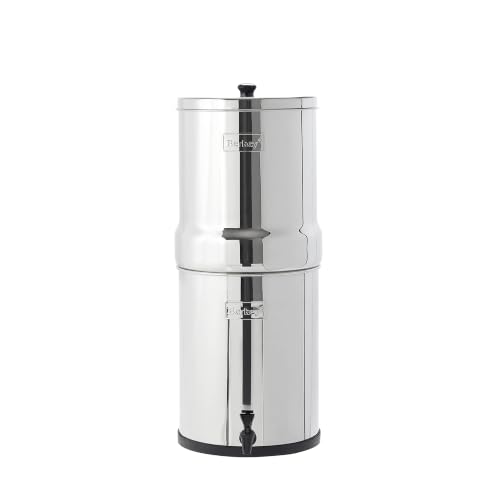
1. Big Berkey 2.25 Gal Gravity Water Filter System
Our pick — 4.5+★ from 4,000+ verified ratings; the strongest balance of quality and price.
The tank that made gravity filtration a household name — and still the safest first buy.
You get a 2.25-gallon system built from polished AISI 304 stainless steel, running two authentic Black Berkey BB9-2 filter elements. If you are new to gravity filters, here is the plain version: you pour tap water into the top chamber, gravity pulls it down through the filter elements, and filtered water collects in the bottom. No electricity, no plumbing, no tools. It is rated for roughly one to four people, which fits a couple or a small family well.
The number that matters most here is filter life. Each pair of filter elements is rated for up to 6,000 gallons of filtered water before replacement — far beyond what a pitcher filter delivers. Buyers report the practical side of that, putting the flow rate at about 1.75 gallons filtered in 2.25 hours, with roughly a quart left behind in the upper chamber. That leftover is normal for gravity systems, not a defect, and it tells you to start a refill before you actually run dry rather than at the moment you need a glass.
What wins people over is the build and the taste — the steel feels substantial in the hand, and the water comes out clean and flavorless. The recurring honest gripe is cost: the system and its replacement filters are a real outlay, and separately sold accessories like a stand add up. Assembly and priming take about an hour the first time. As one long-term user put it, it has run for 1.5 years without a leak.
Where the Berkey earns its reputation
- Up to 6,000 gallons per filter pair — years of use between replacements
- AISI 304 stainless steel body with a 0.03 gpm maximum flow rate
- Zero electricity or plumbing; the upper chamber nests inside the lower for storage
- Owners mention the steel stays leak-free long past the first few months
The part that stings
- Replacement filter pairs and a stand are sold separately
- First-time priming can take an hour and a bit of patience
- At 19.25 inches tall when assembled, it needs real counter headroom
Buy this one if: you want the most trusted name in gravity filtration and can absorb the cost of filters once every few years.
Look elsewhere if: you want a stand included and a smaller starting outlay — the Purewell and Waterdrop both bundle a stand.
2. AquaEasy Stainless Steel Gravity Water Filter System
Comes from the start with everything — stand, spigot, two filters, no extras to buy.
If you have well water, the AquaEasy is the one worth a hard look. It holds 2.25 gallons (about 8.5 liters) and pushes it through two coconut shell activated carbon filters (carbon made from coconut shells that traps taste and odor). It also arrives ready to run: top and bottom chambers, both filters, a stainless steel spigot, a wooden stand, blocking plugs, and a lid with knob. You buy nothing else before your first pour.
Its footprint is where it separates itself from the big Berkey. The AquaEasy measures 8″L x 8″W x 20″H against the Berkey’s 8.5″L x 8.5″W x 19.25″H — a slightly narrower, slightly taller column that tucks into a tighter corner of the counter. The body is food-grade 304 stainless with a matte black finish, and it carries NSF/ANSI 372 certification, which relates to lead content in the wetted materials. Each filter set is rated to purify up to 6,000 liters.
Customers note it simply works: filling cups and containers is a breeze, assembly is quick, and households on hard well water are delighted with the taste. The honest trade-off is flow over time. As one owner put it, “We have had it two months and now the water won’t completely drain from the upper chamber.” A slow or stalled drain usually means a filter needs cleaning or replacing, but it is the one thing to watch. Also budget for replacement filters on a 6-month cycle.
The well-water verdict: a complete kit with a stand and spigot at a far friendlier entry than the flagship brands, certified for material safety, and pointed squarely at homes with hard or mineral-heavy water.
Before you commit: the 1.2-liter-per-hour maximum flow rate is on the slow side, so plan refills ahead — and if the upper chamber stops draining fully, clean or swap the filters rather than assuming the unit is broken.
Reach for this if: you are filtering hard well water and want a stand and spigot in the box from day one.
Pass if: you want the fastest pour available — this is a patient system, not a fast one.
3. CO-Z Gravity-Fed Water Filter System, 2.25 Gallons
The cheapest way into gravity filtration — with a slow drip you have to plan around.
Here is the entry point. The CO-Z holds 2.25 gallons, runs two coconut shell activated carbon filters, and carries NSF/ANSI 42 certification — the standard covering chlorine, taste, and odor reduction. The maker rates it to reduce chlorine by over 99% and says the two included filters can handle up to 6,000 gallons total. It is a stackable design with a stainless steel spigot, built for a family of four on paper.
The trade-off is speed, and it is the recurring theme. Owners describe the flow as very slow, with some reporting roughly a drop per second even after priming. One buyer found the included filters were likely defective and swapped in replacements from another company, after which the system behaved normally. That is worth knowing: if your CO-Z crawls from the first fill, suspect the filter rather than the tank.
What people do like is the value and the build for the tier — easy assembly, a stable footprint, no leaking on the countertop, and water that tastes noticeably better than a pitcher filter. One owner notes you should run a couple of full cycles through it before drinking. Taste feedback does split, so if you are coming from a reverse osmosis system, set expectations accordingly.
What you are really buying: a functional stainless gravity tank at the lowest entry in this group, with certification on the chlorine-reduction claim and a spare filter included.
The honest catch: filtration speed is the weakest point here, and taste results vary by household — this is a starter system, not a finale.
Worth it when: you want to try gravity filtration without committing flagship money, and you can live with a slow drip.
Skip when: you have a big family filling glasses back to back — the drip rate will frustrate you.
4. Purewell 3-Stage Gravity Water Filter System

A 0.01-micron membrane that catches what carbon-only filters let through.
The headline here is pore size. Purewell’s 3-stage composite filter pairs a 0.01-micron hollow fiber UF membrane with a silver ion membrane and an activated carbon block. A micron is one millionth of a meter, so 0.01 microns is a very fine mesh — the maker points out that many rival filters sit at 0.2 microns, which is a coarser catch. It carries both NSF/ANSI 42 and NSF/ANSI 372 certification, and the maker claims a 4 gallon/hour flow rate despite the tighter mesh.
You get the full kit: upper and lower chambers, stainless steel spigot, two carbon filters, and a non-slip stand. The body is 304 food-grade stainless, the unit stands 20 inches tall, and it weighs 8.5 pounds dry. Each filter element is rated for 3,000 gallons, with the pair covering 6,000 gallons total, though Purewell recommends swapping them every 6 months for best performance. Like every gravity system here, it does not lower TDS.
Owners consistently point to two things: the water tastes clean and the stainless looks good on the counter. The practical patience requirement is real — one buyer timed roughly 1.5 to 2 hours for a full 2.25-gallon batch. A recurring nitpick is that the polished steel hides the water level and shows fingerprints, so trust the float rather than eyeballing. The filter priming takes some doing on the first setup.
Why the spec sheet stands out
- 0.01-micron hollow fiber membrane — finer than the 0.2-micron filters many rivals list
- Dual NSF/ANSI 42 and 372 certification
- Stand, metal spigot, and silicone mat all included
- 3000 gallons per filter element, 6000 gallons for the pair
Where it asks for patience
- A full batch takes roughly 1.5 to 2 hours to filter through
- The polished body hides the water level and picks up fingerprints
- Overfilling the top chamber risks a leak — watch the float
Pick this if: fine particle removal is your priority and you want certification on both the carbon and the material side.
Think twice if: you need a fast pour for a busy kitchen — the tighter membrane trades speed for accuracy.
5. AQUA CREST TN-A-FS Gravity Water Filter System
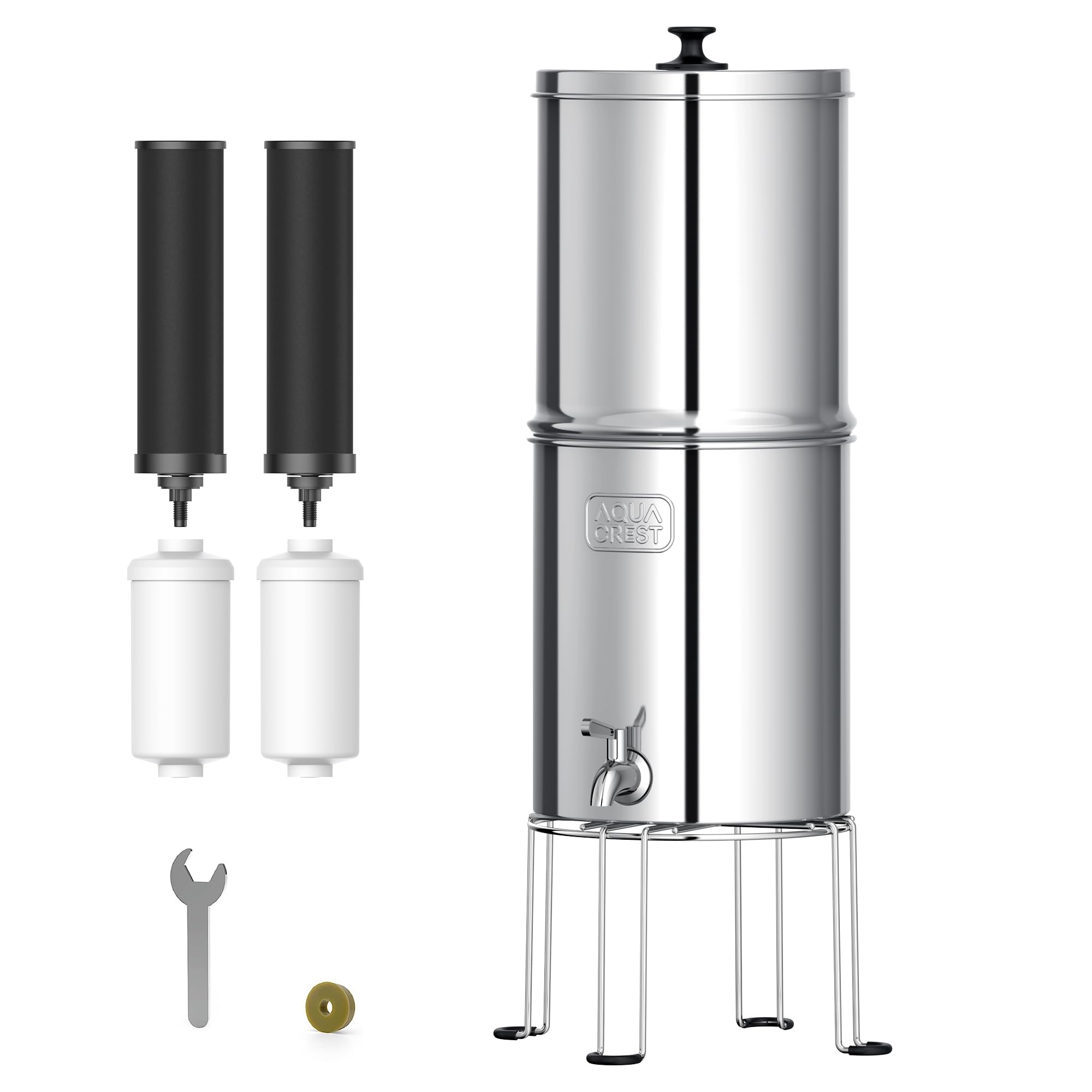
One of the few systems here that ships with fluoride filters in the box.
Most gravity tanks in this group stop at chlorine and sediment. The AQUA CREST goes further: it includes two white fluoride filters alongside two black carbon filters, and the carbon stage is certified to NSF/ANSI 42. The maker claims up to 99% chlorine reduction, tested by a third-party lab, and states plainly that the system cannot reduce TDS. The fluoride filters are rated for 1,000 gallons; the carbon pair for 6,000.
It arrives with four filters, a non-slip stand, a stainless steel spigot, and a manual — a genuinely complete package. The body is 304 food-grade stainless, measuring 9.98″D x 9.98″W x 17″H, which makes it one of the shorter tanks in the lineup. There is a one-year manufacturer warranty on the system, which is a nice piece of mind for a countertop appliance.
The honest split is on taste. Some households call it great; others describe an earthy, charcoal-like flavor rather than the spring-water taste they wanted, and one notes the system seems to start filtering well only after it has processed about 1.5 gallons. Assembly gets consistent praise — easy to put together, no leakage, fits neatly in a kitchen. It is a reasonable fit for a camper or a small household, less so if you are chasing bottled-water flavor.
The fluoride argument: four filters in the box, an NSF/ANSI 42 carbon stage, a one-year warranty, and a shorter 17-inch profile that slips under more cabinets than most.
What to weigh: taste is divisive, so if you are picky about flavor, order with a return window in mind.
Choose it for: fluoride reduction and a compact stainless build without buying extra filters.
Not for you if: you want spring-water sweetness from the first glass — expect an earthy note.
6. ZENWATER 6-Gallon Countertop Gravity Water Filter System

Six gallons of storage so you can fill the dog bowl and the pasta pot without waiting.
Capacity is the whole story. The ZENWATER holds 6 gallons — far more than any 2.25-gallon tank here — which means you fill the top a lot less often. It uses a ceramic dome filter plus a multi-stage cartridge and mineral stones, and it claims to add micro-nutrients while removing bacteria, chlorine, and impurities. The body is BPA-free plastic rather than stainless, which keeps the weight to 8.3 pounds even at this size.
There is a real method to living with it. Expect a slow drip — owner reports put it at roughly 1.5 drops per second, with the first filtering taking four to five hours and later batches two to four. The trick is to scrub the ceramic dome aggressively during setup; a dome that is not scrubbed enough blocks the flow. Several owners skip the mineral stones entirely because they prefer the taste without them.
What people love is the taste and the everyday convenience of a bottom tank that rarely empties. The honest caveats are setup friction and the occasional leak, most often traced to a gasket or an over-tightened dome rather than a broken unit. Filters are reported to last 6 to 12 months, which is far longer than a pitcher cartridge cycle.
The capacity case: 6 gallons of ready water from a BPA-free plastic body that stays manageable to move, with a 1 gpm maximum flow rate.
The setup warning: the ceramic dome needs a proper scrub before first use, and any drip from the spout usually means reseating a gasket.
This suits: big households and pet owners who want to fill once and forget for a while.
This does not suit: anyone who wants stainless steel construction — this one is plastic.
7. Waterdrop TK-FS Gravity Water Filter System
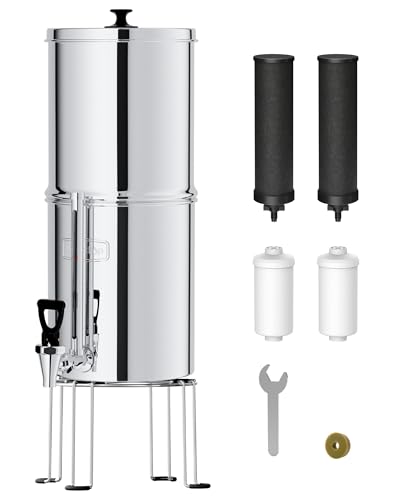
A water-level window on the spout — the fix for the one complaint every gravity owner shares.
The single most useful feature here is the metal spigot with a visible water-level indicator. On most systems you have to lift the lid and guess; here you can see how much filtered water is left without touching anything. It holds 2.25 gallons, runs coconut-shell carbon filters rated to reduce chlorine by up to 98% (third-party tested), and carries both NSF/ANSI 372 and NSF/ANSI 42 certification on the carbon stage.
Where it beats the flagship: the Waterdrop stands 14.4 inches tall against the Berkey’s 19.25 inches, so it slides under a cabinet where the taller brands will not. The body is 304 food-grade stainless with a stand included. Filters cover 6,000 gallons of carbon and 1,000 gallons of fluoride. Owners who upgraded from an older Berkey frequently note the Waterdrop’s steel feels nicer and its spigot is better designed.
The honest note is overfilling. When the bottom chamber fills while the top is still loaded, water can escape — the fix is to stop a quart short and mark your refill line on the sight gauge. Filter longevity has been a rare snag for a few owners who found mold after washing, and customer service handled those with same-day replacements. Otherwise this one quietly does its job.
What makes it livable
- Visible water-level spigot — check your supply without lifting the lid
- 14.4 inches tall, well under cabinet overhangs
- Dual NSF/ANSI 42 and 372 certification, stand included
- 6000 gallons of carbon filtration and 1000 gallons of fluoride per set
Where to be careful
- Overfilling the top chamber can cause a leak around the rim
- Filters need a soak and a full flush before first use
- No sight glass for the upper chamber, only the lower
Reach for this one if: cabinet clearance is tight and you want to see your water level at a glance.
Leave it if: you want a single fixed filter set with no soak-in ritual — this insists on proper priming.
8. Culligan MaxClear Gravity Water Filter System
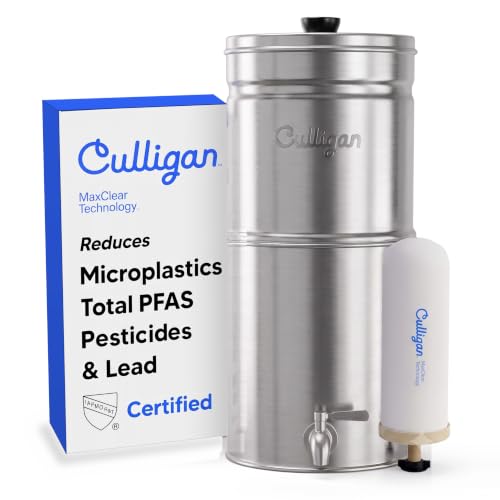
The only tank here certified to reduce microplastics and total PFAS — at a longer wait per glass.
If forever chemicals are why you are shopping, this is the listing to read closely. Culligan states the MaxClear is the only gravity filter system certified to NSF/ANSI 42 standards to reduce microplastics, lead, and Total PFAS. For context, PFAS are the synthetic chemicals often called forever chemicals because they persist in the environment. The filter pairs a ceramic shell with proprietary carbon media and is rated for up to 6 months per filter.
The design is clever for small kitchens. The stainless body stands 26 inches tall assembled but nests under 12 inches when you are not using it, so it disappears into a cabinet. A brushed or polished stainless finish, an ergonomic spigot, and a sturdy stand are all included. It holds 2.25 gallons and the maker notes you can add up to two filters for faster and longer-lasting output — worth doing if you find the drip rate too slow.
Owners who come from hard or smelly tap water are enthusiastic: the system turns orange well water clear, and overfilling is the only way it leaks. The recurring caveat is real, though. Filtered water left standing in the bottom basin for days without cleaning can develop a smell. This system rewards a regular rinse routine, not a set-and-forget habit.
The certification argument: a ceramic and carbon combo certified for microplastics, lead, and Total PFAS, with a nesting design that saves counter space.
Where it asks discipline: standing water develops odor if left too long, so plan to clean the basin on a schedule.
Best matched to: buyers whose tap water has a known PFAS or microplastic concern and who want certified coverage.
Consider another if: you refill infrequently and would rather not clean the basin on a routine.
9. Survivor Filter Ultra Gravity Water Filter System

Ceramic filtration with a lifetime warranty and a body you can carry anywhere.
Survivor Filter takes a different approach from the carbon-block crowd. This system uses two Ultra Ceramic filters that the maker says remove bacteria, viruses, and parasites while leaving minerals intact. The filters are compatible with Big Berkey, so you are not locked into one parts source. It carries a lifetime warranty covering manufacturing defects, and the stainless body weighs 6 pounds, making it the lightest stainless 2.25-gallon unit here.
At 9″L x 9″W x 19″H, it takes a slightly smaller counter footprint than the Berkey’s 8.5″L x 8.5″W x 19.25″H. That extra height on the Survivor buys you nothing in capacity — it is the same 2.25 gallons — but the wider base makes it feel stable when you are pouring. The unit is listed as heavy duty, leak proof, and portable, and owners confirm it travels well, including on RV trips.
The ceramic filters are slow to start — patience is the price of admission, and a couple of owners note the first few batches crawl before settling in. The other honest gap: there is no water-level indicator, so you have to lift the lid and peer into the reflective stainless to gauge your supply. Owners generally find the trade worth it for the taste and the portability.
The survivalist’s shortlist
- Ceramic filters claim removal of bacteria, viruses, and parasites
- Lifetime warranty from a North American company
- 6 pounds — the lightest stainless 2.25-gallon tank in this group
- Filters are compatible with Big Berkey, so parts stay available
The trade you make
- No water-level gauge — you lift the lid to check supply
- The stand is not included
- Ceramic filters start slow and need patience to break in
Built for: campers, RV owners, and anyone who wants ceramic filtration plus a lifetime warranty.
Not ideal for: someone who wants to glance at a sight glass — this one makes you look inside.
10. British Berkefeld Doulton W9361136 Countertop Water Filter System
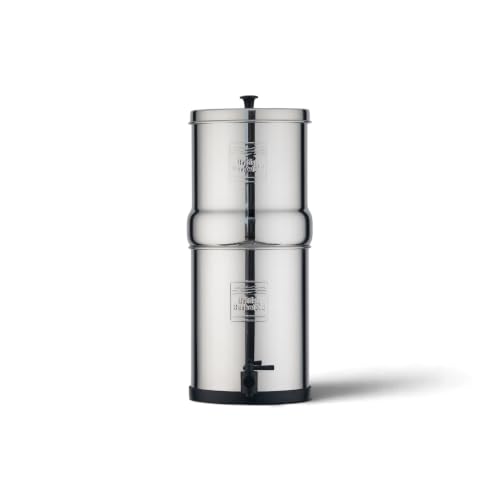
A small-footprint ceramic classic built for kitchens, offices, and RVs.
Doulton has been making ceramic filters for a very long time, and this model reflects that heritage. The body pairs ceramic filter elements with a stainless steel dispenser, and the maker says it reduces bacteria, chlorine, sediment, and heavy metals. Replacement filters run on a 6-month cycle.
Where this one shines is taste and portability. It eliminates the musty, municipal-water flavor that drove several owners to it in the first place, and it has traveled on two-month RV trips without a hiccup. The stainless dispenser is durable, easy to refill, and simple to clean. A plastic spout comes standard and several owners replace it with a stainless one; a couple also add a metal sight glass to solve the level-checking problem.
The trade-off is capacity — 1.58 gallons empties fast for a family — and a leak risk if you overfill past the weep hole. Value is a genuine mixed bag: some buyers feel the build justifies the price, others think it is steep for the volume. For a small kitchen, a camper, or an office, the trade is easy to justify.
The compact case: a 1.58-gallon, 12.79-inch-tall ceramic system from one of the oldest names in the game, easy to clean and easy to move.
What to accept: less water per fill than nearly every other pick, so plan on topping it up more often.
The right buy for: small households, RVs, and offices where counter space is short.
Skip this if: you need a big tank — this one runs out quickly for a family of four.
11. ProOne Big+ Gravity Water Filter System

Three gallons and up to nine months per filter — the fewest swaps on this list.
Filter longevity is the pitch. Each ProOne G2.0 filter is rated to last up to 9 months with regular daily use, and filters are infused with silver to help prevent contaminant growth. The G2.0 series carries NSF/ANSI-42 certification. The Big+ itself is a 3-gallon stainless system, the largest steel tank in this group outside the ZENWATER, and it ships with two 7-inch filters, a stainless steel spigot, a stand, and a mat.
It leaves beneficial minerals like calcium in the water, which is why the taste is a recurring strength — owners describe it as simply cleaner and easier to drink. Setup is quick and the polished stainless looks good on a counter or in an RV. Because it needs no electricity, it also doubles as emergency water capability.
Speed is the honest trade here. At roughly a drop per second per filter, filling 3 gallons takes hours, and owners commonly order a second filter to cut the wait. Quality control has been hit-or-miss on a small number of units — one arrived with tool marks and a rough spigot cutout, though the seller refunded promptly. If you plan on a busy kitchen, buy the two-filter configuration from the start.
Why it wins on upkeep
- Up to 9 months per filter — the longest replacement cycle in this lineup
- 3-gallon capacity in polished stainless steel
- Silver-infused filters to deter contaminant growth
- No electricity; works during weather-driven outages
Why patience is required
- Roughly one drop per second per filter means multi-hour waits
- A second filter is nearly essential for larger households
- Occasional units have arrived cosmetically rough
Worth choosing when: you want the least filter maintenance and the largest stainless tank in this group.
Think again if: you cannot tolerate a slow drip — pair it with a second filter or look at the faster-flowing picks.
Know the Specs
Capacity (Gallons and Liters)
Capacity tells you how much filtered water sits ready in the lower chamber. For one to four people, a 2.25-gallon tank (about 8.5 liters) is the standard. A 3-gallon tank gives a bit more breathing room. A 6-gallon tank suits big households, or anyone filling pet bowls and cooking pots from the same spout. Remember the total is split between the upper fill chamber and the lower storage chamber, so the drinking water on hand is always less than the box number.
Filter Pore Size (Microns)
Filter Pore Size (Microns)
A micron is one millionth of a meter. When a listing says 0.01 microns, it means the membrane catches particles that fine — finer than the 0.2-micron filters many rivals list. Smaller pores catch more, but they also slow the drip. That is the trade every gravity filter makes: accuracy against speed.
NSF/ANSI 42 vs 372
NSF/ANSI 42 covers aesthetic claims — chlorine, taste, and odor reduction. NSF/ANSI 372 certifies that the materials touching your water meet a lead-content standard. They do different jobs, and a system may carry one, both, or neither. Read which certification is on which component, not just on the box.
Flow Rate and Refill Timing
Flow rate is listed in gallons per hour, liters per hour, or gallons per minute. It tells you how long a full batch takes. A system rated at 1.2 liters per hour will need patience; one rated at 4 gallons per hour moves noticeably quicker. The practical habit is to fill the top chamber at night so you have filtered water by morning.
TDS and What Gravity Cannot Do
TDS stands for total dissolved solids — the minerals that stay dissolved in water. Several listings here state plainly that their filters do not lower TDS. If your goal is stripping minerals out entirely, you need reverse osmosis, not gravity. Gravity carbon and ceramic filters target chlorine, sediment, heavy metals, and in some cases fluoride.
Body Material: Stainless vs Plastic
304 food-grade stainless steel resists corrosion and does not hold onto flavors the way plastic can, but it makes the unit heavier. A BPA-free plastic body like the ZENWATER’s is lighter and cheaper to move, but some buyers prefer steel for taste neutrality. Weigh the material against how often you plan to relocate the tank.
Common Questions
Do countertop gravity water filters need electricity or plumbing?
How often do I need to replace the filters?
Will a gravity filter remove fluoride from my water?
Why does my gravity filter drip so slowly?
Do these systems lower TDS like a reverse osmosis filter?
What is the difference between NSF/ANSI 42 and NSF/ANSI 372?
Can I use Berkey filters in a different brand of gravity system?
How much counter space does a gravity filter take up?
Is standing filtered water in the tank safe to drink after a few days?
Can I take a gravity water filter camping or in an RV?
The Bottom Line
For most households, the countertop gravity water filter that earns the top spot is the Big Berkey 2.25 Gal. It pairs a polished AISI 304 stainless body with two authentic BB9-2 filter elements rated for up to 6,000 gallons — the longest proven track record in this lineup. If tighter filtration is what you are after, the Purewell 3-Stage drops to a 0.01-micron membrane (a pore size that catches the smallest particles) with dual NSF certification (a third-party safety standard). And for a family that empties the tank daily, the ZENWATER 6-Gallon holds more than twice the water of the standard 2.25-gallon picks.
Two more worth flagging. If PFAS or microplastics are your specific worry (PFAS are long-lasting man-made chemicals; microplastics are tiny plastic bits), the Culligan MaxClear is the only system here certified for both. If cabinet height is tight, the Waterdrop TK-FS at 14.4 inches tall, with a visible level spigot, fits where the tall tanks will not. Whichever you choose, plan on filling it at night — gravity is patient, and so should you be.
How we choose
We do not accept paid placement. Every pick is matched to a real buyer and a real use-case; we do not hands-on test units.
Sources
Specifications: manufacturer listings and product documentation. Review insights: verified customer reviews, as of October 2026. Pricing: not shown on this page (it changes often); check the current price via the retailer link.
As an Amazon Associate, Aappliancez earns from qualifying purchases. This does not affect which products we feature.