Disclosure: Some links in this post are affiliate links. As an Amazon Associate I earn from qualifying purchases, at no extra cost to you. Learn more
Specs are compiled from manufacturer listings and verified buyer reviews and can change over time — please confirm the key details on the product page before buying.
If your sofa still looks fine but you sink into it every time you sit down, you do not need a new couch. You need the right couch cushions — either a firm support board under the seat cushions or fresh foam inside the covers. That single test splits the six picks below into two groups: boards and foam.
This guide is built by comparing the manufacturers’ published specifications and the patterns across verified customer reviews, so you get each pick’s real strengths and trade-offs instead of marketing spin.
The quick version: a sagging frame or tired springs call for a rigid board, while flattened seat foam calls for a replacement slab you trim to fit. Below you will find the specs that actually decide which one works in your living room, plus the best couch cushions for each job.
Top Picks

How To Choose The Best Couch Cushions
Start by pressing down hard on a seat cushion with one hand. If it springs back but the whole cushion drops toward the frame, the foam is fine and the base is the problem — you want a rigid support board. If the foam itself stays squashed or feels crunchy, no board will save it and you need replacement foam instead.
Board Versus Foam: Match The Fix To The Failure
A support board is a thin sheet that sits on the sofa frame beneath your existing cushions. It works because it gives the cushion something solid to rest on, which is why plywood thickness matters — the firmer the sheet, the less the seat dips. Replacement foam is the opposite approach: you pull the old slab out of the cover and slide a new one in.
Measure The Inside, Not The Outside
For a board, run a tape from the inside of the left arm to the inside of the right arm. For foam, measure the cover itself, seam to seam, and expect a small amount of trim work. Every foam slab here arrives vacuum-compressed, and all of them need time to puff back up, so plan the job a few days ahead.
Firmness Is A Preference, Not A Grade
Plush foam is what you want if the couch is too hard. Medium firmness suits most living-room seats. Extra-firm slabs go under heavy use or into covers that have stretched out. Decide what you want the seat to feel like before you compare thickness, because a thicker soft slab and a thinner firm slab can land in the same place.
Side-by-Side Comparison
| Model | Best For | Type | Size | Firmness | Amazon |
|---|---|---|---|---|---|
| GORILLA GRIP Support Board★ Best Overall | Sagging springs and frames | Plywood support board | 78 in long, 21.5 in wide,.43 in thick | Rigid | Amazon |
| Frienda 4-Piece Foam SetMost Pieces Per Order | Replacing several covers at once | High density foam slabs | 24 x 24 x 5 in, four pieces | Plush | Amazon |
| FoamRush Gel Memory Foam | Bench and chair seats | Gel memory foam over support foam | 27 x 24 x 7 in | Medium | Amazon |
| POYNUC CertiPUR-US Slab | Floor sleeping and hard mattresses | Dual-density memory foam | 72 x 24 in, 4 in thick | Deep comfort, dual layer | Amazon |
| HOMBYS Shredded Foam Back Cushions | Collapsed back cushions | Shredded foam back pillows | 31 x 18 in, three packs | Medium | Amazon |
| Upholstery Foam Gel Pad | Softening a too-firm couch | Gel memory foam over support layer | 72 x 24 x 6 in | Firm with a soft memory top | Amazon |
Detailed Reviews
1. GORILLA GRIP Couch Cushion Support Board 24×78
Our pick — 4.5+★ from 4,500+ verified ratings; the strongest balance of quality and price.
The firmest cure for a couch that swallows you whole — a plywood board you slide under the cushions.
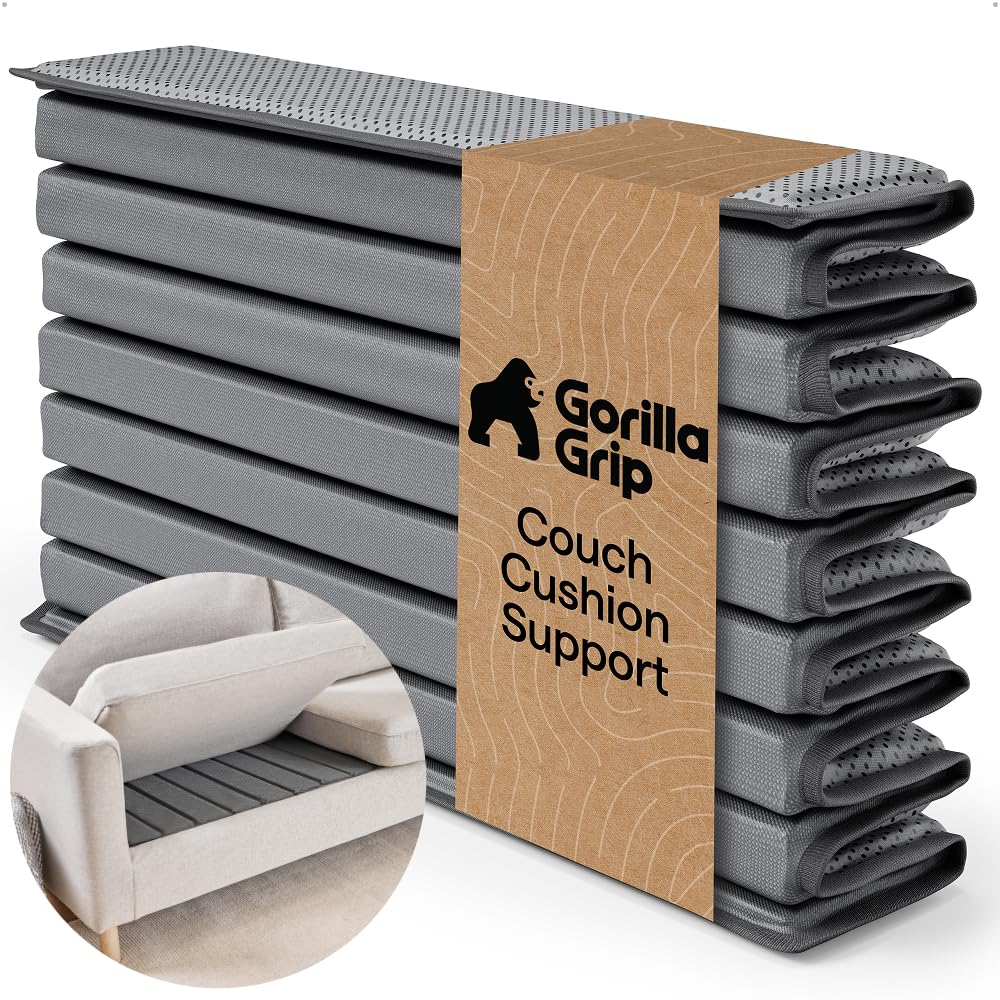
This is the pick for the couch that still looks acceptable but has lost its base. The board is solid plywood at.43 inches thick and takes up to 400 pounds of load, so the cushion above it stops dipping toward the frame. It measures 78 inches long and 21.5 inches wide, which makes it a fit for a standard sofa measured arm to arm.
What wins people over is how invisible the fix is. You lift the cushions, unfold the board, and lay it across the frame with its grip dots facing down — hundreds of PVC dots (small rubbery bumps) that bite into the sofa and keep the sheet from creeping during daily use. The rounded corners reduce the chance of the cover tearing. Total install time is closer to a minute than an afternoon, and no tools are involved.
The honest catch is orientation. Plywood is far more rigid than the MDF or particle board used in cheaper sagging-sofa boards, and that same rigidity means this is not the right product for foam that has already broken down. If the cushion itself is crunchy or flat, a board only props up a dead slab. Do the hand-press test first: a cushion that springs back wants this board, a cushion that stays squashed wants replacement foam.
Where It Earns Its Keep
- Solid plywood at.43 in thick carries up to 400 pounds, so heavy sitters get a base that will not bow.
- Grip dots on the underside stop the board sliding out of position when you get up and down.
- Folds and stacks, so the same board can be trimmed down for loveseats and smaller couches.
- No assembly, no tools — unfold and drop it in.
Where It Stops
- Does not rebuild a cushion whose foam has already collapsed.
- Sits at 78 inches, so very large sofas and sectionals need a careful measurement first.
Right call if: your sofa has weak springs or a tired frame and the cushions themselves still feel like cushions.
Think twice if: the foam inside the covers is crumbling — that is a foam swap, not a board job.
2. Frienda Upholstery Foam Cushion 24 x 24 x 5 Inch
Four five-inch slabs in one box — enough to refill a whole sofa instead of one guilty seat.
If several covers on the same couch have gone flat, buying one slab at a time gets expensive and slow. This box ships four pieces, each 24 by 24 inches and 5 inches thick, so a three-seat sofa plus one spare is covered in a single order. That is four times the slab count of the FoamRush pick below, which arrives as a single piece.
The foam is described as plush and high density at the same time, and it is meant to be trimmed. You can slice it to fit a cover, or cut smaller pieces for dining chairs, a boat seat, or a craft project. It is vacuum-packed on arrival, so give it 2-3 days out of the bag to reach full thickness before you judge the fit — measuring a still-compressed slab is how people end up cutting too small.
The trade-off is that this foam is soft, not firm. Seats that need a plush feel and a bit of give do well here; a heavy sitter who wants a rigid base will find it too yielding. Sizing also deserves a tape measure rather than an assumption, because at least one reviewer noted a slab landing closer to 23 inches than the listed 24 — buyers report, bluntly, “23×23 these are not 24×24.” Order with a little slack in your plan, not a hairline fit.
What the foam feels like: plush rather than structural — the 5-inch thickness gives a soft, cloud-like seat rather than a firm platform.
The practical angle: 6.08 kg for four slabs, so the whole set is manageable to move around one piece at a time while you fit covers.
Built for: the household replacing multiple flat seat cushions at once, or a crafter who wants raw foam to cut down.
Not the pick for: anyone chasing a rock-hard seat or an exact untrimmed 24-inch fit.
3. FoamRush 7″ x 24″ x 27″ Gel Memory Foam Bench Cushion

Seven inches of gel-topped foam for a bench or chair that needs a serious new seat.
The number that decides this one is the thickness: 7 inches, which is 16.3 times the.43-inch profile of the GORILLA GRIP board above. The board is a rigid sheet and this is a full seat slab, so the comparison only shows where each one belongs. This is what you reach for when a bench, chair, or window seat has lost its padding entirely rather than sagged.
The build is a layer of ventilated gel memory foam bonded to a layer of high density support foam, tuned to a medium feel. The ventilated gel layer is designed to pull heat away from the seat during long sits. All the foam is CertiPUR-US certified, and it is cut to order and made in the USA. At 2.32 kg it slides in and out of a cover without a fight.
Two things to plan for. It arrives rolled and compressed, and the maker asks for up to 3 to 4 days for it to expand to full size — so do not cut it on day one. Second, it is a single piece at 27 by 24 inches, so it fits one seat, not four. The upside is that this is a slab you can slice with a serrated knife or an electric knife to fit an awkward cover. Owners mention the biggest win plainly: “I like the fact that by purchasing these foam cushions it saved me a lot of money versus buying a new couch.”
Where the money sits: a gel memory layer on an inner-sprung couch whose coils have given up is the exact failure this slab is built to answer — it replaces the worn foam so the springs stop doing the work alone.
Best match for: bench seats, window seats, and single chairs that need a medium-firm fresh seat rather than a whole-sofa refill.
One caveat to plan around: the 3-4 day expansion window means this is a weekend-project purchase, not an instant fix.
4. POYNUC Couch Cushion Replacement 72″L×24″W×4″

A long roll of layered memory foam that can soften a hard mattress or rebuild a tired sofa run.
Two layers do the work here. On top sits 2.5 Lb density slow-rebound memory foam that molds to your shape; underneath is 1.87 Lb density high-resilience support sponge that stops you sinking through. The maker claims the two-layer build lasts 3x longer than a single-layer slab, but that figure is unverified. Both layers are CertiPUR-US certified.
The size is the other headline act. The slab runs 72 inches long by 24 inches wide, which is three times the length of the Frienda’s 24-inch square, so it covers a full sofa run in one piece rather than in segments. This particular listing is the 4-inch version, the thickest option, aimed at turning a hard mattress into something sleepable or replacing heavy-duty chair padding. Shorter people and lighter uses can drop to 2 inches.
What you should know before ordering: this ships vacuum-compressed and the maker asks for roughly 48 hours of airing before it reaches full thickness. A few units have arrived with a hard crease down the fold line that never relaxed, which is the one complaint worth knowing about — it is not the norm, but it is real. At 11.68 pounds it is the heavier slab of the group, so fitting it into a cover is a two-person job.
The fit story: a 72-inch run means one continuous piece under a sofa, with no gaps between segments and no edges to catch.
What buyers keep coming back to: the molding — it settles around a recliner or a body rather than staying flat and unyielding.
Reach for this if: you need a long continuous slab for floor sleeping, a hard mattress, or a sofa run that needs one unbroken piece.
Look elsewhere if: you want a small, cheap single-seat fix — this slab is larger and heavier than that job needs.
5. HOMBYS Shredded Foam Couch Back Cushion 3 Packs
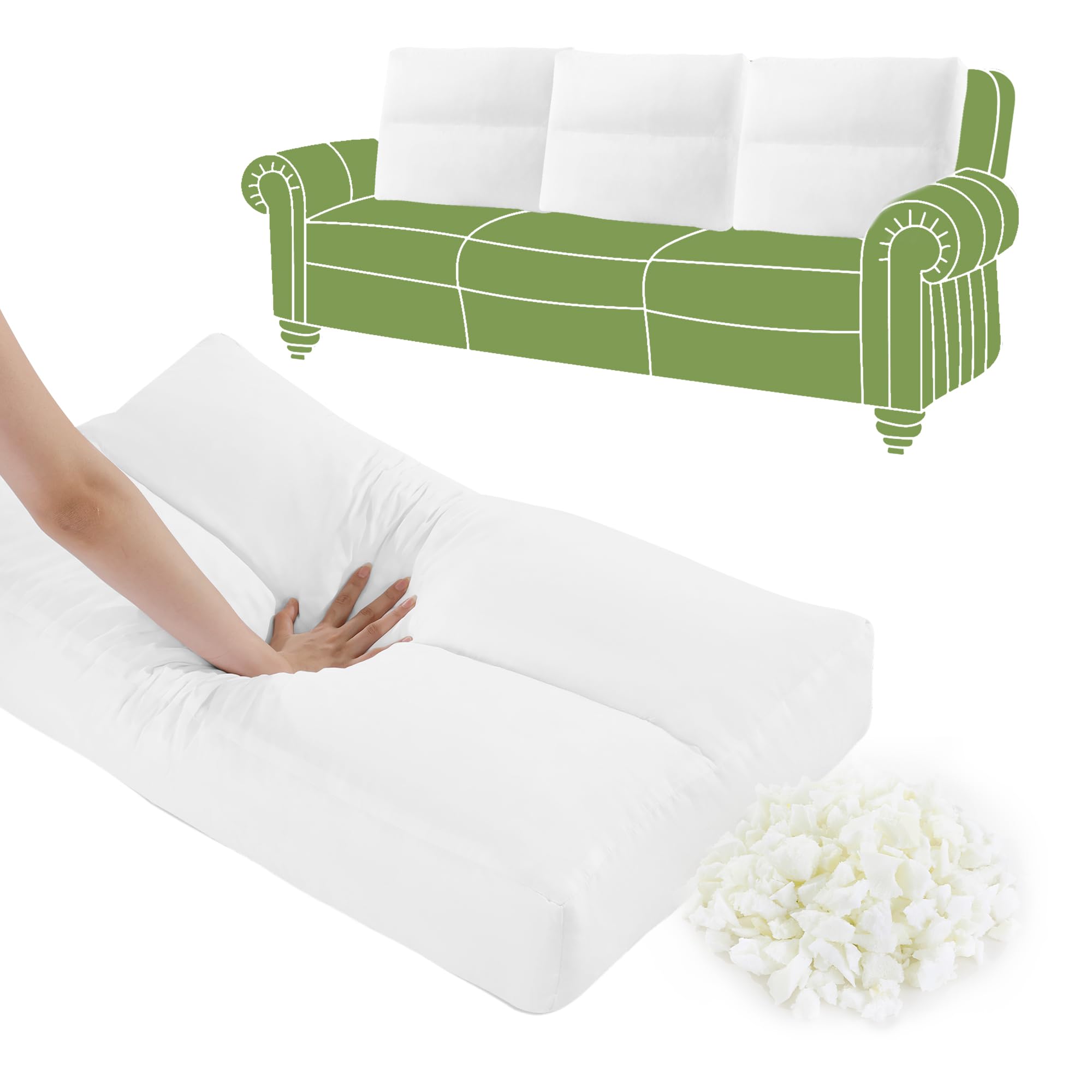
Back cushions, not seat cushions — three fluffy shredded-foam pillows to fix a collapsed backrest.
Most of the picks on this list address the seat. This one addresses the part you lean against, which is a different failure with a different fix. You get three cushions, each 31 inches long and 18 inches wide, filled with shredded foam rather than a solid block. That loose fill is why they contour to your back instead of sitting flat and stiff.
Thickness is 5 inches, which reads as substantial on a backrest and keeps the cushion from feeling like a thin pillow. The cover is 100% microfiber, described as soft and breathable for long sits. The cover is not washable, and the maker recommends slipping a sofa cover over it — note before you buy, because a back cushion that cannot be washed needs protecting.
Here is where to be honest about what these are. Firmness is a matter of taste: some owners find them excellent, others find them too soft, and the size runs a little small for some sofas. They ship vacuum-compressed and need time to fluff up — patting them and letting them sit in the sun speeds that along. If your sofa backrest has sagged, these are the right tool. If your seat cushions have sagged, they are the wrong tool entirely.
What people notice first: quality is the thing that gets praised most, with comfort close behind — they read as real furniture, not stuffing in a sack.
The honest sizing note: check your cover’s seam-to-seam measurement before ordering, because a 31 by 18 inch cushion is generous for some sofas and tight for others.
Pick these when: the backrest has gone flat and the seat cushions are fine.
Skip these if: the seat is the problem — these are back cushions and will not fix a sagging seat.
6. Upholstery Foam 72″ x 24″ x 6″ Gel Memory Foam

Six inches of gel-topped foam, designed for the opposite problem — a couch that is too hard to sit on.
Plenty of newer sofas are firm to the point of being uncomfortable, and no support board helps that. This pad solves it from the other direction. It pairs a 1-inch blue gel memory foam top layer with a 5-inch foam support layer, so you get softness where you sit and structure underneath. The 1-inch memory top stays thin enough to keep the support, and the 5-inch base keeps you off the frame.
The slab runs 72 inches by 24 inches and comes in six thickness options that max out at 6 inches — the listing you are looking at is the thickest one. It is also sold in thinner versions if you only want a topper. That cut-to-size flexibility matters most for odd furniture, and the maker lists sofa cushions, mattress padding, bed support, and foam mats as uses. At 10.83 pounds it is heavier than the FoamRush slab’s 2.32 kg, but it is also six inches taller in profile.
The recurring honest note is the memory-foam word itself. Some owners say it does not feel like true memory foam, and a few say it is not as thick as expected — sizing and expectations, mostly, but it is fair to know. It also ships compressed and needs about 48 hours to reach its full 6-inch thickness. Customers note the effect as intended: the foam is “soft and comfortable, and then you feel the firm support” underneath.
What it feels like under you: a soft memory top over a firm base — you get give where you sit and support under the surface, so hard couches stop feeling punishing.
Where it lives best: a couch that is too firm, a mattress that is too hard, or an RV and trailer seat that needs padding.
Made for: hard seats and mattresses that need softening, not sagging seats that need raising.
Check before you cut: the full 48-hour expansion time and the slightly-thinner-than-expected reports — measure after it fluffs, not before.
Know the Specs
Thickness And Density
Thickness is how tall the foam or board is at its highest point, and density is how much material is packed into it. A thicker denser slab holds its shape longer under a heavy sitter, while a thin soft one feels plush for the first weeks and then flattens. Density figures like 2.5 Lb and 1.87 Lb appear on the foam listings, and both are stated per cubic foot of foam. Higher density is the slower-wearing option, which matters most under a seat that takes daily use.
Board Versus Foam
A support board is rigid plywood or similar and sits under the existing cushion to carry the load. Replacement foam is a slab that goes inside the cover. A board fixes a weakened base under a cushion that is otherwise fine; foam fixes the cushion itself. Using the wrong one is the most common expensive mistake — the cushion keeps sagging because the base is the problem, or the board does nothing because the foam has already broken down.
CertiPUR-US And Fill Types
CertiPUR-US is a certification that a foam meets certain content and emissions standards. It appears on the FoamRush and POYNUC picks, and it is worth asking about if you are sensitive to foam smells. Fill types differ too: solid foam holds a shape, shredded foam moves and contours, and memory foam slowly springs back. Shredded fill is for back cushions, solid fill for seats.
Measuring And Sizing
Foam is forgiving — a slab can usually be trimmed down with a knife or electric hot wire. The measurement people skip — inside arm to inside arm, or seam to seam on a cover — is the one that decides the fit. Seat width goes from inside arm to inside arm, and a cushion cover is measured seam to seam. Add nothing for slack on a board, and allow a small amount of overage on a foam slab you plan to cut. Measure twice, because a slab cut too short cannot be grown back.
Common Questions
How do I know if I need a support board or replacement foam for my couch?
Will the GORILLA GRIP support board fit my loveseat or smaller couch?
How long does vacuum-packed foam take to reach its full size?
Can I cut upholstery foam to fit an odd-size cushion cover?
Are these cushions safe for an indoor sofa, or is there any odor?
What is the difference between back cushions and seat cushions?
Do I need a sofa cover if I use shredded foam back cushions?
Can a gel memory foam slab go under the seat cushion of a hard sofa?
Will a support board work on a couch with broken springs?
The Bottom Line
For most people searching for the couch cushions that actually solve the sag, the answer is the GORILLA GRIP Support Board — it is the only pick that rebuilds the base under a cushion that is still intact, and its plywood build carries up to 400 pounds. If you are replacing the foam instead, the Frienda four-pack gives you the most slabs in one order. And if your backrest is the part that has collapsed, reach for the HOMBYS back cushions — they are built for the back, not the seat.
How we choose
We do not accept paid placement. Every pick is matched to a real buyer and a real use-case; we do not hands-on test units.
Sources
Specifications: manufacturer listings and product documentation. Review insights: verified customer reviews, as of October 2026. Pricing: not shown on this page (it changes often); check the current price via the retailer link.
As an Amazon Associate, Aappliancez earns from qualifying purchases. This does not affect which products we feature.