Disclosure: Some links in this post are affiliate links. As an Amazon Associate I earn from qualifying purchases, at no extra cost to you. Learn more
Specs are compiled from manufacturer listings and verified buyer reviews and can change over time — please confirm the key details on the product page before buying.
Your couch is not ruined — it is usually the foam or the deck underneath that has given up. This guide covers the foam slabs, plywood boards, and full replacement cushions that actually restore a seat, sorted by what each one does best.
This guide is built by comparing the manufacturers’ published specifications and the patterns across verified customer reviews, so you get each pick’s real strengths and trade-offs instead of marketing spin.
You will learn which spec actually predicts a fix that lasts, how density and compression rating work together, and where a board beats foam. The picks below cover the full range of the best Couch Cushion Support, from a firm foam slab you cut yourself to a fold-out board that takes minutes to drop in.
Top Picks

How To Choose The Best Couch Cushion Support
The first decision is not which product to buy — it is what has actually failed on your couch. Sit down and listen. If you feel hard rails or springs riding up through the fabric, the foam has lost its body and you need a new core. If the foam still feels thick but the whole seat dips in the middle, a rigid board under it is often the faster fix.
Foam slabs versus support boards
A foam slab replaces the cushion core, so the seat looks and feels new again. You order a block at a set thickness and cut it down to fit your covers, which means you need a sharp knife and some patience. A support board does a different job: it sits flat across the frame under your existing cushions, adds a hard deck, and stops the dip without touching the foam. Boards install in minutes with no cutting and no drying time.
Density and ILD, in plain terms
Density is how much material is packed into the foam, and it is the best clue to how long the foam will hold up. The numbers here run from 1.79 up to 2.81. ILD (indentation load deflection, or how many pounds it takes to dent the foam one inch) is the firmness you feel with your hand. A high-density, high-ILD block feels rigid on day one and stays that way. A low-ILD block gives more at first but can soften sooner.
Measuring before you order
Get the fit right and the board disappears under your cushion. Run a tape from the inside of the left arm to the inside of the right arm, then measure the depth front to back. Add the height of the cushion you want and check it against the cover you already own. One buyer measured the gap between the couch ends and sized down deliberately to avoid overhang, and that is the right instinct — a board that pokes past the front edge is worse than one that stops just short.
The expansion wait nobody warns you about
Almost every foam product here ships vacuum-compressed, which is why it arrives in a box far smaller than the foam you ordered. It needs time to breathe back to full thickness — some makers say 48 hours, others 72 hours, and one asks for 3 to 4 days. Cutting or fitting it before it finishes expanding is the single most common way buyers end up with a cushion that comes up short.
Side-by-Side Comparison
| Model | Best For | Type | Thickness | Firmness Rating | Amazon |
|---|---|---|---|---|---|
| GoTo Foam 6″ x 36″ x 72″ 44ILD★ Best Overall | Couch cushion replacement | Foam slab | 6 inches | 44 ILD (Firm) | Amazon |
| GORILLA GRIP Support Board 24×78Fastest Fix | Sagging seat on a solid frame | Plywood board | .43 inches | Holds up to 400 pounds | Amazon |
| POYNUC CertiPUR-US Memory Foam 72×24 | Soft-to-firm cushion layers | Dual-density foam | 2 inches (4-inch option listed) | 2.5 Lb density memory top | Amazon |
| MLMTFI High Density Foam 6x24x24, 3PCS | Firm multi-seat rebuilds | Foam slabs (3-pack) | 6 inches | 2.81 density / 70 ILD | Amazon |
| RaceCityFoam Ultra Firm 50 ILD 4x24x80 | Very firm custom seats | Foam slab | 4 inches | 50 ILD (Ultra Firm) | Amazon |
| Foamma 8″ x 30″ x 72″ High Density | Deep, tall seat rebuilds | Foam slab | 8 inches | 44 lb compression rate | Amazon |
| Arden Outdoor Deep Seat Set, 4-Pack | Patio chair and sofa seats | Finished cushion set | 4 inches | Firm high-density foam | Amazon |
Detailed Reviews
1. GoTo Foam 6″ Height x 36″ Width x 72″ Length 44ILD (Firm) Upholstery Cushion Made in USA
Our pick — 4.5+★ from 450+ verified ratings; the strongest balance of quality and price.
A 6-inch slab of 44 ILD foam that rebuilds a dead couch seat in an afternoon.
This is the pick that covers the most ground, because a 6-inch block at 44 ILD (a firmness figure for how hard the foam resists a push) sits on the firm end without turning into a plank. It arrives as one 72 x 36 x 6 inch sheet weighing 16.2 pounds, so you have real material to work with and room to trim. For a three-seat couch with tired springs and flat cushions, this is the core you rebuild around.
What wins people over is the foam quality itself. The reviews keep circling back to how solid the block feels and how it keeps its shape once it is inside a cover. Owners have used it for far more than sofas — a dog bench holding 90+ pound dogs, a poker table, boat and car seats — and the story is the same: it holds up under weight. As one buyer put it: “These are a good value for the price. They worked perfectly replacing old worn out couch cushions.” Cutting is the one job to plan for, so have a long serrated blade or an electric carving knife ready and slice vertically to avoid ragged edges.
The honest catch is the firmness. At 44 ILD this is a genuinely hard seat, and owners who wanted a softer landing have said a medium would have suited them better than the firmest option. It also ships compressed into a small box, so leave it sealed until you are ready to cut and fit — once it opens, it takes up a lot of floor space. Measure your couch seat first and order the sheet size closest to it. This slab is built for people who want firm support under them, so if you want a plush sink-in couch, look elsewhere in this list.
Where it earns its keep
- 44 ILD firmness gives real support without a rock-hard feel under a seat cover
- One 72 x 36 x 6 inch sheet is big enough to cut several cushions from
- Made in the USA and CertiPUR certified
- 16.2 pounds of foam means there is genuine substance to shape and trim
What to plan around
- Firm end of the scale — softer-seat fans may want a medium
- Arrives vacuum-compressed and needs to sit before cutting
- You supply the knife and the patience to shape it yourself
Reach for this if: you want one large sheet of firm foam to rebuild several couch cushions and you are comfortable cutting it to size.
Think twice if: you want a soft, sink-in seat — 44 ILD is deliberately on the firm side, and several owners wished they had chosen a medium.
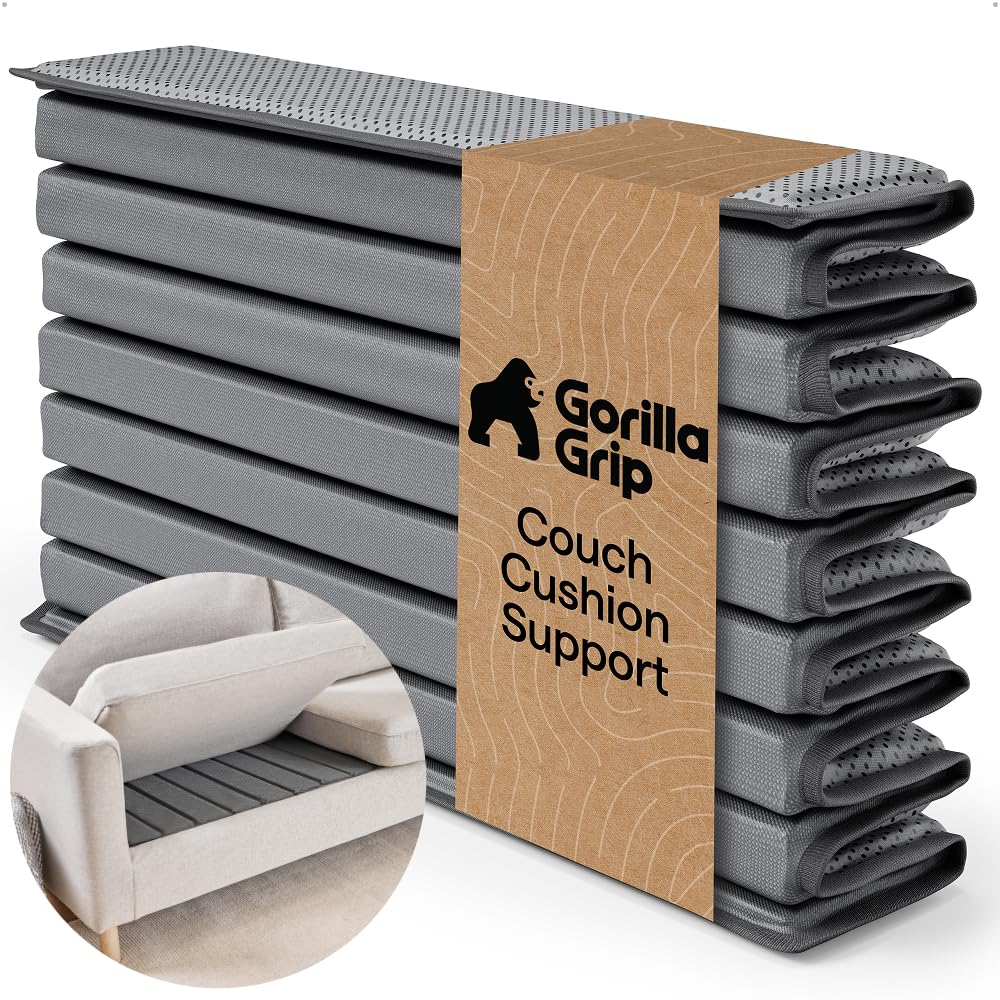
2. GORILLA GRIP Couch Cushion Support Board 24×78 Gray
A fold-out plywood deck for the couch where the frame sags but the foam still has life.
If your cushions still feel padded but the whole seat dips into a hollow, this board is the direct answer. It is.43-inch plywood, layered with hundreds of slip-resistant PVC dots (small rubbery bumps that grab the frame) on the underside so it does not slide around under daily use. The maker rates it to hold up to 400 pounds, and it unfolds accordion-style with no assembly and no tools. You lift the cushions, lay the board across the seat, drop the cushions back on, and you are done.
The thing everyone raves about is how completely it changes a sagging seat. An owner who was skeptical about whether it would work ended up buying a second board for the other side of an L-shaped couch. Another described the couch as feeling almost brand new again. For a firmness-per-dollar trade-off, it is the one that costs the least and works fastest. A 78-inch board spans a standard sofa, and the foldable, stackable design lets you shorten it for a loveseat by folding the ends under.
Measure before you buy, because the fit decides whether this board helps or hurts. Measure your seat width from the inside of the left arm to the inside of the right arm, then check how far the board will reach across the front edge so it does not stick out past the cushion. It is also a rigid deck — if your cushions have lost their foam entirely, this stiffens the seat but does not restore the padding, so you would pair it with fresh foam. The one real limitation: it is not for the patio. This is an indoor product.
Best value in the bunch: it fixes the dip without replacing any foam, which makes it the cheapest path to a firm-feeling couch seat.
Watch the fit: order the right length for your couch width, because an overlong board sticking past the front edge is the most common sizing mistake.
Who it suits: anyone whose couch dips but whose cushions still have padding left — a few minutes of install and no cutting involved.
Skip this one if: the foam inside your cushions has collapsed, because a board stiffens the deck but will not refill a dead cushion.
3. Couch Cushion Replacement, CertiPUR-US Certified 2.5 Lb Density Upholstery Memory Foam High Density Sponge 72″L×24″W×4″Thick

Memory foam with a firmer sponge underneath, so you get softness on top and support below.
This is the one for people who want a cushion that feels like a cushion, not a board. It layers a 2.5 Lb density memory foam top over a 1.87 Lb density support sponge, so the top conforms to your body and the base keeps it from bottoming out. The listed size is 72 x 24 inches with four thickness options from 1 inch up to 4 inches, and the 4-inch build pairs 1.5 inches of memory foam with 2.5 inches of support sponge. For a recliner with a bad back or a hard chair you want to soften, that layering is the whole point.
The firm-but-molding feel is what makes it work. It is CertiPUR-US certified (a certification that the foam is made without certain restricted chemicals), and the reclaimed loft is why it suits recliners and chair seats where you want to give a little without sinking. One buyer building a custom car seat for a senior dog with arthritis covered it and strapped it in, and said it sits well under a cover. The 3-inch option is the maker’s pick for long-sitting and back discomfort; the 4-inch is aimed at turning a hard mattress or hard chair into something softer.
The trade-off here is quality control. A few units arrive with a crease down the center from the vacuum fold, and one expanded unevenly. The fix is simple: unpack it, give it the full 48 hours to expand in a ventilated room, and inspect it before you cut or cover it. Like all memory foam, it softens as it warms — suited to cooler rooms and lighter bodies, and it can feel firmer after hours of sitting. If your couch needs a firm, flat rebuild, a plain high-density slab is a better bet than this layered pad.
The layered edge: an actual memory foam top over a support base is what makes this feel comfortable rather than hard, and it is the only pick here that is built for that soft landing.
Read the thickness chart: buy the 3 or 4-inch version for real seat support, because the 1-inch is a portable pad, not a core.
Unpack and wait: give it the full 48 hours to expand and give a folded center a chance to flatten before you decide it is wrong.
Fits the buyer who: wants a softer, memory-foam feel on a recliner or hard chair rather than a rock-firm rebuild.
Not the one for: a couch that needs firm, flat, long-lasting structure — the memory layer trades firmness for comfort on purpose.
4. High Density Upholstery Foam 6″ X 24″ X 24″, 3PCS Couch Cushion Replacement

Three 6-inch blocks at 70 ILD — for the seat that has to stop sagging completely.
If you are tired of sinking into your couch, this three-pack of 6 x 24 x 24 inch blocks is built to push back hard. The 2.81 density and 70 ILD compression rating (ILD measures how much force it takes to dent the foam, so higher means firmer) put it among the firmest slabs in this guide. At 6 inches thick, three pieces give you enough to do a full three-seat couch or to cut down into odd-sized covers. It is the pick for firmness above everything else.
What the reviews show is that firmness is the whole personality here. A 250-pound owner barely compresses the foam, and a 180-pounder notes that it does not dip when sitting. The bigger insight from owners: put the foam inside the cushion cover before you break the vacuum seal. The blocks puff up fast once opened, and wrangling an expanded 6-inch block into a tight cover is a genuinely hard job. One trick shared by owners is to start with the cover inside-out, corner by corner, and roll it down over the foam. Softer cushions may feel more forgiving, but if you have back pain and want a seat that stops sagging for good, this is the one.
Two things to know before you click. First, unpack it and let it stand for the 48 to 72 hours the maker lists, because the vacuum creases need time to flatten and a premature cut can leave you with less than 6 inches. Second, this is a genuinely firm seat — if you want something with give, the layered memory foam pick earlier in this list is a better match. The trade-off for this firmness is that fitting the blocks into your covers takes time and a sharp knife, but once they are in, they stay put.
Why owners keep buying it
- 70 ILD and 2.81 density deliver the firmest feel here
- Three 6 x 24 x 24 inch blocks cover a full couch or several chairs
- Cuttable to size, so it fits odd-shaped covers and DIY seats
The real trade-off
- It is very firm — no sink-in comfort
- Vacuum-expanded blocks are hard to fit into covers unless you load them before opening
- 48–72 hours of standing time before use
Pick this when: your only goal is to stop a seat from sagging and you want real firmness under you.
Look elsewhere when: you want a soft, giving couch seat, since 70 ILD is the stiffest foam on this list.
5. RaceCityFoam High Density Upholstery Foam (Ultra Firm) 50 ILD – 4″x24″x80″

A big 4 x 24 x 80 inch sheet of ultra-firm foam you shape to any seat you like.
This is the pick for the buyer with a project rather than an emergency. At 50 ILD (a firmness rating, so higher means more pushback) the foam is labeled Ultra Firm, and it comes as a single 4-inch thick sheet sized 24 x 80 inches — plenty of room to cut cushions for a vintage chair, a window seat, a boat, or an RV bench. It is 1.8 density and CertiPUR-US certified (an independent foam safety and emissions program), so the long-term wear is on the durable side. The plain-language upshot: you buy one big sheet and make exactly the cushion you want.
The reviews back that up. Buyers describe it as firm yet still a little flexible, so it holds a seat shape without feeling like stone. One owner swapped a too-stiff slab for this one and said the difference was the ability to give just enough. Another notes a 200-pound person sinks 1 to 1.5 inches and the cushion recovers within a minute. That recovery is what separates foam that lasts from foam that flattens. It also cuts cleanly — serrated blades and electric knives both work, and the maker ships a small safety tool to open the plastic without slicing the foam.
The catch is the effort. This arrives rolled and compressed, and it needs 3 to 4 days to fully expand before you cut. Patience is not optional here — cutting early is how you end up several inches short. If you have a custom-sized seat or a project with irregular shapes, this is the pick. If you want a simple cut-to-fit for standard cushions, the GoTo Foam earlier in this list is simpler to work with.
What it delivers: a large 80-inch sheet with a 50 ILD firmness that holds shape under body weight and recovers fast.
The catch: 3 to 4 days of expansion before cutting, so this is not a same-day fix.
Best for: custom seats, vintage furniture, boat and RV cushions — anywhere you need to cut foam to a size you measured.
Not ideal if: you want to install today, because the 3–4 day expansion wait is built into the product.
6. Foamma 8″ x 30″ x 72″ High Density Upholstery Foam Cushion

An 8-inch deep, high-density slab for the sofa seat that needs a tall, solid rebuild.
Foamma fabricates this one to order, and the 8-inch thickness separates it from everything else here — this is for a deep seat where you want height and firmness, not a thin pad. The 30 x 72 inch footprint gives you a generous sheet, and the maker lists a 44-pound compression rate (how much force the foam takes before it gives), 1.8 density, and a 100% recovery rate. Made in the USA and CertiPUR-US certified, and the maker rates the foam for 7 to 10 years of use. It is the upgrade pick for a couch cushion that is genuinely gone.
Buyers report a foam that matches or beats the original cushion. It firms up under weight without permanently flattening, which is the sign of a block that will not collapse back into a dip in a few months. One owner used it to replace a badly squished couch cushion and found it equal to or better than the factory piece, then bought more to do another chair during reupholstering. It cuts with an electric carving knife, and it expands to near full size in a day or two.
Two honest notes. First, the density gets mixed comments — some say it is super dense and others say it is not high density, so order the firmness to your taste and not to the label alone. Second, this ships compressed, and the maker wants it opened immediately and allowed up to 72 hours to fully expand. Measure carefully, because custom-cut foam that arrives at the wrong size is a hassle to return. For a firm, tall, made-to-order core, this is the top of this list — the heaviest and most expensive option, built for the buyer who wants the most sturdy result.
The case for Foamma
- 8-inch thickness for deep seats that need real height
- 44 lb compression rate and 100% recovery rate
- Made in USA, CertiPUR-US certified
- Maker rates the foam for 7 to 10 years
What the buyer needs to know
- Custom-cut means careful measuring — measure twice, order once
- Density comments are split; order the firmness you want
- Up to 72 hours to expand before it is at full thickness
Goes to: the deep-seat rebuild where you want the thickest, most substantial core and will measure to the inch.
Reconsider if: you want a lighter, faster project — the compression wait and the trim-to-fit step make this a slow build.
7. Arden Outdoor Chair Cushions 22×24 Foam Deep Seat, 4 Sets

A four-set of finished patio cushions with firm foam seats that hold their shape outdoors.
Everything else on this list is an insert you put inside a cover. This is the complete cushion — a 4-pack of 22 x 24 inch deep seat sets, each with a 4-inch high-density foam seat bottom and a blowfill back pillow. The seat measures 22 inches wide by 24 inches long by 4 inches high, the back measures 23 inches wide by 19 inches long by 5.5 inches high. If your patio furniture is sagging and you don’t want to build the cushions yourself, this is the finished answer.
The materials are the part that matters for outdoor use. The cover is UV-treated polyester with a PFAS-free C0 water and stain treatment, designed to resist fading in the sun and handle a little weather. The seat bottom is firm high-density foam made to keep its shape, and a dual tie system — two sets of ties on the seat and the pillow — keeps them from shifting on a windy porch. Owners describe them as better made and more comfortable than the cushions their furniture came with, and the seats are dense enough that they won’t squish flat under you.
The honest note is the thickness. A few buyers found the seat cushion thinner than expected, so check your chair’s depth against the 24-inch seat and plan accordingly. The back pillows are softer than the seat, but the zippered opening lets you add poly fill if you want more loft. Colors are available, and the fabric does fade in harsh sun — one owner in Texas reported slight fading over time, which is normal for an outdoor cushion. It is the only pick here built for outdoor use, with UV-treated fabric and a water-resistant finish.
What you get: four complete deep seat sets, so you replace tired patio cushions with a firm, weather-ready pair without buying inserts and covers separately.
Worth a check: the seat cushion runs firm and a little thin for some chairs — confirm your chair depth before you order the set.
Choose this for: outdoor patio chairs and sofas that need a complete new cushion set with a firm seat.
Not for: indoor couches — this is built for outside, with UV-treated fabric and a water-resistant treatment.
Know the Specs
Density vs. ILD
Density is how much foam is packed into a given volume, and it predicts how well the foam ages. The slabs here range from 1.79 up to 2.81. ILD (indentation load deflection) is how many pounds it takes to press the foam down one inch, so it measures the firmness you feel. A block can be dense and soft, or less dense and hard — you want a high ILD for support and a decent density for lifespan. When you see a number like 44 ILD or 70 ILD, that is the pushback; higher means stiffer under you.
Compression Rating and Recovery
The compression rate is often listed in pounds and tells you how much weight the foam can take before it gives. A 100% recovery rate means the foam returns to its original shape after you stand up, so the seat springs back instead of staying dented. A rigid plywood board works differently: it holds up to 400 pounds because it is not foam at all, it is a hard deck that takes the weight off a sagging frame. Match the tool to the problem: foam for collapsed cushions, a board for a frame that dips.
Common Questions
Is foam or a support board better for a sagging couch?
How do I measure a couch seat for a replacement cushion?
Why does replacement foam arrive so compressed?
Can I cut upholstery foam to fit my own cushions?
What does ILD mean on foam, and what number should I pick?
How long will high-density foam last in a couch cushion?
Can I use a couch support board on a sofa with a wooden frame?
Do outdoor patio cushions need different care from indoor ones?
Can I use memory foam for a couch cushion replacement?
The Bottom Line
For the widest range of sagging couches, the winning pick is the GoTo Foam 6″ x 36″ x 72″ 44ILD Cushion — it is a substantial 6-inch sheet of firm foam that cuts down to fit multiple cushions, and it holds its shape where it counts. If your cushions still have padding and only the deck dips, the GORILLA GRIP Support Board is the faster, easier fix that takes minutes and no cutting. And for a patio set that needs a complete refresh, the Arden Outdoor Deep Seat Set is built for outside with UV-treated fabric and a firm 4-inch foam seat.
How we choose
We do not accept paid placement. Every pick is matched to a real buyer and a real use-case; we do not hands-on test units.
Sources
Specifications: manufacturer listings and product documentation. Review insights: verified customer reviews, as of October 2026. Pricing: not shown on this page (it changes often); check the current price via the retailer link.
As an Amazon Associate, Aappliancez earns from qualifying purchases. This does not affect which products we feature.