Disclosure: Some links in this post are affiliate links. As an Amazon Associate I earn from qualifying purchases, at no extra cost to you. Learn more
Specs are compiled from manufacturer listings and verified buyer reviews and can change over time — please confirm the key details on the product page before buying.
If you have a corn on the bottom of your foot, the goal is simple: stop it pressing into your shoe every time you stand up. The five options below solve that in two very different ways — a powered sander that grinds hard skin down, or a padded ring that lifts the pressure off the corn so it can heal. Which one you want depends on whether your corn is thick and crusty or thin and tender.
This guide is built by comparing the manufacturers’ published specifications and the patterns across verified customer reviews, so you get each pick’s real strengths and trade-offs instead of marketing spin.
You will see exactly how each corn remover works on real foot skin, how long it lasts, and where it falls short — so you can pick the right one for your corn. This breakdown of the best corn remover for feet covers sanding discs, cushion pads, and medicated patches side by side.
Top Picks

How To Choose The Best Corn Remover for Feet
The most common mistake is buying the wrong type. A grinder only helps if you can reach the corn and it is hard, dead skin. A pad only helps if the corn is still tender and the problem is pressure, not thickness. Get that choice wrong and a product that works brilliantly for one person does nothing for the next.
Sanding vs. cushioning: pick your mechanism first
An electric sander uses a spinning abrasive disc to file the hard skin flat. It suits thick calluses and rough heels you can see and reach. A felt pad with a hollow centre does the opposite — it surrounds the corn so your shoe presses on the pad, not the sore spot. That suits a corn that hurts to walk on but is not thick enough to file.
What a grit number tells you
Grit is the roughness of the sandpaper disc. A lower number like 80# is coarse and takes off more skin per pass. A higher number like 180# is fine and smooths the surface. A kit that ships coarse, medium, and fine discs lets you start aggressive on a thick callus, then finish gentle so the skin is not left raw.
Check the shape against where the corn sits
Corns hide on the ball of the foot, the sides of toes, and the heel. Flat oval pads press on evenly, which is why they work on the sole and heel. A powered file with a round head reaches the same spots but needs a steady hand. If your corn is between two toes, neither flat shape will fit cleanly and a medicated patch is the practical answer.
Plan for more than one application
Established corns rarely vanish after a single try. Expect a grinder session to smooth skin now and need repeating later, and expect medicated patches to require several days of wear before the corn lifts. Buy a multipack if you know your corn is old and stubborn — running out halfway through is the most common reason people give up.
Side-by-Side Comparison
| Model | Best For | Type | Key Spec | Repeat Use | Amazon |
|---|---|---|---|---|---|
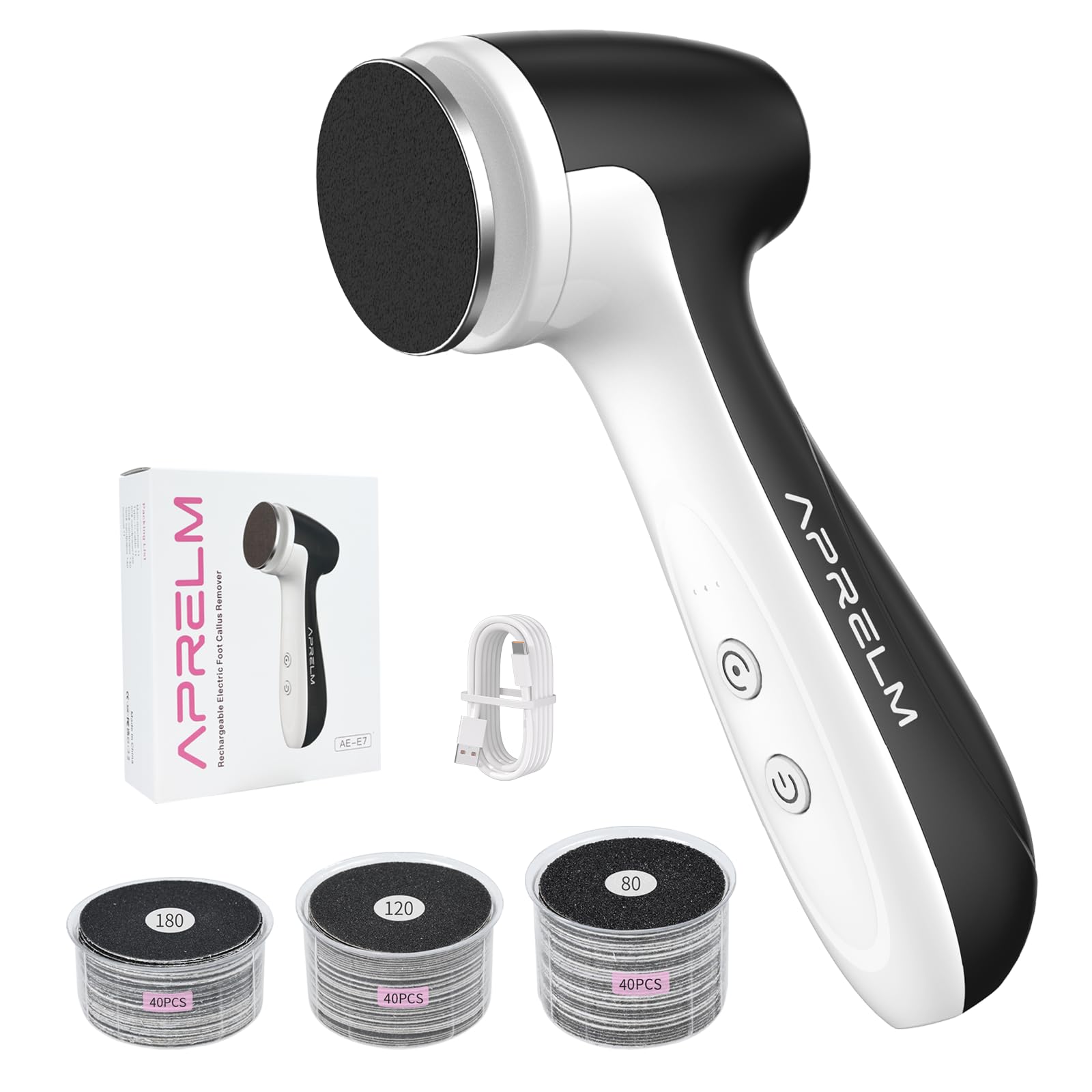
| APRELM Rechargeable Electric Foot Callus Remover★ Best Overall | Thick calluses and rough heels | Electric sander | 1000 RPM, 3 speeds | Rechargeable, 120 discs | Amazon |
| WILLBOND 60 Pcs Callus Corn PadsBest for Walking Pain | Walking pain from a corn | Felt ring pad | 2.25 x 1.7 in, 1/8 in thick | 60 pads | Amazon |
| Dr. Scholl’s Corn Remover One Step | Established corns on toes | Medicated patch | 6 count, pack of 2 | 12 patches | Amazon |
| Dr. Scholl’s Extra Thick Callus Removers | Ball-of-foot and heel calluses | Cushion plus medicated disc | 4 cushions, packs of 5 | 20 cushions | Amazon |
| Fshow Corn Cob Stripper Tool | Kitchen corn prep | Handheld kitchen tool | Stainless serrated blade | Reusable | Amazon |
Detailed Reviews
1. APRELM Rechargeable Electric Foot Callus Remover
Our pick — 4.5+★ from 1,000+ verified ratings; the strongest balance of quality and price.
A spinning disc sander for your feet that files hard skin flat in one sitting.
This is the pick for someone whose corn sits on a thick bed of dead skin, or whose heels are cracked and rough. It works like an orbital sander: a round abrasive disc spins at up to 1000 RPM (revolutions per minute — how many times the disc turns each minute) and files the surface down. You get three speed settings — 1000 RPM on high, 750 RPM on medium, and 600 RPM on low — so you can start gentle on a thin patch and go firmer on a rock-hard callus.
The kit ships with 120 discs across three grits: 40 coarse at 80#, 40 medium at 120#, and 40 fine at 180#. Lower grit cuts faster, so the 80# handles a thick corn and the 180# finishes smooth. That is enough discs to keep going for months of sessions. The built-in battery is rated for up to 120 minutes at the top 1000 RPM speed, up to 160 minutes at 750 RPM, and up to 220 minutes at the low 600 RPM — plenty for several foot sessions between charges. It weighs just 0.71 ounces in the package, which makes it easy to hold steady in one hand.
What wins people over is the sanding approach itself. The old rotating-head style of remover gets compared unfavorably to this one, because a flat disc with replaceable sandpaper follows the shape of your foot instead of digging in one spot. Buyers describe rough, deeply cracked heels turning smooth after one session, and a five-star verdict of “Best one yet. Tried others and this by far works the best.” The honest catch is the battery: leave it in a drawer for a couple of weeks and it will be flat when you reach for it. Buyers report it “self-discharges to ’empty’, i.e. expect you need to charge prior to every use” — so plug it in the day before you plan to use it. A few also find the two coarser grits too aggressive for regular use.
Where it earns its keep
- Three grits in the box — 80#, 120#, and 180# — let you go coarse then finish fine on the same corn.
- 1000 RPM top speed files a thick callus down fast, with 750 RPM and 600 RPM for lighter control.
- 120 discs mean you are not re-ordering refills every few weeks.
- Cordless and under an ounce in the package, so it stores in a bathroom drawer.
The trade-offs worth knowing
- Battery drains in storage, so charge it before each session rather than trusting a shelf-life charge.
- Only a round head — it will not reach a corn wedged between two toes.
- Coarse 80# discs can be too harsh for thin or sensitive skin.
Made for: thick, hard calluses and cracked heels that need material taken off, not just pressure lifted.
Think twice if: your corn is a soft, tender spot between toes — a padded ring will serve you better.
2. WILLBOND 60 Pcs Callus Corn Pads for Feet
The pad that takes the shoe’s pressure off your corn instead of grinding the corn down.
Here is the simplest corn fix there is. Each pad is a felt oval measuring roughly 2.25 x 1.7 inches and 1/8 inch thick, with a hollow cutout in the middle. You stick it on so the corn sits inside the hole. Your shoe then presses on the felt ring around it, and the corn itself touches nothing. That is why people who stand all day reach for these. The felt is breathable and the pad flexes to fit the sole, heel, and sides of the foot.
Adhesion is the thing that wins people over — it is the most-praised quality of this pack, and it makes sense given how the pads behave in shoes. The adhesive is the nonslip, collision-proof type that holds through walking, standing, and running. Sixty pads per box means you can change one daily without panicking about running out. At 3.84 ounces for the whole package, a few slip into a bag or a desk drawer with room to spare.
The trade-off is thickness. The 1/8-inch felt is enough to separate a corn from a shoe, but it is not a deep cushion, so a heavy, bony callus on the ball of the foot may want something softer. Owners mention: “The adhesive is strong and keeps the pad in place, lasting all day,” while also noting “it would be helpful if it came in a thicker pad.” If you have oily skin or have just applied lotion, wipe the skin dry first — that is where most stick failures start.
Why it fits the job: the hollow centre does the actual work. It lifts and surrounds the corn so friction and impact never reach the sore spot, which is exactly what a corn needs to stop hurting.
One honest limit: thin felt under a hard heel strike wears through faster than a thick gel cushion would, so plan to swap pads more often if you are on your feet all shift.
Reach for this if: the corn hurts when you walk and you want relief today, before any filing or patch has done its work.
Look elsewhere if: you need to physically remove a thick, raised corn rather than cushion it.
3. Dr. Scholl’s Corn Remover One Step Maximum Strength

A medicated disc that softens the corn from the inside out over several days.
When a corn has been on a toe for years, filing the top off does not solve it — the hard core is still there. This pack takes a different route: a small medicated disc sits over the corn and gradually softens the hardened skin so it lifts away. You get 6 patches per box and two boxes, so 12 applications in total. That matters, because a long-standing corn usually needs more than one patch before it lets go.
What owners describe is a slow, steady result. Effectiveness is the quality people come back to again and again with this one, and it is why it has stayed on shelves for years. The instructions are printed on the pack and easy to follow.
The honest trade-offs are real. The clear cover can be stubborn to peel off, and the packs need scissors to open. Some find the adhesive lets go before the treatment is done, and a few report a burning sensation on sensitive skin — so test one patch and watch how your skin reacts. One buyer summed it up plainly: “Very good product, I am buying it again for the second time as it stayed on very well and cleared up my corn.” If your corn is established, budget for more than one patch before you judge it.
How it stacks up: unlike the sander above, this does not need you to reach or steady anything — it works while you wear shoes and socks through the day.
The catch to plan for: a single patch rarely finishes a long-standing corn, so buy the two-pack and commit to the full run of applications rather than judging after day one.
Best suited to: corns on the tops or sides of toes, where a flat pad or a spinning disc will not sit cleanly.
skip it if: your skin reacts easily to medicated patches — try a plain cushion pad first.
4. Dr. Scholl’s Extra Thick Callus Removers

Extra-soft cushioning built for the ball of the foot that has lost its natural padding.
Some calluses are not really corns at all — they are the ball of your foot bruising because the fat pad underneath has thinned out. That is the problem this pack targets. Each cushion is a thick, soft pad with a medicated disc in the centre, and you get 4 cushions per pack across 5 packs, so 20 in total. The larger cushion spreads pressure over more of the sole, which is exactly what a tender ball-of-foot needs.
Callus removal is the strength here, and it happens gradually. Wearers describe the medicated disc lifting hardened skin a layer at a time — one reviewer noted half a callus lifting off after working through a single four-pack. The extra-thick backing is what makes it comfortable in a shoe, and the larger disc gives better coverage than a small patch. Socks over the top keep everything in place through a workday.
The one thing to plan around is adhesion. The pads hold well when you cover them with a sock or a plaster, but on bare feet inside a loose shoe they can work loose. Customers note: “One doesn’t do the job but get’s it started and they come off easily if you don’t wear socks over the pads.” Treat each cushion as a 48-hour wear and expect a second one before a hard callus gives way. Sizing is also worth a check — the pads run generous, which suits the sole but can crowd a narrow toe box.
What makes it different
- Extra-thick backing, so it doubles as a cushion for a thinned ball-of-foot pad.
- Medicated centre disc lifts hard skin gradually over repeated wears.
- Five packs of four mean you have a spare set when a stubborn callus needs round two.
- The larger pad covers more of the sole than a small patch.
Where it asks patience
- Needs a sock or plaster over it to stay put, especially in a roomy shoe.
- One cushion alone rarely finishes a thick callus — plan for more than one.
- Runs large, so check it fits inside tighter footwear before relying on it.
Go for this when: the pain is on the ball of your foot and you want cushioning and skin-softening in a single pad.
Not your pick if: you want a removable, reusable file rather than a wear-and-cover treatment.
5. Fshow Corn Cob Stripper Tool

Not a foot product at all — a corn-on-the-cob stripper for the kitchen.
Hold on. If you searched for a corn remover and landed on this, read the name twice: this strips corn kernels off a cob, it does not go anywhere near your feet. It is here because shoppers searching “corn” sometimes end up on it. As a kitchen tool it works well — a serrated stainless steel blade runs down a cooked cob and pushes the kernels off in seconds. The handles are plastic, and the whole thing weighs 12 ounces, far heavier than the 0.71-ounce foot sander above because it is built to be gripped while you push.
What earns it a place is the speed and safety. The blade is sharp and rust-resistant, and the safety handle lets you push without exposing your fingers to the edge. It is compact at 5.1 inches long and 3.15 inches wide, and the detachable design lets it break down for a drawer. Cooks rate it well for turning fresh corn into salads, casseroles, and freezer bags without the knife-and-board mess. Functionality is what people praise most about it, followed closely by how easy it is to use.
The honest catch is size. Reviewers point out: “This works great but it needs to be taller. You can only get half of the cob done before the cob hits the bottom of the dish.” There are also reports of the plastic cracking over time, and it should be hand-washed rather than put through a hot dishwasher. If you came here for a foot fix, scroll back up to the APRELM sander or the WILLBOND pads; if you came for corn prep, this does the job neatly.
What it does well: a sharp stainless blade plus a safety handle strips a cooked cob fast, with the detachable build keeping it drawer-sized between uses.
Know what you are buying: this is a kitchen gadget with nothing to do with corns on feet, and its plastic body wants hand-washing and a little care to avoid cracking.
The right buy for: home cooks who freeze or cook fresh corn and want it off the cob without a knife.
Wrong item for: anyone treating a foot corn — this tool has no role in foot care.
Know the Specs
Grit Grades on a Sanding Disc
Grit is how rough the abrasive surface is, and the number runs backwards from what you might expect. An 80# disc is coarse — it takes off more hardened skin with each pass, so it suits a thick corn or a callused heel. A 180# disc is fine and smooths the surface after the heavy work. Using coarse first and fine last gives you a flat, even finish instead of a patch that feels raw. A kit that ships all three grades leaves you in control of how much comes off.
The Hollow Cutout on a Corn Pad
A corn pad is not just a cushion — the hole in the centre is the point. The oval hollow creates a pressure-free zone, so when your shoe presses down, the felt ring takes the load and the corn sits untouched inside the opening. That breaks the friction-and-impact cycle that keeps a corn sore. Thickness matters here: a 1/8-inch felt pad separates the corn from the shoe, while a thicker pad spreads a hard heel strike over more area. Match the thickness to how much pressure your corn takes each day.
Common Questions
Should I sand a corn down or use a pad on it?
How many grits do I need for a hard callus?
Why does my corn pad keep sliding off during the day?
How long does a Dr. Scholl’s corn patch take to work?
Can I use an electric foot sander on a corn between my toes?
Is the Fshow tool a foot corn remover?
How long does the APRELM sander run on one charge?
Will a medicated pad burn my skin?
How often should I change a corn cushion or patch?
If I buy a callus sander, how often should I use it?
The Bottom Line
If you want the corn gone by taking the hard skin off, the APRELM Rechargeable Electric Foot Callus Remover is the one to choose — its 1000 RPM motor and three grits do the filing work, and 120 discs keep you going for months. If walking hurts more than the skin looks thick, the WILLBOND 60 Pcs Callus Corn Pads lift the shoe’s pressure off the corn with a hollow felt ring you can swap daily. And for a stubborn corn on a toe, the Dr. Scholl’s Corn Remover One Step softens the core over several days of wear. Pair a sander with a pad and you cover both the hard skin and the pressure — that is the combination most people end up sticking with.
How we choose
We do not accept paid placement. Every pick is matched to a real buyer and a real use-case; we do not hands-on test units.
Sources
Specifications: manufacturer listings and product documentation. Review insights: verified customer reviews, as of October 2026. Pricing: not shown on this page (it changes often); check the current price via the retailer link.
As an Amazon Associate, Aappliancez earns from qualifying purchases. This does not affect which products we feature.