Disclosure: Some links in this post are affiliate links. As an Amazon Associate I earn from qualifying purchases, at no extra cost to you. Learn more
Specs are compiled from manufacturer listings and verified buyer reviews and can change over time — please confirm the key details on the product page before buying.
If your lawn has gone flat, spongy or hard underfoot, you need to pull actual plugs of soil out of it — not just poke holes. A core aerator (sometimes called a plug aerator) drives hollow tines into the turf and lifts out small cylinders of dirt, which is what opens the ground up so water, air and fertiliser can reach the roots. The single most important thing to know before you buy: a core aerator only works well on moist ground, and every manual one on this list will fight you in bone-dry clay. Pick the right one for your soil and your body, and a small yard takes a couple of hours.
This guide is built by comparing the manufacturers’ published specifications and the patterns across verified customer reviews, so you get each pick’s real strengths and trade-offs instead of marketing spin.
Manual core aerators come in two flavours — hollow-tine step tools that lift plugs, and rolling spiked drums that punch the ground instead. Below are the seven worth your time. If you only want the short answer, here it is: use the Best Core Aerator picks on damp soil, work in sections, and clear the tines before the dirt sets.
Top Picks

How To Choose The Best Core Aerator
Start with the ground under your feet, not the listing photos. A core aerator is a leverage tool — you push it in with your bodyweight and pull a plug out — so the tool has to match your soil, your lawn size and your height. Get those three right and the purchase works. Get them wrong and the best-built tool on the page will sit in the shed.
Hollow tines versus spikes
A hollow tine is a tube, open at the bottom, that cuts a cylinder of soil and lifts it clear. That is coring, and it is the version that genuinely relieves compaction. A spike aerator punches tapered holes instead; it is faster and pulls no plugs, but it presses soil sideways rather than removing it. If your goal is to break up a hard, compacted layer, buy hollow tines. If your goal is to open the surface before overseeding, a rolling spike drum covers more ground with less strain.
Tine count and plug depth
Three hollow tines is the common layout on a step tool — enough to make real progress, not so many that pressing down becomes a fight. Four tines means fewer insertions per square foot, but each one takes more force. Look for tines that are replaceable and long enough to pull a full core. The Landzie unit is built around 4-inch plugs, while the Xuperace Lawn Aerator Tool is documented pulling 3.5–5.5 inch plugs from compacted clay without pre-watering.
Handle height and body fit
A short handle forces you to stoop, and by the third hour your lower back will tell you about it. The step tools here run around 38 to 42 inches; the Yard Butler tops out at 36 inches, which a 6-foot user found too short. If you are tall, favour the longer tools. If you have knee or back trouble, favour a lighter tool with a wide footplate and work in short sessions.
Soil moisture is half the purchase
Every manual core aerator on this list performs dramatically better after rain or a good soak. Wet soil lets the tines slide in and the plugs slide out. Dry soil jams the tubes and turns a two-hour job into an all-day one. Water the lawn the day before, or wait for rain — that habit matters more than any single spec below.
Side-by-Side Comparison
| Model | Best For | Tine Type | Tine Count | Listed Weight | Amazon |
|---|---|---|---|---|---|
| Lawn Aerator Tool (Xuperace)★ Best Overall | Best overall for compacted clay | Hollow, side-eject | 3 | 5.91 lb | Amazon |
| EEIEER Manual Lawn Aerator ToolTidiest Work | Soil basket keeps the lawn tidy | Hollow, clog-prone | 3 | — | Amazon |
| Dolibest Lawn Coring Aerator | Stainless build with a collection tray | Hollow, stainless | 4 | 2.81 kg | Amazon |
| Manual Lawn Core Aerator (LawnVigor) | Spot treatment on a tight budget | Hollow, replaceable | 3 | — | Amazon |
| Yard Butler IM-7C | Spike aeration in tight spots | Solid spike | 4 | 2.25 lb | Amazon |
| LANDZIE 42″ Hollow Tine Core Aerator | No-assembly heavyweight for small lawns | Hollow, beveled | 3 | 5.6 lb | Amazon |
| Senvert Rolling Lawn Aerator | Push-along aeration for small-to-medium lawns | Spiral spike drum | — | 38.3 lb | Amazon |
Detailed Reviews
1. Lawn Aerator Tool Alloy Steel
Our pick — 4.5+★ from 150+ verified ratings; the strongest balance of quality and price.
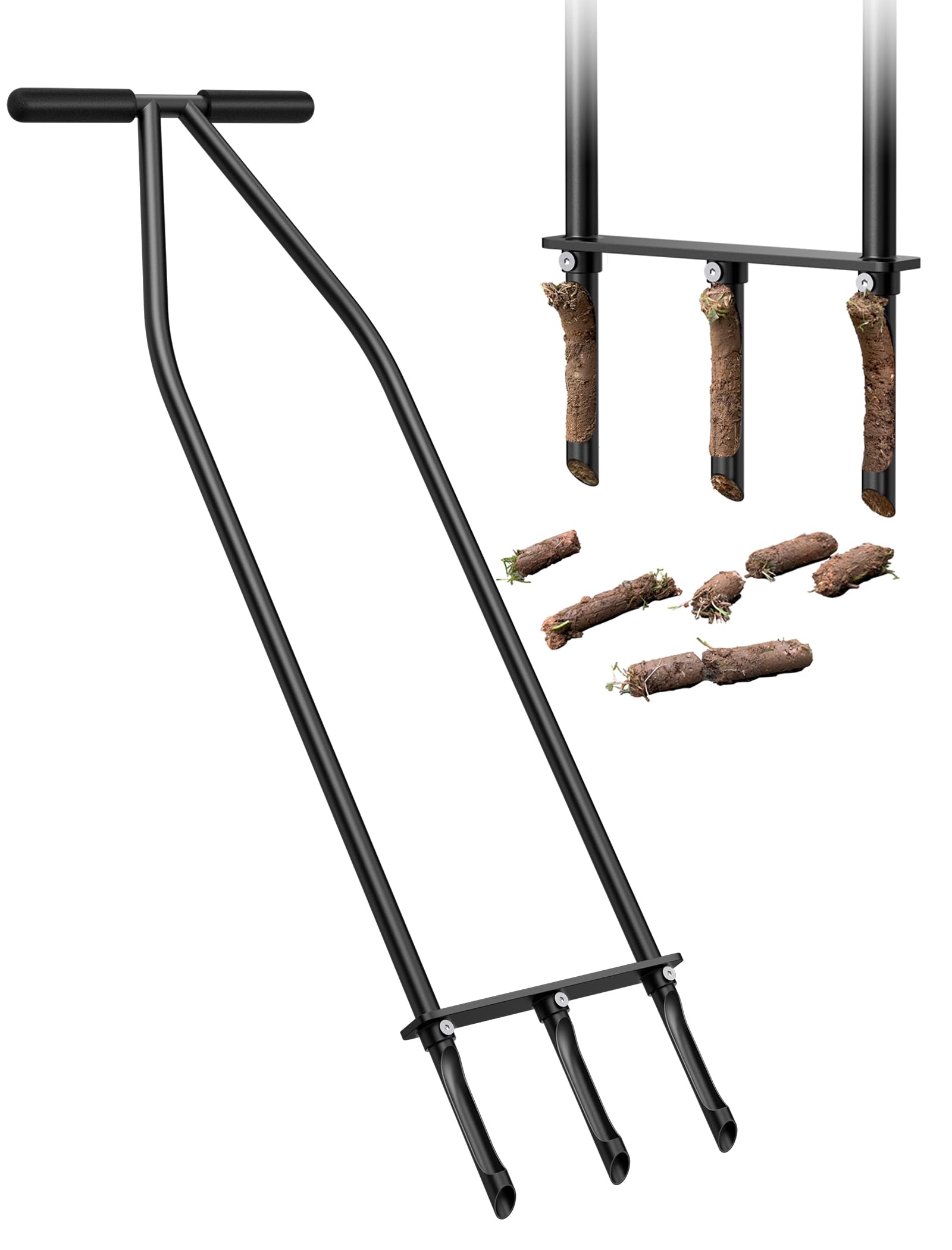
Three hollow tines and a side ramp that spits plugs out instead of packing them in.
The whole point of a core aerator is that it removes soil rather than pushing it sideways. This Xuperace tool does it with 3 hollow tines, and the design twist that earns it first place is a patented ramp that ejects each soil plug out of the side. In practice that means the tube is empty before your next step down — no stopping to poke out a jammed cylinder every few feet. Buyers report pulling 3.5–5.5 inch plugs from compacted clay without pre-watering, and reviews keep returning to the same point: it drives straight through the ground.
The numbers back up why it feels manageable in hand. The frame is integrally formed from high-strength alloy and listed at 5.91 pounds, heavy enough to stay planted and light enough to lift between positions. Height runs about 3 feet from the footplate to the top of the handle, which a 5’11” user found comfortable, and the dual downtubes let you press force directly onto the centre tine without striking your leg. If press-in still feels tough on hard ground, the middle tine comes out — making it a 2-tine tool for the worst spots. Tines are screw-mounted and replaceable.
The catch is honest and small. The angled screw-on ends have a habit of working loose, so it is worth checking them before each session — the factory screws arrive with threadlocker and a spare is included, which tells you the maker knows. Cleaning matters too: oil the tines afterwards to keep rust off, and clean with a stick rather than a metal tool so you do not scratch the finish.
What earns it the crown
- Side-eject ramp means plugs fall away without a clearing break — the feature owners mention most.
- Functionality is the top praise by a wide margin, with Quality right behind it among the most-mentioned aspects.
- Pulls 3.5–5.5 inch plugs from compacted clay without pre-watering.
- Middle tine removes to lighten the load on harder ground.
- Integrally formed alloy frame rated for demanding jobs.
Where it asks for care
- Angled ends can loosen — re-tighten before each use.
- At 3 feet of step-to-handle height, very tall users may want more reach.
- Durability drew some mixed notes, so store it dry and oil the tines.
- Manual coring is still real work; a big lawn will take several sessions.
Reach for this one if: you have compacted clay, a small-to-medium lawn, and you want plugs out of the ground without stopping to unclog a tube.
Look elsewhere if: you want to aerate a full acre in an afternoon — a rolling drum covers more ground with less per-step effort, though it perforates rather than cores.
2. EEIEER Manual Lawn Aerator Tool with Soil Storage Basket
The one that catches its own mess in a basket instead of scattering plugs across the grass.
A 10-foot by 12-foot patch runs roughly half an hour at light-to-moderate effort with this EEIEER tool, and the soil storage basket is a big part of why it stays clean. Coring soil that squeezes out lands in the tray rather than spraying over the lawn, so you are not out there raking up cylinders afterwards. The build is stronger than the welded competition too: a patented one-piece bottom and an inner wall thickened from 1.2mm to 2mm, which is the maker’s answer to the cracked-frame complaint that plagues cheap step tools.
Where it earns its place on this list is the reach. The handle measures 38 inches, which lets you work more upright than a squat tool, and the 4.3 inch heightened pedal gives your foot something to push against. Three sharp tines go in together. A cleaning stick comes in the box for the moment a tube packs up, and it doubles as a weeding tool.
The honest caveat here is clogging — it is the single most-discussed issue with this model, and wet soil makes it worse rather than better, which is the opposite of what most corers want. Dry-ish soil and short sessions suit it better. The foam grips are also a long-term wear item on a tool that leans on your hands every stroke.
Who this suits best: a small yard with soft, workable soil and an owner who would rather not sweep up cores afterwards. The quality is the thing praised most, with the compact size close behind — this is a tool built for a limited patch, not an acre.
What to plan around: clear the tines promptly after each run. Dirt left to dry inside the hollow tubes sets like concrete, and that is exactly when a helpful tool starts feeling like a chore.
Better than most at: keeping the job tidy — the storage basket is a genuinely useful idea that the plain corers on this list do not have.
Not your tool if: your soil runs wet and sandy, or you plan to do a whole yard in one go — the tines will pack up and slow the pace.
3. Dolibest Lawn Coring Aerator with 4 Stainless Steel Plugs
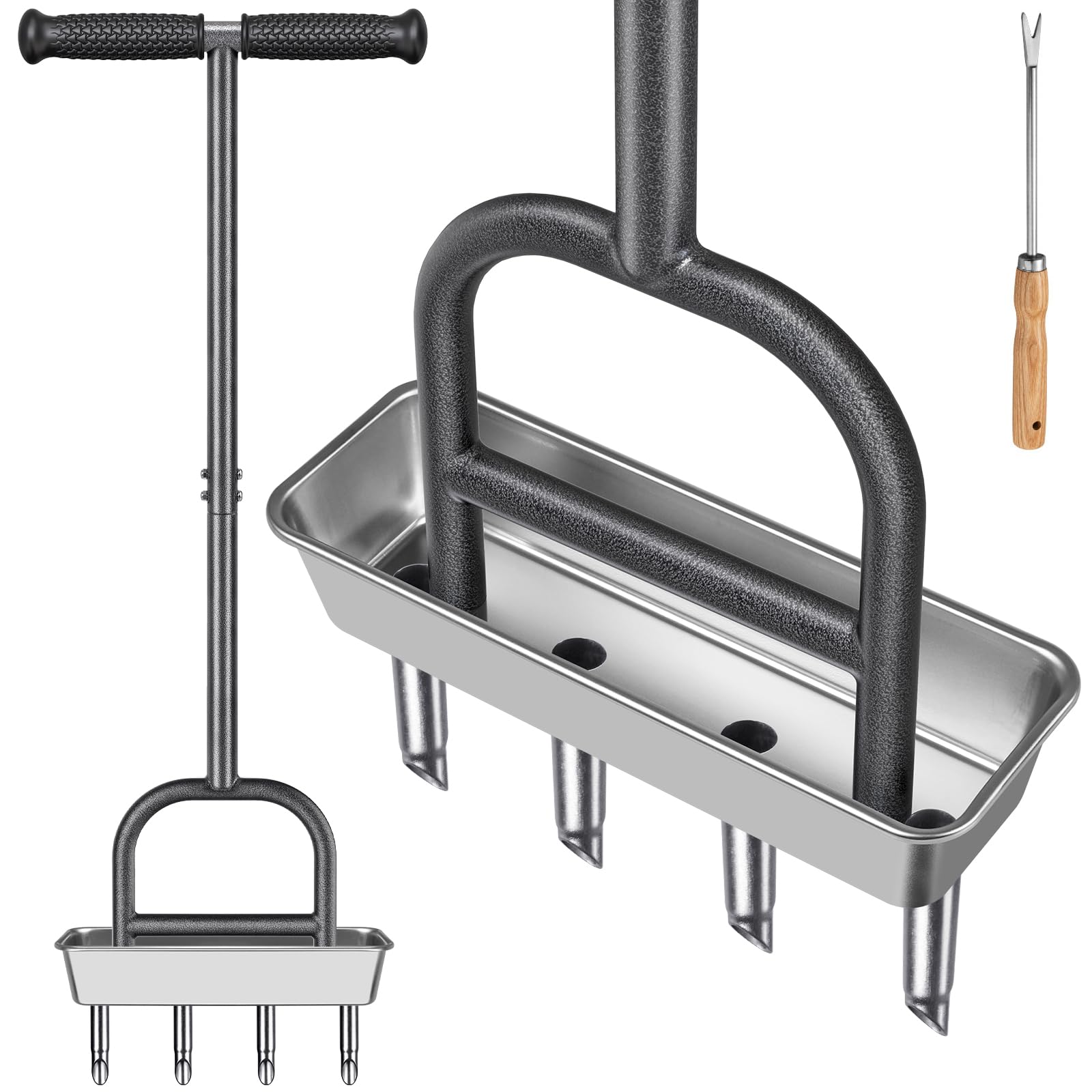
Four stainless tines and a tray that catches cores, straight from the start in about two minutes.
Rust is the quiet killer of garden tools, and this Dolibest unit answers it head-on. The 4 coring plugs are made from SUS 304 stainless steel — the rust-resistant grade — and the soil tray is stainless too, so the parts that touch wet earth do not corrode. The rod underneath carries a black powder coating for the same reason. That is the strongest material story on this list, and functionality is the aspect buyers talk about most, with quality right behind it.
The layout is unusual: 4 tines rather than the more common 3, which means fewer insertions to cover the same patch but more force at each one. The improve crossbar is set to keep your shoe clear of the plug as it ejects, and the soft rubber grip is shaped to cut hand fatigue. Assembly genuinely is quick — three parts, lock the centre of the pole, tighten the handle, fasten the bottom, done.
Two things to weigh before you commit. First, the tray fills faster than you might expect, so empty it as you walk. Second, clogging shows up as a recurring theme, and hole depth divides opinion — some find the cores shallower than they would like. The supplied 12 inch hand tool clears a jam and doubles as a weeder or transplanter, which softens the chore.
The standout detail: stainless steel through the tines and the tray — a spec that matters if your lawn is irrigated or you garden in a damp climate.
Where it needs patience: expect the occasional clogg, and favour moist-but-not-sodden ground. This is more of a precise spot-treatment tool than a whole-lawn workhorse.
The pick for you if: rust resistance and a self-collecting tray rank higher than maximum speed — you will trade some pace for cleaner work.
Pass it by if: you want to core a large stretch in one sitting; four tines and a filling tray make this a slower tool over big distances.
4. Manual Lawn Core Aerator
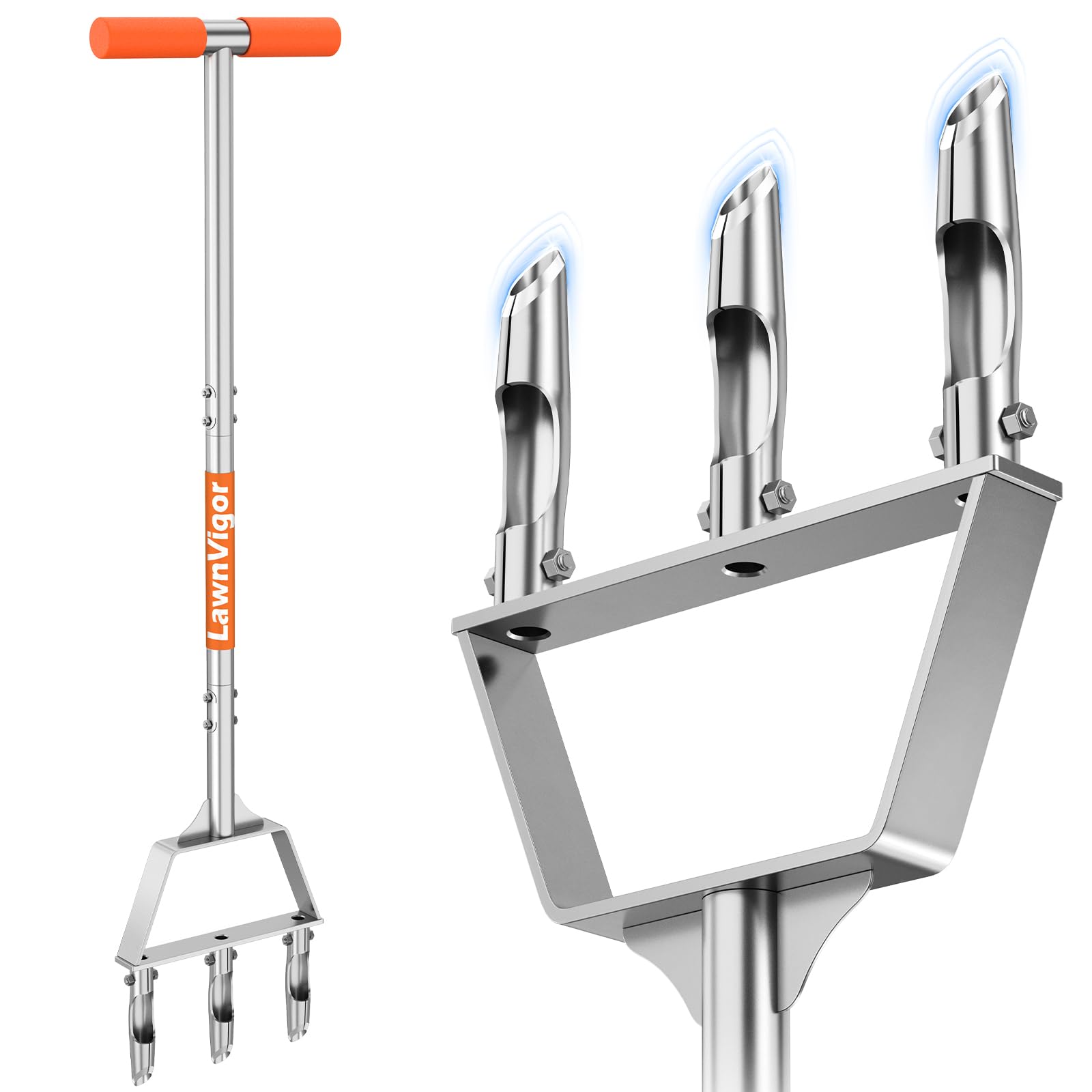
Three heat-treated tines that turn a hard, crusty patch into something water can actually enter.
Not every lawn needs a full aeration campaign. If you have one compacted corner where water pools and the grass has thinned, this LawnVigor tool is made for exactly that. The 3 hollow tines are heat-treated to hold a sharp edge through tough soil, and they are replaceable, so the tool does not die when the cutting edge dulls. Quality drawing the most praise and ease of use close behind tells you what owners feel first — this one goes into the ground without a fight when the soil is right.
The build has some smart touches at the bottom end. White plastic inserts sit inside the tubes to help each soil plug release cleanly, and there is a drainage hole at the base of the tubing so trapped water cannot pool and start rust. The hardware kit is complete — wrenches and hex bolts included — and the non-slip handle is shaped to shorten the reach to the ground, which takes pressure off your lower back. A 5-foot-2 senior buyer aerated a full lawn in two passes.
Here is the honest limit, and it is a big one on paper but a fair one in practice: the listing weight figures on this model are inconsistent, and the working footprint is genuinely small. Pair it with an expectation of spot work, not acreage. Owners also flag that the handle covers can spin loose during use, and that long sessions punish ungloved hands.
Where it delivers
- Heat-treated hollow tines slice into tough, crusty ground.
- Drain hole in the tubing base keeps rust from starting inside.
- Complete hardware kit — no trip to the store mid-assembly.
- Shorter handle reach limits the stoop and spares your back.
- Replaceable tines extend the life of the whole tool.
Where it falls short
- Built for spot treatment, not whole-lawn coverage.
- Handle covers can slip and spin — a dab of adhesive fixes it.
- Grip drew mixed notes; wear gloves on long sessions.
- Restricted working depth compared with a full-size step tool.
Made for: the lawn owner with two or three bad patches — compacted soil, poor drainage, thin grass — who wants a small, sharp, easy-to-handle corer.
Not for: whole-yard aeration in one afternoon; the tight working area and modest depth suit repair, not a full overhaul.
5. Yard Butler IM-7C Spike Grass Aerator
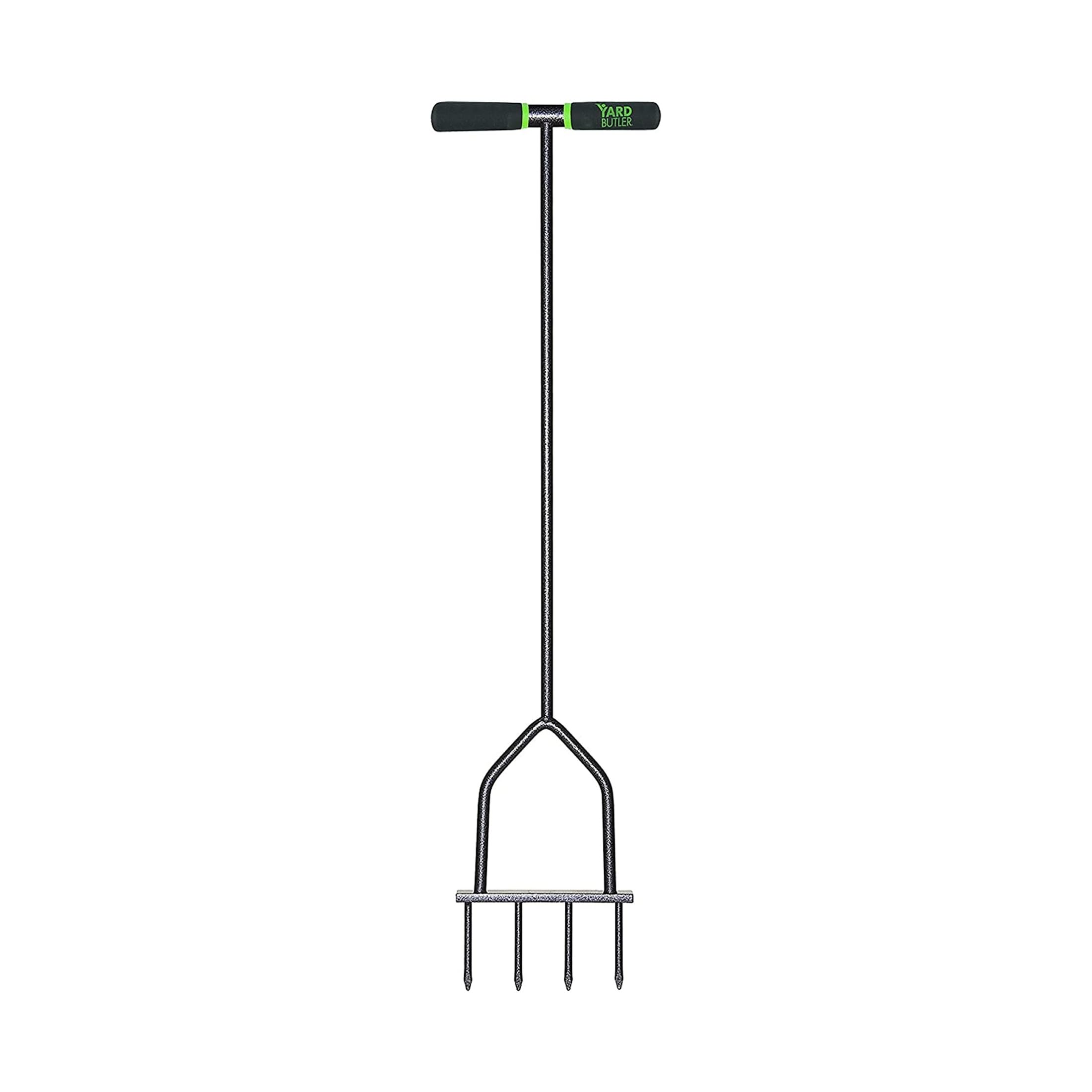
Four 3-inch spikes on a long handle — the fastest way into a tight corner without a plug in sight.
Be clear about what this one does before you buy: it is a spike aerator, not a core aerator. Four tapered spikes up to 3 inches long punch into the turf and pull back out, leaving holes but no plugs. That makes it the wrong tool if you are fighting deep compaction, and the right one if you want to open the surface before overseeding, or reach into a narrow bed where no step tool fits. It weighs 2.25 pounds and is powder-coated steel, so it also survives being leaned in a shed year after year.
What owners value most is simply how well-built it feels in the hand — quality and functionality are the two loudest themes — along with ease of use in small or awkward spots. The cushioned handles are shaped for pulling up without gloves on short sessions, and the design asks for a foot press rather than a bend. In loamy, rain-moistened soil a step plate sets the spikes and a pull lifts them; one buyer used it after thatching and saw grass seed germinate evenly within a week.
The trade-off is that spike aeration does not remove soil, and the current build has drawn a mixed note on tine stiffness compared with older versions. Budget for a slower, more repetitive rhythm on a larger area — this tool asks for many insertions per square yard. Taller owners also found the 36 inch handle a touch short.
Why it earns a slot: build quality is the praise it draws most, with functionality right behind — the metalwork and welds feel stout, and the tool simply does what the box says.
Be honest with yourself: this is perforation, not coring. If the problem is a hard pan under the turf, you need hollow tines; if it is a crust on top, spikes are quicker.
Grab this for: small yards, tight beds, and pre-seed surface prep where speed and reach beat plug removal.
Skip it for: breaking up serious compaction — it punches holes but does not lift the soil out, so hollow-tine tools are the better answer there.
6. LANDZIE 42″ Hollow Tine Core Aerator
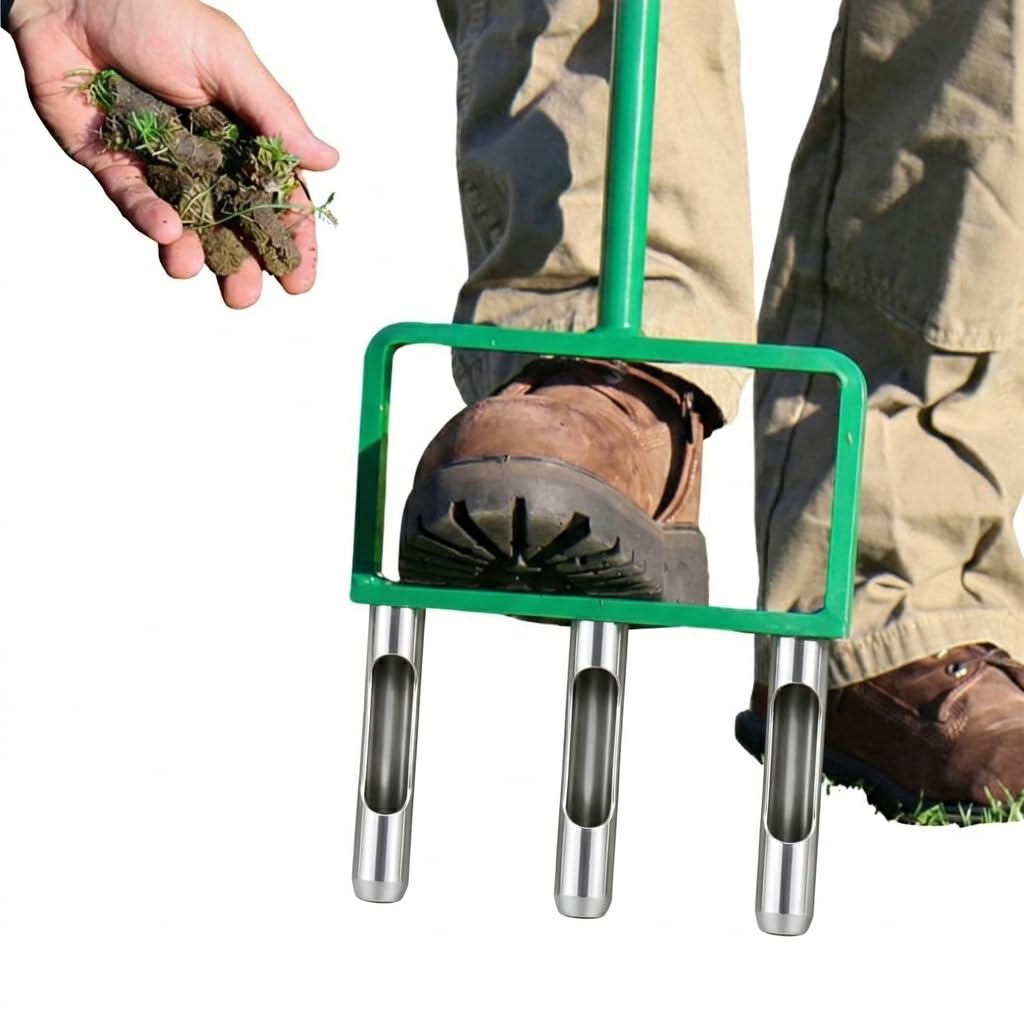
A 42-inch corer with beveled stainless tines that is ready to work the moment it comes from the start.
Assembly is the first chore most core aerators hand you, and Landzie sidesteps it entirely — the tines arrive already fitted to a powder-coated steel frame, and you go straight to the lawn. The 3 solid stainless tines carry a beveled cutting edge, and the tube is open at the top so each plug pushes up and out as you press down. Owners describe plugs popping out continuously with no unclogging needed, and a 240-pound user reportedly jumped on the foot bar without bending the frame. For dense clay after a light watering, it goes in and lifts full cores.
At 5.6 pounds and 42.38 inches of height it is the tallest fully-manual corer on this list, which is the number that matters if you are over six feet. The tines can be swapped out, and the maker sells replacement sets with a swap tool. In a tight, machine-inaccessible strip — the kind a powered aerator cannot reach — three tines give you the control to work around sprinkler heads and shrubs.
Where it asks something back is stamina. This is a full-body tool; a 25-by-25 patch can run under an hour in damp soil, but a large lawn is hours of hard work, and buyers are candid that it is best aimed at the tough compacted spots rather than the whole property. The top foot bar is smooth steel without friction cuts, so boots help.
The build to bank on: quality is the praise it draws most, with functionality close behind — stainless tines, powder-coated frame, and replaceable parts add up to a tool you keep for years.
The real cost: time. It is the slowest way to cover ground on this page, so weight the purchase toward how much lawn you truly plan to core.
Best matched to: the taller gardener with dense clay, a small-to-medium patch, and no appetite for assembly or tine maintenance.
Not your answer if: you have a big yard and a weekend — three tines and a full-body stroke will take far longer than a push-along drum would.
7. Rolling Lawn Aerator
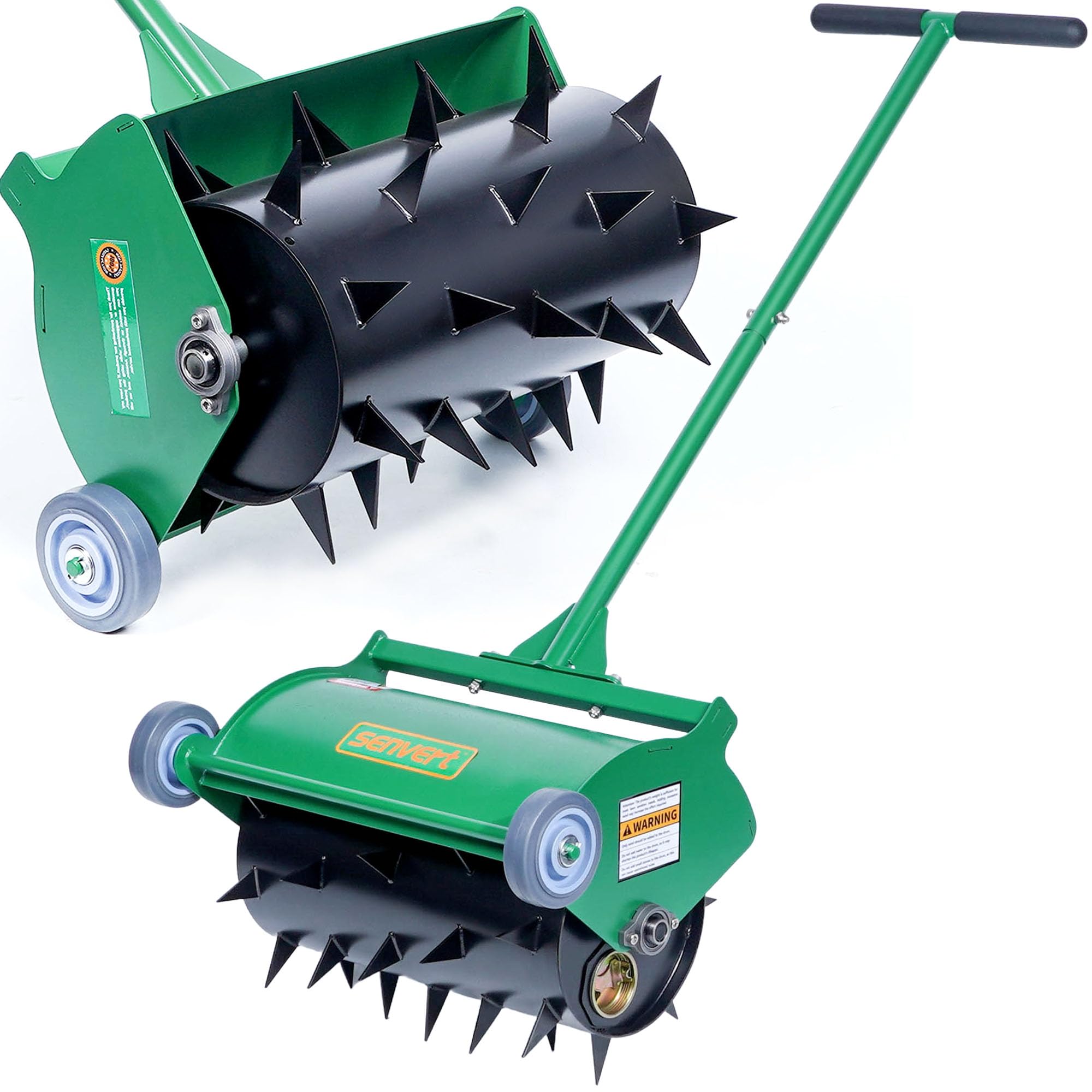
A weighted drum you push, not a bar you stomp — the least punishing way to cover a whole lawn.
If the idea of lifting plugs by hand for hours makes your back ache in advance, this rolling aerator changes the motion entirely. The drum weighs 32 pounds on its own, enough to sink the spiral spikes into most soils on a pass, and you can pour sand or stones through the covered opening to take it up to 55 pounds for harder ground. Do not fill it with water — the maker is explicit on that point. The spiral spike pattern rolls smoothly and holds a straight line, which makes long passes far easier to steer than a row of fixed spikes.
Where it leaves the manual corers behind is efficiency: compared with aerator shoes and step-style tools, a rolling drum covers small-to-medium lawns with noticeably less effort per square foot. The main body arrives assembled — you attach the handle and go. A pair of TPR auxiliary wheels lets you roll it to and from storage without the spikes chewing up your driveway.
Two honest limits. First, this is spike aeration, so it perforates the soil rather than pulling cores out — several owners mention it is less effective than coring, even though it is far easier on the body. Second, at 38.3 pounds and still heavier once filled, it is a workout to push across a big yard, and the spike spacing drew a complaint that it leaves fewer lines of holes than the photos suggest.
Why it beats hand tools on step count
- Fillable drum: 32 pounds empty, up to 55 pounds with sand or stones for tougher ground.
- Spiral spike tread rolls smoothly and holds a controlled direction.
- TPR auxiliary wheels keep the spikes off driveways and paths.
- Handle attachment is the only setup — the body ships assembled.
- Perforation about 2 inches deep opens the surface for overseeding.
What you give up
- Spikes perforate rather than remove plugs, so it won’t break up deep compaction the way hollow tines do.
- Still a push workout at full weight over a large lawn.
- Spike spacing has been called narrower than the listing images imply.
- Cannot be filled with water — sand or stones only.
Choose this if: the lawn is small-to-medium, your knees or back rule out step tools, and you want the job done in long, easy passes.
Look elsewhere if: your soil is heavily compacted and you need plugs lifted out — a hollow-tine corer is the one that actually removes soil.
Know the Specs
Hollow Tine vs Spike
A hollow tine is a tube that cuts a cylinder of soil and lifts it out — that is coring, and it is the version that genuinely relieves compaction. A spike is a solid point that pushes into the turf and pulls back out, leaving a hole but removing nothing. Hollow tines are slower and can clog; spikes are faster and easier on the body. Match the type to the job, not the other way round.
Tine Count
Three hollow tines is the common step-tool layout — enough progress per push without overloading your foot. Four tines means fewer insertions per patch but more force at each one. On this list the Dolibest and Yard Butler run 4, while the Xuperace, EEIEER, LawnVigor and Landzie run 3. More tines is not automatically better; match it to your soil and your stamina.
Weight and Foot Pressure
Listed weights here range from 2.25 pounds on the Yard Butler spike tool up to 38.3 pounds on the rolling drum. On a step tool, lighter is easier to lift between positions but needs more force to drive in. On a rolling drum, more weight means deeper spikes — the rolling unit lets you add sand or stones up to 55 pounds to suit the ground.
Handle Height
A short handle forces you to stoop, and that is where back soreness creeps in over a long session. Step tools on this page run about 36 to 42 inches. The Landzie’s 42.38 inches is the tallest, and the Yard Butler’s 36 inches drew a note that it can feel short for a six-foot user. Choose height to your own stature.
Moisture and Clogging
Every manual core aerator works far better on damp ground. Wet soil lets tines enter and plugs release; dry soil jams the tubes. On some models wet soil makes clogging worse, so it is a balance — damp, not sodden. Water the lawn the day before, or catch it just after rain, and clear the tines promptly so dirt cannot dry and set.
Materials and Rust
The tine and tray materials determine how long the tool survives wet earth. The Dolibest uses SUS 304 stainless steel in the tines and tray; the Xuperace uses high-strength alloy with replaceable screw-mounted tines; the Landzie uses stainless tines on a powder-coated steel frame. Wherever the finish is exposed, oil the tines after use to keep rust off.
Common Questions
Is a core aerator better than a spike aerator for compacted soil?
How wet should my lawn be before using a core aerator?
How many tines do I need on a manual core aerator?
How do I stop a hollow tine from clogging?
How long does it take to aerate a small lawn by hand?
Will a core aerator damage my lawn or sprinkler heads?
Can I aerate in winter or when the grass is dormant?
What is the difference between a rolling aerator and a step aerator?
How do I keep the tines from rusting between seasons?
How tall should the handle be for someone five foot ten?
The Bottom Line
For most people chasing better turf, the winner is the Lawn Aerator Tool from Xuperace because it does the one job that actually relieves compaction — pull plugs out — while its side-eject ramp spares you the constant clog-clearing that turns manual aeration into a chore. If tidy work matters and your soil is soft, the EEIEER catches its own cores in a basket. Want to core a small patch without assembly or turning a screw? The Landzie arrives ready. And if step tools are simply out for your back, the Senvert rolling aerator lets you push the job along in easy passes. Whichever you choose, soak the lawn first and work in short sessions — that one habit does more for the turf than any single spec on this page.
How we choose
We do not accept paid placement. Every pick is matched to a real buyer and a real use-case; we do not hands-on test units.
Sources
Specifications: manufacturer listings and product documentation. Review insights: verified customer reviews, as of October 2026. Pricing: not shown on this page (it changes often); check the current price via the retailer link.
As an Amazon Associate, Aappliancez earns from qualifying purchases. This does not affect which products we feature.