Disclosure: Some links in this post are affiliate links. As an Amazon Associate I earn from qualifying purchases, at no extra cost to you. Learn more
Specs are compiled from manufacturer listings and verified buyer reviews and can change over time — please confirm the key details on the product page before buying.
You want to know who is calling before you get up. A good home phone in 2025 does three things well: it blocks robocalls before the first ring, it records voicemail even when the power flickers, and it tells a hard-of-hearing caller in plain words what happened while they were out. Everything else — intercom, Bluetooth cell pairing, belt clips — is bonus. This guide walks you through seven real cordless systems and tells you which one fits your kitchen counter, your hearing, and your hands.
This guide is built by comparing the manufacturers’ published specifications and the patterns across verified customer reviews, so you get each pick’s real strengths and trade-offs instead of marketing spin.
If you are swapping a dead landline or adding handsets to a home office, the right cordless phones with answering machine depends on three things: blocks robocalls before the first ring, records voicemail, and feels natural in your hand.
Top Picks


How To Choose The Best Cordless Phones With Answering Machine
A cordless phone with an answering machine is a small piece of infrastructure. You ignore it for years, then a doctor’s office leaves a voicemail on Tuesday morning and you need to hear it. Picking well means understanding four numbers and one feature set — nothing more.
Voicemail recording minutes
The answering machine figures listed on these phones — 14, 17, or 22 minutes — measure how much combined audio the system will hold across incoming messages, your own outgoing greeting, and any household memos. Fourteen minutes sounds like plenty until a telemarketer leaves three rambling five-minute messages in one afternoon. Twenty-two minutes is the ceiling in this group and gives you real slack. Older systems often cap at ten, so this is a genuine upgrade reason.
Call blocking before the first ring
The feature that separates a calm kitchen from a loud one is pre-blocking: the phone decides no, before the ringer ever fires. AT&T’s Smart Call Blocker and Panasonic’s Automated Call Block both work this way. Both let you also blacklist individual numbers permanently with a one-touch button. A call block directory of 1,000 entries is the practical standard at this tier — enough to hold a year’s worth of nuisance numbers without ever clearing the list.
Key size and screen readability
If anyone in the house is over sixty, or wears reading glasses, oversized backlit keys and high-contrast text on a large screen matter more than any other spec. Lit keys let you dial without turning on a lamp. Large screens show caller ID at a glance instead of a squint. AT&T leans hardest on big keys. Panasonic leans on large illuminated keypads with high-contrast displays.
Handset count and range
One handset per occupied floor is the rule. A two-handset system suits an apartment or a single-floor home. A four- or five-handset system suits a two-story house where you do not want to run stairs to answer. Range is the second half of that: VTech publishes up to 2,300 feet, which is enough to reach a back yard or a mailbox. Panasonic buyers report solid working range at 75-plus feet from the base.
Side-by-Side Comparison
| Model | Best For | Handsets | Voicemail Minutes | Call Blocking | Amazon |
|---|---|---|---|---|---|
| AT&T EL52113★ Best Overall | Seniors and low-light dialing | 1 | 14 | Caller ID only, no built-in block | Amazon |
| AT&T CL82167Best Call Blocker | Robocall filtering with a huge blacklist | 1 (expandable to 12) | 22 | Smart Call Blocker, 1,000-entry list | Amazon |
| AT&T BL102-2 | Two-handset homes on a budget | 2 | 22 | Smart Call Blocker, 1,000-entry list | Amazon |
| Panasonic KX-TGD833M | Three-handset households that record calls | 3 | 18 | Automated + 1,000-number one-touch block | Amazon |
| Panasonic KX-TGD864W | Whole-home Bluetooth cell pairing | 4 | 18 | Automated + 1,000-number one-touch block | Amazon |
| VTech IS8151-5 | Long range across yard and garage | 5 (expandable to 12) | 22 | One-touch block plus robocall screening | Amazon |
| Panasonic KX-TGE645M | Five-handset homes with bilingual caller ID | 5 | 17 | Automated call blocking + 1-touch block button | Amazon |
Detailed Reviews
1. AT&T EL52113 Cordless Phone
Our pick — 4.0+★ from 18,500+ verified ratings; the strongest balance of quality and price.
Oversized backlit keys, a 50-entry caller ID log, and a 14-minute answering machine for under.
If anyone in your house wears reading glasses or turns the lights down at night, the AT&T EL52113 is the single most forgiving handset on this list. The keys are deliberately oversized and backlit with a big font — you can dial a number in a dark hallway with no lamp on and no squint. That one design choice is what makes it the highest-rated pick here: 4.0+ stars across 18,000+ owners, a figure that almost no other cordless phone in this category touches.
The digital answering system holds up to 14 minutes of messages, which is enough for a typical household that empties its inbox weekly. You can screen calls as they come in on the handset, retrieve messages remotely, and store up to 50 caller ID entries with name and number displayed. The phone runs on DECT 6.0 (the cordless standard that operates on its own quiet radio band) so calls stay private and clear with less interference from Wi-Fi routers and microwaves. Calls are full-duplex on the speakerphone, meaning both people can talk at once without cutting each other off, which is how a normal conversation actually works.
The honest catch is sound. Owners split on it — plenty hear clean, natural voices, while some say the volume tops out too low for a noisy room. And if you want built-in call blocking, this isn’t your phone: the EL52113 relies on your provider’s robocall filtering, not an on-device blocklist. An owner of these phones for seven years described their longevity in the review pages: “This is my 3rd set of these phones. Very long lasting, as long as you don’t lose a handset, like we do.”
Genuine strengths
- Extra-large backlit keys and big font — dial by feel in a dark room
- 50-entry caller ID and 14-minute recording window on the digital answering machine
- DECT 6.0 digital transmission keeps the line clear and private where Wi-Fi once caused hiss
Real limitations
- Sound quality splits buyers — some find the speaker and ringer volume too low for a busy kitchen
- No built-in blocklist; you lean entirely on your phone company’s spam filtering
- Only one handset in the box, so stairs and back bedrooms need a second system
The call here: Reach for it if a parent, grandparent, or low-light dialer is on the other end of the phone every evening. The oversized keys are the whole point.
Look elsewhere if: Robocalls are your daily torment — the AT&T CL82167 one step down blocks them before the first ring.
2. AT&T CL82167 Cordless Phone
A wood-grain base and AT&T’s Smart Call Blocker, which stops robocalls before the first ring.
The CL82167 takes the single number that matters most here seriously: robocalls on your landline are blocked before the phone rings even the first time. That is a hard stop, not a redirection to voicemail. You also get a one-touch button for permanent blacklisting, and a call block directory that stores up to 1,000 name and number entries — enough to hold every nuisance caller you’ll meet for a decade. The handset also announces the caller’s name out loud, so you know whether to stand up before you lift the receiver.
Voicemail holds 22 minutes of combined incoming messages, outgoing greeting, and household memos, which is the largest figure in this group’s mid-tier. A voice guide walks you through first-time setup so you don’t have to dig out a manual. The 2-inch screen and lighted keypad carry enlarged font for dialing in dim light — the same accessibility instinct as the AT&T EL52113 above, though the EL52113 pushes the backlighting harder.
What wins people over in review is the build quality — the CL82167 is the most-praised-for-quality phone in its price band here. Appearance gets secondary praise, thanks largely to that wood-grain finish. The honest split is on sound and volume: some hear it fine, plenty report the volume top-end is limited. And the phone is expandable to 12 accessory handsets (using CL80107 or CL80067), which turns one base into a whole-house system over time.
Where it earns its spot: The 1,000-entry blacklist and pre-ring blocking are the killer combo — this is the phone for someone whose landline rings ten times a day for no reason.
What to know going in: Volume ceiling is real; on a loud kitchen counter or with hearing loss, the Panasonic KX-TGD864W further down this list has a friendlier speaker setup for hands-free calls.
The case for it: If your landline is drowning in telemarketers and you only want one handset to start, this is the cleanest stop-the-ring solution at this tier.
The honest caveat: Screen readability and backlighting are strong but not as generous as the top AT&T pick — very-low-vision buyers should compare side by side.
3. AT&T BL102-2 Cordless Phone
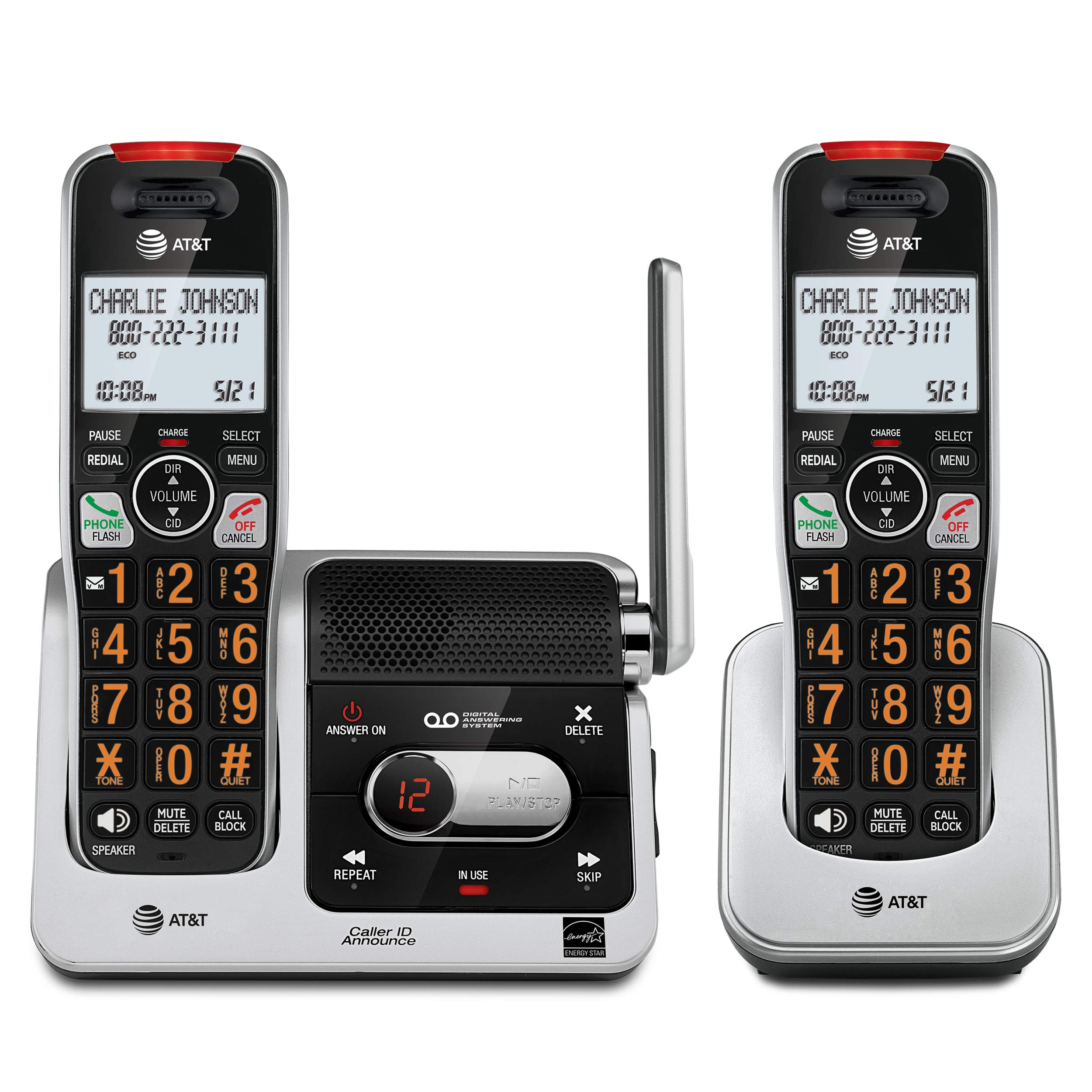
Two handsets, 22 minutes of voicemail, and the same pre-ring Smart Call Blocker as the CL82167.
Two handsets is the number most apartments and single-floor houses actually need, and the BL102-2 delivers that with the same Smart Call Blocker setup as its CL82167 sibling above. Robocalls are pre-filtered before ringing through, you get one-touch blacklisting with a dedicated key, and the block directory stores up to 1,000 entries. The handset also announces the caller’s name so you can decide whether to pick up.
The voicemail side is where the BL102-2 beats its own sibling: recording time is 22 minutes versus 14 on the AT&T EL52113 — a 57% wider window covering incoming messages, outgoing greetings, and household memos. If you routinely let the inbox fill between cleans, that gap is not academic. The 2-inch screen, enlarged font, and lighted keypad carry the same low-light usability, and the Audio Assist mode boosts incoming voice for callers who have trouble hearing the other end.
Call blocking gets 594 mentions — the most-praised feature on the review pages. The catch is mixed feedback on quality, setup, sound, and battery life; some units arrive perfect and some arrive fussy, so test yours inside the return window. AT&T says the range is unsurpassed, helped by a dedicated antenna design and noise-filtering that cuts background hum on long-distance calls.
Who this fits best: Two-floor homes, home offices, or anyone who wants the same sturdy blocklist as the CL82167 with the larger recording window and a spare handset for the kitchen.
The trade-off to weigh: The review spread is wider on this model than on the single-handset AT&T systems — sound quality and battery life both drew enough mixed feedback that testing during the first week is worth doing.
Take this one if: You want the biggest answering machine window from AT&T plus a second handset, and you’re comfortable being the one to spot a lemon quickly.
Pick differently if: You want the tightest quality-control reputation over handset extras — the AT&T CL82167 or the Panasonic KX-TGD833M below both show less mixed sound feedback.
4. Panasonic KX-TGD833M Cordless Phone

The only phone here with 2-way call recording, announced out loud so scammers hang up.
Panasonic’s KX-TGD833M brings a feature nobody else on this list has: 2-way recording of your side of the conversation, saved so you can replay a doctor’s instructions or a contractor’s quote later. The system announces “Start Recording” out loud, which by itself deters most suspicious callers — they hang up rather than have their pitch recorded. Call blocking is equally stacked: automated pre-blocking kicks robocalls, telemarketing call block screens announced callers, and a one-touch button permanently blocks 1,000 more numbers.
One-ring scam protection displays a confirmation screen when you try to return a number that called and hung up after a single ring — the classic trick that racks up premium charges if you call back blind. The illuminated keypad and illuminated keypad with large characters handle dialing in the dark, speed dial gives one-touch access to your most-dialed numbers, and the whole system can be wall-mounted to keep the phone near your standing spot. Setup is described as easy by most reviewers, and answering machine usability gets specific praise.
The recurring honest note is message playback volume — it works, but plenty of owners want it louder. The manual is also thin on some menu details, and a few buyers took several tries to route messages to only the main base instead of ringing on every handset. Range is solid: users report working at 75-plus feet from the base, which handles most single-family homes.
Why three handsets matter: A handset per floor, with one in reserve for the garage or office, turns one answering machine into a whole-home system without extra base units.
The limitation to expect: Message playback volume runs soft, so a kitchen with a dishwasher running isn’t the best place to check voicemail. The 18-minute recording window is also a little tighter than the 22-minute AT&T options in the same tier.
Made for: Two-story homes where the kitchen, bedroom, and office each need a handset — and where recording important calls is worth having.
Not the pick if: You only need one phone in one room — the single-handset AT&T picks earlier save the extra charging cradles and wall outlets.
5. Panasonic KX-TGD864W Cordless Phone
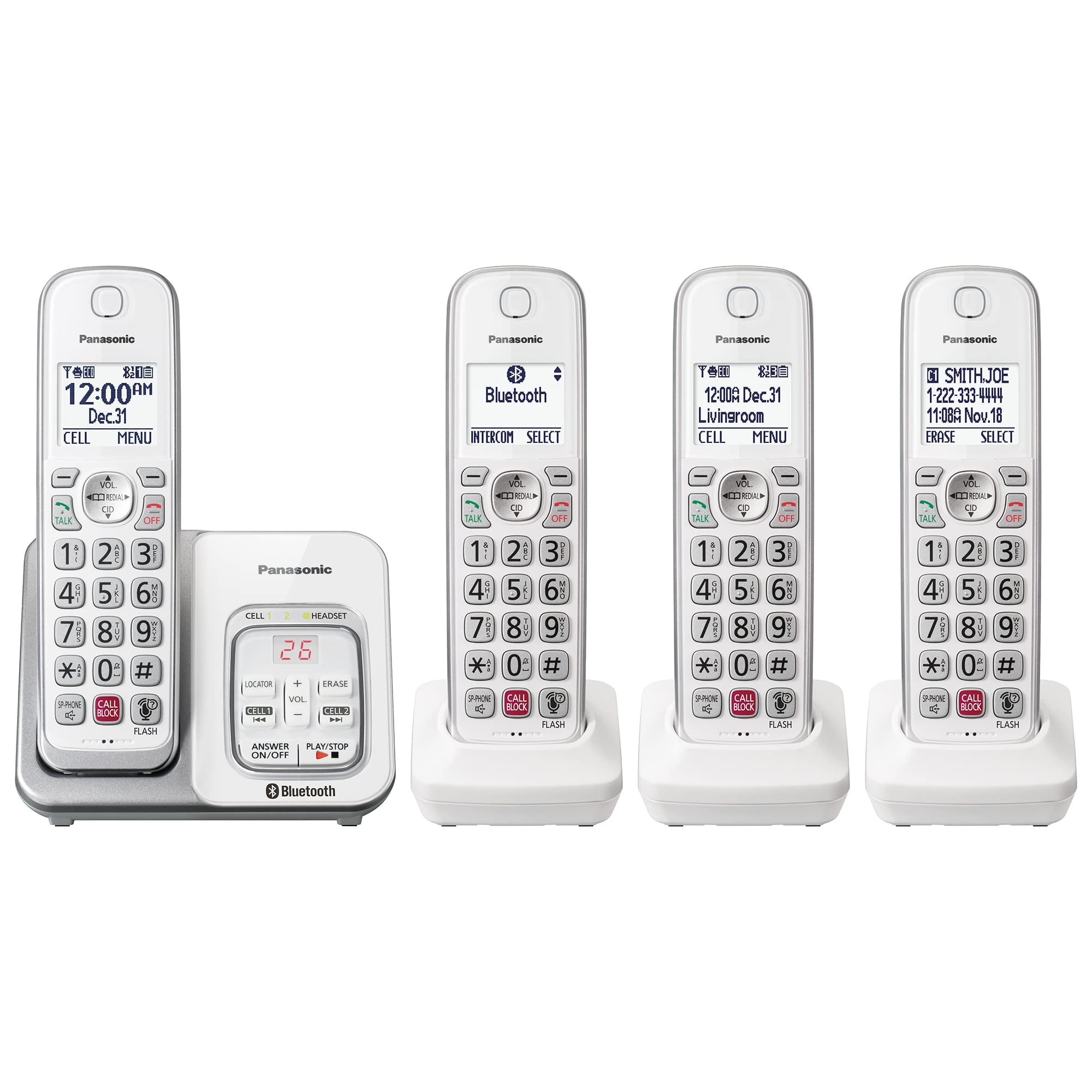
Link2Cell Bluetooth pairs two cell phones, so mobile calls ring on all four handsets.
Four handsets and full Link2Cell Bluetooth — that’s the pitch. Pair up to two cell phones to this base, leave the cells by a strong-signal window, and every mobile call runs through the handsets wherever you are in the house. It’s the practical fix for the cellular dead spot in the back bedroom. Bilingual Talking Caller ID announces callers in English or Spanish so you know who is calling before you walk to the phone.
Call blocking is the same Panasonic stack as the KX-TGD833M: automated robocall pre-blocking, telemarketing call block for announced callers, and one-touch blocking for 1,000 more numbers. One-ring scam alert displays a confirmation screen before you return a suspicious single-ring number. The 2-way recording feature carries over too, with the same out-loud “Start Recording” announcement deterring sketchy callers. Illuminated keypad with large characters, speed dial, wall-mountable base — the usability checklist is fully covered.
Where it differs from the AT&T systems earlier is who owns the network. If your household has cut the cord on a traditional landline and lives on two cell plans, this is the only way to put a cordless phone back in every room without a phone-jack landlord. The catch: the same 18-minute answering window as the KX-TGD833M, and message playback volume draws the identical soft-volume grumble.
The distinguishing trick: Link2Cell turns your cell plan into a home-phone system — pair two phones, answer either one from the kitchen, and stop running to the bedroom phone.
What to weigh: If you don’t use cell phones heavily or your landline already has strong coverage, the extra Bluetooth pairing is a feature you’ll never touch, and the AT&T CL82167 at a similar tier wins on call-block legend.
The right home: Households where one or two members rely on cell phones but everyone loves having a cordless handset in every room.
Skip this one if: You want pure landline simplicity and never intend to route cell calls through the base — the extra pairing menu is unnecessary friction.
6. VTech IS8151-5 Cordless Phone

Up to 2,300 feet of range, the longest here, plus five handsets and a 3.5-inch base screen.
Range is the story. VTech rates the IS8151-5 at up to 2,300 feet from base, which is the largest working distance on this list, and owners confirm taking calls to the mailbox, the back acre, and through thick stucco walls that kill most cordless systems. Five handsets in the box means one per room plus spares, and the system expands to 12 total using IS8101 accessory handsets — the widest expansion ceiling here, matching the AT&T CL82167 and BL102-2. Two large screens help: a 2-inch handset screen and a 3.5-inch base screen for reading caller ID across the room.
Call blocking is a full multi-layer build. Robocalls can be screened by asking the caller to press the pound key before the phone rings; unknown callers can be asked to record their name first; and one-touch blocking catches whoever slips through. A voice guide walks you through setup, and the digital answering system holds up to 22 minutes of combined messages and memos with an LED message counter. Bluetooth connects up to two cell phones — or one cell phone and a Bluetooth headset — and lets you use Siri or Google Now from the handset for calls, texts, and voice replies.
What wins people over is the raw quality of the system — 498 mentions of quality on the review pages is the top aspect, and call blocking follows right behind at 150 mentions. The recurring gripes are a bright red night light on the base, and a blocklist flow that some found confusing when trying to whitelist legit callers like doctor’s offices and delivery drivers. Speaker volume also draws complaints from hard-of-hearing owners, so if the person using it is hearing impaired, test volume before committing.
Where it wins outright: Nobody else here reaches as far as 2,300 feet, and the 3.5-inch base screen plus 22-minute voicemail make it the most generous package for a big property.
Plan for this: The blocking whitelist flow takes a few minutes to learn — press “2” to permanently approve a legit number, not “1” — and the volume ceiling is real for anyone with significant hearing loss.
The fit: Houses with a yard, garage, garden, or shop that need a phone to follow you outside — casual range just won’t cut it here.
Consider skipping if: You live in an apartment and care more about a quiet ringer than reaching the mailbox — the AT&T CL82167 blocks robocalls more cleanly for city-size dwellings.
7. Panasonic KX-TGE645M DECT 6.0 Expandable System with Answering Machine, 5 Handsets

Five handsets on one base, upright stand-up design, and bilingual talking caller ID.
Five handsets from the start, no expansion required — the KX-TGE645M is the phone for a house where every floor, the office, the garage, and the guest room all get their own handset. Panasonic’s standout ergonomic is that these phones stand upright on a counter (unlike most rivals that lie flat), and the intercom lets you name each handset so its screen shows the room it belongs in — you know exactly where to return a misplaced phone. There’s also a cell-phone locator button that rings your mobile if you set it down and can’t find it.
The digital answering system stores up to 17 minutes of messages across incoming calls, outgoing greetings, and memos, with a Quick-Read message counter so you can see at a glance how many messages are waiting. Retrieval works from the base or from any handset. Bilingual Talking Caller ID announces incoming callers in English or Spanish — helpful for households with Spanish-speaking members, and handy when you’re across the room. Automated call blocking prompts callers for an access code to screen robocalls, and the one-touch block button blacklists individual numbers instantly.
What owners rave about is the long-term reliability of the Panasonic system — one household replaced a similar set that lasted 13 years on the original batteries. Setup is logical and easy, and the larger display is a genuine upgrade over the older generation. The recurring honest critique is tactile: the main console buttons need a firm push to dial out, which one buyer called out honestly in the review pages: “The biggest negative is the main console they made the buttons harder to push for calling out – otherwise would give it a 5.”
The one upgrade you’ll touch daily: Stand-up upright handsets with named intercom labels — a small ergonomic detail that changes how the phone feels in the hand every single call.
The trade-off worth knowing: The 17-minute recording window is the smallest here, and the base console buttons require deliberate presses rather than light taps. Neither is a dealbreaker; both are worth knowing going in.
Right for: Large households that want a handset in every room without buying expansion handsets piecemeal, and families that want bilingual caller ID.
Choose the VTech IS8151-5 instead if: You need wider range to a yard or mailbox — VTech’s 2,300 feet beats the Panasonic’s already solid working range.
Know the Specs
DECT 6.0 — what it actually means
DECT 6.0 is the cordless radio standard that runs on its own frequency band, away from Wi-Fi and Bluetooth traffic. In real life it means fewer dropped syllables when the microwave runs and fewer neighbors overhearing your calls through the radio, because the transmission is digitally encrypted end-to-end. Every phone on this list uses DECT 6.0.
Answering machine recording time
The number — 14, 17, 22 minutes — measures total stored audio across incoming voicemails, your personal outgoing greeting, and household memos. Higher counts mean you can leave the inbox longer between cleanouts. The AT&T EL52113 sits at 14 minutes, the Panasonic KX-TGE645M at 17 minutes, and several AT&T and VTech systems at 22 minutes.
Pre-ring call blocking
Robocalls are best stopped before the ringer fires, not after. AT&T Smart Call Blocker and Panasonic Automated Call Blocking both work this way. Panasonic adds a prompt asking unknown callers for an access code, and both brands offer one-touch permanent blacklisting. A 1,000-entry list is the practical storage ceiling here — plenty for most households.
Handset count versus range
Handset count is a coverage decision, not a quality marker. One handset per occupied floor keeps everyone in reach without recharging every hour. Range is the second half of that math: VTech publishes up to 2,300 feet, AT&T describes its range as unsurpassed, and Panasonic owners mention working comfortably at 75-plus feet from the base.
Common Questions
Will a cordless phone with answering machine work on a VoIP line?
How does pre-ring call blocking actually work?
Can I add more handsets later?
Does the answering machine still record if the power goes out?
What is 2-way recording and does every pick have it?
Will my existing landline wiring handle a DECT 6.0 cordless system?
Which pick is best for someone with hearing loss?
Can I Bluetooth-pair my cell phone to these cordless systems?
How long do the rechargeable handset batteries last?
How much voicemail recording time do I actually need?
The Bottom Line
For most homes, the cordless phones with answering machine winner is the AT&T EL52113 — because it holds the highest customer score in this group at 4.0+ stars across 18,000+ owners, and its oversized backlit keys and big font solve the one daily problem a cordless phone actually creates: dialing in low light. If robocalls are your battle, grab the AT&T CL82167 and let the pre-ring blocklist do the work. For a yard, garden, or mailbox need, the VTech IS8151-5 at up to 2,300 feet of range is the one to reach for. And for large households wanting a handset in every room plus bilingual caller ID, the Panasonic KX-TGE645M delivers five handsets on one base. If you want to check current Amazon pricing on any of these, the links above go straight to the live listings.
How we choose
We do not accept paid placement. Every pick is matched to a real buyer and a real use-case; we do not hands-on test units.
Sources
Specifications: manufacturer listings and product documentation. Review insights: verified customer reviews, as of October 2026. Pricing: not shown on this page (it changes often); check the current price via the retailer link.
As an Amazon Associate, Aappliancez earns from qualifying purchases. This does not affect which products we feature.