Disclosure: Some links in this post are affiliate links. As an Amazon Associate I earn from qualifying purchases, at no extra cost to you. Learn more
Specs are compiled from manufacturer listings and verified buyer reviews and can change over time — please confirm the key details on the product page before buying.
You want a nailer that drives a 3-1/2 inch framing nail flush without dragging a compressor, a hose, and a generator behind you. Simple as that. The short answer is that battery framing nailers have finally caught up to air guns on power, and the real differences now are weight, magazine capacity, and which nail strip the tool will actually feed without jamming. This guide sorts the current crop by the jobsite reality behind each spec.
This guide is built by comparing the manufacturers’ published specifications and the patterns across verified customer reviews, so you get each pick’s real strengths and trade-offs instead of marketing spin.
You will see which guns shoot 3-1/2 inch fasteners into dense lumber, which ones force you into one brand of nail strip, and which ones will wear your arm out by lunchtime. Here is what actually matters when you shop for the best cordless framing nailer.
Top Picks


How To Choose The Best Cordless Framing Nailer
A framing nailer is not a trim gun with a bigger nose. It has to seat a nail the length of your finger into engineered lumber, over and over, all day, without a compressor to lean on. That job puts three things under strain: the drive motor, the magazine that feeds the strip, and your arm. Pick well on those three and the rest is convenience.
Nail angle and collation decide your fastener supply
Framing nailers feed plastic or paper collated strips set at a fixed angle — 21-degree, 30-degree, or 33-degree. A 21-degree gun takes full round head nails; a 30-degree gun takes clipped or offset head nails in a paper tape. Buy the wrong strip and the tool will jam or refuse to seat the head. Check the nail length range the gun accepts before anything else — several here handle up to 3-1/2 inches, and at least one stops at 3-1/4 inches.
Weight in pounds is the spec you feel at 3 p.m.
A cordless framing nailer carries the motor, the drive spring, and a battery, so it runs heavier than the air gun it replaces. The spread here runs from a claimed 7.9 pounds up to 11.9 pounds with a battery fitted. That gap is the difference between one-handed work up a ladder and needing both hands to steady the tool. If you frame overhead or work alone, weight belongs near the top of your list.
Magazine capacity and reload stops
Capacity ranges from a 41-nail rear-load magazine up to a 55-nail strip. More capacity means fewer stops mid-wall, but a longer magazine pushes the tool’s balance forward. Read the load specs against how you work — a punch-out crew reloads constantly, while a deck builder can afford a short magazine.
Bump fire, sequential, and dry-fire lockout
Bump fire lets you hold the trigger and fire a nail each time the nose contacts the wood — fast, but it demands control. Sequential mode fires once per full trigger pull and is safer on ladders and near edges. A dry-fire lockout stops the tool from firing blanks when the strip runs low, which saves the driver blade and the workpiece. Most of the picks here offer both modes through a selector.
Side-by-Side Comparison
| Model | Best For | Fastener Angle | Max Nail Length | Weight | Amazon |
|---|---|---|---|---|---|
| Milwauke M18 FUEL 21-Degree Framing Nailer★ Best Overall | All-day framing with consistent depth | 21-degree | — | 10 pounds | Amazon |
| DEWALT 20V MAX Framing Nailer Kit (DCN692M1)Complete Kit | Buying a complete kit in one box | 30-degree | 3-1/2 inches | 7.8 pounds | Amazon |
| Ryobi 18V ONE+ Airstrike Brad Nailer P321Budget Trim Pick | Light trim and punch-list work | 18-gauge brad | — | 6 pounds | Amazon |
| NuMax SFR2190WN Pneumatic Framing Nailer | Framing on a compressor-based budget | 21-degree | 3-1/2 inches | 8.6 pounds | Amazon |
| WORX 20V 18GA Brad Nailer WX842L | Trim, molding, and small builds | 18-gauge brad | 2 inches | 7.06 pounds | Amazon |
| Milwauke M18 FUEL Gen II 18-Gauge Brad Nailer | Professional finish work | 18-gauge brad | — | — | Amazon |
| CRAFTSMAN V20 Framing Nailer CMCN621PLB | Fence and wall runs on the V20 platform | 21-degree | 3-1/4 inches | 10.75 pounds | Amazon |
| Paslode Cordless Xpro 30 Degree 906800 | Lightest carry up a ladder | 30-degree | — | 7.9 pounds | Amazon |
| DEWALT 20V 30-Degree Framing Nailer DCN930B | Crews beating on one gun | 30-degree | — | 9.9 pounds | Amazon |
| Makita XNB03Z 18V LXT Framing Nailer | Long runs on a single charge | 21-degree | 3-1/2 inches | 11.9 pounds | Amazon |
| Metabo HPT NR1890DRS Framing Nailer Kit | Full kit with a lifetime tool warranty | 21-degree | 3-1/2 inches | 10.1 pounds | Amazon |
Detailed Reviews
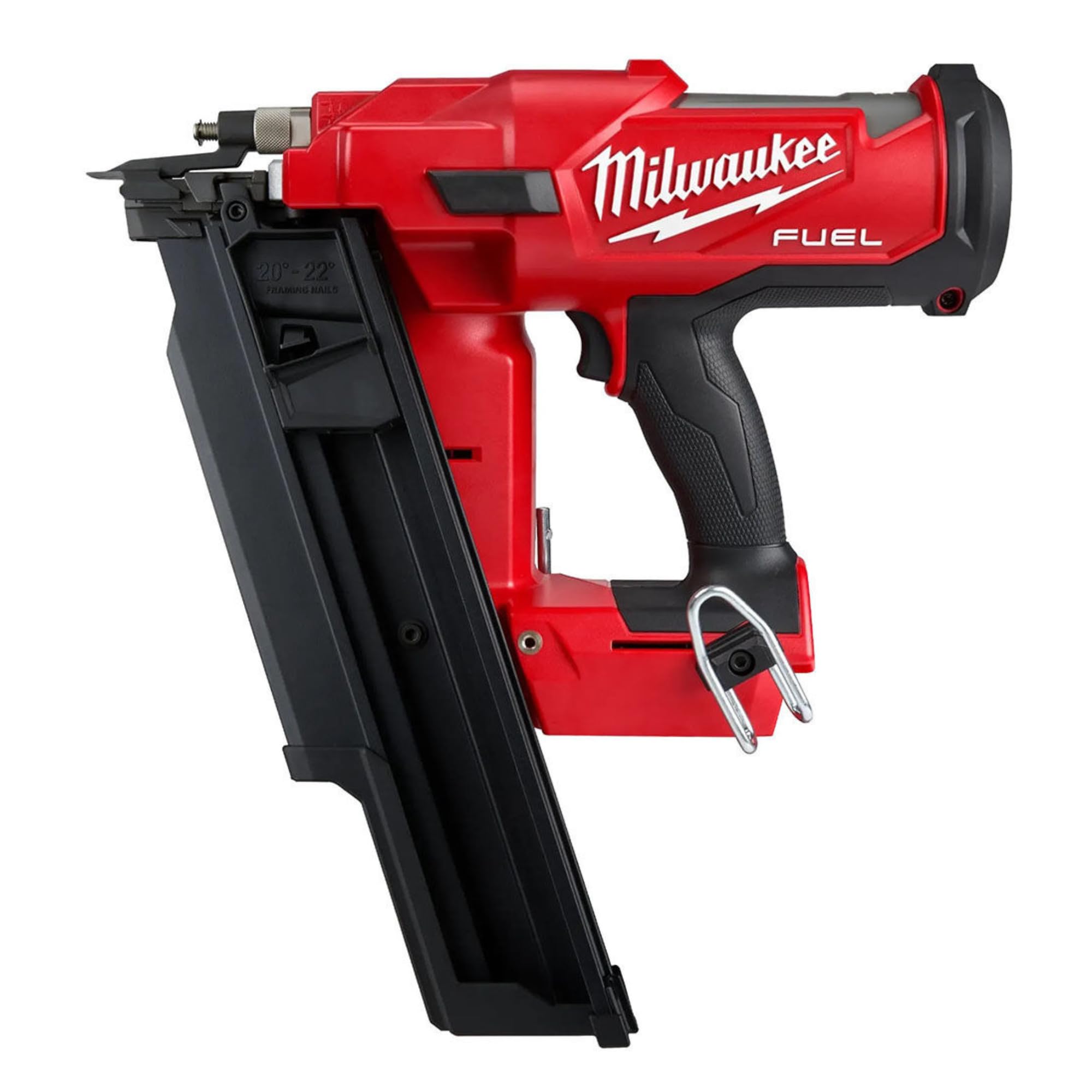
1. Milwauke M18 FUEL 21-Degree Framing Nailer (Tool Only) New
Our pick — 4.5+★ from 350+ verified ratings; the strongest balance of quality and price.
A 21-degree framer that drives every nail to the same depth, at 10 pounds.
This is the crowd favorite of the group — 4.5+ stars across 300+ owners — and the reason sits in the repeatability. Owners describe a nailer that drives the first nail and the twentieth to identical depth, with a 2-second tool-free depth adjustment when you move to a different material. Switch from a pneumatic and you stop dragging a hose and waiting on a compressor to charge, which is why so many trades make the jump.
The 21-degree magazine feeds full round head nails, and buyers report reloads are quick through the rear-load design. Where this gun separates itself is reliability on the strip — the drive train simply keeps feeding. The nail capacity quirk shows up in use: the magazine will take about one and a half slats rather than two full ones, so you reload a touch sooner than the capacity number suggests. Weight is the real trade-off. At 10 pounds it is a workout over a full day, and owners say so plainly.
Buyers who switched from a compressor setup call it a time saver, and one sums it up this way: “Has more than enough power for typical applications, and its never jammed. That said its mag doesn’t hold two full nail slats, only 1.5 for some reason. Also its a heavy tool so using it all day is a workout.” That is a fair read of the gun — the power and depth consistency are pro-grade, and the tax is arm fatigue. If you frame all day every day on a crew, budget for a lighter backup or plan your holds.
What earns the top spot
- Consistent nail depth from the first shot to the last, with a 2-second depth adjustment
- Rear-load magazine on a 21-degree strip with quick reloads
- No compressor, hose, or gas cartridge to haul or prime
What you should know before buying
- 10 pounds is heavy for extended overhead or all-day use
- The magazine takes about one and a half nail slats rather than two full ones
- Tool only — battery and charger are not included
Settle on this one if: you want the most consistent depth and the strongest reliability reputation in the lineup, and you already run M18 batteries.
Think twice if: you work overhead or solo up a ladder all day, where 10 pounds will wear on you by mid-afternoon.
2. DEWALT 20V MAX Framing Nailer Kit DCN692M1
A 30-degree kit with battery, charger, and bag in the box, at 7.8 pounds.
If you are starting from nothing, this kit removes the homework. You get the DCN692 nailer, a DCB204 20V MAX battery, a DCB115 charger, a no-mar tip, and a kit bag, so the tool fires the day it lands. The 30-degree magazine drives paper collated nails up to 3-1/2 inches into dense lumber, and the dual-speed motor lets you match the drive to the material instead of forcing one setting through everything.
You get jobsite features, not bench-only ones. A tool-free selector switches between sequential fire (one nail per trigger pull) and bump fire (hold the trigger and tap the nose to fire), and depth adjusts without tools. A stall release lever resets the driver blade after a jam, and a dry fire lockout stops the tool firing on an empty strip. The adjustable rafter hook hangs the gun on a roof, and the nosepiece opens for jam removal. Owners who built a 400 sq ft cabin with it called it workhorse performance, and reported a 6Ah battery lasting nearly a full day of hard use.
Nails are where this gun asks for your attention. It is fussiest about which strips you feed it — one owner found the gun would not drive ring shank nails well, and another notes that off-brand strips jam unless the tips are black. Let the motor reach full speed before you fire and the jams mostly disappear. That nail discipline is the price of a 30-degree paper collated setup.
Verdict on the drive: You can carry this framer all day more easily than most, because it drives 3-1/2 inch nails from a 7.8-pound body — noticeably lighter than the 10-pound Milwauke above. The kit also saves you buying a battery separately.
The right call for: first-time framing buyers who want everything in one box and can commit to one brand of paper collated strip.
Not your tool if: you plan to run ring shank nails throughout a build, where the drive is known to struggle.
3. Ryobi 18V ONE+ Brad Nailer P321
A 6-pound 18-gauge brad nailer for trim work, not 3-1/2 inch framing nails.
Read the spec before you assume this is a framer: it is an 18-gauge brad nailer, so it fires thin trim nails, not 3-1/2 inch framing fasteners. What it does well is kill the compressor setup for trim and punch-list work. Owners who keep an air brad nailer in the shop say this one wins on convenience — no hose to drag, no compressor to start, no cool-down. At 6 pounds it is 4 pounds lighter than the 10-pound Milwuakee framer above, so it lives comfortably in one hand for beadboard and casing work.
The bright spot owners talk about most is value — this is a budget-tier tool that earns its keep on small jobs, and the ONE+ platform means the batteries you already own run it. Setup takes seconds compared with a compressor. What the design will not do is drive big framing nails, so keep expectations tied to trim, panel molding, and fastening light stock.
The honest caveat sits in the reliability column. Most units run clean, but a minority fail early — one example stopped driving nails after about half a magazine, and support could not bring it back. That risk profile is normal for the price tier and the 30-day limited warranty is short, so inspect it hard in the first month of use. Oil the tool and use the recommended brads, and you tilt the odds in your favor.
Where it shines
- Runs on the 18V ONE+ batteries you may already own
- 6 pounds is easy to carry for trim and overhead work
- Skips the compressor setup entirely for punch-list jobs
Where the limits are
- 18-gauge brad nails only — not a framing tool
- Short 30-day limited warranty on reliability
- A small number of units fail early; inspect during the return window
Best fit: a trim carpenter or DIYer who already lives in the ONE+ system and wants the compressor gone for small jobs.
Step past it if: you need a gun for structural framing or 3-1/2 inch nails — this is a brad nailer, not a framer.
4. NuMax SFR2190WN Framing Nailer

A pneumatic 21-degree framer that needs a compressor but costs far less than a battery gun.
This one is not cordless, and that is the whole point. It is a pneumatic framer (an air-powered gun that hooks to your compressor) and delivers raw power for a fraction of what a battery framer asks. If your site already runs air, this gun is genuinely worth a look. It drives 21-degree plastic collated full round head nails (nails held in a plastic strip at a 21-degree angle) from 2 inches up to 3-1/2 inches with a 0.113 to 0.131 inch shank (the nail’s shaft thickness), so it handles both framing and sheathing. It ships with 500 3-inch bright framing nails to get you started.
You get the same features as the big-name framers. A dual-mode trigger lets you choose bump fire (hold the trigger and tap the nose) or sequential fire (one nail per pull), and depth adjusts without tools. An anti-dry-firing design protects the internals, a one-piece drive blade adds durability, and a pull-back pusher magazine loads fast. The comfort-grip handle helps on long framing runs. Owners liken its output to more expensive models — one framed an entire two-story house with it, from framing nails down to sheathing, and called it a workhorse.
The trade-offs are the compressor tax and the packaging. You will need a compressor and hose, and one product arrived scuffed up in its box because of loose shipping — the tool itself worked fine, but check the depth adjustment and the pressure settings on arrival. Durability opinions split, which is the honest story for a budget-tier air gun; it is not built to the same tolerance as a premium framer, but it delivers the volume.
Straight talk on the power: You get pnuematic-grade drive force in a 8.6-pound body, and the included 500-count nail pack gets you through your first wall without a store run.
Go here if: your compressor and hose are already on site and you want maximum framing power for the least money.
Keep walking if: you need to work off a ladder without air — this gun cannot leave the compressor behind.
5. WORX Cordless Brad Nailer, 20V 18GA Nail Gun, WX842L

A 20V 18-gauge brad nailer that fires up to 80 nails per minute into hardwood.
The WORX WX842L takes brad nails up to 2 inches and uses an air impact drive to push them into hardwood — no compressor, no cartridge. It fires up to 80 nails per minute, which makes short work of baseboards, window trim, and panel molding. The magazine loads easily and the tool-free jam release clears a stuck nail without reaching for an Allen wrench. Depth adjustment sets heads flush on trim.
On the platform side, the 20V battery that runs this nailer also runs the wider Power Share lineup, so one battery covers a shelf of tools. Owners point to the build and the smooth drive as the reasons it stays in their kit — beadboard, planter boxes, and small trim jobs come up again and again.
The honest edge is bulk and nail penetration. It is somewhat heavy for prolonged one-handed use, and on dense hardwood you may find a nail or two under-driven, so a firm press against the wood and the correct depth setting do the work. It will not push into engineered framing lumber the way a 21-degree framer does — this is a trim tool, and it should be chosen as one.
Why it earns a spot
- Fires up to 80 nails per minute for fast trim coverage
- Anti-ejection design keeps nails from flying when you open the magazine
- Tool-free jam release and depth adjust
What to keep in mind
- Somewhat heavy for prolonged one-handed use
- Nail penetration is mixed on dense hardwood
- 2-inch brad capacity — not a structural framing tool
Point your money here if: you want a battery trim gun that still fires into 2×4 stock without a compressor.
Pass it by if: your work runs long on 2-inch-plus dense hardwood where penetration is the make-or-break spec.
6. M18 FUEL 18-Gauge Brad Nailer
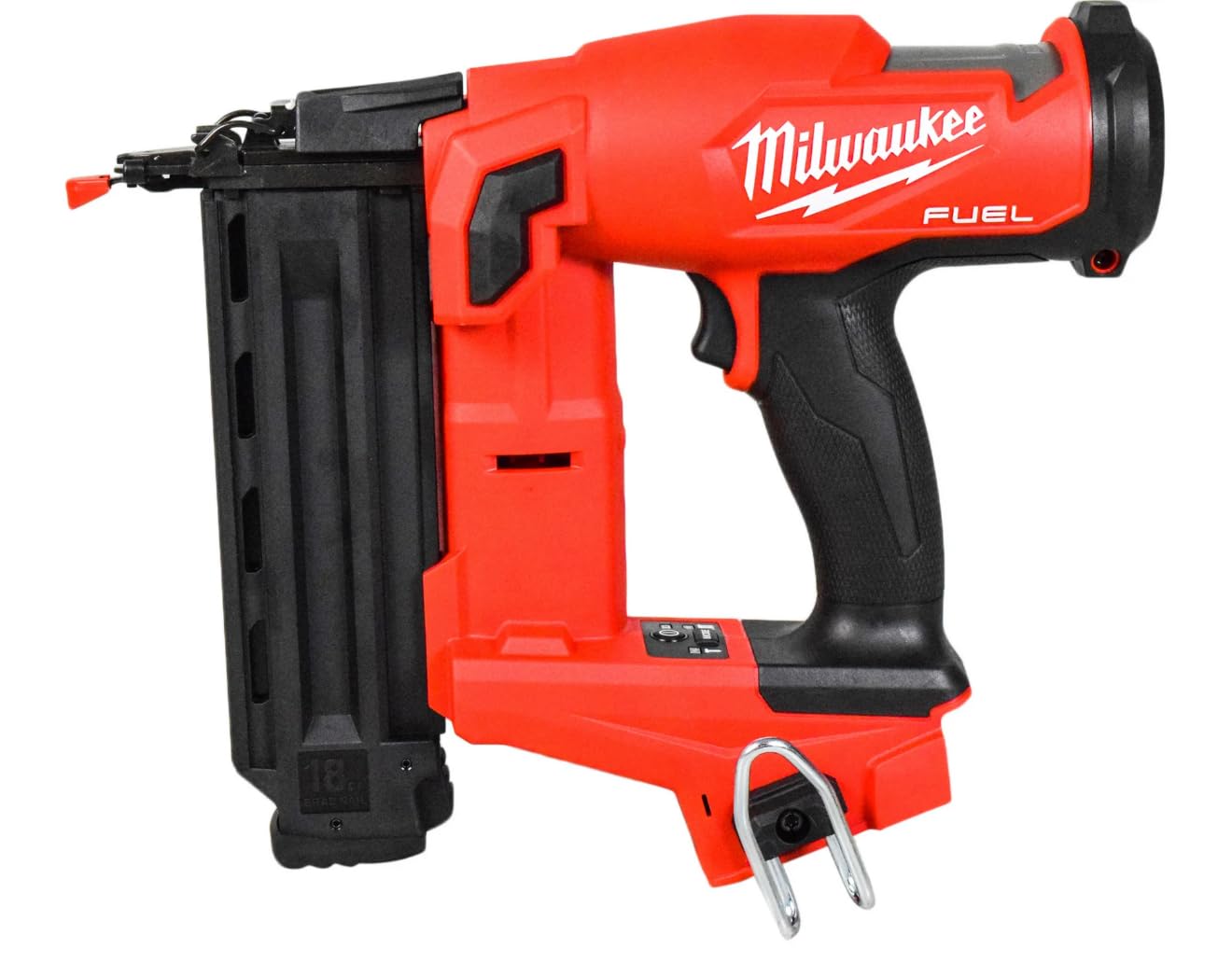
An M18 brushless 18-gauge brad nailer that sinks brads into oak casings without a compressor.
Trim carpenters who need a brad nailer that seats every head cleanly in oak casings will find a lot to like here. The M18 Gen II brad nailer drives 18-gauge brads into hardwood up to nearly 2 inches thick without a compressor, and the brushless motor on the M18 platform means it shares batteries with the rest of the lineup. Owners drove hundreds of brads on a door and window casing job and reported only a handful failing to sink at the highest depth setting.
For someone new to nail guns, the learning curve is short. A complete novice described it as easy to use and figured it all out in 10 minutes, then used it for railing and modeling with no trouble. That ease matters if you are stepping up from a manual hammer or a rented air brad gun — there is no compressor to dial in and no hose to fight.
The quality and value story lands where you would expect for a FUEL-tier tool. If you are a weekend DIYer doing one shelf a year, a cheaper brad gun makes more sense; this one is aimed at people who will fire a few thousand brads.
The one-spec takeaway: a brushless M18 finish driver that pushes an 18-gauge brad into an oak casing nearly 2 inches thick and has the reliability to keep firing through a full project.
Buy this if: you are a carpenter already invested in M18 batteries and want finish-grade pull-trigger control.
Look elsewhere if: you only nail a few boards a year — the premium over a budget brad gun will not pay back in your shop.
7. CRAFTSMAN V20 Framing Nailer CMCN621PLB

A 21-degree framer for fence lines and wall runs that runs on CRAFTSMAN V20 batteries.
If you keep CRAFTSMAN V20 batteries for yard tools and drills, this framer plugs straight into that system and saves you buying a new platform. It is a 21-degree gun that drives up to 3-1/4 inch round head nails into laminated veneer lumber, with tool-free depth adjustment for flush placement. The rafter hook is a nice touch for wall and roof work, and there is no compressor or gas cartridge to bring along.
Owners who put it on a fence project drove 160 linear feet of fence in a day and a half with this gun and called the output impressive for the tier. The build quality earns the most praise, and the motor has enough punch to drive nails into old lumber “like butter.” For a crew that wants a cordless framer without a premium price tag, it handles the volume.
The catch is weight and the occasional jam. At 10.75 pounds this is one of the heavier framers here, so overhead work will remind you. Owners also see the occasional jam, though most accept it as normal for any nail gun. A tool-free depth adjust does the fine work, and the 3-year limited warranty backs the tool. One unit died after a couple of hours, but that is the rare exception rather than the rule.
What the numbers say: 10.75 pounds is heavier than the 7.9-pound Paslode and the 7.8-pound DEWALT kit above, so if you work overhead all day, factor that in.
Reach for this if: you already own CRAFTSMAN V20 batteries and need a framing gun for fences, walls, and deck builds.
Leave it on the shelf if: you work overhead for hours — the 10.75-pound body will tell on your shoulders.
8. Paslode Cordless Xpro Framing Nailer 906800

A gas-cartridge 30-degree framer claimed at 7.9 pounds and 6,000 shots per charge.
The Paslode Xpro makes its case on weight and battery life. At a claimed 7.9 pounds it is the lightest cordless framing nailer the maker lists, and that matters most when you are on a ladder or carrying a gun for hours. The maker also specs 6,000 shots per charge — a number worth weighing against the 41-nail class magazine capacity, because you will reload far more than you recharge.
Owners who bought refurbished units report the tool works better than expected and view it as money well spent. The fuel and nail loading is easy to learn, and one job-site favorite dropped off a ladder several times keeps working like new. Paslode has a long reputation among framing carpenters, and this gun carries that forward in a 30-degree format that drives nails flush into demanding materials.
The catch with any gas-cartridge framer is that you are buying fuel cells and specialty nails alongside the battery. That is upkeep you do not have with a pure battery-electric gun. The trade-off for the lightest carry is a running consumables cost and a magazine that asks you to reload through a big framing day.
Carry weight versus consumables: The 7.9-pound claim and 6,000-shot charge are genuinely attractive for ladder work, but gas cartridges and Paslode nails are a tax a battery-only gun avoids.
The gun for you if: you are a pro who lives on ladders and will trade for the lightest carry and longest runtime per charge.
Better elsewhere if: you want to skip gas cartridges and specialty nails entirely — a pure battery framer is less upkeep.
9. 20V 30DEG FRAMING NAILER BARE

A 30-degree bare-tool framer that a whole crew can lean on.
This DEWALT 30-degree framer (model DCN930B) is a bare tool, so you bring the battery and charger — a plus if you already run the 20V MAX platform. At 9.9 pounds it sits in the middle of the pack on weight. The gun takes 30-degree paper tape nails, and owners who framed a small wall with it say a cordless setup beat dragging out the compressor and hose. The convenience read is strong: no tank, no regulator, no cooldown.
On a working crew, this gun has proven it can take the daily beat. One crew harnessed it hard and it held up without issue. Another owner fired it all day and never saw a failure to sink the nail, a misfire, or a jam — the only minor drawback being the weight against the performance and convenience it delivers. That noise profile and durability picture is a good match for framing and structural work.
The honest issue is consistency of the drive on the 30-degree strip. Most units fire clean, but one buyer documented double-shots and bent nails across four different brands of paper tape full head and clipped head nails — a real problem, though not one most owners share. Check the strip seating, use clean tape, and make sure the battery is charged before you lay out a wall.
What the fan mail says
- Powerful, smooth firing that has yet to fail to sink a nail in sustained use
- Framed a small wall in 15 minutes without a compressor or hose
- Held up to a crew working it hard over a full day
What to watch
- 9.9 pounds can wear on you overhead
- One documented case of double-shots and bent nails across multiple strip brands
- Bare tool — battery and charger sold separately
Where it fits: a framing crew already on DEWALT 20V batteries that wants a rugged 30-degree gun without paying for another battery kit.
Where to look elsewhere: if you want a fully kitted first setup, a tool-only buy leaves you sourcing battery and charger on your own.
10. Makita XNB03Z 18V LXT Framing Nailer
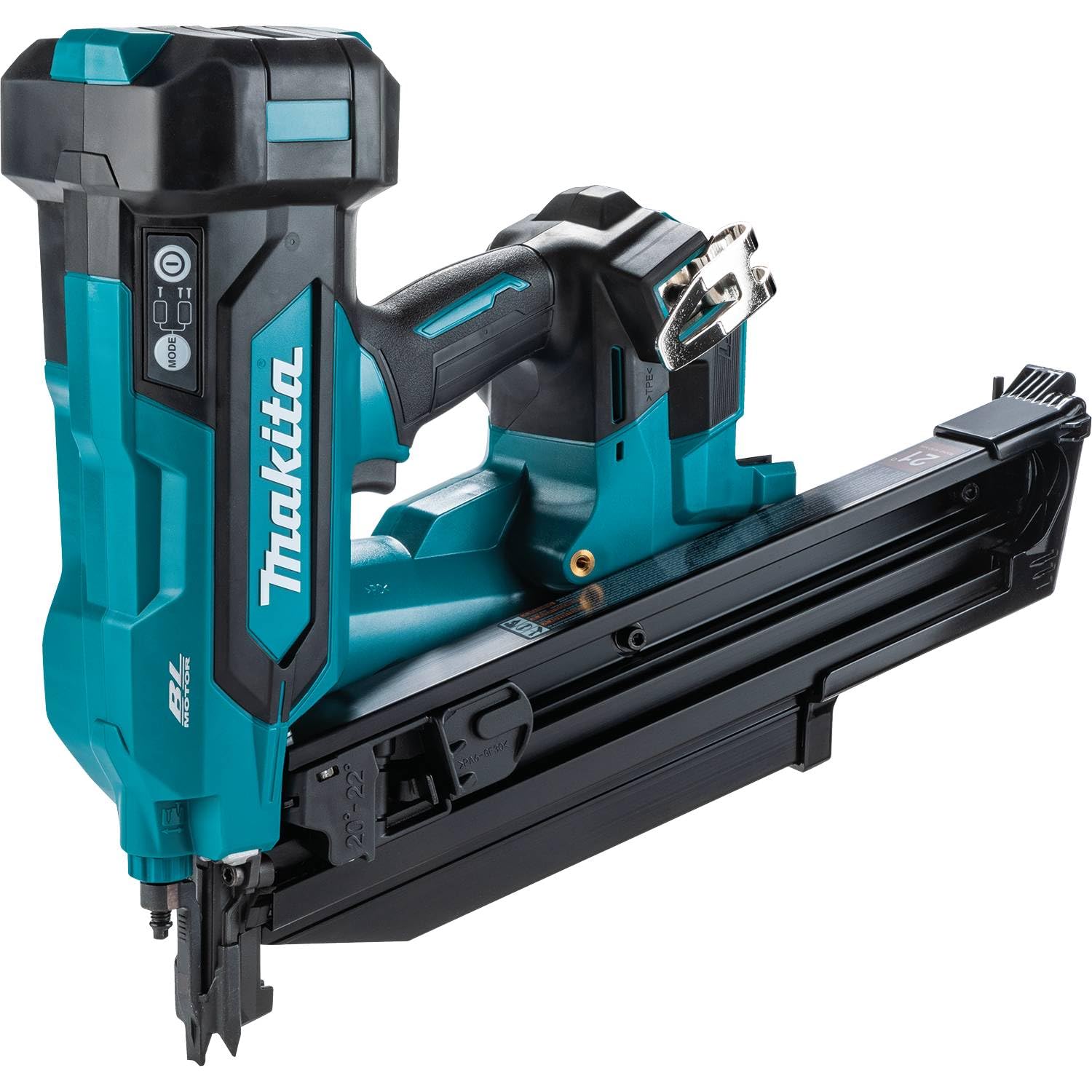
A 21-degree framer built to fire up to 1,000 nails on a single LXT charge.
Runtime is the headline with the Makita XNB03Z, and it is a serious number: up to 1,000 framing nails on a single charge. For a framing contractor or deck builder working through long runs without a generator, that is real time saved at the ladder. The gun takes 21-degree plastic collated full round head nails from 2 inches to 3-1/2 inches and 0.113 to 0.148 inch shank, with a 41-nail rear lock-and-load magazine to keep you firing.
Owners describe a powerful, consistent driver that seats nails clean with no hose or compressor. The 2-mode selector gives you sequential or bump fire, an anti-slip nose helps control angled shots, and the tool-less depth adjustment handles flush and countersink work. Owners put the battery stamina through its paces, with steady use still leaving charge on one battery — a genuine advantage over shorter-runtime framers.
Now the weight, which is the one real gripe. This gun is 11.9 pounds with an 18V LXT battery fitted and it is the heaviest framer in this lineup — owners feel the arm fatigue and say so. It must be braced or rested for overhead work. It also will not carry two full nail sleeves, so expect to reload often. Set both of those against up to 1,000 nails per charge and the trading is clear.
The weight-versus-runtime trade: a 41-nail magazine and up to 1,000 nails per charge are top-of-class, but 11.9 pounds with a battery makes this an arm-wear tool on a long day.
Pick it for: long framing runs where minimizing charge swaps beats minimizing weight, and you are already on LXT batteries.
Do not pick it for: overhead and ladder work or long one-handed stretches, where the 11.9-pound load will slow you down.
11. Metabo HPT 18V Framing Nailer Kit NR1890DRS

The complete kit with a lifetime tool warranty and a pneumatic-like feel.
Where most framers here sell as bare tools, the Metabo HPT arrives as a full kit: the NR1890DRS nailer, a compact 3.0Ah lithium-ion battery, a fast charger, a contractor bag, and safety glasses. The tool warranty is a lifetime on the nailer, which is a real reason to look here if you want long-term coverage. The 18V brushless motor drives 21-degree plastic strip collated nails from 2 inches up to 3-1/2 inches, and the air spring drive system is built to feel like a pneumatic gun.
Owners point to the punch-out use case — no tank, no hose, no ramp-up. Drivers with extensive experience report thousands of nails with zero misfires and consistent depth once dialed in, and one user with an 18/36V 8Ah battery drove around 2,000 nails per charge. The bump-to-sequential switch is fast, and the tool-less depth adjust keeps the finish clean. On paper the maker rates 400 nails per charge on the included 3.0Ah battery.
The catch is nail brand dependency and weight. This gun prefers Metabo HPT/Hitachi strips — off-brand plastic placement leads to jams, so you are somewhat locked into one supply. It is also 10.1 pounds, and several owners note the weight. Depth adjustment sometimes needs a few test nails before it settles, and occasional under-drives need a hammer tap. Set against the lifetime tool warranty and the pneumatic feel, the trade-offs are worth understanding up front.
Kit value and the warranty: a full kit including a fast charger and lifetime tool warranty is the standout here — but the gun prefers Metabo HPT strips, so factor in that nail source.
Choose this one if: you want a complete kit with a lifetime tool warranty and are willing to commit to Metabo HPT nails.
Look past it if: you need the lightest possible carry or want total freedom to run any brand of 21-degree strip.
Know the Specs
Nail angle and collation (21-degree vs 30-degree)
The angle is the tilt of the nail strip as it feeds into the magazine. A 21-degree gun takes full round head nails; a 30-degree gun takes clipped or offset head nails in a paper tape. The two do not swap. Pick your strip before you pick your gun, because the angle locks you into a family of fasteners, and the wrong strip causes jams or half-set heads.
Magazine capacity in nails
A larger magazine means fewer reload stops mid-run. The range in this lineup runs from a 41-nail capacity on the Makita up to a 55-nail strip on the DEWALT kit. A short magazine keeps the gun balanced but forces more reloads, so match capacity to whether your day is punch-out or long runs of framing.
Weight with battery
The weight you carry includes the motor, the drive spring, and a battery. The spread here runs from a claimed 7.9 pounds on the Paslode up to 11.9 pounds on the Makita with a battery fitted. Overhead or one-handed work turns that difference into minutes and fatigue, so weigh the tool against the way you actually use it.
Drive motor: brushed versus brushless
A brushless motor uses electronics instead of carbon brushes to spin, which typically means less maintenance and longer runtime per charge. On the Metabo HPT and CRAFTSMAN picks, the brushless motor is called out as the reason for longer run time and increased durability. If you fire thousands of nails, that spec matters more than the badge on the side.
Dry-fire lockout and jam release
A dry-fire lockout stops the tool from firing when the strip is empty, protecting the driver blade and the workpiece. A tool-free jam release lets you clear a stuck nail without hunting for an Allen wrench. Both show up across the picks here, and both save time when a strip misbehaves in the middle of a wall.
Bump versus sequential firing
Sequential mode fires one nail per full trigger pull, which is safer on ladders and edges. Bump fire lets you hold the trigger and fire each time the nose touches the wood, which is faster but demands control. Most picks here let you switch between the two with a tool-free selector, so you can match the mode to the job.
Common Questions
Can a cordless framing nailer drive a 3-1/2 inch nail into engineered lumber?
What is the difference between 21-degree and 30-degree framing nails?
Do I need a compressor for a battery-powered framing nailer?
How many nails can a cordless framing nailer fire on one charge?
Why does my framing nailer jam, and how do I clear it?
Is bump fire or sequential mode safer on a ladder?
How heavy is a cordless framing nailer compared with an air gun?
Can I use any brand of nails in a cordless framing nailer?
Does a cordless framing nailer need gas cartridges like older models?
How long does a framing nailer battery last before it needs replacing?
The Bottom Line
For most people buying a cordless framing nailer, the winner is the Milwauke M18 FUEL 21-Degree. It earns the highest score in this lineup — 4.5+ stars — on the strength of consistent nail depth, quick reloads, and reliable strip feeding. The trade-off is weight: 10 pounds is a workout over a full day. If that matters more to you, grab the DEWALT DCN692M1 kit — at 7.8 pounds it is lighter, arrives with a battery and charger, and handles 3-1/2 inch fasteners. And for long runs where runtime beats weight, the Makita XNB03Z delivers up to 1,000 nails per charge. One honest note on the top pick: the DEWALT kit has more reviews behind it, but the Milwauke holds the higher score — pick on your priorities, and you will not go wrong.
How we choose
We do not accept paid placement. Every pick is matched to a real buyer and a real use-case; we do not hands-on test units.
Sources
Specifications: manufacturer listings and product documentation. Review insights: verified customer reviews, as of October 2026. Pricing: not shown on this page (it changes often); check the current price via the retailer link.
As an Amazon Associate, Aappliancez earns from qualifying purchases. This does not affect which products we feature.