Disclosure: Some links in this post are affiliate links. As an Amazon Associate I earn from qualifying purchases, at no extra cost to you. Learn more
Specs are compiled from manufacturer listings and verified buyer reviews and can change over time — please confirm the key details on the product page before buying.
Ground coffee goes flat fast once you open the bag, and the fix is simpler than most people think: get the air out and keep it out. The right canister holds a full bag, seals tight with a rubber or silicone ring, and blocks the light that dulls flavor. Below are five that do that job, sorted by what each one is best at.
This guide is built by comparing the manufacturers’ published specifications and the patterns across verified customer reviews, so you get each pick’s real strengths and trade-offs instead of marketing spin.
You will see how capacity, seal design, and lid style change the day-to-day experience of scooping your morning coffee, plus which trade-offs matter most. Here is the breakdown of the container for ground coffee that fits how you actually brew.
Top Picks

How To Choose The Best Container for Ground Coffee
Ground coffee has more surface area exposed to air than whole beans, so it loses its aroma faster once the bag is open. That makes the seal the single most important thing you are buying. Everything else is comfort and looks.
Start with the seal, not the shape
A rubber-lined or double-silicone ring is what actually keeps air out. A plain metal-on-metal lid will feel tight but still let air creep in over days. Look for the word airtight in the listing, then check that the gasket is described as rubber or silicone rather than just a friction fit.
Match capacity to how much you buy
Capacity is listed in different ways across listings — some give ounces, some give liters, some give pounds. A 40 oz canister holds far more than a 22 oz one, so read the number carefully before you commit. If you buy big bags at once, go larger; if you buy small bags weekly, a compact canister keeps the coffee turning over faster.
Decide if you want to see inside
A clear window lets you check how much is left without opening the lid. The trade-off is that light reaches the grounds. Opaque stainless or powder-coated metal blocks light completely, which many buyers prefer for longer storage.
Side-by-Side Comparison
| Model | Best For | Capacity | Material | Lid / Seal | Amazon |
|---|---|---|---|---|---|
| Airtight Coffee Canister 40 oz★ Best Overall | Big bags and counter display | 40 oz | Iron, matte white | Rubber-lined bamboo | Amazon |
| Coffee Canisters with Window, 22ozBest Visibility | Checking levels at a glance | 22 oz | Stainless steel | Airtight locking buckle | Amazon |
| Ohtomber 22oz Stainless Steel | Everyday single-bag storage | 22 oz | 304 stainless steel | Double silicone ring | Amazon |
| KIVY Vacuum Coffee Canister | Push-down vacuum sealing | 32 fl oz | Stainless steel | Vacuum push-down lid | Amazon |
| AirScape Planetary Design | Long-term freshness and gifting | 32 fl oz | 18/8 stainless steel | Plunger lid | Amazon |
Detailed Reviews
1. Airtight Coffee Canister 40 oz
Our pick — 4.5+★ from 750+ verified ratings; the strongest balance of quality and price.
The one canister that swallows two whole bags of grounds and seals them with a rubber-lined bamboo lid.
At 40 oz, this is the largest pick on the list, and for ground coffee that is the whole point. You tip in a full bag without playing Tetris with a scoop. The square iron body has a matte white powder-coated finish, and the bamboo lid carries a rubber lining that presses down to shut out air, moisture, light, and heat.
You get a lot of ground coffee in one spot, and buyers notice. As one owner describes it: “I put 2 bags of coffee in it, approx 11oz each and it filled it to about the halfway point.” The wide mouth means you can reach a hand or a scoop straight in. The handle on the lid lifts off easily, so you are not wrestling a tight tin on the counter every morning. It is also genuinely light for its bulk, so moving it around your coffee station is no chore.
The rubber-lined lid closes snug and opens without a fight, which is the balance most canisters get wrong. One thing to know before you buy: at 5.9″L x 5.9″W x 7.8″H it takes up real counter space compared with a slim 22 oz tube. If your counter is tight, a smaller pick lower down will sit better. For most kitchens, though, the footprint is earned back by how often you are not spooning grounds out of a bag clip.
Where this canister earns its place
- 40 oz capacity takes a full bag of grounds with room to spare, so you are not refilling every other day
- Rubber-lined bamboo lid seals out air, moisture, light, and heat to protect flavor
- Matte white metal with a contrasting lid looks intentional on an open shelf, not tucked in a cupboard
- Light enough to lift one-handed despite the generous size
What to weigh before you commit
- The 5.9″ x 5.9″ footprint is the broadest here, so tight counters feel it
- Hand wash or wipe only — it is not built for the dishwasher
- Bamboo lid means keeping it dry so the wood stays in good shape
Reach for this if: you buy ground coffee in large bags and want one attractive canister that holds the whole thing on the counter.
Look elsewhere if: your counter is short on space and you would rather store small amounts in a compact tube.
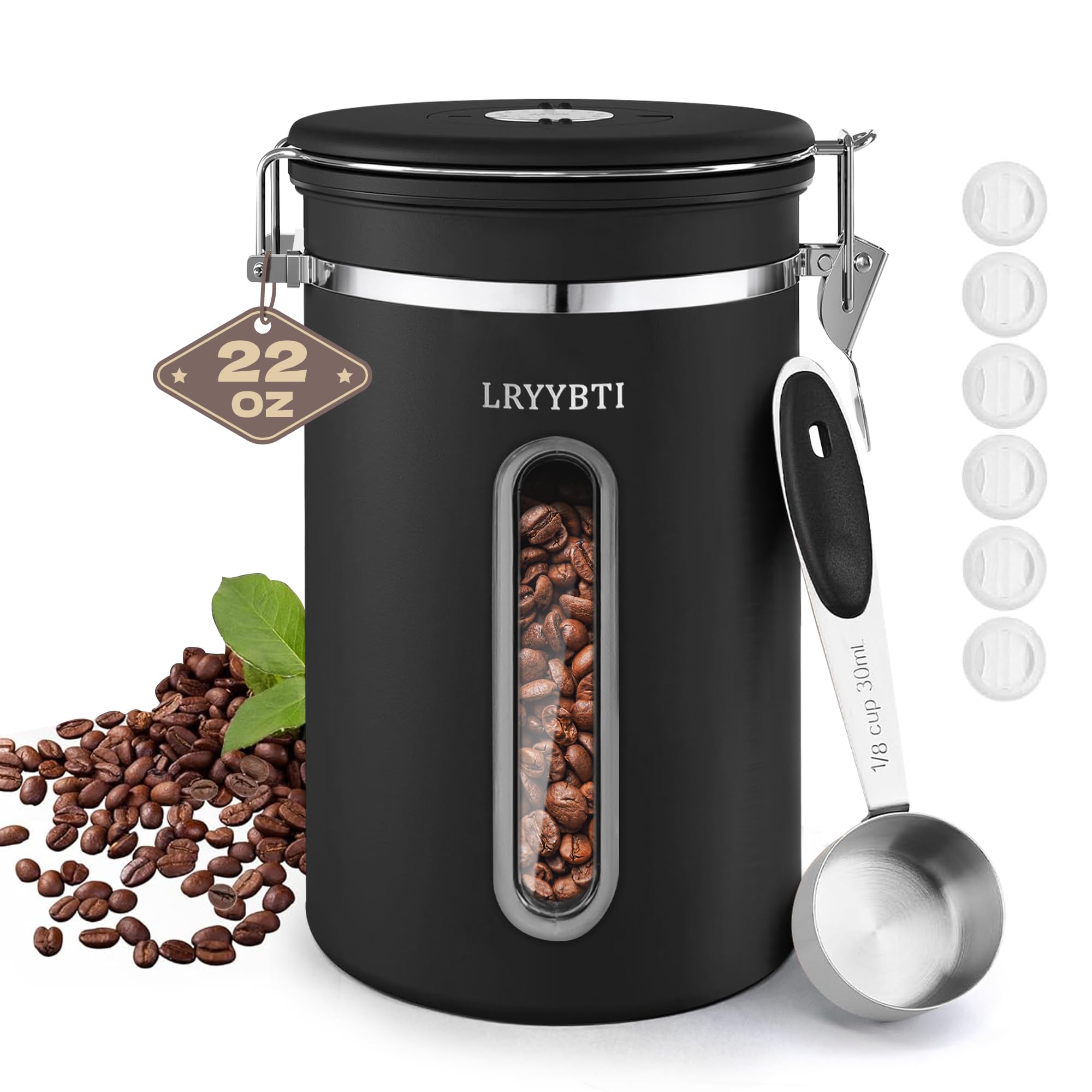
2. Coffee Canisters with Window 22oz
A clear strip down the side so you can see how much ground coffee is left without lifting the lid.
This one solves a small but real annoyance: never knowing whether you have enough for a full pot. The black stainless body has a lengthened clear viewing window and an internal capacity scale, so you read the level at a glance. It also carries a built-in date tracker on the lid, which helps you keep track of how long that bag has been open.
A standard bag fits nicely in this one, thanks to 22 oz of capacity. As buyers report: “This canister fit the 18 ounces of coffee beans I bought with a little room to spare.” A single-side locking buckle clamps the lid down airtight, and a measuring scoop snaps onto the side carabiner when you are done. Compared with the 40 oz metal jar above, this one is a slimmer 5.12″L x 5.12″W x 7.88″H, which suits a shorter counter run.
The honest catch is the feel. The finish reads like a rough ceramic — a bit gritty to the touch, as several describe it — which some love and some do not. It is a style choice, not a flaw, but if you want a smooth polished surface, go elsewhere. The included replacement valves are also short on paperwork; how often to swap them is not spelled out clearly.
What you get for the size: 22 oz of storage with a window, a scale, a lid date dial, and a scoop — a lot of small conveniences packed into one compact tube.
The honest catch: the textured outer finish and the thin instructions on replacing the freshness valves will not suit everyone.
Suits you when: you like seeing your supply at a glance and want a compact canister with a built-in date dial.
Pass if: you prefer a smooth, understated finish over a textured one.
3. Ohtomber 22oz Stainless Steel Coffee Canister

A 22 oz stainless canister that seals with two silicone rings and keeps a pound of grounds shut away from air.
This is the pick for someone who buys a single bag at a time and wants it stored properly without fuss. The body is food-grade 304 stainless steel, which shields the grounds from light and heat, and the lid carries two silicone sealing rings to isolate air and slow the oxidation that flattens coffee flavor. A one-way venting valve releases built-up carbon dioxide and water vapor without letting fresh air back in.
The little extras are what make it feel considered. A date dial on the lid lets you mark when the bag was opened, and a stainless scoop hangs on the side of the jar so it is always within reach. The package also includes four replacement valves. At 4.96″L x 4.96″W x 7.24″H it slots neatly beside a black coffee maker, which is where most owners park it.
What wins people over is the seal. It clamps down hard enough that the grounds stay loose and aromatic rather than clumping. A rare unit does show up with a looser lid fit than its twin, so if you plan on buying two, check the second one on arrival. One quibble from the detail-minded: a top-mounted vent releases gas upward when CO2 actually settles downward, though that does not bother most daily users.
Why the seal is the story: the locking lid and double silicone rings keep a pound of grounds fresh, and the stainless body blocks the light that dulls flavor.
Small things to know: the vent sits on top even though CO2 sinks, and an occasional unit arrives with a lid that does not clamp as tightly as it should.
Buy this one if: you want dependable airtight storage for a single bag, with a date dial and a scoop right on the jar.
Keep looking if: you need to store more than one bag at a time or want the vent at the bottom.
4. KIVY Vacuum Coffee Canister
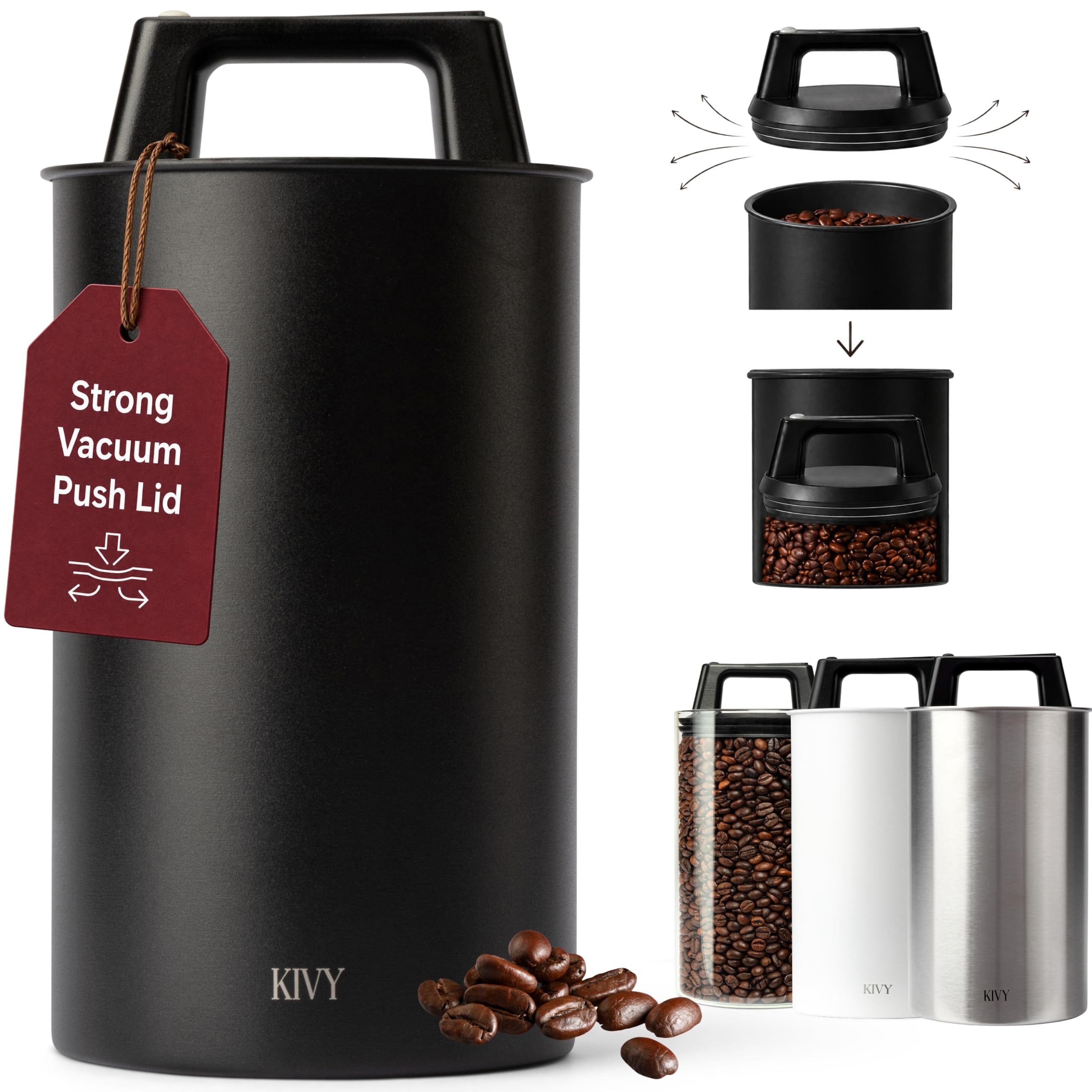
Push the lid down, lock the button, and the air leaves the canister along with it.
The KIVY works differently from the others here. Instead of just clamping a gasket shut, the lid pushes down into the canister and forces the air out before locking. That is a meaningful difference for ground coffee, where trapped air is what steals flavor first. The body is stainless steel with a BPA-free build, and the shape is round rather than square, which some find easier to grip and wipe out.
Buyers tend to describe the same thing: the lid opens and closes without effort and the vacuum holds. As one owner describes it: “The lid is easy to open and close and the vacuum keeps the coffee fresh.” The plain stainless interior also earns mentions — no coating to worry about, and easy to rinse. Capacity is listed at 32 fluid ounces, but the reported experience varies from holding roughly 3 pounds of beans down to not fitting a 12 oz bag depending on how you pack it. Measure your usual scoop size against the stated volume before you buy.
Where it lands: the vacuum action and the stainless build are the draw, and the round 4.5″L x 4.5″W x 7″H body fits neatly on a shelf. The trade-off is the lid popping or feeling less locked if you overfill it past the working line, so leave headroom when you fill. The capacity reading also swings depending on how finely you grind and how you settle the grounds.
Why the vacuum design stands out
- Push-down lid forces air out and locks it there, which targets the exact reason ground coffee goes flat
- BPA-free stainless steel inside and out, plain enough to rinse clean
- Round body is easy to grip, open, and wipe down
Things that trip people up
- Overfilling past the working line can make the lid pop instead of hold
- Capacity experience varies with grind and packing, so measure your bag before you fill it
- It costs more than the plain clamp-lid picks here
The fit for you: someone who wants the extra freshness of real vacuum extraction and does not mind leaving a little headroom in the canister.
Size it right: pack to the fill line, not above it, or the lid will not hold its seal.
5. AirScape Planetary Design Stainless Steel Coffee Canister

The one that presses a plate down onto the grounds and makes a little swoosh to tell you the air is gone.
AirScape has been doing this the longest of the group, and the design shows it. A plunger lid drops onto the surface of the coffee and pushes the air out, keeping the grounds compacted under the plate. The body is 18/8 restaurant-grade stainless steel, and the maker states that it resists staining and odor transfer — real comfort when you are switching between a dark roast and a light one.
The swoosh sound is the signature. When you press the plunger down and it releases that puff of air, you know the seal is working. Capacity is stated at 32 fluid ounces, and the round 5″L x 5″W x 4″H body stacks with others, so it fits a shelf or a drawer. It is also a popular gift pick, and the brushed steel finish wears a year of daily handling without looking scuffed.
The real limitation is headroom. The plunger needs room to come down, so the canister works best filled to about three-quarters. Pack it to the brim and the outer lid will not sit tight, and the scoop resting on the inner plate can make the top lid pop. Leave the space and it seals as tightly as it did on day one. One more thing: it is hand-wash only, so treat it like good cookware, not a dish-rack item.
The signature move: the plunger lid pushes the air off the grounds and releases it with a soft swoosh, so you know exactly when the seal is live.
Leave it room: fill it to about three-quarters, or the outer lid will not sit flush and the seal weakens.
Your pick when: you want a proven plunger design in heavy-grade stainless and do not mind leaving headroom for the plate.
Avoid it if: you want to pack a full bag right to the rim — this one wants breathing room to seal.
Know the Specs
Capacity in ounces
A 40 oz canister holds roughly twice the ground coffee of a 22 oz one, though listings vary — some quote fluid ounces, some weigh the contents in pounds. Bigger capacity means fewer refills but a larger footprint on the counter. Match the number to how much you buy at once.
The gasket and seal
A rubber or double-silicone ring is what makes a canister airtight; a metal lid alone will feel tight but still pass air over days. Look for the word airtight plus a named gasket material. A locking buckle or clamp adds a second layer of pressure on the seal.
One-way valve
Whole beans release carbon dioxide as they rest, and a valve lets that gas out without letting air in. Ground coffee gives off less gas, so the valve matters more for beans, though it does no harm for grounds. AirScape and Ohtomber both use this design.
Metal versus window
Opaque stainless or powder-coated metal blocks light, which slows flavor loss in ground coffee. A clear viewing window lets you check supply at a glance but lets light in. Choose based on whether you store on an open shelf or inside a dark cupboard.
Common Questions
How full should you fill a coffee canister with ground coffee?
Does a coffee canister keep ground coffee fresh longer than the bag it came in?
Should I store ground coffee in the fridge or freezer in a canister?
What is the difference between an airtight canister and a vacuum canister?
How do I know which capacity size to pick?
Can I wash a stainless coffee canister in the dishwasher?
Do I need a one-way valve for ground coffee or only for whole beans?
Which is better for keeping grounds fresh, a locking buckle or a double silicone seal?
Will a square canister or a round canister fit my kitchen better?
How often should I replace the freshness valve on a canister?
The Bottom Line
For most kitchens, the container for ground coffee worth reaching for first is the Airtight Coffee Canister 40 oz. A full 40 oz of space plus a rubber-lined bamboo lid means a whole bag goes in and stays sealed without constant refills. If seeing your supply at a glance matters to you, the Coffee Canisters with Window gives you a clear strip and a date dial in a compact body. And for the freshest-sealing option here, the AirScape plunger pushes the air off your grounds with that unmistakable swoosh. A final nudge: the 40 oz pick holds the highest score of the group at 4.5+ stars, a fair sign that size and seal together are what most people actually want.
How we choose
We do not accept paid placement. Every pick is matched to a real buyer and a real use-case; we do not hands-on test units.
Sources
Specifications: manufacturer listings and product documentation. Review insights: verified customer reviews, as of October 2026. Pricing: not shown on this page (it changes often); check the current price via the retailer link.
As an Amazon Associate, Aappliancez earns from qualifying purchases. This does not affect which products we feature.