Disclosure: Some links in this post are affiliate links. As an Amazon Associate I earn from qualifying purchases, at no extra cost to you. Learn more
Specs are compiled from manufacturer listings and verified buyer reviews and can change over time — please confirm the key details on the product page before buying.
You want your acoustic to sound like your acoustic when it hits the PA, and a contact microphone is the least invasive way to get there. These tiny piezo sensors stick to the instrument’s body, read the vibrations of the wood itself, and ignore the room around them — which is exactly why they beat a stage mic for feedback control. Below you’ll find the five picks worth your time, sorted by what each does best, from a first-timer’s stick-on kit to a hand-wired set for a cherished vintage guitar.
This guide is built by comparing the manufacturers’ published specifications and the patterns across verified customer reviews, so you get each pick’s real strengths and trade-offs instead of marketing spin.
Installation fuss, preamp matching, and adhesive quality separate the good kits from the frustrating ones, so each pick here is judged on those three things first. The five picks below are ranked on those three factors, from a first-timer’s stick-on kit to a hand-wired set for a vintage guitar.
Top Picks

How To Choose The Best Contact Microphone
A contact microphone is not a microphone in the usual sense. It is a piezo sensor — a thin disc of crystal that turns physical flex into an electrical signal — pressed against your instrument’s top. It senses the soundboard’s flex, not the air pressure in the room. That difference drives the sensor count, preamp, and adhesive choices below.
How many sensors do you actually need
One sensor captures one spot on the soundboard. Three sensors, wired together, average out the top so the low strings and high strings arrive at the same level. Single-sensor kits suit a ukulele or a small-bodied instrument; three-head kits suit a dreadnought where a lone sensor tends to favour whichever string sits closest to it.
The preamp question nobody mentions
Piezo sensors put out a weak, high-impedance signal — think of it as a whisper that needs the right kind of ear. A high-impedance input (a pedal, a DI box, an acoustic amp, or the instrument input on a mixer) gives you full, warm output. A line or mic input often leaves you with a thin, quiet result and a lot of hiss when you turn the gain up.
How it sticks, and what that costs you
Every kit here attaches with something removable: green putty, 3M double-sided stickers, or reusable adhesive dots. Removable is good for resale value. It also means the sensor can shift, and some adhesives leave residue or grip harder than you’d like on a delicate finish. Test the placement with putty before you commit to anything permanent.
Side-by-Side Comparison
| Model | Best For | Sensors | Connection | Weight | Amazon |
|---|---|---|---|---|---|
| Donner DSS-3★ Best Overall | First-time installs on any acoustic | 3 transducers | Pre-wired passive cable | 6 ounces | Amazon |
| Piezo Contact Pickups 6 PackBest Value | Multiple instruments or spares | 6 pickups | 1/4″ jack, 11.6″ cable | 2.88 ounces | Amazon |
| 3-Head Contact Pickup | Battery-free retrofit on a budget | 3-head | 1/4″ audio jack | 8.4 ounces | Amazon |
| KNA AP-1 | No-drill mounting on odd instruments | Wood-enclosed single sensor | 1/4″ to 1/8″, 8-ft cable | 3.2 ounces | Amazon |
| AMUMU BOUNTIFUL | Permanent install on a prized guitar | 3 hand-wired transducers | 1/4″ end-pin jack | 1.06 ounces | Amazon |
Detailed Reviews
1. Donner Acoustic Guitar Pickup Sound Seeker DSS-3
Our pick — 4.0+★ from 250+ verified ratings; the strongest balance of quality and price.
Three piezos, a bag of glue, and zero soldering — the easiest way in.
Here is the pick that gets the most out of a modest instrument. Three transducers spread across the soundboard balance the strings, and the pre-wired piezo means you never touch a soldering iron — a real advantage if you’ve never opened a guitar before. The whole external job, according to buyers, runs about 10-15 minutes with the supplied green glue or 3M stickers. You mount the piezos, run the cable through the holders, and plug in.
What wins people over is the sound itself. Owners put it up against far pricier systems and come away satisfied, with clear highs and lows and a natural wood character rather than the quacky bite cheap piezos are known for. It’s particularly strong as a retrofit: it replaced a factory undersaddle system in one guitar and reportedly sounded as good as the original. The signal is strong enough that one player called it the best pickup they’d owned, running through a sound console.
The weak point is the manual, not the hardware. The manual is thin to the point of being unhelpful — several players ended up guessing where to place the transducers — and the supplied adhesive is really a short-term solution for testing placement, not a permanent bond. The plastic cable anchors are the flimsiest part of the kit and tend to pop loose. Treat the included glue as a trial run, settle on a spot, then finish the job properly.
What earns its keep
- Three transducers give balanced string-to-string output
- No soldering, no battery — plug in and play
- External install finishes in about 10-15 minutes
- Holds its own against multi-hundred-dollar systems
Where it asks patience
- Installation guide is thin — placement is guesswork
- Supplied adhesive is short-term only
- Plastic cable anchors don’t stay clipped
- Needs extra gain from a high-impedance input
The smart buy: anyone fitting a first pickup to a working guitar who wants real tone without drilling.
Expect this instead: budget for your own putty or tape, because the kit’s adhesive won’t hold a placement long-term.
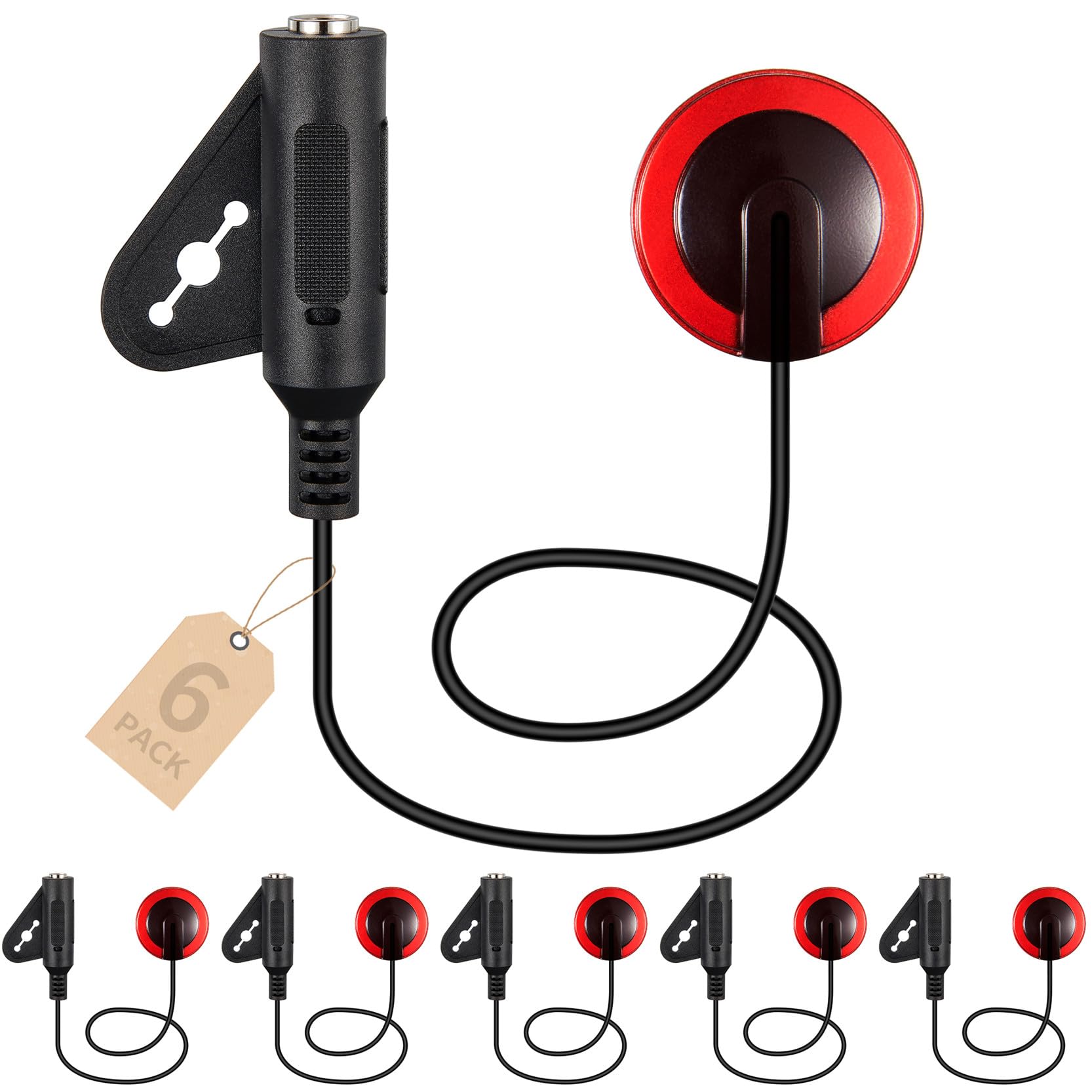
2. Piezo Contact Microphone Pickups, 6 Pack
Six stick-on sensors for less than most single pickups cost.
Fitting one pickup to one guitar is fine until you have three instruments and a gig bag. This pack gives you six sensors, each with its own 1/4″ output jack and 11.6-inch reinforced cable, so you can leave one in the ukulele, one on the banjo, one in the mandolin case, and still have spares. At 2.88 ounces for the whole set, it’s the lightest kit here by a wide margin — the 3-head alternative weighs 8.4 ounces. Nothing to solder, no battery to replace, and industrial-grade double-sided tape does the mounting.
Buyer reports are consistently positive. The soprano uke gave full sound without muting acoustics or losing low end, as buyers report, which is the exact thing a badly matched piezo usually ruins. There’s no feedback and no hum on the reported setups, and the tape leaves little residue when you peel it off. A lot of buyers describe getting usable results on guitar and strings straight away, then improving them noticeably with EQ or a compressor.
Read the fine print on impedance before you judge these. They want a high-impedance input — a pedal, preamp, DI, or the instrument input on an amp — and will sound weak and noisy into a straight line or mic channel. The adhesive is genuinely strong, which cuts both ways: it holds beautifully, but it can lift a delicate finish, so test on a hidden spot first. On tongue drums, response is reported as less convincing than on strings.
Six for the price of one: the economics here are the whole argument — you can kit out a household of instruments and still have spares in the drawer.
The honest caveat: this is a raw sensor, not a system. Whatever tone-shaping your mixer or preamp provides is doing real work, and without one the output feels thin.
Go this route if: you own several acoustic instruments and want one budget solution covering all of them.
Pass it by if: you’re fitting a single high-value guitar and want a finished, permanent install.
3. Acoustic Guitar Pickup Contact Microphone Piezo Transducer

A three-head rig that shines on a cheap guitar and stumbles on a good one.
The pitch is simple: three piezo heads on a 1/4″ jack, mounted with green glue or 3M stickers, and not a battery or solder joint in sight. For a church guitar or a beater classical, that’s a sensible proposition — one buyer fitted it to a budget acoustic, upgraded the bridge bone, and came away impressed enough to plan a second purchase for an old classical. Someone else installed it with zero prior experience and had it working quickly.
It performs best on a mid-range acoustic with a solid top. Fitted externally to an Ovation Custom Balladeer, it produced loud, clear output that one player compared to active pickups — no preamp involved. Build quality feels solid, the pickup bodies are thick 1/4″ units, and the kit even includes a faux-leather strap-pin pouch so you can mount without touching the finish. The reversible green putty is genuinely useful for auditioning placement.
The instructions are poorly written and give no real placement guidance, so you’re experimenting blind. Alone, the signal is weak — a preamp makes a large difference, and one player found an iRig Pre 2 transformed it. Low end comes through thin. The heads also pick up handling contact as static noise, so play clean. It’s a solid value that asks more of you than the pricier kits.
On the right guitar: a cheap acoustic with a bone bridge upgrade is exactly the scenario this was made for, and it delivers.
Where it bites: no placement guidance plus a weak raw signal means you’ll likely need a preamp and some trial and error before it sings.
Worth grabbing if: you’re amplifying a modest instrument and don’t mind experimenting with mounting position.
Think twice if: you need a strong signal straight into a mixer with nothing in between.
4. KNA AP-1 Universal Piezo Pickup

The one you can move between a dulcimer, a banjo and a guitalele in one afternoon.
Some instruments have no sensible place to fit a pickup. A lap dulcimer, a mountain dulcimer, a small soundhole you can barely reach — that’s the KNA AP-1’s territory. The sensor sits inside a maple wood enclosure and attaches with reusable putty or double-sided adhesive discs, so nothing gets drilled and nothing gets permanently altered. The cable detaches, runs 8 feet, and terminates in 1/4″ to 1/8″ jacks, which covers an amp, a PA, or a recording interface. It weighs 3.2 ounces, light enough to leave clipped in place.
What it does best is bring an odd instrument to the front of the mix without touching it. Owners mention it amplifying small, irregular soundholes loudly and accurately, which is precisely where clip-on pickups fall down. The maple body takes the brittle edge off the top end — one player found it dampened annoying high-frequency noise and string squeaks, leaving a cleaner tone. On a Yamaha guitalele it reportedly works far better than you’d expect for the size.
Setup rewards attention. Placement is critical — the best spot tends to sit between the bridge and tail block, off-centre near the bridge, with the jack angled so the cable hangs straight. Some owners ditch the included adhesive dots as too treble-heavy and swap in museum putty for a neutral tone. The generous negatives in the feedback are adhesive and durability, so plan for your own mounting solution. One buyer also expected volume controls that aren’t there, and found it didn’t cut through a loud jam session.
Strengths that stand out
- No modification to the instrument at all — fully removable
- Wood enclosure warms the tone and tames high-frequency noise
- 8-ft detachable cable with 1/4″ to 1/8″ jacks
- Works on dulcimers and irregular soundholes other pickups can’t reach
Where it lets you down
- Included adhesive is the weakest link — bring your own putty
- No volume control, and quiet against a full band
- Placement is fussy and changes the tone a lot
- Passive output needs a decent input to sound its best
Built for this: anyone amplifying an uncommon acoustic instrument who refuses to drill a hole in it.
The trade-off: you’re trading onboard control for portability — there’s no volume knob, so the mix engineer handles your level.
5. AMUMU BOUNTIFUL Acoustic Guitar Pickup

The end-pin jack and step-by-step manual that turn a pickup into a permanent install.
This is the one you fit to a guitar you intend to keep. Three hand-wired transducers feed a 1/4″ end-pin jack — the same socket your strap button screws into — so the whole system disappears inside the body and looks factory. No soldering, no battery, and the package includes a detailed step-by-step manual plus a fitting accessory pack. It senses the soundboard’s vibrations directly and is described as completely insensitive to air vibrations, which is why feedback stays manageable on a loud stage.
Owners with serious instruments keep coming back to the tone. Fitted to a ’60s Gibson J50 and pushed through a PA, the plugged-in sound reportedly matched the acoustic sound exactly, with no feedback or rattle. A 1975 Alvarez-Yairi dreadnought got one too, after the owner weighed it against a pricier name-brand option and chose this instead — the installing luthier was impressed by the result through a high-end amp. One long-time player compared it to a well-known premium system and suggested they might share a manufacturer.
This is the most demanding install on the list. You need to drill the end-pin hole yourself, and the instructions, while present, are described as vague on the illustrations. It also costs the most here. If you’re not confident with a drill, budget for a luthier’s labour. That said, the result on a fine guitar justifies it — the passive design keeps the signal pure and the tone uncoloured.
The tonal payoff: a warm, woody, uncoloured voice that owners describe as matching the guitar’s acoustic sound, at a fraction of what the big-name equivalents run.
Before you commit: drilling an end-pin hole is permanent, and the manual’s diagrams won’t walk a nervous first-timer through it comfortably.
Made for: the player fitting a lifelong acoustic who wants a clean, hidden, battery-free system and will pay for the install.
The reality check: it’s the most involved fit here — if a drill makes you uneasy, add the cost of a professional.
Know the Specs
Piezo Sensor Count and Placement
A piezo sensor converts physical flex in the soundboard into an electrical signal. One sensor hears one spot, which usually favours the strings nearest it. Three sensors average the top so the low and high strings arrive balanced. Where you mount them matters as much as how many you use — near the bridge is louder and brighter, further out is warmer and softer.
Impedance and Why Your Input Matters
A piezo puts out a weak, high-impedance signal, which needs a matching high-impedance input to sound full. Feed it into a line or mic channel and you get a thin, quiet result that needs heavy gain, and heavy gain brings hiss. A preamp, DI box, or acoustic amp’s instrument input solves this — many owners describe a preamp as the difference between usable and excellent.
Passive vs Active: The Battery Question
Every pickup here is passive, meaning no battery. That’s a plus for reliability — nothing to die mid-set — and it preserves the natural tone of the instrument because no onboard circuit colours the signal. The trade-off is that passive piezos can’t boost their own output, so the gain has to come from whatever you plug into.
How It Attaches and What That Risks
Green putty, 3M double-sided stickers, reusable adhesive dots, or a strap-pin pouch — each has a different grip and finish risk. Putty is the safest for auditioning placement; double-sided tape holds firmer but can lift delicate finishes. The recurring theme across these kits is that the supplied adhesive is best used for testing, and a permanent mounting needs a more considered choice.
Common Questions
Do I need a preamp for a contact microphone to work?
Will the adhesive damage my guitar’s finish?
How many transducers do I need for an acoustic guitar?
Can I install a contact pickup without drilling my guitar?
Will a piezo contact mic feedback on stage?
Do these pickups work on violin, banjo, or mandolin?
Will it work on a cheap acoustic guitar?
Does a contact mic need a battery?
How long does installation take?
The Bottom Line
For most players chasing a contact microphone to amplify an acoustic without surgery, the Donner DSS-3 is the reliable choice — three transducers, no soldering, and tone that punches above its price. If you want to cover a whole rack of instruments on a shoestring, the Piezo 6 Pack is the value play. And for fitting a guitar you’ll keep forever, the AMUMU BOUNTIFUL delivers the cleanest, most hidden permanent install.
How we choose
We do not accept paid placement. Every pick is matched to a real buyer and a real use-case; we do not hands-on test units.
Sources
Specifications: manufacturer listings and product documentation. Review insights: verified customer reviews, as of October 2026. Pricing: not shown on this page (it changes often); check the current price via the retailer link.
As an Amazon Associate, Aappliancez earns from qualifying purchases. This does not affect which products we feature.