Disclosure: Some links in this post are affiliate links. As an Amazon Associate I earn from qualifying purchases, at no extra cost to you. Learn more
Specs are compiled from manufacturer listings and verified buyer reviews and can change over time — please confirm the key details on the product page before buying.
Contact cement is the one adhesive where “almost stuck” is a total failure. You coat both surfaces, let the solvent flash off, then press — and the bond either grabs instantly or it never will. So the real question is not which can is cheapest, but which formula gives you enough open time to position the piece before it locks. This guide covers five picks that hold, plus the exact mistakes that make any contact cement fail: skipping the wait, over-coating, and gluing a surface that still has old adhesive on it.
This guide is built by comparing the manufacturers’ published specifications and the patterns across verified customer reviews, so you get each pick’s real strengths and trade-offs instead of marketing spin.
Every pick below is judged on cure time, material compatibility, and how much working time you actually get. By the end you will know which can to reach for, which to leave on the shelf, and why the wrong one turns a ten-minute repair into a weekend of scraping. Read on for the honest breakdown of the contact cement options worth your bench space.
Top Picks
How To Choose The Best Contact Cement
The mistake nearly every first-time buyer makes is treating contact cement like white school glue: squeeze it on, push the parts together, done. That is exactly how you get a bond that peels in a week. Contact cement is a two-surface adhesive — you coat both sides, let the solvent evaporate until the film is tacky but not wet, then press. Get that sequence right and the bond is permanent. Get it wrong and no brand on this list can save you.
Match the formula to the material before anything else
Wood, laminate, and leather are forgiving; almost any solvent-based contact cement will bite into them. Vinyl, PVC, and rubber are pickier. A can built for vinyl sheeting is the right tool for a pool liner patch. A general-purpose neoprene formula is the right tool for a boot sole or a sagging headliner. Read the compatible-material list on the can before you buy, because no adhesive handles everything. Notably, one of the picks here will not touch polyethylene tarps — the typical blue tarp material — so check what your repair actually is first.
Working time is the number that decides your repair
Working time is how long you have between pressing the surfaces together and the glue locking. A fast-tack formula gives you seconds; you get one shot at alignment. A slower formula lets you slide and reposition a large sheet of laminate or a headliner panel. Most buyers only look at full cure time, which is how long until the bond reaches maximum strength. Both matter, but the one that ruins projects is working time.
Spray, brush, or built-in applicator
Spray cans cover large flat areas — acoustic panels, veneer, headliners — in a hurry with an even film. Brush-on cans give you control in corners, on seams, and around edges, and they waste far less on small repairs. Built-in brush caps are convenient but can shed bristles or apply too thick. If you are patching a two-inch tear, a can with a proper brush beats a spray every time.
Side-by-Side Comparison
| Model | Best For | Form | Full Cure Time | Container | Amazon |
|---|---|---|---|---|---|
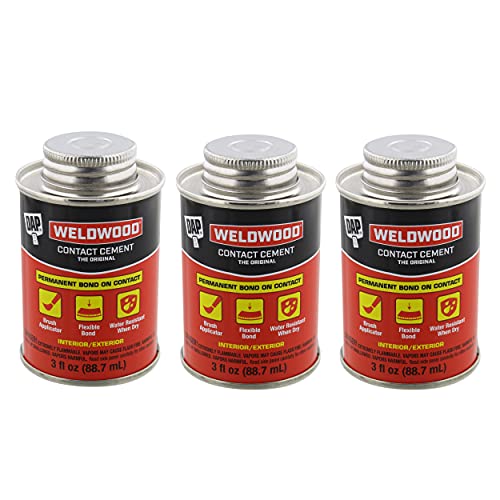
| DAP 00107 Weldwood Original★ Best Overall | All-round household repairs | Liquid | 2.5 hours | Can (3-pack) | Amazon |
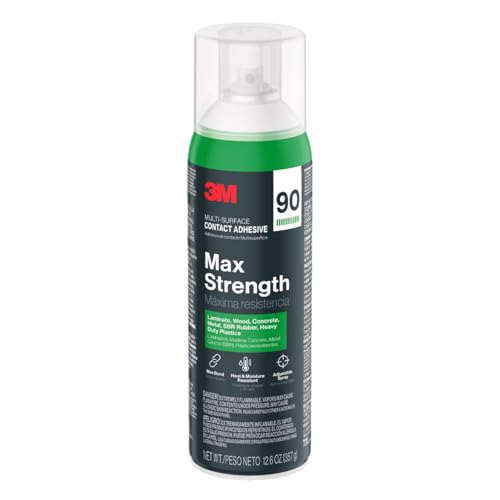
| 3M Max Strength Contact AdhesiveTop Performer | Big flat surfaces | Spray | 10 minutes | Aerosol can | Amazon |
| HH-66 Vinyl Cement | Vinyl and PVC repairs | Liquid | 24 hours | Can | Amazon |
| RH Adhesives S-18 All-Purpose | Headliners and upholstery | Liquid | 24 hours | Can | Amazon |
| Wonshine Contact Cement with Brush | Small craft and shoe fixes | Liquid | 24 hours | Can | Amazon |
Detailed Reviews
1. DAP 00107 Weldwood Original Contact Cement, 3 oz – 3 Pack
Our pick — 4.5+★ from 600+ verified ratings; the strongest balance of quality and price.
Three 3-ounce cans of low-VOC contact cement that cures in 2.5 hours and holds a boot sole for years.
This is the can that gets reached for when something needs to stay stuck and never come back. A full cure inside 2.5 hours keeps a repair on the same day, and a low-VOC, nonflammable formula means you are not working with the harshest solvent on the shelf. You get three cans, so one lives in the toolbox, one in the garage, and one waits as backup.
You get a bond that holds. Buyers report boot soles, linoleum strips that had peeled off a cabinet, a heater pad and a sagging door repair all staying put for good. One buyer put it plainly: “It’s definitely a permanent bond which is awesome. The smell is not overwhelming but if you’re sensitive set a fan up or use it outside and you’ll be fine. The holding strength beats the 4 or 5 other brands I’ve used.” Patience is part of the job, too: owners mention you should “wait at least 15 minutes to let the solvent evaporate before putting the pieces together.” Rush that step and a strong glue acts like a weak one.
The catch is the container, not the chemistry. Once opened, the glue dries out in the can, so a can becomes a one-project tool rather than a long-term pantry staple. The newer metal cans also have lids that are shallow and harder to grip than the old glass bottles. The 3-pack covers that gap neatly, since a fresh can is waiting when the first one skins over.
What earns its place on the bench
- Full cure in 2.5 hours — same-day repairs stay on schedule
- Bonds suede and leather, wood, plastic, and rubber, so one can covers shoe, cabinet, and auto jobs
- Nonflammable, low-VOC formula for less aggressive shop conditions
- Three cans, so a skinned-over lid does not stall the next project
Where it asks more of you
- Glue thickens and skins inside the open can, limiting reuse
- Metal can lids are shallow and awkward to reseal cleanly
- The solvent smell calls for a fan or outdoor work
Reach for this if: you want one dependable can for shoe soles, headliners, trim, and household wood fixes.
Look elsewhere if: you are covering a large flat panel, where a spray gives a far more even film.
2. 3M Max Strength Contact Adhesive, 12.6 oz (357 g)
Ten minutes to a full bond, and a spray pattern you can steer.
Where a brush can fights you on a big flat panel, this one wins on speed and coverage. A max-strength bond sets in 10 minutes — the fastest cure on this list, and a full 2 hours 20 minutes quicker than the DAP’s 2.5-hour cure. It sprays, so you get even coverage across laminate, wood, concrete, metal, rubber, and heavy-duty plastics without a brush stroke in sight. An adjustable nozzle lets you dial the pattern to the job, and the formula resists heat and moisture once set, which matters for acoustic panels and automotive trim.
Control is what buyers keep coming back to. Go light and uniform rather than soaking the surface — that is the whole trick with a spray adhesive. For foam-backed material, press lightly so the face does not dip, because saturated foam dries compressed. It is fast, so have your placement planned before you spray. On a truck bed liner repair, one buyer found that “It didn’t hold very well in some spots, but other spots it worked great,” and noted the old backing had not been fully cleaned off — a reminder that prep is half of any contact bond.
The honest caveat is the air around you. The fumes are strong, so this is an outdoor or wide-open-garage product, not a kitchen-table one. Spray drift also means masking off anything you do not want tacky. Judge the trade fairly: a spray lays down a far more even film on large surfaces than a brush ever will, and that evenness is what keeps a laminate panel flat.
Speed you can plan around: a 10-minute full cure and heat-and-moisture resistance make this the pick for panels, veneer, and trim that see temperature swings.
Prep does the heavy lifting: clean the old backing off first, spray light and even, and press foam gently so the surface stays flat.
Best suited to: headliners, acoustic panels, veneer, and any large flat lay-up where an even spray beats a brush.
Think twice if: you are working indoors with no cross-breeze — the fumes demand ventilation.
3. HH-66 Vinyl Cement 4 oz – Waterproof PVC & Vinyl Glue
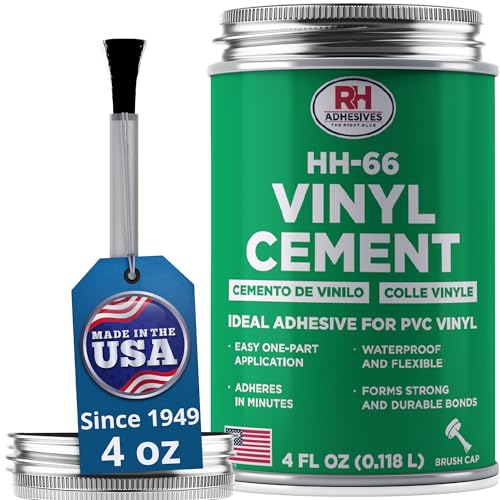
The pool-liner specialist that bonds underwater and stays flexible for years.
Most contact cement gives up the moment water is involved. This one does not. HH-66 bonds in temperatures from 35 °F to 95 °F and can even be applied underwater. Once cured it stays serviceable from -30 °F to 150 °F — a temperature band that covers a pool liner in summer and a tarp in a cold snap. A specialized vinyl cement penetrates PVC and vinyl rather than sitting on top, so seams stay flexible instead of cracking.
That flexibility is why it earns its reputation on inflatables and liners. It handles PVC vinyl, vinyl-coated fabric, canvas, fiberglass, neoprene, leather, EVA and nitrile foam, cork, and wood, which is a wider material list than the general-purpose formulas here. The bond is waterproof once set, and the built-in brush cap lays a controlled, even coat on PVC, vinyl-coated fabric, canvas, and leather. Two things it will not touch: polyethylene tarps — the typical blue tarp material — and extremely thin vinyl used for lettering or wraps. Check your material before you commit.
Two trade-offs to size honestly. It dries to tack fast, so you get precision rather than wiggle room — plan your placement, especially on a large patch. And it is not meant for load-bearing attachments; patches on an inflatable hold long-term, but a seat mount under constant pull will peel. For repair work, that is exactly the right behavior. For structural, look elsewhere.
The waterproof edge: an underwater-applicable formula with a -30 °F to 150 °F service range is what separates this from a general-purpose can.
Know the limit: polyethylene tarps and ultra-thin wrap vinyl are outside its compatibility list.
Pick it for: pool liners, inflatable boats, SUP patches, awnings, and any repair that lives in water.
Pass it by for: blue poly tarps or a load-bearing mount that takes constant pull.
4. S-18 All-Purpose Adhesive 4 oz
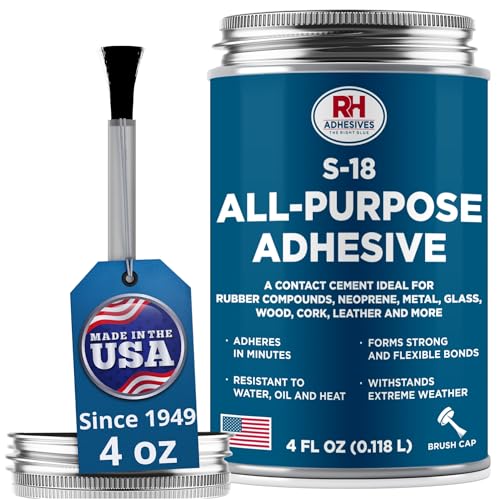
A 5.6-ounce can that rescues a sagging car ceiling in an afternoon.
What makes this one worth a spot is reach on awkward, contoured surfaces. It bonds porous and non-porous materials alike — ceramics, cork, fabric, felt, glass, tile, metal, and rubber compounds — and the neoprene base grabs fast on vinyl-to-metal. A headliner is the classic job: thin coat on the foam and the liner, let the solvent flash, press, and it stays up. A 4-ounce can is small enough to store in a glovebox and covers a surprising amount of ground.
Where it pulls ahead of a general-purpose formula is in heat. A headliner that drooped in a hot car stayed put at 90 °F with no sag after the repair. The water-resistant solvent base also makes it usable on marine and difficult-temperature jobs, and the film resists oil, which suits garage and shop work. It is the same neoprene cement family a cobbler uses, and boot soles and straps stay bonded through repeated wear.
Now the honest bit: adhesion is the mixed bag here. It sticks to vinyl, metal, and most fabric, but it can struggle with some rubber surfaces — so if your repair is rubber-on-rubber, test a small spot first. The fumes are strong and ventilation is not optional. A 4-ounce can covers roughly a couple of pairs of boot soles, so buy for the job rather than the year.
Contour-friendly: a thin, fast-grabbing coat on foam and fabric makes it the pick for headliners, seats, and upholstery panels that shift in heat.
The rubber caution: test on a hidden spot first if your repair is a rubber surface, since the bond there is the one spotty area.
Pick it for: car headliners, upholstery, boot soles, and marine repairs on mixed materials.
Look elsewhere for: rubber-on-rubber, where a spot test first is the wise move.
5. Contact Cement Adhesive 4.16 Oz, Strong Neoprene with Brush
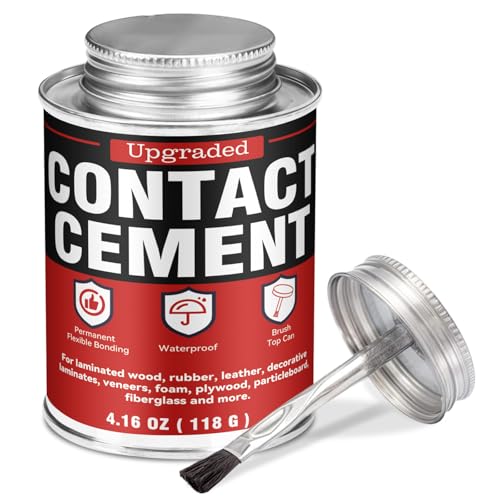
One small can with the brush built into the lid — no fingers, no mess.
For a quick craft fix or a shoe repair, the neatness is the whole point. The brush tip is integrated into the lid, so you reach tight corners and small surfaces without dipping a separate applicator and without glue-covered fingers. A 4.16-fluid-ounce can covers wood, leather, rubber, laminate, foam, plywood, particleboard, fiberglass, veneer, and decorative laminates — a broad list for a can this compact. A waterproof rating and flexible bonding round out a formula meant for everyday household repair.
For a small can, it does big-can work. Buyers have used it on a ceramic figurine and a wooden pantry door with strong, secure bonds, and shoe and wood repairs hold up. It is a low-cost 4.16-ounce can to keep in a drawer for the one-off craft or shoe fix rather than a production job. Expect a full 24-hour cure before you put any real load on the joint.
The one thing to know is the lid, not the glue. The cans have arrived with poorly sealed lids, and several have leaked in transit — leaving a can less than half full and a lid that is glued shut. It is a shipping-and-packaging issue rather than a bonding one, and the glue itself works when it arrives intact. Order it for a small repair, check the seal on arrival, and you have a solid value can.
Clean hands, tight corners: the brush-in-the-lid design makes small repairs tidy and precise.
Check the seal on arrival: leaked-in-transit cans have been the recurring complaint, so open and inspect before the job.
Pick it for: craft fixes, shoe repairs, and small household bonds where tidy application matters most.
Look elsewhere if: you need a large, even coat on a big panel — a spray covers that job better.
Know the Specs
Full Cure Time
This is how long until the bond reaches maximum strength — the 2.5-hour figure on the DAP versus the 24-hour figure on the S-18 and HH-66. It is not the same as working time, which is how long you have to position the parts. A 10-minute full cure on the 3M spray means it sets fast, so plan your placement before you spray. A 24-hour cure means you can leave the repair clamped and come back the next day.
Container Form: Spray vs Brush
An aerosol can like the 3M lays down an even film across a large flat surface, which is what keeps a laminate or acoustic panel flat. A brush-on can gives you control on small seams, corners, and edges, and wastes less on a tiny repair. A built-in brush tip on the Wonshine can shortens the job on small surfaces but can apply thicker than you want on a broad panel.
Material Compatibility
Every formula has a list of what it will and will not bond. Wood, laminate, leather, and most fabric are forgiving. Vinyl and PVC need a specialized vinyl cement. Polyethylene — the typical blue tarp material — and ultra-thin wrap vinyl are refused outright by the HH-66, even though it handles almost everything else on the list. Always match the material list to your repair first.
Ventilation and VOCs
Solvent-based contact cement gives off fumes, and that is a safety consideration, not a quality one. A low-VOC formula reduces the odor, and a fan or outdoor work keeps the air moving. The strong fumes on the 3M spray and the general-purpose cans call for cross-ventilation. Treat this as part of the job setup, not an inconvenience to skip.
Common Questions
How long should I wait before joining the two surfaces?
Will contact cement work on a vinyl pool liner?
Does contact cement stick to blue poly tarps?
Can I use contact cement in below-freezing temperatures?
Why does my contact cement dry out in the can?
Is a spray adhesive or a brush-on contact cement better?
How much surface does a small 4 oz can cover?
Will contact cement hold a headliner in hot weather?
Can contact cement work underwater?
How do I stop a repair from peeling off later?
The Bottom Line
For the everyday repair — a boot sole, a sagging headliner, a strip of trim, a wobbly cabinet edge — the DAP 00107 Weldwood Original is the safest single can on this list. It cures in 2.5 hours, it is nonflammable and low-VOC (low in volatile organic compounds, the solvents that give glue its smell), and three cans mean a skinned-over lid does not end your project. If your job is a large flat surface, the 3M Max Strength spray gives the even film and 10-minute cure a panel needs. And for anything living in water — a pool liner, an inflatable, a boat seat — the HH-66 Vinyl Cement is the one to reach for, thanks to its underwater application and -30 °F to 150 °F service range.
The one honest nudge: if you are stocking a workshop for the long haul, start with the DAP 3-pack and add a specialized can only when a job calls for it. Buy the material match, not the biggest can — that is the choice that decides whether your repair holds.
How we choose
We do not accept paid placement. Every pick is matched to a real buyer and a real use-case; we do not hands-on test units.
Sources
Specifications: manufacturer listings and product documentation. Review insights: verified customer reviews, as of October 2026. Pricing: not shown on this page (it changes often); check the current price via the retailer link.
As an Amazon Associate, Aappliancez earns from qualifying purchases. This does not affect which products we feature.