Disclosure: Some links in this post are affiliate links. As an Amazon Associate I earn from qualifying purchases, at no extra cost to you. Learn more
Specs are compiled from manufacturer listings and verified buyer reviews and can change over time — please confirm the key details on the product page before buying.
Buying a bag of cement for stepping stones sounds simple until you open the bag and find half the volume the label promised. A mix for a garden path or molded paver needs to pour smooth, hold fine detail in a silicone mold, and cure hard enough to walk on. This guide covers the mixes that do that job, and it tells you plainly which ones set so fast you have to work in tiny batches.
This guide is built by comparing the manufacturers’ published specifications and the patterns across verified customer reviews, so you get each pick’s real strengths and trade-offs instead of marketing spin.
Pick a bag by its set time and your pour volume, not by the label on the front. Below are the strongest concrete mix options for stepping stones, with their real set times and weights laid bare.
Top Picks


How To Choose The Best Concrete Mix for Stepping Stones
Two specs decide whether a stepping stone pour goes well: the work time before the mix grabs and the density of the cured stone. Bag size, box color, and whether a mold is included matter far less than those two numbers. Here is what actually matters when you are standing in the aisle with two bags that look identical.
Set time and work time are not the same thing
A bag that reads “sets in 3 to 5 minutes” is telling you about the final grip, not the whole job. Hydraulic fast-setting cements like these begin stiffening the moment water touches powder, so you mix one small batch, pour it, and clean the bucket before you start the next. If you plan a row of six identical stones, that means six small mixes — never one big one you intended to divide.
Why bag weight understates what you actually pour
Owners of general-purpose concrete repeatedly run into this: the bag weighs what it says, but the mixed volume lands short of the count on the label. For stepping stone work that matters, because you buy by the pound and pour by the mold. Read the coverage note on the bag, then plan for a little less than the label implies. A specialized stepping stone mix is blended to be more predictable on this front.
Smooth finish is a mix decision, not a mold decision
Fine-detail molds — leaf shapes, paw prints, lettering — only come out clean if the mix is blended for it. Mixes built with latex and curing agents are blended toward a smooth, professional-looking surface that holds imprints. General concrete mix is thicker with aggregate and will show that texture on your stone face.
Side-by-Side Comparison
| Model | Best For | Bag Weight | Set / Cure Time | Form | Amazon |
|---|---|---|---|---|---|
| Quikrete Rapid Setting Hydraulic Water Stop Cement★ Best Overall | Water-stopping and rapid patching | 10 Pounds | Sets in 3 to 5 minutes; full cure 5 minutes | Patch | Amazon |
| Hartline Rockite 10010 10 Lb Fast-Setting CementTop Performer | Fine mold detail and craft pieces | 10.5 pounds | Hard in 15 minutes; full cure 1 hour | Powder | Amazon |
| Hartline 10001 Rockite Expansion Cement 15 Min 1 Lb | Small anchoring and repair pours | 16 ounces | Hard in 15 minutes; full cure 1 hour | Powder | Amazon |
| Quikrete Concrete Mix Bag 10 Lbs. | Post and pole setting in the ground | 10 Lbs. | — | Bagged mix | Amazon |
| Midwest Products Milestones Premium Stepping Stone Cement Mix | Stepping stone kits and smooth imprints | 8 pounds | — | Powder | Amazon |
Detailed Reviews
1. Quikrete Rapid Setting Hydraulic Water Stop Cement, 10 Pounds
Our pick — 4.5+★ from 350+ verified ratings; the strongest balance of quality and price.
The bag that grabs in the time it takes to rinse your hands.
If your stepping-stone project sits anywhere near a sprinkler line, a pool edge, or a slab that takes on water, this is the bag that earns its place first. It is a hydraulic water-stop cement — a powder that hardens by reacting with water and can be pushed into a crack while water is still moving through it. The headline number is the set: it plugs leaks in 3 to 5 minutes, with a full cure listed at 5 minutes. That is not a typo, and it is exactly why it works and exactly why it is fussy.
What wins people over is speed. The quick grab is the reason this bag carries a 4.5+ star reputation across 380+ owners, most of whom bought it to stop a leak rather than to make a garden paver. That said, the same trait that seals a foundation crack in minutes also means you cannot linger over a mold. The review pages sum it up: “Works great. Only mix up very small batches, it dries quickly.” One buyer solved a crawlspace water problem with four bags and reported nothing left over — which tells you each bag goes a short way when you are working fast.
The honest catch is durability. Some buyers report that a patched area cracked later, and the mix can be finicky about its water ratio — too wet and it slumps, too dry and it will not bind. For narrow cracks, a practical trick is to carve a 3/4″ wide, 1/8″ deep channel first so the material has something to bite into. Treat consistency as a skill you build over two or three batches. Also note the packaging: the powder ships in a sturdy sealed box with an inner bag as backup, which is nicer than the open buckets you haul home from a big-box store.
Where this bag delivers
- Plugs flowing water in 3 to 5 minutes, so a leak stops before you lose the batch
- Works above and below grade, in pools, foundations, and around concrete pipes
- Easy to mix and genuinely effective at blocking intrusion
- Sealed box with a backup inner bag keeps the powder dry in transit
Where it asks more of you
- Full cure listed at 5 minutes leaves almost no shaping window for a mold
- Water-to-powder ratio takes practice; loose or wet mixes behave badly
- Some owners saw patched areas crack over time
Grab this one if: you need a stone or patch that must hold back moisture, or you want a pour that is walk-ready fast.
Think twice if: you plan a long, relaxed session with a detailed mold — the 3 to 5 minute grab punishes slow hands.
2. Hartline Products Rockite 10010 10 Lb Fast-Setting Cement
Fifteen minutes to hard, and fine lettering comes out clean.
This is the bag to reach for when the stone is the point and the setting is decorative. Rockite is described by its maker as never shrinking, and it hardens in 15 minutes — inside the same hour it develops a compression strength of 4500 lbs. per square inch. If you are pouring paw prints, leaf veins, or a house number into a silicone mold, that non-shrinking property is the difference between a crisp imprint and a blurry one.
At 10.5 pounds, this pail carries 52% more weight than the Midwest stepping stone box at 6.9 pounds, so you simply get more pours per container. What earns it the top-performer slot is how cleanly it casts. Owners describe it pouring smoothly into silicone molds, holding fine detail with only light tapping, and curing solid and dense without a chalky crumble — and it survives sanding and painting afterward. One craft user has been running it into silicone molds for plant pots and calls it “super easy to work with.”
The trade-off is time pressure plus a surface note. The working window is short, so measure water before you start and keep batches small. It also throws curing heat and leaves a slightly rough face unless your mold itself is very smooth. And do not read “hydraulic” as “waterproof” — it is a water-based product, so a stepping stone meant to sit in a puddle needs a sealer on top.
What owners keep saying: the working consistency is the star — it spreads into corners and holds the shape you press into it.
Plan around this: a 15-minute hard time means you mix, pour, and tap within minutes, not over a leisurely afternoon.
The right fit: crafters and gardeners pouring detailed decorative stones who want a dense, sandable finish.
Pass it by: if you need a waterproof stone or you like to work slowly across a big mold.
3. Hartline 10001 Rockite Expansion Cement 15 Min 1 Lb
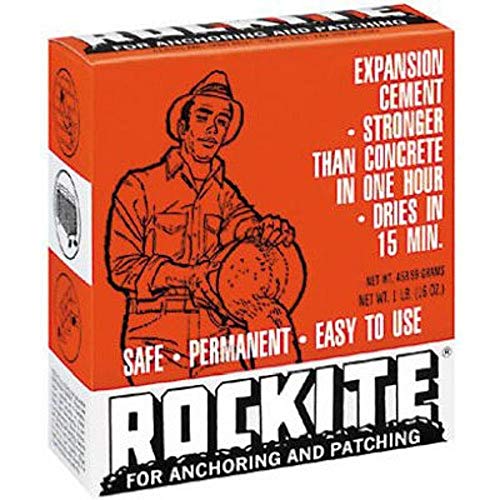
A one-pound box that hardens in the time it takes to make coffee.
For a single test stone or a small repair where a full bag is overkill, this small box is the sensible size. It is an expansion cement — a powder that swells slightly as it hardens, which is what makes it grip a post or anchor a railing tight — and it goes hard in 15 minutes. The weight is 16 ounces, twice the 8 ounces listed for the Quikrete water-stop bag, so the box itself is not skimpy on material.
Effectiveness is what this product is known for, and it has been put to work hard: owners have used it to hold heavy equipment within an hour of mixing. The general read is that it locks up fast and cures to a genuinely rock-hard finish, which is exactly what you want under a garden ornament or a wobbly path stone. It is easy enough to handle that people reach for it for small jobs without reading a manual.
The mismatch to plan for is expectation on size and coverage. The box is compact, so a single-unit pour does not stretch far, and the mixing process draws mixed reactions — some find it straightforward, others find the ratio fussy. Buy two if your project is more than one stone. If you only need a firm set under a birdbath or a marking stone, one box does the trick.
Small-job hero: the 15-minute hard time and 1 lb box make it the easiest way to test a mix before committing to a bigger project.
Watch the coverage: a single pound fills a modest mold, so scale your order to the number of stones you actually plan.
Best for: a quick anchor job, a single decorative stone, or a trial pour before a full path.
Not your bag: if you are casting a whole walkway in one session — the compact box runs short.
4. Quikrete Concrete Mix Bag 10 Lbs.

The familiar gray bag that does the ground work, not the art work.
This is standard concrete mix, the kind you set a fence post or a cell-phone antenna pole into, and it works well at that job. Owners have used it to anchor a booster antenna and pole in the ground and reported it mixing and setting as expected. It is easy to handle and mixes up familiar, which is exactly what a general-purpose bag should be.
Two honest limits keep it off the top of a stepping-stone list. First, the mixed volume runs under the label — one buyer put it plainly: “Concrete is good, but quantity is not accurate, dry or mixed you won’t get as much as stated on bag.” Second, it is thick general mix rather than a fine stepping-stone blend, so it will not hold delicate mold detail the way the Midwest or the Rockite does. The quality and value question does draw mixed reactions from buyers, which is worth knowing before you commit.
For its actual purpose — a post hole, a footing, a base under a heavy ornament — it is solid and uncomplicated. The 27 x 8 x 9 inch dimensions make it the largest footprint bag in this group, stacking awkwardly in a shed but easy to carry. If you are filling a path with plain square pavers rather than art stones, it will get you there.
Running strong on
- Reliable general-purpose function for setting posts, poles, and footings
- Straightforward mixing that needs no technique
- Gets a heavy object anchored and stable in the ground
Held back by
- Mixed volume falls short of the bag’s stated 10 Lbs.
- Coarse texture will not carry fine mold detail
- Quality and value impressions are a genuine mix across owners
Pick it when: the job is structural — a post, a pole, a footing — and the stone does not need to be pretty.
Skip it when: your mold has lettering or leaf veins, because this mix is too coarse to render them.
5. Midwest Products Milestones Premium Stepping Stone Cement Mix, 8 Pound Box

Built for one purpose: a garden stone with a surface worth looking at.
Nobody blends a general concrete bag to make a pretty round paver, and this box is the answer to that gap. It is a specialized mix of super-fine cement, latex, and curing agents — the latex is what pushes the finish toward smooth and professional rather than gritty. The maker states it withstands up to 250 pounds of pressure, which covers a person stepping on it. The box holds 8 pounds of mix.
Quality and mixing are the two things owners come back to again and again, and both hold up. One long-term user has made many stones as pet memorials and reports the mix is easy to work, takes an imprint cleanly, and has held up outdoors through weather extremes for years. Pouring into a mold is described as straightforward, and the small batch suits a single round stone. That same 8-pound box is dramatically more compact than the Quikrete bag at 27 x 8 x 9 inches — it tucks onto a shelf instead of hogging the garage.
The practical caveats are quantity and finishing touches. Some find the box yields exactly what they need; others find one box short for a large mold, so measure your mold first. Assembly and drying time draw mixed reactions — some pours are ready to unmold sooner than others. And the kit ships without decorative accents, so plan your own shells or colored stones before you pour.
The thing everyone raves about: the surface. The fine-cement blend yields a smooth face that a general concrete bag simply cannot match.
One real caveat: the 8-pound box is purpose-sized — check your mold dimensions so you do not come up short mid-pour.
The clear choice for: anyone making a decorative garden stone or a memorial paver who wants the face to come out smooth.
Not the one for: a structural post hole — you would be paying for finish you do not need.
Know the Specs
Set time and cure time
Set time is how quickly the mix stops flowing; cure time is how long until it reaches full hardness. A bag that hardens in 15 minutes still lists a full cure of 1 hour, and a hydraulic mix that plugs a leak in 3 to 5 minutes lists a full cure of 5 minutes. A 3-to-5-minute window means small batches and a pre-measured cup of water, because there is no time to correct a wet mix.
Compression strength and shrink
Compression strength tells you how much load a cured piece can take before it cracks — 4500 lbs. per square inch is a figure that indicates a genuinely dense stone. “Never shrinks” matters just as much for decorative work, because a mix that pulls in as it dries will shrink away from a mold face and blur the imprint. Fine cement blended with latex and curing agents is what puts a smooth face on a stepping stone.
Common Questions
Can I use a fast-setting cement for a stepping stone mold?
How much stepping stone does a 10 pound bag make?
Is hydraulic water stop cement the same as waterproof cement?
Will a stepping stone mix hold up outdoors in winter?
Why did my cement stone crack after it dried?
Can I mix small batches in a bucket without wasting it?
How do I get a smooth surface on a concrete stepping stone?
What is the difference between expansion cement and regular concrete?
Do stepping stone kits come with decorations for the stone?
The Bottom Line
The best concrete mix for stepping stones is the fine-cement blend for a decorative face and a general mix for a structural footing. For a garden stone with a face worth showing off, reach for the Midwest Products Milestones Premium Stepping Stone Cement Mix — the super-fine cement and latex blend holds imprints and takes 250 pounds of pressure. If speed and detail both matter, the Rockite 10010 hardens in 15 minutes and casts clean without a chalky crumble. And for anything that has to hold back moisture, the Quikrete Rapid Setting Hydraulic Water Stop Cement plugs water in 3 to 5 minutes — the clear pick for a stone or patch that must stay dry. Whichever you choose, buy about 10% more than your mold measures and mix batches small enough to pour before the mix grabs.
How we choose
We do not accept paid placement. Every pick is matched to a real buyer and a real use-case; we do not hands-on test units.
Sources
Specifications: manufacturer listings and product documentation. Review insights: verified customer reviews, as of October 2026. Pricing: not shown on this page (it changes often); check the current price via the retailer link.
As an Amazon Associate, Aappliancez earns from qualifying purchases. This does not affect which products we feature.