Disclosure: Some links in this post are affiliate links. As an Amazon Associate I earn from qualifying purchases, at no extra cost to you. Learn more
Specs are compiled from manufacturer listings and verified buyer reviews and can change over time — please confirm the key details on the product page before buying.
The roaches keep coming back because you are spraying the ones you can see and missing the ones hiding behind the baseboards. A concentrated roach killer is the fix: you mix a small amount of liquid with water in a tank sprayer and lay down a barrier that keeps working long after it dries. The picks below are the ones worth mixing, from a bottle that treats a whole season to a fast-knockdown formula for heavy infestations.
This guide is built by comparing the manufacturers’ published specifications and the patterns across verified customer reviews, so you get each pick’s real strengths and trade-offs instead of marketing spin.
Concentrates beat ready-to-use sprays because one small bottle mixes into gallons of working solution, so you treat more of your home for less. Below you’ll find what actually matters when you shop for the Best Concentrated Roach Killer: the active ingredient, the mixing ratio, the coverage per bottle, and how long the residue keeps killing after it dries.
Top Picks


How To Choose The Best Concentrated Roach Killer
Roaches are not one problem, they are two. There are the ones you see when you flip on the kitchen light, and the ones breeding behind the fridge, under the sink, and inside the wall void. A spray that only kills what it touches handles the first group. A concentrate that leaves a dried residual film handles both, because roaches walk through it long after you have put the bottle away.
Start With The Active Ingredient
You want to know what actually kills the roaches, so start with the active ingredient — the chemical that does the killing, and it is the first line on the label for a reason. Bifenthrin is a synthetic pyrethroid (a lab-made version of the natural insecticide found in chrysanthemum flowers), and it is the backbone of most modern roach concentrates. Beta-cyfluthrin is a fifth-generation pyrethroid, which simply means it has been engineered to hold up longer and hit a wider range of insects. Both work. Which one suits you depends on if you want the broadest possible pest list or the longest-lasting barrier.
Understand Mixing Ratios Before You Buy
A concentrate is sold as a small bottle of undiluted chemical that you dilute with water in a tank sprayer. The label gives you the ratio in ounces per gallon, and that ratio controls everything: how strong the spray is, how much area one bottle covers, and how often you have to refill your sprayer. A bottle that mixes at a lean ratio treats far more square footage than the same volume mixed heavy. If you have a large perimeter to treat, the ratio matters more than the bottle size.
Residual Versus Contact Kill
Contact kill means the insect dies when the wet spray lands on it. Residual protection means the surface keeps killing after it dries — roaches pick up the dried chemical on their bodies and die later. Roaches are a recurring problem, so residual is the number that matters for most homes. Look for a stated protection window on the label, and treat the cracks, baseboards, and entry points rather than open floor where the spray gets wiped away.
Coverage And Cost Per Treatment
Two bottles of the same size can cover wildly different areas depending on dilution. One of the picks here makes up to 88 gallons of ready-to-use spray from a single 16-ounce bottle — a whole season of perimeter work. Another mixes into just two gallons. Neither is wrong; they are built for different jobs. Match the coverage figure to the size of your home and the number of problem areas you need to treat.
Side-by-Side Comparison
| Model | Best For | Active Ingredient | Liquid Volume | Stated Coverage | Amazon |
|---|---|---|---|---|---|
| Elanco CyLence Ultra Pest Control Concentrate★ Best Overall | Flies, ants and spiders indoors and out | Beta-cyfluthrin | 1.08 fluid ounces | 2 gallons / 2,000 sq. ft. | Amazon |
| Ortho Home Defense Insect Killer for Indoor & Perimeter ConcentrateBest Value | Year-round roach and ant barrier | Bifenthrin, Zeta Cypermethrin | 32 fluid ounces | 4 gallons | Amazon |
| Compare-N-Save Concentrate Indoor and Outdoor Insect Control | Large properties and yards | Bifenthrin | 16 fluid ounces | 88 gallons / 88,000 sq. ft. | Amazon |
| 7.9% Bifenthrin Insecticide by Liquid Harvest | Fire ants and heavy outdoor infestations | Bifenthrin | 16 fluid ounces | Up to 3 months protection | Amazon |
| Paragon Conquer Residual Insecticide Concentrate | Ants, crickets and carpenter ants | — | 16 fluid ounces | — | Amazon |
Detailed Reviews
1. Elanco CyLence Ultra Pest Control Concentrate
Our pick — 4.5+★ from 800+ verified ratings; the strongest balance of quality and price.
A 32 mL bottle that mixes into two gallons and drops over 60 kinds of pests.
If you want one bottle that handles roaches, flies, ants, and spiders without juggling three products, this is the pick. The active ingredient is beta-cyfluthrin — a fifth-generation pyrethroid, meaning a lab-tuned version of the natural chrysanthemum insecticide — and it targets over 60 pests at once. You pour the whole 32 mL bottle into two gallons of water and spray. That mix covers roughly 2,000 square feet, which is a kitchen, a bathroom run, the baseboards, and the outside perimeter in a single session.
What wins people over is how thoroughly it clears the flying and crawling pests around a property line. Buyers report that trash cans stop filling up with flies and maggots, that ants clear out, and that they no longer feel attacked by flies and mosquitoes near the yard. The spray holds for several days, so the workplace barrier keeps doing its job while it dries and settles rather than needing an immediate reapplication. It also goes quiet on the pet-safety front once dry — the recurring note is that it is fine around dogs after it has fully dried, not before.
The catch is the value question, which buyers split on. Some find the small bottle worth every bit because it stretches into two gallons; others feel the volume runs out faster than expected on a large property. The other honest note is coverage math: at 1.08 fluid ounces of concentrate, this is the smallest liquid volume in this lineup, well under the Ortho’s 32-ounce bottle. That smaller bottle is the trade-off — a tight, concentrated dose instead of a big jug, so it suits an apartment or a single-family perimeter better than a sprawling yard you treat twice a year. It holds 4.5+ stars across 800+ reviews.
What It Does Best
- One bottle targets over 60 pests — roaches, flies, ants and spiders in a single mix
- 32 mL mixes into two gallons, enough to treat about 2,000 square feet
- Safe around dogs once the sprayed surface has fully dried
- Holds up for several days after application, so the barrier keeps working
Where It Falls Short
- Tiny 1.08 fluid ounce bottle — heavy users will go through it fast
- Buyers are split on value; some feel the small volume does not stretch far
- Must be diluted before use — no spray-and-go here
Reach for this if: you have a mixed pest problem indoors plus a perimeter to protect and want one bottle to cover it.
Look elsewhere if: you are treating a large yard twice a year and need the biggest possible concentrate volume.
2. Ortho Home Defense Insect Killer Concentrate 32 oz.
The barrier-builder with a stated 12-month window and the biggest bottle in the lineup.
This is the one to buy if you want to treat the house once and forget about it for a year. Applied indoors on non-porous surfaces, it forms a bug barrier with up to 12 months of protection against ants, roaches, and spiders. The active ingredient is a bifenthrin and zeta cypermethrin blend — two pyrethroid chemicals working together — and it’s aimed at the full indoor invader list: ants, cockroaches, spiders, fleas, ticks, scorpions, earwigs, silverfish, and periodical cicadas.
What owners mention most is straightforward effectiveness and reach. Sprayed around a property, the anthills get cleared and the ants stop showing up in the house and yard. In the damp-basement cases where granules never got the job done, this reaches into the cracks the granules cannot. The 32-ounce bottle is the largest liquid volume in this lineup — it dilutes into up to 4 gallons of working spray, which is what makes the cost-per-treatment work out so well. The dry-down is invisible and odorless, so you are not living with a chemical smell for a week.
The honest catch: in a genuinely damp, century-old basement with centipedes and spiders, one pass is not enough. That setting calls for roughly two applications a year, which stretches the savings narrative a little. And like any concentrate, you supply your own tank sprayer and do the mixing yourself. But for a normal home, this is the reliable default — and if you want to compare a stronger active-ingredient blend against the single-ingredient bottles in this lineup, few get close to the Ortho’s year-long claim. It carries 4.5+ stars across 1,000+ reviews, the widest feedback base here.
Why it stays a crowd favorite: A 32-ounce bottle that mixes into 4 gallons, a stated 12-month barrier window, and an odorless formula that dries invisible. That combination is hard to argue with for a whole-home treatment.
Worth knowing before you buy: The claim assumes indoor application on non-porous surfaces. Porous concrete and exposed subfloors will not hold the barrier as long, so budget for a second pass in rougher spaces.
Best for: the homeowner who wants one reliable product for year-round indoor perimeter defense.
Skip if: you have a severe ongoing infestation and want maximum active-ingredient strength per ounce instead of maximum coverage.
3. Compare-N-Save Insect Control 16-Ounce

One 16-ounce bottle that stretches to 88 gallons and 88,000 square feet of ground.
If you manage a large property, this is the volume champion. A single 16-ounce bottle of this bifenthrin concentrate makes up to 88 gallons of ready-to-use spray and covers up to 88,000 square feet. That is a season’s worth of perimeter and yard work from one small bottle — the kind of coverage that dwarfs the Ortho’s 4 gallons. It weighs in at 16 ounces, twice the physical weight of the 8-ounce Ortho bottle. For flea, cockroach, and ant control indoors plus ornamentals, trees, and shrubs outdoors, this does the whole property in one purchase.
The mosquito results are why this bottle has so many loyal users. Customers note zero mosquito bites for 8 hours the day after spraying, down from as many as 10 bites a minute. At a lean 1 ounce per 2 gallons, one bottle is reported to last about two years. The most-discussed advantage, though, is the mixed-pest coverage: ants, mosquitoes, and fleas all get hit, and dead bugs on a porch show up within 2 hours of application. It mixes clean with little to no smell and takes roughly 10 minutes to apply.
You get strong pest control, but the trade-off is real, not cosmetic. This is a strong chemical concentrate, so it calls for eye and nose protection, long sleeves, and pants while you work — and the label warns it is harmful to lungs if you skip protection. It also is not a silver bullet for every pest: on lawns it keeps things relatively bug-free but does not wipe out spittlebugs, which survive a direct hit. Non-fruit trees and shrubs are fine to treat. If you have a large yard and no qualms about proper protective gear, the coverage math here is class-leading.
The Standout Specs
- 88 gallons of mixed spray from one 16-ounce bottle
- Covers up to 88,000 square feet — ideal for large properties
- Controls fleas, cockroaches and ants indoors and out
- Can be tank-mixed with other pesticides, including insect growth regulators
The Trade-Offs
- Strong formula — requires eye, nose and skin protection during mixing and spraying
- Does not eradicate spittlebugs even with a direct hit
- Bifenthrin residue lasts 2 to 2.5 weeks on foliage, so treated zones need repeat passes
Pick this one when: you are treating a big yard, a beach house, or a garage and want the lowest cost per treated square foot.
Not the right call when: you want a no-fuss indoor-only product with no protective gear required.
4. 7.9% Bifenthrin Insecticide by Liquid Harvest, 16 Ounces

A 7.9% bifenthrin concentrate built for fire ant mounds and heavy outdoor infestations.
When the roaches are coming from outside and the problem is bigger than a kitchen, this is the tool. It targets over 75 indoor and outdoor pests — ants, fleas, ticks, spiders, scorpions, mosquitoes, roaches, and wasps — and it doubles as a mound drench to wipe out fire ant colonies. The active ingredient is 7.9% bifenthrin, a synthetic pyrethroid modeled on the natural pyrethrins found in chrysanthemum flowers. It kills on contact and then keeps protecting for up to 3 months — the longest stated residual window here.
The water-based formula is what makes it flexible. It dries clear, leaves no residue, and is odor-free, so it goes on lawns, patios, porch surfaces, hardscape cracks, window frames, baseboards, cabinets, sinks, and even interior planters. Buyers describe using it in a lawn sprayer instead of paying an exterminator, with ants disappearing from the house, fire ants knocked back, and wasps thinning out of an outbuilding. Once the sprayed areas dry completely, people and pets can safely re-enter, which makes same-day treatment of living space practical.
Here is what to weigh. The longevity question is genuinely mixed — some reviewers point out it outlasts the alternatives, others find it fades sooner than the 3-month claim suggests, so treat that window as a best case for the conditions, not a guarantee. A 4.0+ star rating across 300+ reviews trails the top picks here. It is also a higher-strength formula, so if you have pets or sensitive lungs in the house, plan the treatment day around the drying time. For fire ant mounds and a whole-property outdoor push, that strength is a feature; for a light indoor touch-up, it is more than you need.
The fire-ant specialist: Mound drenching to clear whole colonies is the standout capability — no other bottle here names fire ant colonies as a direct target.
The honest caveat: The 3-month protection claim sits at the top end of what buyers experience. Some report it fades faster, so re-treat on your own schedule rather than trusting the calendar.
Made for: yards with fire ant mounds, ticks, or a roach population coming in from outside.
Better to pass if: you want a gentle indoor-only formula or you prefer to rely on a shorter, more predictable re-treatment cycle.
5. Paragon Conquer Residual Insecticide Concentrate, 16 FL.OZ
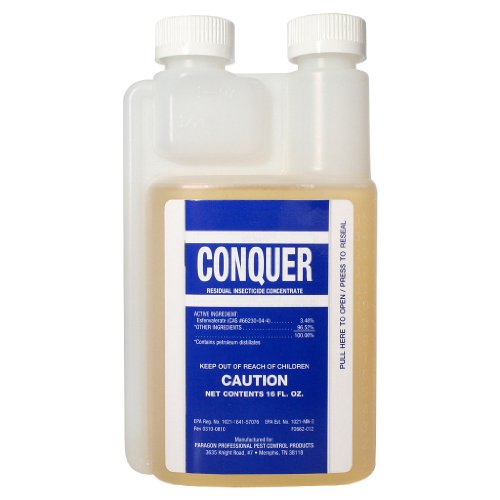
A 16-ounce residual concentrate that keeps ants and crickets out with almost no smell.
This is the quiet achiever of the group — no flashy claims, just a 16-fluid-ounce residual concentrate that does steady work around the house. It is formulated as a residual insecticide, meaning the surface keeps killing after the spray dries, and it is registered to EPA specification. Buyers point to it clearing crickets around the house and keeping ants from returning, with termites and carpenter ants called out as targets it handles well. If you want a straightforward concentrate that gets the perimeter job done without drama, this is it.
Two things stand out from the pattern of owner experience. First, ease of use: it mixes and sprays without fuss. Second, the near-absence of odor — a formula you can walk back into shortly after applying without waiting for a cloud of chemical smell to clear. The value angle is also strong, since a single bottle compares favorably against the cost of hiring an exterminator for a routine treatment. It holds 4.5+ stars across 700+ reviews, matching the top pick’s score on a longer track record.
You should know the longevity is genuinely mixed in owner feedback — some report a solid residual window, others a shorter one, so plan on re-treating more often than you would with the Ortho’s stated 12 months. The listing is also thin on detail: there is no published coverage figure and no named active ingredient on the page, so buyers who like to see the exact chemistry up front will have to check the bottle label. At 16 fluid ounces and 0.57 kg, it is a physical bottle, not a lightweight one, so store it with your other chemicals. For routine ant and cricket control with minimal odor, it delivers.
Your move if: you want odorless, easy-to-mix residual control against ants, crickets and carpenter ants at a value price.
Think twice if: you need a stated coverage figure or named active ingredient before buying, or you are chasing the longest possible residual window.
Know the Specs
Active Ingredient And Its Percentage
The active ingredient is the chemical that kills the roach, and the percentage on the label tells you how concentrated it is before dilution. A higher percentage means more killing power per ounce of concentrate, which matters most for heavy infestations and outdoor perimeter work. Bifenthrin and beta-cyfluthrin are the two pyrethroids that dominate this category — both are lab-made versions of a natural chrysanthemum insecticide. For routine indoor control, a standard-strength bifenthrin does the job; for fire ants or a large yard, the stronger percentage is worth the trade-off in handling care.
Coverage And Mixing Ratio
Coverage is the total area one bottle treats, and it is governed by the mixing ratio — the amount of concentrate per gallon of water called for on the label. A bottle that dilutes to 88 gallons of ready-to-use spray covers a property; a bottle that makes 2 gallons covers a single-family perimeter. The mixing ratio also sets the strength of the spray, so follow the label exactly rather than eyeballing it. Treated areas should dry fully before people and pets re-enter, and porous surfaces like bare concrete tend to hold a residual barrier for less time than non-porous surfaces like tile or sealed wood.
Common Questions
How do I mix a roach killer concentrate with water?
How long does a concentrated roach killer keep working after it dries?
Is a concentrated roach killer safe around pets and children?
Do I need a tank sprayer to use a roach killer concentrate?
Which is better for roaches — a bifenthrin or a beta-cyfluthrin concentrate?
Can I spray a concentrated roach killer outdoors around my foundation?
How many square feet does one bottle of roach concentrate cover?
Will a concentrated roach killer work on ants and other household pests too?
How long should I keep pets and children away after spraying?
Which concentrated roach killer is best for fire ants specifically?
The Bottom Line
For the Best Concentrated Roach Killer job, the strongest all-rounder is the Elanco CyLence Ultra Pest Control Concentrate, because one 32 mL bottle mixes into two gallons, targets over 60 pests, and clears the roaches, flies, ants and spiders in a single treatment. If you need a year-long indoor barrier, grab the Ortho Home Defense Concentrate — its 32-ounce bottle makes 4 gallons and its 12-month protection claim is the longest here. And for fire ant mounds and a whole-property outdoor push, the Liquid Harvest 7.9% Bifenthrin is the specialist to reach for. Match the bottle to the job, mix it to the label ratio, and treat the cracks and perimeter — that is what turns a one-time spray into a problem that stays gone.
How we choose
We do not accept paid placement. Every pick is matched to a real buyer and a real use-case; we do not hands-on test units.
Sources
Specifications: manufacturer listings and product documentation. Review insights: verified customer reviews, as of October 2026. Pricing: not shown on this page (it changes often); check the current price via the retailer link.
As an Amazon Associate, Aappliancez earns from qualifying purchases. This does not affect which products we feature.