Disclosure: Some links in this post are affiliate links. As an Amazon Associate I earn from qualifying purchases, at no extra cost to you. Learn more
Specs are compiled from manufacturer listings and verified buyer reviews and can change over time — please confirm the key details on the product page before buying.
If your legs ache by mid-afternoon and your ankles leave a sock ring you can see, the fix is almost never a softer sock — it is the right pressure, properly graduated. Venous insufficiency means the veins in your legs can’t push blood back up efficiently, so fluid pools in the lower calf. A 20-30 mmHg medical stocking (mmHg is millimetres of mercury, the standard pressure unit) squeezes tightest at the ankle and eases off as it climbs, which is what moves that pooled fluid. Below you get five picks worth considering, sorted by what each one is genuinely good at.
This guide is built by comparing the manufacturers’ published specifications and the patterns across verified customer reviews, so you get each pick’s real strengths and trade-offs instead of marketing spin.
Pressure class comes first, then calf measurement, then whether the fabric actually stays put through a full workday. Here is the honest read on the compression stockings for venous insufficiency.
Top Picks

How To Choose Compression Stockings for Venous Insufficiency
The mistake almost every first-time buyer makes is picking a stocking by how it looks on the listing photo. Compression is a measurement product, not a fashion one. Your ankle and calf numbers decide whether the stocking does its job or just feels tight in the wrong places.
Start with the pressure class, not the colour
Compression is graded in mmHg, and the band on the box tells you the squeeze range. The 20-30 mmHg group is the firm tier, aimed at swelling, varicose veins and post-procedure recovery. A 15-20 mmHg sock is milder and a different tool for a different job. All five picks here sit in 20-30 mmHg, so you are comparing like with like.
Measure your ankle and your calf before you order
Graduated compression only works when the tightest point is at the ankle and the pressure drops as the stocking climbs. That means the ankle circumference is the number to measure first, with the calf circumference a close second. Brands size differently, so measure bare skin in the morning before swelling builds, and check that specific brand’s chart rather than assuming your usual size.
Decide on open toe or closed toe
An open toe lets you check circulation and skin at the toes without removing the stocking, and it makes adjusting around the heel easier. A closed toe holds the whole foot in one continuous squeeze, which some wearers find more secure and others find warm. Neither is better — it depends on if you want to see your toes through the day.
Look hard at the top band and the heel pocket
The top band is where most stockings quietly fail: too loose and it rolls down the calf, too tight and it digs in. A silicone grip dot-top lining and a knit heel pocket are the two construction details that keep a stocking where you put it. Cushioning at the toe and heel is a comfort bonus, not a medical function.
Side-by-Side Comparison
| Model | Best For | Compression | Toe Style | Fabric | Amazon |
|---|---|---|---|---|---|
| BBFREY Medical Compression Socks (3 Pairs)★ Best Overall | All-day everyday wear | 20-30 mmHg | Closed | Nylon/spandex blend | Amazon |
| EvoNation Women’s Open Toe Knee HighSheer Pick | Warm weather and sheer look | 20-30 mmHg | Open | 80% nylon, 20% spandex | Amazon |
| Amazon Basics Medical Compression Stockings | First pair, wide size range | 20-30 mmHg | Open | 83% nylon, 17% spandex | Amazon |
| DYNAVEN by Sigvaris Calf-High | Long lower legs | 20-30 mmHg | Closed | 79% nylon, 21% spandex | Amazon |
| JOBST Relief Waist High | Thigh and hip coverage | 20-30 mmHg | Open | Thick knit, durable | Amazon |
Detailed Reviews
1. Medical Compression Socks 20-30 mmHg for Men Women (3 Pairs)
Our pick — 4.5+★ from 950+ verified ratings; the strongest balance of quality and price.
Three pairs of firm 20-30 mmHg support that hold their squeeze past the eleven-hour mark.
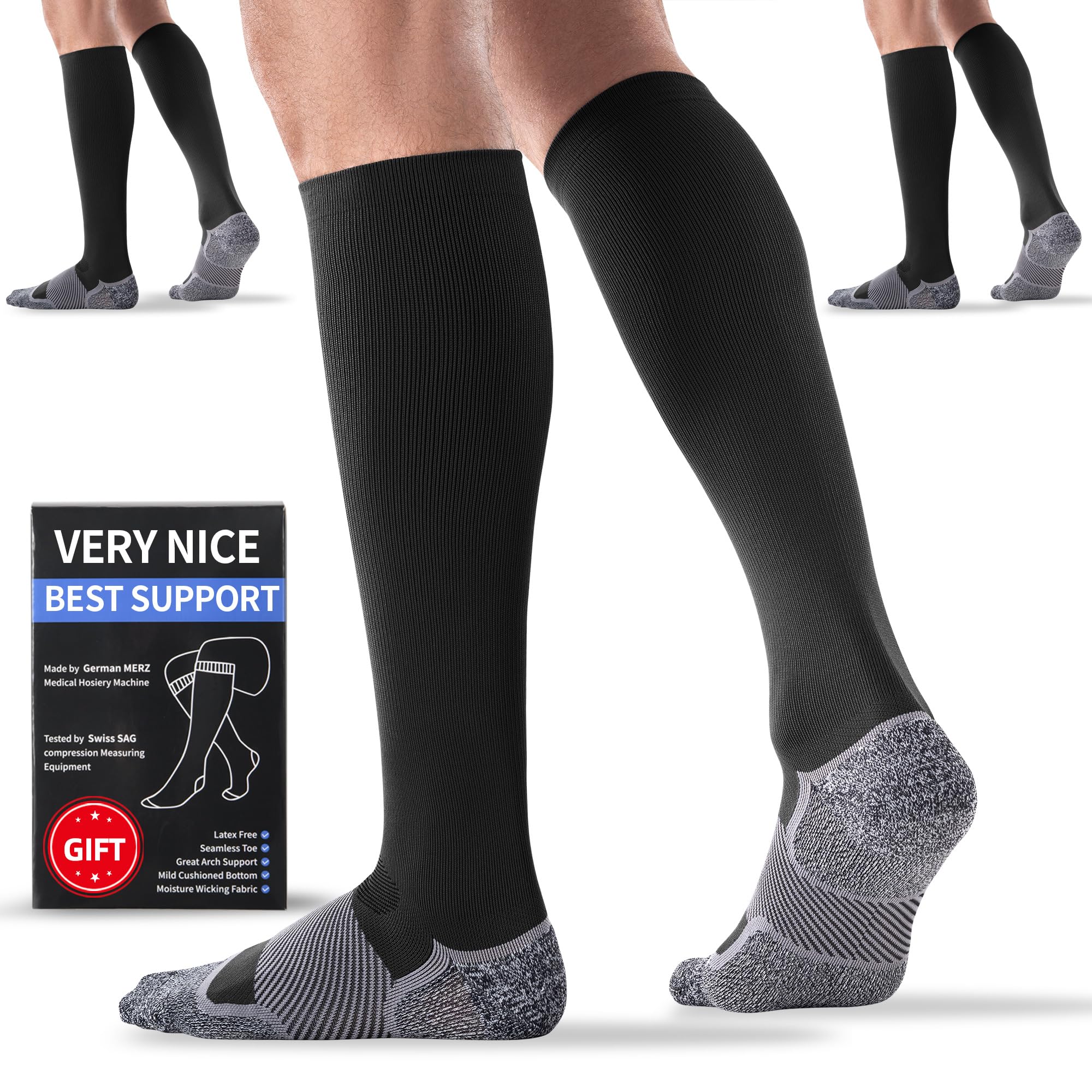
Your first real decision is whether to buy one pair or a rotation, and this set settles it: three pairs at 20-30 mmHg means one on, one in the wash, one ready. They are knit on German medical sock machines and pressure-tested, so the squeeze lands at the ankle and eases up the calf instead of running evenly tight ankle to knee. The ankle and calf hold firm while the top band stops without cutting in. If you want a stocking that simply gets on with the job, the crowd favourite here is a safe place to land — 4.5+ stars across 900+ ratings.
What wins people over is the construction, not the price tag. Owners single out the build quality more than any other trait, and the compression itself is a close second — the kind of feedback you get from a sock that still holds pressure after repeated washes. The toe and heel carry light cushioning, the toe seam is flat rather than a ridge across your toes, and the left-right anatomical fit stops the bunching that causes blisters. A wide-calved wearer measured in at a snug, comfortable fit, and one owner measured before ordering and went up a size to get a genuinely firm hold on an inflamed Achilles.
The honest catch is the putting-on. Firm compression is firm for a reason, and pulling these over the heel takes a bit of patience — noticeably less than most, but still patience. Softer hands or weaker grip will find the last inch over the heel the fiddly part, and going up a size makes that easier without giving away much squeeze. Air-dry them rather than machine-drying, since heat is what kills elasticity in a graduated knit.
What earns the top spot
- Three-pair rotation so a clean pair is always ready while one dries
- Graduated 20-30 mmHg pressure tested on medical sock machines
- Flat toe seams and left-right fit that cut down on bunching
- Top band holds firm without digging into the skin
Where it asks a little of you
- Firm pressure means the heel still needs a deliberate pull to clear
- Air drying is recommended, so machine drying is off the table
- Sizing runs snug — measure the calf before you commit
Made for: anyone who wants one solid, well-built pair on the leg and two more in reserve without hunting for a second brand.
Think twice if: your hands struggle with firm elastic — going up a size solves most of it, but the pull over the heel never disappears.
2. EvoNation Women’s Open Toe Compression Socks 20-30 mmHg
The sheer, open-toe knee high that reads as hosiery and still delivers a firm 20-30 mmHg squeeze.
Here is the pick for anyone who has to be in a skirt or cropped trousers in July and cannot face an opaque medical sock. The fabric is 80% nylon and 20% spandex, sheer enough to pass as ordinary hosiery and open at the toe so you can check circulation without peeling the whole thing off. EvoNation says its graduated compression is tested to be tightest at the ankle and looser up the leg, and the stockings are made in the USA with medical-grade testing behind that claim. The consistent tension across the garment is what owners rate highest about it.
Buyers report the open-toe cut suits people heading into vein procedures, and one described wearing them through 100+°F Texas workdays because the sheer knit breathes. The nude tone is picked to sit close to skin rather than read as a bandage, and the smooth fabric resists fingernail tears better than a thin knit has any right to. It is a good sock for warm weather and for anyone who wants support that stays discreet under real clothes.
Where it pushes back: getting these on is the recurring friction. The fit divides opinion sharply — some find a great fit, plenty find them tight — and the fabric is thin, which shows in how hard it pulls. Owners mention the weave simply will not stretch for some legs: “It is like they are cut the wrong way of the fabric. I cannot even get them on and if I get them on I cannot get them off.” Sizing up is the standard fix, and it is worth doing before your first wear rather than after.
The trade-off worth knowing: the thin sheer knit is the whole point and also the weak spot. It slips under trousers beautifully and demands a careful pull that starts at the ankle and works upward.
Reach for this if: you need something that looks like normal hosiery and open at the toes through a warm-weather workweek.
Look elsewhere if: your calf runs wide or your hands need an easy pull-on — this is a sock you ease into place, not yank.
3. Amazon Basics Medical Compression Stockings X-Large
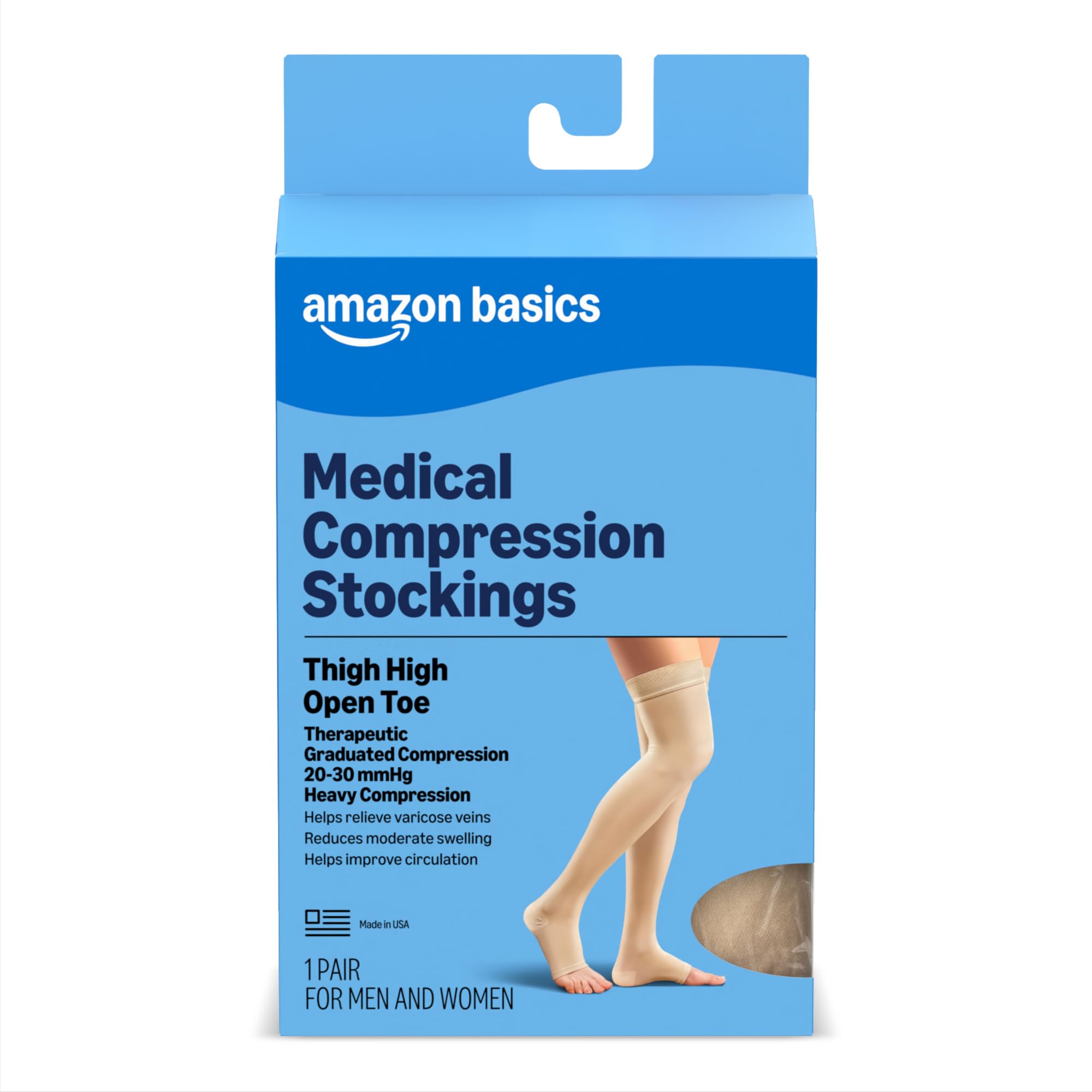
Hospital-grade yarn, a silicone dot top and a knit heel pocket make this the unglamorous workhorse of the group.
If your main worry is a stocking that rolls down your calf before lunch, start here. The silicone grip dot-top lining is the specific answer to that problem, and the knit heel pocket anchors the garment so it does not creep. The fabric is 83% nylon and 17% spandex in heavier medical weight yarns, opaque enough to conceal rather than look clinical, and it is made in the USA. The open toe lets you or a carer check toes and skin during recovery without removing the stocking.
What the reviews confirm is that the construction is the star: build quality is far and away the most-praised thing about these, with the compression itself close behind. Customers note they hold up through long shifts of standing or sitting and stay put all day. One described her mother moving from a hospital-issued stocking that kept rolling down to these, which stayed up and went on easier. A 6’4″, 225 lb wearer found the fit spot on, and a calf measuring around 19″ went up to the 2X. This is also the pick with the deepest size range, which matters when your ankle and calf land in different brackets.
Two things to plan around. First, the ankle fit is looser than the calf on some legs — these are for calf and knee support, not a targeted ankle squeeze, so a stocking aimed at ankle edema specifically will suit you better. Second, the toe-less open design and the thicker yarn make them warm through summer, and a few reviewers point out early wear on the seam if they are pulled on roughly. Ease them on with your thumb inside the top and they last far longer.
Best match for: a first medical stocking, a post-surgery recovery pair, or a wide calf that needs a real size chart to shop from.
Not the one for: a buyer whose main problem is ankle swelling — the calf support here outruns the ankle grip.
4. DYNAVEN Sigvaris Compression Calf-High Socks 20-30mmHg

Built for the wearer every standard stocking was cut too short for — a genuine long-calf option.
Most compression socks come in one length and leave tall wearers with a garrote around the shin. This Sigvaris calf-high is the one that fixes that: it is a closed-toe 20-30 mmHg stocking offered in a Small Long cut, with double-covered inlay yarns in 79% nylon and 21% spandex for a firm graduated squeeze. The fortified heel and wide toe space mean the closed toe is built for all-day wear rather than just to close the knit off.
What people talk about most is the quality of the knit and the length, and for good reason. A 5’9″ wearer who found every other brand’s single length too short called this the best compression sock she had tried, and a long-legged owner with severe varicose veins rated the tall size a stand-out for exactly that. Shoppers say they hold their elasticity over time, stay up on the calf without binding, and go on easier than an equivalent Jobst for the same pressure class. It is the option here that treats a longer lower leg as a design target rather than an afterthought.
The one dent in the armour: breathability is the weak link. The fabric runs warm and legs can feel hot by the end of a long day, which the manufacturer’s own pricier Sigvaris lines address with a better texture. It is a fair trade for a stocking cut specifically to length.
Pick this when: off-the-peg lengths leave your calf exposed or pinch your shin, and you want a closed-toe medical-grade stocking built long.
Pair it with something else if: you run hot through summer — the thicker knit traps heat.
5. JOBST Relief 20-30 mmHg Waist High Compression Stockings

The waist-high that reaches the parts knee-highs cannot, with a thick knit that refuses to be sheer.
When the swelling and heaviness sit above the knee, a calf-high stocking runs out of coverage. This JOBST Relief garment is waist high, reaching up over the hip, which is why it earns a place here. The knit is thick and non-sheer, open at the toe so you can adjust around the heel and foot, and cut at a firm 20-30 mmHg. One 5’6″, 180 lb nurse wore a Medium through long shifts and called it as comfortable as full compression hose can be.
The waist-high cut helps with hip and joint discomfort above the knee. A 5’4″, 130 lb wearer with post-DVT support-hose experience found the Medium fit had the usual firmness at pull-on, firm compression that eased leg ache, and an open toe that worked with flip flops. The thick yarn is long-wearing — buyers report it does not crease into a rubber-band effect if you smooth it out as you put it on.
Where it stumbles is the top band, which rolls over and can bunch behind the knees on a long shift, plus a seam risk at the crotch that a few owners hit early. It also runs warm in summer. Treat the waist band as something to seat flat at every wash and the garment serves you far longer. Given the price tier, it is a considered purchase for someone who needs full-leg support, not an impulse add-on.
It earns its spot: if you need support that runs over the hip and knee, the open toe helps with adjustment, and you want a thick durable knit.
Go back to a calf-high if: your support need stops below the knee — the waist band is the part that needs the most attention.
Know the Specs
Compression class in mmHg
mmHg means millimetres of mercury, the unit used to measure pressure. The number on the box is a range, so 20-30 mmHg means the stocking squeezes with a pressure between those figures. The tighter bottom number and looser top number describe how graduated knit works. When you see “20-30 mmHg” on every pick above, that is the firm tier — the one aimed at swelling, varicose veins and recovery, rather than the milder 15-20 mmHg group.
Graduated compression
Graduated simply means the squeeze is not the same everywhere. The stocking is tightest at the ankle and gets gradually looser as it climbs the calf or thigh. That gradient — tight at the ankle, looser up the calf — is what pushes fluid up and out of the lower leg. A sock that is evenly tight top to bottom is not graduated, and it does a different job.
Open toe vs closed toe
An open toe leaves the toes uncovered, so you can see skin and check circulation without removing the garment. It also makes adjusting the stocking round the heel easier in the morning. A closed toe covers the whole foot in one consistent squeeze, which some wearers find more secure. Neither changes the pressure class — both exist at 20-30 mmHg.
The top band and heel pocket
The top band is the part that decides whether a stocking stays up or rolls down. A silicone grip dot lining anchors it, and a knit heel pocket holds the garment in place over the heel. Without one or both, a firm stocking can slide down through the day. It is the least glamorous spec and the one that most affects whether you can wear it to work.
Common Questions
Is 20-30 mmHg the right compression for venous insufficiency?
How do I measure my calf and ankle for compression stockings?
Should I choose open toe or closed toe stockings?
How long do compression stockings keep their pressure?
Why do my compression stockings roll down my calf?
Can I wear 20-30 mmHg stockings all day?
What is the difference between knee-high and waist-high compression stockings?
Do long-length compression stockings exist for tall wearers?
How should I wash compression stockings to protect the pressure?
Are compression socks for flying the same as medical stockings?
The bottom line
For most people, the compression stockings for venous insufficiency winner is the BBFREY Medical Compression Socks because three pairs at a firm 20-30 mmHg means you never skip a day waiting on the wash, and the construction holds its squeeze where it matters. If you need something that looks like ordinary hosiery and is open at the toes through a warm week, the EvoNation Women’s Open Toe answers that. And when the swelling runs above the knee, the JOBST Relief Waist High covers the hip the calf-highs cannot.
One last nudge: measure both your ankle and your calf before you order anything, because every stocking here is sized by measurement, and the right number does more for your legs than any feature on the box.
How we choose
We do not accept paid placement. Every pick is matched to a real buyer and a real use-case; we do not hands-on test units.
Sources
Specifications: manufacturer listings and product documentation. Review insights: verified customer reviews, as of October 2026. Pricing: not shown on this page (it changes often); check the current price via the retailer link.
As an Amazon Associate, Aappliancez earns from qualifying purchases. This does not affect which products we feature.