Disclosure: Some links in this post are affiliate links. As an Amazon Associate I earn from qualifying purchases, at no extra cost to you. Learn more
Specs are compiled from manufacturer listings and verified buyer reviews and can change over time — please confirm the key details on the product page before buying.
If you have POTS, the stocking that helps you most is the one you can actually get on before your heart rate spikes. Look for a real 20-30 mmHg pressure rating (the tightness measured at the ankle in millimeters of mercury), a waistband that stays put, and a toe box that leaves your toes alone. Get those three right and the pair earns a spot in your daily rotation instead of the drawer.
This guide is built by comparing the manufacturers’ published specifications and the patterns across verified customer reviews, so you get each pick’s real strengths and trade-offs instead of marketing spin.
Below you’ll find eleven options sorted by what they actually solve, from zippered open-toe socks that go on without a struggle to footless tights that leave your stomach free. Every pick here is a real compression garment with a stated pressure level, so you can match the tightness to your day. These are the compression stockings for pots picks worth your attention, chosen for pressure accuracy and everyday wearability.
Top Picks


How To Choose The Best Compression Stockings for POTS
When you stand, POTS (postural orthostatic tachycardia syndrome, a condition that makes your heart race and blood pool) makes it hard for your body to push blood upward. So the compression level and where it sits on your body both matter a lot. A stocking that is too loose does nothing. One that is too tight cuts circulation and forces you to peel it off. the balance is a garment that hits its stated pressure at the ankle and relaxes as it climbs.
Start with the pressure number, not the brand
Medical compression is graded in mmHg — millimeters of mercury, a pressure reading where the highest number is the tightest point. A 20-30 mmHg garment squeezes hardest at the ankle and gradually relaxes upward, which is what pushes blood back toward your heart. POTS support usually leans on that 20-30 mmHg range rather than a lighter 15-20 mmHg. Look for the number printed on the packaging, because listing copy can drift from what actually ships.
Ankle, calf, and thigh measurements decide your size
Brand sizing is not interchangeable. Measure your ankle at its narrowest point and your calf at its widest before you order anything. A size that is right in one brand can be a full size off in another. Skip this step and you either get a garment that bunches at the ankle or one that stands off your leg like a loose sock.
Pantyhose, thigh-high, or knee-high changes the support
Knee-high socks work your lower leg only. Thigh-highs and pantyhose extend support higher, which some POTS wearers prefer because more of the leg gets help. Footless tights leave your toes and feet free while still wrapping your legs and waist. Decide how much of your body you want compressed before you compare pressure ratings.
Side-by-Side Comparison
| Model | Best For | Compression | Style | Fabric | Amazon |
|---|---|---|---|---|---|
| CASMON Zipper Compression Socks★ Best Overall | Easy on and off with arthritis or limited hand strength | 15-20 mmHg | Knee high, open toe, zippered | — | Amazon |
| Compression Pantyhose Stockings for Women MenTop Performer | Full-leg support for long standing shifts | 20-30 mmHg | Pantyhose | — | Amazon |
| Amazon Basics Medical Compression StockingsBudget Champion | Budget full-leg support with a stay-put top | 20-30 mmHg | Pantyhose-style, toe-less | 83% Nylon, 17% Spandex | Amazon |
| Truform Knee High Closed Toe | Firm knee-high pressure for post-op recovery | 20-30 mmHg | Knee high, closed toe | — | Amazon |
| Truform Thigh High Dot Top | Support that reaches higher on the leg | 20-30 mmHg | Thigh high, closed toe, dot top | 80% nylon, 20% spandex | Amazon |
| beister Thigh High Compression Socks | Graduated thigh-high support with a roomy toe | 20-30 mmHg | Thigh high, closed toe | Cotton Fiber, Spandex | Amazon |
| beister Compression Pantyhose Footless | POTS support without abdominal compression | 20-30 mmHg | Footless leggings | 70% nylon, 25% spandex, 5% elastane | Amazon |
| FUTURO Firm Pantyhose | Warm-weather full-leg support | 20-30 mm/Hg | Pantyhose, reinforced toe and heel | Nylon and Spandex | Amazon |
| JOBST Relief Knee High | Premium knit and steady all-day pressure | 20-30 mmHg | Knee high, closed toe | — | Amazon |
| 20-30mmHg Compression Pantyhose for Women & Men | Sheer look for skirts and dresses | 20-30 mmHg | Pantyhose, open toe | 70% Nylon 30% Spandex | Amazon |
| KTINNEAD Compression Pantyhose | An affordable full-leg pair to try out | 20-30 mmHg | Pantyhose, closed toe | — | Amazon |
Detailed Reviews
1. CASMON 15-20mmHg Zipper Compression Socks
Our pick — 4.5+★ from 650+ verified ratings; the strongest balance of quality and price.
The pair you can actually pull on when your hands won’t cooperate.
CASMON’s 15-20 mmHg socks sit on the lighter end of medical compression, and for many POTS wearers that lighter level is what makes daily wear possible. The number matters: 15-20 mmHg is the gentlest graduated squeeze of the picks here, a rung below the 20-30 mmHg garments that dominate this list. What wins people over, though, is the zipper. It runs up the front so the fabric opens wide instead of stretching over your heel.
That open-up design changes the whole morning routine. It saves you from wrestling a tight tube over your foot, and on an arthritis day that is the difference between putting them on and giving up. The open toe also keeps your toes free rather than bunched, so shoes fit without pinching. Owners describe slipping them on themselves, unassisted, which is the exact thing most compression socks fail at.
Here is the trade-off you should plan around. The lighter 15-20 mmHg grasp means these are for comfort and mild support, not for the firm, higher pressure a doctor may specify for POTS. Fit is also the recurring weak point — the sizing can run generous, and one buyer measuring an 8-inch ankle and 14-inch calf found the XL far too big. Measure and size down if you’re between sizes.
Where the zipper earns its keep
- Zipper opens wide so you can put them on without a fight
- Open toe keeps toes free and shoes comfortable
- Gentle 15-20 mmHg squeeze for easier all-day wear
- Hidden zipper sits smoothly under leggings and trousers
The honest trade-offs
- Lighter pressure than the 20-30 mmHg picks, so milder support
- Sizing can run large — measure ankle and calf before ordering
Your best fit: anyone whose biggest barrier is simply getting a stocking over their foot — the zipper solves that.
Look elsewhere if: your doctor specified firm 20-30 mmHg pressure, since this pair tops out at 15-20 mmHg.
2. Compression Pantyhose Stockings for Women Men, 20-30 mmHg
Full-leg 20-30 mmHg support that reads like an ordinary pair of black tights.
This is the middle of the list for a reason: it delivers the firm 20-30 mmHg graduated squeeze POTS wearers often want, and it does it as a full pantyhose rather than a knee-high. That means support climbs from your ankle all the way up your leg instead of stopping at the calf. The opaque black finish also lets you wear it to work without announcing it’s medical wear.
For long shifts, that combination pays off. It holds steady through a twelve- or thirteen-hour day, and owners who stand or move constantly report their legs feel lighter rather than heavy. It pulls on faster than a heavy rubber-feeling stocking, which matters when you’re suiting up in a hurry. Better yet, it does the same job as far pricier clinical pairs while staying in the affordable range.
The real catch is sizing, and it’s worth taking seriously. The size chart can be too generous, so measure your thigh and calf rather than guessing, and drop to the smaller waist size if you’re between sizes. The crotch also runs short, so you may find yourself tugging it back up through the day. Treat it as a firm fit you wear a few days a week rather than every single day.
Wearability verdict: firm graduated support that behaves like regular tights, comfortable for long standing shifts but best rotated with a knee-high on off days.
Measure before you buy: sizing is the weak spot — the chart skews loose, and the short crotch means extra adjusting.
The core idea: full-leg firm support you can wear to the office unnoticed.
One thing to plan for: size down between sizes and expect to adjust the crotch through the day.
3. Amazon Basics Medical Compression Stockings, Beige, Large
The budget pick that behaves like a hospital-grade stocking.
Amazon Basics brings a genuine 20-30 mmHg medical stocking at an everyday price, built from 83% nylon and 17% spandex with thicker medical-weight yarns. The toe-less design lets you check on your toes and skin without pulling the whole thing off. A silicone grip dot-top lining helps it stay put so it doesn’t roll down your leg mid-morning.
What people notice most is the construction — it feels sturdy rather than flimsy, and the graduated squeeze is steady enough to settle swollen legs through a long day. It suits the person who sits or stands for hours and wants reliable pressure without paying premium-brand money. The 3.53-ounce fabric is lightweight enough to layer under trousers.
Where it can let you down is at the ankle. Some find the ankle loose with no real support, especially if your ankle is slim, and the heel seam can sit off-center. Durability is mixed too — a few pairs tear within a couple of wears. Go in knowing you’re buying a dependable everyday stocking, not an indestructible one.
What keeps it dependable
- Firm 20-30 mmHg graduated squeeze at a budget-friendly price
- Silicone dot band fights rolling and sliding
- Breathable toe-less design for easy checking and layering
- Hospital-grade feel from 83% nylon, 17% spandex
Where it can slip
- Ankle fit runs loose for slimmer ankles
- A few pairs tear early; treat them gently when pulling on
Worth grabbing if: you want serious 20-30 mmHg support on a tighter budget.
Keep in mind: the ankle can be loose and durability varies, so pull it on slowly.
4. Truform 20-30 mmHg Compression Stockings
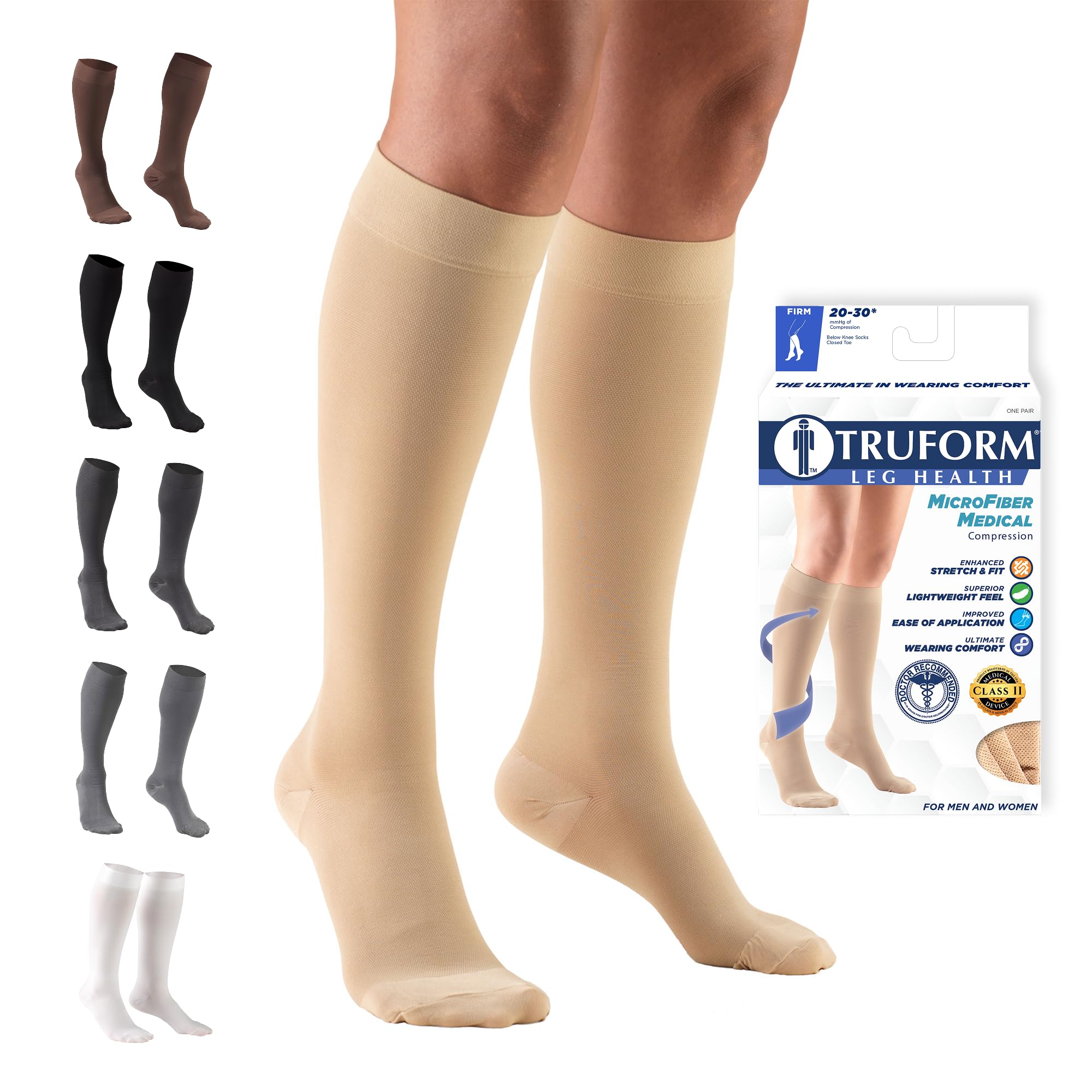
A knee-high workhorse with the firmest, most clinical squeeze on this list.
Truform has been making medical compression for a very long time, and this 20-30 mmHg knee-high carries a Class II medical rating — the regulated sort meant for real venous issues, not just general support. If you want an unambiguous firm squeeze at the ankle that grades down the calf, this delivers it. It’s a closed-toe sock, so your whole foot gets wrapped.
What stands out is effectiveness for swelling and post-surgery legs. Buyers report ankle swelling easing noticeably after the first day, with the 20-30 mmHg squeeze holding steady through a full shift. The sizing chart is accurate if you measure properly, so the fit can be dialed in precisely. It’s a solid pick for the person who wants knee-high support with a clear medical pedigree behind it.
Getting one on takes some practice, though — the very firmness that makes it work also makes it tough to pull on at first, sometimes taking minutes before you learn the technique. Sizing can also run a touch off between your ankle and calf, so a size that suits one measurement may pinch the other. Plan to size by your ankle first.
The payoff: firm, regulated 20-30 mmHg compression that visibly eases swelling and holds steady for hours.
The effort: expect a learning curve to pull them on, and size by the ankle rather than the calf.
Matches well with: knee-high support, post-op recovery, and anyone who wants a firm clinical squeeze.
Think twice if: dexterity is limited — the firmness makes donning a chore at first.
5. Truform 20-30 mmHg Thigh High, Dot Top, Closed Toe
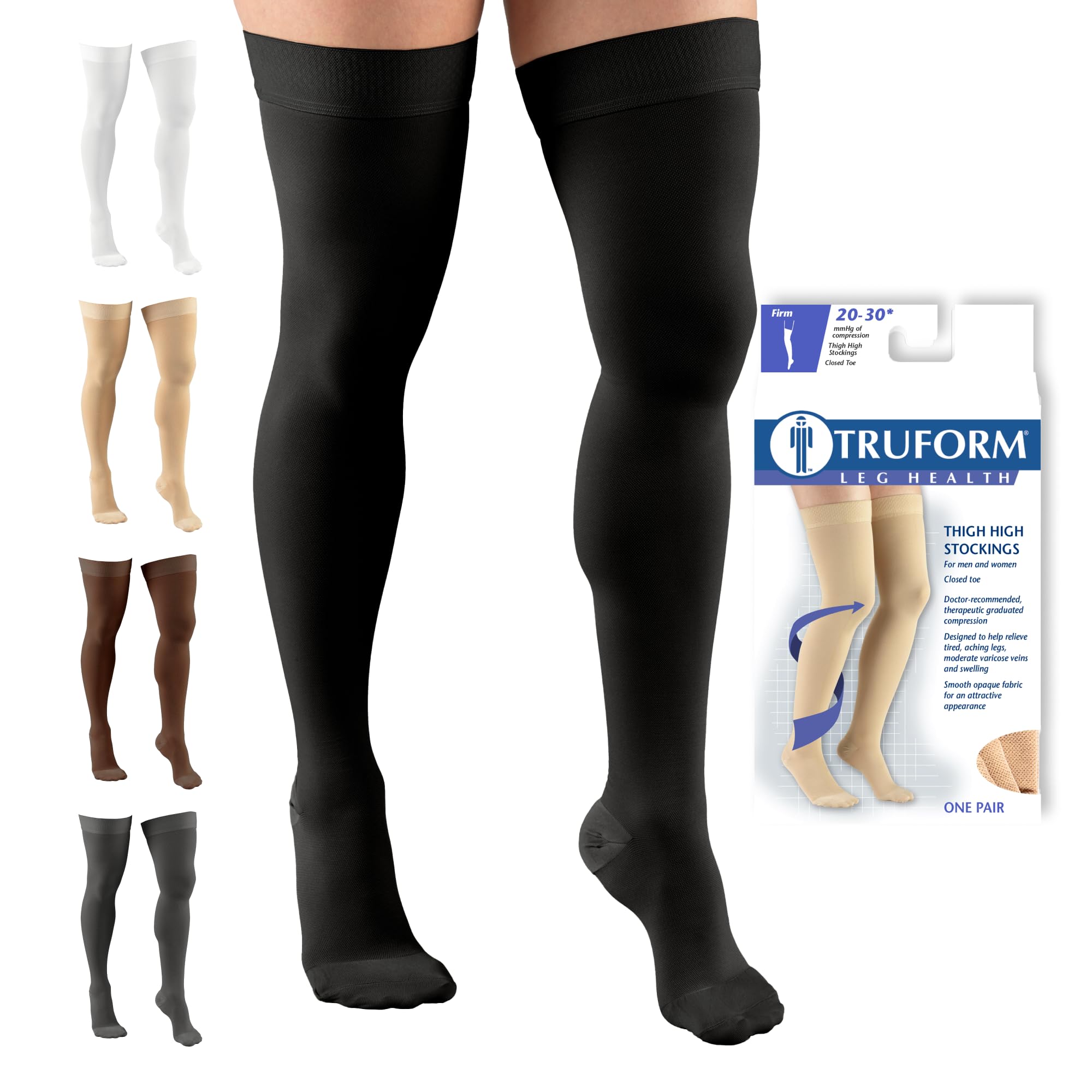
Truform’s firm squeeze, extended all the way to the thigh.
Take the firm 20-30 mmHg graduating pressure that made the knee-high Truform a favorite and run it all the way up the leg. That extra reach is the whole point here — more of your leg gets support, which some POTS wearers find steadier through a long day of standing. The 80% nylon, 20% spandex knit is tough and resists snags, and the roomy comfort toe leaves sensitive toes some room.
A silicone dot band around the top is meant to hold the thigh section in place so it doesn’t slide. When it works, it works well — the sock stays put through hours of activity. The closed-toe foot gives full coverage, and the defined heel makes it sit squarely once positioned. It’s a strong choice if you want thigh-high support with proven fabric.
The silicone dots are also the sticking point. For some wearers the dot band leaves red, itchy marks on the thigh after long wear, and a couple of sensitive-skin users found the marks lasted a day or more. Compression at the top can feel tight relative to the lower leg too. If your skin reacts to adhesives, this may not be the pair for you.
Why it holds its ground
- Firm 20-30 mmHg graduated squeeze reaching to the thigh
- Tough nylon-spandex knit resists snags
- Silicone dot top helps prevent sliding
- Roomy closed-toe keeps sensitive feet comfortable
Where it can irritate
- Silicone dot band can leave itchy red marks on sensitive skin
- Top can feel tight relative to the lower-leg squeeze
Reach for it when: you want firm support that climbs all the way to the thigh.
Be cautious if: your skin reacts to adhesives — the dot band may leave marks.
6. beister Thigh High Compression Socks, 20-30 mmHg, Closed Toe
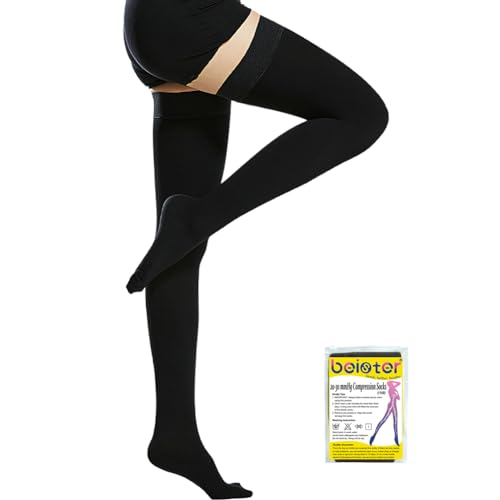
Built with a roomy toe so your toes never get squeezed flat.
This is a thigh-high 20-30 mmHg stocking with five graduated pressure intervals, meaning the squeeze steps down in stages from ankle to thigh instead of dropping all at once. The closed-toe foot is deliberately designed with a roomy toe box so your toes aren’t compressed, which cuts down on toe pain during long wear. The fabric is a soft cotton-spandex blend made on German machinery, according to beister.
Owners who stand for hours find the graduated support keeps their legs from feeling heavy, and the wider silicone-dot cuff is meant to hold the sock up without constant tugging. The reinforced heel adds wear, and seven size options help you zero in on a closer fit. It’s a considered option if thigh-highs are what your legs need.
Sizing is where you need to be careful. The size chart overlaps in confusing spots and can recommend a size that ends up loose, so measure twice and expect to size down. Some wearers also find the toe fabric retracts and pinches after twenty minutes, and the top band runs tight for some. If you’re between sizes, order the smaller one.
Best quality: five-interval graduated compression in a soft cotton-spandex knit with a toe box that respects your toes.
Sizing caution: the chart can be confusing and runs loose — measure carefully and lean smaller.
Worth picking for: thigh-high support paired with a roomy toe for tender feet.
Tread carefully if: you dislike confusing sizing or find tight top bands uncomfortable.
7. beister Compression Pantyhose 20-30 mmHg, Footless
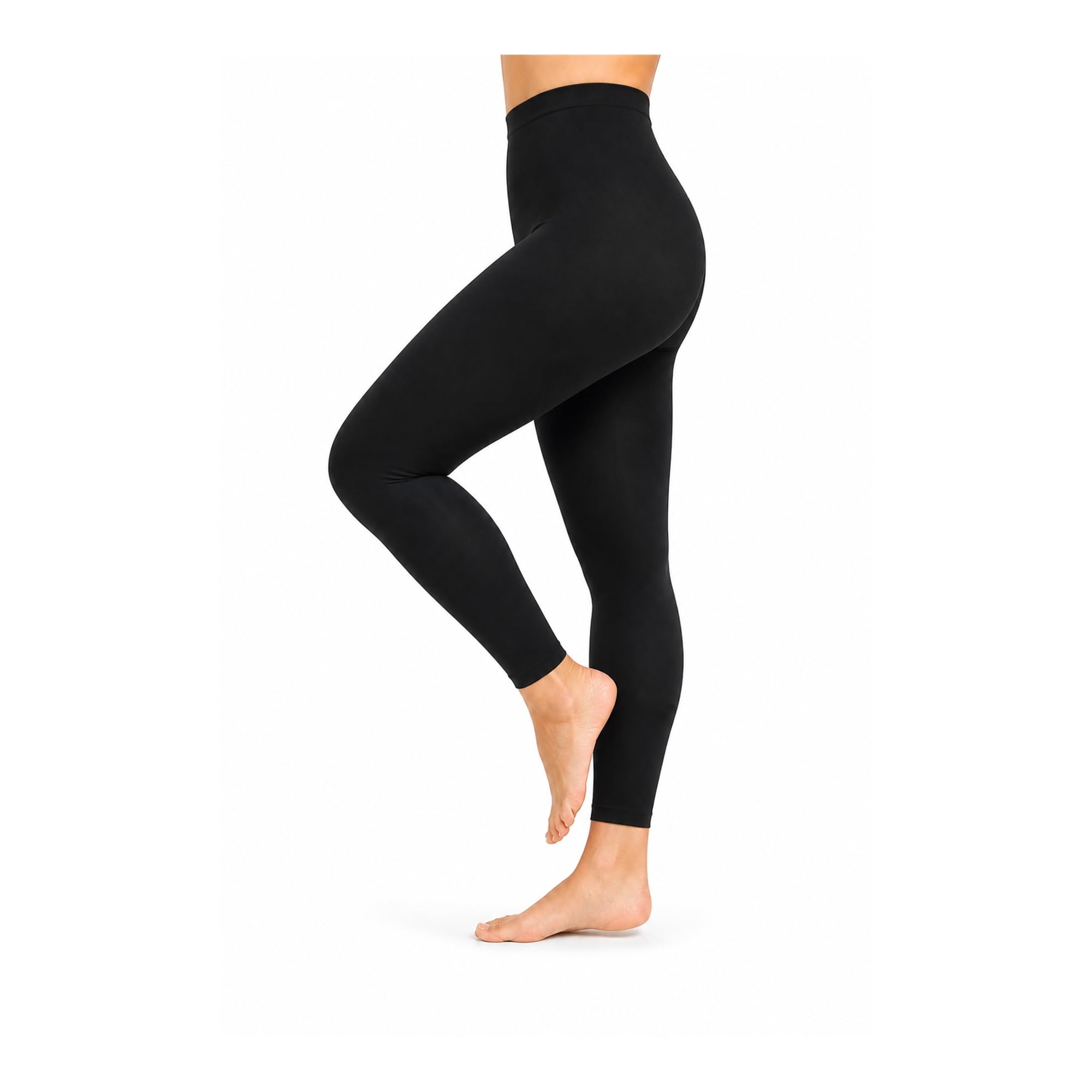
Full-leg compression that skips the stomach — the detail POTS wearers keep mentioning.
Here’s the nuance that makes this pair different from the other footless tights on this list: the high waist is designed to sit snug without really compressing your abdomen. For POTS specifically, that matters — firm belly compression can feel uncomfortable, and this cuts that out. The five-interval 20-30 mmHg graduated squeeze runs from ankle to waist, wrapping the legs hard while leaving the torso freer to move and breathe.
Owners who wear it daily note it’s easier to put on than a closed-toe pair and stays comfortable for long stretches. The opaque fabric holds its shape and lets you pass it off as plain leggings rather than medical wear. The stretchy, tagless waistband is built to avoid digging in or sliding down. It’s the kind of piece you can keep on through a workday without wanting to peel it off.
The catch is fit and construction. The waist can run large or sit too tight depending on your build, and one pair ripped after just a few hours of casual wear — so treat it kindly. A front seam bothers some men who find it sits awkwardly. Size down if your hips run narrow, and check the crotch and thigh fit before you rely on it daily.
The clever design bits
- Footless legs leave your feet and toes free
- No abdominal compression — the waist stays gentle
- Five-interval 20-30 mmHg squeeze from ankle to waist
- Opaque, leggings-like look for everyday wear
Watch-outs to know
- Waist fit varies and can run large or tight
- Occasional tearing and an awkward front seam for men
Top of the pile for: POTS wearers who want leg compression without a tight stomach.
Consider another pair if: you need a dependable waist that won’t tear within hours.
8. 20-30mmHg Compression Pantyhose for Women & Men

Sheer 20-30 mmHg support that slips under a skirt or dress without a second glance.
This pantyhose gives you full-leg support that looks like regular tights, thanks to its sheer, open-toe design. It uses graduated compression (pressure that is firm at the ankle and eases as it goes up) in a 20-30 mmHg squeeze (millimeters of mercury, the standard pressure unit). The open toe keeps your toes free, and the thin fabric pairs with a skirt, dress, or tunic so it reads like ordinary hosiery. It’s the pair for the person who wants full-leg support without giving up their work wardrobe.
Owners who wear it on long flights and through full days on their feet say it keeps their legs comfortable and doesn’t bunch or slip. The compression feels snug and steady, holding its pressure through hours of wear. The thin, tights-like fabric works well under loose jeans or sweatpants too, so it’s versatile across seasons.
That same thinness is a double-edged sword. The fabric runs tight and takes some maneuvering to pull on, so allow extra time and patience in the morning. The crotch and upper inner thigh can feel uncomfortable, and the material tends to attract lint. It’s also on the delicate side, so treat it like fine hosiery rather than a rugged sock.
The fashion win: sheer, open-toe 20-30 mmHg compression that looks like normal tights under any outfit.
The fiddly part: it’s tight to pull on and delicate, so it rewards a little patience.
Ideal for: full-leg, dressed-up days when you want support that stays hidden.
Not the one if: you want something you can yank on quickly or wear ruggedly day after day.
9. FUTURO Firm Pantyhose, Medium, Nude (20-30 mm/Hg)

A warm-weather full-leg stocking you can wear under nothing heavier than a dress.
FUTURO brings a firm 20-30 mm/Hg pantyhose in a nude shade, which is the detail that matters here — it’s a summer-friendly alternative for people who find knee-high socks too hot. Graduated compression runs from toe to leg to help with circulation, and the reinforced toe and heel add wear where the fabric takes the most stress. It’s a full-length stocking rather than a sock.
The POTS crowd tends to like this one because it holds firm pressure while still letting you move your legs and feet freely, and it doesn’t poke at your lower stomach. Wearing it under a summer outfit keeps the support hidden and cool. It’s a solid choice if you want firm compression from a recognizable maker without heavier layers.
Two things to weigh up. It’s a firm squeeze, so pulling it on takes effort, and the fit runs tight for some — a size that suits your waist may pinch elsewhere. A few pairs tear at the first wear, so be gentle on the initial pull-on. The color range is also narrow, which bothers some wearers wanting to match skin tone.
Why it suits warm days
- Firm 20-30 mm/Hg graduated compression for full-leg support
- Nude sheer look wears discreetly under summer clothes
- Reinforced toe and heel add durability where it counts
- Leaves your stomach and movement more comfortable
Small things to know
- Firm fit runs tight and takes effort to pull on
- Narrow color range and occasional early tearing
The warm-week choice: sheer full-leg firm support for hot days when socks feel like too much.
Go slow with it: it’s firm to pull on and can tear if yanked, so treat the first wear with care.
10. JOBST Relief 20-30 mmHg Compression Stockings, Knee High

The clinic-grade knee-high with a steady, even squeeze all day long.
JOBST Relief is the premium knee-high of the group, and its 20-30 mmHg graduated squeeze is the kind that stays consistent from morning to evening instead of loosening by lunch. The durable knit is built for daily wear, and the closed-toe foot wraps the whole foot evenly. It’s the clinic-grade stocking many doctors’ offices dispense, which is why people seek it out online.
The quality of the knit shows in the feel — smooth, sturdy, and even in pressure rather than patchy. Owners say it’s easy to get on and slips off easily at the end of the day, and it holds its support without slipping down the calf. If you want a knee-high that behaves like clinical-grade gear, this is where to look.
The catch is cost and toebox. It’s the most premium pick here, and the closed toe runs small for some feet — a few wearers find the toes tight and the fabric a little unpleasant against the skin. Fit can also feel firm for some and just right for others. Measure your foot, not just your calf, before committing.
The premium promise: consistent 20-30 mmHg pressure and a durable knit that holds up to daily wear.
The tight spot: a roomy calf doesn’t guarantee a roomy toe, so check your foot length first.
Worth the spend for: knee-high users who want clinical-grade pressure that lasts the day.
Skip if: your toes need a wide box — this closed toe runs small.
11. KTINNEAD 20-30 mmHg Compression Pantyhose, Closed Toe

A high-waist closed-toe pair meant to stay up over your belly.
KTINNEAD’s closed-toe pantyhose aims at a specific gripe: waistbands that roll down. The high waist is designed to sit over the belly and stay put, and the 20-30 mmHg graduated squeeze runs the length of the leg. For someone who’s fought waistbands sliding all day, that’s the promise worth testing. The opaque fabric reads like tights rather than medical wear.
Owners who like it praise how the waist stays up and how the legs feel supported during long standing stretches. The material is on the sturdy side, and the support through the leg is real, which is why it earns a spot for everyday wear. If a stable waist is your priority, this is worth a look.
The weaknesses are the ones to check before you commit. The compression can feel uneven — some wearers find it too tight at the ankle and knee, cutting circulation, and the sizing runs large so a size down often fits better. The fabric feels rougher than a medical-brand stocking, and the crotch can tear with wear. Order carefully and treat the waist as the main fit variable.
The waist-first appeal
- High waist designed to stay up over the belly
- Opaque 20-30 mmHg legs read like ordinary tights
- Closed toe for full-foot coverage
- Sturdy feel with real leg support
What can come up short
- Compression can feel tight at the ankle and knee
- Runs large and the fabric is rougher than premium brands
A fair match for: anyone whose main frustration is a waistband that won’t stay up.
Go carefully if: your ankles need a gentler, evenly graduated squeeze.
Know the Specs
mmHg (the pressure rating)
mmHg stands for millimeters of mercury, and it’s the number that tells you how tight a stocking squeezes. The higher the number, the firmer the pressure at its tightest point, which is the ankle. A 15-20 mmHg garment is a gentle squeeze; a 20-30 mmHg garment is firmer and is what most POTS-focused pairs here use. Always match the number on the package to what you need, because the label, not the marketing copy, is what counts.
Graduated compression
Graduated compression means the stocking squeezes hardest at the ankle and gradually relaxes as it climbs toward your heart. That gradient is what helps move blood upward instead of letting it pool. A sock that squeezes the same everywhere, or that pinches only at the knee, defeats the purpose. Look for wording that says the pressure decreases up the leg, and check that the tightest point feels like the ankle, not the calf.
Closed toe versus open toe
A closed toe wraps your whole foot, giving full coverage and a snug fit under shoes. An open toe leaves your toes free, which helps if your toes are sensitive or if a closed toe pinches. Open-toe designs also let you check your skin without removing the stocking. Neither is better in general — it depends on whether your toes tolerate compression and how you plan to wear shoes over them.
Knee, thigh, and footless styles
Knee-highs support the lower leg only. Thigh-highs and pantyhose extend support further up, which helps if you want compression over a larger area. Footless tights wrap your legs and waist while leaving your feet bare. The more of your leg that’s covered, the more support you get, but also the more fabric to pull on and the more potential for a pressure point at the waist or thigh band.
Common Questions
What compression level is right for POTS?
Should I choose knee-high or thigh-high stockings for POTS support?
Do footless compression tights still help with POTS?
How do I measure my ankle and calf for the right size?
Will a zippered compression sock give the same pressure as a pull-on?
Why do some compression stockings leave marks on my legs?
Why do compression pantyhose tear so easily?
Can I wear compression stockings all day with POTS?
What is the difference between 15-20 mmHg and 20-30 mmHg stockings?
Do I need open-toe or closed-toe compression stockings?
How do I stop my compression stockings from rolling down?
The Bottom Line
For most people living with POTS, the compression stockings for pots winner is the CASMON 15-20mmHg Zipper Compression Socks, because the zipper turns the hardest part of compression — getting the sock on — into something you can do yourself, even on a tough morning. If you want firmer 20-30 mmHg full-leg support that reads like ordinary tights, reach for the Compression Pantyhose Stockings for Women Men. And if abdominal pressure is the thing you want to avoid, the beister Compression Pantyhose Footless pair wraps your legs while leaving your stomach free.
One honest nudge before you order: measure your ankle and calf first, and match the mmHg number to what you actually need. The right pair is the one you’ll still reach for on day two.
How we choose
We do not accept paid placement. Every pick is matched to a real buyer and a real use-case; we do not hands-on test units.
Sources
Specifications: manufacturer listings and product documentation. Review insights: verified customer reviews, as of October 2026. Pricing: not shown on this page (it changes often); check the current price via the retailer link.
As an Amazon Associate, Aappliancez earns from qualifying purchases. This does not affect which products we feature.