Disclosure: Some links in this post are affiliate links. As an Amazon Associate I earn from qualifying purchases, at no extra cost to you. Learn more
Specs are compiled from manufacturer listings and verified buyer reviews and can change over time — please confirm the key details on the product page before buying.
You want a sock that squeezes your ankle the right amount and still slides on without a fight in the morning. The pressure is measured in millimetres of mercury (mmHg, the standard unit for compression). Pick the wrong number and you either feel nothing or wrestle the fabric. Pick the wrong size and the sock bunches at the heel or rolls down your calf by lunch. Below are five pairs that get this right.
This guide is built by comparing the manufacturers’ published specifications and the patterns across verified customer reviews, so you get each pick’s real strengths and trade-offs instead of marketing spin.
Below you get the pressure levels side by side, the fabric and toe details that decide all-day comfort, and the sizing traps that trip up even experienced wearers. Here are the compression stockings for men that hold their pressure past the first wash and go on without a wrestling match.
Top Picks

How To Choose The Best Compression Stockings for Men
The biggest mistake is buying by shoe size. Compression stockings are sized to your calf circumference and the length of your leg, and a sock that is one size off will either cut in at the ankle or hand you almost no squeeze at all. Before you compare brands, get a soft tape measure around the widest part of your calf and around your ankle.
Start with the pressure level, not the pattern
Pressure is printed in mmHg, which stands for millimetres of mercury — a measure of how much squeeze the sock puts on your leg. Everyday travel and tired-leg support usually sits around 15-20 mmHg, while firmer medical-style pairs run 20-30 mmHg or 30-40 mmHg. Firm pairs are harder to pull on, so be honest about your hand strength and your patience at 6 a.m.
Check the graduated taper
Graduated compression means the sock is tightest at the ankle and loosens as it climbs the calf. That ankle-to-calf taper is what helps blood travel back up the leg instead of pooling. A pair that feels uniformly tight all the way up the calf is not doing the job the same way.
Decide on open toe or closed toe
An open toe lets air reach your toes and makes it easy to check circulation or skin without removing the sock. A closed toe feels more like a normal sock but leaves less room in a tight shoe. Men with wide feet or sensitive toes often prefer the open version.
Look at the top band and heel
A silicone grip dot-top lining helps the sock stay put instead of rolling down your calf, and a knit heel pocket keeps the foot aligned so the compression lands in the right place. Thin fabric at the ankle is the usual weak point — check that the knit stays dense down there.
Side-by-Side Comparison
| Model | Best For | Compression | Fabric | Toe Style | Amazon |
|---|---|---|---|---|---|
| Sockwell Men’s Pulse OTC Firm Graduated Compression Sock★ Best Overall | Daily wear with wool comfort | 20-30 mmHg | Merino wool blend | Closed | Amazon |
| Truform 15-20 mmHg Compression Stockings, LargeBest Value | Travel and mild swelling | 15-20 mmHg | 85% nylon, 15% spandex | Closed, roomy | Amazon |
| FULLSOFT Medical Graduated 30-40mmHg Compression Socks | Firm support, three-pair pack | 30-40 mmHg | 47% polyester, 41% nylon, 12% spandex | Closed | Amazon |
| Amazon Basics Medical Compression Stockings, Beige, 2X-Large | Bigger calves, post-surgery | 20-30 mmHg | 83% nylon, 17% spandex | Toe-less | Amazon |
| Copper Fit Mobilizer Compression Socks | All-day wear and travel | — | — | Closed | Amazon |
Detailed Reviews
1. Sockwell Men’s Pulse OTC Firm Graduated Compression Sock
Our pick — 4.5+★ from 650+ verified ratings; the strongest balance of quality and price.
A wool blend that holds firm graduated pressure while your feet stay dry.
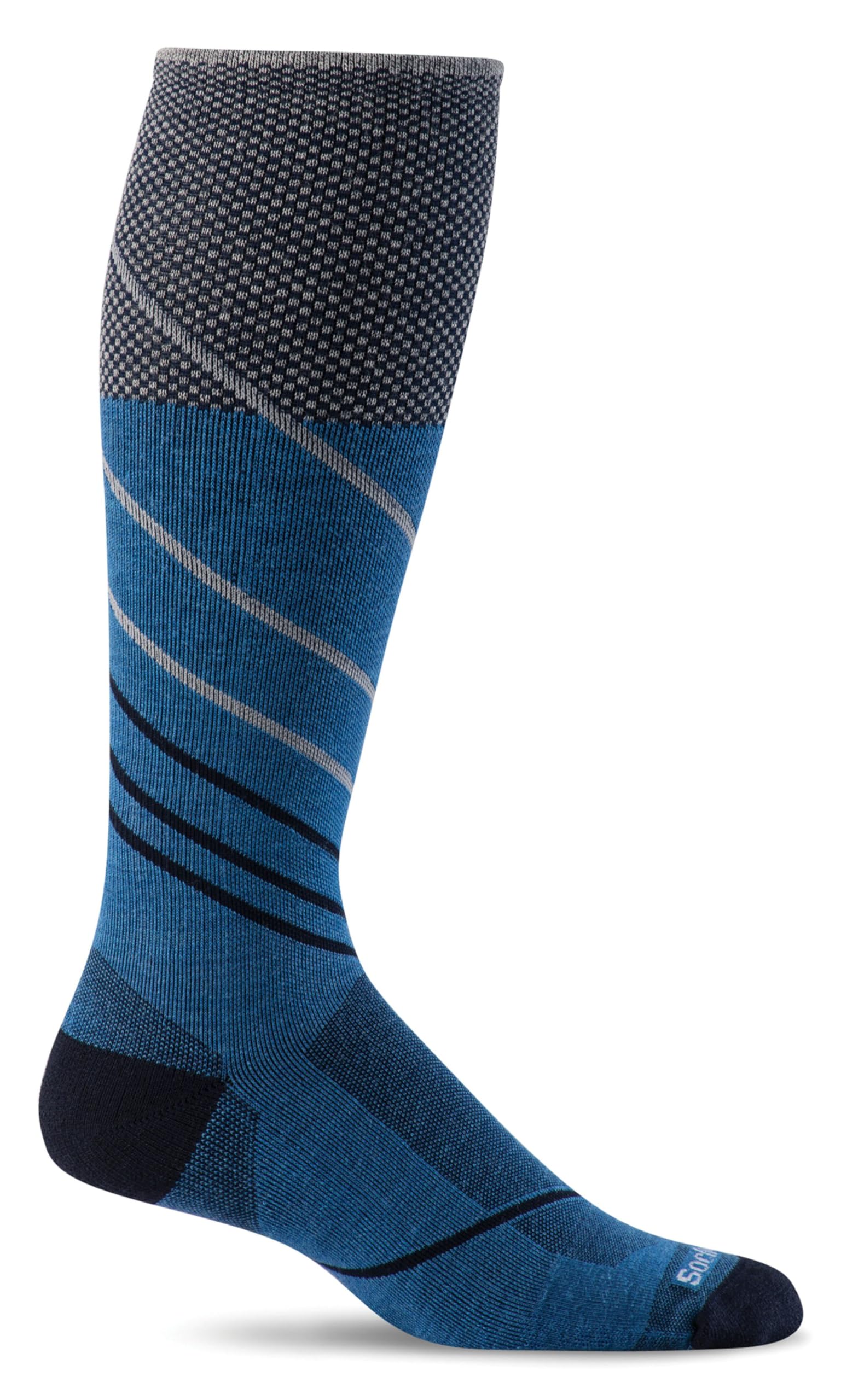
The reason this pair tops the list is a combination no other pick here matches: graduated firm pressure in a sock you can wear in summer without your feet turning into a swamp. The wool-based yarn blend keeps feet dry and controls odor, so men who wear these through a full shift stop noticing them by mid-morning. What wins people over here is the build — it draws more satisfied comment than any other aspect of the sock, and the compression itself sits right behind it.
It is made in the USA from American wool-based yarns, and the firm 20-30 mmHg range is genuinely graduated — tight at the ankle, easier up the calf. The wool thickness does real work: buyers report it stays up above the calf all day and never gets too tight, because the fabric has enough body to distribute the squeeze rather than pinch one spot. Buyers finish a long day without the heavy, backed-up feeling, and one 90-minute rollerblading session logged no foot or ankle fatigue and no skin irritation.
The catch is sizing, and it is a real one. The fit is the most-discussed thing in this sock’s reviews, and the split runs both ways — some men pull them on without trouble, others find the same pair a fight. Owners mention the sizing runs small, with one size-10.5 buyer saying they “felt 2 sizes too small” and could not get them over the toes. Check the size chart against your calf measurement, not your shoe size, before you commit.
What makes it the pick
- Genuinely graduated 20-30 mmHg pressure that holds without pinching
- Wool blend keeps feet dry and controls odor through a full day
- Stays up above the calf instead of sagging by afternoon
- Wears thin enough in a shoe — the company calls it “not bulky” and buyers agree
- Holds shape over long-term wear rather than stretching out
Where it asks more of you
- Sizing runs small — one size-10.5 buyer could not get the pair over the toes
- Firm pull-on effort, so weaker hands may want a put-on aid
- The wool price tier is the highest among the firm-pressure pairs here
Reach for this if: you want firm graduated pressure with wool comfort for daily wear, long shifts, or recovery days.
Measure first: the fit leans small, so chart your calf and foot length before choosing a size.
2. Truform 15-20 mmHg Compression Stockings Large
Mild 15-20 mmHg support that goes on in seconds and comes off just as fast.
If pressure is not the point but ease is, this is the pair. At 15-20 mmHg it is the gentlest sock on this list — the FULLSOFT runs at 30-40 mmHg, so the two sit in completely different strength classes, and the Truform is the milder of the two by design. That makes it the right pick for travel days, long desk stretches, and the man who wants support without a fight at the ankle.
The construction is an 85% nylon, 15% spandex knit with a soft top that will not constrict the leg, a defined heel for alignment, and a roomy comfort toe for sensitive feet. It’s latex-free and made in the USA. The stand-out trait buyers keep coming back to is compression that works without the wear pain — “not bulky or too hot and actually feel good on the legs,” as the review pages sum it up. Compression is the most-praised strength of the sock, with quality right behind it.
What you give up is squeeze. Customers note lower compression than a prescription pair, with one buyer noting a “notable difference at 30-40 mmHg” and planning to step up next time. Sizing also runs long — the XL ran long in the toe and leg for a size-12 shoe and long legs, so a size 10.5 buyer may want the smaller option.
Who it saves: the man who needs gentle support on a plane or at a desk and wants a sock he can remove without a shoe horn.
The honest limit: 15-20 mmHg will feel mild next to the firm 30-40 mmHg pairs, so buy it for everyday comfort, not heavy support.
The easy-on choice: travel, mild swelling, and men who want support without the effort of firm compression.
Look elsewhere if: your doctor specified firm pressure — this one is deliberately gentle.
3. FULLSOFT 30-40mmHg Compression Socks

Three pairs at the firmest pressure here — real squeeze, real effort to pull on.
This is the firmest sock in the lineup, and the gap is worth understanding. It’s rated 30-40 mmHg against the Truform’s 15-20 mmHg, a material jump in pressure between the two — roughly double the squeeze at the low end. If your legs need serious support and you want three pairs so one is always clean, this is the value play: three knee-highs built from 47% polyester, 41% nylon, and 12% spandex.
The graduated knit — firmest at the ankle, looser as it climbs the leg — pushes blood back up, and the breathable fabric stays put on the calf instead of sliding down. Reviewers point out it is easy to manage too. One review called the socks “perfect,” saying they were comfortable, fit well, and were “easy to pull on & off & quite durable.” Another wrote they were “easy to get on my feet.” That is unusual for a firm sock.
Here is the honest half: the 30-40 mmHg label is the biggest thing buyers argue about. Multiple reviews say the squeeze feels lighter than that number claims — softer than a previous 30-40 and even a 20-30 pair they owned. Sizing is tight, too: a size-10.5 buyer with 15.5-inch calves found the L/XL too long in the foot and too loose at the ankle. Measure carefully, and expect a softer feel than the label suggests.
Three pairs, one firm number: the strongest-rated pressure on this list, with three knee-highs so a clean pair is always waiting.
Check the ankle squeeze: the recurring note is that the squeeze can feel lighter than the label — a size mismatch makes that worse.
Good for: men who want firm graduated support and the convenience of a three-pair rotation for washing.
Watch the sizing: measure your calf and ankle, and size down if you sit between sizes.
4. Amazon Basics Medical Compression Stockings 2X-Large
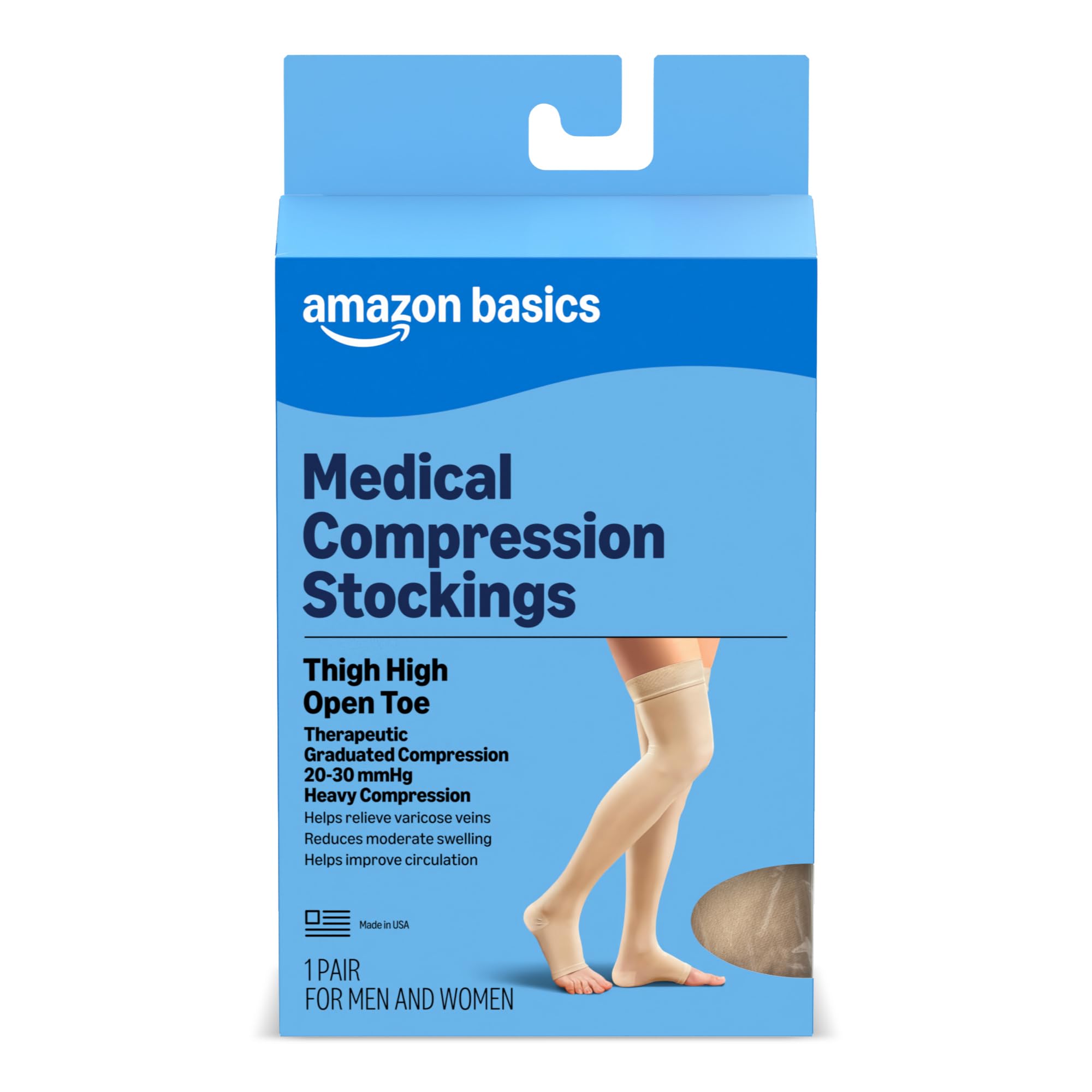
Hospital-grade 20-30 mmHg with an open toe and a silicone grip top that holds.
For the man with a bigger calf who has watched every other sock roll down by lunchtime, this is the practical answer. The 20-30 mmHg graduated pressure sits a band above the Truform’s 15-20 mmHg and below the FULLSOFT’s 30-40 mmHg, so it fills the middle of the range. The fabric is 83% nylon and 17% spandex, thick medical-weight yarn, and the top band carries a silicone grip dot lining that resists slipping.
The toe-less design is the detail that makes recovery easier — air reaches your toes and skin inspection needs no removal. A knit heel pocket keeps the garment aligned as the compression tapers up the calf. What earns the most praise here is the build quality, with compression a close second among satisfied buyers. One holder of a roughly 19-inch calf bought the 2X and found it a perfect fit; another at 6’4″ and 225 lb reported it fitting exactly and not slipping.
The recurring trade-off is the ankle. Some wearers find it too tight and loose across the ankle, and the recurring gripe is that stay-in-place performance varies from person to person — the fit is the most debated part of this sock. Durability expectations also split, with a few buyers reporting wear after a second use. Most wearers get a long run from a pair, but the ankle is the place to check your measurements most carefully.
Why it earns its place
- Silicone grip dot top resists rolling down the calf
- Toe-less knit stays breathable and needs no removal for skin checks
- Hospital-grade material and thicker yarns in a 20-30 mmHg band
- Works for wide calves — a 2X fit a roughly 19-inch calf cleanly
The reality check
- Ankle fit divides wearers — some find it loose there, others too tight
- A few report tearing after the second wear, so treat the top band gently
- Toe-less design lets cold air in on a winter commute
The wide-calf answer: men sized at 2X who need dependable 20-30 mmHg support and an open toe for recovery days.
Measure the ankle: that is where this sock’s fit is most argued about, so chart both calf and ankle.
5. Copper Fit Mobilizer Compression Socks
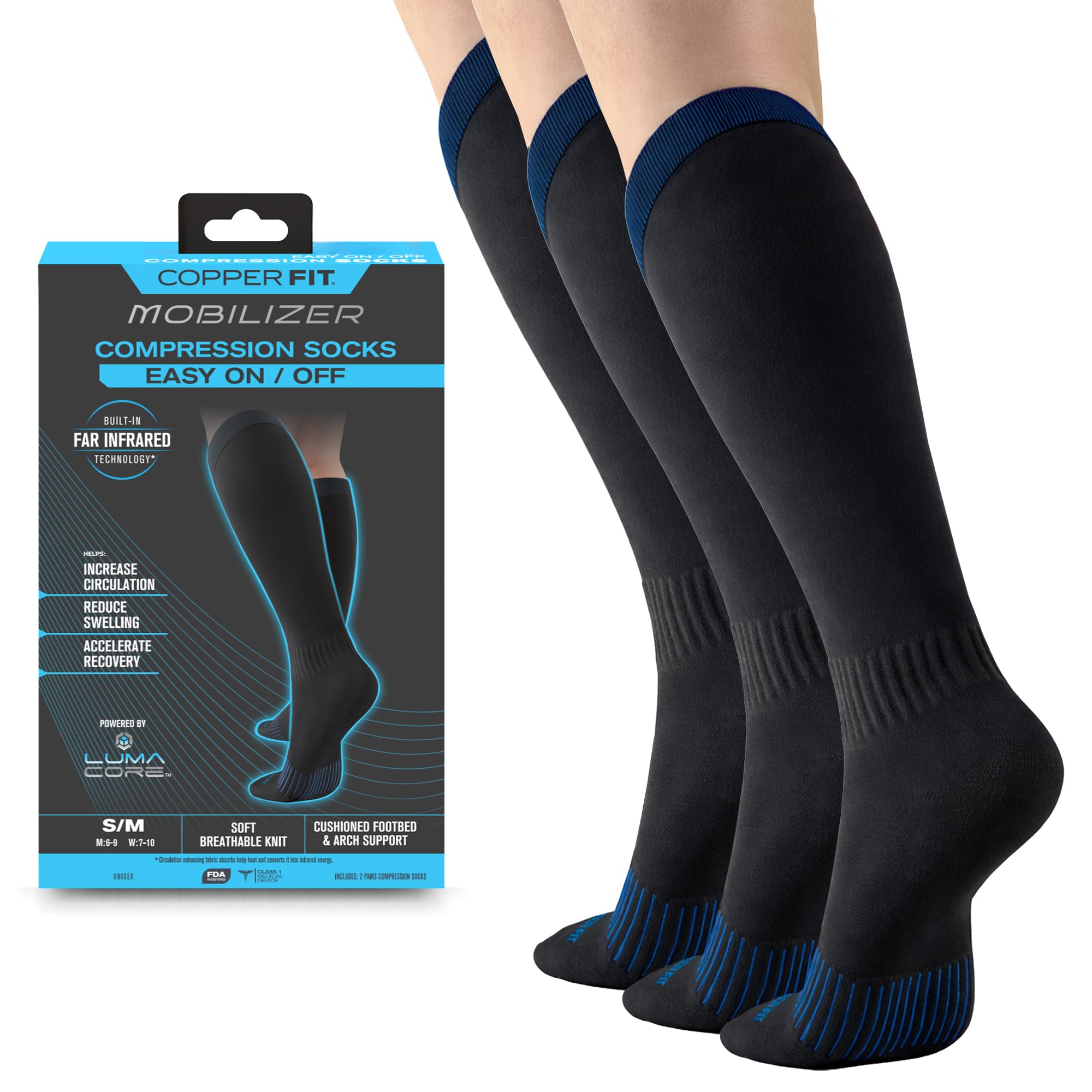
The premium pick for breathability and all-day wear, if your legs can tolerate it.
Copper Fit’s Mobilizer takes the top price tier, and what you pay for is comfort rather than a printed pressure number. The brand doesn’t publish a mmHg figure for this sock, which is worth knowing up front — you buy it on how it feels, not how it measures. The breathable knit is the standout, keeping feet and legs from overheating so the pair is comfortable enough to leave on from morning to evening.
What shoppers say backs that up. The consensus is that this sock is well made and genuinely comfortable, with the quality drawing the most praise of any aspect. Buyers report less aching in the feet and legs by evening and breathability that holds up through a full day. Diabetic wearers who need a gentle knit on the skin are among its most loyal buyers. A 6’4″ owner called it the best of many he’d tried, crediting the construction with easing ankle discomfort and lower-leg swelling across sitting, standing, walking and travel.
The catch is the one thing the marketing promises hardest: it advertises “easy on, easy off,” and the fit is the most argued part of this sock. Some owners pull it on without trouble; others find it a fight, and one size-12 buyer reported that it absolutely was not easy to put on, so returned it. The fit also runs long — a 6’4″ owner found it too long for his below-average height, with a fold-over at the ankle. Sizing can settle after a few wears, but check your leg length against the chart before you buy.
The comfort verdict: breathable enough to wear all day, well made, and easy on the skin for men with sensitive feet.
The caveat: the pressure is unlabelled and the pull-on effort divides owners, so fit and sizing matter more here than on any other pick.
Pick this for: all-day wear, running, or travel when comfort and breathability matter more than a printed pressure figure.
skip it if: you need a known mmHg number or a guaranteed easy-on experience — try the Truform instead.
Know the Specs
mmHg — what the pressure number means
mmHg stands for millimetres of mercury and measures how much the sock squeezes your leg. Everyday support sits around 15-20 mmHg, firmer support around 20-30 mmHg, and firm medical-style around 30-40 mmHg. A higher number is not automatically better — a firm sock that is hard to put on or sized wrong gives less real support than a mild one that fits.
Graduated compression
Graduated means the sock is tightest at the ankle and eases as it climbs the calf. That ankle-to-calf taper is what moves blood back up the leg instead of letting it pool. A sock that feels uniformly tight from ankle to knee is doing less for circulation than one with a real taper.
Calf measurement
Size charts for compression stockings are built on calf and ankle circumference, not shoe size — the Truform and Amazon Basics both rely on a measurement-based chart. A sock one size off loses compression at the ankle or cuts into the widest part of the calf. Measure the widest part of your calf and your ankle with a soft tape.
Open toe versus closed toe
An open or toe-less design lets air reach your toes and makes skin checks easy without removing the sock. A closed toe feels more like a normal sock but takes up more room in a tight shoe. Men with sensitive toes or wide feet often find the open version more comfortable.
Common Questions
Will firm 30-40 mmHg stockings feel too tight to wear all day?
Should I size by shoe size or by calf measurement?
What is the difference between 15-20 and 30-40 mmHg?
Are compression stockings with an open toe better for recovery?
How long should a pair of compression stockings last?
Why does my compression sock roll down my calf?
Can men wear these for long flights?
What should I do if a sock feels too tight at the ankle?
Are wool compression socks better than nylon for daily wear?
The Bottom Line
For most men, the winner is the Sockwell Men’s Pulse OTC Firm Graduated Compression Sock because it pairs genuinely graduated 20-30 mmHg pressure with wool that keeps feet dry and the sock on the calf all day. If you want the gentle, easy-on option for travel or a desk day, the Truform 15-20 mmHg Compression Stockings give you years of comfort without a fight. And for a firm 30-40 mmHg sock with three pairs in the pack, the FULLSOFT Medical Graduated pair is worth a look. The one honest nudge: whatever you pick, measure the widest part of your calf and your ankle before ordering — a sock sized off your shoe size wastes the compression you paid for.
How we choose
We do not accept paid placement. Every pick is matched to a real buyer and a real use-case; we do not hands-on test units.
Sources
Specifications: manufacturer listings and product documentation. Review insights: verified customer reviews, as of October 2026. Pricing: not shown on this page (it changes often); check the current price via the retailer link.
As an Amazon Associate, Aappliancez earns from qualifying purchases. This does not affect which products we feature.