Disclosure: Some links in this post are affiliate links. As an Amazon Associate I earn from qualifying purchases, at no extra cost to you. Learn more
Specs are compiled from manufacturer listings and verified buyer reviews and can change over time — please confirm the key details on the product page before buying.
Compression socks only help if the pressure matches your need, so first decide between medical-style squeeze and gentle travel-level support. Choose 20-30 mmHg (millimeters of mercury, the standard pressure unit) when your legs swell, ache, or throb after a long shift—that level is designed to push fluid back up your legs. Choose 15-20 mmHg when you want support on a flight or during a run without feeling clamped. Pick wrong and the sock either does nothing or fights you every morning. Get the mmHg number wrong and no amount of fabric quality or brand reputation rescues the pair.
This guide is built by comparing the manufacturers’ published specifications and the patterns across verified customer reviews, so you get each pick’s real strengths and trade-offs instead of marketing spin.
Below you get five picks sorted by how tightly they squeeze, how well they stay up, and what they honestly cost you in daily effort, so one read is enough to pick your pair. Each of the five picks below is a pair you can wear all day without regret.
Top Picks


How To Choose The Best Compression Socks
Buying compression socks is not like buying ordinary socks, because the wrong pair can be genuinely uncomfortable rather than just cosmetically off. Treat the mmHg number as the whole starting point. Everything else — length, fabric, pack size — is a secondary decision you make once that number is locked.
Decode the mmHg number first
mmHg stands for millimetres of mercury, and it’s the unit that measures how much pressure the sock puts on your leg. A 15-20 mmHg sock is a light, everyday level of squeeze — the kind you’d wear on a long flight or during a run. A 20-30 mmHg sock is a firmer squeeze, the level people reach for when their legs ache, swell, or throb after hours on their feet. If you buy a 15-20 mmHg sock hoping for a firm, firm hug, you’ll be disappointed. If you buy a 20-30 mmHg sock as a first-timer, be ready for a fight getting it on the first few times.
Why graduated compression is the real point
Graduated compression means the pressure is strongest down at the ankle and eases as it climbs up the calf, which is the opposite of how an ordinary tight sock behaves. That ankle-to-calf gradient is what lets a well-made pair support the ankle without strangling the top of your calf. A sock that feels uniformly tight from ankle to knee is usually just undersized, not properly graduated.
Measure your calf, not just your shoe size
Most returns happen because people order by shoe size alone, and the calf is what actually determines whether the sock fits. Wrap a soft tape measure around the widest part of your calf and check it against the brand’s own size chart. If you land between two sizes, going up usually beats going down — a sock that’s too small is the one that rolls down, digs in, and feels like work to remove.
Think hard about what the fabric does on day 40
Compression socks live or die on whether the squeeze survives washing. Look for a stated knit that’s described as holding shape across many wears, and expect to air-dry the pricier pairs to protect the elastic. A sock that shrinks or loses grip after a handful of washes has cost you more per wear than the pricier pair that held its squeeze.
Side-by-Side Comparison
| Model | Best For | Compression Level | Pack Size | Style / Length | Amazon |
|---|---|---|---|---|---|
| Ultrafun 6 Pairs Soccer Socks★ Best Overall | Team sports and youth players | — | 6 pairs | Knee-high tube with grip | Amazon |
| Physix Gear Compression SocksFirmest Squeeze | Nurses, runners and shin splints | 20-30 mmHg | Single pair | Knee-high | Amazon |
| Merino Wool Compression Socks | Cold-weather travel and daily wear | 15-20 mmHg | Single pair | Over-the-knee | Amazon |
| 6 Pack Copper Compression Socks | Long shifts and budget stock-ups | Graduated (level not stated) | 5-6 pairs | Knee-high | Amazon |
| CHARMKING Compression Socks (8 Pairs) | All-day wear and colour variety | 15-20 mmHg | 8 pairs | Knee-high | Amazon |
Detailed Reviews
1. Ultrafun 6 Pairs Soccer Socks Men Women Youth Team Sports
Our pick — 4.5+★ from 1,000+ verified ratings; the strongest balance of quality and price.
Six pairs of knee-high grip socks that survive a full season of Sunday matches
If you’re kitting out a team — or a family of kids who lose socks at a suspicious rate — this is the pack that makes sense. You get six pairs in one box, spanning yellow, white, black, blue and green, so a squad can be colour-matched without six separate orders. The knee-high tube cut stays up during play, and the grip pads on the sole keep feet from sliding inside cleats or indoor shoes.
These work as team socks because the material stretches yet stays snug on the leg—exactly what you want when a young player runs hard for an hour. Sizing is the real caution: buyers report a split, with green socks fitting a size 10 foot comfortably while the black set ran much smaller and extremely tight. That is a fit mismatch, not a defect, and it is the main reason to check the brand’s chart against your actual shoe size before committing.
A six-pack spreads the cost so thin that a lost sock stops being an emergency. The fabric is listed as polyester, and owners mention the colours hold up well in the wash. Accept going in that these are sports socks with a compressive tube fit, not a measured 20-30 mmHg medical compression garment—so if swelling is your reason for shopping, look further down this list.
What earns the top spot
- Six pairs in one box across five colours — a whole team sorted in a single order
- Grip pads on the sole stop feet sliding inside cleats during play
- Knee-high tube cut that stays put through a full match
- Colours stay vibrant and hold up in the wash
What to know before you buy
- Sizing runs inconsistent between colours — check the chart against a real shoe size
- Polyester sports knit, not a measured mmHg compression level
Made for: coaches, parents and recreational players who need a full set of knee-high grip socks that stay up through a match.
Look past it if: you’re buying for swelling or circulation support and need a specific mmHg pressure listed on the label.
2. Physix Gear Compression Socks 20-30 mmHg
The firm 20-30 mmHg pair that nurses and runners keep buying a second time
Here’s the headline number that separates this sock from most of this list: 20-30 mmHg. That’s a firm, medical-style squeeze, and it sits a full step above the 15-20 mmHg you’ll see on the Merino Wool pair further down — a concrete gap between light everyday support and genuine firm pressure. If your legs throb after twelve hours on a hospital floor, a shop floor, or a long run, this is the level that actually does something.
The knit is textured so the sock grips your hands as you pull it on, which is the difference between a two-second job and a wrestling match with a thin spandex tube. It reaches just past the knee and stays there without sagging. The trade-off is the first few wears: it is very tight at the start, and easing into it is normal rather than a sign you bought the wrong size.
Durability is the honest weak spot, and it’s specific. The striped material above the heel is the part that wears thin first under daily use, while the solid heel and toe sections hold up. Plan to air-dry these rather than tumble them, and the squeeze will last far longer. The firmness also means warmth — expect a clammy feel in hot weather even though the sock performs well in cool conditions. As buyers put it, these are the ones that “go up all the way to just below my knee and they don’t sag or fall.”
Where the value sits: a genuine 20-30 mmHg garment at a fraction of what a clinical brand charges, with a textured knit that makes daily dressing manageable.
The honest catch: the stretch panel above the heel is the first to wear under hard daily use, so rotate pairs and air-dry to stretch the lifespan.
Reach for this if: you want real firm pressure for long shifts, shin splints, or travel swelling and you’re prepared to wrestle it on the first few times.
skip it if: you want a gentle first compression sock — start with a 15-20 mmHg pair and work up.
3. Merino Wool Compression Socks 15-20 mmHg
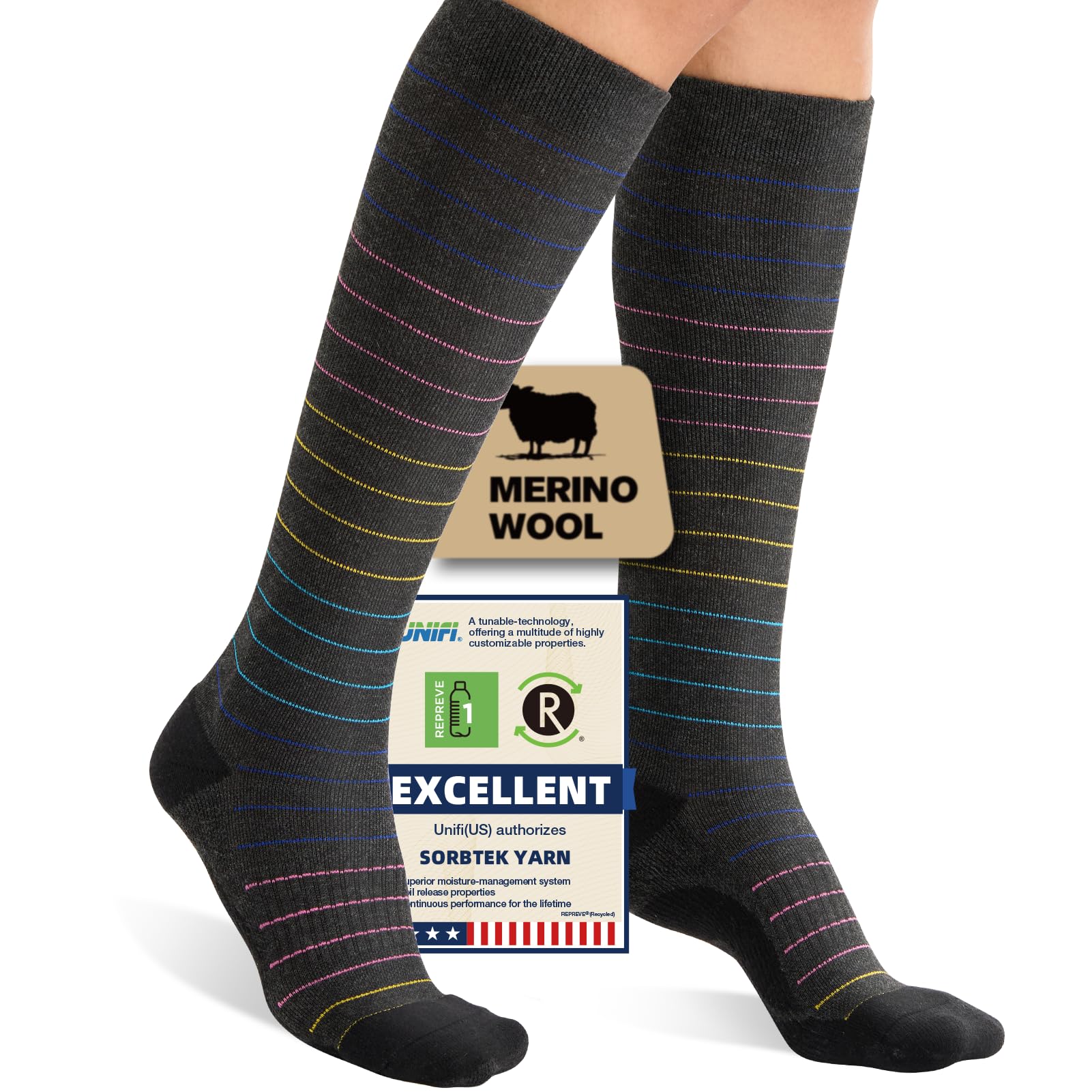
The over-the-knee wool blend that makes a ten-hour flight feel shorter
Most compression socks are built for a fight. This one is built for a long-haul seat. The 15-20 mmHg level is a light, gentle squeeze — enough to keep blood from pooling in your calves on a flight, not so much that you’re grimacing as you pull it up. The merino, Lycra and bamboo blend is smooth against the skin and genuinely warm, which is why these get worn for chilly morning runs and winter travel rather than just as a medical item.
What wins people over is the fabric itself — the quality of the knit is the most-praised thing about this sock, and it shows in how the merino mix resists odour over repeated wears. It goes over the knee rather than stopping below it, so you get coverage where a shorter sock leaves a gap. The wool blend also means a thicker sock than a thin synthetic, which reads as durable rather than flimsy in the hand.
Two honest notes. First, this is a blend rather than pure wool, so don’t expect the full insulation of a 100% merino sock — the fabric is a mix by design. Second, the top band can feel itchy on sensitive skin, and if you have wide calves, sizing gets tight above the knee. The over-the-knee length is also slightly more work to pull on and peel off than a shorter sock. None of that changes the verdict: for cold-weather travel and daily wear, this is the most comfortable pair on the list.
Why wool beats synthetics here
- Merino, Lycra and bamboo blend stays warm without overheating
- 15-20 mmHg gives light, gentle support for flights and long sitting
- Over-the-knee coverage with no gap and no rolling down
- Odour-resistant natural fibre that survives repeated wears
Small things to plan around
- Top band can irritate sensitive skin
- Not 100% wool, so warmth is a blend rather than full merino
For the frequent flyer: anyone who wants gentle, warm support that goes over the knee and feels like a soft everyday sock.
Not for firm-pressure seekers: if you need a hard 20-30 mmHg squeeze, this light 15-20 mmHg level will feel too soft.
4. 6 Pack Copper Compression Socks

A whole week of graduated compression socks for the price of one firm pair
If a single pair of firm compression socks feels like too much commitment, this pack flips the maths. You get a knee-high graduated sock in a multi-pack, with enough pairs to wear a fresh one daily and still have spares in the drawer. Graduated means the pressure is strongest at the ankle and eases upward — the correct way to support circulation rather than simply squeezing the whole leg equally.
The everyday feedback is that these feel like normal socks rather than hospital garments. They’re easy to get on and off, the colours stay bright through washing, and people describe their legs feeling better after a full day in them. The pack format is the real selling point: you’re getting multiple pairs to rotate, so each one survives longer and you’re never caught with a damp sock on a work morning.
The honest caveat is fit consistency. A few of the pairs can run tighter on the calf than the rest of the pack, and one-size assumptions don’t always hold across every colour. Wash cold and air-dry them — a warmer tumble cycle is what tends to shrink compression knits. After that, this is the most sensible way to stock a work-week drawer without spending premium money on one pair.
The smart-buyer angle: graduated compression in a multi-pack, so a daily wearer always has a fresh pair ready instead of one precious sock that has to be washed nightly.
What to watch: fit can vary slightly pair to pair on the calf, so buy your size from the chart and rotate until you know which pair behaves.
Best for: long-shift workers, frequent sitters and anyone who wants a full week of support without paying premium per-pair money.
Think twice if: you need a stated mmHg figure on the label for a specific medical pressure — this is graduated but the level isn’t printed.
5. CHARMKING Compression Socks 8 Pairs

Eight pairs at 15-20 mmHg — the drawer-filler for anyone who lives in compression socks
The number that matters here is eight. This is the largest pack on the list, and at 15-20 mmHg it’s the light, all-day level rather than the firm squeeze of the Physix Gear pair. The fit holds up, too: it stays in place without sliding down, and the knit stretches without being flimsy. For someone who wants to wear a fresh pair every day of the week without hand-washing nightly, eight pairs is the practical answer.
Where it wins is the balance between comfort and support. The compression is even through the calf, with some support in the instep and a looser toe, so the run feels supported without being choked. It’s easy to pull on and off, and the colour range is wide if you like a bit of variety. The sock is reasonably soft and not overly thin, which makes it comfortable for long hours on hardwood or carpet without wearing through quickly.
Be honest with yourself about the patterns. Solid colours are the safer choice for daily wear — some of the patterned options leave indentations on the skin and have loose threads inside that need cutting out before they’re comfortable. A small hole in the toe or heel can appear on an occasional pair, so keep an eye on the seams in the first few wearings. Weigh those against the sheer quantity here and this is still the most forgiving way to build a compression-sock rotation.
Why it earns a slot
- Eight pairs, the largest pack on this list
- 15-20 mmHg light support that’s easy to pull on and off
- Even pressure through the calf with a comfortable toe
- Wide colour range and a soft, mid-weight knit
The fine print
- Patterned colours can leave indentations and have loose inner threads
- Occasional toe or heel seaming needs watching from the start
The daily-driver choice: people who want eight light, easy-on pairs for everyday work wear and colour choice.
Better elsewhere if: you want maximum squeeze for clinical-level swelling rather than gentle all-day support.
Know the Specs
mmHg (the pressure number)
mmHg is short for millimetres of mercury, and it describes how much pressure the sock presses onto your leg. A 15-20 mmHg sock applies a light squeeze — good for flights, runs, and everyday wear. A 20-30 mmHg sock applies a firm squeeze — the level people choose when their legs ache, swell, or throb after long shifts. Neither is “better”; they do different jobs. Match the number to what your legs are telling you, not to what sounds more serious.
Graduated compression
Graduated compression means the squeeze is strongest at the ankle and eases as it climbs toward the knee. That gradient is what supports circulation rather than simply clamping the whole leg. A sock that feels equally tight from ankle to top isn’t graduated — it’s just undersized. When you check a listing, look for the word “graduated” and a stated mmHg range together; that combination is what tells you the sock is engineered rather than just knitted tight.
Common Questions
Is 20-30 mmHg too tight for a first compression sock?
What is the difference between 15-20 mmHg and 20-30 mmHg socks?
How do I measure my calf for compression socks?
Should compression socks be washed in hot water?
Can I sleep in compression socks overnight?
How long do compression socks keep their squeeze?
Are toe-less or open-toe compression socks better?
Why do my compression socks roll down during the day?
How many pairs of compression socks do I need for daily wear?
Can I wear compression socks for running and sport?
The Bottom Line
For most people, the winning call among the best compression socks is the Physix Gear Compression Socks, because it delivers a genuine 20-30 mmHg squeeze with a textured knit that makes daily dressing practical. If you want warmth and an over-the-knee cut for cold-weather travel, the Merino Wool pair is the one to pack. And for building a whole week’s rotation without premium pricing, the 6 Pack Copper Compression Socks is the sensible stock-up. Match the mmHg level to your legs first; a 20-30 mmHg sock from an unknown label will serve a swollen-leg buyer better than a 15-20 mmHg sock from a famous one.
How we choose
We do not accept paid placement. Every pick is matched to a real buyer and a real use-case; we do not hands-on test units.
Sources
Specifications: manufacturer listings and product documentation. Review insights: verified customer reviews, as of October 2026. Pricing: not shown on this page (it changes often); check the current price via the retailer link.
As an Amazon Associate, Aappliancez earns from qualifying purchases. This does not affect which products we feature.