Disclosure: Some links in this post are affiliate links. As an Amazon Associate I earn from qualifying purchases, at no extra cost to you. Learn more
Specs are compiled from manufacturer listings and verified buyer reviews and can change over time — please confirm the key details on the product page before buying.
Most knee-high compression socks are cut for a five-foot-eight leg. On a shorter frame, the top band climbs over your kneecap or bunches behind the knee instead. The fix is simple: buy a sock whose length and size chart match a shorter leg. Below are five pairs short women keep coming back to, with plain notes on which run long, which run tight, and which sit just under the knee.
This guide is built by comparing the manufacturers’ published specifications and the patterns across verified customer reviews, so you get each pick’s real strengths and trade-offs instead of marketing spin.
Length is the spec that makes or breaks a short leg. Every pick below was checked against real petite wearers before it earned a spot. Here is what actually matters when you shop for the best compression socks for short women.
Top Picks


How To Choose Compression Socks for Short Women
Compression socks squeeze hardest at the ankle, then ease off as they climb. That squeeze pushes blood back up instead of letting it pool. It only works when the sock’s length matches your leg. On a short leg, a standard knee-high puts its tightest band around the kneecap or bunched behind the knee. That is where the discomfort and red marks come from.
Start with the compression level, not the color
The pressure is written in mmHg (millimeters of mercury, the same unit a blood-pressure cuff uses). A 15-20 mmHg pair is the gentler everyday level. It suits travel, long standing shifts, or a first-timer easing in. A 20-30 mmHg pair squeezes noticeably harder. That is the level most people move to when they want firmer, all-day support. Pick your level first — everything else is fit.
Then hunt for the word “short” or “petite”
A petite length is a separate cut of the same sock, not just a narrower width. It is the single biggest difference between a knee-high that stays put and one that rolls under your knee by lunchtime. When a brand offers a short length, treat it as the default for a shorter frame. Size down in width only if your measurements call for it.
Measure your ankle and calf before you order
Two tape measurements decide your size: around your ankle and around the widest part of your calf. Take them in the morning before swelling builds up. If you land between two sizes, the smaller sits tighter and higher, and the larger sits lower and gentler. So a short leg often does better sizing down in length and up in width, not the reverse.
Side-by-Side Comparison
| Model | Best For | Compression | Toe Style | Standout Detail | Amazon |
|---|---|---|---|---|---|
| BSERA 2 Pairs Sheer Knee High★ Best Overall | Everyday sheer wear | 15-20 mmHg | Closed | Two pairs per pack | Amazon |
| Truform Knee High, Closed ToeBest for Petite Fit | Short-leg fit with toe room | 20-30 mmHg | Closed | Short length option | Amazon |
| Truform Knee High, Open Toe | Toe freedom and breathability | 20-30 mmHg | Open | Toeless design | Amazon |
| DYNAVEN by Sigvaris Calf-High | Premium daily support | 20-30 mmHg | Closed | Medium Short sizing | Amazon |
| JOBST Relief Knee High | Firm all-day hold | 20-30 mmHg | Open | Regular band | Amazon |
Detailed Reviews
1. BSERA 2 Pairs Sheer Compression Socks
Our pick — 4.0+★ from 600+ verified ratings; the strongest balance of quality and price.
Two sheer pairs that disappear under work clothes and hold a gentle 15-20 mmHg squeeze all day.
This pair wins its spot on the data: 4.0+ stars across 600+ ratings, the strongest showing in this lineup. It suits a short woman who wants office-ready compression that nobody notices. The knit is deliberately thin — sheer, almost like a stocking — so it slides under trousers and skirts where a thick athletic sock would show. Two pairs come in the pack, so rotating and hand-washing is realistic rather than a chore.
The 15-20 mmHg rating is the gentle everyday tier (the pressure unit a blood-pressure cuff uses). That means light support for long sitting, travel, or standing shifts — not the firm squeeze of a 20-30 pair. That lighter pressure helps on a shorter leg. The sock is less likely to dig in at the top band when the length runs only slightly generous. Buyers report the compression itself is what they praise most: ankles stay down and lumpy veins stay calm through a full day.
Length runs close to the knee but a touch long for the very shortest frames. A petite wearer around 5’2″ may want the top smoothed down rather than pulled fully up. The fine knit also snags on a rough fingernail, so treat it like hosiery on laundry day. That lighter pressure is exactly why first-timers who find firmer socks uncomfortable tend to land here. If you need a hard squeeze, look at the Truform Closed Toe instead — it steps up to 20-30 mmHg.
What it does well
- Sheer finish hides under slacks and skirts, so nobody spots a medical sock
- Gentle 15-20 mmHg support that suits long travel or standing shifts
- Two pairs per pack for easy rotation and hand-wash cycles
- Stays in place through a long day with no slipping reported
Where it asks a little care
- Fine knit snags easily — hand-wash and hang-dry rather than tumble
- Runs slightly long for the very shortest legs, so expect a small fold at the top
- Light pressure only; firmer support seekers will want a 20-30 pair
Grab these if: you want discreet, light everyday support that vanishes under clothes and costs little for two pairs.
Pass if: your legs need firm 20-30 mmHg pressure — this gentler weave will not squeeze hard enough for you.
2. Truform 20-30 mmHg Compression Stockings Closed Toe
The one with a genuine short cut that lands under the knee on a five-foot-one frame.
A five-foot-one wearer reports this Truform sits just under the knee and keeps heavy swelling in check. That is the short-length cut doing its job, not a lucky guess. Short women hunting firm support keep circling back to this model for exactly that reason. Pick the short size in your width and the top band stays where it belongs instead of bunching.
At 20-30 mmHg this squeezes noticeably firmer than the BSERA pair — real support for a leg that wants it, not light everyday compression. The closed toe box is generous. That keeps toes from cramping and stops seams from pressing on the toenails. Owners who wear compression daily describe it as supportive and comfortable for a full day.
The honest catch is sizing. The chart alone will not always land you in the right pair. A medium in the standard length can double over at the top band and press on the knee, while a short small delivers the correct squeeze. Measure your calf and ankle, and be ready to exchange once if the first pick runs long. On a short leg, the payoff is worth that extra step.
Why it earns second place: it is the rare knee-high with a true short length AND a firm 20-30 mmHg profile, so petite legs get genuine support without the over-the-knee climb.
The trade-off: the sizing chart is a starting point, not a guarantee — expect to size by calf and ankle measurement and swap once if the top band lands too high.
Reach for this if: you are petite and want firm 20-30 mmHg support with a roomy closed toe.
Look elsewhere if: you want a no-fuss sizing experience — the fit here rewards careful measuring and a possible exchange.
3. Truform 20-30 mmHg Compression Stockings Open Toe
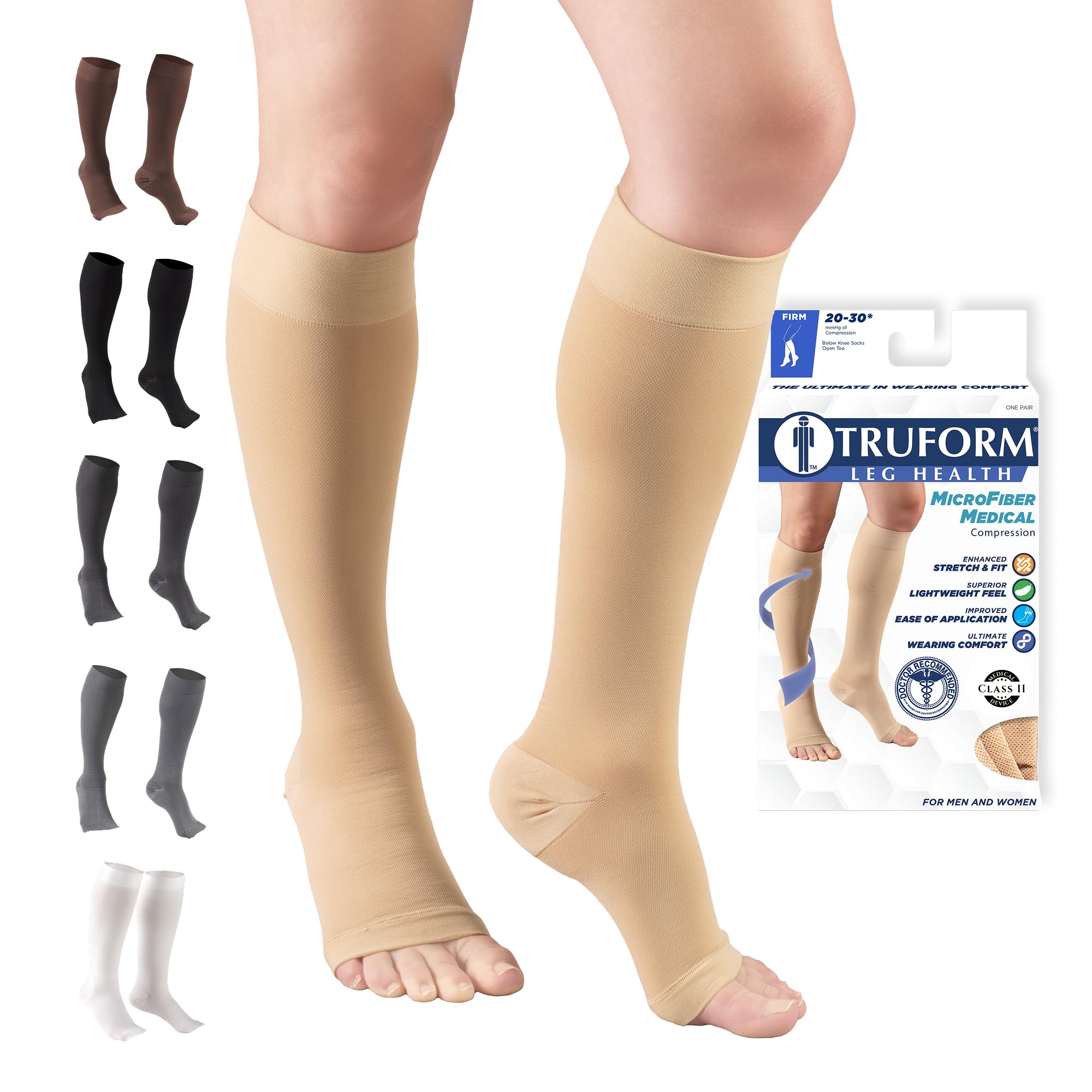
Same firm Truform squeeze, but the toes stay free — a small change that transforms short-foot comfort.
On a short, wide or sensitive foot, the toe end is usually where a compression sock goes wrong: too much fabric, a pressing seam, or a foot that feels boxed in. This open-toe version fixes that by leaving the toes uncovered. Your foot can flex and your toes move freely. A five-foot-three wearer describes it as easy to don, reaching the knee in the short length with no bunched fabric behind the knee.
Compression here is the same 20-30 mmHg as the closed-toe model, so you give up no pressure for the toe freedom. The upper band is wide and sits securely without leaving a dent. That matters on a shorter calf, where a slim band would concentrate the squeeze. It is also breathable and stretchy enough for a long day without feeling locked in.
One wrinkle: the forefoot band (the strip that wraps the ball of your foot). On some wearers it lands too tight and rolls, leaving a mark within minutes. A wide forefoot feels it most. If your foot runs narrow to average, this tends to be fine. If it runs moderate to wide, test it early or pick the closed-toe model instead. For many short women, though, the toe freedom is the upgrade they did not know they needed.
The short-leg case: a true short length paired with an open toe means no extra foot fabric and no fold behind the knee — the two most common short-leg complaints handled at once.
What to watch: the forefoot band can run snug and roll on a wider foot, so this suits narrow-to-average feet best.
This suits you if: your feet feel cramped in closed-toe compression and you want firm 20-30 mmHg support with free toes.
Think twice if: you have a wide forefoot that tends to feel pressure bands — the closed-toe pick above is the safer fit.
4. DYNAVEN by Sigvaris Compression Calf-High Socks Medium Short

A premium everyday calf-high built from a nylon-and-spandex blend that feels like fine hosiery, not a medical garment.
This is the pick for the woman who wants her sock to feel like part of her outfit, not a piece of equipment. The light beige shade keeps a low profile. Double-covered inlay yarns (a knit that wraps stretchy fibers in smooth nylon for durability and a soft face) give it a polished finish under trousers or a skirt. The medium short sizing is the detail that matters on a shorter leg.
At 20-30 mmHg it delivers a firm, graduated squeeze. That means a tighter ankle easing to a lighter calf — the pattern that supports long days on your feet. One reviewer with poor lower-leg circulation reported it eased her symptoms. The reinforced heel and roomy toe space keep the foot comfortable around the shoe. This is the pair for the woman who wants everyday support she is happy to be seen in.
The honest note is the top band. On some wearers it sits tight enough to leave a red calf mark and rolls down through the day, so expect frequent readjusting. Fit also depends on how your shoe size and calf measurements line up. One wearer sized medium by shoe size (9.5-10) found the calf compression light even though the ankle squeeze was clearly there. If your calf measurement and shoe size pull in different directions, follow the shoe size and be ready to try a different short length.
Where it shines
- Premium nylon-and-spandex knit looks like fine hosiery, not a medical sock
- Firm 20-30 mmHg graduated squeeze that supports long days on your feet
- Reinforced heel and roomy toe space keep the foot comfortable
- Medium short sizing is built for a shorter calf
What could bug you
- The top band can feel tight and leave a mark on some calves
- It can roll down through the day, so expect to readjust
- Premium-level cost for a single pair
Worth it for: the woman who wants firm support that looks like real legwear and does not mind paying for the finish.
Skip if: you hate readjusting — the band on a shorter calf can roll, so a wide-band pick may hold steadier for you.
5. JOBST Relief 20-30 mmHg Knee High Open Toe

A medical-grade 20-30 mmHg knee-high with a wide band that stays put under the knee on a shorter leg.
Wearers describe the fabric as twice as thick as other brands they had tried, and it holds its shape through weeks of near-constant wear and lukewarm washing. The wide, custom-height band is the star for a short leg. It sits securely below the knee instead of rolling down or digging in.
The 20-30 mmHg squeeze is strong and consistent. The open-toe design keeps the toe end free, so a short foot is not stuffed with extra fabric. A plus-size wearer found it slid on easily and stayed comfortable from morning into the afternoon, without the cutting-in below the calf that a firmer knit can cause.
One thing to get right: the fit is fussy. If you land between sizes, choose the smaller height. Extra length is where this sock creases and cuts circulation. A wide toe opening can also bunch slightly under the arch, and the open toe is long enough that sandals show the excess. Get the height right and it is among the most dependable pairs you can buy for a shorter leg — firmer and more substantial than the DYNAVEN by Sigvaris, though less discreet under clothes.
The firm-support verdict: thick, durable knit and a wide band that stays below the knee — the closest thing here to a true medical-grade hold.
The sizing caution: between sizes, go smaller in height to stop folds and ankle creasing; the open toe also runs long for sandal wear.
Choose this if: you want a firm, heavy-duty 20-30 mmHg sock with a wide band that holds its place under the knee.
Consider another if: you want a thin, discreet sock or a shorter open toe — this one is thick and generous in the foot.
Know the Specs
What mmHg Means
mmHg (millimeters of mercury) measures how hard a compression sock squeezes. The number tells you the pressure at the tightest point, which is the ankle. It eases off as the sock climbs the calf — a pattern called graduated compression. A 15-20 mmHg pair is the gentle everyday tier. A 20-30 mmHg pair is the firmer tier for stronger all-day support. Match the level to how much squeeze your leg wants, then worry about length.
Why Length Beats Everything on a Short Leg
A knee-high cut for a longer leg will climb over the kneecap or bunch behind it. That is where red marks and rolling come from. A “short” or “petite” length is a separate cut of the sock, engineered so the top band rests below the knee on a shorter frame. Look for that word in the size options. When a brand offers it, treat it as your starting point before you touch the width sizing.
Common Questions
How do I know if I need 15-20 or 20-30 mmHg compression?
Will a short length really sit below my knee at five foot two?
Should I size down in width if I have short legs?
Does an open-toe sock help on a shorter foot?
Can I wear these compression socks all day at work?
How should I wash compression socks so they keep their squeeze?
What is the difference between the Truform closed-toe and open-toe models?
Why do my compression socks roll down under the knee?
Are thicker compression socks better than thinner ones?
Can I return a compression sock if the fit is wrong?
The Bottom Line
For most short women, the compression socks for short women winner is the BSERA 2 Pairs Sheer Knee High — gentle 15-20 mmHg support, a sheer finish that hides under clothes, and two pairs in the pack for easy rotation. If you need firmer support with a genuine short length, the Truform Closed Toe is the one to reach for, and its open-toe sibling gives you the same squeeze with free toes. For the firmest, most substantial hold under the knee, the JOBST Relief is the dependable pick.
The one thing worth doing before you buy: measure your ankle and calf, and choose the short length every time a brand offers it. That single step is what turns a knee-high from a bunching nuisance into support you forget you are wearing.
How we choose
We do not accept paid placement. Every pick is matched to a real buyer and a real use-case; we do not hands-on test units.
Sources
Specifications: manufacturer listings and product documentation. Review insights: verified customer reviews, as of October 2026. Pricing: not shown on this page (it changes often); check the current price via the retailer link.
As an Amazon Associate, Aappliancez earns from qualifying purchases. This does not affect which products we feature.