Disclosure: Some links in this post are affiliate links. As an Amazon Associate I earn from qualifying purchases, at no extra cost to you. Learn more
Specs are compiled from manufacturer listings and verified buyer reviews and can change over time — please confirm the key details on the product page before buying.
If you have POTS (postural orthostatic tachycardia syndrome, a condition where standing up sends your heart rate racing), the sock that helps most is graduated: firmest at the ankle, lighter toward the knee. That ankle-to-knee pressure difference is what helps push blood back up instead of letting it pool in your calves. Get that gradient right and standing still stops feeling like a countdown. Get it wrong and you are either fighting a sock that will not budge or wearing a tube that does nothing.
This guide is built by comparing the manufacturers’ published specifications and the patterns across verified customer reviews, so you get each pick’s real strengths and trade-offs instead of marketing spin.
Below you will find five picks sorted by what they actually do for your legs, from everyday wear to long-haul travel and post-surgery recovery. Every option here delivers a genuine graduated squeeze, so the only real question is which fit matches your calf and your day; this breakdown of the best compression socks for pots walks you through exactly that.
Top Picks

How To Choose The Best Compression Socks for POTS
For POTS, the compression level matters more than the brand name. You want a sock rated 20-30 mmHg — that is millimeters of mercury, the same way blood pressure is measured, and it tells you how much squeeze the fabric puts on your leg. Below that range you are mostly getting a snug athletic sock; above it you are into prescription territory that needs a fitting.
Measure your calf, not your shoe size
Calf circumference is the number that decides whether a sock stays put or rolls down. Run a soft tape around the widest part of your calf, then match it to the size chart on the listing. Sizing that spans too wide a range is the most common reason a pair feels loose at the top and tight at the toe.
Gradient is the whole point
Graduated compression means the squeeze is strongest at the ankle and gradually lighter as it climbs toward the knee. That ankle-to-knee gradient is what assists blood returning upward instead of pooling. A sock with an even squeeze top to bottom gives you the tightness without the benefit.
Fabric decides how long you can wear them
Wool and bamboo blends breathe and regulate temperature; nylon and spandex do the work of holding shape. A sock you can keep on through a 12-hour shift is worth more than one that traps heat and comes off by lunch.
Side-by-Side Comparison
| Model | Best For | Compression | Style | Pack Size | Amazon |
|---|---|---|---|---|---|
| Medical Compression Socks 20-30 mmHg (3 Pairs)★ Best Overall | Daily wear and flying | 20-30 mmHg | Knee high | 3 pairs | Amazon |
| 7 Pairs Copper Compression SocksBest Value | Healthcare shifts and value | 20-30 mmHg | Knee high | 7 pairs | Amazon |
| fenglaoda 8 Pairs Compression Socks | Everyday non-severe swelling | 20-30 mmHg | Knee high | 8 pairs | Amazon |
| Sockwell Women’s Lotus Lift | Casual and deskbound days | 20-30 mmHg | Knee high | Single pair | Amazon |
| Sockwell Men’s Pulse OTC | Pattern wear and durability | Firm graduated | Over the calf | Single pair | Amazon |
Detailed Reviews
1. Medical Compression Socks 20-30 mmHg for Men Women (3 Pairs)
Our pick — over 4.5★ from 500+ verified ratings; the strongest balance of quality and price.
The three-pair workhorse that holds its squeeze like a sock twice the price
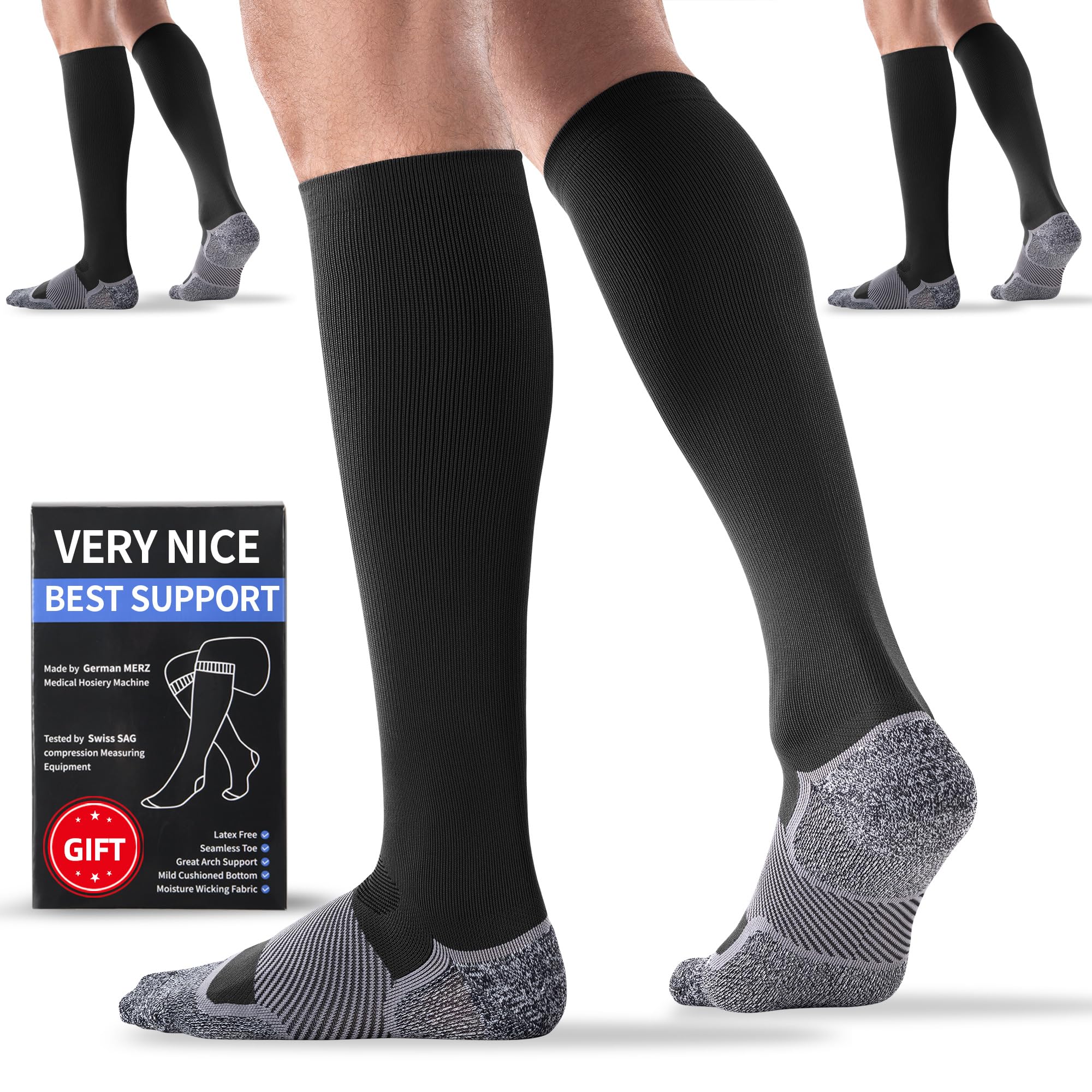
Every pair is pressure tested and built on German medical sock machines, so the tightest squeeze sits at the ankle where blood pools and eases off toward the knee. The foot is where they separate from the field: a lightly cushioned heel and toe, a smooth left-right toe box (no seam rubbing across your toes), and real arch support you can feel underfoot. They feel closer to a padded walking sock than a stiff medical tube.
Buyers report the pressure is firm and honest — the arch support and smooth toe keep showing up as what wins people over, with the 20-30 mmHg reading (a measure of how much pressure the sock applies) holding up next to pricier socks. The top band is the quiet achievement here: it grips without biting, so you are not peeling your sock down every hour to relieve a pressure line.
The trade-off is the squeeze itself. The fit runs narrow and the sock has to be worked on with patience, and anyone with weaker hands or a frail grip will find the pull-on harder than a softer pair. Wash cool and air dry, as the maker advises, and they keep their shape.
What holds up
- Genuine 20-30 mmHg gradient that starts firm at the ankle and eases toward the knee
- Padded heel and toe with a smooth, left-right fitted toe box
- Non-pinching top band that stays up without cutting in
Where it asks for patience
- Getting them on takes some effort, especially with a weaker grip
- Fit runs on the narrow side, so measure your calf carefully
Buy it if: you want one dependable everyday pair you can trust for flights, long standing, or post-activity swelling.
Think twice if: you need to pull your socks on one-handed or without assistance.
2. 7 Pairs Copper Compression Socks
A seven-pair rotation that turns compression into a daily habit without the price sting
The pitch here is simple: enough pairs to actually build the habit. Owners mention these substitute for the hospital-grade socks handed out after procedures, with the compression effect landing as expected once they are on. The material is soft, the stitching is consistent, and the cuffs hold their shape through repeated washes rather than stretching out.
Where they shine is longevity. The weave stays supportive rather than thinning, and the calves keep their fit wash after wash. If your goal is simply having a fresh pair ready every morning, the math works in your favor here.
The honest catch is sizing. The foot area runs large toe-to-heel and the shaft can ride too long over the knee, so the fit depends more on your proportions than the label suggests. Measure your calf and check the chart before committing, because the size range is broad enough to trip you up.
The lasting part: the cuffs and stitching hold up after repeated cycles, which matters when compression is a daily routine, not an occasional sock.
The sizing part: because the graded range is wide, the same labeled size can fit differently on two people — lean on the calf measurement, not the shoe size, and size down if you are between.
Reach for these if: you want a full week of pairs at a budget-friendly price and your measurements sit clearly inside a single size.
Look elsewhere if: your foot and calf proportions straddle the size break, since the fit gap is wide.
3. fenglaoda 8 Pairs Compression Socks

Eight pairs that feel like normal socks — and slip on like them too
The defining trait of this pack is that you barely notice it. The sock pulls on without a fight, leaves the toes unsqueezed, and carries enough cushion to feel like an ordinary everyday sock rather than a medical device. The build holds up too: customers note one pair easing post-surgery swelling and staying in rotation past a month of daily wear.
Put the pack size against the closest competitor and the value gap is plain — eight pairs set against the three-pair Medical Compression pack, a 2.7x difference in quantity for roughly the same money spent.
The compromise is compression strength. This is a moderate, everyday squeeze rather than a prescription-grade hold, and some buyers want it firmer than they found it, with a few noting the stitching could be tidier. For long shifts where you just need circulation support without a vise grip, that lighter feel is the point, not the problem.
The winning traits
- Slips on easily and feels like a standard sock rather than a medical-grade tube
- Eight pairs in one pack for stocking a full week of wear
- Machine washable and holds up to daily rotation
What to weigh
- Compression feels moderate, not the firmest 20-30 mmHg squeeze
- A few buyers found the stitching less than perfect
Best for: everyday wear, deskbound days, or anyone easing into compression who wants an easy-on sock in quantity.
Not for: someone chasing the tightest medical-grade hold their legs will tolerate.
4. Sockwell Women’s Lotus Lift Firm Graduated Compression Sock

Wool-forward construction that puts breathability first without giving up the squeeze
The blend is what sets this pair apart: 32% merino wool, 31% bamboo rayon, 32% stretch nylon, and 5% spandex. That mix nods to warmth regulation and breathability while the spandex runs through the whole structure to keep the sock from sliding down over a day of routine wear. Firm graduated compression moves up the leg, easing from ankle toward the calf.
Small construction details carry the comfort: a turn welt top (a folded, finished edge instead of a raw cut) that resists rolling, smooth toe closure that removes a friction point across the forefoot, and an ultra-light cushion sole that adds a barrier inside your shoe without bulk. It is designed for someone who needs sustained support through prolonged sitting or standing, not for a sprint.
What you give up is choice of quantity. This comes as a single pair rather than a pack, and the merino-blend construction makes it the premium option among the crowd. The benefit is a sock you can wear for a full day at the desk and not want to peel off by lunch, which is harder to put a number on than a pile of extra pairs.
Where the blend pays off: wool and bamboo work together for warmth and moisture management, useful when you are sitting or standing for long stretches and want less of that hot, clammy build-up.
Where the design shows: the smooth toe and light sole cushion remove the forefoot pressure points and the sock-in-shoe bulk that make thinner compression socks uncomfortable by afternoon.
Worth it for: the buyer who treats compression as a daily habit and wants a breathable, low-bulk pair that holds up without constant adjusting.
skip it if: you want multiple pairs out of one purchase and prefer a thicker, more traditional sock feel.
5. Sockwell Men’s Pulse OTC Firm Graduated Compression Sock
Over-the-calf coverage in wool blends made in the USA, built to keep the support above the calf line
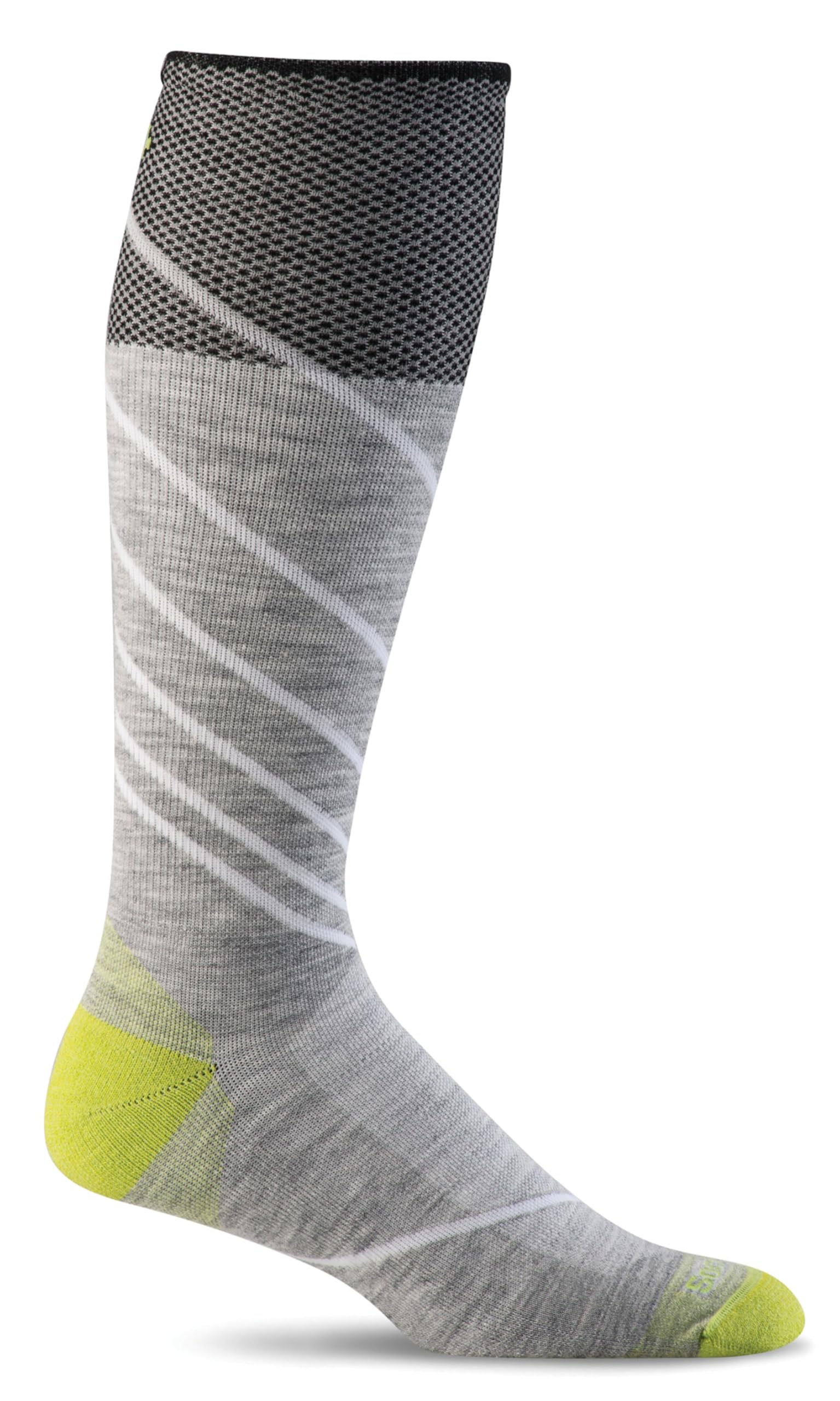
This is a construction story. Fine merino wool blended with rayon from bamboo and fine merino wool and alpaca is designed to bring durability and temperature regulation (it helps keep your legs from overheating) to the same yarn, in an over-the-calf cut that sits above the calf rather than at the knee. Made in the USA, from American wool-based yarns.
The performance read is straightforward: the support shows up where buyers need it, the leg feel is noticeably better and the fatigue and soreness of long standing ease off, and the socks hold up over time with patterns people actually like. That combination of durability and looks is unusual in compression.
Fit is the one variable that splits opinions, with some buyers finding the sock tighter than expected. That sensitivity is worth watching because the OTC height means more of the leg is wrapped. Size from your calf measurement first and treat the chart as a range to narrow, not a guess.
What stands out
- Over-the-calf height for coverage that climbs past the calf
- Wool-blend yarns chosen for durability and temperature regulation
- Attractive patterns that hold up over repeated wear
What splits opinion
- The fit reads tight for some buyers, even at their usual size
- Single-pair pricing asks more per sock than the multi-packs above
Pick this if: you want durable wool-blend compression with pattern options and coverage above the calf.
Leave it if: you need several pairs out of one order or your calf measurement sits near the top of a size band.
Know the Specs
Compression level (mmHg)
mmHg stands for millimeters of mercury, the same unit used for blood pressure, and it tells you how much pressure the fabric puts on your leg. A 20-30 mmHg rating means the sock is designed to deliver a squeeze in that band, firm enough to assist circulation. Lower numbers feel like a snug athletic sock; higher ones edge toward prescription territory.
Graduated compression
Graduated means the pressure changes as you go up the leg — strongest at the ankle, gentlest near the top. That ankle-to-knee gradient is what supports blood returning upward rather than pooling in the calf. A sock with even pressure throughout gives you the tightness without the direction, which is the whole reason compression works for standing and travel.
Common Questions
Will 20-30 mmHg compression socks help with POTS symptoms?
How do I measure my calf for the right size?
Are knee-high or over-the-calf socks better for circulation?
Can I sleep in compression socks for POTS?
How long do 20-30 mmHg compression socks last?
Will the sock stay up all day or roll down?
Are copper compression socks different from regular ones?
How do I get compression socks on more easily?
Can I machine wash compression socks?
What is the difference between the Sockwell women’s and men’s models?
The Bottom Line
For most people managing POTS symptoms day to day, the pick that earns its keep is the Medical Compression Socks 20-30 mmHg (3 Pairs) — a true 20-30 mmHg gradient (the pressure range that supports blood flow back up the leg), padded heel and toe, and an arch support that holds without pinching. If breathability and a lighter wear feel matter most, reach for the Sockwell Women’s Lotus Lift and its merino wool blend. And if you simply want to build the habit without the price sting, the fenglaoda 8-Pair Pack makes it easy to keep a fresh pair ready every day. Whichever pair you choose, measure your calf first — the right size is the difference between support you forget you are wearing and a sock you peel off by lunch.
How we choose
We do not accept paid placement. Every pick is matched to a real buyer and a real use-case; we do not hands-on test units.
Sources
Specifications: manufacturer listings and product documentation. Review insights: verified customer reviews, as of October 2026. Pricing: not shown on this page (it changes often); check the current price via the retailer link.
As an Amazon Associate, Aappliancez earns from qualifying purchases. This does not affect which products we feature.