Disclosure: Some links in this post are affiliate links. As an Amazon Associate I earn from qualifying purchases, at no extra cost to you. Learn more
Specs are compiled from manufacturer listings and verified buyer reviews and can change over time — please confirm the key details on the product page before buying.
Your shift ends and your ankles have doubled. That is the problem this page solves — matching the right compression level and the right top band to twelve hours of standing, so your legs still feel like yours at handover. The short answer: most nurses get the most out of a true 15-20 mmHg sock with a wide, non-cutting cuff, and the picks below are ranked on exactly that. Buy the pair whose band stays put without digging a groove, and skip anything that sags by lunchtime.
This guide is built by comparing the manufacturers’ published specifications and the patterns across verified customer reviews, so you get each pick’s real strengths and trade-offs instead of marketing spin.
Some socks here are gentle enough for a full shift, others grip hard. A few even come with padding you will feel on concrete. Below you will find the honest differences between them, so you can pick a pair that survives the workday rather than just the walk to the car. That is what separates a genuine compression socks for nurses pick from a sock that only looks the part.
Top Picks


How To Choose Compression Socks for Nurses
Most nurses who end up with socks in a drawer made the same mistake: they bought a level that felt fine for ten minutes, not a level that works after twelve hours on a hard floor. The goal of a compression sock is even, steady pressure that stays the same from the first patient to the last. That means you are choosing on three things — the pressure rating, the cuff, and the sizing — before you ever look at colour.
Start with the mmHg rating
The squeeze strength is measured in millimeters of mercury (mmHg). An 8-15 mmHg sock feels light, close to a regular sock, so it suits a desk day or a flight. A 15-20 mmHg sock is the balance for a standing shift: it adds real support without a fight to get on. A 20-30 mmHg sock is firmer again and suits long stretches of standing, if you can manage the pull-on.
The cuff does the most visible work
The top band is where socks fail. A band that is too narrow pinches behind the knee and leaves a groove. A band that is too loose rolls. Look for a sock with a wide, non-binding top that grips the calf instead of cutting into it, and check that the length lands below your knee rather than across the kneecap.
Fit it to your calf, not your shoe size
Measure the widest part of your calf as well as your foot length. Calf size is the number that decides whether a sock can reach a solid compression without squeezing. If your calves are bigger, size up even if the shoe-size chart says otherwise, and expect the sock to feel snug on the first wear.
Side-by-Side Comparison
| Model | Best For | Compression | Construction | Pairs | Amazon |
|---|---|---|---|---|---|
| Sockwell Women’s Micro Grade★ Best Overall | All-day hospital shifts | Graduated (multiple levels) | Merino wool/rayon bamboo blend | 1 | Amazon |
| FNOVCO Athletic Crew 5-Pair PackBest Value Pack | Thick under-boot comfort | Support without restriction | Thick cushioned athletic crew | 5 | Amazon |
| PULIOU Compression SocksBest Easy-On | Easy on, right pressure | 15-20 mmHg | Nylon/spandex | 2 | Amazon |
| Merino Wool Blend Compression Socks | Cold units and travel | 15-20 mmHg | Merino/nylon blend | 1 | Amazon |
| Physix Gear Compression Socks | Firm support for long stands | 20-30 mmHg | Soft textured knit | 1 | Amazon |
| CHARMKING 8-Pair Set | Rotation without washing daily | 15-20 mmHg | Light stretch knit | 8 | Amazon |
| Juclise Crew Running Socks | Overnight and off-shift runs | Medium compression | Cushioned breathable mesh | 3 | Amazon |
| Medical Compression Socks (Bbfrey) | Wide calves | 20-30 mmHg | German-knit, cushioned heel/toe | 3 | Amazon |
| NEWZILL Open Toe | Open footwear on shift | 20-30 mmHg | Cotton blend open toe | 1 | Amazon |
| Dr. Motion Floral Knee Socks | Style with light support | 8-15 mmHg | Scallop-pattern knit | 3 | Amazon |
| Women’s Therapeutic 6-Pack | Everyday all-day wear | 8-15 mmHg Class I | Three-zone knit, smooth toe | 6 | Amazon |
Detailed Reviews
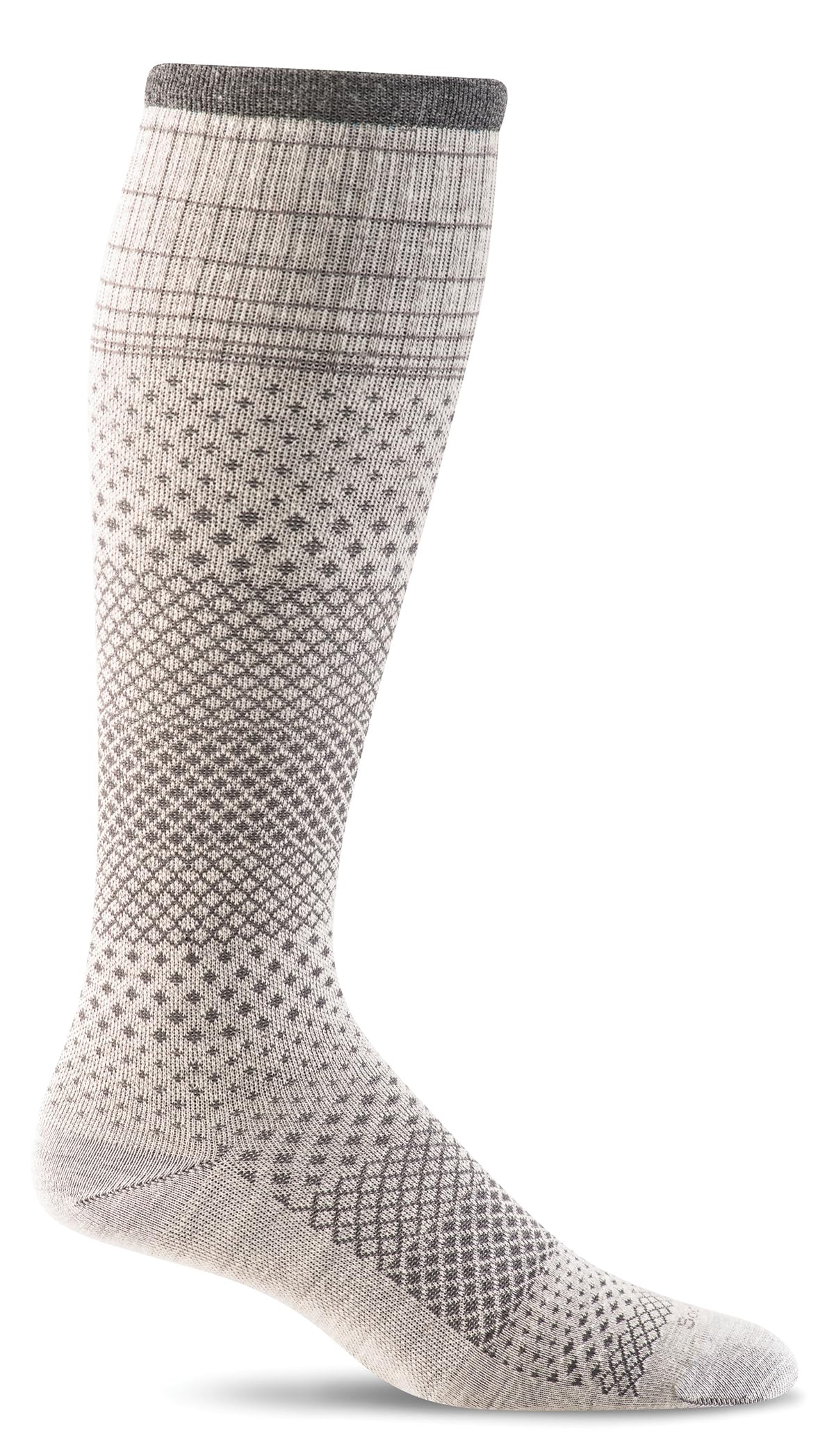
1. Sockwell Women’s Micro Grade
Our pick — 4.5+★ from 850+ verified ratings; the strongest balance of quality and price.
The one nurses keep reaching for: wool-blend compression that grips the calf without cutting in.
This is the pair for a twelve-hour shift where you need real support and a fabric that does not turn into a swamp. It is built from 32% merino wool, 31% rayon from bamboo, 32% stretch nylon and 5% spandex. In plain terms, the wool regulates temperature and the bamboo rayon keeps the surface soft against your skin, so your legs stay dry when you are running between rooms. The four-zone graduated compression squeezes hardest at the ankle and eases toward the calf — the direction that helps push blood back up the leg rather than pooling at your shoes.
Nurses on the review pages say the same thing in different words: no swelling after a long shift, legs that still feel good at the end of it. The fit holds without feeling like a tourniquet, and the sock comes in several compression strengths and patterns, so you can step up or down depending on how your legs respond. There is one honest catch — sizing sits between two options for some wearers. A 12-inch calf in a size 8 shoe landed in the M/L with room in the toe, while the S/M was too short in the foot for the same person. Measure your calf, then choose.
You are paying for the build here. Accu-fit graduated compression (squeeze that is firm at the ankle and eases up the leg) works with an arch-support band and a smooth toe closure, so nothing rubs across your toes inside a clog or a running shoe. It is a non-cushioned sock, which keeps volume down inside tight footwear. Comfort is what owners talk about most — a huge share of reviews land on that one word. Fit runs second. Both are worth the price if you wear them every shift.
Why it earns the top spot
- Four zones of graduated compression give firm support at the ankle and eases up the calf.
- Merino wool and bamboo rayon keep feet dry and temperature-regulated through a long shift.
- smooth toe and arch support remove the rub points that bother nurses most.
- Several compression strengths and patterns under one roof.
What to know before you buy
- Fit can land between sizes — check calf circumference, not just shoe size.
- Non-cushioned build means less padding on hard floors.
Reach for this if: you want one high-quality pair for long hospital shifts and travel days.
Look elsewhere if: you want thick underfoot padding or a multi-pack to rotate.
2. FNOVCO Women’s Hiking Walking Running Crew Socks, 5 Pairs
Five pairs of thick, cushioned crew socks for nurses who want padding underfoot and a full week of rotation.
The first thing to understand is that this is a cushioned athletic crew, not a clinical-grade compression sock. It gives support without squeezing tight, and the thick sole puts a soft layer between your foot and a hard floor. Five pairs in one pack means you never face a laundry-night scramble before a shift.
The build survives real abuse. The ribbing holds — the sock stays put and does not roll down, which is the failure that ruins a cheap crew sock. One buyer wore them under hiking boots for eight hours and reported the fit stayed put; after eight months of machine washing with towels, the elastic was still perfect and the socks showed no pilling.
Where it trips up is the sizing. The size chart runs large for some wearers, and a smaller-footed buyer found extra length at the heel and toe that washing did not fix. The thicker knit also cuts down on how much compression you actually feel, so treat this as a comfort-and-cushion pick rather than a firm support sock. For a nurse who wants several pairs to rotate and dislikes tight socks, that trade makes sense.
Padding you can feel: the cushioned sole is the standout — it softens long stretches of standing without the bulk of a heavy hiking sock.
Buy it for the comfort and the count: five cushioned pairs that survive machine washing and hard wear.
Not the answer for: firm compression — look for a dedicated 15-20 mmHg or 20-30 mmHg sock instead.
3. PULIOU Compression Socks for Women Men, 15-20 mmHg
The sock you can pull on before coffee without wrestling your heel through a fight.
Compression socks are only useful if you actually wear them, and the biggest reason nurses leave a pair in the drawer is the morning struggle. This one is rated 15-20 mmHg — a real level of support for a standing shift — and users describe it as easy to get over the heel. The top band does its job without pinching: a buyer with 17-inch calves in a size 9 shoe wore the L/XL and found it stayed up by day’s end while not cutting in behind the knee. That is the balance you want.
The fabric is nylon and spandex, which means it feels cool and smooth rather than woolly. For a warm ward that is a real plus. One buyer dealt with sensitive skin and reported no itching or rash. Others wore it for 8-10 hours on their feet with aching legs afterwards, and the review pages keep returning to the same pair of words: comfortable and supportive. Even pressure is the theme — no single spot grabs harder than the rest.
Two black pairs ship in the pack, which is practical for a uniform, and this model includes a QR code for a 180-day free replacement guarantee. The honest limit is that a 15-20 mmHg sock still takes some tugging over the heel; it is easier than firmer socks, not easy. If yours arrive and feel loose at the calf, that is a sizing sign rather than a defect — move one size down or measure your calf first.
The case for the PULIOU
- 15-20 mmHg support designed to be easy to pull on.
- Wide top band that holds without pinching behind the knee.
- Cool nylon/spandex feel for warm units.
- Two black pairs plus a 180-day free replacement QR code.
Keep in mind
- Still requires a tug over the heel.
- Not a firm sock for those wanting 20-30 mmHg.
Pick it when getting dressed fast matters: real support you can pull on without a battle.
skip it if: you have firm medical compression and find anything less than 20-30 mmHg slips down.
4. Merino Wool Compression Socks for Women Men, 15-20 mmHg
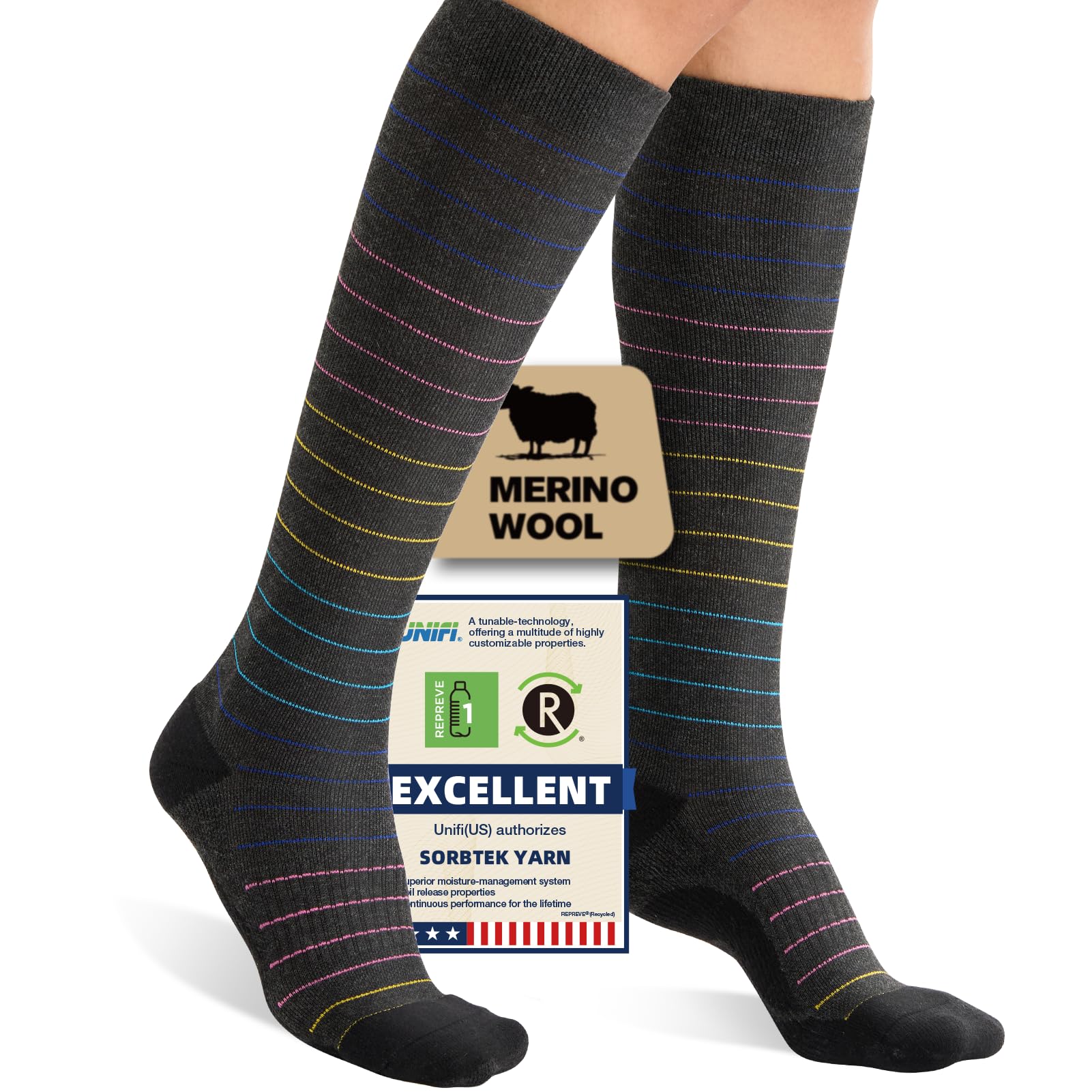
Wool-blend warmth for the overnight shift, with 15-20 mmHg support that goes over the knee.
For anyone who works in a cold theatre, an overnight ward or the back of a refrigerated unit, warmth is a working condition. This sock is a merino blend — merino is a fine wool that insulates without the itch of coarser wool — paired with nylon for stretch. It runs to 15-20 mmHg of support and sits over the knee, which keeps the compression going higher up the calf than a below-knee sock can. Buyers describe the fabric as soft and the compression as just right without feeling cramped.
Wool brings a benefit that matters on consecutive shifts: odour resistance. A reviewer who replaced their whole sock drawer with these pairs praised the merino mix for that reason. The warmth is the other quality people return to, and the sock holds its length rather than sagging above the knee. If your legs swell at the end of a stand-all-day shift, the longer coverage is doing useful work there.
Two caveats sit alongside that comfort. Some buyers report the material split — this is a merino blend, not 100% wool, so expect a synthetic component in the stretch. The other is the length and tightness: pulling an over-knee sock on takes patience, and one wearer found the top edge itchy against the skin below the knee. If you have sensitive skin, that is worth knowing.
The warmth plus the support: merino insulation and 15-20 mmHg coverage is a combination built for cold, long shifts.
Best for the cold-shift nurse: a warm, over-the-knee sock that holds its place through a long day.
Try a nylon sock instead if: you run hot or find wool against the skin irritates below the knee.
5. Physix Gear Compression Socks, 20-30 mmHg

Twenty to thirty millimeters of mercury that shuts down ankle swelling on a long stand — if you can get them on.
This is the firmest level on the list, and that is the whole point. At 20-30 mmHg, the sock squeezes harder than a 15-20 mmHg model, which means it puts in more work when your legs are on concrete all day. A nurse who had worn compression for seven years and tried cheaper socks reported noticeably less ankle swelling in these. The material is thick and soft rather than thin, and it keeps its shape without sagging below the knee.
The fit runs generous enough to accommodate larger calves. A wearer with 15-16 inch calves and size 10 feet found the XL right, and the sock reaches just past the knee. That extra length helps because the compression can climb higher without pinching at the top. Long-time users wear them for construction and long flights and report they still look new after repeated use.
Here is the honest catch. A 20-30 mmHg sock is not the easy-on kind — buyers describe a real pull over the heel, and one review notes a striped panel above the heel can wear thin or tear sooner than the solid heel and toe areas. The sock also feels clammy in heat and on long walks late in the day, so it suits cool conditions and indoor shifts better than a hot summer commute. Treat the firmer feel on day one as normal, not a sign it is too small.
The firm-support lane
- 20-30 mmHg for stronger all-day support.
- Thick, soft material that stays up below the knee.
- Knee-high length and roomy calf sizing.
- Long-term users report it holding up.
Honest limits
- Harder to pull on than a 15-20 mmHg sock.
- Can feel clammy in heat.
Choose it if your ankles need the firmest squeeze: 20-30 mmHg that holds up under long shifts.
Choose a lighter sock if: you dress in a hurry or work in warm conditions.
6. CHARMKING Compression Socks, 8 Pairs, 15-20 mmHg

Eight pairs at 15-20 mmHg so a full shift week never runs out of socks.
Eight pairs changes how you live with compression. You can go most of a week between washes, and a lost or torn sock does not sideline the routine. The set sits at 15-20 mmHg — the standing-shift zone — and buyers describe the pressure as supportive without being tight. A wearer on her feet 10-18 hours on hard floors found the set comfortable through the whole stretch and easy to get on and off.
What makes people reach for these again is the fit staying put. The cuff doesn’t slide down the calf, which is the thing that most annoyed buyers with other pairs. The stretch is generous and the knit reasonably soft, though not as thick as a cushioned athletic sock. The colours are a real draw too — you can pick a set that suits you rather than settle for plain black.
Two things to weigh before you buy. The patterned versions can arrive with stray loose threads inside that press against your skin, and a few owners trimmed them painstakingly. The solid colours don’t have that issue. Toe wear also crops up after some months, so this is a rotation sock rather than a buy-once-for-years sock. None of that stops it being among the most practical multi-packs on this list.
Eight pairs, one wash cycle: the volume here does as much for your week as the compression does for your calves.
Best for the rotation: nurses who want a full week of support without daily hand-washing.
Go with solid colours: patterned pairs are where the loose-thread complaints cluster.
7. Juclise Women’s Compression Crew Socks 3 Pairs

A cushioned crew built for the run after a shift and the long hike on a day off.
Compression socks do more than get you through a workday; they are the same support you want on a recovery walk or a weekend trail. This three-pair set takes that job seriously. A ventilated mesh footbed keeps air moving, a hand-finished smooth toe cuts blisters, and left/right specific shapes let each sock follow the contours of the foot it belongs to. The SecureFit TAB at the back of the heel adds a cushion where a shoe rubs, and the heel and ankle get extra padding.
Runners feel the difference in the arch and the ankle. One buyer ran a 10K without the blisters that had spoiled the prior year, in a crew that stayed put and left room in the toe box for a bunion. The arch band is fitted but the toes have room. That balance is unusual and it is why the sock suits both long shifts and long miles.
Where this one lets you down is sizing. It runs a little small and some people go up a size, so a women’s 9.5 may land better in the Large than the Medium. One nurse on 8-hour shifts found it snug on the calves as the day wore on. Durability is the other worry in the mixed feedback — a few owners mention fraying after one wash. Treat it as a well-padded crew for active days, and size up if you are near the top of a size band.
what separates it
- Mesh in the footbed keeps feet cool and dry.
- smooth toe and heel padding reduce friction and blisters.
- Left/right shaped for a closer fit.
- Strong arch and ankle support for runs and hikes.
What to watch
- Sizing runs small near the top of a size band.
- Some owners see fraying after a wash.
Grab these for the trail and the gym: cushioned support with real arch and ankle work.
Size up if you are near the edge of your size chart — that fixes the most common gripe.
8. Medical Compression Socks 20-30 mmHg, 3 Pairs
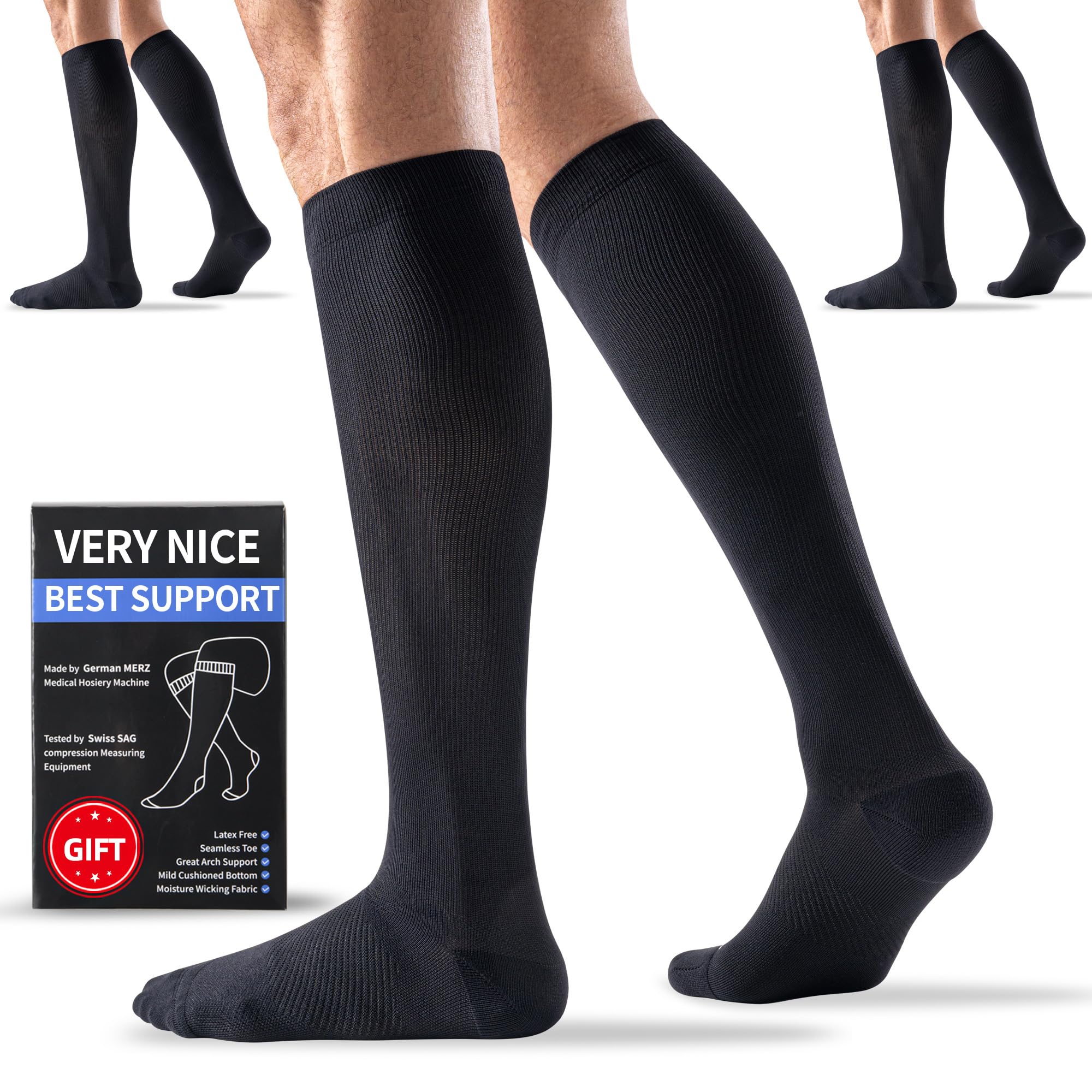
Built for bigger calves: firm 20-30 mmHg pressure that doesn’t give up halfway up the leg.
Compression on a well-muscled calf is a sizing problem first and a sock problem second. This three-pair set handles it with a graduated 20-30 mmHg squeeze and a knit made on German medical sock machines, which the maker says undergo pressure testing so the grip lasts. A buyer with big calves and normal ankles found these the best fit for muscular legs, and a wearer with 14.5-inch calves in a 10.5 shoe found the size chart accurate. That is exactly the kind of feedback wide-calf buyers need to hear.
The details support long shifts: lightly cushioned heel and toe for comfort underfoot, smooth stitched toes with a left-right fit to prevent blisters, and a wide top band that holds without cutting. One wearer reported the wide top band staying up for 11-plus hours. The fabric blend is designed to be breathable and sweat-wicking, and buyers who compared them to more expensive socks came away thinking they were the better value pick.
The trade-off is getting them on. A 20-30 mmHg sock takes determined pulling, and one buyer found it hard enough to move up to X-Large for easier self-management. There’s a trick: slide a hand inside the top and loosen toward the ankle before rolling the sock up. The maker also recommends hand washing or cold machine washing and air drying rather than tumble drying.
The wide-calf fix: firm graduated pressure that stretches to fit instead of fighting back.
The pick for stronger legs and larger calves: three firm socks that fit where others pinch.
Air dry them, always — the maker does not recommend the tumble dryer, and that keeps the grip intact.
9. NEWZILL Open Toe Compression Socks, 20-30 mmHg
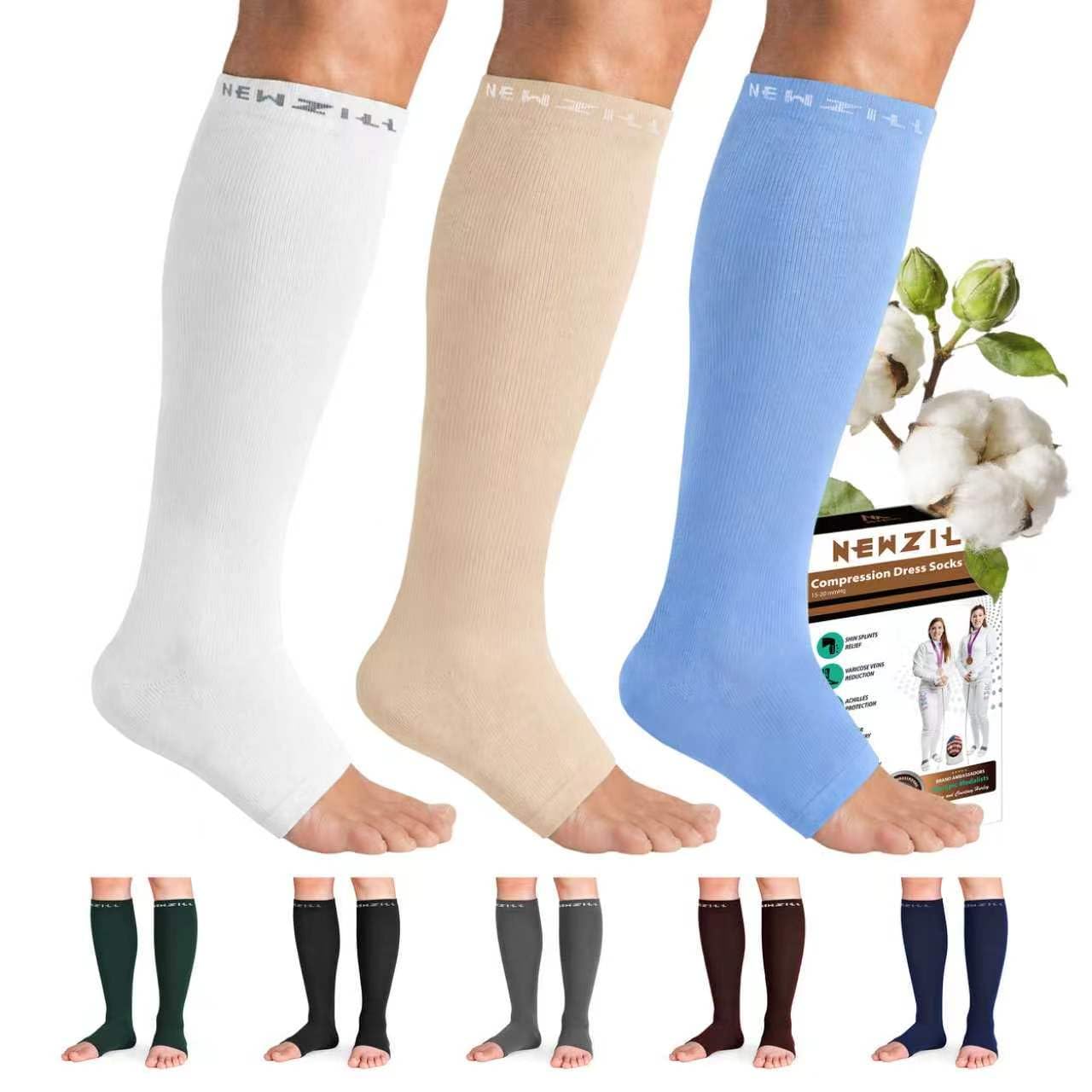
Open at the toe so your sandals and wide shoes still work while the calf gets supported.
An open toe is a problem solver. It lets air around the toes and keeps a sandal or a roomier shoe comfortable while still squeezing the calf at 20-30 mmHg. That makes it a rarity outside medical channels, and a buyer who had trouble with socks that choked the toes called this the only pair they could wear. The cotton-blend knit is soft and non-irritating, easy on and off, and gentle on sensitive skin.
Coverage reaches well up the calf. A wearer with 16.75-inch calves and a size 9.5 shoe found the L/XL fit and had less ankle swelling by noon. The compression stays in tune after washes, and users who sleep, drive or sit at a desk in them find them comfortable for hours on end. That range of uses — work, travel, sleep — is what the open toe buys you.
One word of caution on fit. The published sizing is on the small side, and a buyer with athletic 21-inch calves found the XXL would not go on, which looks like a mislabeled smaller size rather than a real size. Order a size up if you are near a boundary. Also, the cotton blend pills and fuzzes over time, and the compression feels gentler than a full medical-grade sock, so don’t expect the same grip as a firm closed-toe model.
Where the open toe wins
- Toes stay free for sandals and wide shoes.
- Soft cotton blend that suits sensitive skin.
- 20-30 mmHg that holds its compression after washes.
- Easy on, easy off compared with closed socks.
Where it asks more
- Runs small — size up near a boundary.
- Cotton blend pills and fuzzes with wear.
Worth it if you want your toes out: the only open-toe pair here with firm, durable calf support.
Look at a closed-toe sock if: you need maximum grip or hate the fuzz that cotton develops.
10. Dr. Motion Women’s 3-Pack Floral Compression Knee Socks
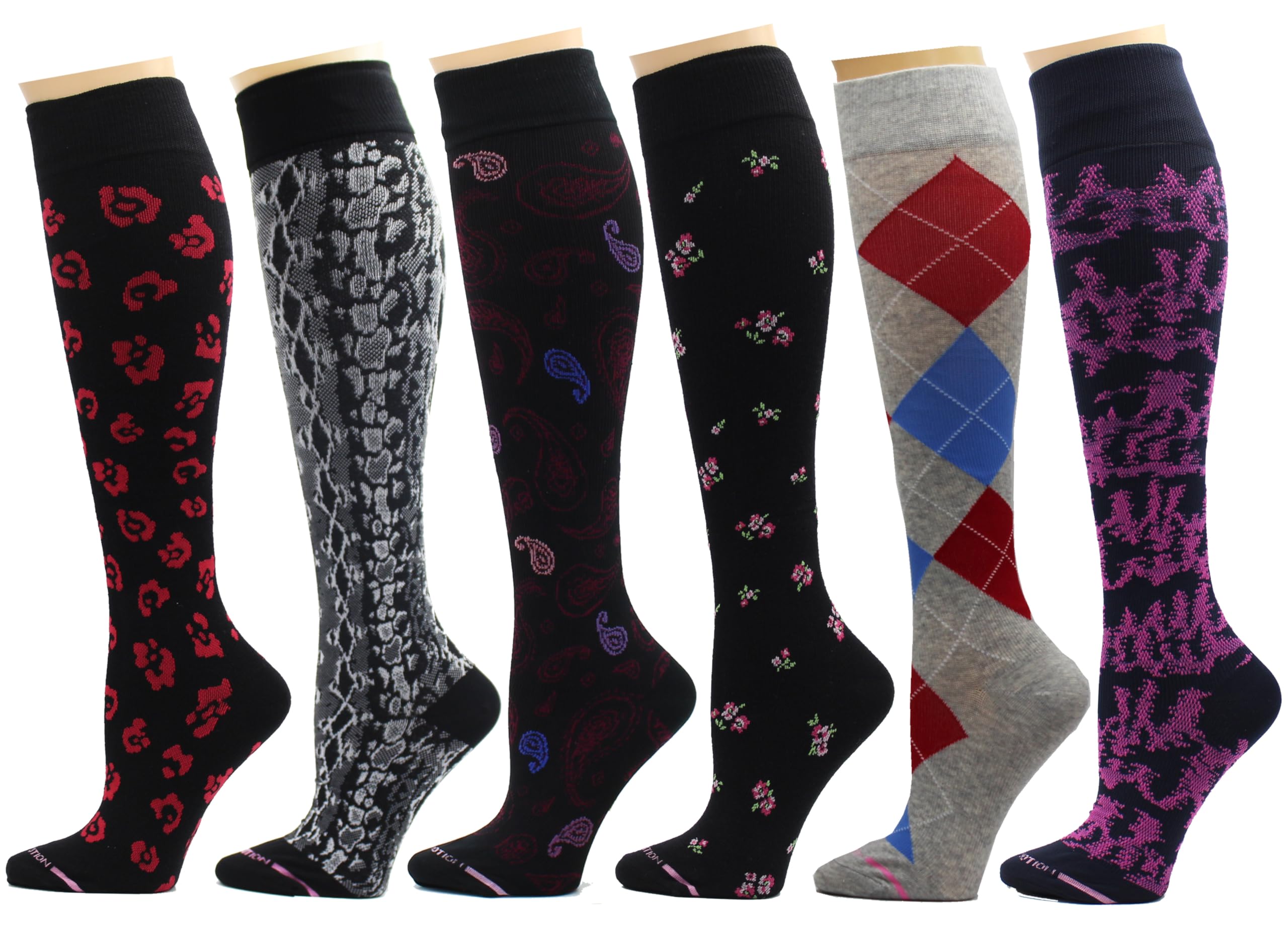
Gentle 8-15 mmHg in cheerful patterns — for the nurse who wants a little support, not a squeeze.
Not every shift needs a 20-30 mmHg sock, and this set is the gentle option. At 8-15 mmHg, it gives light graduated pressure for ordinary days on your feet. The scalloped floral designs are the draw: they look like a nice sock rather than a medical one, which means you’ll actually wear them. Three pairs in one pack covers a work week between washes.
Buyers wear these for plane travel and long workdays and come away with less swelling at the end of the shift. The knit is smooth and leaves no deep marks on the leg, and the top band holds with just enough pressure to stay put without digging in. Nurses who want a lighter level of compression rather than a firm medical sock find this the comfortable middle ground. And the fit is consistent from pair to pair, so the second pair feels like the first.
The honest limits are worth hearing. Some people want more compression for long flights than 8-15 mmHg delivers, and a couple of owners find the cuff can cut into the back of the leg if the sock isn’t pulled up high enough. Pulling them higher solves it. One pack arrived with a nylon pair mixed in with the cotton-blend ones, so check what you unbox. Treat this as a light-support, everyday sock and it delivers exactly what it promises.
Style with a light squeeze: the floral patterns are the point, and 8-15 mmHg is a soft daily level rather than firm support.
Good for the light-support wardrobe: everyday socks that look nice and keep feet calm on routine days.
Not the pick for a high-compression shift — go 15-20 or 20-30 mmHg when the legs need a firmer grip.
11. Women’s Compression Socks Therapeutic Graduated, 6 Pairs
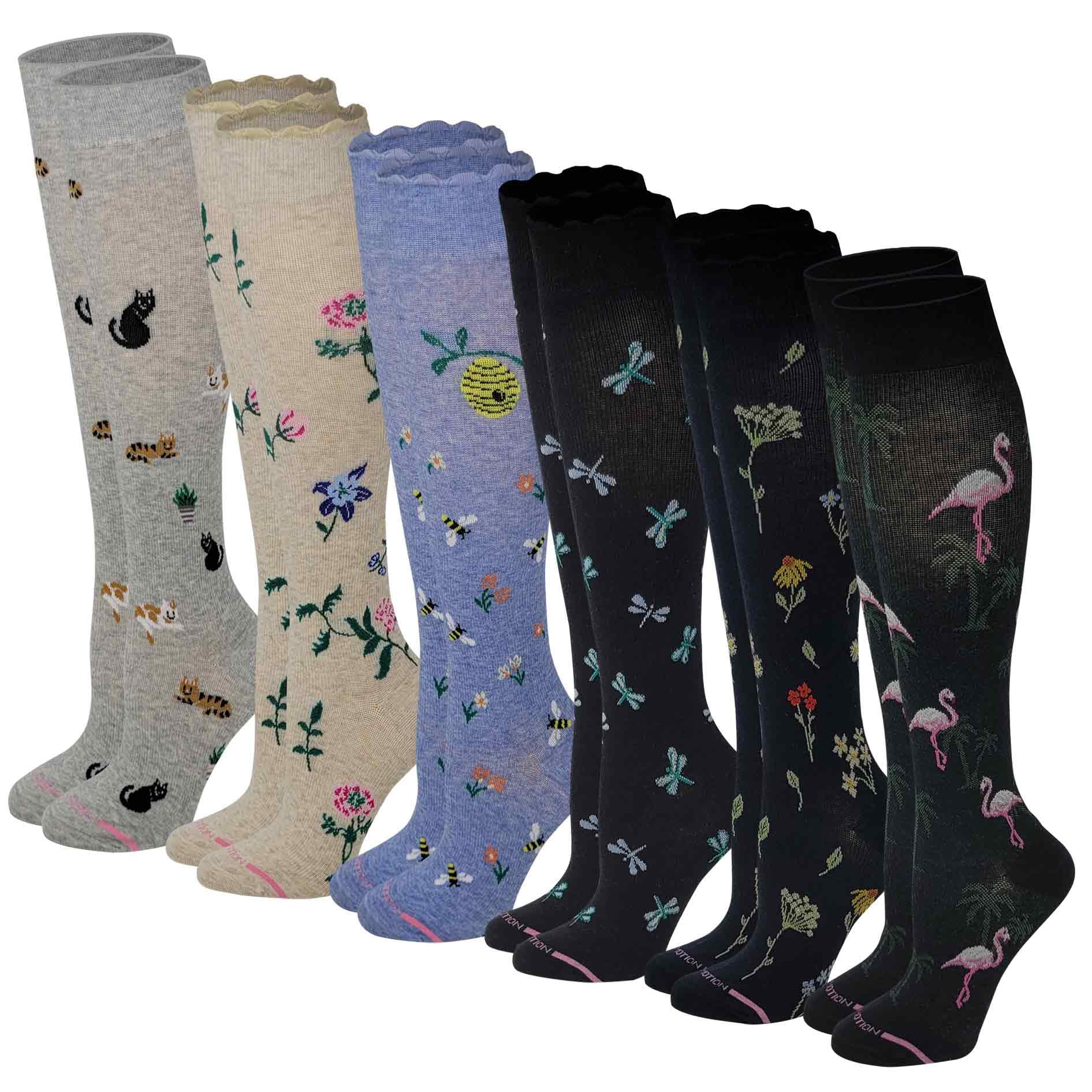
Six pairs of gentle, three-zone support for everyday wear, with a cuff that doesn’t leave dents.
This set is built for the long haul of daily life, not for a single punishing shift. It uses Class I mild compression at 8-15 mmHg, knit in three compression zones from ankle to calf so each part of the leg gets the right amount of squeeze. The point of that design is a graduated fit that eases off toward the top instead of clamping down. The non-binding cuff adds just enough hold to stay in place without interrupting circulation, and the smooth toe seam keeps the toe seam from rubbing under a tight shoe.
Six pairs is a rotation you can live with, and the range of prints means you can match a pair to an outfit. Customers note they’re easy to put on and take off, that they hold their shape through washing and drying, and that one set has worn for years. For a working nurse who wants a sock she can pull on in the morning without a battle, that ease matters. They sit below the knee and stay there over the day.
The fair caveat: at 8-15 mmHg this is light support. It suits ordinary standing and sits easily under clothes, but it is not the firm grip of a 20-30 mmHg sock if you are managing heavy swelling. A few wearers also find the cuff gentler than expected, which suits sensitive legs but not anyone who wants a strong squeeze at the calf. Air drying is the maker’s advice for keeping the fit.
What you get from the six-pack
- Three knit zones for even pressure from ankle to calf.
- Non-binding cuff that stays without marking.
- Smooth toe seam for comfort in tight shoes.
- Six pairs, so a week of support is covered.
Where it lets you down
- 8-15 mmHg is light rather than firm support.
- Not the sock for heavy swelling.
Choose it for everyday, gentle compression: six pairs with a cuff that disappears under clothing.
Swap to a firmer level if: you need real resistance against heavy swelling at the foot and ankle.
Know the Specs
mmHg compression level
This is the force of the squeeze, and the number you’ll see on every page. A lower figure like 8-15 mmHg is a light hug — good for a desk day or a light swelling day. A 15-20 mmHg sock is the everyday standing-shift level, and a 20-30 mmHg sock is the firmest of the three. Graduated compression means the pressure is stronger at the ankle and weaker up the calf, which is the direction that helps blood return rather than pool. Match the level to how long you stand, not to how much the label promises.
Calf and cuff fit
The top band is where most compression socks succeed or fail. A band that doesn’t bind stays in place without cutting into the leg, while a narrow tight band leaves a mark. Wearers report these two failure modes as pinching behind the knee or rolling down by midday. Measure the widest part of your calf and compare it to the size chart rather than guessing from shoe size, and if you’re between sizes, size up so the compression still fits rather than digging in.
Material composition
What the sock is knit from decides how it feels after hour eight. Merino wool blends regulate temperature and resist odour, which is why they’re loved on long cold shifts. Nylon and spandex feel cooler and smoother, and suit warm wards. Cotton blends are soft and skin-friendly but can pill over time. Whatever you choose, check the washing instructions — several makers recommend hand washing or cold machine washing and air drying, and that keeps the compression and elasticity working longer.
Open toe vs closed toe
Most compression socks cover the toes, but an open-toe design leaves the front of the foot free. That helps if you want to wear sandals, wide shoes or your own socks underneath, and it’s easier on the toes for anyone with sensitive feet. The trade is that fewer open-toe options exist, and they can run smaller than expected. Closed-toe socks hold better across the whole foot but need a roomier toe box to stay comfortable.
Common Questions
Will 15-20 mmHg compression socks be enough for a 12-hour nursing shift?
How do I keep compression socks from rolling down behind my knee?
Can I machine wash and dry compression socks?
What is the difference between 15-20 mmHg and 20-30 mmHg socks?
How do I measure my calf for compression socks?
Are open toe compression socks as supportive as full socks?
How long should compression socks last with daily wear?
Do compression socks help with swelling from standing all day?
Should I size up or down if I am between sizes?
Can I wear compression socks for a night shift and then a flight the next day?
Why does the sock feel tighter on the first wear?
The Bottom Line
For most nurses, the winner is the Sockwell Women’s Micro Grade. It pairs a real graduated squeeze with a merino-and-bamboo fabric that keeps your feet dry through a long shift, and the smooth toe means nothing rubs inside a clog. If getting the sock on is your daily battle, the PULIOU 15-20 mmHg is the easier pull-on with genuine support. And if your calves have always made compression a fight, the Medical Compression Socks 20-30 mmHg 3-pack is the set built for a wider calf.
One last thing worth knowing before you decide: the biggest difference between a pair that stays in the drawer and one you wear every shift is the cuff, not the mmHg number. Pick a sock with a wide non-binding band, check your calf size against the chart, and air dry it. Do those three things and whichever pair you choose will keep working well past the point where a cheaper sock gives up. Start with the level that matches your worst shift, and buy a second pair so one is always dry.
How we choose
We do not accept paid placement. Every pick is matched to a real buyer and a real use-case; we do not hands-on test units.
Sources
Specifications: manufacturer listings and product documentation. Review insights: verified customer reviews, as of October 2026. Pricing: not shown on this page (it changes often); check the current price via the retailer link.
As an Amazon Associate, Aappliancez earns from qualifying purchases. This does not affect which products we feature.