Disclosure: Some links in this post are affiliate links. As an Amazon Associate I earn from qualifying purchases, at no extra cost to you. Learn more
Specs are compiled from manufacturer listings and verified buyer reviews and can change over time — please confirm the key details on the product page before buying.
Your shoes should still slide on when you land. That is the whole point of compression socks on a long flight — a graduated squeeze that helps your legs keep moving blood while you sit still for hours. If you only buy one thing before your next trip, buy the right pair, and the five below are the ones worth packing.
This guide is built by comparing the manufacturers’ published specifications and the patterns across verified customer reviews, so you get each pick’s real strengths and trade-offs instead of marketing spin.
Here is what actually separates one pair from another: how much squeeze it delivers in millimeters of mercury, and whether it holds up after a few washes. Everything below is organized around those two things, so by the end you can pick a pair for compression socks for air travel without second-guessing the size chart.
Top Picks


How To Choose The Best Compression Socks for Air Travel
Two numbers decide almost everything about a pair of flight socks: the compression rating and your calf measurement. Get those right and the rest — fabric, colors, pack size — is preference. Get them wrong and even an expensive pair will sit in a drawer.
Start with the mmHg rating on the packaging
Compression is measured in millimeters of mercury, written mmHg — the same unit your doctor uses on a blood-pressure cuff. It tells you how much squeeze the sock puts on your leg. A 15-20 mmHg pair is the lighter end: noticeable, comfortable, and easy to wear for a full travel day. A 20-30 mmHg pair squeezes harder and is the range often used for people who already swell badly on planes or who stand all day at work. Neither is “better” — the harder squeeze is simply more support and takes more effort to pull on.
Measure your calf, not your shoe size
This is the mistake almost every first-time buyer makes. A compression sock has to fit the widest part of your calf, because that is what it is squeezing. The size chart almost always asks for calf circumference in inches, and many brands also want ankle circumference. If you are between two sizes on a 20-30 mmHg pair, the larger one is usually the safer travel choice — a too-tight top band digs in and rolls down, which defeats the purpose entirely.
Look for graduated compression, then check the fabric
Graduated compression means the sock is tightest at the ankle and gradually looser as it climbs toward the calf. That pressure ladder is what supports the return of blood up your leg. On fabric, three options dominate travel socks: nylon and spandex blends that stretch and dry fast, copper-blend knits that are soft and inexpensive in multi-packs, and merino wool that insulates and manages moisture in a cold, dry cabin. Wool costs more and runs warmer; nylon dries fastest.
Side-by-Side Comparison
| Model | Best For | Compression | Pairs Included | Fabric Type | Amazon |
|---|---|---|---|---|---|
| Physix Gear Compression Socks★ Best Overall | All-day support and hard-wearing use | 20-30 mmHg | 1 pair | Nylon/spandex knit | Amazon |
| Votprof Graduated Compression SocksTop Performer | Long-haul flights and airport days | 20-30 mmHg | 1 pair | Lightweight knit | Amazon |
| Bluemaple 6 Pack Copper Compression Socks | A week of travel from one pack | Graduated (copper blend) | 6 pairs | Copper-blend knit | Amazon |
| CHARMKING Compression Socks (8 Pairs) | Light compression and easy pull-on | 15-20 mmHg | 8 pairs | Stretch knit | Amazon |
| Merino Wool Compression Socks | Cold cabins and over-the-knee coverage | 15-20 mmHg | 1 pair | Lycra, wool and bamboo blend | Amazon |
Detailed Reviews
1. Physix Gear Compression Socks 20-30 mmHg
Our pick — 4.5★ from 96,000+ verified ratings; the strongest balance of quality and price.
The firmest squeeze on this list, from a sock that outlasts the trip that started it.
If you want the firmest squeeze here, this is the pair. A 20-30 mmHg rating means it presses noticeably harder than the 15-20 mmHg options further down — it beats the CHARMKING pack on compression, 20-30 mmHg against 15-20 mmHg, though both arrive in the same abstract value tier, and it is the one to reach for if long days on your feet are the norm rather than the exception. You get a single pair per order, so there is nothing spare in the suitcase.
What wins people over is durability. The knit holds its shape and its 20-30 mmHg squeeze through repeated washes, with the calves and arches staying supported rather than going slack after a season. It carries 4.5 stars across 96,000+ ratings, the most-reviewed pair on this page. One buyer reports it “left no cankles on a 5.5-hour flight, kept legs warm and comfortable, not too tight.”
Graduated compression is the mechanism doing the work: tightest at the ankle, easing as it rises so the pressure supports the blood’s trip back up your leg. Travel-wise it handles a full airport day — the morning pull-on through the evening landing — without the top band cutting in. The recurring gripe is the trade-off of that firm squeeze: the 20-30 mmHg fit is stubborn to wrestle on, and calf size is where the sizing fights back. The size chart runs literal, so measure the widest part of your calf before you order.
What keeps it on top
- 20-30 mmHg graduated squeeze — the firmest on this list, and enough support for a full travel day.
- Durable knit that keeps its shape and compression through repeated washes.
- Arch and heel support built into the knit, not added as a separate pad.
- Unisex sizing, so it works as a shared pair in a household.
Where it asks for patience
- One pair per order — no spares for a two-week trip.
- The firm 20-30 mmHg fit takes real effort to pull on and off.
- Calf sizing is unforgiving; a wrong measure means a sock that fights you.
Reach for this if: you fly often, stand long shifts, or want the strongest squeeze on this page and only need one pair.
Look elsewhere if: you want a pack of several pairs, or you find firm compression hard to put on.
2. Votprof Graduated Compression Socks 20-30 mmHg
Built for the traveler who measures a trip in airports, not just flight hours.
Here is the pair that earns its place on long-haul itineraries specifically. The 20-30 mmHg graduated squeeze matches the Physix Gear above for firmness, but the fabric is lighter, which matters once you are wearing it through a connection, a rental-car queue and a hotel lobby. Travel is the use case the makers target — their own description lists air flight first among the activities it is meant for.
Where this one separates itself is the airport test rather than the seat test. Hours shuffling through terminals and standing in queues is exactly what it is built to handle, and the fit runs generous enough for the toe box to stay roomy — sizing for a 9.5 shoe on an 8 foot, with high insteps and skinny legs, still works, with the foot part snug and the rest of the leg supported. If your swelling shows up in the ankle and the top of the foot, this is the geometry you want.
The honest catch is that the same 20-30 mmHg squeeze that makes it effective is what makes sizing tricky. It is the highest-count aspect on this product and Amazon’s own read of the reviews calls it mixed — some buyers find the fit spot on, others find it too tight, and one pair simply would not cooperate with large calves. The foot section runs narrow relative to the calf, so if your calves are wide, size by the calf and expect the foot to feel snug.
The airport-day case: light fabric under a firm 20-30 mmHg squeeze is a good combination for anyone whose travel day is eight hours of standing and sitting in rotation, and the roomy toe box helps on a flight where your feet are the first thing to complain.
The sizing caveat: this is a pair to buy by calf measurement, not shoe size. Wide calves are the scenario where buyers most often end up returning it.
Best matched to: frequent flyers and airport-heavy itineraries who want firm compression in a lighter knit.
Think twice if: your calves are wide or you want a roomy fit through the whole leg rather than just the toes.
3. Bluemaple 6 Pack Copper Compression Socks

A full week of travel socks in one order, in colors you will actually wear.
Six pairs in one order is the reason this one exists on this list. A two-week trip with a wash mid-way, or a household splitting pairs between two travelers, is exactly the scenario it fits — and the graduated copper-blend knit keeps the squeeze strongest at the ankle and lighter up the calf, the same pressure ladder the singles above use. The wide top band is built to stop the rolling that ruins a travel day.
The six pairs come in colors you can wear to the office or the gym. The multi-pack also makes it the easy pick for anyone traveling with a partner or a family, since one order covers several people.
The honest trade-off is the pressure itself. This is a graduated copper compression sock, not a medical-grade one, and the fit runs tighter than a standard sock but looser than a clinical pair — so if you need serious compression for a diagnosed condition, this is a support sock, not a treatment device. The other recurring gripe is durability: the soles on some pairs fray well before the rest of the sock gives out. Treat the multi-pack as a season of travel rather than a lifetime purchase.
Why the pack wins: six pairs at a multi-pack price makes it the sensible buy for anyone who flies more than twice a year, and the colorful knit means the socks get worn to the office, the gym and the airport without anyone noticing they are support socks.
What to expect honestly: moderate compression rather than clinical-grade squeeze, plus a sole that wears faster than the leg. Plan to rotate pairs rather than lean on one.
Pick this when: you want several pairs for the price of one premium single, and you like a sock that looks like a sock.
skip it if: you need clinical-grade compression or you want one pair to survive years of heavy use.
4. CHARMKING Compression Socks (8 Pairs) 15-20 mmHg

The light squeeze that slides on without a fight, eight times over.
Not everyone wants a firm squeeze, and this eight-pair pack is the answer for the traveler who wants gentle support. At 15-20 mmHg it presses lighter than the 20-30 mmHg picks above — a real difference if you have ever abandoned a pair mid-flight because the top band was digging in. Eight pairs also means you can pack one per travel day without doing laundry on the road.
What makes this the easiest pair on this page to live with is how little effort it takes to get on. The stretch runs generous, the top band is wide, and the sock stays up without sliding down, which is the exact combination that makes a compression sock wearable for a full travel day rather than an hour. Buyers report the swelling in their legs easing overnight after a long flight. The breathable knit stays soft enough to wear past hour three.
The catch is the flip side of that easy pull-on: lighter compression means less support than a 20-30 mmHg pair, so if your legs swell hard on planes, this may feel like it is not doing much. Durability is the other half of the story — most pairs survive washing well, but the toe area is where holes tend to appear first. Rotate the eight pairs rather than wearing the same two on repeat and that concern mostly takes care of itself.
What makes it the easy pick
- 15-20 mmHg — light enough to wear all day without the top band biting.
- Eight pairs means a fresh sock for every travel day.
- Wide top band that stays up without sliding down.
- Easy pull-on and pull-off, which matters at a cramped airplane seat.
What to keep in mind
- Lighter compression than the 20-30 mmHg options on this list.
- Toe area is the first place holes show up.
- Plain-looking compared with the patterned packs.
Made for: light-compression travelers who hate fighting a sock on, and anyone who wants a fresh pair for every leg of a trip.
Not the one if: you need serious squeeze for heavy swelling or you are buying for daily hard-wearing use.
5. Merino Wool Compression Socks 15-20 mmHg
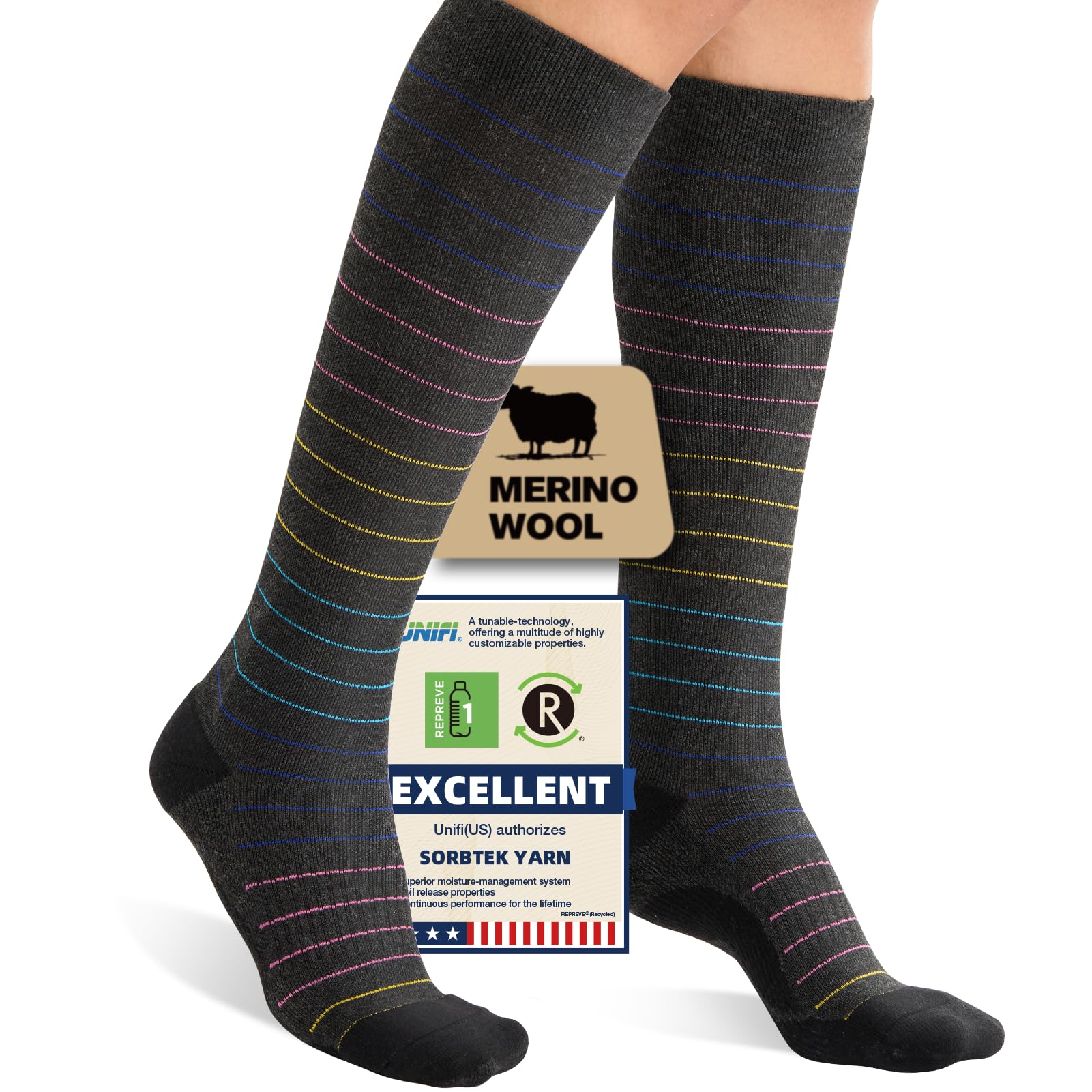
Wool warmth and full over-the-knee coverage, sized by calf rather than shoe.
Cold cabins are the reason this pair makes the list. A Lycra, wool and bamboo blend insulates in a way the nylon and copper options cannot, so if you are the passenger who spends a long-haul flight with an airline blanket wrapped around their legs, this is the pair that solves the problem. At 15-20 mmHg it is a medium squeeze — supportive, not aggressive — which makes it easy to keep on for the whole flight and the taxi ride after.
The fit is the standout detail. It goes over the knee, which is rare in this category and genuinely useful on a red-eye, and it still manages that without bunching at the heel or cramping the toes. Sensitive skin is another reason people gravitate here — softer yarn on the sole means less of the itch and dryness some tighter knits cause. The wool insulates without overheating, so the same pair works for a chilly morning walk at home and a cold cabin in economy.
Now the honest part. It is thicker than everything else on this list, which shows up in two places: it may feel warm if your feet run hot, and it fits mesh walking shoes but not a snug ankle boot. Calf sizing is what matters most here, and even buyers whose measurements sit outside the published chart have had success choosing by calf rather than foot length. The other real consideration is cost-per-pair — this is a single-pair purchase at a premium, and cheaper near-equivalents exist, so it is the buy for warmth and feel rather than value per sock.
The cold-cabin rationale: a merino blend with over-the-knee coverage is the only pair here built for insulation as well as support, and it makes a long overnight flight noticeably more comfortable if you run cold.
What you give up: it is a single pair at a premium price, and the thickness that comes with the warmth means nothing slimmer than a mesh walking shoe will fit over it.
Worth packing for: cold-natured travelers, red-eyes, and anyone who wants over-the-knee coverage in a softer yarn.
Pass on this if: your feet run hot, you need several pairs, or you plan to wear it inside a slim ankle boot.
Know the Specs
What mmHg Actually Measures
mmHg is the compression rating printed on the packaging, and it tells you how hard the sock squeezes your leg. A 15-20 mmHg pair is the lighter, easier option — noticeable support that you can wear for a full travel day without thinking about it. A 20-30 mmHg pair presses harder and is the choice for frequent flyers or people who stand for long shifts. The rating is a single number, so when you see two pairs side by side, the higher figure is simply more squeeze.
Graduated Versus Even Compression
Graduated compression means the sock is tightest at the ankle and gets gradually looser as it climbs toward the calf. That pressure ladder is what supports the upward flow of blood in your leg, and it is why compression socks are built this way rather than squeezing evenly from top to bottom. Even compression wraps the whole leg at the same pressure, which is a different feel and a different job. For air travel, graduated is the design you want.
Common Questions
What compression level should I wear on a flight?
How do I know which size compression sock to buy?
How long before a flight should I put compression socks on?
Are compression socks for travel the same as medical compression stockings?
Can I wear compression socks all day after I land?
Is 15-20 mmHg enough compression for a long-haul flight?
Do compression socks for air travel help with swollen ankles?
How long do travel compression socks last before they wear out?
Are merino wool compression socks better for flying than synthetic ones?
Can I sleep in compression socks on an overnight flight?
The Bottom Line
For most travelers, the pair worth packing is the Physix Gear Compression Socks 20-30 mmHg, because it delivers the firmest squeeze on this page in a knit that keeps its shape wash after wash — and that is what makes it the one that gets bought again rather than replaced. If long airport days are your routine and you want that same firm support in a lighter fabric, the Votprof Graduated Compression Socks is the one to reach for. And if you would rather have a fresh pair for every day of the trip, the Bluemaple 6 Pack covers a full week in one order. One last thing worth knowing before you check out: the firm pairs here do not forgive a guess on size, so take the tape measure to your calf before you order — it is the single step that decides whether a good sock works for you.
How we choose
We do not accept paid placement. Every pick is matched to a real buyer and a real use-case; we do not hands-on test units.
Sources
Specifications: manufacturer listings and product documentation. Review insights: verified customer reviews, as of October 2026. Pricing: not shown on this page (it changes often); check the current price via the retailer link.
As an Amazon Associate, Aappliancez earns from qualifying purchases. This does not affect which products we feature.