Disclosure: Some links in this post are affiliate links. As an Amazon Associate I earn from qualifying purchases, at no extra cost to you. Learn more
Specs are compiled from manufacturer listings and verified buyer reviews and can change over time — please confirm the key details on the product page before buying.
For lymphedema and swelling-prone legs, what actually moves the needle is how much pressure the pump can build and how many separate air chambers squeeze your leg in sequence — those two things decide whether fluid gets pushed back toward your torso or just sits there. This guide walks through nine real options, from entry-level corded units to full medical-grade systems, and tells you plainly which one fits which set of legs.
This guide is built by comparing the manufacturers’ published specifications and the patterns across verified customer reviews, so you get each pick’s real strengths and trade-offs instead of marketing spin.
Pressure range, chamber count, and fit are the three things you cannot compromise on when you need real swelling relief. Below you will find the compression boots for lymphedema picks that get those details right, plus honest notes on what each one gives up.
Top Picks


How To Choose Compression Boots for Lymphedema
Lymphedema swelling is protein-rich fluid that your lymphatic system is not clearing on its own, so the machine has to do the work your body cannot. That changes what you should look for. A boot built for post-gym soreness and a boot built to move lymph fluid are not the same tool, even when they look identical on a product page.
Pressure range is the number that matters first
Every boot here states its pressure ceiling in mmHg (millimeters of mercury, the same unit your blood pressure cuff uses). The entry-level models top out around 100 to 110 mmHg. Serious medical and recovery units reach 140 to 150 mmHg. If your doctor has told you that you need meaningful compression to reduce leg swelling, a low ceiling limits what the unit can realistically do for you. Match the ceiling to what your care team has told you to expect, and always confirm your specific pressure range with your doctor before buying.
Chamber count and sequencing
Chambers are the separate air bladders along the sleeve. A four-chamber sleeve inflates in sequence — foot first, then calf, knee, thigh — which is what “milks” fluid upward and out. Fewer chambers, or a single bladder that inflates all at once, squeeze without direction. For lymphedema, sequential multi-chamber design is the whole point, so count the chambers before you look at anything else.
Fit: the spec almost nobody checks until it hurts
Zippered sleeves need to close comfortably over your calf at its swollen size, not your morning size. Sizing that fits fine when your legs are calm can become a struggle on a bad day, so it pays to measure at your worst and pick a size that closes with a little room. Several picks on this list come in multiple sleeve sizes, and a couple let you buy extra sleeve sets separately for arms and hips.
Where you will actually use it
A corded pump with a stronger motor and no battery limits is the classic medical setup. Cordless units with rechargeable batteries let you treat your legs on the sofa, at a desk, or while traveling — but check the published battery window and weigh that against the pressure ceiling, because portability usually costs you a little top-end power. Neither is wrong; they just suit different routines.
Side-by-Side Comparison
| Model | Best For | Pressure Range | Chambers | Power | Amazon |
|---|---|---|---|---|---|
| Air Relax AR-2★ Best Overall | All-around daily swelling relief | Up to 230 mmHg claimed | 4 | Corded | Amazon |
| FIT KING FT-068ABudget Champion | Budget swelling relief, foot and calf | 60–100 mmHg | 3 | Corded | Amazon |
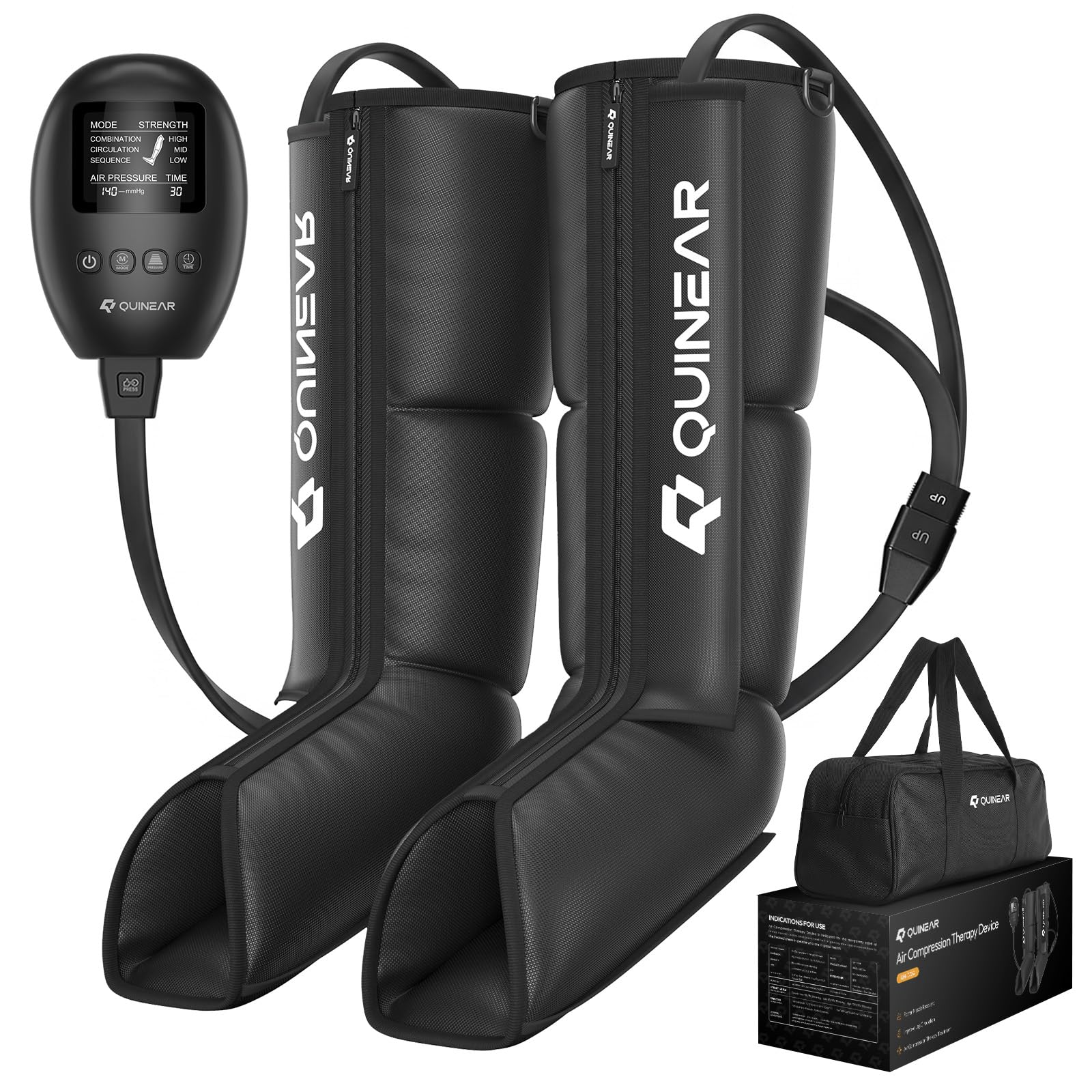
| QUINEAR QN-070ABest for Recovery | First boot for feet and calves | 60–140 mmHg | 3-channel | Corded | Amazon |
| CINCOM CM-108A | Untethered sessions around the house | 40–150 mmHg | 4 zones | Cordless, 3–4 hr | Amazon |
| FIT KING FT-091A | Multi-user homes and travel | 40–150 mmHg | 4 | Cordless, 3–4 hr | Amazon |
| Therabody JetBoots Prime | Short inseams under 29 inches | 4 pressure levels | 4 overlapping | Cordless, 3 hr | Amazon |
| Mueller REVIVE M2 | Medical-grade home therapy | Variable, multi-chamber | Multi-chamber | Corded console | Amazon |
| Hyperice Normatec 3 | Full-leg coverage with app control | 7 levels + ZoneBoost | 5 zones | Corded | Amazon |
| LONGEST LGT-2200 | Full-body and multi-sleeve setups | 30–150 mmHg | 4 | Cordless, 6500mAh | Amazon |
Detailed Reviews
1. Air Relax AR-2 Professional Compression Boots
Our pick — 4.5+★ from 350+ verified ratings; the strongest balance of quality and price.
The medical-grade pump that has been quietly holding the top spot for a decade.
Owners keep describing this as the machine they plug in every single night, and the pattern behind that habit is simple: the AR-2.0 reaches a claimed 230 mmHg ceiling, roughly double the 110 mmHg figure that turns up in the lower-cost category. That ceiling is why it lands in clinics and living rooms at the same time. If your legs hold fluid by evening, a pump that can push hard enough to empty them is the entire reason you bought one.
The sleeve itself is a four-chamber garment — foot, calf, knee, thigh inflate in sequence rather than all at once — and the compressor runs three therapy modes: A for peristaltic (a wave that travels up the leg), B for cyclical uniform, C for continuous pressure. A 6’1″ buyer and a 5’0″ buyer in the same house reported the same sleeves working for both of them, which speaks to how forgiving the fit is. What wins people over is relaxation first and settings second, judging by the way owners describe the sessions — this is a machine people fall asleep in. One home user put it plainly: “50yo female post total hip replacement used Air Relax nightly 30min + after PT.” She credits it with helping her get off pain medication, though she notes some movements stayed limited and dislocation remains a risk — and that checking with your surgeon first is the right move.
Physicians, chiropractors, and physical therapists order these for their offices, and the hardware is FDA-cleared in the US and CE MDD-cleared in Europe. The garment is built from non-toxic, lead-free materials and tested for biocompatibility, meaning it has been checked for how it interacts with skin and tissue. It is FDA-cleared as a device, but your specific treatment plan is still a conversation to have with your doctor before the box arrives. At 8 pounds it is the heaviest pump on this list — more than double the weight of the 3.5-pound FIT KING FT-068A, so if you planned to carry it up and down stairs daily, that is the trade you are making for the stronger motor.
The case that holds up
- Claimed 230 mmHg ceiling — the highest pressure figure on this list of nine
- Four-chamber sequential sleeve fits everyone from a 5’0″ to a 6’1″ user in the same household
- Three distinct therapy modes so the same session can be a gentle wind-down or a hard flush
- Remote control and a 1-year warranty backed by lifetime support
The honest caveats
- 8 pounds and 15 x 13 x 13 inches — the bulkiest unit here, and a two-hands lift
- No battery, so you are tethered to an outlet for every session
- The motor is audible; one endurance athlete called it not super quiet but not loud
Best for: Anyone treating swollen legs nightly at home who wants the hardest-working pump on the list and does not need to carry it anywhere.
Think twice if: You want to treat your legs on a plane, in an office, or somewhere with no outlet nearby — the cord and the 8 pounds will get in your way.
2. FIT KING Air Compression Leg Massager for Recovery
Half the bulk of a full pump, and enough squeeze to take the edge off swollen calves.
Three air chambers wrap your feet and calves 360 degrees, which means the squeeze circles the whole lower leg rather than pressing one flat panel against it. The pressure range runs 60 to 100 mmHg across nine intensity levels, and there are three treatment lengths of 20, 25, or 30 minutes. That 100 mmHg ceiling is well under what the medical-grade units in this group can reach, so this is a unit for everyday heaviness and mild swelling rather than a hard clinical flush — a distinction worth being clear-eyed about before you buy.
what separates it in this price band is the sizing brain inside it: a built-in sensor measures your leg and adjusts how much air goes in, so a larger calf does not just get the same fixed volume as a smaller one. The zipper closure is the reason so many people can use it solo — no wrestling with straps, just step in and zip up. It also weighs in at 3.5 pounds and measures 16.7 x 6.3 x 6.5 inches, which makes it dramatically more portable than the 8-pound Air Relax above even though both are corded. That portability gap is confirmed: the Air Relax is 2.3 times the weight of this unit.
The recurring gripe on the zipper is worth knowing about — one owner had a right zipper pull give way after six weeks and only a handful of uses, which left the boot unwearable. The flip side, and the reason that story does not sink this pick, is the service behind it: replacements ship without much fuss, and that same buyer had a new pair on the way. An 80-year-old with severe leg swelling saw visible reduction from the first use, and a husband with ankle swelling and a limp felt his leg improve right after the first session. If you want maximum pressure for a stubborn case, look at the Normatec 3 or the LONGEST below; if you want a light, affordable daily unit for feet and calves, this is the one.
What lands: 9 pressure intensities with an auto-sizing sensor, at 3.5 pounds it is light enough to move room to room, and it comes with a carry case and a readable controller.
Where it stops short: The 100 mmHg ceiling limits how much fluid it can move in a hard-swollen leg, and the zipper is the part that wears first — treat it gently and use the warranty.
The everyday pick: Choose this if swelling is mild-to-moderate, your legs are on the smaller side, and you want something you can actually lift.
Look past it if: Your care team has told you that you need high-pressure therapy, because the 60–100 mmHg window will not reach that.
3. QUINEAR Leg Recovery System for Athletes
A three-channel pump that treats feet and calves without charging you for thigh sleeves.
Here is the number that decides whether this boot can help you: the adjustable pressure runs 60 to 140 mmHg, split across three levels — minimum at 60, middle at 90, and a 140 mmHg top end. That top setting is 40 mmHg above the 100 mmHg ceiling on the FIT KING FT-068A above, which is the difference between a machine that nudges circulation and one that can push meaningful pressure into a stubborn calf. The sleeve covers feet and calves only, so if your swelling sits in the calf and foot, this is built for exactly that zone.
Three air channels feed the bladders, and the controller combines three modes with three intensities across 10 professional programs — you are not choosing between a preset and a manual setting, you are picking from a real menu. Two zones (foot and calf) fill in three patterns: sequence, circulation, and combination. Sizing is by zipper rather than hook-and-loop, which a wide range of body types seem to get along with, and the TBP fabric is built to be wiped clean after a session, which matters when you are treating legs daily.
Owners who spend long hours on their feet call it their end-of-day reset, and pregnant users report strong swelling relief from a unit quiet enough to use on the sofa. “High quality. Quiet. Worked perfectly for swelling and aiding in circulation during pregnancy.” The one thing worth weighing is the coverage — the sleeve stops at the calf, unlike the Normatec 3 and the Air Relax, which both run up to the thigh. If your swelling extends above the knee, you will want to skip ahead to one of the full-leg options.
Why it earns its slot
- 140 mmHg top setting nearly doubles the pressure ceiling of the budget FIT KING unit
- 3 channels and 10 programs across 3 modes — real variation, not just high and low
- Zippered TBP sleeve wipes clean, which is what daily use demands
- FSA and HSA eligible
Keep in mind
- Foot and calf only — no thigh coverage if your swelling runs higher
- Corded, so you are tethered to a wall outlet during sessions
Reach for this if: Your swelling lives in the feet and calves, you want real pressure at the top end, and you would rather spend on power than on thigh sleeves you will not use.
Move along if: Your knees or thighs need the same treatment as your lower legs.
4. CINCOM Cordless Leg Recovery Compression System

Cut the cord without giving up the pressure range that actually moves fluid.
A cordless unit usually means accepting a weaker pump, and this one refuses that bargain. The high-capacity battery runs 3 to 4 hours per charge, and the compression still climbs to 150 mmHg — 40 to 150 mmHg across 12 intensity levels — which puts it in the same pressure territory as the top medical units here. Ten timer settings spanning 15 to 60 minutes mean a short session before bed and a long one on a rest day are both on the menu. If you want to treat your legs in a chair by the window instead of a chair next to an outlet, this is the pick.
Zone control is the other half of the story: you can set separate pressure and duration for feet, lower calf, upper calf, and thigh, or work just one leg if that is the one giving you grief. That granularity matters if your swelling is not symmetrical, which it rarely is. The enlarged pump feeds 360-degree dynamic air compression through the sleeve, and the whole unit includes its own carrying bag, so it packs up cleanly for a trip or a move between rooms.
What owners notice first is how much relief shows up after a single session — that is the theme across the feedback, along with how easy the adjustable sleeves are to get on and how the fit stays snug without cutting in. At 9.5 pounds it is heavier than the FIT KING counterpart, so the cordless convenience comes with a little more heft, but the on-board battery means you are still not hunting for an outlet.
The core strength: 40–150 mmHg across 12 intensities on battery power, plus per-zone pressure and timing for feet, lower calf, upper calf, and thigh — or a single leg.
The trade-off: 9.5 pounds is heavier than the other cordless FIT KING pick, so it is a bag you carry rather than one you tuck under an arm.
Suits you if: You want high-pressure treatment without being tied to a wall — around the house, at the office, or on the road.
Less ideal if: You treat your legs at a fixed spot at home and the extra weight buys you nothing.
5. FIT KING Air Compression Leg Massager

One machine, four zones, and a battery that keeps working after the outlet is gone.
Four zones — foot, lower calf, upper calf, and thigh — can each be given their own pressure and time, so a swollen ankle and a tight thigh are not forced into the same setting. The pressure window runs 40 to 150 mmHg across 12 settings, with 10 time intervals from 15 to 60 minutes, and a 2500mAh battery that holds up for 3 to 4 hours of running. Smart pressure sensors inside the sleeve adapt to different leg sizes, which is what makes the “one size fits most” claim hold up better here than on most single-piece sleeves.
The inflation is fast — the maker quotes 40% faster than the previous design — and the four chambers simulate a kneading massage around the whole lower limb. The all-in-one controller lets you treat both legs, a single leg, or just one zone, so a household with two different sets of legs can share the machine without fighting over the remote. Owners describe falling asleep in it, which is either a feature or a scheduling problem depending on your evening.
FIT KING builds in a 2-year warranty and keeps its zippers smooth and its seams double-stitched, and this unit ships in gift-ready packaging. On fit: the M size ran tight for one buyer during a swollen period, and the company swapped it for a larger size the next day inside the 30-day window — a good argument for ordering when your legs are at their worst, not their calmest. One buyer seven weeks out from ACL surgery used it to shrink residual swelling and found the knee compression gave marked relief.
The wins
- 12 pressures across 40–150 mmHg plus 10 timers, all on a 2500mAh battery rated for 3–4 hours
- Per-zone control for foot, lower calf, upper calf, and thigh, including one-leg-only sessions
- Smart sensors adapt pressure to your leg size instead of blasting the same volume at everyone
- 2-year warranty, easy-clean material, smooth zippers, double-stitched construction
The fine print
- 9.81 pounds is heavy for a portable unit
- The M sleeve ran tight for a buyer at peak swelling — sizing is the thing to get right
Made for: Homes where more than one person uses the boot, or where the treatment spot moves from bedroom to living room to hotel room.
Not the one if: You are buying for one person who always sits in the same chair — the zone flexibility is wasted there.
6. Therabody JetBoots Prime Wireless Compression Boots

The one sized for under a 29-inch inseam, and it folds like a pair of pants.
If you are on the shorter side, most full-leg boots will bunch at the knee and dump their pressure in the wrong place. These are the pick for anyone running a short inseam — under 29 inches — because the sleeve is cut to match the leg rather than folded up to fake it. There are four overlapping chambers delivering what Therabody calls TruGrade pressure, which adjusts to your leg size rather than inflating to a fixed volume, and you choose from 4 time intervals and 4 pressure levels on a control panel built right into the boot. No separate pump unit to place on the floor.
The design is genuinely packable: they fold like a pair of trousers, come with a drawstring backpack, and run 3 hours on battery — and they can operate while charging, so a treatment is never blocked by an empty battery. Medical-grade, non-porous material lines the inside, and the interior is one flat easy-to-clean surface instead of a maze of pockets and flaps. That last detail saves you real cleaning time if you are treating legs daily.
Post-injury users report relief from nightly foot and knee swelling without pills, and the timer includes an infinity setting so a long session never cuts off. The honest trade-offs: owners describe them as bulky and heavy for travel despite the fold-flat design, the pressure releases quickly at the top of the leg, and the highest setting is not especially strong. There is also an occasional unit that develops an air leak near the pump over months of use, and Therabody’s replacement-parts support has drawn complaints — at least one owner was told a lost power adapter could not be replaced separately, which would leave the boots unusable.
Where it shines: Sized for a under-29-inch inseam, folds flat into the included drawstring backpack, runs 3 hours wirelessly, and uses medical-grade non-porous liner material with a flat easy-clean interior.
What to weigh: 4 pressure levels is a short menu versus the 12 settings on most picks here, the top setting is not the strongest, and replacement parts for the power adapter have been hard to source.
Buy it if: Your inseam is under 29 inches and you need something that packs down for travel and never needs a cord mid-session.
skip it if: You want to dial in precise pressure levels across a wide range, or you need a boot you can run for years without worrying about where the next power adapter comes from.
7. MUELLER REVIVE M2 Air Compression Boot

A zippered full-leg sleeve with a separate console, built by a sports medicine house.
The thing that separates this from the consumer boots here is where it sits in the regulatory world: it is an FDA-registered medical device, marketed to physical therapists and sports trainers as much as to home users. The sleeve is a medical compression leg sleeve in size Large, with a zipper closure, and the kit includes both the compression sleeves and the M2 console as two pieces. Multi-chambered sleeves with variable pressure and programmable modes let you set a sequential pattern rather than one flat squeeze, and the manufacturer names swelling, edema, and lymphedema specifically among the conditions it is designed to help with. Confirm the specifics with your clinician before you order.
What buyers here describe is a leg sleeve that beats the cheaper alternatives. One person with leaky leg valves and lymphedema, who had tried over-the-counter options that only partly worked, called it superior and easy enough to use on their own without instructions. A 69-year-old with circulation trouble and dry, eczema-like skin on the feet and ankles expected pressure to make things worse and found it comforting instead. A law enforcement worker on their feet all day, an outdoorsman with flat feet, and a post-run athlete all report relief from aching legs, and the sleeve material has held up through repeated use.
The pump is small enough to pack for travel — the console plus sleeves come in at 3.61 kg total — and multiple reviewers describe the setup as quick and intuitive, with a wide pressure range and an adjustable timer. At 4.5+ stars this is the highest-scoring pick on this list, but it is doing that on the back of a small review pool of 14, so read the score as encouraging rather than definitive. The one recurring fit note: the Large ran small for at least one buyer who wished they had gone a size up, so measure your thigh and calf before choosing.
What justifies the jump
- FDA-registered medical device with a zippered Large compression leg sleeve and separate M2 console
- Programmable multi-chamber sequencing and variable pressure for a real therapy pattern
- Sleeve material is durable and the setup is quick enough that you don’t need a manual
- Packable for travel despite the medical-grade build
Before you commit
- Large ran snug for a buyer at their normal size — size up if you’re between
- The small review base means less real-world history to lean on than the other picks here
- No published mmHg ceiling in the specs, so you can’t compare pressure numbers directly with the Air Relax or LONGEST
Pick this when: You want a medical-grade device with a dedicated console and programmable sequencing for ongoing therapy at home.
Hold off if: You need to see an exact mmHg pressure ceiling before you buy, because this one does not publish one.
8. Hyperice Normatec 3 Legs Compression Boots

Five overlapping zones, seven pressure levels, and an app that tailors the fit.
The Normatec 3 covers the whole leg with 5 overlapping zones, driven by 7 levels of compression and a patented Pulse technology that mimics the natural muscle pumps and one-way valves in your legs. There is a ZoneBoost function that lets you add extra pressure to a single zone — useful when your swelling is not spread evenly — and the system maxes out at 110 mmHg plus a 10 mmHg boost per zone. Compare that with the 140 or 150 mmHg ceilings on the QUINEAR and LONGEST picks and the picture is clear: this boot trades raw top-end pressure for an unusually precise distribution of it.
The bluetooth-connected Hyperice App is the part that makes it work for a range of bodies. On paper this boot fits a 31 to 35 inch inseam and a maximum 30 inch thigh circumference. Without the app, all 5 zones fill at once, which one buyer found genuinely painful when the fit was not right — with the app, you can turn off zones that do not line up and dial in a comfortable pattern. That is a real advantage if your proportions sit outside the average, and it is why size charts alone do not tell the whole story here.
What people consistently praise is the build quality and the recovery benefit after hard workouts and long swim sessions, and the system is light enough to move around the house easily for a full-leg unit. The biggest complaint is the battery, which owners find disappointing for a boot at this level, followed by value for money and comfort — some find it overpriced, and the comfort rating is split. Worth knowing: owners also report that Hyperice runs promotions and that FSA funds can sometimes cover part of it, so the price you see today may not be the price you pay tomorrow.
The standout: 5 overlapping zones with ZoneBoost, 7 pressure levels, and app control that lets you shut off zones that do not fit your leg — a real fix for in-between proportions.
The honest catch: Battery life draws the most complaints of any feature here, and the 110 mmHg ceiling sits below several rivals, so it wins on precision rather than raw power.
Choose it if: Your legs don’t fit the standard size bands and you value being able to customize exactly which zones fire.
Pass if: You need the highest pressure number you can buy, because the Normatec 3 tops out lower than the QUINEAR and LONGEST units here.
9. LONGEST Lymphedema Pumps Legs Foot

Named for what you are treating, and the only one here that sells you a matching arm sleeve.
This boot goes after lymphedema by name, and it is the only pick on the list that will also sell you an arm sleeve, a hip piece, a shoulder jacket, or a full-body set to go with your leg sleeves. That matters if swelling is not confined to your legs. The pressure range is a wide 30 to 150 mmHg with 6 massage modes, and a digital controller shows real-time compression so you can adjust as you go. There are 3 boot sizes to choose from, and every sleeve uses a 4-chamber design with an overlapping closure that helps keep the pressure from leaking at the seams.
The pump runs on a 6500mAh rechargeable battery, so you can treat your legs without sitting next to an outlet, and it comes with a bag for travel, the gym, or just moving to another room. Six pressure settings and a “Flush” mode (a full clearance cycle) are the ones owners reach for most, along with the flexible setting that lets you treat one leg, both, or run the four compartments in sequence. The controller is remote-operated, which is what makes a 30-minute session bearable if you want to read while it runs.
What buyers report is a well-made machine that holds up, with significant reduction in leg swelling even when the user is working around an infection, and a 87-year-old father using it to slowly reduce fluid and gain range of motion in his leg. The seller is another bright spot — when someone needed an arm sleeve, it was expedited in 6 days rather than the month or more they expected. One caution worth heeding: the manufacturer asks you to confirm with your doctor before ordering, and given what this device is designed to treat, that advice is worth taking seriously.
what separates it: A 30–150 mmHg range with 6 modes, a 4-chamber overlapping sleeve design, 3 boot sizes, and the option to add arm, hip, and shoulder attachments into one system.
What to plan around: 12.13 pounds makes it the heaviest cordless unit on this list, and the instruction to check with your doctor first is a real step, not a formality.
For you if: Your swelling is not just in your legs, or you want one system you can expand with arm and hip pieces as your needs change.
Not for you if: You want a leg-only unit you can move with one hand — the battery and pump add up in weight.
Know the Specs
What mmHg means for your legs
Millimeters of mercury is a measure of pressure, and it is the same unit your doctor uses on a blood pressure cuff. On a compression boot, the number tells you how hard the sleeve can squeeze. The units here range from a 30 mmHg floor on the LONGEST to a claimed 230 mmHg ceiling on the Air Relax, with most picks clustering in the 60 to 150 mmHg band. More pressure is not automatically better for everyone — the right range depends on what your care team has advised, which is why several of these manufacturers tell you to confirm with your doctor first.
Corded versus cordless
A corded pump draws from the wall, so it can run a stronger motor without worrying about battery. A cordless pump carries its own battery — the CINCOM and FIT KING FT-091A both run 3 to 4 hours per charge, the LONGEST uses a 6500mAh battery, and the JetBoots Prime delivers 3 hours and can run while charging. Cordless means you are not stuck in one chair, but the battery adds weight, which is why the cordless units here tend to be heavier than their plugged-in counterparts.
Chambers and sequencing
A chamber is a separate air bladder built into the sleeve. Four-chamber sleeves inflate in a sequence — foot, calf, knee, thigh — which pushes fluid in one direction rather than squeezing it all at once. This is the mechanic that matters most for lymphedema, because a directional squeeze is what moves trapped fluid up toward the body’s drainage points. When you compare two boots, count the chambers before you look at anything else.
Fit and sizing method
Zippered sleeves need to close around your leg at its swollen size, not its rested size. Measure your thigh and calf at the end of the day, and if you land between sizes, go up — the Mueller M2 in Large came in snug for one buyer for exactly that reason, and the FIT KING M size fit tightly during one owner’s swelling flare-up until it was swapped for a larger one. Some picks, like the Normatec 3, use app controls to switch off zones that do not align, which helps when your proportions sit between sizes.
Common Questions
Can compression boots help with lymphedema swelling in my legs?
What pressure setting should I start with on a compression boot?
How do I know which size compression boot to order?
Is a cordless compression boot as strong as a corded one?
How many air chambers should a lymphedema boot have?
Can I use compression boots on just one leg at a time?
How long should a compression boot session last?
What is the difference between a compression boot and a compression pump?
How long do the batteries last on a cordless compression boot?
Can I use compression boots if I have a history of blood clots?
Do compression boots come with a warranty and replacement parts?
Where can I use a cordless compression boot away from home?
The Bottom Line
For most people treating swollen legs at home, the winner is the Air Relax AR-2. It has been on the market since 2015, it carries both FDA and CE MDD clearance, it reaches a claimed 230 mmHg, and its four-chamber sleeve fits everyone from a 5’0″ to a 6’1″ user in the same house. It is the pick that most often turns into a nightly habit, which is what actually reduces swelling over time.
If your swelling sits in the calf and foot and you want to spend less, the QUINEAR reaches 140 mmHg and covers the lower leg without charging you for thigh sleeves. If you need to move around the house or the country, the CINCOM goes cordless without dropping below 150 mmHg. And if your legs do not fit standard size bands, the Normatec 3 lets you switch off zones that do not line up rather than putting up with a fit that hurts.
One last note before you order: measure your calf and thigh at the end of the day, when they are at their most swollen, and choose your size for that number rather than a rested morning measurement. Whichever boot you pick from this group, confirm the pressure range with your doctor first — the machines here are listed as FDA-cleared or FDA-registered devices for a reason, and matching the device to your actual condition is the step that makes the difference.
How we choose
We do not accept paid placement. Every pick is matched to a real buyer and a real use-case; we do not hands-on test units.
Sources
Specifications: manufacturer listings and product documentation. Review insights: verified customer reviews, as of October 2026. Pricing: not shown on this page (it changes often); check the current price via the retailer link.
As an Amazon Associate, Aappliancez earns from qualifying purchases. This does not affect which products we feature.