Disclosure: Some links in this post are affiliate links. As an Amazon Associate I earn from qualifying purchases, at no extra cost to you. Learn more
Specs are compiled from manufacturer listings and verified buyer reviews and can change over time — please confirm the key details on the product page before buying.
If your legs feel heavy and puffy by the end of the day, the fix is a pair of boots that squeeze in a wave from your feet upward — and the one worth starting with is the Air Relax AR-2. It has the highest score of the group and the deepest track record, and it pushes pressure through four chambers in a sequence your circulation can actually follow. The rest of this list covers the cordless options, the heated ones, and the travel-friendly pairs, so you can match a boot to how and where you will actually use it.
This guide is built by comparing the manufacturers’ published specifications and the patterns across verified customer reviews, so you get each pick’s real strengths and trade-offs instead of marketing spin.
Pressure range, chamber count, and whether the pump needs a wall outlet decide most of the buying decision before you ever strap a boot on. That is the filter used throughout this breakdown of the compression boots for circulation.
Top Picks


How To Choose The Best Compression Boots for Circulation
Compression boots work by inflating air chambers around your leg in a set order, then releasing. That squeeze-and-release cycle is what pushes blood and lymph fluid back up toward your torso instead of letting it pool in your ankles. A pump that does this in a wave from the foot upward is doing real work; a pump that just clamps the whole leg at once is mostly just tight. The four things below decide which pair suits you.
Start with the pressure range, not the mode count
Pressure is measured in mmHg, short for millimetres of mercury — the same unit your doctor uses for blood pressure. Most boots here run somewhere between a gentle 40–60 mmHg and a firm 140–150 mmHg. A wide top end gives you room to go firm after a hard workout, while a low bottom end matters more if you want a gentle session while you read or watch television. A boot with only three fixed pressures still works; a boot with twelve gives you finer steps between them.
Sequential wave versus one big squeeze
Sequential compression means the chambers inflate one after another in a set order rather than all at once. That travelling wave is what makes the boot feel like hands pressing fluid upward, and it is why chamber count matters. Two chambers — typically foot and calf — cover the lower leg. Four chambers reach from the foot through the calf and up into the thigh, which is the configuration you want if the heaviness sits higher than your ankle. Zone control, where you can switch individual chambers on or off, is the upgrade that lets you target just the foot on a bad-ankle day.
Does it need a wall outlet?
Corded boots plug into the wall, so they run indefinitely but tie you to one chair. Cordless boots carry a battery — the ones here quote 3–4 hours on a charge — and free you to move to the sofa, the office, or a hotel room. The trade-off is that a cordless pump is generally heavier and larger because the battery lives inside it, and a long session on the firmest setting eats the charge faster.
Measure your leg before you pick a size
Sizing on these garments is usually set by calf and thigh circumference rather than height, though height still affects how high the sleeve reaches on your leg. Measure your thigh and calf with a tape before ordering, and check the maker’s stated maximums. A boot that is too tight is uncomfortable and can slide down mid-session; one that is too loose will not deliver the squeeze to the right spot.
Side-by-Side Comparison
| Model | Best For | Max Pressure | Modes & Chambers | Power | Amazon |
|---|---|---|---|---|---|
| Air Relax AR-2★ Best Overall | All-round circulation and recovery | — | 3 modes, 4 chambers | Corded | Amazon |
| Medisana Leg MassagerMost Zones | Heated, cordless five-zone sessions | 170 mmHg | 5 modes, 5 zones | Cordless, 2600mAh | Amazon |
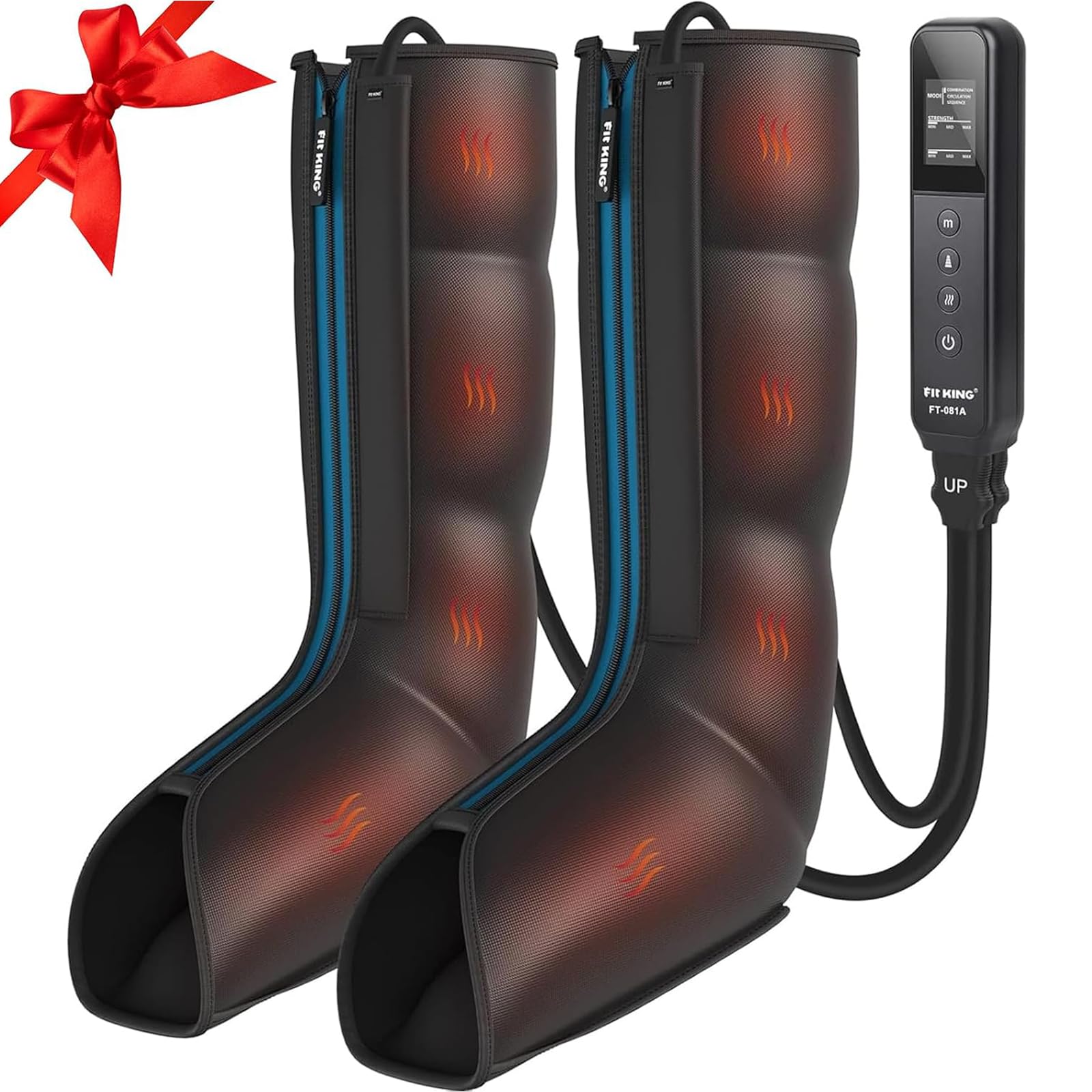
| FIT KING FT-081ABest Value | Budget entry with heat | — | 3 modes, 4 chambers | Corded | Amazon |
| QUINEAR QN-070A | First-time buyers and athletes | 140 mmHg | 3 modes, 2 zones | Corded | Amazon |
| SHINE WELL SW-106A | Full-leg coverage with fine control | 150 mmHg | 3 modes, 4 chambers | Corded | Amazon |
| QUINEAR QN-071A-L | Long-term daily routine use | 120 mmHg | 3 modes, 4 chambers | Corded | Amazon |
| FIT KING FT-091A | Cordless full-leg zone control | 150 mmHg | 3 modes, 4 zones | Cordless, 2500mAh | Amazon |
| CINCOM CM-108A | Travel and on-the-road recovery | 150 mmHg | 3 modes, 4 zones | Cordless, rechargeable | Amazon |
| Therabody JetBoots Prime | Ultra-portable wireless travel | — | 4 pressure levels, 4 chambers | Wireless, 3-hour battery | Amazon |
Detailed Reviews
1. Air Relax AR-2 Professional Compression Boots
Our pick — 4.5+★ from 400+ verified ratings; the strongest balance of quality and price.
The four-chamber workhorse that lets you pick which part of your leg gets squeezed.
Four inflatable chambers run from your foot through the calf and knee and up to the thigh, and the controller lets you run them all upward, all downward, as a whole-leg squeeze, or isolated to one section. That last option is the one that keeps this pair useful long-term — a sore calf and a puffy ankle want different treatment, and you can switch between them without changing boots. The pump itself is the heaviest of the lower-cost picks here, at 8 pounds against the 5.5 pounds of the FIT KING FT-081A, so it is a unit you park next to a chair rather than carry between rooms.
What wins people over is how strongly it performs across the whole leg rather than in one spot — the effectiveness of the squeeze is by far the most-discussed strength, with relaxation close behind it. Owners describe legs that feel normal again after years of heaviness, and the pressure climbs high enough that level 2 is ample for most people. Marathon runners use it to settle the lower leg after long runs; hospitality workers who are on their feet all shift use it to take the ache out at night. One buyer on a 36-hour endurance training block ran it post-workout and pre-sleep across sessions as short as 45 minutes and as long as 8 hours, and still reaches for it several times a week.
The thing worth knowing before you order: the motor is not silent. It is not loud either, but you will hear it cycling in a quiet room, and the power cord is fixed to the boot rather than detachable, so packing it away means winding the lead each time. There is no carrying bag in the box. Sizing runs generously — both a 6’1″ owner and a 5’0″ owner report a workable fit — and the higher pressure settings are genuinely firm, so start low and climb.
Where the AR-2 earns its place
- Four chambers reach foot, calf, knee, and thigh, with isolated-zone modes
- Pressure climbs high enough that level 2 is ample for most people
- Plug-and-play setup with a handheld remote
- Fits both tall and short legs without a size gamble
What you give up
- 8 pounds and no carry bag — this lives in one spot
- Motor audible in a quiet room
- Cord permanently attached to the boot
Reach for this if: you want one boot that handles full-leg recovery and targeted calf or foot work, and it will stay near a sofa or bed.
Look elsewhere if: you need to carry the pump to a gym or on a flight — the cordless FIT KING FT-091A is built for that.
2. Medisana Leg Massager with Heat and Compression
Five independent air valves and a warm foot pan, on a battery you can unplug.
Five separate air valves let you isolate your foot, lower calf, upper calf, lower thigh, and upper thigh — and you can run all five or hand-pick the zones from the LCD controller. Pressure spans 60–170 mmHg across 5 levels, the widest span on this list, so the gentle end is genuinely gentle and the firm end is firm. The heat is the other half of the pitch: three settings at 108°F, 118°F, and 127°F on the foot, calf, and back of the thigh. The 2600mAh battery gives 1+ hour on full power, and you can plug in the 12V/3A adapter and keep going when it runs down.
The fit is the deciding factor here, and the maker publishes hard numbers: a maximum thigh circumference of 29″, a maximum calf circumference of 23.6″, and an inner sleeve length of 33.8″. Check those against a tape measure before ordering. Buyers with swelling report the puffiness coming down after a few sessions, and the zip-on sleeves mean no wrestling with Velcro straps.
Be honest about the squeeze and the bulk. The compression runs strong, and some users find even the low settings too intense to sit through — the built-in sensor adjusts air volume to leg size to head that off, but it does not make the firm end soft. The sleeves are heavy, and the Velcro that secures them can be hard to undo for anyone with limited grip strength. This is a heated, five-zone boot for a patient who wants fine control, not a lightweight travel pair.
The heat is the difference: no other heated pick on this list lets you warm the foot and the back of the thigh while squeezing five separate zones at once.
Check the tape measure first: the 29″ thigh and 23.6″ calf maximums are real limits — measure before you commit.
This one is for you if: you want heat combined with pinpoint zone control and you would rather not be tied to an outlet.
Think twice if: your legs are on the petite side or your hands struggle with Velcro — the bulk and the firm squeeze work against you.
3. FIT KING Leg Massager with Heat & Compression
Heat, four chambers, and twenty-seven combinations at the friendliest tier on this list.
Twenty-seven settings sounds like marketing until you break it down: three heat levels, a set of compression modes, and three intensities combine into that total, and you can switch the heat off entirely when you do not want warmth. Four air chambers run the 360° squeeze around your feet and legs, moving in a cycle from the foot to the calf rather than clamping all at once. At 5.5 pounds the pump is the lightest of the lower-cost picks — the Air Relax AR-2 is 8 pounds, so this is a boot you can move room to room without a thought — and it ships with a carry bag.
The quality of the build is what carries this pair: it is the most-discussed strength by a clear margin, well ahead of relaxation. Owners compare the pressure to the high-quality units at a gym, and the zipper design means you step in and zip up like a snow boot instead of fumbling with Velcro. A 6’1″ buyer in a size 11.5 shoe reports a comfortable fit, and the whole thing wears like something built to last rather than a disposable gadget.
Two honest limits. First, the sleeves stop at the calf — buyers who are used to gym boots that reach above the knee toward the hip note this pair does not climb that high, so if the heaviness sits in your thigh, look at a four-chamber full-leg boot instead. Second, the compression is strong and the fit runs snug; plenty of owners love that, but if you are sensitive to pressure, start at the lowest intensity and the lowest heat. It needs a wall outlet, so plan on a chair near a socket.
Build quality you can feel: double-stitched seams, a smooth zipper, and a breathable lining put this well above its tier on construction — the pressure genuinely matches gym-grade units.
The calf-height ceiling: this boot covers the foot and calf only, so thigh-level heaviness needs one of the full-leg picks.
Pick this if: your heaviness and swelling sit in the feet and calves and you want heat plus a light pump you can shift around the house.
Hold off if: you need thigh coverage or a battery — this one stops at the calf and plugs into the wall.
4. QUINEAR Leg Recovery System (QN-070A)
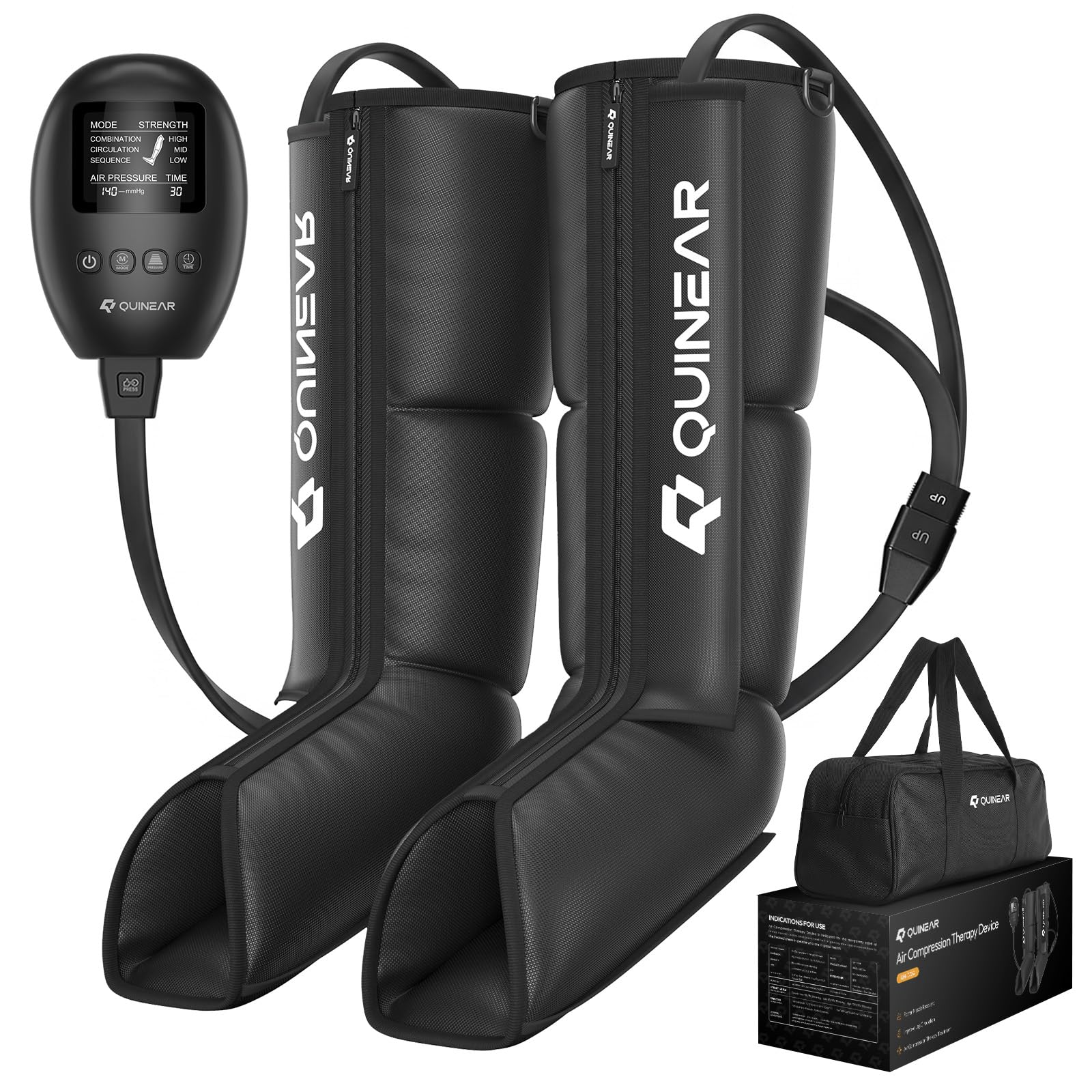
Three channels, ten programs, and nine pressure steps in a pump that weighs under five pounds.
The pressure dial runs from a gentle 60 mmHg up to a firm 140 mmHg across nine intensities and three levels on the digital controller, and ten professional programs sit on top of that. Two zones — foot and calf — inflate in sequence, circulation, or combination patterns, and the LED display shows you which zone is working and how hard. It weighs 4.74 pounds, so it is the lightest full-system pump on this list, and it packs into a bag for the gym.
Recovery is the thing buyers talk about most, with build quality close behind. Athletes use it after hard leg sessions and describe legs that feel light and refreshed instead of dead, and reviewers repeatedly call out the even pressure across the feet and lower legs. A soccer player’s family reports a setup that takes under 10 minutes and fits multiple people’s legs, which is the pattern with this boot — one pair, several users, everyone dials in their own pressure. Pregnancy swelling and end-of-day heaviness from standing both come up as reasons buyers keep using it.
Now the limits. It is corded, so you sit still for the session — standing up mid-cycle with the hoses taut is not a good idea. Coverage stops at the calf rather than running up the thigh, and on the highest setting the squeeze is strong enough that some buyers treat 140 mmHg as a ceiling they rarely touch. None of that undercuts the value; it just tells you this is a two-zone lower-leg boot, not a full-leg system.
Why it holds a top spot
- Nine intensities between 60 and 140 mmHg give fine control
- 4.74 pounds — the lightest full pump here
- LED controller shows live zone and pressure
- Three-channel air hose inflates fast
Set your expectations
- Corded only — no battery option
- Two zones: foot and calf, nothing above the knee
- 140 mmHg is genuinely firm on the top end
Best matched to: runners, lifters, and anyone who wants a light, quick-setup pump for foot-and-calf work.
Not your boot if: you need thigh coverage or you want to move around during a session.
5. SHINE WELL Leg Recovery Compression System
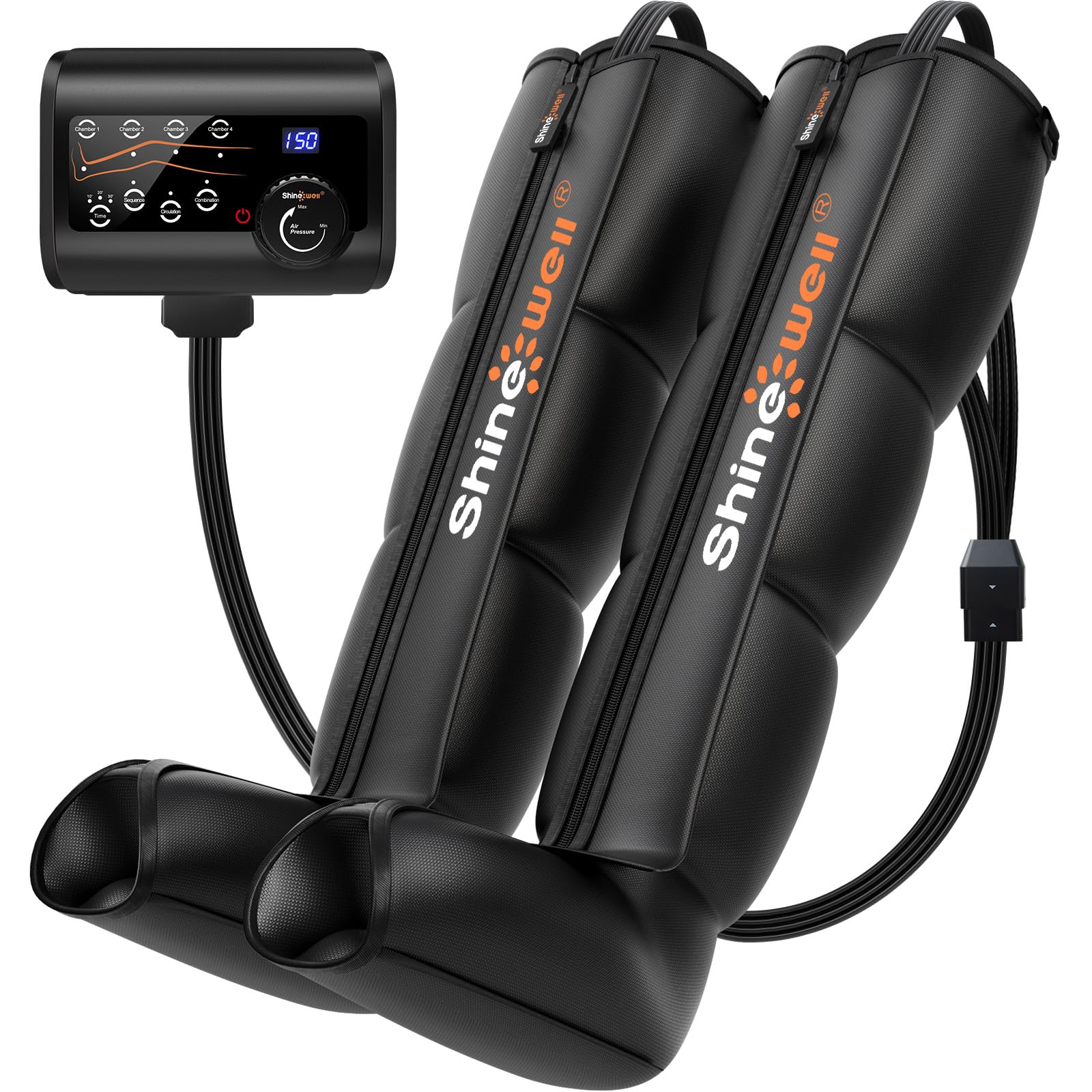
Eleven pressure steps in ten-millimetre increments, four zones, and a touchscreen to run them.
This is the boot for someone who wants to tune the squeeze precisely. Pressure climbs from 50 to 150 mmHg in eleven steps of exactly 10 mmHg each, so you can find the point between “a bit light” and “too much” that other boots skip over. Four separate chambers cover foot, calf, lower thigh, and upper thigh, and any one of them can be switched off while the others work. Three modes and three timer choices of 10, 20, or 30 minutes round it out, all driven from a touch controller with a clear display.
Where this pick shines is full-leg coverage with restraint: the lower settings let you run a long, gentle session, and the top end is described as strong but tolerable rather than brutal. Sleeves zip on, and the pump connects through two separate air hoses. It weighs 8.42 pounds and comes with storage bags, so it is a home unit rather than a travel one. Buyers who have used pricier brands say the transitions between chambers feel smooth. An owner managing one swollen leg reports measurable fluid loss in the ankle, foot, and calf after repeated sessions, though the knee and thigh stayed puffy.
The fit on the thigh section is the recurring note — it slowly slides down on some wearers during a session, which is worth knowing if your thigh circumference is near the size limit. Both sleeves must be plugged in for the system to run, so a one-leg-only session is not on the table. The display has no digital countdown, only the timer setting. And before buying, read the precautions in the manual: the maker states it is not for use with a pacemaker or tumours, which one family only discovered in the fine print.
Granular where it counts: ten-millimetre pressure steps and four switchable zones are the reason to pick this over a three-setting boot.
Measure the thigh: the thigh sleeve can creep down mid-session — a closer fit keeps it in place.
Worth it for: buyers who want to dial pressure in fine steps and isolate a specific zone without a cordless premium.
Skip the upgrade if: you need one-leg sessions, a battery, or a fast put-on — this wants both sleeves connected and time to don.
6. QUINEAR Air Compression Recovery System (QN-071A-L)

The long-haul pick — the boot most likely to still be in the corner five years from now.
Four air chambers run from foot to calf to thigh, applying gradient pressure that steps up the leg rather than clamping evenly, and a built-in pressure sensor adjusts the squeeze to your leg size. Eight intensities span 50–120 mmHg, three modes — sequence, circulation, combination — handle the pattern, and the timer runs at 20, 25, or 30 minutes. It weighs 7.17 pounds and ships with a carry bag, so it travels if it has to.
Durability is the reason this one sits mid-list rather than lower. The build quality draws steady praise, and one owner has run a unit for four years without it losing a step. Customer support comes up again and again — an out-of-warranty pump replaced with an inspected open-box unit at no charge, and a broken plastic connector near the end of warranty answered with a full replacement shipped within days. For a device you plan to use every day, that track record matters as much as the pressure range. Runners, cyclists, and Ultimate Frisbee players all describe the same benefit: legs that are ready for the next session instead of stiff.
Here is the trade-off. The pressure tops out at 120 mmHg, so if you want the harder squeeze of a 140 or 150 mmHg boot, this is not it. It also has no heat function. And you cannot walk while wearing it — the hoses tie you to the pump. None of those change the case for a buyer who wants a reliable daily unit with backup behind it; they just tell you it is a lower-leg compression system, not a heated spa boot.
The reliability story: four years of daily use on one unit and replacement support that goes past the warranty — that combination is why this pick earns its spot.
Where it stops: 120 mmHg and no heat, so it suits steady routine use rather than maximum-force sessions.
Choose this if: you want a low-drama boot for a nightly routine and you value build quality and service over top-end pressure.
Look higher up the list if: you want heat, or you want to push past 120 mmHg.
7. FIT KING FT-091A Air Compression Leg Massager

Full-leg zone control on a battery that lasts three to four hours away from the wall.
Twelve pressure settings run from 40 to 150 mmHg, ten time intervals span 15 to 60 minutes, and four zones — foot, lower calf, upper calf, thigh — can be dialled in individually or run together. The controller also supports a single-leg session, which is rare at this level and useful if one leg needs the work. The 2500mAh battery delivers 3–4 hours per charge, and the included carry bag means the whole system moves with you. At 9.81 pounds it is the heaviest pick here once packed, so it is portable in the sense that it travels in a car to a gym, not in the sense that you sling it over a shoulder on a hike.
Effectiveness and build quality are the two things buyers talk about most, and battery life gets its own following — owners run it entirely off the rechargeable pack for hours. Night-time use is where it earns its keep: legs that used to throb and keep people awake are quiet enough to sleep through, helped by the low-noise pump. A runner seven weeks past ACL surgery used it to bring down residual swelling, and patients with complex regional pain syndrome report relief by the end of a session.
Sizing is the one place this boot asks you to be careful. The thigh measurement runs tight — one buyer with 29″ thighs found them barely fitting despite a 30.5″ claim — so measure and size up if you are between sizes. The other honest note is the price tier; this is a premium cordless system. If you do not need the battery, the corded FIT KING leg massager above delivers the same brand’s build for less.
The cordless case for it
- 2500mAh battery gives 3–4 hours per charge
- Four zones with single-leg mode
- Twelve pressures from 40 to 150 mmHg
- Ten timers, 15 to 60 minutes
Where it asks more of you
- 9.81 pounds packed — heavy to carry
- Thigh sizing runs snug; measure carefully
- Premium tier pricing for the battery freedom
Perfect pairing: a full-leg boot you want to use on the sofa, in the office, or at the gym without hunting for a socket.
The catch: if your thighs are at or near the top of the size range, order carefully — the fit is tight.
8. CINCOM Cordless Leg Recovery Compression System

A cordless full-leg boot with a carry bag, built for the road as much as the living room.
An enlarged air pump drives 360° compression through four zones — feet, lower calf, upper calf, thigh — and you can set pressure and duration for each one, or treat a single leg if that is all that needs it. Twelve intensity levels run from 40 to 150 mmHg, three modes cover sequence, circulation, and combination, and ten timers span 15 to 60 minutes. The high-capacity battery gives 3–4 hours on a charge, and it comes with a carrying bag.
Pain relief is what buyers mention before anything else, with massage quality close behind. For many buyers the relief lands after one session — one owner reports less soreness and fatigue the first time out — and the adjustable sleeves fit snugly without pinching. A 6’1″, 230-pound high school football player found it true to size and reported better recovery on the days he used it. The cordless build is the other draw: it goes to the gym, the office, or outdoors and never asks for an outlet.
Two practical notes cut against the portability pitch. The battery can drop to roughly 1.5 hours at full strength, so a long firm session will outlast a charge, and a full recharge is slow. The fit runs tight for tall or heavy-calved users — one 6-footer found the large size still snug at the calf, and one buyer measured carefully and still had the boots slide down once inflated. Check the size chart against your calf measurement rather than your height.
Relief that shows up fast: noticeable soreness and fatigue reduction after one session, with four zones you can set independently.
The battery reality: plan on 1.5 hours if you run it at full strength, and give it time to recharge.
Suits you if: you want a cordless full-leg boot that packs into a bag and covers feet through thigh.
Reconsider if: you have heavy calves or you need marathon-length sessions — charge time and snug fit both bite.
9. Therabody JetBoots Prime Wireless Compression Boots

No hoses, no pump on the floor, and a boot that folds into a backpack.
The pump lives inside the boot here. There are no hoses to connect and no cord to plug in — you press one touch panel built into the boot itself, pick from 4 time intervals and 4 pressure levels, and sit back. The proprietary TruGrade system pushes pressure through 4 overlapping chambers and calibrates it to your leg size. It weighs 6 pounds, folds up like a pair of pants, rides in a drawstring backpack, and its battery runs 3 hours with the option to use it while charging. The 30–34″ inseam sizing is written on the boot itself, so measure your inseam before you order.
Relaxation is the feeling buyers come back for — nightly sessions that feel like a massage without leaving the house — and effectiveness follows close behind, with shorter recovery windows and less soreness after hard training. It packs in minutes, sets up without a single connection, and travels to a ski trip in a bag. A triathlete training six times a week calls it the best recovery purchase to date, and a coach uses it while reading or watching television. The 4 pressure levels are simple to run with one hand.
Be clear-eyed about the trade-offs. There are only 4 pressure levels and 4 time intervals, so the fine-grained tuning of an 11- or 12-step boot is absent, and the strongest setting is described as not very strong. It is 6 pounds and shaped like a boot, which makes it bulky in a carry-on even though it folds. Battery life is the one spec buyers push back on. And the rechargeable design means a lost power adapter is a real problem — Therabody does not sell replacements, which turns a missing cable into a stranded boot.
Freedom is the whole point: a self-contained boot with a 3-hour battery and no hoses, so a session fits into a hotel room or a ski lodge.
Guard the power adapter: a replacement is not sold separately, so a lost cable takes the boot out of action.
Made for: frequent travelers and athletes who need recovery in a hotel room and will trade pressure granularity for zero setup.
Pass if: you want to dial in precise pressure — 4 levels will not satisfy you.
Know the Specs
Pressure range in mmHg
mmHg means millimetres of mercury, the unit used to measure how hard the boot squeezes. A boot that reaches 150 mmHg can deliver a firm, deep squeeze; one that tops out at 120 mmHg stays in gentler territory. The bottom of the range matters just as much. A boot whose lowest setting is 40 or 50 mmHg can run a long, easy session while you read, while a boot that starts firm will feel like work. Look for a wide span rather than a high number alone, and match the top end to how hard you actually want to be squeezed.
Chambers, zones, and sequential inflation
A chamber is one inflatable pocket inside the sleeve. Two chambers usually mean foot and calf; four chambers reach the thigh as well. Sequential inflation means the chambers fill one after another in a wave, which is the motion that helps move fluid upward. Zone control is the ability to switch individual chambers off and treat just one area. More chambers and more zones mean more precise targeting, and more parts that can slide or need adjusting — a snug fit keeps a multi-zone boot where you put it.
Corded versus cordless
A corded pump plugs into the wall and runs as long as you want, but it pins you to one chair. A cordless pump carries a battery — the ones here quote 3–4 hours per charge — and frees you to move between rooms or take it on a trip. The cordless version is usually heavier and larger because the battery is built in, and a long session on the firmest setting drains it faster. If the boot never leaves the living room, the corded version is simpler and lighter.
Sizing by circumference, not height
Sleeve fit is set by calf and thigh circumference, with height affecting how high the sleeve reaches. A boot that is too tight is uncomfortable and can slide down once inflated; one that is too loose will not press where it should. Check the maker’s stated maximums against a tape measure before ordering, and if you sit between two sizes, take the larger.
Common Questions
How much pressure do I actually need for circulation in my legs?
Will compression boots help with swelling in my feet and ankles?
Can I use compression boots while I sleep?
What is the difference between sequential and combination modes?
How long does a compression boot battery last on a charge?
Will compression boots fit large calves or plus-size legs?
Can I move around while wearing compression boots?
Is the FIT KING FT-081A better than the QUINEAR QN-070A?
Can anyone use compression boots safely?
Do I need a boot with thigh coverage?
The Bottom Line
For most buyers, the Compression Boots for Circulation winner is the Air Relax AR-2 because its four chambers let you treat the whole leg or isolate one section, and the 8-pound pump delivers a squeeze strong enough that the second level is plenty for most sessions. If you would rather have a boot that goes anywhere without a cord, the FIT KING FT-091A runs 3–4 hours per charge across four zones and twelve pressure settings. And for a heated, five-zone boot that plugs in while it warms, the Medisana Leg Massager is the one to reach for.
Buy the boot that matches where the heaviness actually sits. Foot-and-calf heaviness from a desk job or long shifts is handled well by the lighter, cheaper picks. Thigh-level swelling or post-injury recovery pushes you up to a four-chamber full-leg system. And if the boot travels, the cordless premium is worth paying. Lay the pressure range and the chamber count side by side, then pick the one that fits your leg and your routine.
How we choose
We do not accept paid placement. Every pick is matched to a real buyer and a real use-case; we do not hands-on test units.
Sources
Specifications: manufacturer listings and product documentation. Review insights: verified customer reviews, as of October 2026. Pricing: not shown on this page (it changes often); check the current price via the retailer link.
As an Amazon Associate, Aappliancez earns from qualifying purchases. This does not affect which products we feature.