Disclosure: Some links in this post are affiliate links. As an Amazon Associate I earn from qualifying purchases, at no extra cost to you. Learn more
Specs are compiled from manufacturer listings and verified buyer reviews and can change over time — please confirm the key details on the product page before buying.
If you want a kit that eats a weekend and leaves you with something worth showing off, the short answer is this: the LEGO Icons NASA Artemis Space Launch System is the safest big-money pick here, and the ROKR Marble Spaceport is the one that keeps pulling people back for more. Everything else on this list is about matching the build to your patience and your shelf.
This guide is built by comparing the manufacturers’ published specifications and the patterns across verified customer reviews, so you get each pick’s real strengths and trade-offs instead of marketing spin.
Complex kits are not one thing. A 3,601-piece rocket tower, an 801-piece engine that actually turns, and a 454-piece stainless-steel scorpion all ask different things of your hands and your evenings. Below, every pick is sorted by what it demands and what it gives back, so you can choose the best complex model kits for adults for your own table and your own tolerance for tiny screws.
Top Picks

How To Choose The Best Complex Model Kits For Adults
The first thing to unlearn is that more pieces automatically means harder. A wooden kit with 472 laser-cut parts can take you 40 hours because each piece needs sanding, waxing, and careful orientation. A brick kit with 3,601 pieces can move faster because the bricks click and the instructions are picture-perfect. Match the kit to how you like to spend an evening, not to a number on the box.
Build time versus build comfort
A kit that advertises “5 hours” is promising a single sitting. A kit that takes “40-45 hours” is promising a season of evenings. Neither is better — but if you lose interest after two nights, the long-haul wooden kits will sit half-finished. Look for kits that tell you their expected build time, and take that number seriously.
Material matters more than it seems
ABS plastic bricks snap and reseat, which makes them forgiving of mistakes. Plywood and acrylic parts need wax on the gears and a gentle hand when you snap pieces off the frame. Stainless-steel parts bend if you force them and hold their shape beautifully once tightened. Your material choice decides how the finished model feels when a guest picks it up.
Movement: the feature that separates a model from a toy
Some kits sit still. Others run. A USB-powered motor, a hand crank, a gravity-fed marble loop, or a geared locomotive that drives forward and reverse — each one turns a static display into something you will actually touch again next month. If you want to keep the model on a desk rather than in a closet, prioritize movement.
Side-by-Side Comparison
| Model | Best For | Piece Count | Material | Age Rating | Amazon |
|---|---|---|---|---|---|
| LEGO Icons NASA Artemis Space Launch System★ Best Overall | Space fans who want a centerpiece | 3,601 pieces | Plastic (ABS bricks) | 18 years and up | Amazon |
| W16 Engine Building Blocks SetMotion Pick | Mechanical tinkerers who want motion | 801 PCS | Plastic (ABS) | 14 years and up | Amazon |
| Revell 85-2627 Peterbilt 359 | Modelers ready for paint and glue | 302 pieces | Plastic | 13 years and up | Amazon |
| ROKR 3D Puzzles Marble Spaceport LGC01 | Puzzle vets who love a mechanism | 472pcs | Wood | 14 years and up | Amazon |
| ROKR 3D Puzzle Electric Vintage Car Steam Engine | Retro-machine lovers who want motion | 469pcs | Wood | Adult | Amazon |
| Scorpion 3D Metal Puzzles | Detail-obsessed builders who want a challenge | 454 Pcs | Stainless Steel | 16 years and up | Amazon |
| Nifeliz Turbofan Building Set | Engine-heads who want a long, deep build | 2,216 PCS | ABS (Acrylonitrile Butadiene Styrene) | Teens, Adults | Amazon |
Detailed Reviews
1. LEGO Icons NASA Artemis Space Launch System
Our pick — 4.5+★ from 600+ verified ratings; the strongest balance of quality and price.
A 27.5-inch rocket and launch tower that takes about three evenings to build.
Here is the number that decides it: 27.5 inches tall once built. That is roughly knee-height on an adult, which means this is not a desk ornament. It is a piece of furniture that happens to be a rocket. The kit splits into 3,601 bricks, and it comes with a multistage rocket, two solid-fuel boosters, an Orion capsule, and a mobile launch tower with retractable umbilicals, a rocket support, and a crew bridge.
The build itself is the slow part. The tower is repetitive and the company’s own description calls the project “advanced,” but the reward is that everything is functional — the boosters detach, the rocket stages separate, and the finished model has real moving parts. The kit is rated for ages 18 and up and weighs 9.4 pounds boxed, so plan on the box taking up real shelf space before you even start.
What wins people over is the sheer quality of the parts. The bricks feel dense and snap with the confidence you expect from decades of manufacturing consistency. The recurring gripe is stickers: at this level of kit, several builders feel the pieces should be printed rather than decorated by hand. A separate note for anyone buying as a gift — the recommended age really does hold. This is a project for someone who already has the patience for a long build.
Where it shines
- 3,601 bricks with a finished height of 27.5 in. — the tallest, most substantial piece on this list
- Working features: retractable umbilicals, detachable boosters, separating stages
- Dense, forgiving bricks — the launch tower design rewards careful brick alignment
- 4.5+ star average across hundreds of buyer ratings
Worth knowing
- Repetitive tower section can wear down patience
- Stickers instead of printed pieces on a premium-tier kit
- At 9.4 pounds boxed, shipping weight is real — no small footprint
Pick this for: a space fan who wants a build they will keep on display for years.
Think twice if: you dislike applying stickers by hand or want a build you can finish in one weekend.
2. W16 Engine Building Blocks Set
801 ABS pieces that assemble into a 16-cylinder engine with pistons that actually move.
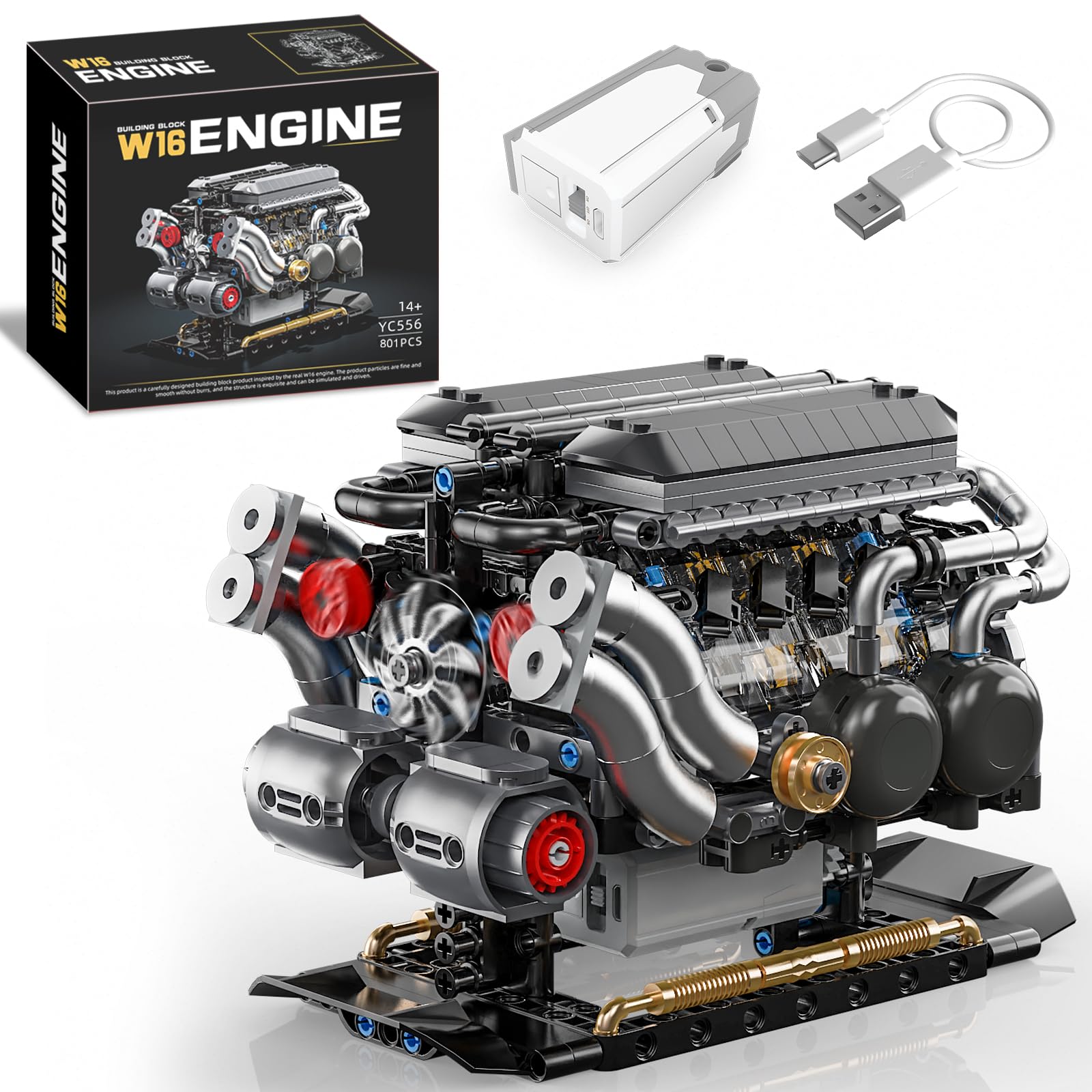
Where the LEGO Artemis is a build-and-display project, this one is a build-and-run project. The 801 ABS pieces assemble into a W-type 16-cylinder layout made from two V8 structures, and once it is together, the transparent cylinder head lets you watch all 16 pistons and the valve system move in coordination. A USB-powered motor drives it in two modes: a slow speed for watching the piston rhythm and a fast speed for a wilder movement.
The transparent cylinder head is the standout design choice. Real engineering is usually hidden inside a black casing. Here, the turbocharger and the exhaust pipe are visible, so the kit works as both a display piece and a teaching aid for gear transmission and piston movement — exactly the kind of thing a STEM-focused teen or a car collector will keep picking up to fiddle with.
Fair warning: this is not the kit for someone who wants the assembly itself to be the easy part. The reviews are split on how smooth the build goes — some love the assembly process, others find it frustrating. The electric motor also gets mixed feedback, with some units running well and others arriving with a motor that does not turn. If you want a sure thing on day one, buy from a seller with easy returns. If you want a conversation piece that actually demonstrates a mechanism, this is the one.
What you actually get: 801 non-toxic ABS blocks, an instruction manual, and a claim of realism that is unusually well earned for the price tier. The included manual and the recommended age of 14 years and up mean a dedicated teen can handle this without hand-holding.
Smaller than you might expect: the assembled model measures 9.84 x 3.15 x 8.66 inches, so it fits on a narrow shelf — noticeably more compact than the turbofan kit and the rocket kit on this list.
Reach for this if: you want a moving, teachable mechanism and you are comfortable with the possibility of a quick return if the motor fails.
Look elsewhere if: you specifically want a large-scale shelf centerpiece rather than a compact working engine.
3. Revell 85-2627 Peterbilt 359 Model Car Building Kit

302 glue-and-paint parts, chrome plating, and a Skill Level 5 finish — no snap-fit bricks.
Everything on this list up to now has been a snap-together kit. This is not. The Revell Peterbilt 359 is a traditional glue-and-paint plastic model at 1:25 scale, made from 302 parts molded in white and clear with chrome-plated details and soft black tires. It requires paint and glue, which are not included, and it carries a Skill Level 5 rating — the top of Revell’s own scale and a signal that this is for someone who has built models before.
At 12.75 inches long once assembled, it is the longest finished model on the list — noticeably longer than the W16 engine kit at 9.84 inches. The working features are what separate it from a static display: the hood lifts to reveal a twin turbo diesel engine, the doors open, the front wheels turn, and the roof lifts off to expose a full sleeper interior. Chains and hoses are molded in as separate parts, which is where the realism comes from.
What customers consistently call out is build quality. The chrome plating and the molded detail give the truck a level of realism you simply do not get from a brick kit, and buyers treat it as a display piece or a gift that earns compliments from anyone who sees it. The honest trade-off is that Skill Level 5 means what it says: no snap-fit parts, no printed picture instructions guiding your hand, and a finish that depends entirely on your painting. If you have never handled a hobby knife and glue, this is the wrong starting point.
The case for it
- 1:25 scale, 12.75 inches long — the largest finished footprint of any model here
- Working features: lifting hood with twin turbo diesel engine, opening doors, lift-off roof with sleeper interior
- Chrome plated parts and soft black tires give a realism bricks cannot match
- 4.5+ star average from hundreds of buyer ratings
Before you buy
- Requires paint and glue, neither of which is included
- Skill Level 5 — the highest difficulty tier Revell assigns
- Recommended for ages 13 and up, but the finish quality depends on your painting skill
Suits you if: you already own an airbrush or a set of model paints and enjoy the finishing stage as much as the assembly.
skip it if: you want a kit that goes together without glue or a paint session.
4. ROKR 3D Puzzles Marble Spaceport LGC01
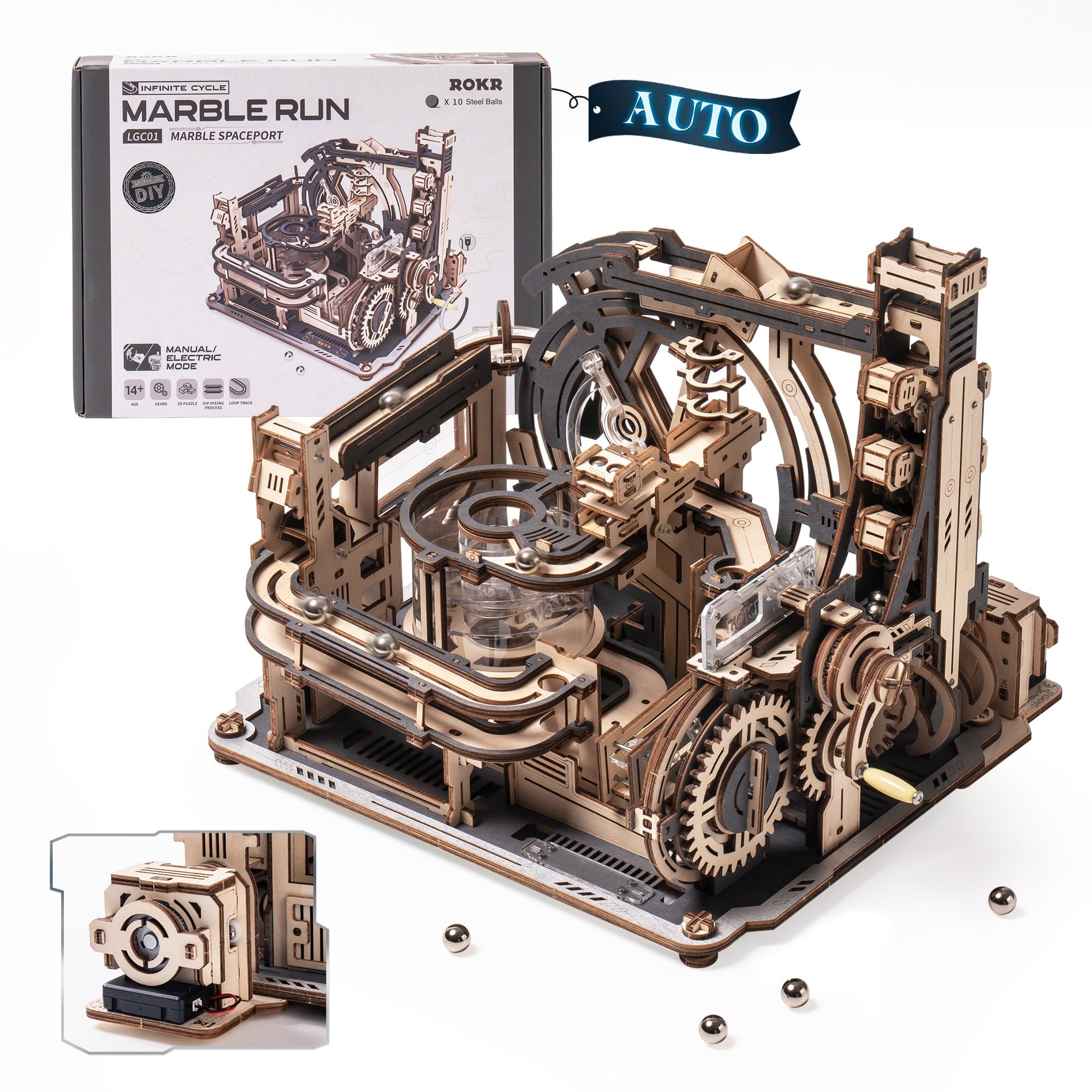
472 laser-cut wood pieces that build a space station where marbles run a gravity-fed loop.
This is the kit that makes people lose track of time. Built from 472 laser-cut plywood and acrylic pieces, the finished Marble Spaceport measures 12 x 10 x 9 inches and runs metal marbles on a gravity-powered loop through a transparent acceleration spiral and a vertical reciprocating lifting staircase — features ROKR markets as exclusive to this model. It is the upgrade path from the Marble Night City LGA01, and it supports switching between manual and electric automatic modes.
What wins people over is the sheer fun of watching it work. The assembly is genuinely difficult — one builder working alongside a 9-year-old had reached only the halfway mark after roughly eight hours and noted the age restriction is not a bluff. A 92-year-old builder with years of puzzle experience took 40-45 hours. The instruction manual is detailed and clear, the plywood is sturdy, and the black-grey wood with acrylic panels gives it a modern look compared to typical wooden puzzles. There is no glue required, and the tools are included.
The honest caveat is hands. Some pieces need more force than they should and can break during removal from the frame — extras are included, and a helpful workaround circulating among builders is to wax the gears and tracks liberally, with a bit of tea-light wax doing the job if your kit did not ship with any. Marbles occasionally jump tracks or jam at the trapdoors, and the motor is loud. Expect to spend some evenings troubleshooting, not just assembling.
Best fit: a mechanical puzzle veteran who enjoys the trouble-shooting phase as much as the build — someone who has worked through a dozen wooden kits before.
Honest limit: a novice or a younger builder will likely need an adult handling the tiny washers and fragile frame-released parts.
Pick this for: a hands-on thinker who wants a puzzle with moving parts rather than a static model.
Choose differently if: you would rather not fuss with wax, jam-prone marbles, or a noisy motor on your shelf.
5. ROKR 3D Puzzle Vintage Car Steam Engine Model Kits

469 laser-cut wood pieces that build a 1:28 locomotive driving forward, in reverse, and through three gears.
ROKR’s first EV model is a 1:28 scale wooden reproduction of a steam locomotive, made from 469 laser-cut pieces and split into two parts — a body and a trailer. A built-in micro motor drives the gears to move the wheels, the chimney and cotton at the front simulate smoke, and an amber flame lamp finishes the vintage steam aesthetic. Assembled, it measures 14 x 4.7 x 5.7 inches, which is wide and low — it needs a shelf or a desk longer than it needs to be tall.
The functional details are where this kit earns attention. It travels forward and reverse, switches manually between three gears for speed changes, and uses a bottom spring shock absorber to cross small obstacles. The piston cylinder is molded as a miniature of the mechanical-era design. ROKR lists the build at about 5 hours with just the included screwdriver, springs, rubber tires, and battery box — you will need two AAA batteries you provide yourself.
The mixed feedback centers on parts that do not always align perfectly, and pieces that can be fragile under pressure. A veteran builder worked through 16-18 hours and lost one piece to breakage (spares are included); a needle-nose plier helps considerably. The gears do need wax to run smoothly, and the wax is typically a buy-your-own item. What owners keep coming back to is the design quality — the finished locomotive looks nearly identical to the product photography, and the mechanism genuinely reads as a small steam engine.
Why it stays on the desk: forward, neutral, and two forward gears with reverse — the moving parts are the point. It does not just sit there.
The trade-off: the 469-piece build needs patience, wax, and a light hand when parts resist, and a burned-out beginner will find the fit tolerances unforgiving.
Best for: someone who likes the vintage-machine look and wants a kit that runs on their desk, not just one that sits on a shelf.
Think again if: you want a kit that goes together without any troubleshooting along the way.
6. Scorpion 3D Metal Puzzles Kits

Four hundred and fifty-four steel screws of patience, and the result fits in your palm.
There is no glue, no motor, and no batteries involved here — every inch of this mechanical scorpion is held together by 454 stainless-steel parts and the tools included in the box. Finished, it measures 16 x 14 x 14 cm and sits around the size of a large hand. ROKR is not the maker — that is Metalkitor, and the kit ships with color drawing instructions and rated for people 16 years and up.
What wins people over is the intricacy you feel when you are done. The parts are small enough that misplacement is a genuine risk, but you get extras of several pieces, and the build rewards careful assembly with a metallic model that reads as engineered rather than assembled. One buyer with a 15-year-old grandson reported the whole thing came together in under 4 hours, though the leg assembly got tedious after a while. Another called it one of the year’s favorite purchases, helped by molded plastic trays and printed part-position cards.
The durability is where the honesty needs to land. The screws have a tendency to loosen with use, so this is a display piece — you can pose it and tighten the bolts, but you cannot play with it the way you would with a plastic-action figure. The parts distribution and packaging are also inconsistent across different models in the line, and the advertised toolbox case does not ship with every one. Expect to need good lighting and patience in equal measure.
The standout
- 454 stainless-steel parts, no glue or batteries required
- Molded trays and printed part-position cards make repositioning easy
- Palm-sized finished model at 16 x 14 x 14 cm
- 4.5+ star average from a few hundred buyer ratings
The reality check
- Parts are very small — good lighting and steady hands help
- Screws loosen over time; this is a display piece, not a toy
- Packaging varies between models; a toolbox case is not guaranteed
Right for you when: you want a compact metal centerpiece and you will treat it as a sculpture rather than something to handle.
Skip when: you want a kit that can be played with once finished or need larger, easier-to-hold pieces.
7. Nifeliz Turbofan Building Set, Engines Series, NF10317

Two thousand and some change bricks that turn a single crank into a moving engine.
This is the deep-end kit of the whole list: 2,216 ABS bricks measured against the LEGO Artemis’s 3,601 and the W16’s 801, so it sits right in the middle of the range while being a serious sustained project at any pace. It arrives with 4 storage boxes and a numbered-bag system. The finished turbofan runs on a hand crank — you rotate the crank and drive linked internal parts in different directions and speeds, a dual-direction, single-axis effect that gives the model a feel closer to a real engine flow than a static display.
The build quality here is the headline. The instructions are well illustrated, the thousands of parts fit snugly, and the finished model is sturdy enough that a small cosmetic piece missing near the 90% mark does not affect structure. The metallic painted parts give it a semi-exposed, engineered look that reads well on a shelf. Several buyers noted it looks and feels like a very different class of kit from typical brick sets.
Two honest notes for anyone buying at this scale. The first is that the description implies powered operation, but the turbofan is hand-crank only — a couple of builders wished they had read that before ordering. The second is that bag numbering can be confusing (numbered 1-6 plus step ranges), a handful of missing key pieces has been reported on some units, and the cowling steps are the hardest section to keep aligned. It took one builder three days of evenings to finish. If you want a kit that rewards patience and delivers motion every time you crank it, this is worth the commitment.
The case for it: 2,216 parts, 4 storage boxes, numbered bags, and clear illustrated directions — this is a kit built for prolonged, serious building sessions and it holds up under them.
What to plan for: the crank-driven movement is the whole reward. There is no motor, and the description is easy to misread on that point.
Digs in for: a mechanical modeler who wants a long build and a piece that moves under their hand — not on a battery.
Better elsewhere if: you want a motor-driven kit or you do not want to face the cowling section of a 2,216-piece build.
Know the Specs
Piece count as a difficulty signal
A higher piece count usually means longer build time, but it is not a reliable indicator of difficulty. The 3,601-piece LEGO Artemis will generally finish faster than the 472-piece ROKR Spaceport, because a brick clicks into place in an obvious orientation while a wooden puzzle piece has to be pressed off a frame, waxed, and rotated correctly. When comparing kits in this category, look at the piece count and then look at what the pieces are made of.
Movement type: motor, crank, or gravity
How a kit moves determines whether you will keep it out on display. A USB-powered motor (as on the W16 engine kit) gives you a hands-off demonstration. A hand crank (as on the Nifeliz Turbofan) gives you the tactile reward of driving the mechanism yourself. A gravity-fed marble run (as on the ROKR Spaceport) gives you a continuous loop of visible motion. None is better — they match different moods.
Skill Level ratings
Revell uses a five-step Skill Level scale on its plastic model kits. Skill Level 5 sits at the top of that scale and indicates a build that requires glue, paint, and prior modeling experience — the Peterbilt 359 on this list carries that rating. Brick kits and wooden kits typically do not use the same scale, so do not assume a number translates directly between them.
Material feel and durability
ABS plastic bricks are forgiving, replaceable, and take repeated assembly well. Plywood and acrylic parts are lighter in the hand, can snap during removal from the frame, and benefit from wax on moving surfaces. Stainless-steel parts hold their shape once tightened but can loosen with handling. The material you choose directly affects how long the finished model tolerates being touched.
Common Questions
How long does a complex model kit take to build?
Which complex model kits actually move when finished?
Do complex model kits need glue and paint?
What does Skill Level 5 mean on a model car kit?
Are wooden 3D puzzles harder than brick kits?
What age is appropriate for these complex model kits?
How do I display a finished model so it lasts?
What happens if a piece is missing or breaks?
Are complex model kits difficult to resell or gift later?
Which of these has the most pieces?
The Bottom Line
After working through the entire list, the complex model kits for adults winner remains the LEGO Icons NASA Artemis Space Launch System, because 3,601 bricks, a 27.5-inch finished height, and a working launch tower together produce the most memorable result on this list. If you want movement you can drive yourself, the Nifeliz Turbofan hand-crank at 2,216 pieces is the deepest build here. And for a desktop-sized project that turns into a real mechanical conversation piece, the ROKR Electric Vintage Car Steam Engine delivers the most motion per hour of assembly.
Whichever you pick, buy it knowing what you are signing up for: the build is the point. The one quiet nudge worth giving — if the LEGO Artemis’s three-day build appeals to you and you want something smaller to warm up on, the ROKR Steam Engine’s 5-hour listed build makes an honest starter before you commit to a longer project.
How we choose
We do not accept paid placement. Every pick is matched to a real buyer and a real use-case; we do not hands-on test units.
Sources
Specifications: manufacturer listings and product documentation. Review insights: verified customer reviews, as of October 2026. Pricing: not shown on this page (it changes often); check the current price via the retailer link.
As an Amazon Associate, Aappliancez earns from qualifying purchases. This does not affect which products we feature.