Disclosure: Some links in this post are affiliate links. As an Amazon Associate I earn from qualifying purchases, at no extra cost to you. Learn more
Specs are compiled from manufacturer listings and verified buyer reviews and can change over time — please confirm the key details on the product page before buying.
A compact Smith machine is the purchase that decides whether your garage gym gets used or becomes a clothes rack. Buy one with a bar that rattles, pulleys that grind, or a footprint that eats your whole garage, and you will dread every session. Get it right and one corner of the room covers squats, presses, rows, and pulldowns. The real question most buyers get stuck on is simple: which compact Smith machine gives you a genuinely stable bar and smooth cables without demanding floor space you do not have?
This guide is built by comparing the manufacturers’ published specifications and the patterns across verified customer reviews, so you get each pick’s real strengths and trade-offs instead of marketing spin.
Below you will find the specs that actually separate these rigs — bar travel, frame gauge, pulley type, and footprint — plus the honest trade-offs owners live with after the boxes are gone. The short answer to your search for the best compact smith machine sits in the reviews below, ordered by what genuinely earns its floor space.
Top Picks

How To Choose The Best Compact Smith Machine
Most first-time buyers assume “compact” means “cheap and wobbly.” The opposite is usually true. A good compact Smith machine squeezes a full rack, a guided bar, and a cable crossover into a footprint that fits a garage bay — and the trade-off lives in the details, not the size. Here are the five things that decide whether you love or regret the machine.
Measure your ceiling and your side clearance first
Height is the number that kills more home gym plans than anything else. These cages routinely stand well over 82 inches tall, and the pull-up area on some rigs needs even more headroom above the frame. Measure your lowest ceiling point — a garage door track, a light fixture, a duct — and leave a few inches above the tower. Then check side clearance. A cage with a wide footprint needs room to load plates on both ends, and a Smith bar that slides on rails wants a clear path front to back.
Read the frame rating separately from the bar rating
“1500 lbs” or “2200 lbs” on the spec sheet usually describes how much weight the steel frame is rated to hold overall. It does not automatically mean the sliding Smith bar carries that same load comfortably. Owners of pulley-driven rigs report that a 2:1 cable ratio halves the resistance at the handle relative to the stack, and that plate-loaded trolleys can run out of room for bumper plates before you hit the advertised number. Look for both the frame capacity and how the bar and trolley are actually built.
Check whether the bar rides on bearings or bushings
Your Smith bar glide is the single most-touched part of the machine. Linear bearings and aluminum pulleys give you a smooth, quiet pull that stays consistent. Plastic bushings and plastic pulleys can work fine at first, but they demand lubrication and can stiffen under load. If a listing names aluminum pulleys or linear bearings, that is a real upgrade worth noting.
Decide if you want plate-loaded or a selectorized weight stack
A weight stack lets you change resistance by moving a pin — no walking around to load plates, and it is quieter in a shared room. Plate-loaded cages are usually cheaper per pound of resistance and let you use the plates you already own. If two people train together, independent stacks on each side are the feature to hunt for.
Budget for assembly time, not just the machine
These rigs arrive in multiple heavy boxes. Realistic build times reported by owners range from a couple of hours to a full weekend, and the manual quality varies widely. Factor in a second pair of hands and a socket set. It is also worth checking how the maker handles missing or damaged parts, because with this many components something occasionally shows up bent.
Side-by-Side Comparison
| Model | Best For | Frame Capacity | Footprint (D x W x H) | Weight Stack | Amazon |
|---|---|---|---|---|---|
| Mikolo Power Cage K6★ Best Overall | Most home gyms | 1500 lb | 67.5″D x 56.5″W x 86.4″H | — | Amazon |
| Mikolo Smith Machine M4Weight-Stack Pick | Weight-stack convenience | 2200 lb | 71″D x 74.4″W x 87.2″H | Included | Amazon |
| pooboo P43 Power CageTop Performer | Highest owner satisfaction | 2000 lb | 62.9″D x 43.3″W x 82.6″H | — | Amazon |
| SunHome 925 Dual Station | Two people at once | 2000 lb | 96.85″D x 55.12″W x 86.61″H | 138 lb | Amazon |
| DONOW DN-DS938 | Twin stacks, big loads | 2240 lb | 54.7″D x 78.58″W x 88″H | Dual stacks | Amazon |
| Major Fitness Drone3 | Small room, full training | 2500 lb | 45.9″D x 78.1″W x 85.3″H | — | Amazon |
| RitFit M1 Pro | Expandable ecosystem | 1850 lb | 63″D x 47.8″W x 85.18″H | Optional add-on | Amazon |
| GMWD HSM Dual-Station | Couples and families | 2000 lb | 109.57″D x 71.18″W x 87.83″H | 121 lb per side | Amazon |
| AOTORJAY Smith Cage | Big step-in space | 2900 lb | 54.6″D x 83.8″W x 87″H | — | Amazon |
| RitFit PSR05 | Low ceilings, tight bays | 1000 lb | 44″D x 45.3″W x 82″H | — | Amazon |
| SunHome S4 with Bench | One-box starter kit | 2000 lb | 65.7″D x 80″W x 87″H | — | Amazon |
Detailed Reviews
1. Mikolo Power Cage K6 with Cable Crossover
Our pick — 4.5+★ from 200+ verified ratings; the strongest balance of quality and price.
Eight machines bolted into one steel cage you can actually fit in a garage.
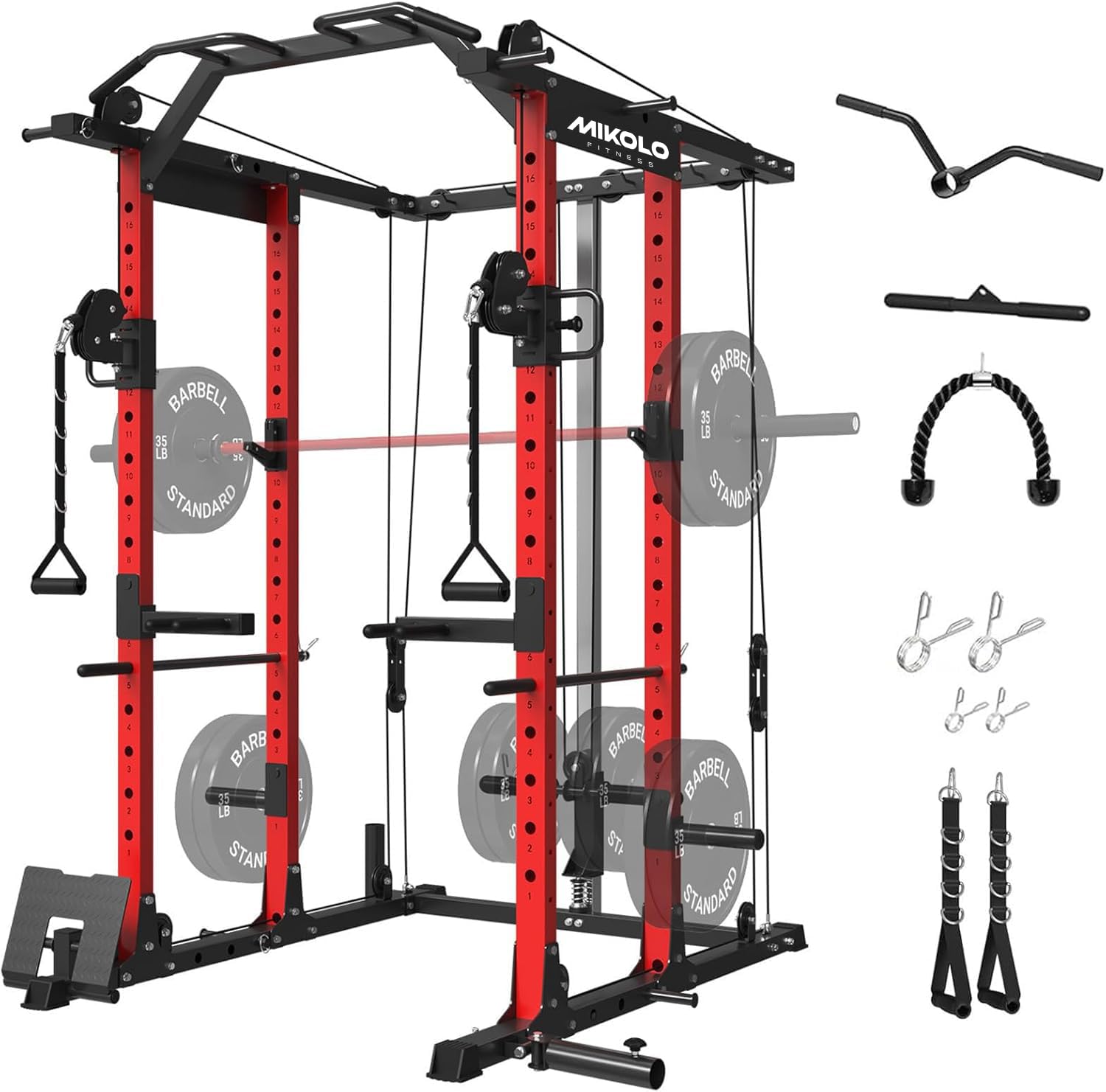
The K6 is the pick that earns its spot on the strength of one idea: give a small room the feel of a real gym floor. It bundles a power rack, cable crossover, lat pulldown, a 2:1 low-row station with a footplate, chin-up bar, dip station, a core trainer, and a resistance station into a single frame. The cage itself measures 56.5 inches wide, 67.5 inches deep, and 86.4 inches tall, and the inside is 41 by 60 inches — deep enough that nearly any weight bench slides in for squats and bench presses. What wins people over most is the build quality, which is the aspect the review pages circle back to again and again. The steel is 2 by 2 inch alloy with eight reinforcing tabs, and the whole unit is rated to 1500 pounds.
Assembly has its own reputation, and it is a fair one — the parts carry letter and number labels and the steps run roughly one per page, and the job lands at around three hours for most builds. Once it is up, the pulley glide is the part that keeps surprising people, with four white rollers traveling the riser to cut wear on the steel. The one recurring gripe is the small lat pulldown attachment, whose end grips twist and slip during a set. Know the trolley math before you load it heavy: the cable runs at a 2:1 ratio, so a full stack of bumper plates gives roughly half that resistance at the handle, and slim cast-iron plates let you stack more actual pull than thick bumpers. Weight storage holds 4×45 lb plates per side.
Where the K6 earns its keep
- Eight stations in one cage — rack, crossover, lat pulldown, low row, chin-up, dip, core, resistance
- 41″ x 60″ interior swallows almost any weight bench for in-cage squats and presses
- Four-roller pulley sleeves glide smoothly and protect the riser from wear
- Weight storage holds 4×45 lb plates per side, keeping the floor clear
- Complete accessory pack included — no extra buys for the basic movements
What to weigh before you commit
- 2:1 pulley ratio means the handle sees roughly half the loaded weight
- The small lat pulldown attachment’s grips twist and slip mid-set
- Roughly three hours of assembly — plan for a second pair of hands
- Plastic pulleys are fine now, but aluminum is the upgrade heavier lifters make
Reach for this if: you want one cage that covers lifting and cable work without a commercial-gym footprint — it is the strongest all-rounder here.
Look elsewhere if: you plan to pull heavy on the cables and want the resistance at the handle to match the plates on the trolley.
2. Mikolo Smith Machine M4 with Weight Stack
A selectorized stack turns changing weight into a pin move instead of a plate shuffle.
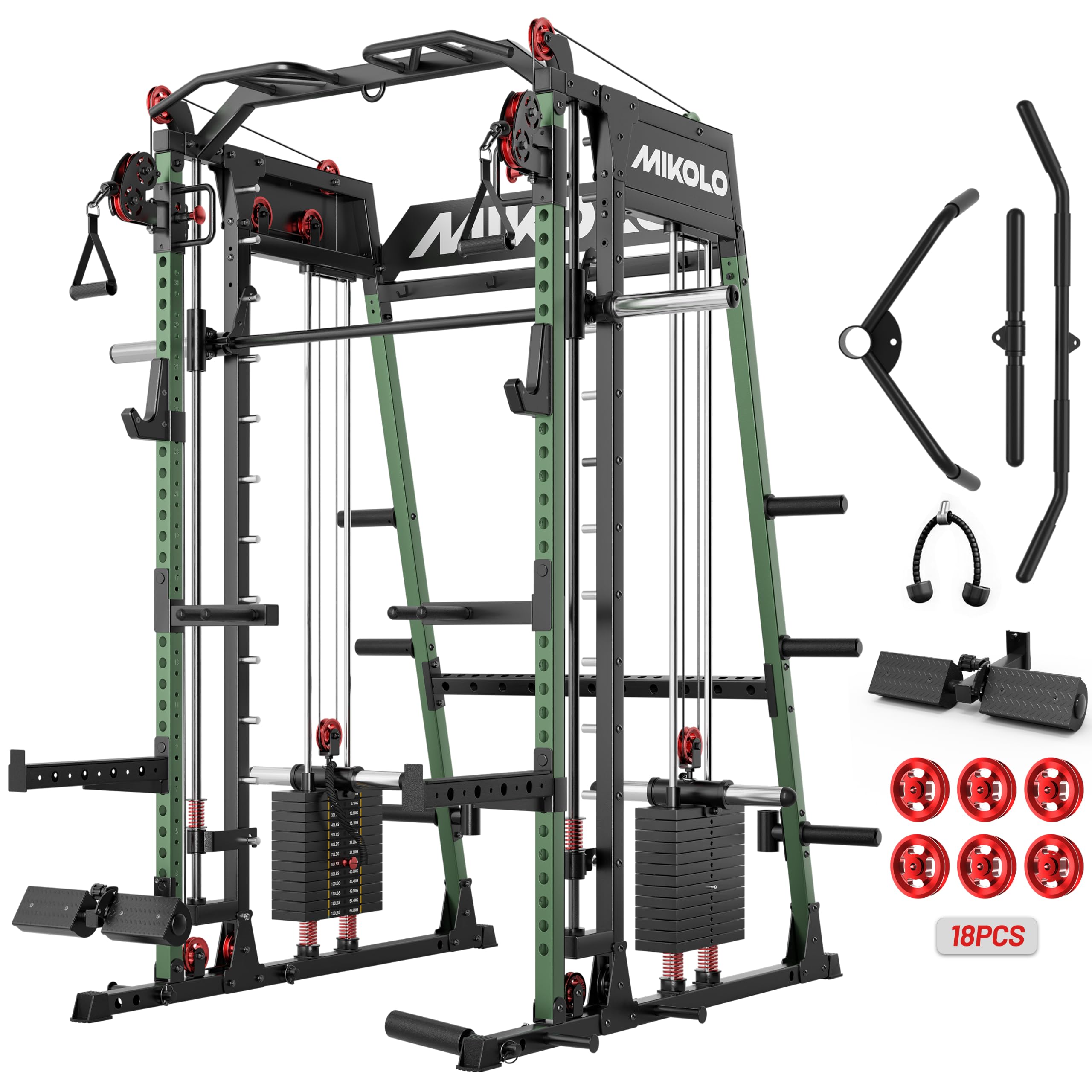
The M4’s defining number is 2200 pounds — the frame capacity on a 2 by 2 inch heavy-duty steel frame reinforced with flat sandwich J-cups that hold the barbell steady when you re-rack. That is a big step up from the 1500-pound rating on the K6 above, which is the honest reason this one costs more. The footprint is compact for a professional-style rig at 71 inches deep, 74.4 inches wide, and 87.2 inches tall, and the whole machine weighs 671 pounds — enough mass that it plants itself rather than skating during a hard squat. Stack that against the K6 at 220 pounds and you can feel the difference in where the steel went.
The truly different feature is the dual weight stack. Instead of loading plates, you move a pin, which means quiet operation and instant resistance changes between a lat pulldown and a seated row. A 34-position height system with 2-inch hole spacing lets you dial in the exact start point, and a 3-in-1 attachment lets you switch between lat pulldowns, seated rows, and pull-ups. The higher pulley position also gives you a fuller range of motion on lat pulldowns than many cages manage. Storage is genuinely thoughtful here: a dedicated 2 by 2 inch attachment rack holds J-hooks, spotter arms, and dip bars, joined by four Olympic plate posts, two fractional plate posts, two barbell holders, and top-mounted hooks.
Smooth bar glide is a real highlight, and the aluminum pulleys are the upgrade that makes it quiet. The trade-offs are real too. Plan for a longer build than the K6 — some buyers report eight to ten hours, and the machine arrives in several heavy packages that can show up separately. Taller lifters find the Smith bar bottoms out before a full hip thrust or RDL, and the interior runs narrow enough that very large users notice it. Owners put it plainly: “I love this machine! I’ve had it for a year now and have zero complaints!”
The stack advantage: instant, quiet resistance changes and a 2200-pound frame make this the pick for anyone who hates loading plates between sets.
The follow-up question: can you spare the weekend and the floor space for a 671-pound build that ships in several boxes? If yes, few compact rigs match this combination.
Pick it for: a two-person household or a solo lifter who wants pin-select resistance and full-ROM lat pulldowns.
Think twice if: you are very tall or doing hip thrusts and RDLs — the bar travel runs short at the bottom.
3. pooboo P43 Power Cage with Cable System
The compact cage that quietly runs the highest owner score on this entire list.
Start with the footprint, because it is the real story for anyone short on floor space. The P43 stands 82.6 inches tall, 43.3 inches wide, and 62.9 inches deep — narrower than the Mikolo K6 and low enough to clear more ceilings. Yet the frame is rated to 2000 pounds of heavy-duty steel, and the machine itself weighs 417 pounds of mass. It arrives with more than 20 attachments in the box: two J-hooks, two safety spotter arms, two dip bars, two cable grip handles, a lat pulldown bar, a row bar, a row low footboard, a 360-degree landmine, four plate storage pins, four weight holders, and four band pegs. That saves you the accessory shopping that pad-loads the cost on cheaper rigs.
What owners rave about is the sense of a commercial setup squeezed into a home footprint — the pull-up bar with multiple grips, the smooth glide on the Smith bar and the cable pulleys, and a sturdiness that holds up under daily use. The pulley system uses bearing pulleys with PU wire rope for smooth, quiet operation, and the metal is sandblasted burr-free with rust-proof paint, so it looks as solid as it feels. Assembly draws praise for clear pictorial instructions, though it is not a solo-afternoon job — some builds stretch to a couple of days spread over evenings.
The honest catch: this ships in multiple boxes, and one occasionally goes missing in transit. Support earns warm words for resolving it fast, so keep the tracking numbers handy. As with any plate-loaded cage, add grease to the slide bars after the first couple of weeks — a squeak is normal and easy to fix. For the money, it is the tightest combination of compact footprint, attached accessories, and owner satisfaction here.
Compact without compromise: 43.3 inches wide and 82.6 inches tall, yet rated to 2000 pounds and packed with 20+ attachments.
What to expect: multiple-box shipping and thin instructions on box order — but support and build quality carry it.
Best for: a garage bay with a low ceiling where you want a full station without a jungle of separate equipment.
Skip only if: you want a selectorized weight stack — this one is plate-loaded, so resistance comes from plates you supply.
4. SunHome 925 Dual-Station Home Gym

Two people, two stations, zero waiting — the shared-rig answer for a two-lifter household.
If two of you train at the same time, this is the one to weigh seriously. The 925 is built for true dual-user work: one person on the Smith machine squat station while the other runs cable crossovers on the opposite side, with no interference. Each side has its own independent 138-pound selectorized weight stack, so a stronger partner and a beginner can train at their own resistance without swapping plates. The frame is 2 by 2 inch commercial-grade steel rated to 2000 pounds, and the whole system is designed to stand up to intense daily use. It replaces several separate machines in a single station footprint of 96.85 inches deep, 55.12 inches wide, and 86.61 inches tall.
Owners consistently highlight the build quality and the smooth cable and Smith bar action. Assembly goes together like flat-pack furniture — a two-person job that lands around four to five hours, with well-laid-out hardware. The weight stack is the convenience feature that sells it, letting you switch resistance in seconds instead of loading plates. There is a huge range of exercises available, from the Smith bar for heavy compound sets to the cables for isolation work.
Now the real-world notes. It weighs a lot and is not meant to be wheeled around as one piece, so pick its final spot before you build it. The leg press foot pads draw mixed reviews for feel, and the Smith release hook takes some practice to re-seat under load. One owner puts the value plainly: “Budget gym not flimsy gym.” The support side earns praise too — a missing pulley bushing shipped as a replacement within days.
Why couples shortlist it
- Independent 138 lb stacks on each side — two users, different strengths, one machine
- 2000 lb commercial-grade steel frame for daily shared use
- Dual-station design replaces several bulky machines in one footprint
- Assembly it handled like IKEA, around four to five hours with two people
The trade-offs to plan around
- Heavy and built to stay put — it is not movable as one unit
- Leg press foot pads feel lackluster to some owners
- Smith release hook is finicky to re-seat under heavy load
- Cable tension quality draws mixed notes from experienced lifters
Choose it when: a partner trains alongside you and you want both of you working at once with separate resistance.
Pass if: you are a solo lifter chasing premium cable feel — plate-loaded plate feel is not the priority of the dual-station design.
5. DONOW DN-DS938 Smith Machine with Weight Stacks

Commercial-style twin stacks and a sturdy bar make this the heavyweight all-rounder.
The DN-DS938 leads with its frame: 2 by 2 inch steel rated to 2240 pounds, with a Smith bar on smooth linear bearings and three-hundred-plus pounds of encased weight stacks. That is the highest frame rating on the list, and it shows in the solidity owners notice immediately — no rocking or wobble during heavy lifts, even when they load the bar hard. Where the SunHome 925 is the couples pick, this is the single-machine powerhouse for someone who wants selectorized resistance and serious frame strength together. It stands 88 inches tall, 78.58 inches wide, and 54.7 inches deep, and arrives in eight heavy boxes.
The dual independent cable system uses high-quality pulleys and selectorized stacks, so you can isolate a muscle group with clean, adjustable resistance instead of hunting for plates. The stacks sit inside steel covers that keep cables and weights contained — a neat look and a safer one. Machine and bar travel run smooth, and the racks let you switch from cable crossover to Smith squats in one move. As with any cage packing motor-style pulleys, check the ratio: this runs a 2:1 cable setup, so the resistance at the handle is lower than the number on the stack.
The catch is assembly. Expect a long build and be patient — owners recommend watching the manufacturer’s video and following the section-by-section organization of the parts. Set aside time for a fix if a rear pulley tangles or the Smith bar guide arrives slightly off, which a few owners have hit. But the payoff is real. As the review pages sum it up, the frame feels commercial, the pulley action stays smooth, and it delivers a full-body setup that replaces a stack of gym machines.
Frame strength first: a 2240 lb rating and linear-bearing Smith bar underpin the reason this one feels rock-solid at load.
It asks for patience: eight boxes and a long build are the price of a commercial-style setup at home.
The right fit: a dedicated lifter who wants twin weight stacks, a strong frame, and smooth linear-bearing bar motion in one system.
Not the fit: anyone wanting a quick weekend build — this one is a project before it is a workout.
6. Major Fitness Drone3 Smith Machine

A full functional-trainer combo squeezed into a 12-by-14-foot room.
For a genuinely tight room, the Drone3’s footprint of 78.1 inches wide, 45.9 inches deep, and 85.3 inches tall is the number to hold onto. It packs a power cage, cable crossover, squat rack, and pull-up station into that space, and the frame is 2 by 2 inch commercial-grade steel rated to 2500 pounds. The cable system is the standout: a dual-pulley setup with four flying-bird swing frames lets you pull a single frame for a 2:1 gravity ratio or two frames for a 1:1 ratio — you choose between smoother lighter resistance and heavier direct pull. The bar rides on linear bearings for smooth travel, and the safety system uses professional spring protection. There are 19 height settings spaced at 3.11 inches.
Owners are drawn to the solidity of the steel pillars and the surprising lack of wobble for a rig this size. The compact footprint earns its own credit in tight spaces. A taller user reports it suits their height, and the 1:1 and 2:1 pulley options add versatility you do not always get at this size. Accessories come complete with a T-bar, high and low pull-up bars, and a chest pull-up bar.
The fair caveats are alignment and pulley finish. The trolley alignment is not perfectly centered on some units, and the nylon pulleys run rough above about fifty pounds — upgrading to aluminum is a known fix that owners make. The paint chips easily, and heavy bands can tilt the front unless you anchor or load it with weight. Anchor it to the floor if you can. But for the footprint and the pulley-ratio flexibility, it is a hard combination to match.
Where it shines in a tight room
- 78.1″ wide x 45.9″ deep footprint fits a modest room
- 2500 lb capacity on 2×2 commercial-grade steel
- Pick 2:1 or 1:1 pulley ratio by pulling one frame or two
- 19 height settings at 3.11″ spacing for precise bar start points
Known snags owners hit
- Nylon pulleys run rough above about fifty pounds — aluminum upgrade advised
- Trolley alignment is not perfectly centered on some units
- Paint chips easily
- Heavy bands can tilt the front unless anchored or loaded
Reach for it if: your room is tight and you want a functional-trainer plus Smith combo with a choice of pulley ratios.
Keep looking if: you plan heavy cable work from the start and don’t want to budget an aluminum pulley upgrade.
7. RitFit M1 Pro Smith Machine Cable Crossover

Buy the core now, bolt on the extras later — a machine built to grow with you.
The M1 Pro’s selling point is not a single spec but a promise: an expandable ecosystem. The core is a Smith machine and cable crossover combo on heavy-duty 2 by 2 inch steel uprights, rated to 1850 pounds and taking up a compact 20.91 square feet — 63 inches deep, 47.8 inches wide, and 85.18 inches tall. Where other rigs are fixed, this one lets you add a weight stack, a lat pulldown and leg holder, a tornado arm, an adjustable lever arm, a DIY dual-ratio kit, and a pegboard attachment over time. That makes it a smart fit for someone who wants to buy once and scale up as their training evolves. The dual slide-rail cable system uses aluminum pulleys and rubber cable balls for smooth, durable operation.
The nitty-gritty on the build: integrated linear bearings plus a bottom spring shock absorption system give the Smith bar a controlled, safe feel with 12 adjustable holes on the uprights. Storage is generous — four top rear hooks, three barbell holders, six weight plate holders, and a central storage crossbeam to keep plates and bars tidy. Owners praise the smooth pulley system and how solid the 2 by 2 frame feels under load. As owners see it, the M1 Pro is right for the vast majority of home lifters, with plenty of room to grow.
The trade-offs center on cable management and shipping logistics. It arrives in multiple packages that may show up on different days, so contact RitFit support for tracking. Cable management can leave slack or tangles that need sorting during assembly, and a build typically runs around five hours. There is also the standard caveat on any plate-loaded or multi-pulley rig — set aside time for a careful setup, and check every bolt when done.
Built to scale: the modular attachment lineup turns a compact 20.91 sq ft cage into a machine you can expand rather than replace.
The practical catch: multi-box shipping and a five-hour build mean you need an afternoon and a tracking list.
Best for: a lifter who wants to add features over time and start with a compact, expandable Smith-and-cable core.
Not ideal if: you want everything included from day one — this is the base to build on, not the fully loaded rig.
8. GMWD HSM Dual-Station Smith Machine

Two independent 121-pound stacks so a couple can train at once, at different strengths.
What sets the GMWD HSM apart is the pairing of a Smith machine, power rack, and functional trainer in a dual-sided rig where two users can work different exercises at the same time. Each side carries its own independent 121-pound weight stack, which means a stronger partner and a beginner can each pick their resistance without touching plates. The frame is strength steel rated to 2000 pounds, and 16-level pulley height settings fit users of different heights. The stated footprint is 109.57 inches deep, 71.18 inches wide, and 87.83 inches tall — long front to back, so measure your room before committing.
Owners point to the quality of the leg press and the smooth Smith bar as reasons to keep it, with the sturdy pull-up station earning praise. The machine supports over 100 movements in one footprint, replacing a roomful of separate machines. A former gym-goer around 6 feet tall reports it works perfectly for their home lifts. The build quality and welds hold up for the money, and the value is a recurring strength.
The honest limit is cable length. Users with a longer arm span — one at 6 foot 1 — find the cables run short before full extension, so front cable flys can feel cut off. A handful of owners also note the butterfly/chest-press arm on the earlier design failed after about eight months, though the maker sent a replacement. Set expectations on assembly too: it can take a full day or two, and the instructions could be clearer. Watch the company’s video and take it step by step.
What makes it stand out
- Independent 121 lb stacks on each side for couples and training partners
- 2000 lb steel frame rated for heavy lifting
- 100+ exercises in one footprint
- 16-level pulley height adjustment fits different users
The honest limits
- Cables run short for tall users with a longer arm span
- Long front-to-back footprint demands room the spec sheet spells out
- A full-day-plus assembly with instructions that could be clearer
- Durability concern on the butterfly arm on earlier builds
Best for: a family or couple who train at the same time and need independent resistance on each side.
Look past it if: you have a long arm span or want full cable extension for flys at the front station.
9. AOTORJAY Smith Cage with Cable Crossover

The widest interior and the highest frame rating on the list, for lifters who want room to move.
Two numbers define the AOTORJAY: a 2900-pound frame rating on a 2 by 2 inch solid tubular steel frame with 2 mm wall thickness, and a 83.8-inch width that gives you a big step-in space to move side to side. Those dimensions — 54.6 inches deep, 83.8 inches wide, 87 inches tall — make it the roomiest cage here for lateral movement. Where the Major Fitness Drone3 stays narrow for tight rooms, this one trades footprint for elbow room. It pairs a Smith machine with a power rack and upper and lower pulley systems for lat pulldowns, bicep curls, and seated rows.
Owners single out the performance first — the Smith bar and cables run smooth and the structure feels sturdy under load. A full accessory kit comes included: a cable straight bar, tricep rope, cable handle, cable bar, lat pulldown bar, a 360-degree landmine, and a large foot board, plus an adjustable independent pulley with up to 32 height choices. Storage includes a weight plate rack and five storage hooks. For someone who wants variety without walking to the gym, it covers squats, bench presses, pull-ups, push-ups, pulldowns, curls, and rows.
Be ready for the manual. The instructions are the recurring complaint, and a few owners needed help from the seller for missing parts, which arrived fast. Assembly runs about four to five hours solo with the included silicone grease for the Smith bar. The pulley system uses plastic on square metal tubing, so it needs lubrication and can feel stiff — a known trade-off at this build level. But once built, it performs like a much pricier rig.
Room to move: 83.8″ wide with a large step-in space, the most lateral freedom on this list.
The catch is the manual: expect to read it twice and keep the seller’s number handy for the occasional missing part.
Pick it for: a lifter who values a wide interior and a high frame rating, and can spare the time to build it carefully.
Think twice if: floor space is tight or you want assembly to be painless.
10. RitFit PSR05 Smith Machine Power Rack

At 82 inches tall, this is the cage that slips under a low garage ceiling.
Height is the make-or-break spec for a garage gym, and the PSR05 answers it: 82 inches tall, 44 inches deep, and 45.3 inches wide, and just over 14 square feet of floor. That triangular frame gives it stability while keeping the footprint slim, which is exactly what a low-ceiling bay needs. The steel uses 2 mm thick walls and is rated to 1000 pounds — lighter than the big rigs here, but honest about its class. The Olympic bar slides up and down on the rack with four safety support hooks to catch a failed rep. Two back storage tubes hold spare plates and bars.
What owners like most is how quickly it goes together — assembly is the aspect the review pages keep returning to, and most builds land around two hours with two people. The frame feels solid for home use, and the package comes with 13 accessories including a landmine, lat pulldown bar, low-row bar, footboards, and pull-up handles. It fits small spaces with low ceilings and handles a wide spread of exercises. Support backs the main frame with a 36-month warranty and the accessories with 12 months.
The fair notes: the bench that ships in some bundles gets mixed feelings for feel and adjustment, and the rack is not as vault-solid as a commercial unit. That is the honest trade for a lower capacity and a compact build. If you only need a low-ceiling home station and not a heavy-load rig, it does the job. As the buyers put it: “Definitely not as sturdy as real gym equipment but for the price who cares still well built.”
Why low-ceiling homes choose it
- 82″ tall — clears more garage ceilings than most rigs here
- Fits roughly 14 sq ft of floor with a triangular, stable frame
- Assembly lands around two hours with two people
- 13 accessories included plus a 36-month frame warranty
What you give up
- 1000 lb capacity is modest next to the 2000 lb-plus rigs here
- Not as vault-solid as commercial equipment
- The bundled bench draws mixed feedback on feel
- Plastic-on-metal pulley feel at this build level
Go with it if: your ceiling is under 84 inches and you need an 82-inch-tall Smith machine that fits a tight garage bay.
Skip if: you need a heavy-load rig rated far above 1000 pounds.
11. SunHome S4 Smith Machine with Bench and 230LBS Plates

The only rig here that arrives with the bench and 230 pounds of plates in the box.
For a first home gym, the bundle matters as much as the frame. The S4 ships as a complete kit: the Smith machine with cable crossover, an adjustable weight bench, a 230-pound Olympic plate set (including 10, 25, 35, and 45-pound pairs), and four collars. That saves you the separate plate-and-bench shopping that adds up fast on a bare machine. The frame uses commercial steel square tubing with 2 mm thick walls, weighs 410 pounds for stability, and fits a footprint of 87 inches tall, 65.7 inches deep, and 60.3 inches wide. Capacity is rated at 2000 pounds, and it is backed by a 2-year warranty.
The solo-lifter safety feature is a standout: auto-lock safety hooks that catch the bar at any angle, so you can fail a heavy bench press without a spotter. The pulley system uses a rolling bearing design rather than a slider, which runs smoother and reduces wear on the cable parts. There are two lat pulldown systems plus a cable crossover, and a seated row cable lets you work the back and arms. Storage is built in with six weight plate posts, one barbell holder, and accessory hooks.
The honest weak point is the manual. Assembly instructions are the recurring complaint, and a few machines arrived with missing parts that the seller replaced within days. Plan to sort the small pieces carefully and give yourself patience. The machine itself, once built, is solid and gets called a good-quality home gym. For someone who wants to open one box and start lifting without a trip to the plate aisle, it is the most turnkey option here — the trade is time spent deciphering the directions.
Everything in one box: bench, collars, and 230 lb of Olympic plates mean no follow-up shopping for a starter setup.
The honest snag: build instructions are the weak link, and a missing part has happened — the seller replaces fast, so keep the receipt.
Best fit: a first-time home lifter who wants bench and plates bundled so they can start training without extra buys.
Not ideal: someone who wants premium component feel or is short on patience for poor assembly directions.
12. SunHome S4 Smith Machine with Bench and 230LBS Plates
The only rig here that arrives with the bench and 230 pounds of plates in the box.
For a first home gym, the bundle matters as much as the frame. The S4 ships as a complete kit: the Smith machine with cable crossover, an adjustable weight bench, a 230-pound Olympic plate set (including 10, 25, 35, and 45-pound pairs), and four collars. That saves you the separate plate-and-bench shopping that adds up fast on a bare machine. The frame uses commercial steel square tubing with 2 mm thick walls, weighs 410 pounds for stability, and fits a footprint of 87 inches tall, 65.7 inches deep, and 60.3 inches wide. Capacity is rated at 2000 pounds, and it is backed by a 2-year warranty.
The solo-lifter safety feature is a standout: auto-lock safety hooks that catch the bar at any angle, so you can fail a heavy bench press without a spotter. The pulley system uses a rolling bearing design rather than a slider, which runs smoother and reduces wear on the cable parts. There are two lat pulldown systems plus a cable crossover, and a seated row cable lets you work the back and arms. Storage is built in with six weight plate posts, one barbell holder, and accessory hooks.
The honest weak point is the manual. Assembly instructions are the recurring complaint, and a few machines arrived with missing parts that the seller replaced within days. Plan to sort the small pieces carefully and give yourself patience. The machine itself, once built, is solid and gets called a good-quality home gym. For someone who wants to open one box and start lifting without a trip to the plate aisle, it is the most turnkey option here — the trade is time spent deciphering the directions.
Everything in one box: bench, collars, and 230 lb of Olympic plates mean no follow-up shopping for a starter setup.
The honest snag: build instructions are the weak link, and a missing part has happened — the seller replaces fast, so keep the receipt.
Best fit: a first-time home lifter who wants bench and plates bundled so they can start training without extra buys.
Not ideal: someone who wants premium component feel or is short on patience for poor assembly directions.
Know the Specs
Frame capacity versus bar travel
The big number on a listing — 1500 lb, 2000 lb, 2200 lb, 2900 lb — describes how much the steel frame is rated to hold, not how much the Smith bar glides comfortably with. The two are separate specs. A rig can carry a massive frame load and still run a guided bar that bottoms out before a full hip thrust for a tall lifter. Read both numbers: the frame rating for stability under heavy squats, and the bar’s usable range of motion for the movement you actually train.
Pulley ratio: 2:1 versus 1:1
Cable resistance depends on how the cable is rigged. A 2:1 ratio means the pulley halves the pull, so a stack of plates delivers roughly half the resistance at the handle — smoother and lighter, but you need more plates for the same feel. A 1:1 ratio passes the load straight through for a heavier, more direct pull. Some cages let you pick by pulling one frame or two. Know which you have before you stack bumper plates and wonder where the weight went.
Linear bearings versus plastic bushings
Your Smith bar and trolley slide on either metal linear bearings or plastic bushings. Bearings give a smooth, quiet, consistent glide that holds up over time. Plastic bushings can work fine when new but demand regular lubrication and can stiffen under heavier loads. A listing that names aluminum pulleys or linear bearings is telling you the moving parts get less attention over the years — a genuine upgrade worth tracking.
Footprint and ceiling height
A compact Smith machine still stands tall — most here run from 82 to 88 inches, and the pull-up area can want extra headroom above the frame. Measure your lowest ceiling point and leave a few inches of clearance above the tower. Then check depth and width: a wide cage needs plate-loading room on both ends, and a long front-to-back footprint can crowd a small room. The spec sheet lists dimensions for a reason — use them before you build.
Common Questions
How much ceiling height does a compact Smith machine need?
Does a 2000 lb frame rating mean the Smith bar holds 2000 lb?
What is a 2:1 pulley ratio and why does it matter?
Can two people use a compact Smith machine at the same time?
Is a weight stack better than plate-loaded for home use?
How long does assembly usually take?
Do these machines arrive in one box?
Do I need to anchor a compact Smith machine to the floor?
Can I do full-range hip thrusts and RDLs on a compact Smith machine?
How much floor space does a compact Smith machine really need?
The Bottom Line
For most home gyms, the winner is the Mikolo Power Cage K6 because it packs a full rack, cable crossover, lat pulldown, and row station into one 1500-pound steel cage that fits a garage — and it backs that up with the highest combination of rating and owner volume here. If you want pin-select resistance and quiet changes between sets, the Mikolo M4 with weight stack is the pick. And for two people training at once, the SunHome 925 dual-station rig is the one to reach for. Whichever you choose, check your ceiling height, measure the footprint, and block out a build session before the first lift.
How we choose
We do not accept paid placement. Every pick is matched to a real buyer and a real use-case; we do not hands-on test units.
Sources
Specifications: manufacturer listings and product documentation. Review insights: verified customer reviews, as of October 2026. Pricing: not shown on this page (it changes often); check the current price via the retailer link.
As an Amazon Associate, Aappliancez earns from qualifying purchases. This does not affect which products we feature.