Disclosure: Some links in this post are affiliate links. As an Amazon Associate I earn from qualifying purchases, at no extra cost to you. Learn more
Specs are compiled from manufacturer listings and verified buyer reviews and can change over time — please confirm the key details on the product page before buying.
If your WiFi dies between the back door and the garage, a bigger indoor router won’t fix it. It is a unit built to sit outside and push signal across open ground. The picks below cover a wide spread of jobs: a tri-band access point for a busy building, weatherproof outdoor extenders for yards and barns, and a dual-band plug-in that quietly fills a house. Match the unit to your space first so you don’t pay for range you’ll never use.
This guide is built by comparing the manufacturers’ published specifications and the patterns across verified customer reviews, so you get each pick’s real strengths and trade-offs instead of marketing spin.
Signal is only half the job, though: the power and data path decides where you can mount the unit. You also need to know whether a unit wants an Ethernet run, a PoE switch, or just a wall outlet, because that choice decides where you can mount it at all. Below you will find the best commercial wifi extender picks laid out by the job each one actually does well.
Top Picks


How To Choose The Best Commercial WiFi Extender
The first question is not speed. It is where the unit will live. A device that wants a wired Ethernet run cannot go where a device that runs on PoE (Power over Ethernet, meaning both power and data travel down one cable) can. Decide the mounting spot, then let the specs narrow the field.
Match the IP rating to your weather, not the brochure
An IP rating is a two-digit code for dust and water protection. The first digit covers solids, the second covers liquid. An IP67 unit is sealed against dust and survives being dunked, while IP65 handles rain and spray but not immersion. Either is fine on a pole or eave. What trips people up is the PoE adapter: on the WAVLINK and INEAUTO units it is not waterproof, so it still has to sit indoors or in an enclosure.
Decide if you need 6 GHz or just 5 GHz
The 6 GHz band is freshly opened air, so it carries traffic with less crowding from neighbours. A tri-band unit like the Ubiquiti U7 Pro Max uses it. A dual-band unit skips it entirely — TP-Link states plainly that the RE223BE does not support 6 GHz. If your devices are all older, that band buys you little. If you have a house full of new phones and laptops, it is the difference between smooth and stuttery.
Count your devices before you buy
Device limits are real ceilings, not marketing noise. They range from 64 on the TP-Link RE223BE up to 256 on the WAVLINK outdoor units. Count phones, laptops, cameras, doorbells, TVs and smart plugs, then leave headroom. Cameras alone can eat a dozen slots.
Side-by-Side Comparison
| Model | Best For | Band Class | Max Speed | Device Limit | Amazon |
|---|---|---|---|---|---|
| Ubiquiti U7 Pro Max★ Best Overall | Busy buildings and high device counts | Tri-Band | 5765 Mbps | 500+ | Amazon |
| WAVLINK AX1800 WN573HX1Best for Outbuildings | Farms, barns and Starlink setups | Dual-Band | 1.8 Gbps | 256 | Amazon |
| TP-Link RE223BE | Filling dead spots inside a house | Dual-Band | 3200 Mbps | 64 | Amazon |
| WAVLINK AC1200 WN572HP3-B | Budget outdoor coverage on a wire | Dual-Band | 1200 Mbps | 64–96 | Amazon |
| INEAUTO AX1801 | Yards and patios on a budget | Dual-Band | 1800 Mbps | 128 | Amazon |
| WAVLINK AX1800 RC-WN573HX1-EU | Large open land and rural lots | Dual-Band | 1800 Mbps | — | Amazon |
| TP-Link Omada EAP772-Outdoor | Managed outdoor WiFi 7 networks | Tri-Band | 9.3 Gbps | — | Amazon |
Detailed Reviews
1. Ubiquiti U7 Pro Max WiFi 7 Ceiling Mounted Access Point
Our pick — 4.5+★ from 100+ verified ratings; the strongest balance of quality and price.
Three bands, eight streams and a 2.5 GbE uplink — this is the one built for a full house.
If your problem is too many devices fighting over one crowded channel, start here. The U7 Pro Max is a WiFi 7 (802.11be, the current wireless standard) ceiling access point with tri-band coverage across 6 GHz, 5 GHz and 2.4 GHz. That spread matters because the 6 GHz lane is newer and carries traffic with far less interference from neighbours. Ubiquiti rates it for 500+ devices, which is where the crowd favourite sits too — 4.5+ stars across 120+ owners, and a lot of those owners sound like they were running an overloaded house before.
You get more speed headroom here than on the TP-Link RE223BE: this unit tops out at 5765 megabits per second (Mbps, the raw data rate), against 3200 Mbps on the RE223BE. Buyers report it holds up in a full house. One household that swapped out five-year-old access points put it simply: “After the upgrade, all the five kids and two tvs runnin do not lag at all.” The 2.5 GbE uplink (a 2.5 Gigabit Ethernet port, the wired connection that feeds the unit) is the other half of that story. A slow wired feed caps everything above it, so this port keeps the fast wireless side from being held back.
Coverage is quoted at 160 m² (about 1,750 ft²), so plan on more than one unit for a large building rather than expecting a single ceiling disc to blanket an entire floor. Setup runs through the app, and the packaging ships without paper instructions — a QR code covers it, which suits most people but leaves the paper-manual crowd hunting. Security features include guest isolation, a private pre-shared key and RADIUS over TLS, which matter if you are separating staff, guests and devices on one network.
What earns it the top spot
- Three bands including 6 GHz, so the newest devices get their own clear lane
- Rated for 500+ devices, well ahead of the 64-device ceiling on the TP-Link RE223BE
- 2.5 GbE uplink keeps a fast fibre line from bottlenecking at the access point
- Ceiling mount spreads signal down and out rather than through one wall
Where it asks more of you
- Coverage of 160 m² means bigger spaces need a second unit
- No paper instructions in the box, so setup leans on the app and a QR code
- It is an access point, so it expects a wired network behind it
Reach for this if: you have a shelf full of devices, a fast fibre line and a ceiling you can mount to.
Think twice if: you want one box to cover an entire barn from a single corner — a second unit will do that job better.
2. WAVLINK AX1800 Outdoor WiFi 6 Extender, IP67 Weatherproof
Four fibreglass antennas on a pole, pushing signal across a vineyard, a marina or half a mile of fields.
The headline here is reach, and the owners who bought it for land are getting it. A WAVLINK AX1800 sits outdoors with four high-gain 8dBi omni-directional antennas — 8dBi being the antenna gain figure, where a higher number means the antenna throws signal further rather than wider. WAVLINK quotes 200-300 m radius in line-of-sight conditions and support for up to 256 devices. That 256 figure is four times the 64-device ceiling on the TP-Link RE223BE, and it is the number that matters if you are wiring cameras, a barn, a shed and a house onto one network.
Its real strength is the long-distance rural job. One buyer ran 250 ft of Cat6 cable out to a barn, mounted the unit 20 ft up on a pole with clear line of sight, and reported: “At 400+ ft got 330M down/150M up off 1G service.” Another buyer covered a small marina — one acre of coverage, in their words, working great. It also works with Starlink through the Starlink Ethernet Adapter, the setup many off-grid properties now run.
Two things to plan for. First, the enclosure is IP67 (sealed against dust and immersion), but the included 54V PoE adapter is not waterproof — it has to live indoors or in a dry box. Second, setup is the recurring grip: the app is less useful than the web management page, and the waterproof gland is tight enough that threading the Ethernet cable takes patience. Neither is a deal-killer, but both cost you an afternoon if you go in blind.
The weatherproofing story: An IP67 casing with heat resistance and 6KV lightning protection is the reason this unit lives outside while your router stays indoors — it is rated to keep running in temperatures from -20°C to 50°C.
One thing to budget for: the PoE adapter needs shelter, so run power and cable to a spot where the adapter can stay dry.
Matches best with: farms, vineyards, marinas and any property where the router is indoors and the work happens outdoors.
The honest limit: the app experience and cable gland take patience on install day.
3. TP-Link BE3200 Wi-Fi 7 Dual-Band Range Extender RE223BE
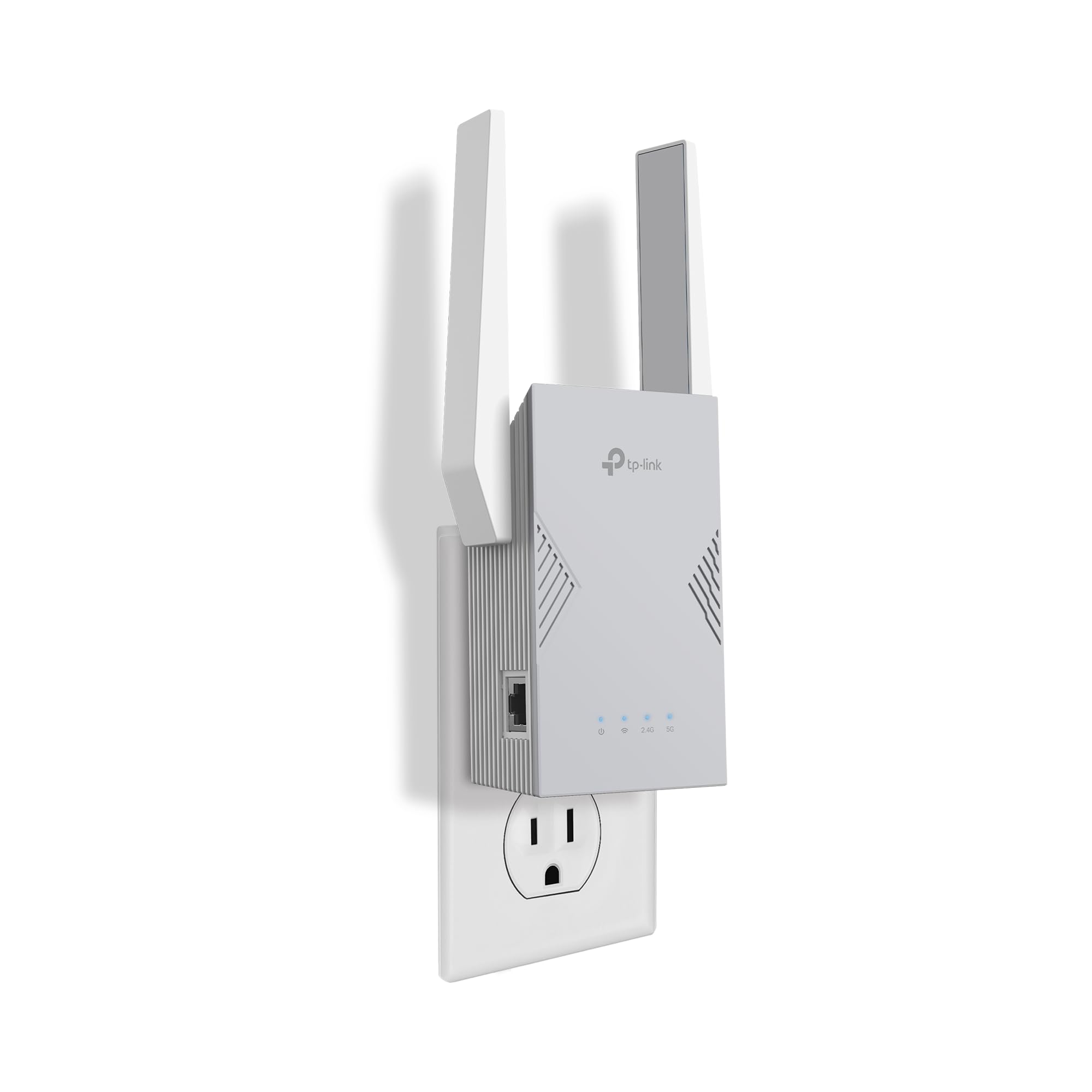
A plug-and-go box that gives a dead bedroom a signal without a ceiling mount or a cable run.
You skip the cable run entirely with the RE223BE, a dual-band WiFi 7 extender with four antennas and Beamforming (which steers the signal toward your device instead of broadcasting evenly). It covers up to 2,400 sq. ft. and handles up to 64 devices, so a whole floor of phones, laptops and smart gear stays connected. Its 3.2 Gbps total splits into up to 2594 Mbps on 5 GHz and up to 688 Mbps on 2.4 GHz. An Ethernet port on the back lets you plug a games console, TV or camera straight in for a steadier wired link.
Setup is what wins people over here, and the range sits right behind it. WPS pairing is the usual route, and a same-name-plus-password handoff means your phone does not need reconfiguring. Buyers describe solutions that reach all the way to the street, and one mentions coverage across 7,600 sq ft in their setup. What you should know before buying: extender coverage figures describe flat square footage on one level, so a two-storey house with solid floors will not match the number on the box.
Two honest limits. TP-Link states in plain terms that this extender does not support the 6 GHz band — it runs 2.4 GHz and 5 GHz only. It also states that extenders improve coverage, not speed, and actual speeds will be 50% or less than your current speeds. If you are chasing raw throughput, this is not that device. If you need the far end of the house to stop dropping calls, it is exactly that device.
Why it fits a normal house
- Setup is the most-praised side of this unit by a clear margin, with range right behind
- EasyMesh-compatible, so it joins an EasyMesh router network
- Ethernet port turns a console or camera into a wired connection
What it will not do
- No 6 GHz band, per TP-Link’s own note on the listing
- Speeds come in at 50% or less than your existing speeds
- Not compatible with Deco mesh systems, which TP-Link states outright
Fits your setup if: you have a WiFi 7 router and a stubborn dead spot one room too far.
Does not fit if: you are on a Deco mesh system — this extender will not join it.
4. WAVLINK AC1200 Outdoor WiFi Range Extender with PoE

Cheapest way onto a pole outdoors, as long as you go in expecting a wired-access-point job.
This is the entry ticket to outdoor coverage, and it is honest about what it is. The AC1200 runs dual-band speeds up to 867Mbps on 5 GHz and 300Mbps on 2.4 GHz, with four 7dBi antennas and an MT7621A chip. It handles 64–96 devices and covers roughly 500 ft unobstructed, per owner reports, though it loses vertical reach — expect a bar drop from the first to the third floor.
The housing is IP65-rated, so rain and spray are handled, and the operating range is -20°C to 50°C with 15KV ESD and 4KV lightning protection. Two Gigabit Ethernet ports let you drop a wired device straight in. PoE support (power and data down one cable) means you can mount it where there is no outlet, which is the whole reason to buy an outdoor unit.
Here is the part buyers get caught on. The main unit is weatherproof; the small PoE switch on the unit is not. Water ran down an Ethernet cable into that switch and shorted the 54V line in one reported case, so mount it with the cable loop lowest and consider a waterproof enclosure. Setup as a repeater is also the rough edge — owners find the management screen unreliable, and the simpler AP or router modes go down easier. Buy this for a wired access point out in the yard, not for a lazy wireless repeat.
The trade-off in plain terms: you get outdoor mounting, PoE (Power over Ethernet, which sends power and data down one cable) and four antennas on a tight budget. What you give up is WiFi 6 and 6 GHz — this is a WiFi 4/WiFi 5 unit that runs on the two older bands.
Best used for: a yard, festival ground or pole-mounted access point where the cable run already exists.
Skip the shortcut: if you want a plug-in repeater for inside the house, this is the wrong tool.
5. INEAUTO AX1801 Outdoor WiFi 6 Extender
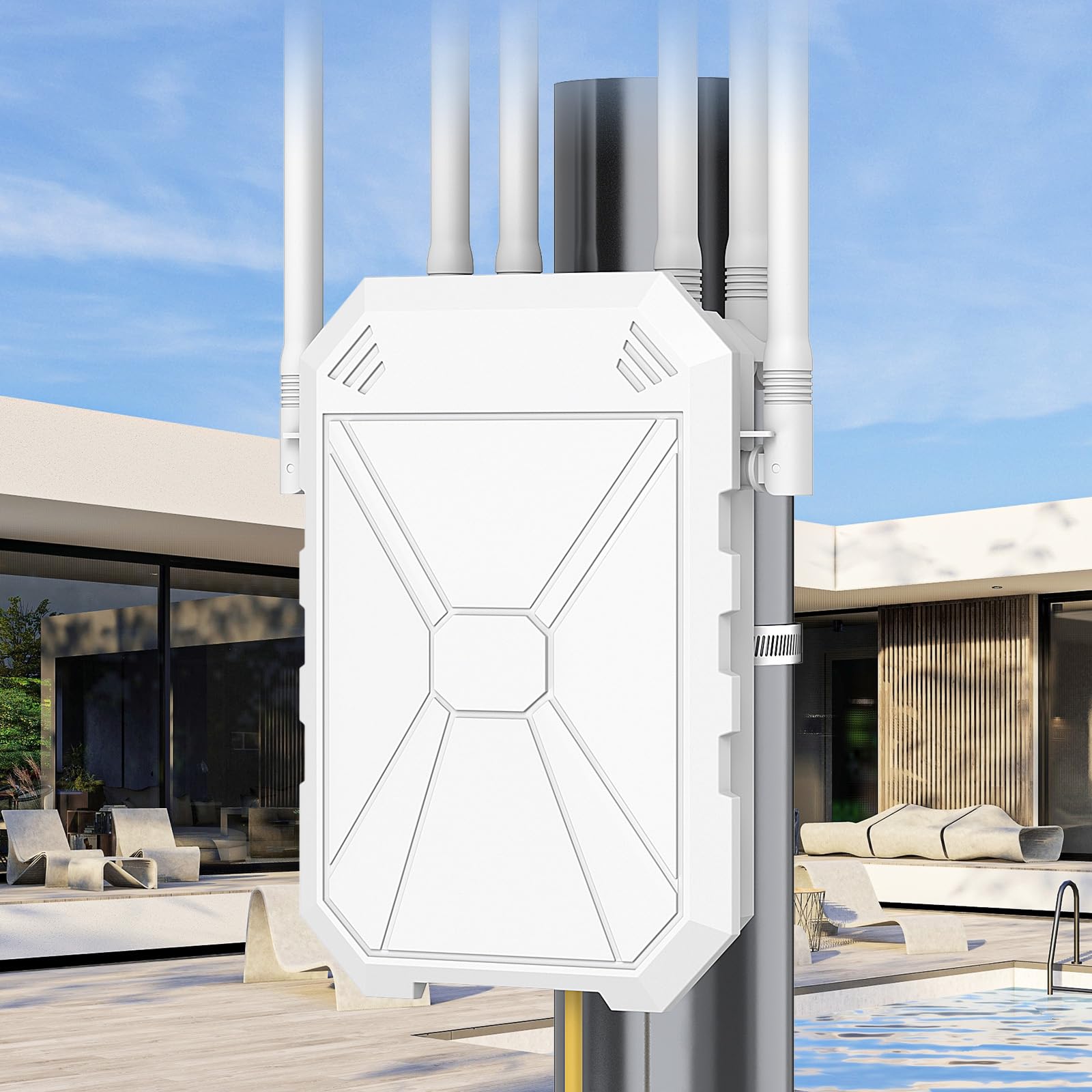
Six antennas and a 300 m range claim, aimed at anyone with an acre and a Ring camera.
Signal quality is what this one gets right. The AX1801 is a WiFi 6 dual-band unit with six high-gain 8dBi antennas and dual amplifiers, quoted at 1800Mbps combined and a 300 m range. It connects up to 128 devices and carries dual Gigabit Ethernet ports. It works with Starlink, outdoor cameras and video doorbells, and INEAUTO claims compatibility with over 99% of routers — that last figure comes from the manufacturer, not from independent testing.
The failures here tend to be about distance rather than build. Owners mention the unit covering a full acre yard and a half-acre lot with dead spots gone, and one notes reaching up to 1,000 feet. But coverage is the loudest complaint too — a couple of buyers found the real range fell well short of the advertised figure and no better than an inexpensive travel router. Treat the range on the box as a line-of-sight best case, then mount high and clear of trees. Reliability is the other mixed note, so buy it where you can return it if a unit dies early.
Two practical details. The PoE converter is not waterproof, so it has to live indoors or in a dry enclosure — the same rule as the other outdoor units here. And the unit is bulky, with one buyer calling it a big honking thing that needs a planned spot on the pole or eave. Neither is a fault, just something to picture before you drill.
What earns the money back: separate 2.4 GHz and 5 GHz network names, which makes it easy to park older 2.4-only cameras and mowers on the slower band while phones get the fast one.
The catch: range figures assume clear line of sight, so a treed lot will land well short of the quoted 300 m.
Strongest for: homeowners wiring up a back lot, patio and cameras on one outdoor unit.
Look past it if: you need reliability you can bet a security system on — test it early.
6. WAVLINK AX1800 Outdoor WiFi 6 Extender, IP67 Weatherproof

Built for acres, not yards — four fibreglass antennas and a true IP67 shell for farms and rural lots.
Build quality is the thing people talk about most with this unit, and it is the reason it sits in the premium tier. The RC-WN573HX1-EU is a WiFi 6 (AX1800) dual-band access point with four custom-engineered 8dBi fibreglass antennas, MU-MIMO and Beamforming. It supports AP, Router, Repeater and WISP modes, runs on 802.3af/at PoE or passive PoE, and meshes with other WAVLINK devices. Starlink compatible, with a full mounting kit in the box.
Where it earns its place is open ground. Buyers describe transmissions working across 3 acres of open land and full bars of reception at 1,000 feet. A farm that lost its previous provider called the range huge and the install beyond easy. The true IP67 housing is rated against dust and immersion, and the fibreglass antennas are built to shrug off UV and wind. Signal strength is the second thing people call out — behind build quality, but right there.
The honest counterweight is setup. Instructions come in for criticism — unclear steps, broken links — and the Wi-Fi extender configuration is not the intuitive part; owners suggest configuring on a computer before plugging into the router. It is also big, cannot stand upright, and has a green cord light that stays on. If you want a unit you set up once on a nice day and then forget, the payoff is real. If you want zero friction on install day, call WAVLINK support before you mount it.
The reason it costs more: fibreglass antennas and a full IP67 enclosure mean it survives seasons outdoors that plastic-bodied units will not, and it ships with the full mounting kit.
What you have to survive: the manual is the weak point, so plan to configure it on a desktop before the pole mount.
Right for: farms, estates and rural lots where one unit needs to reach a neighbour’s field.
Not right for: anyone hoping to plug it in and use it in five minutes — this wants a setup session.
7. TP-Link Omada EAP772-Outdoor Access Point
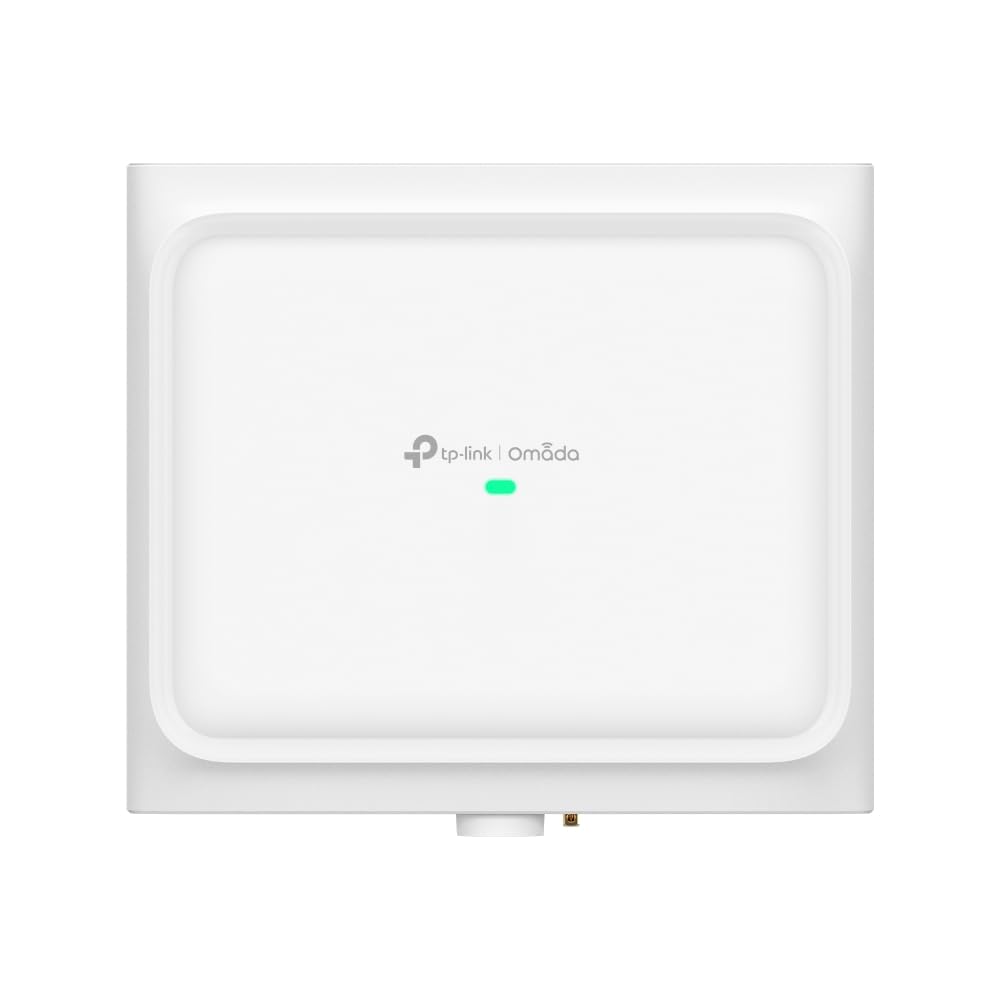
The top of the ladder: outdoor WiFi 7, a 2.5G port and an IP68 shell for managed networks.
If you are running a managed network outside a home, this is the ceiling of the group. The EAP772-Outdoor is a tri-band six-stream WiFi 7 access point rated to 9.3 Gbps, with a 2.5G port and an IP68 (fully sealed, dust-tight and immersion-proof) housing. It is a big step up from the 1.8 Gbps on the WAVLINK AX1800 units. It also covers 300 m² (about 3,200 ft²), so one unit is a real property rather than one corner of it.
You supply the PoE injector separately — TP-Link names the PoE160s and PoE5430G-M2 as the units it works with, so budget for one and plan the cable run. In return, customers note over 1 gig download speed anywhere in a yard, near-gigabit to a phone over 6 GHz, and meshing to a smaller outdoor AP at over 400 Mbps up and down. For a pool, a backyard stadium-light setup or a small commercial lot, it handles the density without complaint.
One real catch: 6 GHz outdoors in the US needs AFC registration, and if that daily registration fails — or you are outside the US — the 6 GHz band turns off while the other bands keep working. Build quality and cable protection are strong, and setup is straightforward once the injector is in place. If you want the newest band and you sit outside its rules, confirm that before you commit.
Why it earns the premium tier
- 9.3 Gbps tri-band WiFi 7 with a 2.5G port — well above the 1.8 Gbps on the WAVLINK units
- IP68 housing, the strongest weather rating in this article
- Covers 300 m², so one unit handles a large property
The catches to plan around
- PoE injector sold separately — PoE160s or PoE5430G-M2 are the named units
- 6 GHz needs AFC registration outdoors; without it, that band stays off
- Built for managed networks, so it is not a simple plug-in for a lone router
Worth it for: large backyards, pool areas and small commercial sites that need the newest band and real weather armour.
Hold off if: you cannot source a PoE injector or you sit outside AFC coverage — you lose the 6 GHz payoff.
Know the Specs
IP Ratings Explained
Two digits tell you how sealed a unit is. The first is solids (dust), the second is liquid. IP65 means dust-tight and protected against water jets — fine on a pole in rain. IP67 adds immersion protection. IP68 is the strongest here. None of it covers the PoE adapter, which has to stay dry on every unit in this article.
PoE and the Adapter Rule
Power over Ethernet sends both electricity and data down one cable, which is how you mount a unit on a pole with no outlet nearby. Active PoE follows the 802.3af/at standard; passive PoE uses a fixed voltage adapter. Either way, the adapter itself is not waterproof — mount it indoors or in a dry box, with the cable loop hanging lowest so water cannot run in.
Band Class and the 6 GHz Question
Dual-band means 2.4 GHz and 5 GHz. Tri-band adds 6 GHz, a newer lane with less interference and more room for devices. A dual-band extender like the TP-Link RE223BE does not touch 6 GHz at all, so if your phones and laptops are WiFi 7-ready, that band is the one to hold out for.
Common Questions
Will an outdoor WiFi extender work with my Starlink dish?
Do I need a PoE switch or can I use the included adapter?
Does a WiFi extender increase my internet speed?
How far will an outdoor access point actually reach?
Is IP65 enough or do I need IP67 or IP68?
Can I use a home mesh extender outside?
Why does the 6 GHz band turn off on outdoor units?
How many devices can one outdoor extender handle?
Can I mix an outdoor extender with my existing mesh system?
The Bottom Line
For a busy building where you want the strongest overall pick, the Ubiquiti U7 Pro Max earns it — three bands, a 2.5 GbE uplink and a 500+ device ceiling turn a laggy house into a fast one. For a pole in a field that has to reach a barn, reach for the WAVLINK AX1800, with an IP67 shell (a weatherproof rating that keeps out dust and water) and 256 device slots. And if you just need the far bedroom to stop dropping calls, the plug-in TP-Link RE223BE does that job without a ceiling mount. Pick the job first, and the right unit follows.
How we choose
We do not accept paid placement. Every pick is matched to a real buyer and a real use-case; we do not hands-on test units.
Sources
Specifications: manufacturer listings and product documentation. Review insights: verified customer reviews, as of October 2026. Pricing: not shown on this page (it changes often); check the current price via the retailer link.
As an Amazon Associate, Aappliancez earns from qualifying purchases. This does not affect which products we feature.