Disclosure: Some links in this post are affiliate links. As an Amazon Associate I earn from qualifying purchases, at no extra cost to you. Learn more
Specs are compiled from manufacturer listings and verified buyer reviews and can change over time — please confirm the key details on the product page before buying.
Your collage looks perfect until the glue dries — then the paper buckles, the edges curl, and the whole page looks warped. The fix is picking a glue that dries clear, stays flexible, and lets you place pieces with enough working time to nudge them straight. That is what this shortlist covers: five glues that handle paper, cardstock, photos and mixed media without the mess or the wrinkle.
This guide is built by comparing the manufacturers’ published specifications and the patterns across verified customer reviews, so you get each pick’s real strengths and trade-offs instead of marketing spin.
You will see which glue suits fine detail work, which one suits big flat photo mounts, and which suits volume crafting on a budget. For most collages, a precision bottle with swappable tips beats a glue stick. Here is the breakdown of the best collage glue for paper, card and photo projects.
Top Picks


How To Choose The Best Collage Glue
Collage work puts glue through a specific kind of stress. You are bonding thin paper to cardstock, layering photos over backgrounds, and pressing down die cuts that must not slide. The glue needs to hold firm without soaking through and puckering the sheet. Three things decide whether a bottle earns a spot on your desk: how it dries, where it lands, and whether it is safe for the paper you are using.
Drying clear and staying flat
A glue that dries clear leaves no cloudy halo around your cut edges, which matters most on light paper and photos. Wrinkle resistance is the second half of that promise — the formula has to stay smooth as it cures so the paper does not warp. A thin, even layer does more for flatness than a heavy bead, so look for a bottle whose tip lets you control the flow.
Tip choice: fine lines versus full coverage
Precision tips put a controlled line exactly where you want it, which is what small die cuts, gems, and journaling corners need. A broad applicator covers large backgrounds fast when you are gluing a full sheet down. Bottles that offer both, or that accept swappable tips, cover more of your collage work without buying a second product.
Acid-free and archival labels
Paper and photos you want to keep deserve a formula labeled acid-free or archival. Those labels signal the glue is designed not to yellow or damage the paper over time. For scrapbook pages, photo albums, and framed collage art, this is the spec worth checking before you buy.
Side-by-Side Comparison
| Model | Best For | Form | Key Feature | Archival Claim | Amazon |
|---|---|---|---|---|---|
| Bearly Art Precision Craft Glue★ Best Overall | Fine detail and mixed-media collage | Liquid, 4 fl oz bottle | Multiple swappable precision tips | Acid neutral, archival safe | Amazon |
| Tombow MONO Aqua Liquid GlueBest for Cards | Card making and scrapbook layering | Liquid, 1.69 oz dual-tip | Dual tip: fine line and full coverage | — | Amazon |
| Erigathe 250g PVA Book Glue | Bookbinding and large flat sheets | Liquid PVA, 250 ml | PH-neutral, flexible after drying | Acid-free | Amazon |
| Scotch Permanent Glue Stick (24-Pack) | Volume paper crafting on a budget | Glue stick, 24 pack | Washable and acid-free | Acid-free | Amazon |
| Scotch Photo Mount Spray Adhesive | Mounting photos and large prints | Spray, 10.3 oz can | Repositionable while wet | Photo safe per ISO Standard 18916 | Amazon |
Detailed Reviews
1. Bearly Art Precision Craft Glue Original 4 fl oz
Our pick — 4.5+★ from 11,500+ verified ratings; the strongest balance of quality and price.
The precision bottle that ends the clogged-tip fight and keeps collage edges flat.
If your collage involves small pieces — die cuts, gems, layered corners — the tip is the whole game. This bottle ships with a tip kit of multiple sizes that twist and snap into place, so you swap from a hairline line to a wider spread without changing bottles. That is the difference between glue landing where you aim and glue smearing over the edge of a delicate cut. Compare it to the Tombow pick below: that bottle’s dual tip handles fine and full coverage, but this kit gives you 100 pieces in the pack against the Tombow’s 3, which is a 33.3x gap in parts.
The formula is where it earns the top slot. It is acid neutral and archival safe, and it is built to stay wrinkle and clump resistant so thin paper does not pucker as it cures. It dries clear rather than cloudy, which keeps bare paper looking untouched. Full cure takes 24 hours, so handle a finished page gently for a day before stacking it in an album. It is tested freeze/thaw stable for 5 cycles, so cold-weather shipping will not wreck it, and the maker lists a 1 year shelf life.
The trade-off is cost. The value question splits opinions, and if you are gluing hundreds of school projects a week you will feel the price per bottle. Some crafters also find a heavier hand causes wrinkling, since the formula wants a conservative layer, not a flood. For an archival piece you plan to keep, neither point should stop you. As buyers put it: “Having the possibility of different tips for this glue makes it so easy to use. Using must a little with a bubble-free application on die cuts is important.”
What earns it the top spot
- Multiple swappable tips for hairline lines or wider spreads
- Acid neutral and archival safe for keepsake collage work
- Wrinkle and clump resistant when applied thin
- Dries clear with a strong, flexible hold
What to weigh first
- Costs more than a basic craft glue, which some crafters note
- Wants a conservative layer or heavy-handed use can wrinkle
Reach for this if: you build detailed collage, card fronts, or gem work and want the tip doing the aiming for you.
Think twice if: you glue in huge batches and want the cheapest bottle per ounce rather than the most control.
2. Tombow MONO Aqua Liquid Glue 1.69 Ounce
One bottle, two ends — a pen tip for corners and a broad edge for full sheets.
Card makers will recognize the appeal straight away: the dual-tip dispenser gives you a fine pen end for detail work and a broad end for covering a whole panel. You get one tool instead of digging through a drawer for a second bottle. On a 1.69 ounce tube, that covers sticky corners and large backgrounds in the same session. It is made for paper and paper textures specifically, so cardstock, glitter paper, and scrapbook sheets are the target, not metal or glass.
What wins people over is the working time. The glue gives you a moment to slide pieces into place before it grabs, which is exactly what a crooked photo or a misaligned greeting needs. It dries clear and dries quick on paper, and the even spread means no wrinkling or bleed-through on photos. Cardstock to glitter paper can look weak at first and then adhere fully overnight, so give it the full dry before you judge the bond. The pen end shines on Bible journaling and bookbinding, where a torn sketchbook page repairs almost invisibly.
Here is the honest limit. This is a paper glue — it will not bond two hard items like a gem to metal, and the listing does not spell that out. Keep a stronger multi-surface adhesive on hand for hardware-like materials. Otherwise it is a steady performer. As buyers report: “The applicator tip is fantastic and the glue gives time to wiggle pieces into place.”
Where it shines: the fine pen tip handles tight detail and the broad edge covers panels fast, all on one dual-tip bottle.
The honest limit: it is built for paper, so gem-to-metal style hard bonds need a different glue — check the listing before you buy for that job.
Suits: card makers, scrapbookers, and journalers who want precise placement plus a little wiggle room before the glue sets.
Pass if: you mainly bond non-paper materials like metal or glass.
3. Erigathe 250g Book Glue, Neutral PH PVA Adhesive, Acid-Free
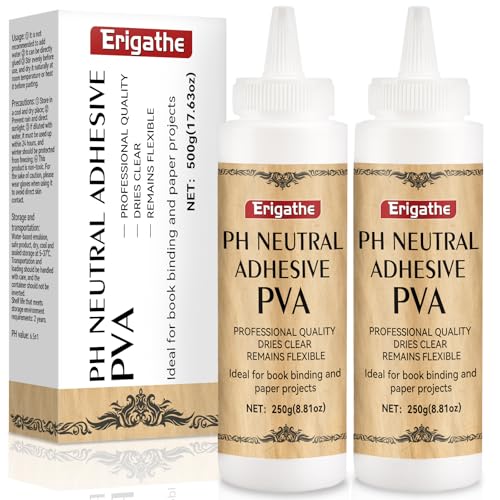
A big bottle of flexible PVA for full-sheet backgrounds and book repairs.
The 250 ml bottle is the standout here — enough glue to cover large collage backgrounds, mount covers, and bind a journal without running dry mid-project. It is a PH-neutral PVA formula, meaning it is built to be paper safe, and it is acid-free so it will not yellow your pages over time. PVA also levels out as it dries, which helps a flat sheet sit flush against its backing instead of trapping bumps.
This is the pick for bookbinding, book repair, framing, and paper art. It stays flexible after drying, so a spine or a folded cover can move without cracking the bond. It is water-soluble and can be diluted with water if you want a thinner coat for delicate work, and it has a long drying time so you can adjust what you place. Full cure is 24 hours. Pressed flowers glued to canvas and wood hold well, and watercolor journal binding comes out clean. The enclosed brush makes it easy to apply.
Two things to know. It is not water resistant, so do not use it for anything that will get wet. And it can leave a film on black paper or canvas if you over-apply — a light, even coat avoids it. As owners mention: “I did some quick binding for watercolor journals and it worked beautifully.”
Big-batch value: a 250 ml bottle of acid-free, PH-neutral PVA that covers large sheets and repairs books, with an enclosed brush for spreading.
Use it dry: the formula is not water resistant and can film on dark paper, so keep it for indoor paper work with a light touch.
Pick this for: bookbinding, journal repair, and full-page collage backgrounds where you need a lot of glue that stays flexible.
Skip it for: outdoor pieces or anything that might get damp.
4. Scotch MMM600824S Permanent Glue Stick (Pack of 24), Clear

Twenty-four acid-free glue sticks for classroom and kitchen-table collage days.
When the collage project is a group activity, a single precision bottle is the wrong tool. A pack of 24 glue sticks keeps every kid at the table supplied, and the storage tray keeps them from rolling off the edge. Each stick is acid-free and dries clear, so paper and photos stay clean. It bonds cardboard, fabric, paper and photos, which covers most of what a family craft session throws at it.
The application is smooth and does not clump the way some glue sticks do, and a tight cap keeps each stick from drying out between sessions. Cleanup is a soap-and-water affair, and there is no hot tip to worry about with small hands. The quality holds up over time on scrapbooks and journals, and the cost stays reasonable for a multi-pack. It does everything you need for bonding flat paper to flat paper without the fuss of a liquid bottle.
The catch is control. A glue stick lays down a broad smear, not a hairline line, so delicate detail work on gems or tight corners is not its job. For that, the Bearly Art precision tips do the work this pack cannot. But for bulk paper crafting, this is the sensible buy.
Why it earns a spot
- 24 acid-free sticks in one pack for group craft sessions
- Smooth, clump-free application that dries clear
- Washable and no hot tip, so safe for small hands
- Bonds cardboard, fabric, paper and photos
Where it stops short
- Broad smear, not fine lines — no precision for detail work
Good fit for: teachers, parents, and bulk paper crafting where a 24-pack keeps the table running.
Not the one for: gem work or fine die-cut detail that needs a pointed tip.
5. Scotch Photo Mount Adhesive, 10.3oz, Safe for Color Photos
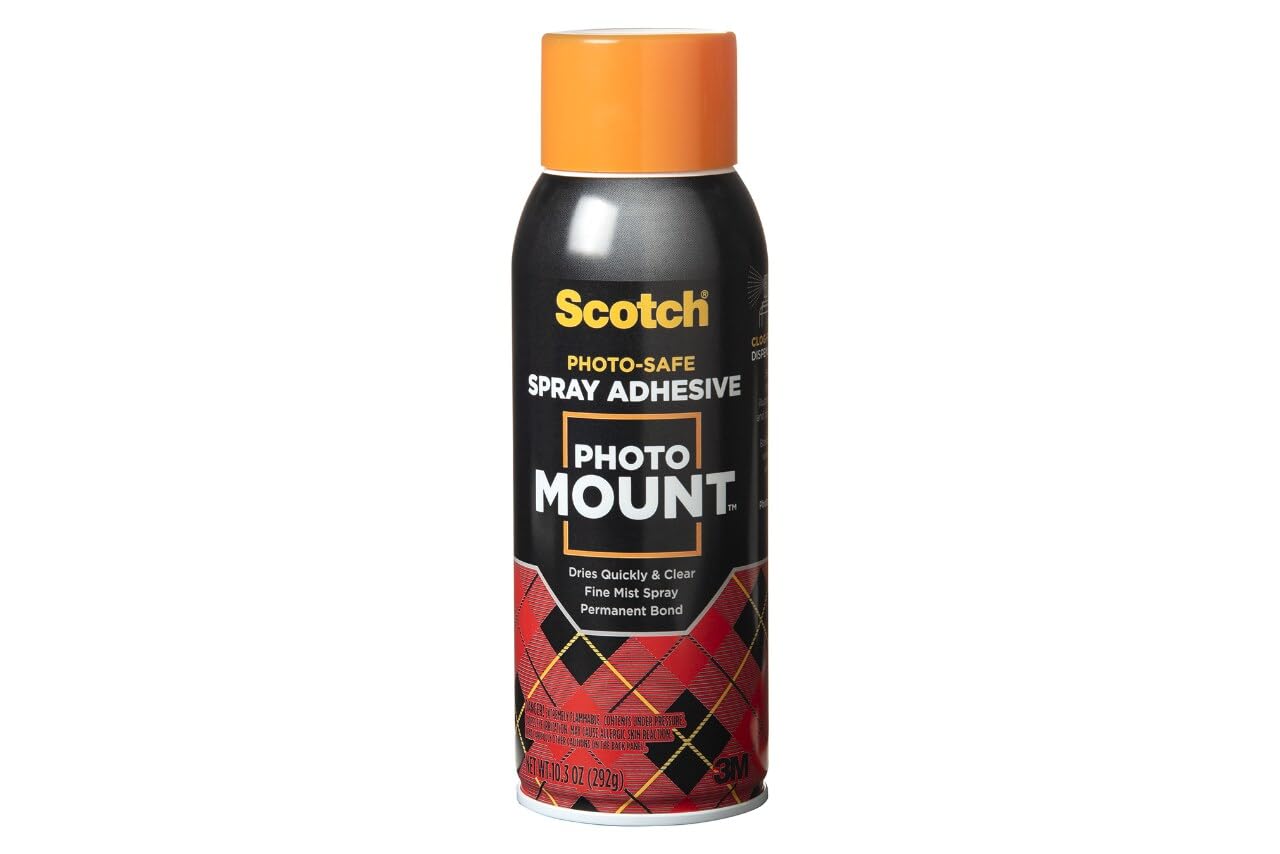
The spray that mounts a full print flat with no brush marks and no wrinkles.
For photo collage, a brush or a liquid bottle can leave streaks or ripple a glossy print. This is a spray adhesive in a 10.3 ounce can, and it puts down an even coat across a whole sheet at once. It is labeled safe for color photos, illustrations and pictures, and it states photo-safe in accordance with ISO Standard 18916 — a paper-safety standard that tells you it is formulated not to harm your prints. Mounting surfaces include good quality cardstock board, plastic, glass, clean metal, and foam core with a smooth surface.
The big practical advantage is that it allows re-positioning while wet, so you can slide a print into line before it grabs, then it holds firmly. A professional photographer mounts photos on mat board, foamcore, and chipboard with it, reporting manageable overspray and a lighter smell than many sprays. It bonds clear and permanent, with a 24 hour full cure. Just do not reach for it outdoors — it is not suitable for outdoor use.
Two honest points. The adhesion quality gets mixed feedback, with some runs coming out in gobs rather than an even mist, so shake well and test on scrap first. And the fumes are real — spray outside or in a ventilated space and wear a mask. As customers note: “Fumes bad, need wear a mask.”
Why it works for prints: an even spray over a whole 8×10 mounts flat to foam core, repositionable while wet, and photo safe per ISO Standard 18916.
Handle with air: the spray can spit gobs and the fumes are strong, so use it outdoors or well ventilated with a mask on.
Best for: mounting photos, large prints, and illustrations onto foam core or mat board with a flat, streak-free finish.
Look elsewhere if: you need a fine line for small collage detail or you plan to work in a closed room.
Know the Specs
Acid-Free and Archival Safe
A glue labeled acid-free or archival is formulated so it does not damage or yellow the paper over time. That matters when you glue photos, scrapbook pages, or anything you plan to keep and frame. The Bearly Art, Erigathe, and both Scotch picks all carry an acid-free or archival claim in their listings, so each one is a reasonable fit for keepsake collage work.
Precision Tips and Applicators
The applicator decides how cleanly glue lands. A fine tip lets you lay a controlled line onto a small die cut or a gem, while a broad end or a brush covers a full sheet fast. Bottles with swappable tips, like the Bearly Art kit, or a dual-tip design, like the Tombow, give you both in one product — which is why they suit detailed collage better than a broad glue stick.
Common Questions
What kind of glue is best for a paper collage?
Will glue make my collage paper wrinkle or warp?
Is a glue stick good enough for collage?
What does acid-free mean and why does it matter for collage?
Can I use PVA book glue for collage?
Does the Tombow glue work for cardstock and glitter paper?
Can I reposition a photo after spraying adhesive?
How long does the Bearly Art glue last before it goes bad?
Is spray adhesive safe to breathe indoors?
Which collage glue is best for gluing photos?
The Bottom Line
The safest bet for most collage makers is the Bearly Art Precision Craft Glue, because its swappable tips give you control on fine die cuts while the acid-neutral, archival formula keeps paper flat and clean. If you make cards and want a dual tip with a little repositioning time, grab the Tombow MONO Aqua. For bookbinding and big flat backgrounds, the Erigathe PVA covers a lot of surface and stays flexible. Mounting photos? Reach for the Scotch Photo Mount, and keep the Scotch glue stick 24-pack for group craft days. The crowd favorite is the Bearly Art — 4.5+ stars across 11,000+ owners — and its swappable precision tips are why.
How we choose
We do not accept paid placement. Every pick is matched to a real buyer and a real use-case; we do not hands-on test units.
Sources
Specifications: manufacturer listings and product documentation. Review insights: verified customer reviews, as of October 2026. Pricing: not shown on this page (it changes often); check the current price via the retailer link.
As an Amazon Associate, Aappliancez earns from qualifying purchases. This does not affect which products we feature.