Disclosure: Some links in this post are affiliate links. As an Amazon Associate I earn from qualifying purchases, at no extra cost to you. Learn more
Specs are compiled from manufacturer listings and verified buyer reviews and can change over time — please confirm the key details on the product page before buying.
The short answer: the Rust-Oleum 710 Elastomeric Roof Coating is the one most RV owners should buy, because it seals a leaking roof fast and keeps the inside measurably cooler. Everything else on this list wins for a narrower job — metal roofs, rubber roofs, or a roof you only want to protect rather than rebuild. Read the surface-matching section below before you buy anything, because the wrong coating on the wrong roof is the single most common mistake in this category.
This guide is built by comparing the manufacturers’ published specifications and the patterns across verified customer reviews, so you get each pick’s real strengths and trade-offs instead of marketing spin.
Every pick below is matched to the roof material it was actually engineered for, so you can stop guessing and start sealing. This breakdown of the best coating for RV roof separates true elastomeric sealants from thin protectants that only hide chalk streaks.
Top Picks
How To Choose The Best Coating for RV Roof
Roof coatings fail for one boring reason most of the time — the coating was never compatible with the roof underneath it. So the first thing to settle is your roof material. Once that is locked, the rest is just math and dry time.
Match the coating to your roof material first
An EPDM roof (a black rubber membrane common on older RVs) does not accept every acrylic coating, and several makers require a primer over EPDM and TPO before anything bonds. Metal and aluminum roofs are the opposite problem — they often want an acrylic formula and will reject a coating that is designed for rubber. If you skip this step, you get peeling and rust bleeding through within a season.
Do the gallons-per-square-foot math before you order
Coverage is quoted as a spread rate, such as 1 gallon per 50 square feet or 1.5 gallons per 100 square feet per coat. Measure your roof, multiply by the number of coats the maker calls for (usually two), and you will rarely be surprised halfway through the job. This is also why pails exist — a 30-foot trailer typically needs a pail rather than a single can.
Weigh dry time and cure temperature against your weather window
A coating that skins over quickly and cures fully overnight lets you watch the sky and finish in one weekend. A coating that needs 24-48 hours before rain is a bigger gamble. Most makers specify an overnight low around 50°F and a cure window, and ignoring that turns a clean job into a re-do.
Side-by-Side Comparison
| Model | Best For | Volume | Dry / Cure Time | Compatible Roofs | Amazon |
|---|---|---|---|---|---|
| Rust-Oleum 710 Elastomeric★ Best Overall | Most RV owners | 2 gallons | 24 hours | Metal, concrete, single-ply, modified bitumen | Amazon |
| Xmntdo RV Roof CoatingBest Heat Reflector | Sun-baked trailers | 1 gallon | 4-6 hours to touch, 24-48 hour cure | EPDM, TPO, fiberglass, aluminum | Amazon |
| Protect All 68128 Rubber Roof Treatment | Routine rubber-roof upkeep | 1 gallon | — | EPDM rubber | Amazon |
| BEEST B-5000 Liquid Rubber | Sealing a stubborn leak | 1 gallon | 4 hours between coats, 48-hour full cure | EPDM, TPO, metal, fiberglass, PVC | Amazon |
| STA-Kool SK-7705 Acrylic | Big roofs on a value budget | 5 gallons | 4 hours | Aluminum and metal roofing | Amazon |
| Dicor RP-MRC-1 | Metal roofing only | 1 gallon | 6 hours | Metal only (not EPDM or TPO) | Amazon |
| Liquid Rubber Silicone | Flexibility above all | 1 gallon | — | Metal, wood, concrete, EPDM, PVC | Amazon |
Detailed Reviews
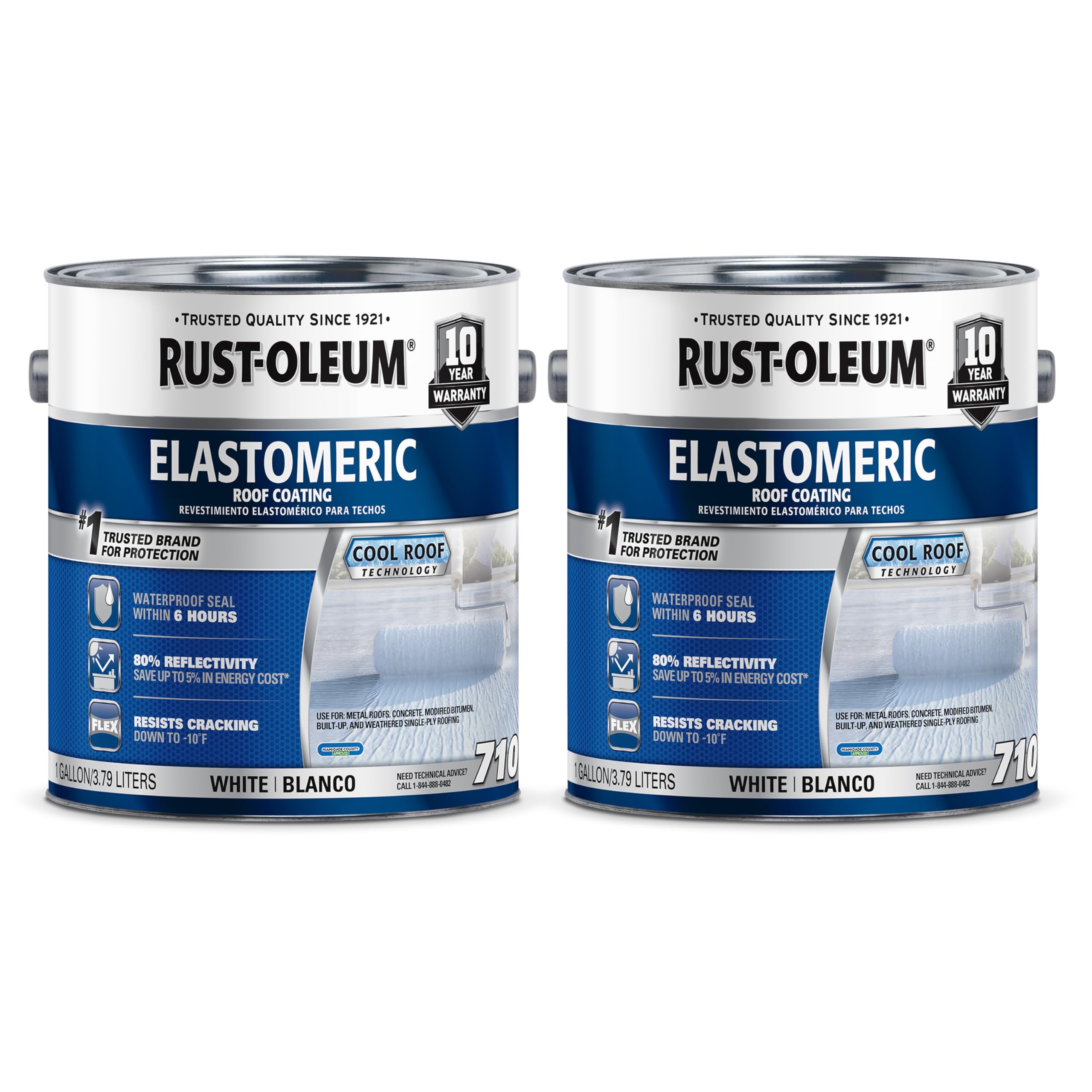
1. Rust-Oleum 710 Elastomeric Roof Coating, 2 Pack
Our pick — over 4.5★ from 600+ verified ratings; the strongest balance of quality and price.
The two-gallon workhorse that seals a leaking roof in a weekend and knocks interior temps down.
If your roof is tired, chalky, and letting drips into the ceiling on a wet night, this is where to start. The 2-gallon box covers two full coats at 1.5 gallons per 100 square feet per coat, which is exactly what the maker calls for, so a typical RV roof finishes without a mid-job store run. Its water-based formula means you thin tools with water instead of solvent, and the manufacturer promises a waterproof seal within 6 hours.
Two numbers actually matter here. The coating reflects 80% of sunlight (Cool Roof Technology), and it is rated to resist cracking down to -10 degrees Fahrenheit, so freeze-thaw winters stop splitting the surface. Buyers report the coated roof runs cooler and the interior drops several degrees on hot days. What the crowd praises most is how simple it goes down — no special gear, just a roller and a little patience.
You get a sturdy roof, but only if you respect the dry time. The spec sheet lists 24 hours, yet owners mention that thick coats can take days to firm up, so a heavy pour sets you back. Roll it on in thin passes, watch the sky, and you get the sturdy result everyone else is getting. For a roof that needs both waterproofing and a heat cut, this pairing of coverage and reflectivity is tough to beat — the Xmntdo and the Protect All each do their one job well, but this one does the whole job.
The case for grabbing this one
- Two full coats at 1.5 gal./100 sq. ft. per coat, so most roofs finish on one purchase.
- 80% reflectivity keeps the roof surface cooler and cuts interior temps by several degrees in summer.
- Resists cracking down to -10°F, which matters through freeze-thaw cycles.
- Water-based and easy to roll on — a genuine one-weekend project.
The fine print worth knowing
- Thick coats can take days to dry despite the 24-hour figure — keep coats thin.
- Rain-readiness in real reports lands closer to 18 hours than the advertised 6.
- Bright white finish reflects glare, so a hat and sunglasses help while you work.
Buy this if: a leaky, heat-soaked roof on metal, concrete, modified bitumen, or weathered single-ply is your problem, and you want the whole fix in one box.
Think twice if: your roof is EPDM or TPO rubber — several formulas here are built specifically for those membranes and this one is aimed at a different set of surfaces.
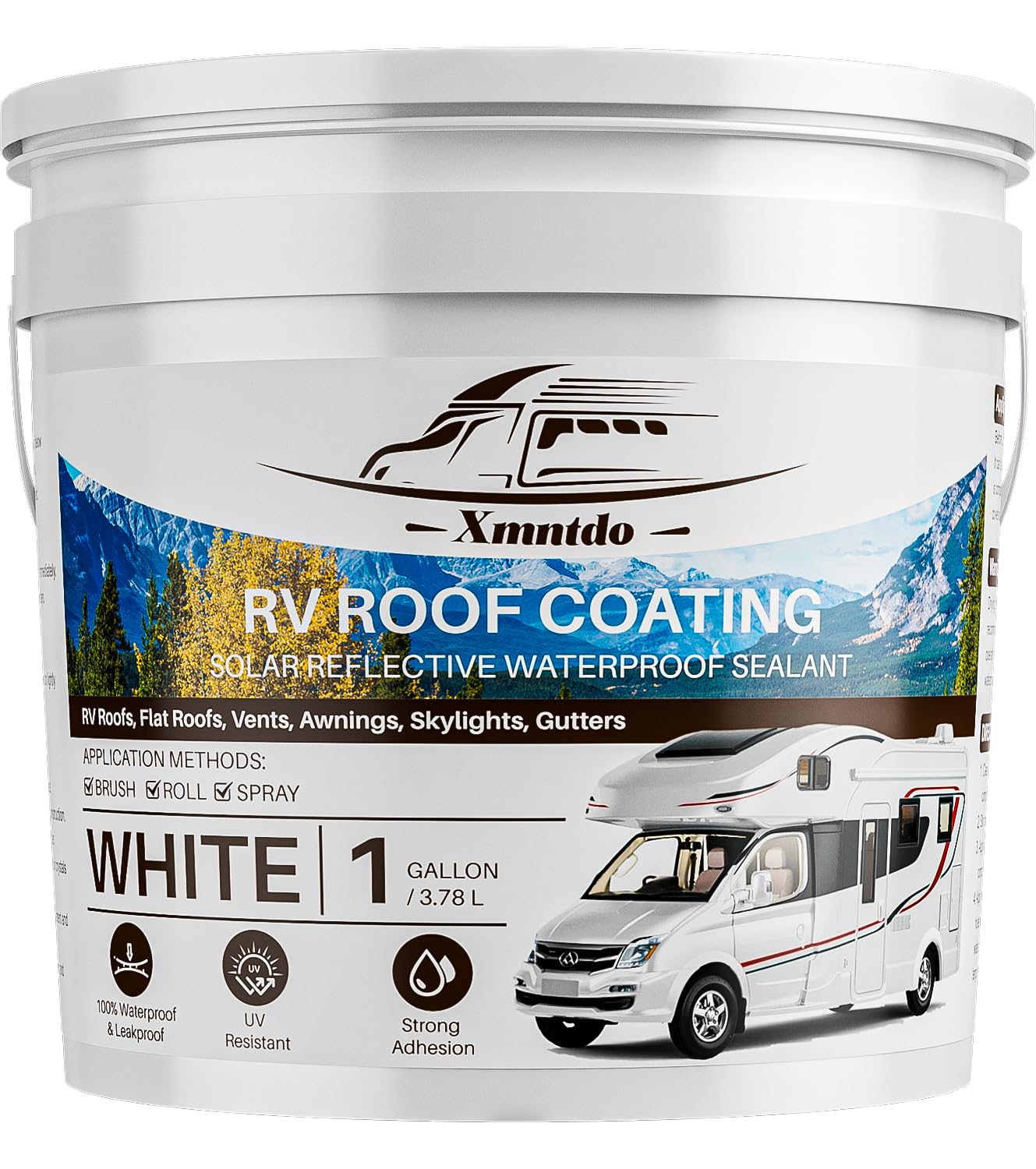
2. RV Roof Sealant, RV Roof Coating White, 1 Gallon (Xmntdo)
For the trailer parked in full sun, this is the coating built to bounce heat back off the roof.
Polyurethane is the material story here. A polyurethane coating (a flexible plastic-like seal that stays stretchy as the roof moves) bonds to EPDM, TPO, fiberglass, and aluminum — a broader material list than the Dicor metal-only formula further down this list. One gallon covers roughly 50 square feet, and the maker says a 5-gallon pail handles a 30-foot RV, so plan your order around your real roof length rather than the can in your hand.
Heat is the headline. The reflective white surface is designed to cut roof surface temperature and ease cooling demand, per the manufacturer, and it pairs with an EPDM primer for stronger grip on EPDM and TPO surfaces. Thin coats dry to the touch in 4-6 hours, full cure runs 24-48 hours, and the maker asks you to hold above 50°F overnight — including the night low, not just the daytime high.
Where should your expectations sit? This is slow-cure work. Choose it when you have a dry, warm stretch and no rain in the forecast, because jumping the cure wastes the coat. If your trailer bakes all summer and the interior never gets comfortable, this is the pick built around that exact complaint.
Why it holds its spot: The material list is the deal-maker — EPDM, TPO, fiberglass, and aluminum in one can buys you flexibility the metal-only coatings simply cannot offer.
Plan the timing around it: Full cure runs 24-48 hours and the maker asks for above 50°F overnight, so treat it as a two-day weekend job, not a Saturday afternoon one.
Reach for this if: your rig bakes in direct sun and you want the roof to stop cooking the cabin.
Look elsewhere if: you need a fast turnaround — 24-48 hours of cure time means rain in the forecast is a genuine risk.
3. RV Rubber Roof Treatment – 1 gallon – Protect All 68128

Not a sealant at all — a rubber-roof treatment that stops the gray chalk streaks running down your RV.
Most buyers trip up here: this is a treatment and protectant for EPDM rubber roofs, not a waterproofing membrane. It solves a different problem — the powdery chalk that EPDM sheds onto your sidewalls and the static that pulls dirt onto the roof. The formula coats the rubber in a tough polymer with anti-static properties that repels grime and reduces that chalk, and the maker claims it cuts maintenance up to 75%.
The application is what makes it a two-hour job for practically anyone. A wide pad on a long handle spreads it fast, and one owner covered a 35.4-foot fifth wheel in about an hour and a half using roughly half to three-quarters of the gallon. A 32-foot trailer went edge to edge in under half an hour when someone worked around the slide-out, AC unit, vents, and joints as well. The formula also carries UV protectant so the rubber does not degrade in the sun.
Where does it show its limit? It reduces chalk — it does not stop it permanently, and the maker’s own estimate is a re-application about once a year. Coat it in spring and you will see far fewer gray streaks by fall.
Where it shines: That wide-pad, long-handle application method turns a whole-roof job into an easy afternoon — one owner finished a 35.4-foot fifth wheel in about an hour and a half with under a gallon.
Best fit: EPDM rubber owners who are tired of chalk streaks on the sides of the RV and want a low-effort protective layer.
Wrong tool if: you have an active leak — this is a protective treatment, not a waterproofing sealant.
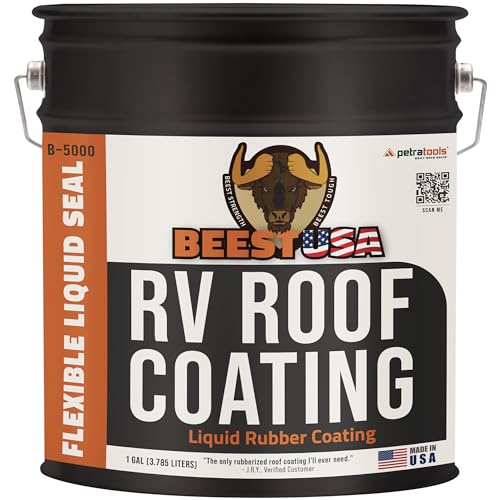
4. BEEST RV Roof Coating White, 1 Gallon (B-5000)
The thick, grippy liquid rubber that goes after leaks on just about any surface you own.
If you have chased a leak for months, BEEST engineered this one for you. It is an acrylic elastomeric (a flexible rubber-like coating that stretches with the roof rather than cracking off it) rated for EPDM, TPO, metal, aluminum, fiberglass, and PVC, so the same can handles almost anything on a trailer, camper, or flat roof around the house. Plan on 1 gallon per 50 square feet at a minimum of two to three heavy coats, and the brand says a 5-gallon pail covers an RV up to 30 feet.
The consistency is the point — this is a thick, non-runny formula that stays where you put it. Wait 4 hours between coats and give it 48 hours to fully cure between 40-90°F. It is solvent-free and labeled ultra-low VOC, so it is meant to be usable around people and pets without a respirator and without heavy fumes filling the camper.
The plain-spoken reality is that this job is labor — two to three heavy coats is a lot of rolling. Some owners find the price high for a single gallon, and the maker’s own guidance is to prime EPDM roofs first before applying. If you want a thick coating that grabs a worn surface and holds through rain, that labor is the trade-off. And do not skip the cleaner on a dirty roof — prepping the surface is where a lasting seal actually comes from.
Why it earns its spot
- Thick, non-runny formula that stays put on slopes instead of sagging.
- Bonds to EPDM, TPO, metal, aluminum, fiberglass, and PVC — the widest material range here.
- Solvent-free and labeled ultra-low VOC.
- Seals leaks and still looks clean once finished.
What to plan around
- Two to three heavy coats means real labor, especially on a long roof.
- The maker requires a primer on EPDM, an extra step and cost.
- One gallon is a modest surface area at the recommended thickness.
Made for: the owner chasing a stubborn leak across EPDM, TPO, metal, or fiberglass who wants one thick coating that actually grabs.
Skip if: you want a fast single-pass job — two to three heavy coats and a 48-hour cure is a commitment.
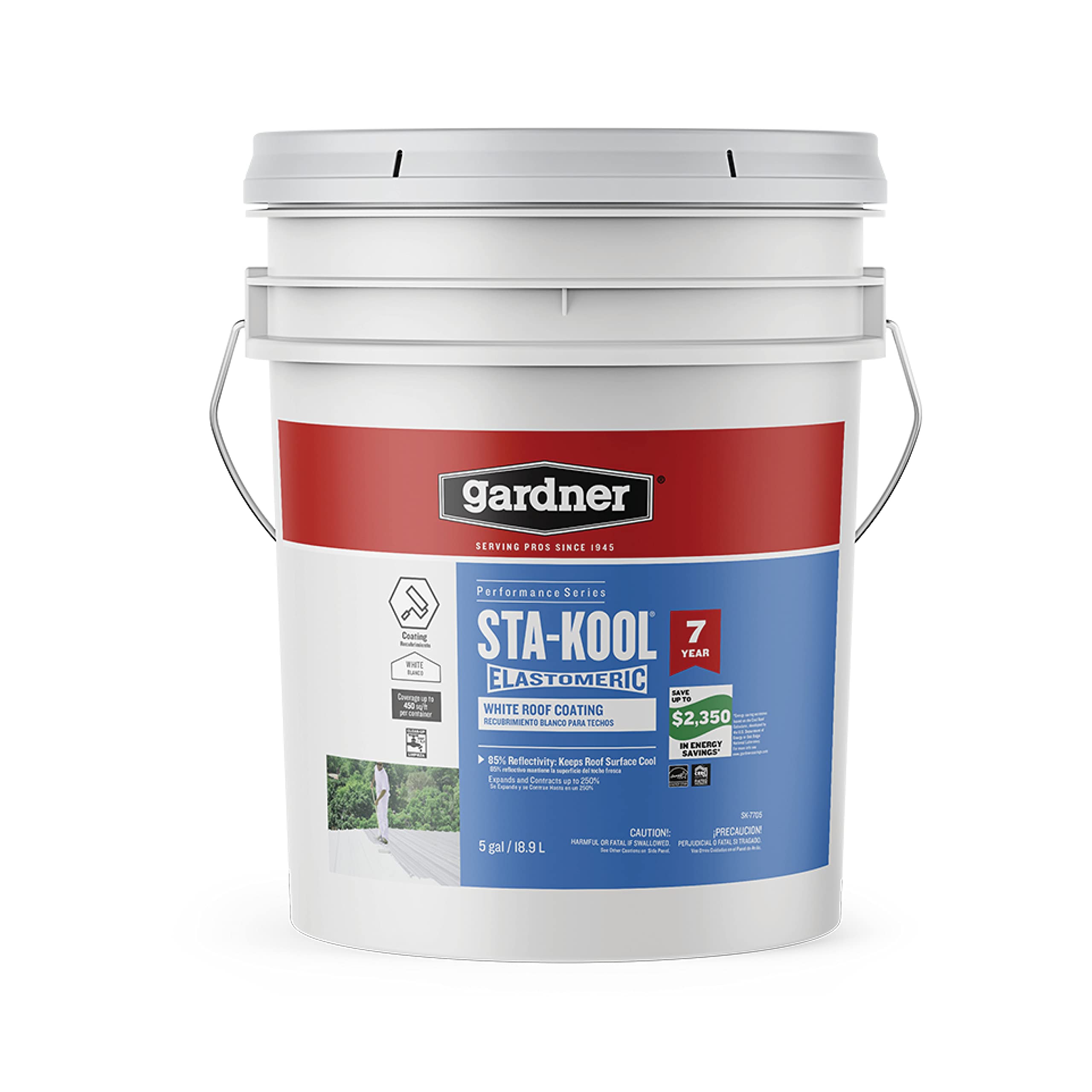
5. STA-Kool SK-7705 Acrylic Elastomeric Roof Coating, 5 Gallon
Five gallons of acrylic elastomeric, made for the roof you can actually see from the ground.
STA-Kool SK-7705 is the quantity play in this lineup. Five gallons of an acrylic elastomeric coating made in the United States, delivered in one bucket — that is the entire premise, and for a full-sized trailer or a home roof, it is a smart one. The reported spread shows 500 square feet going easily with coverage that cleans up in a single coat, though the fine-print reality is that most roofs are better off with two coats, applied with a 3/4-nap roller (a roller with a thick, fluffy nap that holds heavy coating).
Dry time is quick, roughly 4 hours on the label, and the working consistency stays smooth as you roll. The finish is matte white, so it lands reflective and bright, which owners tie directly to a cooler cabin. Of that 5-gallon bucket on a 12×16 aluminum roof, half stayed behind for a second pass later — a welcome cushion against underestimating.
Where does it get tricky? Panel ridges on mobile-home roofs make even coverage difficult with a standard roller — you will want a brush for seams and ribs. But when the reported spread shows 500 square feet going easily, the case rests on volume and a smooth milky texture, not on a specialty formula.
What buyers keep praising: That bucket does an enormous amount of roof. Half of a 5-gallon pail went unused on a 12×16 aluminum job after two coats, which is why it wins for people with large surface areas to cover in one pass.
Ideal when: you have a large roof area and want five gallons of a smooth-rolling acrylic elastomeric in one bucket.
Think it over if: your roof has pronounced panel ridges — those ribs fight a standard roller and need brush work.
6. Dicor RP-MRC-1 Acrylic Elastomeric Coating

Dicor’s acrylic elastomeric is a metal-roof-only coating that lowers interior heat — nothing more, nothing less.
Read the label before you commit. Dicor designed the RP-MRC-1 for metal RV roofing specifically, and the manufacturer’s own guidance says it is not recommended for EPDM rubber or TPO roofing. If your roof is metal or aluminum, that is a straightforward match, and the bright white hue is built for reflectivity that lowers interior temperatures. One gallon covers 200 square feet on paper, though most owners apply thin coats, and the 6-hour dry time keeps the job moving.
The genuine payoff is heat control. Owners on aluminum roofs report the surface touchable and cooler after two thin coats, with interiors following — one user’s roof stayed cool at 90°F. The finish is matte white, and the coating has a body that lays down smoothly on a well-prepped surface.
Honest buyers deserve to hear this: cure runs slower than the 6-hour number suggests in practice. Overnight creep down the sides is a real behavior at 80°F if you apply it thick, and the maker’s own reviews warn that thick coats take significantly longer to firm up. Roll thin, use a high-nap roller or brush on a weathered roof, and it does its job cleanly. For a metal roof with a heat problem, that is a fair trade.
What works in its favor
- White formula reflects sunlight and lowers interior temps, per owner experience.
- Covers 200 square feet per gallon, which is generous for thin-coat work.
- 6-hour dry time keeps the job moving.
- The coating rolls smooth and lays down evenly on metal and aluminum.
Where it asks you to slow down
- Metal only — the maker explicitly excludes EPDM and TPO from its use.
- Thick coats creep and take far longer to cure than the 6-hour figure.
- Long-term durability beyond a few seasons is not yet established in owner reports.
Choose it when: your rig has a metal or aluminum roof and cooling the interior is the primary goal.
Not for you if: your roof is EPDM or TPO rubber — the maker does not recommend it there.
7. Liquid Rubber Silicone Roof Coating, 1 Gallon

A silicone coating built to stretch without cracking — for roofs that move, flex, and breathe with temperature.
Elongation is the word to know here. The cured Liquid Rubber silicone membrane stretches over 237% of its original length before tearing, which suits roofs that expand and contract hard: metal, wood, concrete, EPDM, and PVC are all compatible. Silicone also holds up against sunlight, so exposure does not break the coating down the way it can with cheaper formulas.
Owners describe the material as exceptionally thick and sticky, so plan on rubber gloves and a careful hand — it grabs fast and resists running even on sloped surfaces. It is solvent-free with ultra-low VOC content, safe indoors and out with no special breathing apparatus, and the maker notes no primer is needed except over EPDM and TPO. Application is straightforward: brush, roller, or pad at roughly 1 gallon per 50 square feet in one to two layers.
The honest caveats: this brand invests less in visible customer reviews than the bigger names on this list, so the public feedback pool is smaller and more cautious than the community backing the Rust-Oleum 710. And while it handles most roofing that flexes, it is not the low-cost route. If your roof takes a hard thermal beating — a metal RV or a wooden camper — this flexibility is what keeps it sealed.
Why some owners swear by it: The cured silicone remains stretchy even after it settles, so a seam that flexes won’t crack the coating the way a rigid formula can.
Reality check: It is the priciest can in this lineup, and the feedback pool is smaller than the market leaders — some owners want more of a track record before committing.
Best for: a metal or wooden camper where thermal movement is a concern and you want a coating that flexes rather than cracks.
One to weigh carefully if: you want the largest feedback pool — this formula has fewer visible owner reviews than the market leaders here.
Know the Specs
Coverage rate
This is the surface area a given volume is meant to cover at the maker’s recommended thickness, shown as gallons per square foot per coat. Rust-Oleum, for example, specifies 1.5 gallons per 100 square feet for the first coat and the same for the second. Measure your roof, multiply by two for two coats, and the math tells you whether a single can or a pail is right.
Dry time and cure time
Two different clocks. Dry time is how long before the surface is touch-safe and rain-tolerant; cure time is how long the coating keeps hardening underneath, and it runs far longer — usually 24-48 hours. A quick-dry formula helps, but skimped cure is what causes streaking and peels, so treat the slower number as the rule.
Reflectivity and heat control
The white pigment in these coatings is there to bounce sunlight off the roof. When reflectivity is high, the roof surface stays cooler, and the cabin below picks up less heat. That is why energy savings show up in maker claims for the higher-reflectivity picks — a cooler roof means less work for the air conditioner.
Elongation
A percentage showing how far a cured coating can stretch before it tears. Higher numbers suit roofs that expand with heat and contract in cold, because the membrane flexes with the movement instead of splitting over a seam. A metal roof wants more stretch; a flat, stable roof can get away with less.
Common Questions
Can I put an acrylic roof coating directly over EPDM rubber?
How much coating do I need for a 30-foot RV roof?
What temperature does it have to be to apply roof coating?
Does a white RV roof coating actually lower interior temperatures?
Difference between a roof protectant and a roof sealant?
How long does an RV roof coating last before you recoat?
Do I have to use lap sealant and seam tape before coating?
Can I apply RV roof coating with a roller or do I need a sprayer?
Is a silicone roof coating better than an acrylic elastomeric for an RV?
The Bottom Line
For most RV owners the coating for rv roof decision depends on matching the formula to the surface — and the Rust-Oleum 710 Elastomeric Roof Coating covers the widest ground with two coats, 80% reflectivity, and a 10-year warranty. If your roof bakes in full sun and heat is the priority, reach for the Xmntdo RV Roof Coating, built around solar reflectivity. For EPDM rubber that needs upkeep rather than a full reseal, the Protect All Rubber Roof Treatment takes the chalk and it leaves.
Two final notes before you buy. If your roof is metal, the Dicor RP-MRC-1 is a heavy hitter — one owner was still recoating with Dicor and Eternabond products after six years of service and saw no leaks after storms. And if you want the biggest one-and-done bucket for a large roof, the STA-Kool SK-7705 at five gallons makes a strong value case. The real work in any of these jobs is the prep, no matter which you pick.
How we choose
We do not accept paid placement. Every pick is matched to a real buyer and a real use-case; we do not hands-on test units.
Sources
Specifications: manufacturer listings and product documentation. Review insights: verified customer reviews, as of October 2026. Pricing: not shown on this page (it changes often); check the current price via the retailer link.
As an Amazon Associate, Aappliancez earns from qualifying purchases. This does not affect which products we feature.