Disclosure: Some links in this post are affiliate links. As an Amazon Associate I earn from qualifying purchases, at no extra cost to you. Learn more
Specs are compiled from manufacturer listings and verified buyer reviews and can change over time — please confirm the key details on the product page before buying.
If your deck soaks up water like a sponge and has gone that dull silver-gray, the fix is a coating that gets into the wood fibers rather than sitting on top of them. A film-forming sealer can peel and flake once moisture works underneath it. A penetrating finish feeds the grain and lets the wood breathe, so you are not scraping off a crusty layer two seasons later. Below you will find the seven coatings that genuinely hold up on exterior wood, matched to the deck type you actually own.
This guide is built by comparing the manufacturers’ published specifications and the patterns across verified customer reviews, so you get each pick’s real strengths and trade-offs instead of marketing spin.
Oil-based formulas soak into dense hardwoods, while water-based ones lay a thin film on softwoods like pine and cedar. Below are seven picks rated for exterior wood, matched to deck type and coverage per gallon.
Top Picks


How To Choose The Best Coating for Decks
Your deck’s material decides which coating works, not the color you like. Wood boards need an oil that soaks in, while composite boards need a film that sits on the surface.
Oil-based versus water-based, in plain terms
An oil-based coating (a finish whose carrier liquid is oil) soaks into the pores and protects from the inside. That makes it the natural fit for dense exotic hardwoods like Ipe, Cumaru and Tigerwood, where a surface film struggles to grip. A water-based coating (carried by water instead of oil) tends to lay down a thin protective layer and clean up with soap and water. It is the friendlier choice for pressure-treated pine, cedar and redwood, and it usually smells far less while you work.
Coverage tells you how many cans to buy
Every jug lists its coverage in square feet per gallon. Those numbers are not decoration — they tell you whether one can finishes your deck or you need two. A gallon rated at 100-150 sq ft is a two-coat product trying to spread thin. A gallon rated at 150-300 sq ft goes further per coat. Measure your deck footprint before you order and buy to the honest number, because running short mid-job means a visible seam where you stopped.
Match the finish to how your wood looks now
A semi-transparent finish adds tint while still letting the wood texture read through. A clear finish shows every board exactly as it is, with no color hiding the grain. If your deck is faded and gray, a tinted semi-transparent coat does double duty: it protects and it restores an even tone across boards that have weathered at different rates.
Prep is half the job, and the labels say so
Almost every manufacturer tells you to clean the surface thoroughly first, and a few specify sanding and even a brightener step on tough woods. A coating bonds to what it touches. Skip the wash and you are sealing dirt and old flaking finish under your new coat, which is exactly how peeling starts.
Side-by-Side Comparison
| Model | Best For | Base | Coverage | Finish | Amazon |
|---|---|---|---|---|---|
| DeckWise Ipe Oil★ Best Overall | Exotic hardwood decks | Oil-based | 250 sq ft | Oil | Amazon |
| Thompson’s WaterSeal Semi-TransparentBest Value | Budget deck refreshes | Water-based polymer | 150–400 ft²/gal | Semi-Gloss | Amazon |
| SaverSystems #1 Deck | Fences and rails | Water-based | 100–150 sq ft | Flat | Amazon |
| KILZ Waterproofing Wood Stain | Long-warranty deck cover | Acrylic | 250–500 sq. ft. | Satin | Amazon |
| Ready Seal Stain & Sealer | Fast, fuss-free one-coats | Oil-based | 125–150 sq. feet | Oil | Amazon |
| DEFY Extreme Composite Sealer | Composite and Trex boards | Clear (zinc nano) | 100–150 sq. ft. | Clear | Amazon |
| Armstrong-Clark Oil-Based Stain | Premium softwood restores | Oil-based | 150–300 sq ft/gal | Oil | Amazon |
Detailed Reviews
1. DeckWise Ipe Oil 1-Gallon
Our pick — 4.5+★ from 700+ verified ratings; the strongest balance of quality and price.
The penetrating oil that brings dense, grayed hardwood back to life instead of sitting on top
On dense Ipe, Tigerwood or Cumaru, a surface film struggles to grip, so a penetrating oil is the only finish that holds. Ipe Oil is built for exactly that wood. It is an oil-based finish (the carrier is oil, not water) formulated to soak into even the densest hardwood, so protection lives inside the fibers rather than as a skin on top. One gallon spreads across 250 sq ft.
The semi-transparent tint is the draw: it adds a brown tone while the grain still reads through. The finish is semi-transparent, meaning it adds a brown tint while the grain still reads clear through it, and that tint is what pulls a weathered board back toward its original tone. There is a UV barrier in the mix too, so sun exposure is not left to fade the boards unchecked. It pours from a can and works in with a roller, pad or rag, depending on how much control you want.
Here is the honest catch, and it shows up in more than one direction. This is browner than a pure clear oil, so on a wood whose natural color you love, it will shift the tone darker than you might expect. And on genuinely hard Ipe, even this formula only penetrates so far — the wood is that dense. Plan on more frequent recoats than on a softwood deck, and treat oily rags with real care since they can heat up and ignite on their own.
What earns it the top slot
- Formulated specifically for exotic hardwoods like Ipe, Tigerwood and Cumaru
- 250 sq ft of coverage from a single gallon
- UV barrier built into an oil that penetrates rather than films
- Restores tone and grain on decks that have gone gray
What to plan around
- Browner than a clear oil — expect the wood to darken
- Dense Ipe only absorbs so much, so recoats come sooner
- Not sold in parts of California under SCAQMD jurisdiction
Go for it when: your deck is exotic hardwood and you want the grain glowing through a warm, even tint.
Weigh first: you want a truly clear finish — this one leans brown, and the wood will look darker.
2. Thompson’s WaterSeal Desert Tan 1 Gallon
A budget can that goes on damp wood, cleans up with soap and makes water bead on the surface
For the deck owner watching the budget, Thompson’s is the sensible starting point. It is a water-based polymer coating (a plastic-like protective layer rather than an oil), and it carries a coverage range of 150 ft²/gal to 400 ft²/gal depending on the surface. You can apply it to damp or dry wood, which is a real convenience if your deck has not fully dried out after a wash. It also exceeds the ASTM D-4446 industry standard for waterproofing wood, per the maker.
It rolls, sprays or brushes on over damp or dry wood, and cleanup is soap and water. A roller, pump sprayer, paint sprayer or plain brush all work. The finish is semi-transparent, so you get a lightly tinted color while the wood texture still shows, with fade-resistant polymers holding the color against the sun. Throw-down coverage is decent for the money, and the water beading after a rainstorm is the payoff most people are hunting for.
Two things to know before you cut the tape. The color is a divisive point — a tint that reads attractive to one eye can look off to another, so test a spare board if the exact shade matters. And on a hot, sun-baked deck, one coat is often not enough; plan on two coats for real staying power. Its dimensions run 6.63 x 4.19 x 10.25 inches, so there is no heavy can to hoist up a ladder.
Where the money lands: generous per-gallon coverage, a forgiving damp-or-dry application and soap-and-water cleanup make this the easiest can to learn on.
Fair warning on coats: in hot, exposed conditions a single pass thins out — buy enough for a second coat before you start.
Reach for this if: you are sealing a pine or cedar deck on a budget and want to get it done in a weekend.
Look elsewhere if: you need a clear finish — this tints the wood and hides the grain.
3. SaverSystems Deck Wood Fence Stain Light Walnut 1 Gal
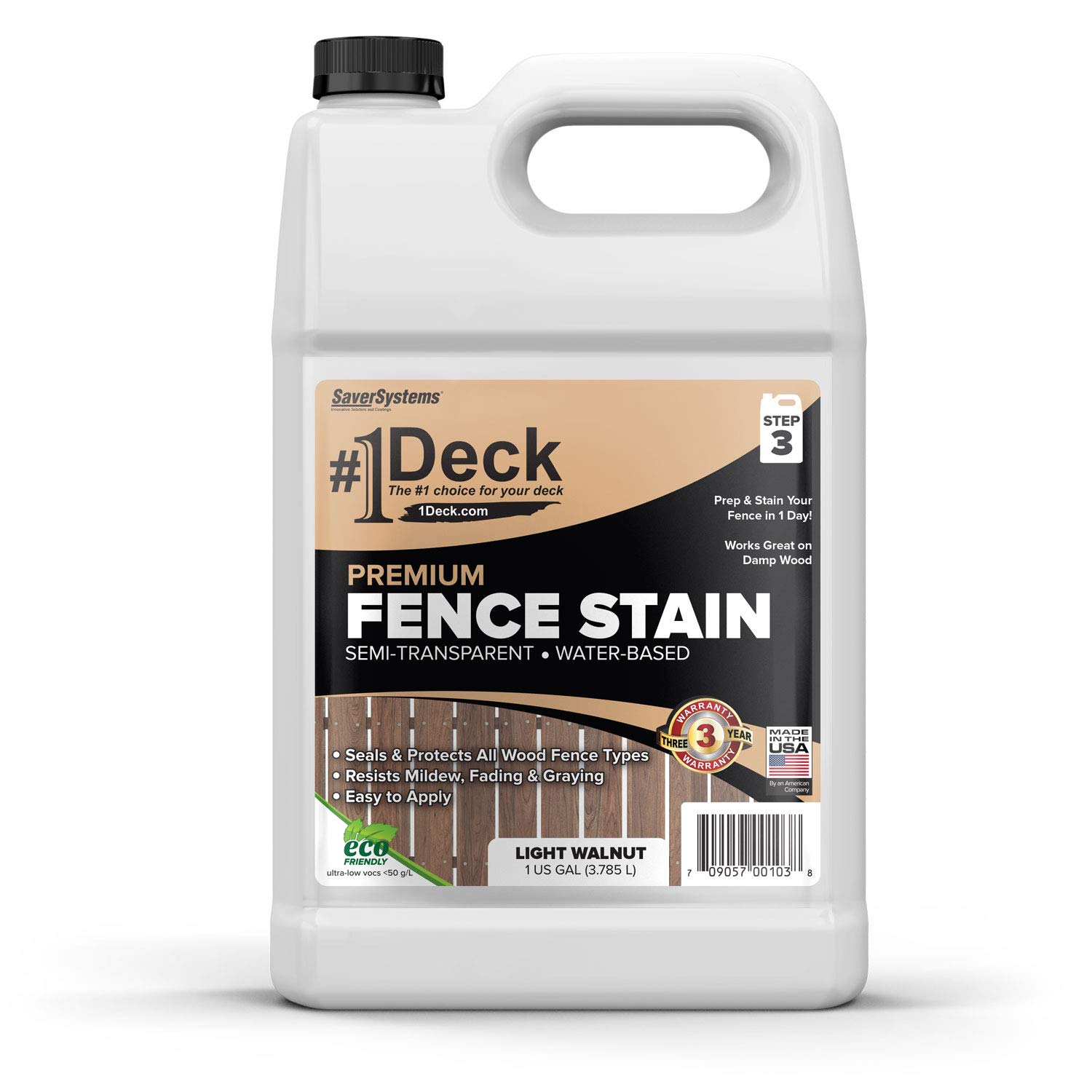
A low-odor water-based stain built to soak into pine, cedar and redwood and flat out on the fence
If your priority is a softwood fence rather than a high-traffic deck floor, SaverSystems is built for that exact job. It is water-based (carried by water, so it cleans up with soap and water), and it soaks deep into the wood pores so the grain still shows through. The flat finish means no sheen — just a natural-looking, even tone. A gallon covers 100-150 sq ft in two wet-on-damp coats. It goes on wood with a pump-up or airless sprayer plus a back-brush, or a quality nylon or polyester brush.
You get five shade options: Natural, Cedar, Light Walnut, Dark Walnut and Driftwood Gray. Buyers seem happiest with Walnut and Cedar, whether they want a light cedar color on a new fence or a rich even coat that holds its deep tone for the long haul. Reviewers mention the Texas heat test more than once, with fences still looking sharp after many months and a full hot summer.
The one place this finish gives ground is a busy deck floor. A high-traffic floor can wear through in a year and want a fresh coat, while the railings off to the side hold up fine. That makes this a natural for fences, siding and rails, and a so-so pick for the main walkway where feet and patio furniture grind day after day. The low-odor, under-250 g/L VOC formula is a welcome detail when you are working near the house.
Best-fit surface: fences, siding and railings in pressure-treated pine, cedar or redwood — a flat, natural look that soaks in rather than films.
The wear note: a heavy-traffic floor deck can demand a recoat after roughly a year; the vertical surfaces hold much longer.
Pick this for: a fence or siding refresh where low odor and a natural flat tone matter more than a glossy deck finish.
Think twice if: you are sealing the main floor of a hard-worn deck — that surface will want refreshing sooner.
4. KILZ Cedar Naturaltone 1-Gallon

A 100% acrylic stain that commits to its finish, backed by a warranty measured in years, not months
The spec that sets KILZ apart is right on the label: this one is warrantied up to 3 years on decks and up to 5 years on fences and siding. That is a company putting its name behind how long the finish should hold. The formula is 100% acrylic (a tough plastic-based binder), so it shields the wood from rain, snow and sun damage. It also carries fade-resistant, mildew-resistant and rainproof claims on top of UV resistance.
Coverage is where it makes its strongest practical case. One can handles roughly 250-300 square feet on the first coat and 500-600 square feet on the second, so a single gallon can genuinely finish a decent-sized project when you work in two passes. You wait 1-2 hours before recoating and the fully cured coat can be washed after 72 hours. The satin finish gives boards a soft sheen rather than a flat matte or a high gloss.
Buyers report the coating matches the label: it goes down clean and smooth once the old product is fully removed, and faded boards come back looking new. The recurring gripe is shipping, not the coating—cans occasionally go missing or arrive in rough shape. Running out mid-job is the most common regret, so some buyers order more than one can. Cleaning up with soap and water keeps the mess manageable.
The case for the can
- Warrantied up to 3 years on decks and up to 5 years on fences and siding
- Second coat stretches coverage to roughly 500-600 square feet
- 100% acrylic resists fading, mildew, rain and UV
- Soap-and-water cleanup keeps the job tidy
Skate these risks
- Some cans arrive battered or go astray in transit
- Two coats are the norm, so buy the second can up front
The smart bet for: a full deck or fence you want covered once and left alone, with a warranty that outlasts a single season.
Order two: a second can up front beats a mid-project scramble if the first coat drinks more than you planned.
5. Ready Seal Dark Walnut 1 Gallon

The stain beginners finish in an hour and a half because it blends itself and leaves no lap marks
Ready Seal takes the fuss out of staining. It is an oil-based stain and sealer in one, and it is self-blending — meaning overlapping passes melt together with no lap marks, streaks, drip runs or dark spots, so you can paint yourself out of a corner. You also skip the primer, the thinning and the back-brushing entirely. Coverage runs 125-150 sq ft per gallon.
Self-blending means overlapping passes melt together, so you skip back-brushing and lap marks. A first-time stainer finished a staircase in an hour and a half, and the finish looked sharp. There is UV protection against fading and weather damage in the formula, and it works on decks, fences, siding and outdoor furniture alike. The oil sinks into the wood for a rich, natural finish that enhances the grain. Because it self-levels, a simple brush-on is genuinely all it takes.
The trade-off here is patience with color, because the wood you start with biases the shade you get. On a red-toned wood, for example, a brown stain pulls differently than it would on a pale board, so testing a sample first is worth the ten minutes. Reapplication every year or two to freshen the look is the rhythm this finish settles into — regular owners treat that as routine upkeep rather than a chore.
Why beginners love it: self-blending oil means no lap marks and no back-brushing, so an amateur can turn out a professional-looking finish on the first try.
The color caveat: the wood beneath the stain shifts the final tone, so test a sample board before committing to the whole deck.
Ideal for: the first-timer or the impatient veteran who wants an even, streak-free finish without fussing over technique.
Skip the shortcut if: you want to recoat less than every couple of years — plan for a periodic refresher.
6. DEFY Extreme Composite Deck Sealer 1 Gallon

Goes on transparent to defend composite and wood from sun and water without covering the color
Most stains are not built for composite or Trex decks, but DEFY Extreme is. It is a crisp finish (no tint at all, so the board’s own color shows untouched), and it is engineered to block the black stains and fading that composite decking is prone to. The zinc nano-particles (microscopic zinc in the formula) work against graying and color loss, while the clear coat handles water and UV radiation.
It applies by sprayer, brush or pad and cleans up with soap and water. Apply with a sprayer, brush or pad applicator, and clean up with soap and water. It dries in 2-4 hours above 45°F, though you want to give it 24 hours before walking on it, and recoating is a simple matter of waiting for gray to appear. One gallon covers 100-150 sq ft for two coats. The key to good results is prep — the clear finish shows everything, so a clean board pays off. Apply it thicker, worked into the grooves, and a faded deck can come back looking close to new.
The mixed note is durability. This clear coat needs a heavier hand and honest wear expectations. Some boards show slight tackiness in direct sun or moderate heat, and a temporary milky white residue can appear where water beads before drying away. Whether it pays off over the long haul varies with the deck and the prep, so it is worth seeing this as a maintenance finish rather than a one-and-done. It is made in the USA per the label.
Where it shines: a clear, UV-blocking coat purpose-built for composite decking, easy on and easy to maintain, with zinc working against gray and fading.
The honest limit: a thin pass barely registers — apply generously, and expect the clear film to want a refresh when gray returns.
Made for you if: you are sealing a composite or Trex deck and want protection that leaves the board’s own color completely intact.
Not the fit for: painted or varnished surfaces — the label specifies bare composite or natural wood only.
7. Armstrong-Clark Cedar Semi-Transparent 1 Gallon
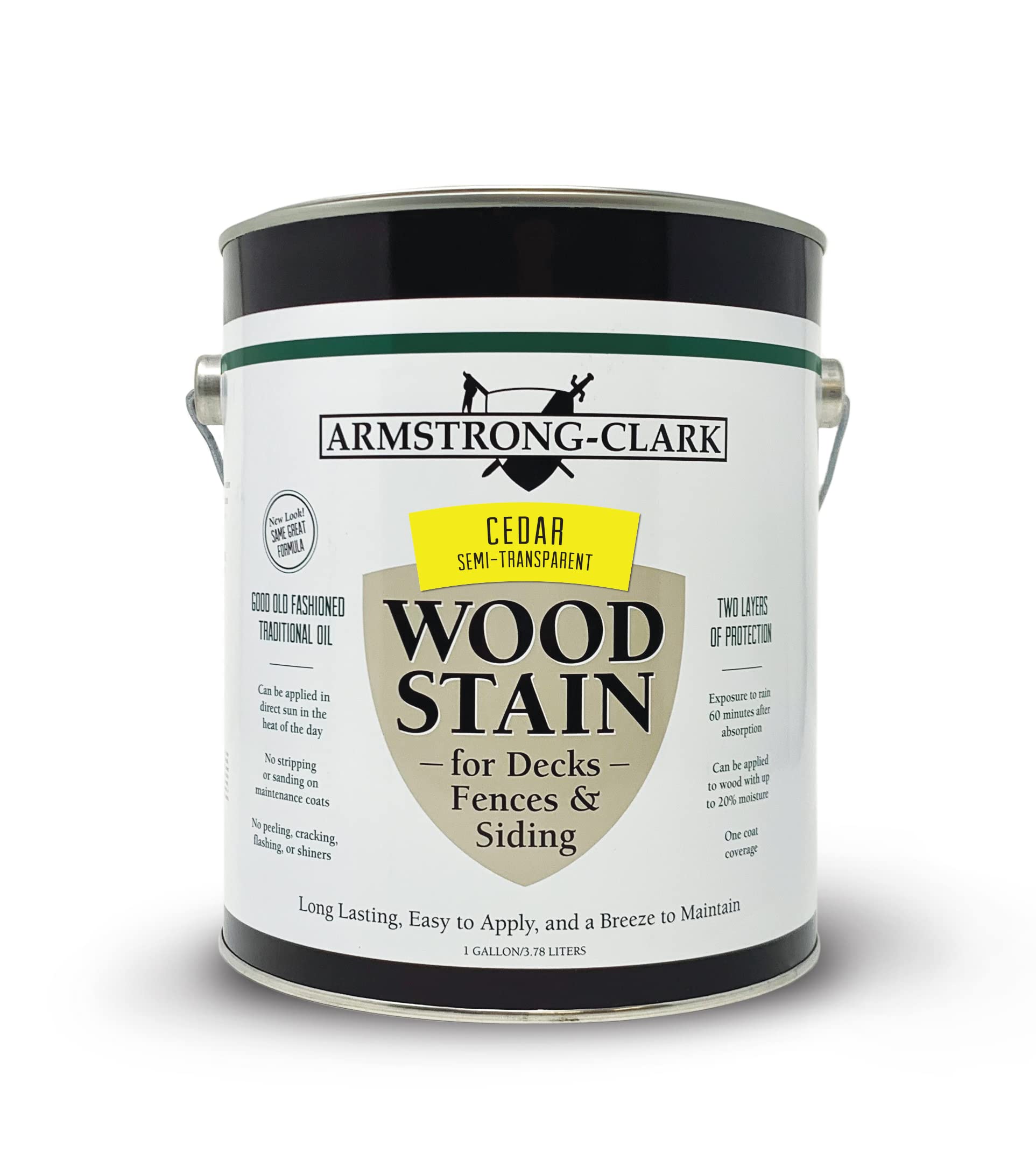
The pro-grade penetrating oil that skips the sanding and stripping come maintenance day
Armstrong-Clark sits at the top end of the range, and it earns that spot with maintenance, not just looks. This is a penetrating oil-based stain whose conditioning oils soak into the wood fibers, while drying oils lock in protection. Together they work against cracking, peeling and premature deterioration. The practical result is a maintenance cycle that typically means cleaning and reapplying — no extensive sanding, stripping or media blasting. That saves a huge amount of labor on a big deck.
It is built for softwoods, so it fits cedar, redwood, pine and pressure-treated decking, railings, pergolas and siding. Coverage runs 150-300 square feet per gallon, and the label spells out more specific figures for horizontal versus vertical surfaces. A cedar-tinted semi-transparent shade adds warmth without fully hiding the grain, and the oil can be applied in direct sunlight and warm temperatures. There is UV and water protection baked in, so boards are shielded against sun and rain.
Owner reports back it up: decks recoated three years running hold through Minnesota winters and hot summers. Decks that were coated three years ago and coated again hold up through Minnesota winters and hot summers. Cedar decks in southern exposure keep their color, and pressure-treated pine decking looks great a month after application. The one point to weigh is that maintenance oil finishes on softwood decks do want regular upkeep over the long run, so factor a recoat into your routine. Amber, Mahogany or Black Walnut are offered for hardwoods like Ipe and Mahogany.
Why the pros reach for it
- Penetrating oils condition the wood rather than filming over it
- Maintenance recoat means cleaning and reapplying — no heavy sanding
- 150-300 sq ft per gallon with vertical and hardwood coverage on the label
- Safe to apply in direct sun and warm temperatures
Weigh before buying
- It is a maintenance finish on softwood decks, so recoat on rhythm
- Exotic hardwoods like Ipe need the Amber, Mahogany or Black Walnut shades
Best for: the deck owner who would rather clean and reapply a coat than sand and strip the whole surface each season.
Check the shade list: on Ipe or Mahogany, pick Amber, Mahogany or Black Walnut instead of Cedar.
Know the Specs
Base material (oil vs. water vs. acrylic)
The base is what carries the pigment and binder onto your boards. An oil-based finish soaks into dense and oily woods that resist a surface film. A water-based finish goes down on damp or dry softwood, cleans up with soap and water and smells far less. An acrylic finish is a water-borne plastic binder that forms a tough, fade- and mildew-resistant film. Knowing your wood type tells you which base to reach for before you read any color name.
Coverage in square feet per gallon
Coverage is your buy-list number. It is how many square feet a single gallon protects, and it tells you whether one can finishes the job or you need two. A low figure like 100-150 sq ft means a two-coat application spread thin. A higher figure like 250 sq ft or 150-400 ft²/gal stretches across more boards. Measure your deck and compare to the label, and always buy to the number for the second coat.
Finish type and how it reads
Finish type describes how the surface looks when dry. A semi-transparent finish tints the wood while letting the grain texture show through—useful for evening out a fade. A clear finish shows the boards exactly as they are with no color added. Flat, satin and semi-gloss describe the sheen level, from no shine to a soft glow to a visible reflection. Pick your finish by if you want to see the wood’s raw color or a smooth, uniform tone.
UV and water resistance claims
UV resistance is protection against sun-driven fading and graying. Water resistance is what makes rain bead on the surface instead of soaking in. Look for explicit mention of both on the label, since these are the two forces that age a deck fastest. Mildew resistance and fade resistance are extra layers on top. A finish that names both UV and water protection is covering the main threats a deck faces outdoors.
Common Questions
Which coating is best for an Ipe or Cumaru hardwood deck?
Can I put a deck coating over composite or Trex boards?
How many coats does a deck stain usually need?
Do I have to strip and sand before recoating?
How long will a deck coating last?
Is a water-based stain better than an oil-based one?
What does semi-transparent actually hide on the wood?
Will my coating change the color of the wood?
Can I apply deck stain in direct sunlight or on a hot day?
How much stain do I need for a standard deck?
The Bottom Line
For most decks that need real protection plus a finish that ages gracefully, the DeckWise Ipe Oil is the best overall pick—it penetrates dense hardwood instead of filming over it, and the 250 sq ft coverage from one gallon goes a long way. If you own a softwood fence or siding and want the easiest path down, the SaverSystems water-based stain is the natural fit. And if you have a composite deck that has faded, the DEFY Extreme clear sealer is built specifically to bring that color back. Check the label’s coverage and wood compatibility before you order, and you will land the right coating the first time.
How we choose
We do not accept paid placement. Every pick is matched to a real buyer and a real use-case; we do not hands-on test units.
Sources
Specifications: manufacturer listings and product documentation. Review insights: verified customer reviews, as of October 2026. Pricing: not shown on this page (it changes often); check the current price via the retailer link.
As an Amazon Associate, Aappliancez earns from qualifying purchases. This does not affect which products we feature.