Disclosure: Some links in this post are affiliate links. As an Amazon Associate I earn from qualifying purchases, at no extra cost to you. Learn more
Specs are compiled from manufacturer listings and verified buyer reviews and can change over time — please confirm the key details on the product page before buying.
If your backyard has become a mosquito buffet, the fix that actually works is a CO2 mosquito trap that turns a fuel source into a steady plume of carbon dioxide — the same gas you exhale — so the insects fly toward it instead of toward you. These machines run day and night, quietly collecting insects you never see, and the three here are the ones real homeowners keep buying. Two of them burn propane (the bottled fuel your grill uses) to make that CO2 plume. One is electric only. That single difference decides how much of your yard gets covered, how much upkeep you sign up for, and which mosquitoes you are fighting.
This guide is built by comparing the manufacturers’ published specifications and the patterns across verified customer reviews, so you get each pick’s real strengths and trade-offs instead of marketing spin.
The hard part of a backyard setup is patience, because these traps do not clear a yard overnight — and every pick here needs a spot that is shaded, sheltered from wind, and close to a power outlet. What follows breaks down each CO2 mosquito trap by coverage, fuel, and the maintenance it quietly asks for.
Top Picks
How To Choose The Best CO2 Mosquito Trap
Buying one of these is less about the box and more about a deal you make with your own yard. You are promising to feed the trap fuel, give it power, and leave it alone for several weeks while the local mosquito population cycles down. Pick the wrong one and it sits dead in a corner; pick the right one and your evenings get quieter.
Start with the fuel, because it decides everything else
Carbon dioxide is what actually pulls mosquitoes in — it is the gas humans exhale with every breath, and these traps copy that signal. Two ways to make it: burn propane (the bottled fuel your grill uses) or buy a separate CO2 tank and emitter kit. Propane models run cordless but need a propane tank on board. Tank-and-emitter setups run on electricity and can catch more mosquito types, but you are now hauling gas cylinders and swapping them. Neither is wrong. They just cost you different kinds of effort.
Match coverage to your real outdoor space
A “1 acre” claim means the trap can reach across open ground on still air. Wind, trees, fences, and hills cut that down fast, so put the unit between the mosquitoes and the patio, not in a far corner. Placement is not a small detail — the traps that underperform are usually the ones stuck in a windy or sun-baked spot.
Count the true running costs before you commit
The unit is the cheapest part. Propane refills, CO2 tank exchanges, replacement catch nets, scent cartridges, and timers all add up season after season. A propane tank that lasts around three weeks sounds fine until you are trading it out every third weekend. Budget the refills, not just the box.
Expect weeks, not results on day one
These machines pull in egg-laying females before they bite. That breaks the next generation, but it takes time — often several weeks of continuous running before bites drop. Traps judged on night one always get returned.
Side-by-Side Comparison
| Model | Best For | Coverage | Power Source | Footprint (L x W x H) | Amazon |
|---|---|---|---|---|---|
| Biogents Mosquitaire★ Best Overall | Shady patios and biting-species control | Not stated | Corded electric (fan) | 15.4″L x 15.4″W x 10.6″H | Amazon |
| Mosquito Magnet Patriot Plus | Whole-yard coverage on propane | Up to 1 acre | Propane + corded electric | 20.2″L x 15.9″W x 17.2″H | Amazon |
| SkeeterVac SV5100 | Large lots wanting cordless placement | Over 1 acre | Propane (cordless) | 33.5″L x 20″W x 26″H | Amazon |
Detailed Reviews
1. Biogents Mosquitaire Outdoor Mosquito Trap
The compact, upgrade-ready trap built for Asian tiger and yellow fever mosquitoes.
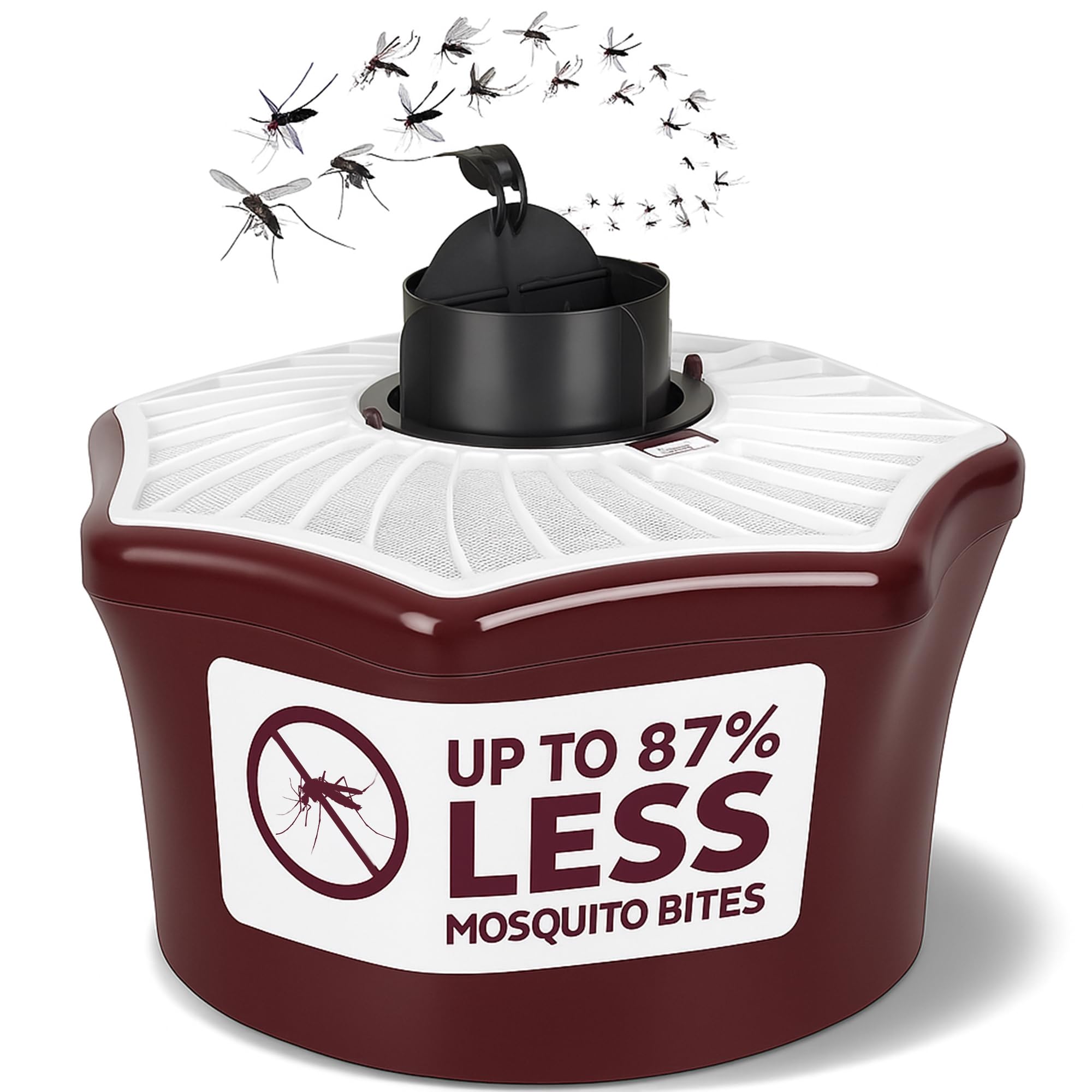
The Biogents Mosquitaire is the smallest pick here by a wide margin. It sits at 15.4″L x 15.4″W x 10.6″H and runs off a corded fan, so you can tuck it under a hedge or beside a shed where nobody notices it. That matters, because the species it targets — Asian tiger and yellow fever mosquitoes, the aggressive daytime biters — tend to work the shaded, humid edges of a yard. The trap uses no propane at all in its base form. Instead it draws mosquitoes toward the unit with a separately sold attractant called BG-Sweetscent that mimics the scent of human skin. The fan then pulls them in, holds them in a catch bag, and dries them out. The box even includes two catch bags, a US power supply with a 1-meter cable, and a 10-meter extension cord so you have reach for a shaded corner.
Here is the upgrade path that makes this the winner. Biogents states the unit runs up to 10x more efficient once you add a CO2 emitter set, sold separately as the BG-Booster. Adding that makes the trap effective on mosquito types beyond the two species it targets by default — which is why buyers who actually add CO2 report the dramatic catches. As one owner put it: “Effective: catches 20-30 mosquitoes/night; without CO2, bitten ~20 times in days.” That distinction — trap alone versus trap plus carbon dioxide — is the biggest pattern in the feedback, and it explains the wide spread in how well this unit performs. Pair it with CO2 and the catch climbs. Run it bare and the results are more modest, which lines up with the mixed reputation this one carries.
The running costs deserve a straight talk. Once you add CO2 you are buying a tank and refilling it, and you will also want a timer so the trap only runs from dusk to dawn — the hours when host-seeking mosquitoes are actually active. Owners have improvised here, using an aquarium CO2 solenoid on a smart plug instead of a dedicated timer, and running dusk-to-dawn to stretch the gas. The recurring complaint is cost: the trap plus a tank plus refills adds up, and a few find the price hard to justify against the catch. If you have a small shaded yard and are willing to add CO2 and a timer, this is the one that earns its keep.
The species edge: It is purpose-designed for the biting Asian tiger and yellow fever types, and it converts to broader coverage with the sold-separately CO2 emitter.
What to know: The base units are for a shaded patio with power access, not a big open lawn. Getting the most out of it means buying CO2 gear and a timer on top of the trap.
Doing right by your yard
- Targets Asian tiger and yellow fever mosquitoes before they bite
- Upgradeable to up to 10x more efficient with a CO2 emitter set
- Compact at 15.4″L x 15.4″W x 10.6″H for small, shaded patios
- Includes 2 catch bags, a US power supply, and a 10-meter extension cord
Before you commit
- Needs CO2 and a timer to reach its best, adding to running costs
- Corded fan means placement near an outlet, not out in the open
The right call when: you want a discreet, small-footprint trap for a shaded patio and are willing to add CO2 to widen the species it catches.
Worth waiting on: if you need one unit to cover a wide-open yard with no outlet nearby, the larger propane models suit you better.
2. Mosquito Magnet Patriot Plus Propane Mosquito Trap
Propane-powered coverage that leans on heat, moisture, and CO2 to pull insects in fast.
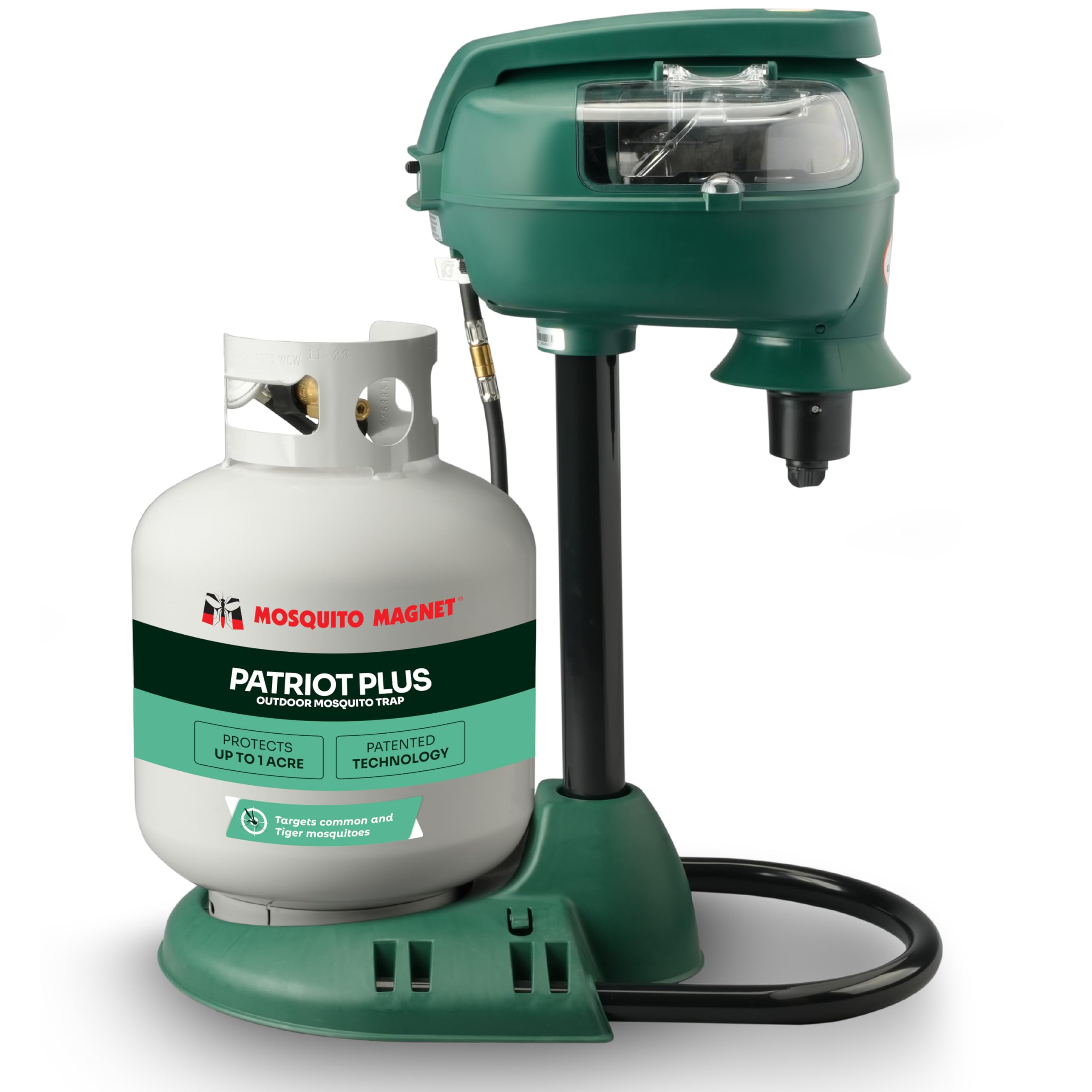
Where the Biogents needs an add-on to reach broader mosquito types, the Patriot Plus runs on propane from the start, burning it to produce the CO2 plume that host-seeking insects follow. The manufacturer says the counterflow design combines CO2, heat, and moisture to mimic human signals, then a vacuum pulls the bugs into a net. Because it runs on a standard propane tank — not included — with a 50-foot power cord, you can park it out in the yard away from the house, and the maker claims each tank fuels up to 21 days of continuous operation. The reach is where this unit separates itself: the manufacturer rates it for protecting up to 1 acre, and it targets not just mosquitoes but no-see-ums, midges, and black flies too. Building it is the easy part — the manufacturer describes a plug-in design with minimal assembly on a sturdy, non-tipping base that holds the propane tank.
The honest catch is what happens after that first season. Buyers report this trap runs beautifully at first — catching steadily, with one noting a full propane tank lasted 23 days — and then, for some, stops running altogether. It is a failure pattern that shows up repeatedly, often after the first summer is done, and the fix is rarely free once it is out of warranty. There is also some real maintenance built into ownership: a burner orifice that eventually clogs with propane residue and needs clearing, plus occasional issues with the igniter or power supply. None of that is unusual for a propane burner, but it does mean this is not a set-it-and-leave-it machine. Buy it knowing you may be cleaning a burner and, eventually, dealing with a repair.
Where the Patriot Plus lands is the whole-yard buyer. If your property is genuinely large and you have a solid propane source and a 50-foot cord reach, the coverage and the fuel-based CO2 output make it a serious tool. If you want something small, low-maintenance, and easy to move, its size and its upkeep push back. It sits at 20.2″L x 15.9″W x 17.2″H — bigger than the Biogents, smaller than the SkeeterVac below — and the brand backs it with a 1-year warranty, which matters given the season-two failure stories.
The coverage case: Up to 1 acre of protection with propane-fed CO2, heat, and moisture, plus a 50-foot cord for flexible placement far from the house.
Plan for upkeep: The burner orifice can clog over time and it may not survive multiple seasons without service — budget patience and repair money, not just fuel.
Best suited to: homeowners with a large lot who want broad propane-driven coverage and do not mind routine burner maintenance.
Think twice if: you want a fuss-free setup — the season-two reliability stories and orifice cleaning demand more attention than a simple corded trap.
3. SkeeterVac SV5100 Outdoor Mosquito & Backyard Insect Trap

The big-yard propane unit with the highest CO2 output and no power cord to drag.
The SkeeterVac SV5100 makes the largest CO2 plume of anything here. Its rated output is 35,000 cc/hour — cc/hour meaning cubic centimeters of carbon dioxide per hour — and that volume of gas is exactly what reaches across a large space to pull host-seeking mosquitoes toward the machine. It runs on propane and burns it to make that plume, and the manufacturer rates its coverage at over 1 acre, the widest claim of the three. The reason it can go that big is design: it is cordless, so there is no power cable to route and no outlet to sit near. Push the electronic ignition, and you are running. As one buyer put it, the unit is built for someone who wants the trap “away from the house,” not tethered to a wall.
The whole reason this unit exists is size. It measures 33.5″L x 20″W x 26″H and weighs 32 pounds, which in plain terms makes it a fixture — you set it where it needs to be and leave it, rather than moving it around like the compact Biogents. That bulk gives it the presence to dominate a big lawn or a property edge, and its cordless propane power means you can place it deep in the yard without running an extension cable. What wins owners over early on is how easy it goes together; the manufacturer claims assembly in minutes with no tools, and that lines up with the feedback, which consistently credits the trap for being quick and simple to put together.
Set your expectations on time and running cost, though. The manufacturer states plainly that this product takes 4 to 6 weeks to take full effect, so a trap that looks like it is doing nothing its first week is behaving exactly as designed. Value and reliability are the recurring sore spots in the feedback — some owners feel the ongoing cost of propane and upkeep is hard to square with the catch, and a few run into units that falter over time. On the positive side, owners mention the fuel is efficient, with the unit running well past three weeks on a single tank. One recurring practical gripe worth knowing: there is no propane gauge, so you find out a tank is empty only when mosquitoes return. Budget for a gauge and a spare tank, and give it a full season before judging.
Where it leads: The 35,000 cc/hour CO2 output and over-1-acre rating give it the widest reach of the three, and the cordless propane build frees it from any outlet.
The patience tax: Plan on 4 to 6 weeks to full effect, no built-in propane gauge, and the 32-pound, 33.5″L x 20″W x 26″H frame is not something you relocate on a whim.
Built for: sprawling yards that need high CO2 output and placement far from any outlet, where you leave the trap in position all season.
Look elsewhere for: a small patio you rearrange often — this unit is heavy, bulky, and slow to show results, so a compact trap fits you better.
Know the Specs
CO2 Output And What It Means In Your Yard
Carbon dioxide is the actual bait — the gas you breathe out, which mosquitoes track to find a meal. A trap that puts out more of it each hour reaches farther across open ground. The SkeeterVac SV5100 is the only one here that states an output figure, 35,000 cc/hour, which is why it carries the widest coverage claim at over 1 acre. More output is not automatically better, though: a big plume in a small, windy yard is wasted, and it burns fuel faster. Match the plume to the space.
Propane Versus Corded Electric
Propane traps like the Patriot Plus and the SV5100 make their own CO2 by burning fuel, so they run without a power cable to the trap head — anywhere you can set the tank. Corded units like the Biogents Mosquitaire run a fan off a wall outlet, which means no propane to buy or swap, but also no freedom from an outlet’s reach. A propane tank in the SV5100’s class runs past three weeks on a fill; going corded trades that fuel chore for a cord. Whichever you pick, placement near a shaded, wind-sheltered spot beats raw coverage on paper.
Common Questions
How long before a CO2 mosquito trap starts catching mosquitoes?
Do I really need to add CO2 to a mosquito trap that does not include it?
Is a propane mosquito trap better than a corded electric one?
How long does a propane tank last on these mosquito traps?
Can a CO2 mosquito trap clear a whole acre of yard?
Where should I place a CO2 mosquito trap for the best catch?
What does a CO2 mosquito trap cost to run each season?
Does a CO2 mosquito trap kill the mosquitoes it catches?
Why is my mosquito trap not catching anything yet?
Can I use a CO2 mosquito trap around pets and kids?
The Bottom Line
For shaded patios fighting aggressive daytime biters, the co2 mosquito trap to start with is the Biogents Mosquitaire because it is small, purpose-built for Asian tiger and yellow fever mosquitoes, and scales up to far broader coverage once you add the CO2 emitter set. If you have a large lot and want propane-driven coverage that reaches out to an acre, reach for the Mosquito Magnet Patriot Plus — just go in knowing it may need burner service after the first season. And for the widest, cordless, high-output coverage on a sprawling property, the SkeeterVac SV5100 is the one to anchor in place all summer. Whichever you choose, give it a full season of shaded placement and steady fuel, because the trap that catches the most is the one you actually keep running.
How we choose
We do not accept paid placement. Every pick is matched to a real buyer and a real use-case; we do not hands-on test units.
Sources
Specifications: manufacturer listings and product documentation. Review insights: verified customer reviews, as of October 2026. Pricing: not shown on this page (it changes often); check the current price via the retailer link.
As an Amazon Associate, Aappliancez earns from qualifying purchases. This does not affect which products we feature.