Disclosure: Some links in this post are affiliate links. As an Amazon Associate I earn from qualifying purchases, at no extra cost to you. Learn more
Specs are compiled from manufacturer listings and verified buyer reviews and can change over time — please confirm the key details on the product page before buying.
Stability is the spec you feel the instant you climb in, and it decides whether the day starts with a confident push-off or a near-swim. Get it wrong and every outing begins with a near-swim. The picks here run from a 10-foot sit-in (a solid hull you sit down inside) that slips into a minivan, to a 14-foot inflatable that carries three people and a motor. Match the boat to how you launch and how much weight you can lift alone.
This guide is built by comparing the manufacturers’ published specifications and the patterns across verified customer reviews, so you get each pick’s real strengths and trade-offs instead of marketing spin.
Below you get the hull shapes, the weight each boat puts on your shoulders, and the honest fit notes. The short version: match the hull to your water and the boat to your storage, and the rest follows. Here is what separates the strong options in this field: clear kayaks hinge on tube diameter, floor rigidity, and how the boat tracks through chop.
Top Picks

How To Choose The Best Clear Kayaks
Every kayak trades stability against speed, and the hull shape sets where yours lands. A wide, flat-bottomed boat feels rock-solid the moment you sit down but pushes water and feels slow. A narrow, V-shaped hull cuts through the water faster but asks for more balance. Most buyers here want the rock-solid feel, not the extra glide.
Sit-In Versus Sit-On-Top Versus Inflatable
A sit-in kayak (where your legs go inside the hull) gives you a drier, warmer ride and sheds wind better. A sit-on-top (where you sit above the shell) makes falling out and climbing back in far easier, which matters for fishing and families.
An inflatable kayak trades a little speed for storage. Deflated, it fits into a bag in a car trunk or an RV compartment, and a rigid plastic boat does not. If you have no roof rack or no garage, that difference decides the purchase.
Weight — the Spec You Will Feel Every Trip
Every pound is a pound you lift onto the roof or haul up a ramp. This field ranges from around 39 pounds up to 76 pounds, and that spread is the difference between one person loading solo and needing two.
A lightweight sit-in can go up on a roof rack alone, even for an older paddler. A heavier tandem usually wants a second set of hands. Read the number before you fall for the hull shape.
Weight Capacity and How Much Room You Really Get
Capacity is the total pounds the boat is rated to float, including you, your gear, and a cooler. That number sits between 275 pounds on the single-person fishing boats and 770 pounds on the largest inflatable here.
Leave headroom under the limit. A boat paddles better and stays drier when you are not sitting at the very top of its rating, and gear weight adds up fast.
Side-by-Side Comparison
| Model | Best For | Seats | Weight | Max Capacity | Amazon |
|---|---|---|---|---|---|
| Pelican Argo 100XR★ Best Overall | Solo day paddling | 1 | 43 lb | 300 lb | Amazon |
| BRIS 14.1ft InflatableRoomiest Hull | Motorized lake trips | 3 | 39 kg | 770 lb | Amazon |
| Wilderness Systems Pungo 120Fastest Glide | Efficient long trips | 1 | 49 lb | — | Amazon |
| Goplus Tandem Inflatable | Beginner tandem paddling | 2 | 39 lb | 507 lb | Amazon |
| GYMAX Inflatable Kayak | Two adults plus gear | 2 | 39 lb | 507 lb | Amazon |
| OCEANBROAD Inflatable | Solo inflatable touring | 1 | 38.5 lb | 308 lb | Amazon |
| Sevylor Big Basin 3-Person | Family calm-water trips | 3 | 44.3 lb | 490 lb | Amazon |
| Pelican Sentinel 100X Angler | Fishing from a sit-on-top | 1 | 20 kg | 275 lb | Amazon |
| Perception Flash 9.5 | Nimble sit-in handle | 1 | 41 lb | 325 lb | Amazon |
| Lifetime Kokanee | Budget tandem family | 2 | 76 lb | — | Amazon |
| Perception Hi Life | Stand-up and sit-down hybrid | 1 | 55 lb | 280 lb | Amazon |
Detailed Reviews
1. Pelican Argo 100XR
Our pick — 4.5+★ from 300+ verified ratings; the strongest balance of quality and price.
The 43-pound sit-in that fits inside a minivan and still tracks through wind gusts.
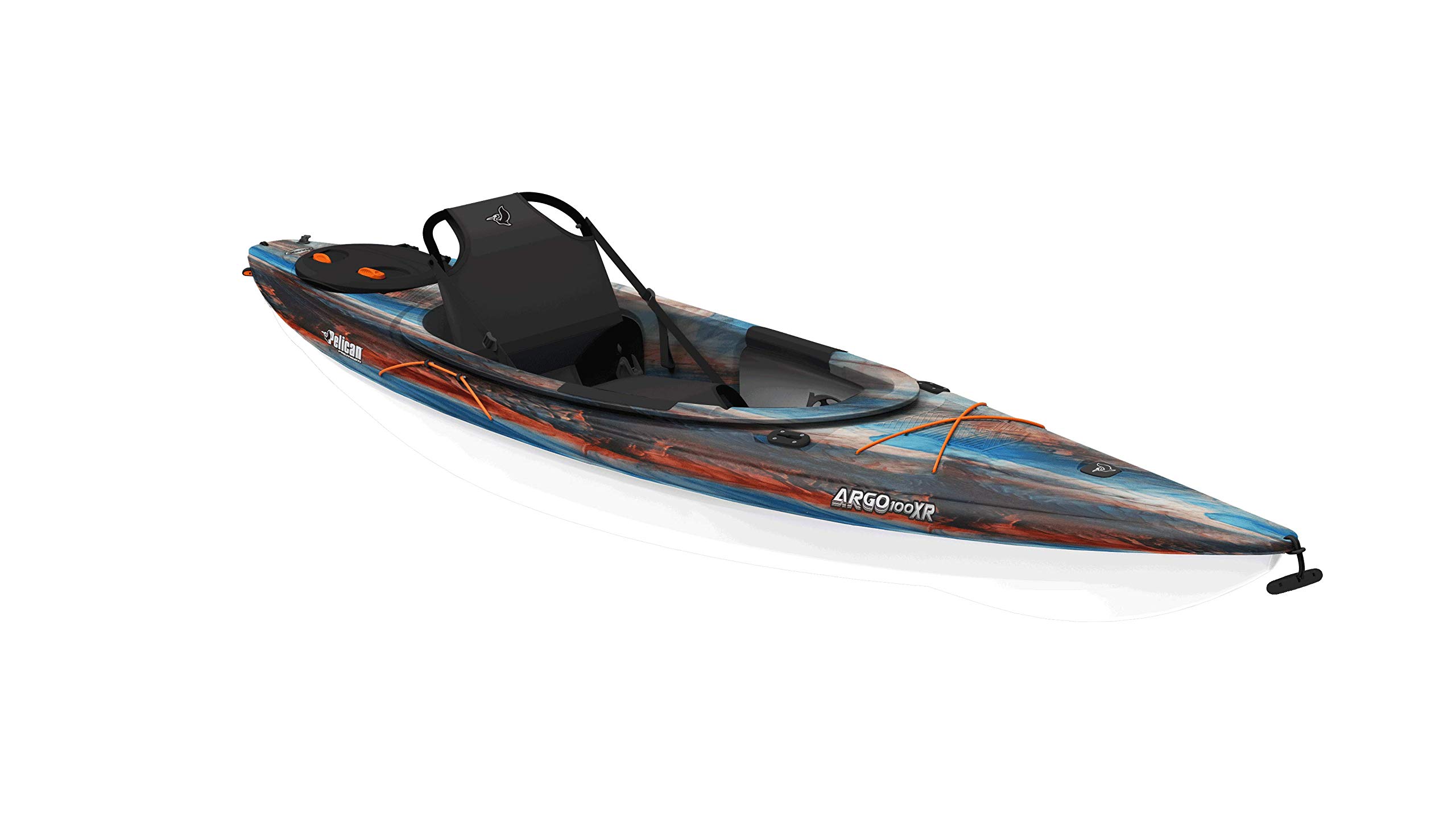
The number that decides this pick is 43 pounds — the total weight of a 10-foot sit-in kayak made from high molecular density polyethylene, a tough plastic that needs less material to build the hull. That weight is why it goes on a roof or into a trunk without a second person. The Twin-arched Multi Chine Hull, a double-curved shape with ridges running nose to tail, gives you a flatter, steadier floor so getting in and out does not feel like a balance test.
A click on the numbers: 120″L x 29″W x 12.75″H is the footprint, and the 300-pound capacity covers you plus a dry bag and a cooler without strain. The Ergocoast seating system lifts out, so the seat doubles as a beach chair at camp. You get a back quick lock hatch with a storage bag, a front storage platform with bungee cords, adjustable footrests, knee pads, a bottle cage, a second bottle holder, and two 1-inch rigging tracks for accessories. Floating blocks on each side add flotation if you take on water.
What wins people over is the build, with comfort right behind it — owners describe a boat that feels solid rather than flimsy, and the removable high-back seat is the reason long afternoons do not wreck your back. Trackability holds up too: paddlers take it through 10 to 15 mph wind gusts and report it stays pointed. The recurring gripe is cosmetic — the thermo-formed polyethylene scratches and can arrive with a pushed-in stern if the box took a hit, so look the hull over before the delivery driver leaves. The crowd favorite here sits 4.5+ stars across 300+ owners, and it earns that on stability rather than speed.
What Earns It First Place
- 43 lb and 120 inches long — one person can lift it and a minivan swallows it whole
- Removable Ergocoast seat turns into a camp chair and adjusts for back support
- 300 lb capacity with floating side blocks for extra confidence
- Rigging tracks, bottle cage, and a lock hatch with bag already built in
Where It Asks Patience
- The polyethylene scratches and dents on impact, so roof-rack loading needs care
- Class 2 water puts water inside the cockpit — it is a flat-water and class 1 boat
Strongest all-rounder: a solo paddler who wants one easy boat for lakes, calm rivers, and a car trunk.
Think twice: if you plan on whitewater past class 1 or want a hull that shrugs off rock scrapes.
2. BRIS 14.1ft Inflatable Boat
The three-person inflatable that swallows an outboard motor and still rolls into an RV bay.
Start with the gap that matters: this boat seats 3, while the Pelican Sentinel above seats 1 — a 3.0x difference in how many people come along. The hull is 1,100 Denier PVC (denier is the thread thickness measure, so a higher number means a heavier, tougher cloth) with a polyester backing, and the maker states it runs heavier than most 1,000 Denier fabric. Every seam is heat-welded, and most are quadruple overlap, so salt water and extreme humidity should not work them loose.
The 17.5-inch tubes are large-diameter, which means more buoyancy and a steadier ride when the water gets choppy. Underfoot sits a high-pressure drop-stitch air floor — a floor built from thousands of internal threads so it inflates rigid like a hard deck — and you can stand, walk, or jump on it. Each side tube carries two air chambers for extra safety. You also get a one-way drain valve, four fins for tracking, three marine plywood bench seats, two aluminum oars, a carrying bag, a repair kit, and a foot pump.
The 770-pound maximum is the highest here, and it is why this boat takes a motor. A 4hp 2-stroke or 6hp 4-stroke outboard pushes it onto plane at the right pressure. Buyers report the floor inflates in around 15 minutes with a Ryobi inflator plus the foot pump, and that it has held air with no patches after 3 years, dog aboard. The seam durability gets split reactions — some boats hold up beautifully and others develop pinholes — so check the seams on arrival. The carry-bag handles are the weak point; swap in cinch straps before you haul it far.
Best use for it: a family or angler who wants a three-person boat that packs flat, takes a motor, and does not need a roof rack.
The real catch: the maker’s 3-person rating is optimistic — a paddler notes it fits 2 adults plus 1 child, not 3 grown adults, so size the crew to reality.
Reach for this if: you want one inflatable that seats a family and accepts an outboard for lake runs.
Look elsewhere if: you expect three full-size adults to paddle it comfortably.
3. Wilderness Systems Pungo 120
A 12.2-foot sit-in built for the paddler who wants to cover water without wearing out.
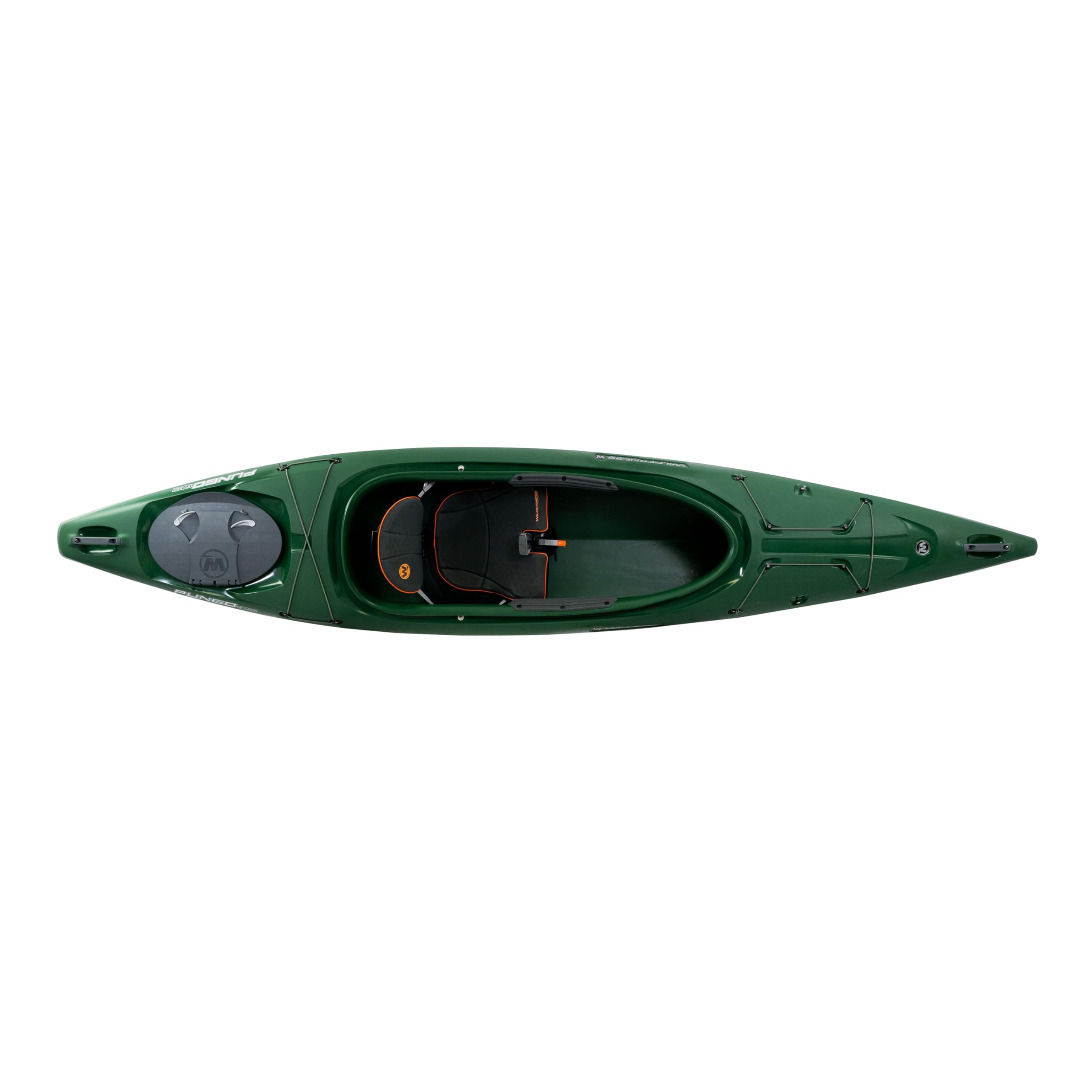
The headline here is the Phase 3 AirPro seat — fully adjustable, with a mesh-covered honeycomb-vented foam that lets air reach your back so you stay cooler on long stretches. The honeycomb pattern means the foam is perforated with open cells rather than solid, which is why it breathes. The hull under it is the reason the Pungo carries its reputation: a shape that keeps stability without giving up glide, so you can lean into a turn without the boat flipping.
At 49 pounds and 12.2 feet long, it is a longer, more efficient boat than the pelican-style 10-footers, and it tracks straighter for it. Adjustable footrests and thigh pads dial the fit for small to medium paddlers. The performance focus is what owners talk about most — this boat is chosen by people who want range, not just a float. Speed is the recurring note: it cuts through the water easier than short recreational hulls, which is exactly the trade you make for a longer, heavier boat.
The trade-off is on the dashboard. The clear-cover waterproof box gets very hot in direct sun, and one owner had the drybox latch pop off every time it opened, plus water finding its way past the bulkhead into the aft storage. That is a fit-note for anyone who plans to keep electronics or a camera in those compartments — bring a separate dry bag. Support contact runs through a web form, which is worth knowing before something goes wrong.
Why Paddlers Commit To It
- top-tier speed for a recreational sit-in, so long trips feel shorter
- Phase 3 AirPro seat vents air and adjusts for real back support
- Stable enough to stand up and step out mid-water, and to lean into turns
- Ample storage room with a dashboard and dry compartments
The Honest Fit Notes
- The clear dashboard box bakes in the sun — keep electronics in your own dry bag
- Not suited for waves over 2 feet, so open water needs a calm day
The pick for distance: a paddler focused on speed and range across lakes and slow rivers.
Pass it up if: you paddle big open water where waves run past 2 feet.
4. Goplus Tandem Inflatable Kayak

A 12.5-foot two-seater that beats a rigid hull on storage and asks less of your arms.
A 12.5-foot inflatable tandem rated to 507 pounds, built from reinforced laminated PVC with a mesh layer — that mesh is the key to it being puncture-proof, sun-proof, and wear-resistant enough to shrug off wave impact. The floor is anti-slip and pressure-resistant, so it stays flat under a full load. Three chambers keep you floating even if one takes a hit, and two fins at the rear give you simple direction control so beginners do not spin in circles.
You get two double-bladed aluminum paddles, two adjustable EVA seats with high back support, and three-level adjustable footrests. Four handles move it to the beach, bungee cord front and rear holds gear, and a drain hole keeps water from collecting inside. The pump fills it to a maximum pressure of 2.18 PSI, and deflated it stows in the carry bag.
The boat itself earns its keep — the quality is what people notice, and the drop-stitch floor keeps the hull rigid when loaded past 400 pounds. Owners note more usable space inside than some rivals. Where it stumbles is the accessories: the seats are the most common complaint, some paddlers find them too low and unsupportive and swap in better ones, and the paddle holders sit where your hands want to be. The paddles themselves have connectors that land under your grip. Plan on upgrading both over time and this boat still makes sense.
Where it earns trust: the rigid floor and 507-pound rating, on a boat you can deflate and stow in a trunk.
Budget the upgrades: the seats and paddle clips are the first things to replace, and most owners do.
Suits you if: you want a two-person inflatable for lakes and easy rivers without paying premium prices.
skip it if: you want plush seats and refined paddles straight out of the bag.
5. GYMAX Inflatable Kayak
The 507-pound tandem that lets a big adult stand on the floor without it sagging.
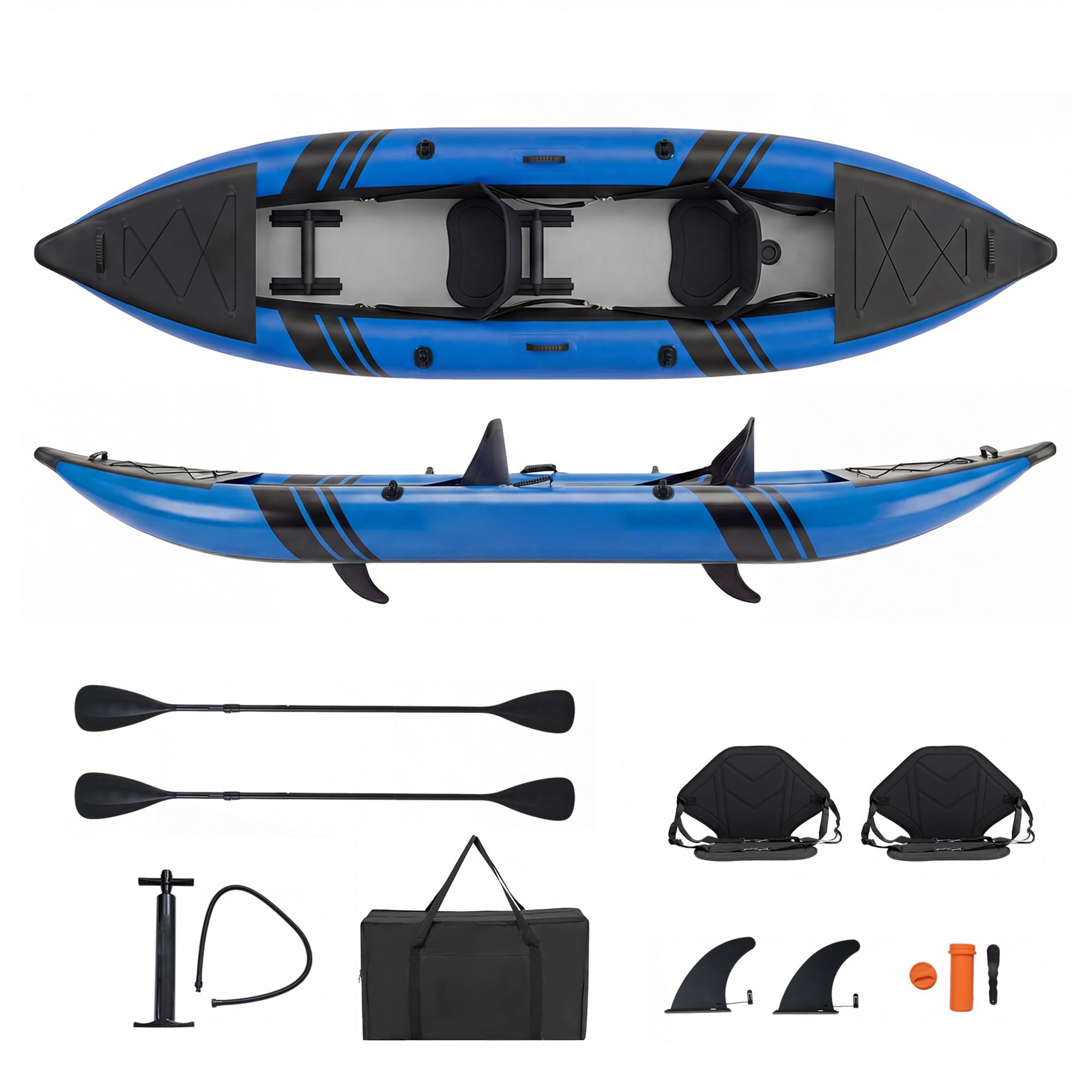
Where this one pulls ahead is the floor. The removable drop-stitch insert inflates rigid enough to hold a 165-pound paddler standing without bending, and that rigid deck is what makes a 12.5-foot inflatable feel closer to a hard boat. Material quality is the thing owners praise most, and with 507 pounds of capacity across 150 inches of length you can load two adults plus gear front and rear without the hull wallowing. Three independent air chambers make inflation and deflation quicker and safer.
You get two padded EVA seats with backrests, a three-position footrest, two aluminum three-section detachable paddles, two fins, a hand pump, a carry bag, and a repair kit. The zipper bag behind the seats and bungee cords up front keep your snacks and dry bag off the floor. At 39 pounds it is one of the lighter tandems here, and deflated it packs down for transport.
Now the honest part. The boat is genuinely sturdy, but owners describe the seats as the weak link — back support is thin and the straps slip, so a seat upgrade is common. The finish is decent but not flawless, and a few note the durability has limits if you run it hard. The tracking is where the fins do their job; owners mention it holds a line without constant correction. This is the tandem to choose if capacity and a stiff floor matter more to you than plush seating.
What Makes It A Contender
- Drop-stitch floor stands up to a 165 lb paddler without flex
- 507 lb capacity and 12.5 ft length fit two adults with gear
- Three air chambers and two skegs for safety and straight tracking
- 39 lb weight and full accessory kit in the box
What You Might Swap Out
- The seats are thin — many owners buy replacements for long days
- Durability is rated mixed, so treat the seams and valves with care
Strong fit for: a heavier paddler or two adults who want a rigid floor and generous capacity.
Weigh it against: a boat with better factory seats if you plan on all-day paddling.
6. OCEANBROAD Inflatable Sit-in Kayak

A solo inflatable that a teen can haul a hundred yards and a sedan can swallow whole.
This is the single-person inflatable for the paddler with no garage and no roof rack. At 38.5 pounds and 10.5 feet it folds down and rides in a car trunk, but the drop-stitch floor is what gives it a hard-boat feel. A drop-stitch floor is built from thousands of internal threads so the deck inflates stiff and flat, and the maker states it gives more rigidity and support than a beam-style floor. Three chambers, durable vinyl sides, and Halkey-Roberts valves — a marine valve type built to hold higher pressure without leaking — round out the safety package.
The 308-pound capacity covers one adult plus gear. A padded EVA seat, footrest, drain hole, and a removable direction fin come as standard, along with an 86-inch paddle, a hand pump, and a repair kit in a duffel bag. The fin is what makes it track; without it, owners note the hull wanders, so leave it on.
What most impresses buyers is the build for the money — the sides are stiff, the floor is tough, and it handles calm water and moderate rapids without drama. The ride is stable enough to be safe with a child up front. Two honest limits: the included seat is flimsy and the footrest is a formality, and the thin bottom wants care around jagged rocks. The scupper holes, the small drains in a sit-on hull, can struggle to clear splash. Swap the seat and pad the bottom and this becomes a serious solo boat.
The reason to buy: a rigid drop-stitch floor and 308-pound rating in a package that fits a trunk and weighs 38.5 pounds.
The catch: the factory seat and footrest are the first things to replace, and the thin floor needs care on rocky launches.
Made for: the solo paddler with a car trunk and no storage space who still wants a firm deck.
Not ideal if: you plan on rocky riverbeds or want a supportive seat from the start.
7. Sevylor Big Basin 3-Person

An open-hull three-seater that keeps kids steady and no one worried about a flip.
This is the calm-water family boat. It seats three, carries up to 490 pounds, and runs 12 feet 3 inches by 3 feet 1 inch — a wide, stable platform. The heavy-duty PVC shell has a tarpaulin bottom for puncture protection, and the multiple air chambers mean a single puncture will not sink the boat. The Boston Valve is double-threaded for easy inflation and deflation, and adjustable seats move to fit the crew.
What families like most is the stability and the sturdy build; it will not flip with kids aboard, and the thick material stands up to real use. It is more of an open-hull sit-in canoe than a kayak, so expect a low-sided, splashy ride on windier days rather than a dry one. Spray covers help keep the splash out, but chop still finds its way in.
The seam-inflation factor gets attention — the foot pump works but is slow, and a larger pump is a common upgrade. The seats are thin and the crevices are awkward to dry, which matters if you store it damp. The boat fits two six-footers comfortably and a third small passenger, so treat the three-person rating as a family figure, not three adults. No paddle is included, so factor that in.
The Family Case
- 490 lb capacity across three seats for a kid or two and a parent
- Multiple chambers and a tarpaulin bottom for real puncture backup
- Adjustable seats and spray covers to keep the crew happy and dryish
Where The Budget Shows
- The included foot pump is slow — budget for an electric or larger pump
- Seats lack support and damp crevices are hard to dry out
- No paddle in the box, and no spare bladders sold in the US
Good for: a family with young children who want a stable, roomy boat on calm water.
Choose differently if: you need a dry ride, strong seats, or a motor-ready hull.
8. Pelican Sentinel 100X Angler

A 9’6″ sit-on-top that lets you cast, reel, and climb back aboard without tipping.
The sit-on-top shape is the whole point here. A multi-chine flat bottom hull — a shallow, multi-faceted base — keeps the boat steady the moment you lean to cast, and the open deck means you can slip off and climb back with a paddle float. At 9’6″ and 20 kilograms, it stays easy to carry and stow. The hull is built from the maker’s Ram-X material and carries extra flotation inside to meet or surpass ABYC Standards (a US boat-building standard for flotation).
You can fish straight from the start, because the angling kit is already fitted: two flush-mount rod holders (sockets set into the deck), two paddle/rod tie-downs, a front storage platform with mesh deck cover, a rear tank with bungee cord, and the ExoPak — a removable storage compartment that drops into the tank well. Adjustable footrests and a backrest seat cushion let you fit the boat to your body. Maximum capacity is 275 pounds, so pack light if you are a big paddler.
Owners treat this as a serious fishing platform — stable enough to reel in a 30-inch gar and a tarpon in the Everglades, and it floats even when a boat wake floods the deck. It is not wide enough to stand and cast comfortably, and the seat wears on a long day, but for seated fishing it does the job. The 275-pound ceiling is the number to respect.
Why anglers like it: two rod holders, the removable ExoPak, and a flat-bottom hull that stays planted while you cast.
Fit to watch: 275 pounds of capacity is the lowest here, so heavy paddlers should size up.
Choose this for: seated fishing on lakes and inshore water where a stable, open deck wins.
Look elsewhere if: you want to stand and cast, or need more than 275 pounds of capacity.
9. Perception Flash 9.5

At 41 pounds, this is the sit-in a seventy-year-old can lift onto an SUV solo.
Weight is the win here — 41 pounds, and owners note that even a 70-year-old can lift it onto a roof rack without help. It is a sit-inside hull made in the USA from polyethylene, 9.5 feet long with a super-wide cockpit and an under-deck storage area. Adjustable foot braces and a roomy interior fit a range of paddlers, and the molded handles make carrying easier.
Capacity runs to 325 pounds, a bit roomier than the Pelican Sentinel’s 275 pounds. Built-in rod holders and a rear storage compartment make it a fishing-capable sit-in, and the wide cockpit makes entry and exit simple. On calm water it tracks and glides well, and the seat back adjusts simply to dial in support. It fits tightly in a Honda Element and slides into a truck bed with the tailgate down.
The honest trade-offs: the seat runs thin for long days, and the footrests feel flimsy to some. It tracks poorly in wind, so novices should pick a calm day. The appearance and stability are what owners point to most — this boat looks sharp and stays steady on calm coastal water. For leisure paddling, the value is hard to argue with.
Where It Wins
- 41 lb — easy solo roof loading and garage storage
- 325 lb capacity with a wide, easy-entry cockpit
- Rod holders and under-deck storage built in
- Molded handles and adjustable foot braces for a fitted ride
What To Expect
- The seat is thin for multi-hour trips — bring a pad
- Tracks poorly in a strong wind, so save it for calm days
Right for: a solo paddler who wants a light sit-in that loads easily and handles calm water.
Consider another hull if: you paddle windy open water or want a plush seat.
10. Lifetime Kokanee Sit-On-Top

A 10’6″ two-seater that flips easily between tandem and solo paddling.
Built from UV-protected high-density polyethylene, this is the durable plastic family boat — the material is molded into a hard shell that shrugs off sun and knocks. It seats two, allows solo or tandem paddling, and comes with two adjustable quick-release seat backs. Multiple footrest positions fit different-sized paddlers, and a 6-inch storage hatch and bungee system hold your gear.
The honest trade is weight: at 76 pounds, it is the heaviest boat here, and getting it on a roof solo is a chore. Two people makes it easy. It tracks straight and stays stable in medium wind and chop, but it is not fast, and a longer paddle is recommended — a short one hits the sides and drips water into the boat. The seats have sturdy hard plastic backs but no butt padding, so a foam pad is a fair fix. A small child in the middle is cramped.
Owners call it a great family kayak, and the quality and stability are what earn that. The storage holes are the weak spot — items slide around — and an occasional unit arrives damaged in shipping, so inspect on delivery. For the price of a two-person hard boat you get a tough, stable platform.
Why families pick it: a tough HDPE shell, two quick-release seats, and a low price for a tandem hard boat.
What you give up: speed and a light carry — 76 pounds and a modest pace are the trade.
Best for: a two-person household that wants a durable, stable tandem on a budget.
Not for you if: you paddle solo and need to load the roof by yourself.
11. Perception Hi Life
The 11-foot hybrid that lets you sit down, stand up, and cool a drink under your seat.
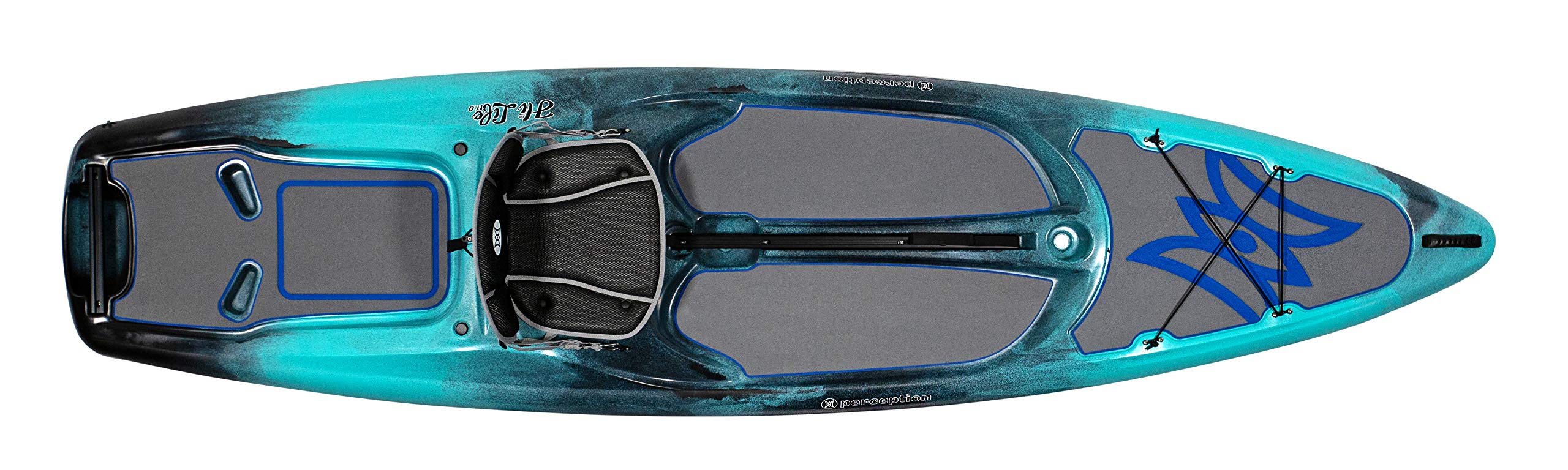
This is a kayak and a stand-up paddle board in one hull, made in the USA for flat, slow, and calm coastal water. At 11 feet long, 34 inches wide, and 55 pounds, it gives you either a seated paddle or a standing deck. Front and rear swim decks with low sides and hand grabs make getting in and out simpler, and the improve seat with a fold-down backrest and thick padding keeps you comfortable either way. Maximum capacity is 280 pounds.
The fun details are practical: a drink holder up top, a built-in cooler under the seat for drinks or snacks, and enough stability that you can stand without the hull feeling like it wants to roll. Owners praise the versatility most — it slides between kayak and SUP depending on the day, and the stability is what makes that switch possible. It loads and unloads with less fuss than a long sit-in, and it stays secure in windy conditions.
The honest limits: the seat fastens with plastic button punches that can pull through, and more than one owner fixed it with wider washers. On the water it is not fast or exceptionally maneuverable, and open ocean waves are not its home. It also needs the convertible paddle (sold separately) to reach its full stand-up potential. For lake days and family water time, it earns its place.
The Hybrid Case
- 11 ft, 34 in wide, and 280 lb capacity for one paddler plus gear
- Sit-down seat and stand-up deck in one hull
- Built-in cooler under the seat and front/rear swim decks
- Stable enough to stand and secure in windy conditions
Worth Knowing
- The seat’s plastic button punches can pull through under heavy use
- Not fast and not at home in open-ocean waves
- The stand-up paddle is sold separately
Pick it for: a paddler who wants to alternate between sitting and standing on calm lake days.
Steer clear of: open-ocean surf or anyone who needs speed over versatility.
Know the Specs
Hull Shape and Stability
A flat, multi-chine hull has ridges along its base that create a wide, planted surface in the water — that is why sit-on-top fishing boats can stay steady while you cast. A V-hull cuts through chop with less bounce but asks for more balance. A twin-arched multi-chine sit-in, like the Pelican Argo, splits the difference with a flatter floor that makes getting in and out easier. Pick the hull for the water you actually paddle, not the one in the product photo.
Drop-Stitch Floors and Tube Diameter
A drop-stitch floor is built from thousands of internal threads so it inflates stiff like a rigid deck — that is why an inflatable with one can let you stand or kneel instead of just sit. Tube diameter does a different job: bigger tubes, like the 17.5-inch ones on the BRIS, push more water aside and add buoyancy and stability. A rigid drop-stitch floor and fat tubes are what separate an inflatable that paddles like a hard boat from one that wallows like a pool toy.
Common Questions
Will a 43-pound kayak fit inside a minivan?
Is an inflatable kayak as stable as a hard plastic one?
What is a drop-stitch floor and why does it matter?
Can I use a trolling motor on a three-person inflatable?
How long does it take to inflate an inflatable kayak?
Is a sit-in or sit-on-top easier to climb back into if I flip?
How do I keep an inflatable kayak from getting moldy?
Do I need a roof rack for a 76-pound tandem?
What does weight capacity actually include?
Will a short sit-in kayak track straight in wind?
Can two adults really fit in a two-person inflatable?
The Bottom Line
For most paddlers, the clear kayaks winner is the Pelican Argo 100XR: 43 pounds to lift, 300 pounds of capacity, a removable seat, and a 10-foot hull a minivan can swallow. If you want a fast, efficient sit-in for covering distance, grab the Wilderness Systems Pungo 120. And for family trips where three people and a motor are part of the plan, the BRIS 14.1ft Inflatable is the one to reach for.
Any of these eleven will float you safely, so let your storage space and your solo carry strength pick the shortlist, then buy the hull that suits your water.
How we choose
We do not accept paid placement. Every pick is matched to a real buyer and a real use-case; we do not hands-on test units.
Sources
Specifications: manufacturer listings and product documentation. Review insights: verified customer reviews, as of October 2026. Pricing: not shown on this page (it changes often); check the current price via the retailer link.
As an Amazon Associate, Aappliancez earns from qualifying purchases. This does not affect which products we feature.