Disclosure: Some links in this post are affiliate links. As an Amazon Associate I earn from qualifying purchases, at no extra cost to you. Learn more
Specs are compiled from manufacturer listings and verified buyer reviews and can change over time — please confirm the key details on the product page before buying.
Water that darkens your concrete instead of running off it is the whole problem in one image. A good clear sealer changes that — rain beads up, the slab stays its natural colour, and you are not repainting a patch every spring. The catch is that “clear sealer” covers two totally different products: film-forming acrylics that leave a low-gloss wet look, and penetrating silane-siloxane formulas that soak in and stay invisible. Pick the wrong type for your surface and you either get a slippery sheen you did not want or a coating that peels within a season. This guide sorts the seven strongest options by what they are actually built to do.
This guide is built by comparing the manufacturers’ published specifications and the patterns across verified customer reviews, so you get each pick’s real strengths and trade-offs instead of marketing spin.
You will see how each one handles water, sun and foot traffic on driveways, patios and pavers. By the end you will know exactly which clear concrete sealer matches your slab.
Quick Picks
- Armor AR350 Low Gloss Wet Look Concrete Sealer
- OAIEGSD 1 Gallon Concrete Sealer — Budget Champion
- OAIEGSD Penetrating Concrete Sealer — Most Versatile
- MasonryDefender Concrete Sealer — Rainy-Climate Pick
- MasonryDefender Patio Paver Sealer — Best for Pavers
- McKinnon Concrete & Paver Sealer — Top Performer
- Armor SX5000 WB Water-Based Silane-Siloxane — Longest Protection
How To Choose The Best Clear Concrete Sealer
The first decision is not brand, it is finish. A film-forming acrylic dries as a thin layer on top of the slab: it darkens the colour, adds a low or semi gloss, and that layer is what wears away when it wears away. A penetrating silane-siloxane sealer reacts below the surface instead, leaving the concrete looking and feeling unchanged. Neither is better in the abstract — they solve different problems.
Match the sealer to what the surface actually is
Pavers, stamped concrete and joint-sand joints want a film that can lock the sand in place and hold an enhanced colour. That is acrylic territory. Poured driveways, garage pads, brick, bluestone and flagstone generally want to keep their natural look and keep breathing, which points to a penetrating formula. Check the bottle’s compatible-material list before you buy; the better listings name concrete, brick, stone and pavers separately.
Do the coverage maths before you start
Square feet per gallon is the number that decides how many jugs you load into the car. Published figures in this category run anywhere from 75 to 350 square feet per gallon depending on porosity, and porous or unsealed surfaces drink far more. Plan on two coats. If the stated figure is generous, buy one extra jug rather than stopping mid-slab — a half-sealed driveway shows every seam at the first rain.
Watch the weather and the surface prep
Most of these products want a clean, dry surface and a couple of rain-free hours on either side. Freshly poured concrete usually needs a curing window before it takes sealer at all. Coverage and adhesion both fall apart on a dusty or wet slab, which is why power washing and a full dry day come before any of these jugs get opened.
Side-by-Side Comparison
| Model | Best For | Finish | Base | Stated Coverage | Amazon |
|---|---|---|---|---|---|
| Armor AR350 | Wet-look colour on driveways and stamped concrete | Low gloss wet look | Solvent acrylic | 175–225 sq ft/gal | Amazon |
| OAIEGSD Penetrating Sealer | Invisible waterproofing on a tight budget | Clear, no film | Silane siloxane | Up to 200 sq ft/gal | Amazon |
| OAIEGSD Water-Based Silane Siloxane | Indoor and outdoor slabs that must stay natural | Clear, breathable | Water-based silane siloxane | 150–350 sq ft/gal | Amazon |
| MasonryDefender Concrete Sealer | Driveways in rainy, freezing climates | Clear, non-glossy | Silane siloxane | 90–150 sq ft/gal | Amazon |
| MasonryDefender Patio Paver Sealer | Locking joint sand and enhancing paver colour | Low gloss | Water-based acrylic | 75–150 sq ft/gal | Amazon |
| McKinnon Concrete & Paver Sealer | Contractor-style wet shine on pavers and stone | Semi-gloss wet look | Acrylic | — | Amazon |
| Armor SX5000 WB | Long-term invisible protection with no colour shift | Matte, no change | Water-based silane siloxane | 175–225 sq ft/gal | Amazon |
Detailed Reviews
1. Armor AR350 Low Gloss Wet Look Concrete Sealer

The one that makes old concrete look like it rained five minutes ago
If your complaint is that the slab went chalky and grey, this is the fix. The AR350 is a solvent-based acrylic that sits on the surface and darkens the concrete the way a hose-down does — the listing calls it a low gloss wet look, and that is exactly the effect. Coverage runs 175–225 square feet per gallon, so a typical two-car driveway is a manageable number of jugs rather than a pallet.
What wins people over is the look. The finish lands on the wet side of satin, not the plastic mirror a high-gloss coat gives you, and it holds up under vehicle traffic, road salts, UV and snow. A stamped-concrete owner put it simply: “Easy to apply on dry stamped concrete with 1/2″ roller; two coats 24hrs apart.” That rhythm — two coats, a day between — is the whole job. It is also self-priming and ready to use, so there is no mixing step before you start.
Here is the honest part: it is a 700 VOC formula, so the smell during application is real and the listing points you toward 350 VOC and 50 VOC versions for states with stricter rules. Check which variation you are buying before checkout. It also has to go on an unsealed surface or one already coated with a solvent acrylic — it is not the product for a slab that has been sealed with something else. Buy a proper respirator and plan the job for a day you can leave the windows shut.
Where it earns its keep
- Deepens colour on stamped concrete and pavers without a heavy film look
- 175–225 sq ft/gal coverage keeps a driveway job to a sensible number of gallons
- Self-priming and ready to use — roller or sprayer, no mixing
- Single maintenance coat refreshes the surface when it dulls
What to plan around
- 700 VOC solvent formula carries a strong odour while wet
- Needs an unsealed or solvent-acrylic-sealed surface to bond to
- Once a jug is opened it has a limited shelf life, per owner experience
Reach for this if: you want the colour boost and can work with a solvent product on a ventilated day.
Look elsewhere if: your concrete is sealed with a water-based product — this will not bond over it.
2. OAIEGSD 1 Gallon Concrete Sealer

An invisible waterproofing pass for the price of a couple of bags of sand
This one does not change how your concrete looks — it just stops it drinking. The silane siloxane formula soaks into porous surfaces instead of sitting on top as a coating, and it is vapour-permeable, which is the technical way of saying trapped moisture can still get out. On a thirty-year-old driveway that has gone dark every rain, that difference is the entire point: water beads and runs, the slab stays light.
One gallon is rated up to 200 square feet, though the listing is upfront that porosity moves that number. It is ready to use with no dilution, applies by low-pressure sprayer, roller or brush, and covers concrete, brick, stone and pavers. It also resists deicing salts and chlorides, which is where spalling starts.
The trade-off is that a matte, no-change finish gives you no colour boost at all. If you were hoping for that dark, freshly-hosed look, this is the wrong shelf. And on glazed or non-absorbent surfaces it simply has nothing to soak into.
What it really delivers: a matte, natural finish that repels rain on concrete, pavers and stone without a coating that can peel or flake later.
The catch worth knowing: coverage is generous on paper but porosity-sensitive in practice, so a porous slab may want a second jug.
Who it beats: anyone wanting invisible protection at the entry-level tier.
Who it does not: buyers chasing a wet-look shine or a colour change.
3. OAIEGSD Penetrating Concrete Sealer
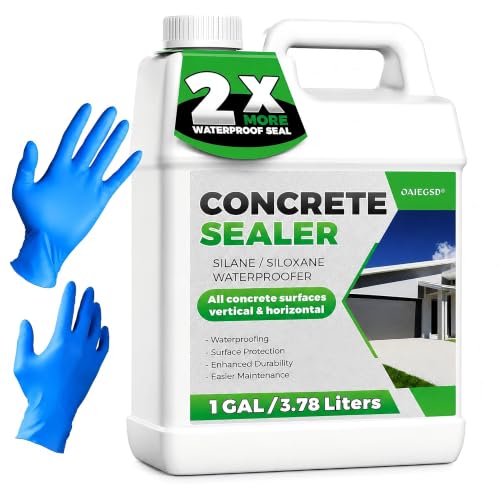
Same invisible idea as the pick above, but stretched to indoor slabs and wider coverage
The spec that matters here is coverage: 150–350 square feet per gallon depending on how porous the surface is. That upper figure is the widest in this lineup, which makes it the one to reach for when you are sealing a garage floor and a patio off the same jug. It is a water-based silane siloxane, so it reacts below the surface and leaves the colour and texture exactly as they were.
Two practical numbers do the heavy lifting. It dries to touch in 1–2 hours at 70°F, and you leave 2–4 hours between coats. Fresh concrete needs 28 days to cure before it takes sealer. It sprays, rolls or brushes on with no dilution, and the breathable formula will not peel, flake or delaminate the way a film-forming coat can — a real advantage on a slab with moisture underneath it.
The honest limit: it is built for absorbent mineral surfaces. Vinyl, glazed tile and other non-absorbent materials are not what this was made for, and it is not a crack, joint or gap filler either. Winter performance on freeze-thaw slabs is the long-term test, so give it a dry, clean surface and the full two coats.
The numbers that sell it
- 150–350 sq ft/gal — the widest coverage band in this lineup
- Touch-dry in 1–2 hours at 70°F, recoat in 2–4 hours
- Water-based and breathable, with no film to peel or flake
- Works indoors on garage floors as well as outdoors
Where it stops
- Not for vinyl, glazed tile or other non-absorbent surfaces
- Will not fill cracks, joints or gaps
- New concrete must cure 28 days first
Best fit: a household sealing both a garage floor and an outdoor slab with the same invisible product.
Wrong fit: anyone wanting the surface to look darker, glossier or visibly coated.
4. MasonryDefender Concrete Sealer, Silane Siloxane 1 Gallon
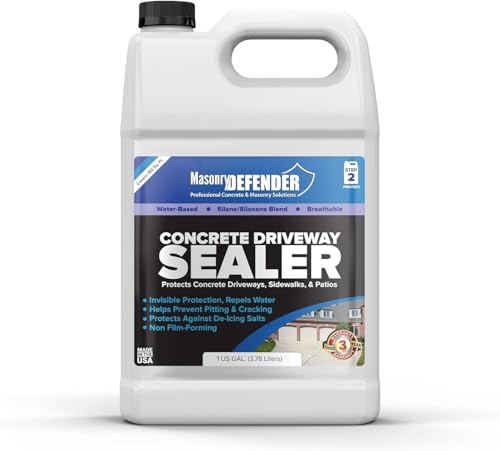
Built for the part of the country where the driveway is wet half the year
Coverage is the tightest trade here at 90–150 square feet per gallon, and that is deliberate — this is a richer, more concentrated dose that bonds deep into the pores. The payment comes back in the weather. It is aimed at pitting, cracking, ice-melt salts, chloride ions, freeze-thaw cycles and efflorescence stains, and it does it without a surface film, so the concrete keeps breathing while it repels.
The application story is where it wins people over. A low-pressure garden sprayer is all it takes, it goes on clear, and it dries without a sticky residue or any change to the finish. One Pacific-Northwest owner sealed a patio and driveway and reported pavers beading and shedding water even through heavy rain. Three years on, a South Carolina fiber-crete driveway was still shedding standing water, and the treated squares looked whiter and cleaner than the untreated ones beside them.
The recurring gripe is inconsistency in the jug. One buyer found white gelatinous solids that would not dissolve when shaken at 75°F, and blotchiness is the other recurring complaint. Give the container a serious shake before you pour, and return it if it pours thick. Otherwise this is the pick for hard winters and constant rain.
Why rainy yards like it: a silane siloxane barrier that beads water, resists deicing salts and chloride ions, and leaves no gloss or coating behind.
The honest caveat: at 90–150 sq ft/gal it needs more jugs per driveway than most, and an occasional container arrives with solids that need shaking.
Buy this when: your slab faces hard winters, road salt or a wet climate and you want it to stay natural.
Think twice when: you are sealing a large driveway on a tight budget — the coverage is the least generous here.
5. MasonryDefender Patio Paver Sealer, Low Gloss Water-Based

The one that hardens joint sand so the weeds stop finding a way in
This is a different job from the penetrating products above. It is a water-based acrylic that dries clear with a low gloss, and its second job is sealing the joints by hardening and stabilising joint sand — which is what keeps weeds and ants from colonising the gaps between pavers. Colonisation, in practical terms, means fewer Saturday mornings spent prying out tufts.
Colour is the other half of the pitch. A wet look with just enough gloss to deepen the tone, VOC-compliant, and it does not yellow. The low odour and soap-and-water cleanup are what make it manageable as a DIY job — you are not fighting fumes in the afternoon heat. Coverage runs 75–150 square feet per gallon with no mixing; a pump-up sprayer and a back brush are the tools, and you wait one to two hours before the second coat.
Two things to plan for. It is at the lower end on coverage, so a large patio needs more jugs than the printed figure suggests — an owner sealing a small brick patio found the stated coverage ran short and needed extra passes to fill cracks. And it is a film-forming product, so it protects the look rather than staying invisible.
Why pavers get this one
- Hardens and stabilises joint sand to keep weeds and ants out
- Low gloss wet look that deepens colour without yellowing
- Low odour, soap-and-water cleanup, no mixing required
- One to two hours between the two coats keeps a patio to a single afternoon
The practical limits
- 75–150 sq ft/gal coverage runs short on porous, unsealed brick
- Film-forming, so it is a visible finish rather than an invisible one
- Needs a back brush to work sealer fully into the joints
Right for: paver patios and brick walkways with sand joints that need locking down and colour brought back.
Not for: a pour-in-place driveway where you want zero visible change.
6. McKinnon Concrete & Paver Sealer, Semi-Gloss Wet Look

The richest shine in the lineup, from a Tampa coatings shop that sells to contractors
McKinnon Materials makes industrial coatings in Tampa, Florida, and this is the semi-gloss wet look version of that formula. It goes onto concrete, pavers, brick and natural stone, deepens the colour, and leaves a shine that is glossier than the Armor AR350’s low gloss. If you want the pavers to look like they have just been rained on for good, this delivers more of that than anything else here.
What wins people over is how fast it sets and how hard the finish goes. One long-time user, on their second gallon, called it the best sealer they had used in sixty years and said it stabilises sand hard as cement. Coverage is generous in practice — one reviewer noted it on 850 square feet, another sealed 1800 square feet of pavers in two to three coats with a pump sprayer. Diluting the first coat 1:1 with water and putting the second on at full strength is the trick for getting it deep before it builds shine.
The mixed report is the finish. Some buyers love the wet shine, others see a whitish sheen, and more than one flags that it is slippery when wet — worth a grip additive if the surface runs along a pool edge. And unlike the invisible products, this one absolutely changes how the slab looks.
The shine story: a semi-gloss wet look from a Florida industrial coatings maker, with UV resistance for sun, rain, freeze-thaw and foot traffic.
The trade to accept: the finish reads whitish on some surfaces, and wet pavers get slick enough to warrant a grip additive around water.
Pick it for: the boldest colour and gloss, with coverage that stretches on big paver jobs.
Pass it over: if you want the concrete to look untouched or the patio borders a pool without a grip additive.
7. Armor SX5000 WB Water-Based Silane-Siloxane Sealer

The invisible option that claims to keep working for the better part of a decade
what separates it is Armor’s claim of a 7–10 year service life for the barrier it forms below the surface, plus a stated cut in water and liquid absorption of up to 95%. Those are manufacturer figures, but the mechanism is real: it reacts chemically inside the pores rather than coating them, and there is no film to maintain, peel or re-coat every couple of years.
It is also the easiest of the professional-grade options to live with. The water-based formula is 0 VOC and has no odour, cleanup is soap and water, and it will not change the look, colour or feel of the surface — the concrete looks exactly as it did before, just water-beading. Coverage is 175–225 square feet per gallon by pump sprayer, on the same footing as the AR350. One driveway job took two coats at about 175 square feet per gallon, with the first coat soaking in within minutes and water still pooling days after rain.
Two honest notes before you buy. The watery, milky consistency means it goes on wet and can leave a stain on a wet surface, so work dry and keep it off adjacent finishes. And because it is fully invisible, you will not get the colour lift some buyers actually want from a “clear sealer”.
Why it costs more: a 0 VOC, odour-free silane-siloxane that works below the surface for years without adding a film, a gloss or a colour shift.
The honest catch: it is watery and can leave marks on a wet surface, and it deliberately leaves the concrete looking exactly as it did.
Go with it if: you want professional-grade, invisible protection and you only want to do the job once every several years.
skip it if: you were hoping the slab would come out darker and richer than it went in.
Know the Specs
Film-forming acrylic vs penetrating silane-siloxane
An acrylic sealer dries as a thin layer on top of the concrete, which is what gives it a gloss and a colour change; it wears away over time and needs re-coating. A silane-siloxane sealer reacts inside the pores and leaves no film. If the slab is damp from below, the build-up of vapour pressure under the film is what makes it lift. On a dry, well-drained slab, an acrylic holds up and delivers the look.
Coverage in square feet per gallon
This figure tells you how far a jug goes, and it is the most important number for planning. Published rates run from 75 to 350 square feet per gallon here, and the low end is the honest one on porous, previously unsealed concrete. Always buy enough for two coats plus a margin, because a switch mid-slab shows as a colour or sheen change at the boundary.
VOC content and odour
VOC stands for volatile organic compounds — the solvents that evaporate as the sealer dries and produce the smell. Solvent formulas run high (the AR350 is listed at 700 VOC), water-based formulas can be 0 VOC, and some products are sold in several VOC versions to meet different state rules. If you are sensitive to fumes, the 0 VOC water-based option is the one to pick.
Breathability and freeze-thaw
A breathable, vapour-permeable sealer lets moisture escape from inside the slab while repelling water from outside. That matters where the temperature swings below freezing, because trapped water expands as it freezes and that is what cracks concrete. A non-breathable film over a damp slab can do more harm than good.
Common Questions
Should I use a clear wet-look sealer or a penetrating one?
Will a clear sealer stop my driveway from going dark in the rain?
How many gallons do I need for a two-car driveway?
Can I put a wet-look sealer over concrete that already has a water-based coating?
Is a bright low-gloss finish slippery when wet?
How soon can I walk or park on a freshly sealed slab?
How long does a clear concrete sealer last before I have to reapply?
Does a clear sealer fill cracks or gaps between pavers?
Is a water-based or solvent-based sealer better around brick and stone?
Does a sealer have to cure before it works in rain?
The Bottom Line
For most people, the winner is the Armor AR350 because it turns tired concrete back into rich, wet-look colour and holds it under traffic, road salt and UV — and at 4.5+ stars from a big body of owners, it is the crowd favourite for a reason. If you would rather the slab look exactly as it does now and simply stop absorbing water, go with the Armor SX5000 WB; it is the 0 VOC, invisible, long-service option. And for paver patios where joint sand is drifting and weeds are winning, the MasonryDefender Patio Paver Sealer is the one built for that job specifically.
How we choose
We do not accept paid placement. Every pick is matched to a real buyer and a real use-case; we do not hands-on test units.
Sources
Specifications: manufacturer listings and product documentation. Review insights: verified customer reviews, as of October 2026. Pricing: not shown on this page (it changes often); check the current price via the retailer link.
As an Amazon Associate, Aappliancez earns from qualifying purchases. This does not affect which products we feature.