Disclosure: Some links in this post are affiliate links. As an Amazon Associate I earn from qualifying purchases, at no extra cost to you. Learn more
Specs are compiled from manufacturer listings and verified buyer reviews and can change over time — please confirm the key details on the product page before buying.
Rusted metal does not keep rusting on its own once you seal it — the rust keeps spreading because the pitted surface drinks in moisture and air and holds them there. That is the whole job of a clear coat for rusted metal: lock the surface, stop new oxygen reaching it, and leave a finish you can live with. The picks below split into two jobs, and knowing which job you need is half the buying decision. Some are true 2K clear coats (a two-part formula with a hardener that cures hard and glossy) meant for visible panels, headlight housings and painted bodywork. Others are rust converters and reformer paints that go straight over the rust and turn the surface into a stable, paintable base. Pick the wrong type and you will be spraying gloss over loose flakes or sealing bare rust under a finish meant for fresh paint.
This guide is built by comparing the manufacturers’ published specifications and the patterns across verified customer reviews, so you get each pick’s real strengths and trade-offs instead of marketing spin.
Two details decide most of it: how much surface one can covers, and how long you have to work before the product sets. Here is how each of these picks handles both, so you can match one to your project rather than guessing at the shelf. Match the can’s coverage figure to your panel’s square footage and its cure time to how long you can leave the part untouched.
Top Picks


How To Choose The Best Clear Coat for Rusted Metal
Most buyers treat all clear coats as interchangeable sprays. They are not. A rusted surface has a rough, porous profile that traps moisture, and the product you choose has to either neutralise that surface or seal it completely. Once you know which type you need, the rest of the decision depends on coverage per can and pot life.
Decide first: converter or clear coat
A rust converter soaks into the rust and turns it into a stable, paintable layer you can coat afterwards. A clear coat sits on top and seals. If the metal is scaly, flaking or deeply pitted, the converter does the structural work and the clear coat only finishes the job. If the surface is sound and you want gloss, go straight to a 2K clear.
The 2K advantage and its catch
A 2K clear (two components in one can, mixed when you activate it) cures chemically rather than by drying alone. That is why it hardens glossier and resists fuel, road salt and weather. The catch is built in: once activated, a 2K can has a pot life — a working window before the mixed product thickens and stops spraying cleanly. Plan your coats so you use that window fully.
Coverage and flash time
Coverage tells you how far a can stretches. Flash time — the short pause between coats while the solvent escapes — tells you how fast you can layer. Thin, evenly spaced passes with the recommended overlap beat one heavy soak every time. Heavy passes are the number one cause of runs and drips, and drips on a cured 2K finish mean sanding back and starting over.
Side-by-Side Comparison
| Model | Best For | Finish | Dry / Cure Time | Coverage | Amazon |
|---|---|---|---|---|---|
| Eastwood 2K Aerosol Clear Coat★ Best Overall | Best Overall | High-Gloss | 12 hours | 5.4–8.1 sq ft | Amazon |
| 2-in-1 Rust Converter & Metal Primer (35 oz)Best Rust Base Coat | Best Rust Base Coat | Matte | 24 hours | Less than 400 sq ft per gallon | Amazon |
| Meuvcol 2 in 1 Rust Converter & Primer (35 oz) | Best for Frameworks | Matte | 24 hours | 50 sq ft | Amazon |
| ERA Paints 2K High Gloss Clear Coat | Best Fast-Cure Gloss | High-Gloss | 1 hour dry / 24 hours cure | 3.5 sq ft | Amazon |
| Moshify SprayMax 2K Clear Coat Bundle | Best Large-Panel Coverage | Gloss | 48 hours | 118–130 sq ft per can | Amazon |
Detailed Reviews
1. Eastwood 2k Aerosol Spray
Our pick — 4.5+★ from 950+ verified ratings; the strongest balance of quality and price.
A 2K aerosol that lays down a hard, high-gloss finish close to a paint-booth result.
For a rusted panel you have already stabilised and want to look factory-fresh again, this is the one that carries the crowd. It holds 4.5+ stars across 900+ ratings, and the thing everyone raves about is the quality of the finished surface — a gloss that reads like a professional paint shop rather than a rattle-can job. It is a genuine 2K formula, meaning two parts that react when you activate the can, so it cures hard instead of simply drying.
The published numbers explain the finish. One can covers 5.4–8.1 square feet, so it is a detail-and-panel product rather than a chassis product. Lay 1 to 2 passes with 50% overlap, at roughly 1.2 mil per pass, and allow 3–7 minutes flash between coats depending on temperature. Full cure is 12 hours at 68 degrees Fahrenheit, or 35–40 minutes at 140 degrees Fahrenheit under IR drying. Pot life runs approximately 48 hours after the button is pushed — generous working time for a 2K, and enough to do two or three sessions on one panel.
Compared with the Moshify SprayMax bundle below, this one is the tighter, glossier can for small refinish areas; the SprayMax stretches across 118–130 square feet per can but cures over 48 hours, while the Eastwood finishes curing in 12. Owners who restore headlight assemblies rate it as one of the best options they have tried, and it is colourless and solvent-resistant with no yellowing over time. The honest catch is the spray itself — the nozzle and mist pattern draw the most negative feedback in the whole listing, and the fumes are genuinely toxic. A respirator in a ventilated space is not optional here.
What earns it the top spot
- High-gloss 2K finish that holds a hard, fuel- and weather-resistant surface
- Colourless and non-yellowing, unlike single-part 1K clears
- 12-hour full cure at room temperature keeps a project weekend-sized
- 48-hour pot life gives you room to work across sessions
Where it asks for patience
- Coverage of 5.4–8.1 sq ft means large panels need multiple cans
- Spray quality is the recurring gripe — a steady hand and light passes matter
- Requires respiratory protection and a well-ventilated space
Reach for it when: you have a stable rusted surface, a headlight housing or a body panel and you want a gloss finish that lasts.
Stock up instead if: your project is a frame, chassis or anything measured in square feet rather than inches.
2. 2-in-1 Rust Converter & Metal Primer 35 oz
A water-based converter and primer in one step that brushes straight onto rusted steel.
If your rust is on a trailer, a fence, a set of outdoor iron furniture or a farm implement, you do not want a gloss coat at all. You want something that converts what is already there. This water-based formula is a rust converter and a metal primer in one step, and the quality of what it lays down is what wins people over. It dries to a flat, tightly bonded matte finish, seals out moisture and air, and cleans up with plain water — under 1% VOC, no harsh solvents.
Coverage is less than 400 square feet per gallon across a 35 fluid ounce can, so a single container handles a lot of fencing or framework. The working rhythm is slow and simple: remove loose rust or debris, apply by brush, roller or sprayer, and use 2–3 thin coats. Dry time and full cure are both 24 hours — versus 12 hours for the Eastwood 2K clear above, so budget a full day before you touch the surface. It holds up to heat at 350°F (176°C), which is why engine bays and brake parts come up as real uses, and it is compatible with steel, iron and aluminum.
Owners on lightly rusted steel often report no prep beyond a wipe-down, while heavier rust needs the loose flakes scraped back with a wire brush before two coats go on. The honest caveat is durability under abrasion — the recurring gripe is that it can scratch off, so treat it as a protective base rather than an armour plate, and add extra coats anywhere rust threatens to poke through. The little brush included in the box is not worth relying on; bring your own.
The value read: a brush-in, water-cleanup converter that needs no separate primer and covers a lot of metal per container — ideal for outdoor ironwork and trailers where finish matters less than stopping the spread.
Plan around this: the 24-hour dry window and the scratch-prone surface mean it suits a base coat role rather than a final wear surface.
Suits you if: you are treating fences, frames, furniture or equipment with existing surface rust.
Look past it if: you need a hard, glossy, abrasion-resistant top finish on a visible panel.
3. 2 in 1 Rust Converter & Metal Primer Black
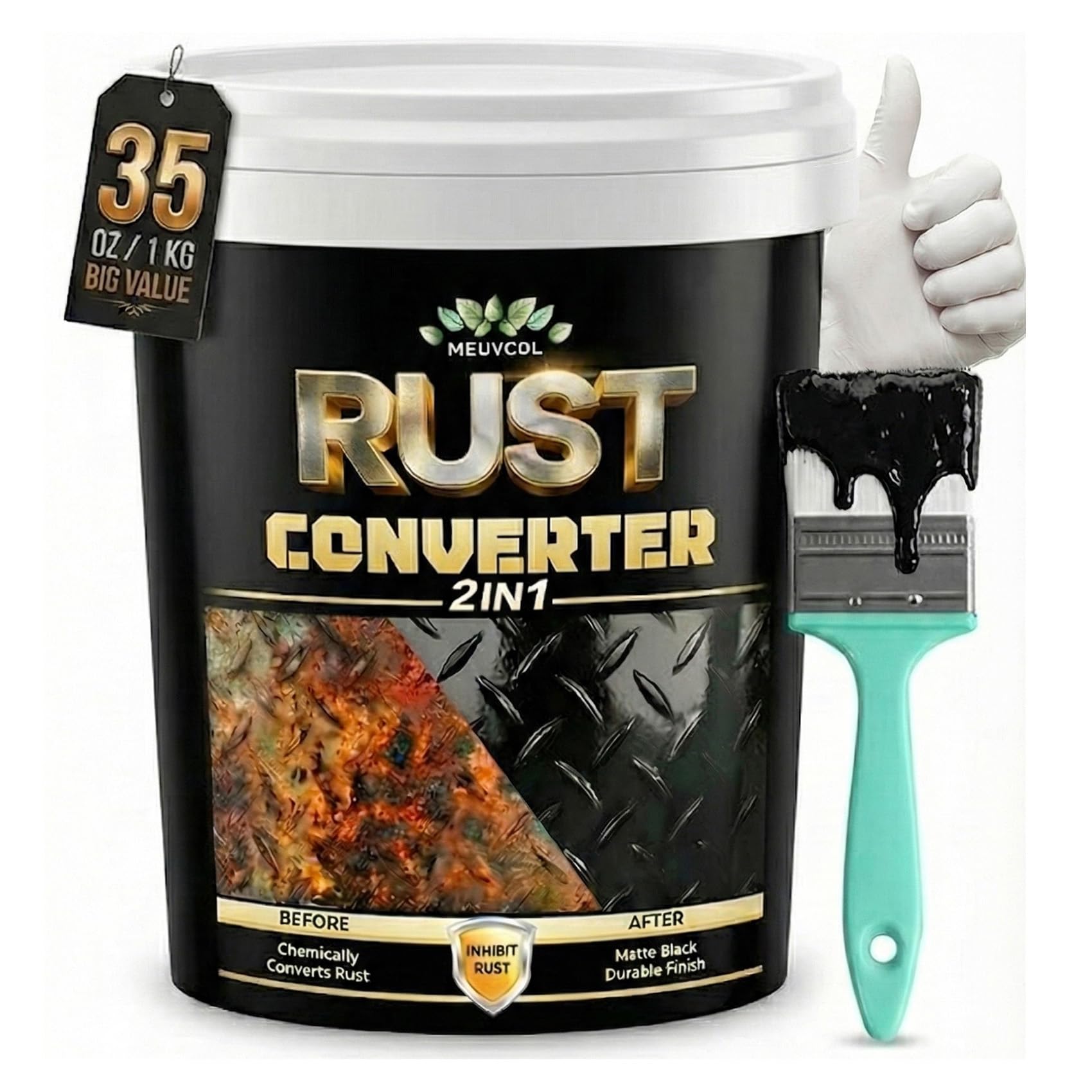
A single-component matte black encapsulator for chassis, trailers and frames exposed to road salt.
Truck frames, chassis rails and trailer beds are the case this product was drawn up for. It is a ready-to-use, single-component rust encapsulator that seals metal against water, chemicals, salt and everyday wear, and the quality of the coating is what draws the most positive attention in the listing. It lays down a flat matte black and locks out air and moisture to interrupt the oxidation cycle rather than simply hiding it. The kit arrives with a brush, gloves and a manual.
The stated coverage is 50 square feet from a 35 fluid ounce can. Application is deliberately slow: wipe the surface dry, brush on thin coats, use a minimum of two, then give it 24 hours to form its protective film. That matches the 24-hour dry and full cure times of the MuzeFansi converter above, but the working consistency is different — this one brushes on with a house-paint feel, thin or thick as you load the brush. It is rated for both indoor and outdoor use and holds up to the heat and chemical exposure of an engine bay or undercarriage.
What the finish does well is build confidence on pitted metal. Buyers report rust not bleeding back through once the coating cures, and two coats take green oxidation on old cast metal down to a clean finish with no seep-through after 24 hours. The honest caveat is that some users cannot tell whether a true chemical conversion happened or whether they simply have a black paint layer that may chip — so on heavily rusted plate, scrape first and expect to re-coat wear points.
Why it earns its place: waterproof encapsulation with heat and chemical resistance, and a kit that gives you the brush and gloves in the box.
The right call for: anyone restoring frames, chassis, trailers or cast metal where matte black is an acceptable look.
Pass it over for: a gloss finish — this coat is matte and stays matte.
4. ERA Paints 2K High Gloss Clear Coat Spray
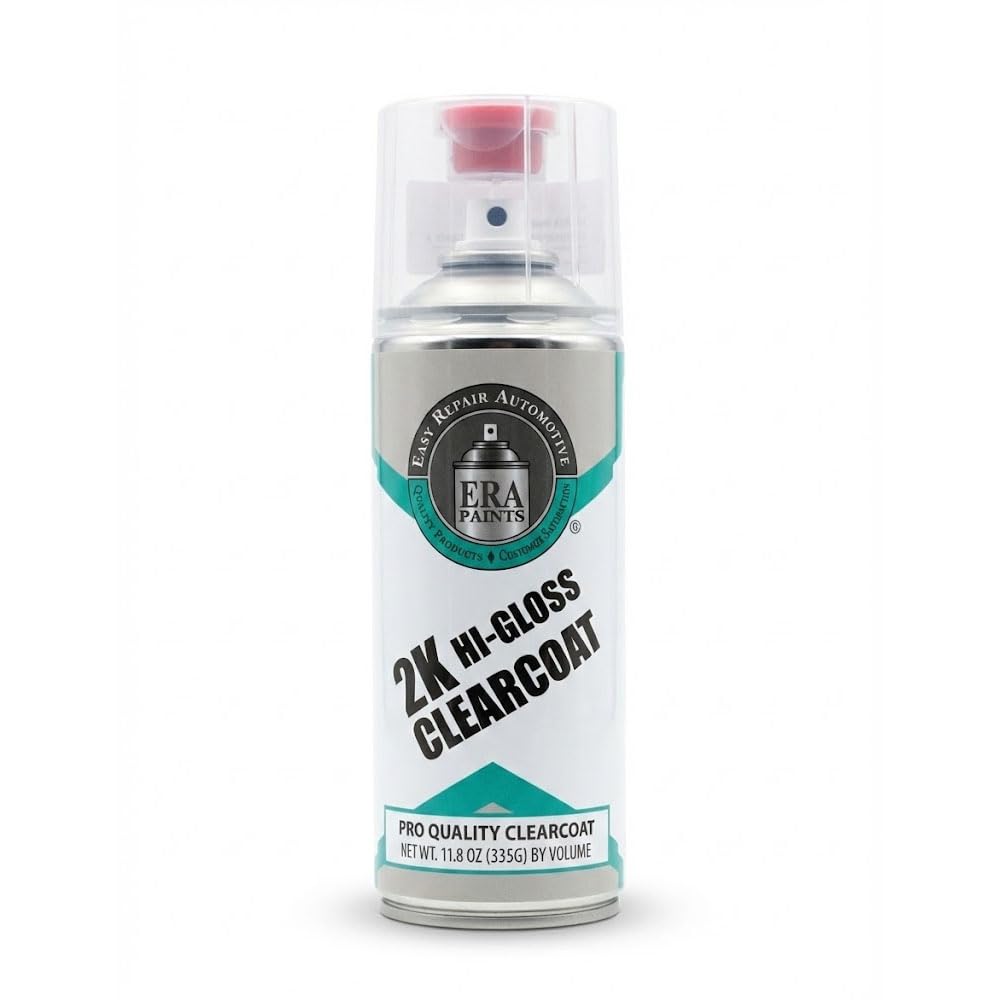
A catalyst-activated 2K gloss that dries to touch in 1 hour and cures in 24.
This can dries in 1 hour and cures fully in 24 hours, which is the quickest dry figure of the 2K sprays here. It is a catalyst-activated formula with a built-in hardener, so it chemically bonds as it cures and resists fading and yellowing. The high-gloss finish is exactly what owners single out most, and the wide fan nozzle spreads a smooth pattern that helps keep runs down.
Coverage is listed at 3.5 square feet per 11.8 fluid ounce can, so this is a touch-up tool, not a panel painter. The maker formulates and packages it in Oregon with automotive-grade resins. It is rated outdoor and seals against UV, fuel, road salts and debris. That makes it a solid choice for engine-bay plastics and heat-exposed parts, where owners mention it holds up well — provided the prep is done properly underneath.
Here is the trade-off worth knowing before you buy: durability, spray performance and coverage all read mixed in owner feedback, and the nozzle spitting or leaking is a recurring point. Soak the can in hot water for ten minutes and shake for two before you start — that routine is how the smoothest results come out. The sharpest contrast with the Eastwood 2K above is coverage: 3.5 square feet here against 5.4–8.1 square feet there, so budget more cans for the same area.
What makes it worth grabbing
- 1-hour dry time gets you back to the panel the same day
- Catalyst-activated 2K hardens for real rather than just drying
- Wide fan nozzle lays an even pattern with fewer runs
- Made in the USA with premium automotive resins
The fine print on the label
- 3.5 square feet of coverage per can goes fast on larger panels
- Nozzle can spit or leak — some owners swap it out
- Premium resins at this coverage add up across a multi-can job
Choose it when: speed and a deep gloss on small parts or under-hood plastics are the priority.
Skip past it when: you are coating a whole panel and want fewer cans doing the work.
5. Moshify SprayMax 2K Clear Coat Spray Can

A 118–130 sq ft can bundled with a snap-on trigger for long spray sessions.
Big projects are where this bundle makes its case. One can covers 118–130 square feet, so a single container can finish a substantial panel run rather than three. The 2K formula cures faster and harder than a single-part clear, leaving a high-gloss finish with strong resistance to abrasion, scratching, gasoline and weathering. The included Moshify trigger snaps onto the rotating nozzle and lets you spray with a finger grip instead of a fingertip. The finish is what draws the most positive feedback, and it gets called a legitimate professional result.
The published cure time is 48 hours — a full two days, versus 12 hours for the Eastwood 2K at the top of this list — so schedule accordingly. Pot life is 48 hours after activation, and shelf life is 3 years with the manufacturing date stamped on top of the can. That pot life is the flexible part; the prep and the patience are not. Owners working on full repaints report sanding the old clear back, wet-sanding with 600–800 grit, removing any wax, and spraying only when there is no wind. Three coats on a car runs around two cans.
Smoothness of spray is the split point. Some owners get an even, airgun-like lay-down; others report inconsistent results. There is a real technique note: when the can is tilted, orange peel can appear, and it cleans up with 2000–3000 grit and a polish. Spraying with the handle above the surface can let mist collect and drip, so keep the trigger clear of the paint line. One more hard limit — release the hardener and the clock starts; letting it sit too long risks bubbling that ruins the job.
Big-job logic: the widest coverage here at 118–130 square feet per can, paired with a trigger that reduces finger fatigue over a long spray session.
One thing to respect: the 48-hour cure and the hardener clock mean you plan before you pop the button, not after.
Built for: full-panel and whole-vehicle clear-coating where coverage and a long pot life outweigh a slower cure.
Not the fit for: small spot refinishing, where a narrower, tighter can is the more sensible tool.
Know the Specs
Dry time vs full cure time
Dry time is when the surface is safe to touch; full cure is when the coating has reached its final hardness. They are not the same. A can that lists 1 hour dry may still need 24 hours to fully cure, so do not handle, wet-sand or mount the part based on the dry figure alone. Rust converters often list the same figure for both because they set by solvent escape rather than a chemical reaction.
Pot life and shelf life
Pot life is the window you have to spray after activating a 2K can. Once the hardener is released, the mixed product thickens and eventually stops spraying cleanly — plan your coats inside that window. Shelf life is different: it counts from manufacture, and the date stamped on the top of a 2K can is the manufacturing date, not an expiry date. A long pot life is valuable when a job stretches across sessions.
Coverage per can
Coverage tells you how far one container goes and is the single best number for avoiding a mid-job shortage. Aerosol 2K clears run small — a few square feet per can for touch-up cans, up to well over a hundred square feet for a whole-panel can. Converters and reformer paints usually measure in square feet per gallon or per can, because they are brushed on thick. Match coverage to the panel, then buy one extra can for the learning curve.
Rust converter vs rust encapsulator
A converter reacts with rust to turn it into a stable, paintable layer. A reformer or encapsulator seals the surface under a durable coating, holding out water and air. Many products here claim both roles in one. Whichever you pick, loose and flaking rust has to go first — a coating barrier cannot hold a surface that is already lifting away.
Common Questions
Can I put a clear coat directly over rust without a converter?
How long after activating a 2K clear coat can I still spray?
Does a clear coat need a topcoat over a rust converter?
How many coats of clear should I apply over a rusted repair?
Will 2K clear coat stop rust coming back?
Do I need a respirator to spray 2K clear coat?
What is the difference between 1K and 2K clear coat?
How much clear coat do I need for a single panel?
Can I apply a rust converter over old paint?
The Bottom Line
For a stable rusted surface, a visible panel or a headlight housing that needs a real finish, the Eastwood 2K Aerosol Clear Coat is the pick — a hardened 2K gloss that cures in 12 hours and holds up against fuel and weather. If your rust is on a trailer, fence or frame and you want the spread stopped before you finish it, reach for the Meuvcol Rust Converter for its matte black encapsulating coat, or the MuzeFansi 2-in-1 Converter if you want a water-based, low-VOC base that needs no topcoat. And when the job spans a whole car, the Moshify SprayMax bundle covers the most square feet per can and gives you the trigger to spray it comfortably.
How we choose
We do not accept paid placement. Every pick is matched to a real buyer and a real use-case; we do not hands-on test units.
Sources
Specifications: manufacturer listings and product documentation. Review insights: verified customer reviews, as of October 2026. Pricing: not shown on this page (it changes often); check the current price via the retailer link.
As an Amazon Associate, Aappliancez earns from qualifying purchases. This does not affect which products we feature.