Disclosure: Some links in this post are affiliate links. As an Amazon Associate I earn from qualifying purchases, at no extra cost to you. Learn more
Specs are compiled from manufacturer listings and verified buyer reviews and can change over time — please confirm the key details on the product page before buying.
Yellow-brown film on your walls is sticky tar, not dirt, and plain soapy water just smears it around. You need a cleaner that dissolves that oily nicotine layer so a single wipe lifts it off the paint. That is the whole decision here, and the five picks below are chosen for exactly that job.
This guide is built by comparing the manufacturers’ published specifications and the patterns across verified customer reviews, so you get each pick’s real strengths and trade-offs instead of marketing spin.
Some of these are ready-to-use sprays you wipe on and walk away from, others are concentrates you mix in a bucket for a whole-room wash-down. Below you will find the cleaner to remove cigarette smoke from walls and ceiling that fits how much wall you actually have to do.
Top Picks


How To Choose The Best Cleaner to Remove Cigarette Smoke From Walls and Ceiling
Cigarette smoke leaves two things behind on a wall: an oily tar layer and a smell that soaks into the paint itself. A cleaner has to break the tar down chemically before your cloth ever touches it. Scrubbing harder just pushes the tar deeper into the texture.
Ready-To-Use Versus Concentrate
A ready-to-use spray comes out of the bottle at full strength and you wipe straight away. That suits one bedroom, a hallway, or a spot behind the couch. A concentrate is a liquid you mix with water in a bucket, which is what you want for a whole apartment or a commercial space. Concentrates cost less per wall and let you control the strength for light versus heavy staining.
Dwell Time Is The Real Workhorse
Every one of these cleaners needs a moment on the surface before you wipe. Give a degreaser 15 to 20 seconds and the tar releases on its own. Leave a potent cleaner sitting far longer than the label says, though, and it can soften the paint itself — one concentrated spray is noted for eating through paint if it sits more than five minutes.
Watch The Smell And Your Skin
Smoke-damage cleaners are strong by design, and the ones built around chlorine smell sharply. Ventilate the room, open windows, and keep chemical-resistant gloves on. A citrus or pine scent does not mean the liquid is mild — it means the maker added a fragrance on top of it.
Match The Method To The Surface
Flat painted walls take a spray-and-wipe with a microfiber cloth. Textured ceilings and popcorn finishes hold residue in every ridge, so a pump sprayer and a soft brush or roller works far better than a cloth. Whichever you pick, test a hidden corner first, because a freshly cleaned patch can end up visibly whiter than the wall around it.
Side-by-Side Comparison
| Model | Best For | Format | Size | Weight | Amazon |
|---|---|---|---|---|---|
| Spitfire Diversey Professional Power Cleaner★ Best Overall | All-round ready-to-use wall and floor degreaser | Ready-to-use liquid | 1 Gallon | 8.47 pounds | Amazon |
| CHOMP! Painted Wall Cleaner SprayEasiest To Use | Light upkeep and odor refresh on painted walls | Ready-to-use spray | 32 Oz | 2 pounds | Amazon |
| InstaGone Stain Remover (2 Pack + Spray Bottle) | Stubborn ceiling and wall stains, tar included | Powder packs, just add water | 2 packs + 24oz bottle | 7.2 ounces | Amazon |
| Unsmoke Wall Wash with Biosolv | Heavy smoke and fire damage across a whole room | Concentrated liquid | 1 Gallon | 8.5 pounds | Amazon |
| Klean-Strip Jasco TSP Substitute | Deep pre-paint strip of decades of nicotine | No-rinse concentrate | 8 Fl Oz (Pack of 4) | 2 pounds | Amazon |
Detailed Reviews
1. Spitfire Diversey Professional Power Cleaner
Our pick — 4.5+★ from 450+ verified ratings; the strongest balance of quality and price.
A full gallon of concentrated-strength cleaner that does the dissolving for you.
If you want one jug that handles a smoke-stained hallway, the baseboards, and the floor underneath, this is the pick. The Spitfire comes ready to use at full strength — no mixing, no measuring, no bucket dilution — so you can spray a tar-covered section of wall and start wiping immediately. That is the reason it sits at the top of this list rather than one of the concentrates.
What wins people over here is the pine scent. It clocks the most praise of any single quality in the customer feedback, and the second most-praised thing is how easily the residue wipes back off — owners consistently find they are not fighting the wall, just lifting the film away. One high-rated note from a commercial kitchen sums the whole method up: “Leave on for 15 minutes and be amazed by how much just wipes off without needing to scrub.” That dwell-and-wipe rhythm is exactly what wins against baked-on nicotine tar.
It is also the heaviest bottle on this list at 8.47 pounds, against the 2 pounds of the CHOMP! spray — a real difference if you are hauling it up a ladder to reach a ceiling. The catch worth knowing is potency inside the home. The label is built for commercial facilities, garages, and workshops, and the same strength that dissolves tar will soften a shower coating or a fresh paint film if you let it pool. A little goes a long way, so spray, wait, wipe, and do not walk away from a wet patch.
What earns it the top spot
- Ready to use straight from the bottle — no mixing, so a stained wall gets cleaned the day you buy it
- One-gallon size covers walls, ceilings, floors, and counters on the same pass
- Owners consistently report the residue wipes away easily after a short dwell
- Lifts grease, grime, and tracked-in soil from washable hard surfaces
- Fresh pine scent leaves the room smelling cleaned rather than chemically raw
What to respect about it
- The formula is potent enough to strip a coating if left sitting far too long
- The scent is strong, so ventilate the room while you work
- At 8.47 pounds it is the heaviest jug here to carry up a step ladder
- Built for commercial-grade surfaces; test it on a small patch of finish first
Buy this if: you want one ready-to-use gallon that cleans the walls, the ceiling trim, and the floor in a single session without measuring anything.
Go elsewhere if: you only have a small room with light odor and would rather have a light 2-pound spray bottle to hold.
2. CHOMP! Painted Wall Cleaner Spray
The grab-and-go spray for a wall that smells like smoke but is not caked in tar.
This is the one you reach for when the walls are painted, the stain is light, and you want the smell gone today. It is a 32-ounce ready-to-use spray that works on painted walls, ceilings, and baseboards, and the maker states it is safe for all paint finishes and free of VOCs — the solvent vapors that give cheap thinners their sharp chemical bite. For a nursery, a pet room, or anywhere you would rather not bring a commercial degreaser inside, that matters.
The deodorizing side is where it genuinely pulls its weight. It is built to knock out pet, smoke, cooking, body, food, and garbage odors, and the peppermint note lingers in a pleasant way rather than a chemical one. Users describe the room being left smelling fresh rather than perfumed, and it cuts through dirt and grime without stripping the paint back or leaving streaks — which is the failure mode you are trying to avoid on a flat wall finish.
Compared to the InstaGone, which is a powder you dissolve in the supplied bottle, this is the simplest thing on the list to actually operate — spray and wipe with a clean cloth, or clip it onto the Chomp extendable wall washer tool for ceilings. The honest limit is strength: this is a general painted-wall cleaner and odor neutralizer, not a tar dissolver. Against set-in cigarette residue on an unpainted surface it will fall short, and a couple of owners have found it leaves streaking over a door where the paint was already compromised. Weigh the 2-pound bottle against the 8.47-pound Spitfire and you can feel the trade: lighter to hold, gentler on paint, less aggressive on heavy tar.
The real job it does: it is an odor and light-soil neutralizer for painted surfaces, and that is a different task from stripping heavy tar. If your smoke damage is years deep, step up to a degreaser.
Where it struggles: set-in tar on unpainted wood or trim will beat it, and the peppermint scent is strong enough that a closed room gets overwhelming fast — crack a window.
Pick this when: the walls are painted, the residue is a light film, and the smell is the bigger problem than the staining.
Step up if: you are facing years of yellow-brown tar, where a degreaser will do in one pass what this needs many attempts to touch.
3. Stain Remover 2 Pack
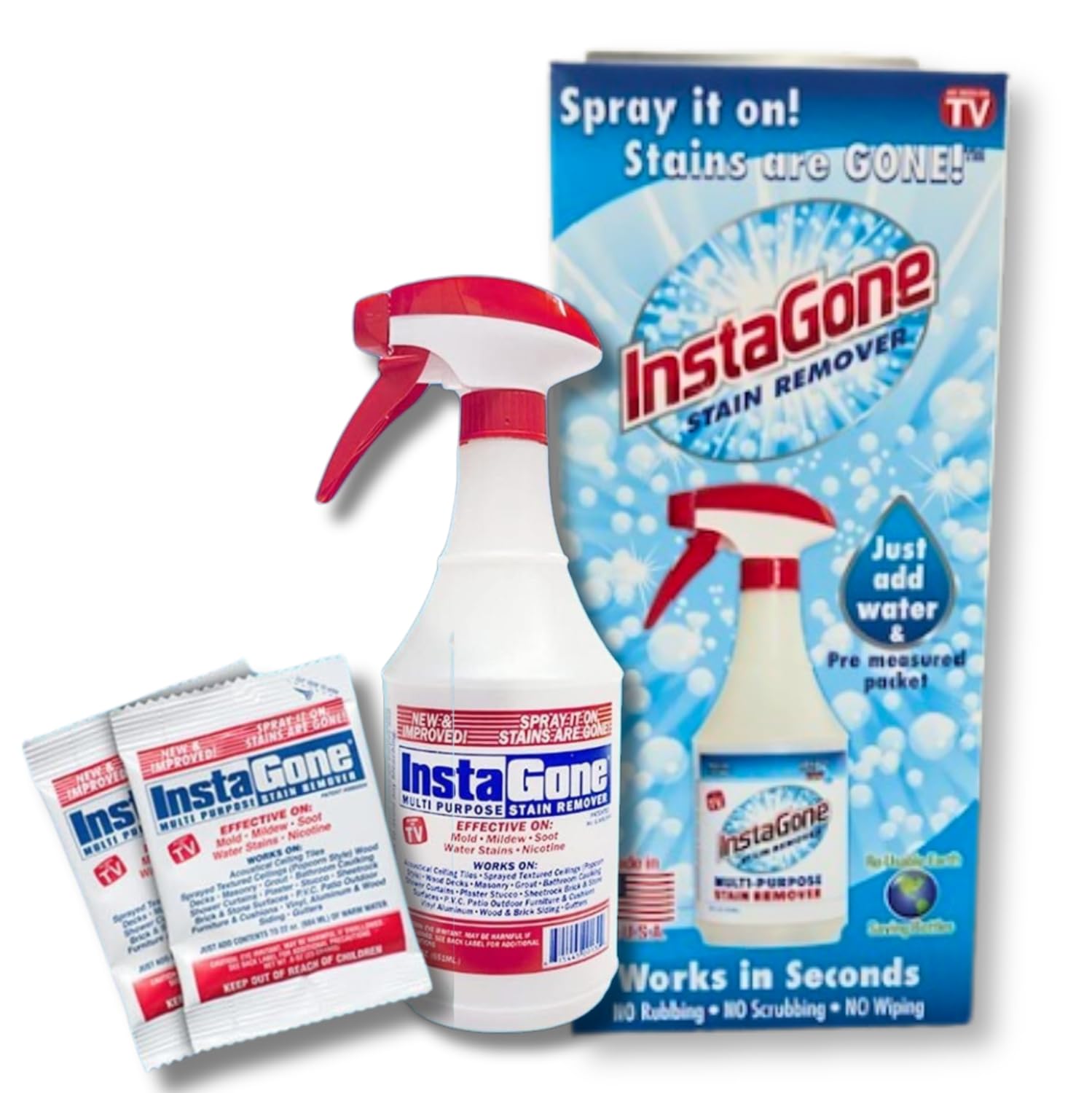
Two powder packs you dissolve at home — and the one buyers specifically name for tar.
For cigarette tar on a ceiling, this is the pick with the loudest owner evidence behind it. You get two 0.8-ounce refill packs plus a 24-ounce spray bottle; you add water, shake, and you have a working spray. That shipping format is why it weighs just 7.2 ounces on arrival and travels flat, though the flip side is that you are doing the mixing yourself rather than grabbing a bottle off the shelf.
The reason it earns a place here is the tar verdict. Buyers report it pulled heavy cigarette smoke and tar staining off walls more effectively than vinegar, baking soda, dish soap, or Windex. Buyers also credit it with clearing roof-leak water stains on ceilings and, in one case, years of nicotine from a textured popcorn ceiling without repainting or re-texturing.
Now the honest part, because this cleaner has a split personality. There is a clear quality-control complaint in the review pages — the newer “New & Improved Formula” packs drew a report of being weaker, along with spray bottles that stopped working after the first use. Some users also find it works unevenly across a ceiling and can leave the cleaned area looking whiter than the surface around it, and the chlorine-style smell is strong enough that you want airflow. It is also a slower clean on old set-in staining, sometimes needing a second or third application, compared with the Unsmoke’s near-instant lift on fresh residue.
Why ceiling owners choose it: it is the formula people name when the stain is tar rather than ordinary grime, and it handles textured ceilings that trap residue in every ridge.
The trade you accept: mixing is on you, the results can be uneven across a large ceiling, and the newer formula packaging has drawn some dissatisfaction. Buy from a listing you can return.
Best match for: a smoke-stained ceiling, especially popcorn or textured finishes, where you need a formula built for tar rather than a wipe-down spray.
Think twice if: you want a single ready-to-spray bottle with no mixing, or you are sensitive to a sharp chlorine-type odor indoors.
4. Wall Wash with Biosolv, Smoke Damage Degreaser, 1 Gallon
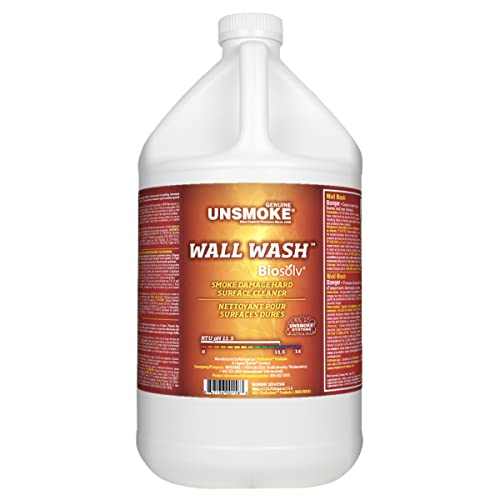
A restorer’s degreaser built for fire damage, and it wipes tar off in one pass.
This is the one professionals reach for when a whole room has gone yellow, and its name says it plainly: smoke damage degreaser. It is a concentrated liquid — one gallon of 128 Fl Oz that you dilute yourself, typically one part product to three parts hot water — and it is labeled residue free, so it does not leave its own film behind for you to chase. It is citrus scented and made for smoke-damaged spaces in both commercial and residential settings.
What the cleaner does well, it does definitively. Owners mention it lifting smoke tar and yellowing off walls, doors, and cabinets in a single pass, even on years of built-up residue. For a heavy stained wall, the method owners pass along is to let it sit about 30 minutes, then do a second pass with fresh solution and only light scrubbing. One real-world note worth having: it also works on cooking smoke and oil stains, and one diluted gallon reportedly covers about 350 square feet of RV interior.
Two things to know before you commit. First, it does not forgive a lazy rinse — the manufacturer’s guidance is to follow with clean water, or you can end up with ugly tobacco-colored streaks where the dissolved tar dried back onto the wall. Second, dwell time cuts both ways. Twenty seconds on the surface and a damp-cloth wipe gives a perfect result; leave it more than five minutes and it will eat through paint, which means this is a poor choice for a finished surface you are trying not to disturb. It is heavier to handle than its closest competitor, the Spitfire at 8.47 pounds, and it costs more per bottle — the trade is that the concentrate stretches across a much larger area.
The pro-mover setup: mix it hot, apply with a rag or sprayer, and work in passes — that is the routine that clears tar instead of spreading it. Rinse with clean water at the end, every time.
The one rule you cannot skip: the label is a rinse-step formula. Skip the clean-water pass and the tar you just lifted will dry back on as brown streaking.
Made for: smoke-damaged rooms and renovation cleanup, where you have a large area to restore and can work the rinse step properly.
Not for: a quick single-surface touch-up, or any painted finish you cannot afford to lose if the liquid sits too long.
5. Klean-Strip GIDDS-881056 Jasco TSP No Rinse Substitute Cleaner

The pre-paint stripper that pulls fifty years of nicotine out of the plaster first.
If your smoke-stained walls are about to get a fresh coat of paint, cleaning is only half the job — you need the residue fully gone or the new paint will bleed brown. That is what this TSP substitute is for. TSP stands for trisodium phosphate, a traditional heavy-duty wall prep chemical; this is a no-rinse substitute version, a concentrated liquid you mix with water at a couple of ounces per bucket. It is sold here as four 8-ounce bottles, and the formula is biodegradable, which is unusual for something this strong.
Its calling card is the deep strip. Customers note it stripping more than fifty years of accumulated nicotine from walls before a shellac primer and paint. The method that works best for a whole room is a pump sprayer to wet the wall, a soft brush or flat broom to spread the liquid into the texture, and a microfiber roller to lift it off — which is also how people handle a popcorn ceiling. In practice, it can save a full sanding step: one wood-prep user reported it stripped 95 percent of the gloss off honey oak without sanding back to bare wood.
Two practical notes. The liquid itself is unscented, but the working solution has a noticeable smell that fades once you wipe with water, and the cleaner will irritate bare skin — chemical-resistant gloves and eye protection are non-negotiable. That is also the honest gap here: it is a prep product, not a wipe-and-done spray. It does not leave a fresh scent behind the way the pine or peppermint options do, and it needs the two-step apply-and-lift routine, so there is more labor than spraying and walking away. What you get for the effort is the most thorough residue removal on the list.
Why pre-painters keep buying it
- Pulls decades of nicotine out of walls rather than just deodorizing the surface
- No-rinse formula saves a step compared with traditional TSP products
- Sold as four 8-oz concentrate bottles, so you mix only what you need
- Works on popcorn ceilings with a sprayer-brush-roller routine
- Biodegradable, and it strips grime, grease, and old residue off wood, metal, and vinyl wallpaper alike
The respectful way to use it
- Requires chemical-resistant gloves and eye protection — it irritates bare skin
- The working solution has a noticeable odor until you wipe with clean water
- It is a prep product, so it is slower and more hands-on than a ready-to-use spray
- Unscented, so it leaves no fresh fragrance behind once the room dries
The right buy if: you are repainting and want the nicotine fully out of the wall before the roller touches it.
Look past it if: you want a fast, smell-good spray for a light daily wipe-down rather than a full prep wash.
Know the Specs
Ready-To-Use Versus Concentrated
A ready-to-use cleaner is already diluted to its working strength, so you can spray a tarred wall and wipe it the moment you get home. A concentrated cleaner is a liquid you mix with water — stronger per ounce and cheaper across a large area, but it adds a measuring and mixing step before any cleaning starts. Match the format to the size of the job, not to the shelf label.
Dwell Time
Dwell time is how long you let the liquid sit on the surface before wiping, and it is what actually breaks the tar bond. Twenty seconds is often enough for a strong degreaser. Push far past the label’s guidance, though, and a potent formula will soften the paint film itself — so set a timer rather than walking away.
VOC Content And Scent
VOCs are the solvent vapors that give strong cleaners their sharp chemical bite; a VOC-free formula is a gentler choice for a bedroom or a room with children and pets. Note that a fresh scent like pine or peppermint does not make a cleaner mild — the fragrance is simply added on top of the working ingredients.
Coverage And Format
Powder packs are light to ship and you dissolve them yourself, sprays are ready on arrival, and gallon jugs cover the most wall per bottle but weigh the most to carry. If your ceiling is the target, a light bottle that pairs with an extendable wall washer saves a lot of ladder time. If the whole apartment is the target, a concentrate pays off.
Common Questions
Will these cleaners damage paint on my walls?
Can I use these on a popcorn or textured ceiling?
Do I need to rinse after using a wall cleaner?
How do I stop cigarette smell from coming back after cleaning the walls?
Are these cleaners safe to use around children and pets?
Do I need gloves and eye protection with a smoke residue cleaner?
How many applications does heavy nicotine staining take?
Will a smoke stain cleaner leave the wall looking patchy?
Is a TSP substitute better than a ready-to-use degreaser for smoke stains?
How much wall does one bottle of concentrate actually cover?
The Bottom Line
For most people facing cigarette tar on walls and ceilings, the winner is the Spitfire Diversey Professional Power Cleaner, because it arrives at full working strength in a full gallon and the residue wipes away after a short dwell — no mixing, no measuring, no second bottle. If your walls are about to be repainted, grab the Klean-Strip TSP Substitute, which strips the nicotine out of the plaster so the new coat does not bleed through. And for tar on a textured or popcorn ceiling, the InstaGone Stain Remover is the one buyers single out by name. Start on a hidden corner, let the liquid do the work, and rinse where the label says rinse — that routine beats scrubbing every time.
How we choose
We do not accept paid placement. Every pick is matched to a real buyer and a real use-case; we do not hands-on test units.
Sources
Specifications: manufacturer listings and product documentation. Review insights: verified customer reviews, as of October 2026. Pricing: not shown on this page (it changes often); check the current price via the retailer link.
As an Amazon Associate, Aappliancez earns from qualifying purchases. This does not affect which products we feature.