Disclosure: Some links in this post are affiliate links. As an Amazon Associate I earn from qualifying purchases, at no extra cost to you. Learn more
Specs are compiled from manufacturer listings and verified buyer reviews and can change over time — please confirm the key details on the product page before buying.
Smoke residue is not a smell problem — it is a sticky brown film of tar that settles on walls, ceilings, cabinets and car interiors, and it keeps releasing odor long after the last cigarette. Masking it with air freshener does nothing. You need a cleaner that physically lifts that film off the surface. The five products below split into two jobs: washes that pull tar off hard surfaces, and sprays or bombs that neutralize the smell in the air and in fabric. Pick by which job you actually have.
This guide is built by comparing the manufacturers’ published specifications and the patterns across verified customer reviews, so you get each pick’s real strengths and trade-offs instead of marketing spin.
Some picks are heavy-duty washes for walls and hard surfaces, others are quick sprays for a car or a single room. Below you will find a cleaner for cigarette smoke residue matched to each job, plus the dwell times and rinse steps that decide whether it works.
Top Picks


How To Choose The Best Cleaner for Cigarette Smoke Residue
Before you buy anything, run a finger along the wall. If it comes away brown and tacky, you have tar film and you need a wash. If the wall feels clean but the room still smells, you have odor in the air and the fabric, and you need a spray or a bomb. Most heavy smoke situations need both, in that order.
Surface wash or air treatment — decide first
A surface wash is a liquid you apply, let sit, then wipe. It works on washable hard surfaces: painted walls, tile, countertops, appliances, concrete and car hard trim. An air treatment is a spray or a release device that goes after odor molecules in the air and in soft materials like carpet and headliner. Buying a spray when your walls are coated in tar will disappoint you, because sprays do not remove film.
Why “dwell time” decides the result
Dwell time is how long the liquid sits on the surface before you wipe. Too short and the tar never loosens. Too long and a strong degreaser can start eating the paint or the finish underneath. The safest routine is to test a hidden patch, start short, and work up. A wash that needs scrubbing to shift tar is usually a wash that was wiped off too soon.
Concentrate versus ready-to-use
A concentrate is diluted with water before use, so one jug covers a lot of wall — one owner cleaned a 350 square foot RV from a single diluted gallon. A ready-to-use jug is spray-and-wipe with no measuring. Concentrates cost less per room cleaned but demand that you follow the dilution ratio exactly; get it wrong and you either waste product or risk the paint.
Watch the scent, not just the strength
Smoke-odor sprays are strong by design. A fragrance heavy enough to beat cigarette smell can also overpower a small car or bedroom if you use more than a spray or two. For enclosed spaces, plan on one or two short bursts, then air the space out, rather than soaking the room.
Side-by-Side Comparison
| Model | Best For | Format | Size | Job | Amazon |
|---|---|---|---|---|---|
| Spitfire Diversey Professional Power Cleaner★ Best Overall | Walls, appliances and hard surfaces | Ready-to-use liquid | 1 gallon | Lifts tar and grease film | Amazon |
| Armor All Smoke-X 3.5oz SprayBest for Cars | Cars and single rooms | Spray, 2-pack | 7 oz total | Neutralizes odor in air | Amazon |
| Tobacco Outlet Products Smoke Odor Exterminator | Home, office, car and RV | Spray, 2-pack | 7 oz each | Enzyme odor removal | Amazon |
| Chlorine Dioxide Car Bomb Odor Eliminator | Whole-car smoke treatment | Release kit | 2 oz kit | Treats the entire cabin | Amazon |
| Wall Wash with Biosolv | Smoke-damaged walls and ceilings | Concentrate | 1 gallon | Tar and soot degreaser | Amazon |
Detailed Reviews
1. Spitfire Diversey Power Cleaner
Our pick — 4.5+★ from 450+ verified ratings; the strongest balance of quality and price.
The one-gallon workhorse that pulls tar off walls without a scrubbing marathon.
This is the pick when your problem is physical: brown tacky film on painted walls, cabinet fronts, appliances or concrete. The gallon jug arrives ready to spray — no mixing, no measuring, no dilution ratio to get wrong. That matters on a big job, because you can start the moment it lands instead of hunting for a bucket and a second pair of hands.
The way to use it is to spray, wait, then wipe. As buyers report, “Leave on for 15 minutes and be amazed by how much just wipes off without needing to scrub.” That single routine — dwell, then wipe — is what separates a wash that works from one that frustrates you. A little goes a long way, and the fresh pine scent leaves the room smelling clean rather than chemically.
The honest catch is strength. Test a small hidden patch first, keep the dwell short on anything with a finish, and ventilate because the scent carries. At 8.47 pounds the jug is no trouble to carry but it is far heftier than a pocket spray like the Tobacco Outlet bottle at 1.1 pounds. Against the Chlorine Dioxide bomb at 3.7 x 3.66 x 3.54 inches, this one measures 8.25 x 11.38 x 12 inches — a shelf item, not something you tuck in a glovebox.
What earns its place
- No mixing — spray-and-wipe straight from the jug
- One gallon covers walls, tile, appliances and concrete in one product
- Loosens tar and grease so it wipes off instead of needing scrubbing
- Fresh pine scent leaves the room pleasant rather than chemical
What to respect
- Potent formula — an over-long dwell can strip a finish, so patch-test first
- Strong scent means you should ventilate the room while you work
- Heavy jug and a shelf-sized footprint, not portable
Buy it for: a whole room of smoke-filmed hard surfaces where you want spray, dwell, wipe and done.
Look elsewhere if: you only need to freshen a car cabin — a spray or a bomb does that job with less effort.
2. Armor All Smoke-X Spray
Two pocket-sized sprays for the car you just bought that still smells like the last owner.
A spray is the wrong tool for tar film and the right tool for odour hanging in a cabin. This two-pack puts a 3.5oz bottle in the glovebox and a spare in the house, so you can knock a cigarette smell back down the moment it creeps in. It is formulated for vehicle interiors specifically, which is the use case it is built around.
The Midnight Air scent is the thing buyers rave about, and effectiveness runs a close second in their minds. A Vegas rideshare driver sprays the car before each shift and gets compliments on the scent from passengers — the smell from casino smokers gets handled before anyone notices it. Someone who had tried a lot of other options said it “works better than anything I’ve tried,” which is the kind of line that earns a spray its spot on a shortlist.
What it does is neutralize and refresh, not strip residue. If your seats and door panels are genuinely filmed, follow the spray with a real surface wash and you will get much further. The 6 x 3 x 1 inch bottles store almost anywhere, and the manual pump means no batteries or power to think about. For a quick reset on a small space, this is the least fuss in the lineup.
Where it shines: small enclosed spaces — a car, a closet, a single bedroom — where one or two bursts of Midnight Air reset the air and the scent reads clean rather than chemical.
The trade-off: it treats the smell, not the tar film. Pair it with a surface cleaner if the walls or upholstery are actually coated.
Smart buy for: drivers, rideshare workers and anyone who needs a fast scent reset on a small space.
Not the last word on: deep smoke residue — this handles the air, not the film.
3. Tobacco Outlet Products Sprays

An enzyme spray you spritz into the air, not onto the wall — two scents in one pack.
This one works differently from the others. It is an enzyme formula designed to attack and break down odour rather than simply perfume over it, and you spray it into the air or any circulating vent. That makes it a whole-room tool for a home, office, car or RV where the cigarette smell has soaked into soft furnishings and is being pushed around by the aircon.
The fragrance is what wins people over. The creamy vanilla and the lavender with chamomile both land well, and the scent holds for a good while after a light application. It handles smoke, incense and burnt-food smells — the everyday kitchen-and-living-room offenders rather than just cigarettes. There is a caveat on the lavender, though: it reads strong, so keep it to a spray or two in a small room, and it will serve you better as an air treatment than as a surface cleaner.
At 1.1 pounds for the pair, these bottles go anywhere, and the two-scent setup lets you keep one in the car and one by the sofa. It is made in the USA and arrives in a compact package. The honest trade-off: it is an air and fabric treatment, so it will refresh a smoked-in room but will not pull brown film off a wall — that is the Spitfire’s job. Use this to keep the air clean between deep cleans.
Why it earns a spot
- Enzyme formula targets odour rather than covering it
- Two scents in one pack — vanilla and lavender with chamomile
- Sprays into the air or a vent to reach a whole room
- Light 1.1 pound pair, easy to keep in a car or by the sofa
Where it stops
- The lavender with chamomile runs strong — one or two sprays is plenty
- Does not remove tar film from surfaces, only treats the air and fabric
Reach for this if: the smell hangs in the air and the soft furnishings, and you want a pleasant scent rather than a chemical one.
Skip the double-spray: a heavy hand will overpower a small room — spritz sparingly.
4. Chlorine Dioxide Car Bomb

A set-it-and-leave-it release that treats the whole cabin at once instead of spot-spraying.
Where the sprays chase odour one corner at a time, this kit floods the entire enclosed space. You drop it in water to activate the chlorine dioxide, shut the door, and let it work on every surface and vent at once. For a car that was smoked in for years, that whole-cabin coverage is the appeal — there is no corner you forgot.
Coverage is what people care about most here, and it delivers: it cleared a smoke-and-air-freshener smell inside a new vehicle in a couple of hours, and it cleared heavy cigarette smell in an older car after a professional detail had failed. It also wipes out food and pet odours that survived everything else. One buyer ran it overnight and cleared a spill smell that carpet cleaner and dryer sheets had failed on. The 2 ounce kit sits in a compact 3.7 x 3.66 x 3.54 inch package, so it stores on a shelf until you need it.
There is a real catch, and it is worth knowing before you buy. The treatment leaves a chlorine, pool-like smell behind that fades over a day or more, so plan to air the car out afterwards. Some buyers find it does not fully clear a stubborn musty smell on the first pass, so a second round may be needed. And it is a one-shot treatment, not something you keep on hand — the Spitfire or the enzyme sprays are what you reach for on a recurring basis.
What wins people over: whole-cabin coverage — one release reaches every surface and vent, and there is no clean-up afterwards.
The catch to plan for: it leaves a chlorine smell that lingers before fading, and an especially stubborn odour may need a second treatment.
The right call for: a heavily smoked-in car you can leave shut for hours or overnight.
Not for: a quick touch-up the day of a viewing — air it out first and expect the chlorine note to fade.
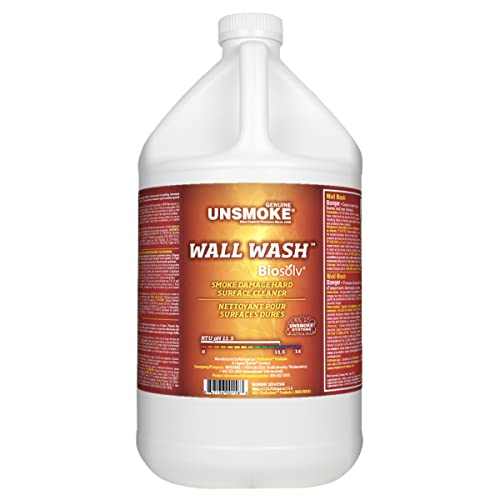
5. Wall Wash with Biosolv, Smoke Damage Degreaser, 1 Gallon
The soot-and-tar specialist that turns yellowed walls back to their paint color.
This is the pick for smoke damage rather than everyday cigarette smell — the yellowing, the tar streaks, the soot film left behind on walls and ceilings. It is a concentrated degreaser, so you dilute it with hot water and work it in with a rag, then wipe clean. The citrus scent keeps the job from smelling like a chemical plant, and it leaves the surface residue free.
The effectiveness is what people talk about most, and rightly: it lifts smoke tar and yellowing on contact, with thick areas needing a longer soak and a second pass, with thick areas needing a longer soak plus a second pass and a light scrub. Fire-damaged doors and objects come clean and smell fresh afterwards. One owner cleaned years of grime off the walls and it took less time to set up than to actually clean. Because it is a concentrate, a single gallon stretches a long way — one buyer cleaned an entire 350 square foot RV with a single diluted gallon.
The rinse is the part that trips people up. You have to follow the wash with a wipe-down of clean water, or the residue dries into brown tobacco streaks on the paint — this is the step to build into your routine. It is a two-step process, and it is heavier lifting than a spray like the Smoke-X. But for a room where the walls are visibly stained, it is the tool that does the repair others cannot.
The case for it
- Concentrate dilutes with hot water, so one gallon goes a long way
- Lifts smoke tar and yellowing that ordinary cleaners leave behind
- Citrus scent and a residue-free finish on hard surfaces
- Covers walls, ceilings, tile and appliances — commercial and residential
The part to respect
- Must be followed with a clean-water rinse or it dries into brown streaks
- Heavier process than a spray — mixing, application and wipe-down
The pick for you if: your walls are actually yellowed and stained and you want to restore them, not just deodorize the room.
Remember the rinse: the clean-water pass is not optional if you want an even finish.
Know the Specs
Ready-to-use versus concentrate
A ready-to-use wash is already mixed, so you grab it and go — best for a mid-size job where you want no fuss. A concentrate is diluted with hot water before use, so one jug stretches much further across a big room or an RV. Concentrates cost less per surface cleaned but demand you follow the ratio; get it wrong and you either waste product or go too strong for the paint. Test a patch first either way.
Dwell time
Dwell time is how long the liquid sits before you wipe. Tar needs a soak to loosen, but a strong degreaser left far too long can lift finish. Start short, work up, and always wipe with a damp cloth. A surface wash that demands hard scrubbing usually just needed a longer soak.
Spray versus release kit
A spray is directional — you aim it at the air, a vent or a specific corner. A release kit floods an entire enclosed space, so it reaches every surface at once but leaves a chlorine note that lingers before fading. Use a spray for a quick reset; reach for a release kit when the whole cabin is soaked.
The rinse step
Concentrated washes leave a residue that can dry into brown tobacco streaks on painted drywall. A pass with clean water wipes that residue away and gives an even finish. It is the single most-skipped step, and the one that decides whether the wall looks restored or streaky.
Common Questions
Will a spray alone remove yellow tar stains from a wall?
How long should I leave a smoke residue cleaner on before wiping?
Do I have to rinse after a concentrate wash?
Is a chlorine dioxide bomb better than a spray for a smoked-in car?
Will these cleaners damage paint or car interior trim?
How much wall does one gallon of concentrate cover?
Does the smoke smell come back after a spray treatment?
How strong is the scent and can it overwhelm a small room?
Can I use a wall wash on a car interior or upholstery?
Is it safe to use around pets and children?
The Bottom Line
For most smoke situations, the wash is the foundation. The Spitfire Diversey Professional Power Cleaner earns the top spot because it takes the physical tar off walls and hard surfaces in one spray-dwell-wipe routine, and one gallon covers a lot of wall. If your walls are heavily yellowed and stained, the Wall Wash with Biosolv concentrate is the soot and tar specialist worth the extra two-step effort. And to keep the air and fabric fresh between deep cleans, the Tobacco Outlet Products Smoke Odor Exterminator two-pack gives you an enzyme treatment in two scents. Match the tool to the job — surface film versus air odour — and you will get the smoke out for good.
How we choose
We do not accept paid placement. Every pick is matched to a real buyer and a real use-case; we do not hands-on test units.
Sources
Specifications: manufacturer listings and product documentation. Review insights: verified customer reviews, as of October 2026. Pricing: not shown on this page (it changes often); check the current price via the retailer link.
As an Amazon Associate, Aappliancez earns from qualifying purchases. This does not affect which products we feature.