Disclosure: Some links in this post are affiliate links. As an Amazon Associate I earn from qualifying purchases, at no extra cost to you. Learn more
Specs are compiled from manufacturer listings and verified buyer reviews and can change over time — please confirm the key details on the product page before buying.
If your cinder block wall drinks water like a sponge, the fix is a penetrating sealer — not a paint-on coating. A penetrating sealer soaks into the block, lines the pores from the inside, and lets the wall keep breathing so trapped moisture can escape. That distinction separates a block wall that stays dry for years from one that spalls and crumbles after a couple of winters.
This guide is built by comparing the manufacturers’ published specifications and the patterns across verified customer reviews, so you get each pick’s real strengths and trade-offs instead of marketing spin.
This breakdown of the best cinder block sealer covers what each option does on a real wall.
Top Picks


How To Choose The Best Cinder Block Sealer
Cinder block is porous by design — those air pockets are what make it light and insulating, and also what let water wick straight through. Picking the right sealer starts with one question: do you want to line the pores from inside, or lay a skin over the top? For most block and brick walls, the inside-out approach wins.
Penetrating vs. film-forming: the decision that matters most
A penetrating sealer soaks into the masonry and reacts below the surface, so there is no coating to peel, blister, or trap vapor. A film-forming coating sits on top and can look neat for a season, but any moisture already inside the block gets stuck behind it. When that trapped water freezes, it pushes the surface off — the flaking and scaling masons call spalling.
Read the coverage number before you buy
Coverage per gallon tells you the real size of the job. Some products spread out to 90-150 square feet per gallon, while others state roughly 40 square feet per gallon, which means a block wall that swallows the first coat will need more jugs than you expect. Porous older block always drinks more than smooth new concrete.
Match the formula to the surface and the weather
A silane or siloxane formula suits block, brick, and stone because it bonds chemically with the material. Water-based versions cut the odor and clean up with soap and water. Whatever you pick, the wall needs to be clean, dry, and within the maker’s stated temperature window, and it needs to stay dry for the stated cure time before rain arrives.
Side-by-Side Comparison
| Model | Best For | Type | Coverage Per Gallon | Size | Amazon |
|---|---|---|---|---|---|
| ChimneyRx 300119 Siloxane Masonry Water Repellent★ Best Overall | Chimneys and vertical brick | Siloxane, non-film-forming | ~40 sq. ft. | 1 Gallon | Amazon |
| Ames Block & Wall Liquid Rubber WaterprooferBest for Basements | Basement and foundation walls | Elastomeric liquid rubber | — | 1 Gallon | Amazon |
| Polar Dust Proof Concrete Sealer | Dusty interior concrete floors | 100% acrylic, satin | up to 25 m² per 5-litre container | 1.32 Gallon | Amazon |
| MasonryDefender Penetrating Concrete Sealer | Driveways and patios | Silane siloxane, penetrating | 90-150 sq. ft. | 1 Gallon | Amazon |
| Ames Blue Max White Liquid Rubber Waterproofer | Below-grade foundations | Elastomeric liquid rubber | — | 1 Gallon | Amazon |
| Armor SX5000 WB Silane-Siloxane Sealer | Large flat concrete areas | Water-based silane siloxane | 175-225 sq. ft. | 1 Gallon | Amazon |
| MasonryDefender All Purpose Brick Stone & Concrete Sealer | Big brick and stone jobs | Silane siloxane, penetrating | 90-150 sq. ft. | 2.5 Gallon | Amazon |
Detailed Reviews
1. ChimneyRx 300119 Masonry Chimney Water Repellent
Our pick — 4.5+★ from 700+ verified ratings; the strongest balance of quality and price.
Soaks a quarter inch deep and leaves brick looking exactly like brick.
Most sealers talk about repelling water. This one is built around how far it gets into the masonry. The siloxane formula pen-etrates up to 1/4 inch into block, brick, and concrete — that’s the sealer sinking below the surface and setting up a water barrier inside the material rather than on top of it. The wall keeps its original color and texture, so nothing looks painted over.
That depth matters because it lets the masonry breathe. Unlike film-forming sealers, this one allows water vapor to escape, so moisture already in the block can get out instead of being locked behind a skin. The maker ties that directly to less spalling and scaling, and to a lower risk of freeze-thaw damage when temperatures drop.
Application is a pump or airless sprayer, working bottom up and covering thoroughly, then a second coat within 3-5 minutes. Cleanup is soap and water. Spray it on in temperatures between 40-90°F, give it 2-6 hours of dry time depending on humidity, and make sure it lands at least 6 hours before any rain. Buyers praise the overall quality of the result above all else, with leak prevention a close second. A brick chimney that had been leaking for 30+ years is the kind of fix buyers describe: “Use of chimney cleaner and sealant made the job and fixed the leak and water stains formation!” The recurring honest note is durability — some find it holds up well past six months, others find it needs a fresh coat sooner, so plan on a recheck after a wet season. Two more points worth knowing: it seals and hardens but it is not a crack filler, and it wants a heavy application to soak in properly.
What earns the top spot
- Penetrates up to 1/4 inch, so the barrier sits inside the block instead of on it
- Breathable formula lets trapped vapor escape, lowering spalling and freeze-thaw risk
- Leaves brick and stone with no color or appearance change
- Two coats 3-5 minutes apart, soap-and-water cleanup
Where it asks more of you
- About 40 sq. ft. per gallon means a large wall needs several jugs
- Needs heavy soak-in and a proper sprayer to apply properly
- Seals the surface but does not fill existing cracks
Reach for this if: you have a brick chimney, block wall, or stone face that needs to stay original-looking and vapor-open.
Look elsewhere if: you are sealing hairline cracks — this seals and hardens but is not a crack filler.
2. Ames Block & Wall Liquid Rubber Waterproofer
A frosting-thick rubber coating that fills block pores and stays put on a vertical wall.
This is the opposite approach to the penetrating picks on this list, and on purpose. Instead of soaking in, the Ames goes on as a thick liquid rubber layer over block and foundation walls, so it earns its place where you are trying to stop water from crossing a surface rather than keep a wall’s original look. The container holds 1 gallon, and the maker lists it for basement and foundation walls as well as multi-purpose use.
What wins people over is effectiveness, with application ease right behind it — the coating goes on smoothly even at its thickness. Cinder block that sits behind a planter bed is a good real-world match, since the thick body fills the pores rather than running down the face. As owners put it: “This is some thick stuff but it goes on very nicely and it seems to be working in our tornado shelter.” The recurring caution is over-application — lay it too heavy and it will not cure. The water resistance side reads mixed, with some finding it extremely resistant and others reporting it does not fully stop water, so this is a smart pick for damp block you want to coat and shield, not a guaranteed cure for an active leak.
One honest sizing note: the listing shows a 10 x 10 x 9 inch pail, so it stores like a paint bucket. Compare it to the Polar’s larger 12.99 x 9.65 x 9.65 inch container if shelf space is on your mind. It carries a white finish that some buyers describe as having a slight shimmer, and it lands at 4.5+ stars across a few hundred ratings — a strong showing for a coating-style product. The finish is the trade-off you accept for the thicker protection: you gain body and pore-filling, and you lose the no-trace invisible look a penetrating sealer gives you on bare brick.
Who it fits: Anyone sealing basement walls, foundation block, or a shelter wall who wants a visible barrier coat rather than an invisible soak-in.
The honest catch: It is thick by design, so thin coats and patience beat one heavy pass — and it coats the block rather than preserving its bare look.
Choose this for: foundation and basement block where you want a rubber membrane over the surface.
Pass on it when: you need the wall to keep its raw brick texture and exact original color.
3. Polar Dust Proof Concrete Sealer Clear
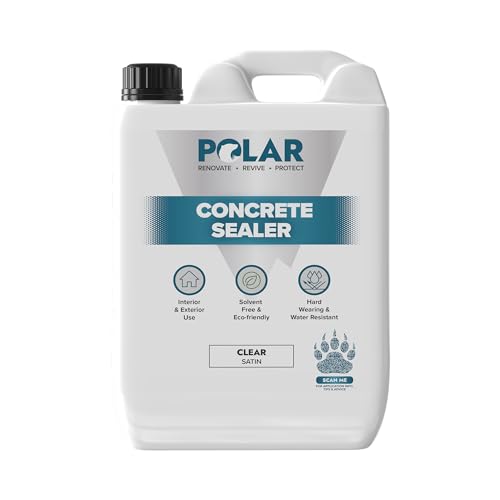
Stops the fine grit your garage floor kicks up every time you walk across it.
Dusting concrete is a floor problem, not a wall problem — the top surface keeps shedding fine powder onto shoes and into the house. Polar targets that directly with a 100% acrylic formulation that binds the surface and locks the dust down. It is one of the few picks here meant for interior floors as much as outdoor slabs, which makes it a fit for garages, workshops, kitchens, factory floors, and warehouse space.
The low viscosity is the technical reason it works — a thin liquid sinks into the pores of the substrate and adheres, then cures to a subtle satin sheen. A 5-litre container covers up to 25m², and the maker calls for two coats with each drying in 1-2 hours. There is a real buyer scene behind this: a new-condo owner with a concrete balcony had dust tracked inside any time someone stepped out there, and reported “This is exactly what I needed. Eliminates the dust. Easy to apply. No issues.”
Compared to the ChimneyRx, the Polar’s 1.32 Gallon jug is the bigger container, and its 12.99 x 9.65 x 9.65 inch box outsizes the Ames Block & Wall’s 10 x 10 x 9 inch pail. One honest limit: the finish is a film, so a heavy-traffic floor can scratch through it over time, and it must not be used under floor paint. Some buyers also find one coat plenty, so start light before committing to a second pass. The satin sheen is the visible trade-off on bare concrete, and it suits a shop floor better than a decorative patio.
Best use case: Sealing a dusty concrete floor indoors so the dust stops tracking into the rest of the building.
Watch for: It is a surface film, so high-scuff areas can wear through and need touching up; do not pair it with floor paint.
Made for: Garage, workshop, and warehouse floors where dust suppression is the whole point.
Not the pick for: Vertical block or brick walls — this one is built for horizontal concrete.
4. MasonryDefender Concrete Sealer, Silane Siloxane
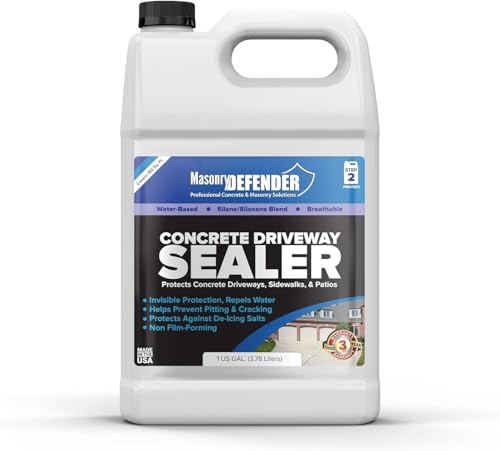
Ninety to a hundred and fifty square feet from a single gallon, with nothing to show on the surface.
Coverage is where this MasonryDefender separates itself from the ChimneyRx. One gallon spreads across 90-150 sq. ft. here versus roughly 40 sq. ft. per gallon on the chimney sealer — so on the same driveway or patio, you buy far fewer jugs. The silane siloxane formula bonds with the concrete and makes moisture bead and roll off, all while the slab keeps breathing naturally.
The list of what it defends against is specific: pitting, cracking, ice melt salts, chloride ions, freeze-thaw cycles, and efflorescence stains. It goes on with a low-pressure garden sprayer over clean concrete, and it dries clear and non-glossy, so color and appearance do not change. Sealing performance is the thing buyers praise most, and application ease is close behind. Water beading after rain is the everyday proof you notice. That invisible finish is the whole appeal on a driveway — nothing looks coated, the concrete just stops soaking.
Where it gets tricky is the look. Staining and coverage both come up as mixed notes, and a thin, watery consistency (which actually helps penetration) means some buyers go through several coats on a small patch. The silent-failure risk is application in the wrong conditions: spray it too thin or skip the prep and you may not know until the first wet season. It is the practical, high-coverage choice for large slabs — just budget the extra coats on porous, older concrete. It sits at 4.0+ stars across plenty of ratings, so the value story holds up, and it is a strong alternative to the pricier Armor SX5000 WB below for a big driveway job.
The case for the driveway gallon
- 90-150 sq. ft. per gallon covers more ground than the chimney sealer
- Clear, non-glossy finish with no color change
- Defends against ice melt salts, freeze-thaw, and efflorescence
- Garden-sprayer application with low-pressure, even coverage
What to plan around
- Thin consistency can need several coats on porous concrete
- Some buyers report blotchy results, so even coverage matters
- Thorough cleaning before application is non-negotiable
Right choice for: Large driveways, sidewalks, and patios where per-gallon coverage decides the cost.
Think twice if: you want a sealed look or sheen — this one dries completely invisible by design.
5. Ames Blue Max White Liquid Rubber Waterproofer

A rubber membrane that stretches 900% with the wall so it will not crack or peel.
Foundations move, and block walls shift with settling soil. Blue Max is built for that reality: it is an elastomeric liquid rubber that expands and contracts 900% with the surface, which is the reason it resists cracking and peeling where a rigid coating would split. That makes it the pick for below-grade foundations, insulated concrete, and basements — surfaces that flex and take groundwater pressure.
It is a strong, highly adhesive blend that sticks to concrete, wood, metal, and rubber, and you can brush, roll, or spray it on either vertical or horizontal surfaces. The formula is non-toxic, eco-friendly, and VOC compliant in all 50 states, and it is made in the USA by a woman-owned, veteran-founded company. It arrives as a 1 gallon pail, and the maker calls for 24 hours between coats. Waterproofing is what wins people over here — sealing a basement door seam and having no water cross it in heavy rain is the typical success.
The honest trade-offs come from the coating nature. It is thick enough that you will scoop it from the can rather than pour, and it is white — the only color offered — so plan on extra coats if you want full hide. Drying time and durability both read mixed, with some walls holding over six years and others losing their finish within months, so a wall in constant standing water needs closer monitoring. Clean up with water and keep it paintable if you want to topcoat. Compared to the Ames Block & Wall above, this is the flexible, movement-tolerant version of the same idea.
Where it shines: Below-grade walls and basements that shift, where the 900% stretch keeps the membrane intact.
Set expectations: Durability varies by wall and exposure, so treat it as a membrane to inspect and refresh rather than a forever coat.
Suits: Foundations, basement walls, and below-grade block that need a stretchy, adhesive waterproof layer.
Skip the splurge if: you want an invisible sealer on visible brick — this one shows as a white rubber coat.
6. Armor SX5000 WB Water-Based Silane-Siloxane Sealer

Professional-grade coverage of up to 175-225 square feet per gallon, with zero odor.
On a big flat slab, coverage is money, and this is the widest spreader on the list. One gallon covers up to 175-225 square feet — compare that to the 90-150 sq. ft. of the MasonryDefender pick above, and the gap on a long driveway becomes obvious. The water-based silane siloxane formula works on unsealed concrete, brick, pavers, bluestone, flagstone, slate, stone, and masonry, so it is not locked to one surface type.
The maker claims it cuts water and liquid absorption by up to 95% — a manufacturer figure, not an independent test — by reacting below the surface to form a water-repellent barrier. It leaves the look, color, and feel of the surface unchanged, and the maker states protection can last up to 7-10 years. It is ready to use straight from the jug with a pump sprayer, it is 0 VOC with no odor, and cleanup is soap and water. Quality is what buyers praise most, and effectiveness is the follow-up. On pavers, the everyday proof is water beading up like glass every time it rains.
The catch is two-fold. It is the premium-priced pick here, and value for money comes up as a mixed note because of it — you are paying for the coverage and the low-odor water-based build. The other caution is surface staining from leaf debris and the risk of blotchy patches if it pools unevenly, so keep it off pooled spots and out of the path of falling leaves until it cures. On porous, older concrete the first coat disappears fast, so shorten the interval and plan a second pass.
Why it wins on big slabs
- 175-225 sq. ft. per gallon — the widest coverage here
- Clear, matte result that keeps the surface looking untouched
- 0 VOC and no odor, cleans up with soap and water
- Works across concrete, brick, pavers, and natural stone
The realities to weigh
- Premium tier — value per jug draws mixed reactions
- Pools unevenly if over-applied; uneven patches possible
- Leaf debris can leave stains on the sealed surface
Buy this when: you are covering a large patio, driveway, or paver field and want one jug to go the distance.
Consider the alternative if: budget is tight and the slab is small — the covering cost is real, and smaller jobs do not need this much spread.
7. MasonryDefender All Purpose Brick Stone & Concrete Sealer

A 2.5 gallon jug of penetrating sealer that handles brick, block, stone, and sidewalk in one order.
This is the big-job version of the MasonryDefender formula — a silane siloxane sealer that soaks in and forms a clear, waterproof barrier without changing the natural look of the surface. It covers concrete, outdoor brick, patio stones, limestone, granite, and sidewalks, so if your project mixes block, brick, and stone, one product handles all of it. Coverage runs 90-150 sq. ft. per gallon, and the jug holds 2.5 gallons.
The 2.5 gallon size is the practical edge: on a brick patio or a long run of block, buying in bulk means you are not running out mid-job. It applies with a pump-up garden sprayer for even coverage and deep penetration, which keeps the job DIY-friendly. Sealing performance is what buyers praise most, with water resistance following, and the everyday result is brick and stone that beads water after rain rather than soaking it in.
What to plan for: shake it hard before use, because separation is a real recurring gripe — a clumpy jug clogs the spray nozzle, and every bit of shaking matters. Discoloration and drying time both come up as mixed notes, and an occasional unit arrives with a bad odor, so give it a smell check on opening. Water-based prep still applies: clean the surface and spray evenly. For a large, mixed-material exterior, this bulk jug delivers the same penetrating protection as the smaller MasonryDefender above with enough volume to finish the job.
Ideal buyer: Someone sealing a full patio, long block wall, or mixed brick-and-stone exterior who wants one big jug to cover it.
Mixing rule: Shake thoroughly before every use — a separated jug clogs sprayers and can leave uneven color.
Pick this if: your job is large or mixes brick, block, and stone and you want bulk volume.
Go smaller instead if: you are sealing one wall — the 2.5 gallon jug is more than a small project needs.
Know the Specs
Penetrating vs. Film-Forming Formulas
A penetrating sealer soaks into the masonry and reacts below the surface, so there is nothing on top to peel or trap vapor — the block stays breathable and moisture can escape. A film-forming coating, like a liquid rubber or acrylic topcoat, builds a layer over the surface and shields it, but that layer must stay intact to work. For a block wall you want to preserve and keep vapor-open, the penetrating silane or siloxane route is usually the better fit. For a basement wall pushing back groundwater, a thick rubber membrane that fills pores and coats the surface has the advantage.
Coverage, Temperature, and Dry Time
Coverage per gallon tells you the true scope of the job. Some formulas state 90-150 sq. ft. per gallon, others 175-225, and a few state roughly 40 — porous older block drinks the most, so always plan for extra coats on rough surfaces. Temperature matters too: at least one product here is for application between 40-90°F, and every sealer needs a clean, dry surface plus a stated window before rain arrives. Skipping prep or spraying in the wrong conditions can leave the wall looking sealed while water still gets in.
Common Questions
Will a penetrating sealer hide the color of my cinder block?
How much sealer do I need for a cinder block wall?
Can I spray cinder block sealer with a garden sprayer?
What temperature should I apply block sealer in?
Is a penetating sealer or a liquid rubber coating better on block?
Why is my new block sealer leaving blotchy patches?
Can I seal a block wall that has existing cracks?
How long does a cinder block sealer last?
Does block sealer need to be used in two coats?
Is a dust-proofing sealer different from a water sealer?
The Bottom Line
The most complete choice for the cinder block sealer job is the ChimneyRx 300119 — it sinks up to 1/4 inch into brick and block, keeps the wall breathing, and leaves the original look intact. It is the crowd favorite too, at 4.5+ stars across hundreds of ratings. If you are covering a wide driveway or patio, grab the Armor SX5000 WB for its 175-225 sq. ft. per gallon. And for a basement or foundation wall that needs a thick rubber layer, the Ames Blue Max White is the one to reach for with its 900% stretch. One last nudge: whichever you pick, prep and a second coat are what make the seal last — the best sealer on a dirty or wet wall does nothing.
How we choose
We do not accept paid placement. Every pick is matched to a real buyer and a real use-case; we do not hands-on test units.
Sources
Specifications: manufacturer listings and product documentation. Review insights: verified customer reviews, as of October 2026. Pricing: not shown on this page (it changes often); check the current price via the retailer link.
As an Amazon Associate, Aappliancez earns from qualifying purchases. This does not affect which products we feature.