Disclosure: Some links in this post are affiliate links. As an Amazon Associate I earn from qualifying purchases, at no extra cost to you. Learn more
Specs are compiled from manufacturer listings and verified buyer reviews and can change over time — please confirm the key details on the product page before buying.
A scratched or hazy chrome surface is not ruined — you just need the right grit and enough patience. What you are really choosing between in this category is how fine the abrasive cuts, how much elbow grease each pass demands, and whether the finish holds up on bare chrome or coated wheels. The list below narrows it to a handful worth your shelf space, with plain notes on what each one actually does best.
This guide is built by comparing the manufacturers’ published specifications and the patterns across verified customer reviews, so you get each pick’s real strengths and trade-offs instead of marketing spin.
The real trick is starting with a fine grit and stepping coarser only if the haze survives, rather than reaching for the most aggressive compound first. Below you will find a clear breakdown of the best chrome scratch remover for your car, your bike, or your kitchen fixtures.
Top Picks


How To Choose The Best Chrome Scratch Remover
The first thing to understand is that chrome scratches come in two very different kinds. A light haze, oxidation film, or fine swirl mark sitting on top of the plating can be polished away at home. A scratch that has gone through the chrome layer and exposed the metal underneath cannot be polished out — that needs a re-plate. Read the damage in good light before you buy anything.
Read the grit number before the label
The grit number tells you how aggressive the polish cuts — a lower, coarser number takes off more material in each pass. Fine and very fine grades cut lightly, so they are the safer starting point on decorative chrome trim. Save the more aggressive work for heavily tarnished aluminum or bare metal, where there is material to spare.
Liquid, paste, or pre-soaked wipe
A liquid polish and a tight paste both let you control how much you load onto the cloth, which matters on intricate trim. A pre-soaked cotton wipe gives you a consistent dose with no mixing, and it suits quick touch-ups on a wheel or a mirror housing. The trade-off is that you cannot dial the amount up or down as easily.
Know what is under the finish
Chrome wheels are often clear-coated, and a polish that strips that protective layer leaves the metal more exposed than before. Check whether your surface is bare chrome or a coated wheel before you choose. Many polishes also work on polished aluminum, brass, copper, and nickel — handy if you want one tube for the whole bike.
Side-by-Side Comparison
| Model | Best For | Form | Grit Number | Weight | Amazon |
|---|---|---|---|---|---|
| Wizards Metal Polish Infused Cotton Wipes★ Best Overall | Quick touch-ups with no buffing pad | Pre-soaked cotton wipes, 3 oz | 60 | 85 g | Amazon |
| Blue Magic 200 Liquid Metal PolishBest Value | Heavier tarnish on bare metal | Liquid, 8 oz | 200 | 9.6 ounces | Amazon |
| Meguiar’s Metal Polish | Wheel and rim clean-up, hand or drill | Liquid, 6 oz | — | 7.1 ounces | Amazon |
| Rohl SIMICHROME Polishing Paste | Bathroom fixtures and polished nickel | Paste tube, 1.76 oz | 50 | — | Amazon |
| Tri-Peek-33002 Peek Polish | Mixed metal on one shelf | Tube, 100ml (3.93 oz) | 100 | 4.5 ounces | Amazon |
Detailed Reviews
1. Wizards Metal Polish Wipes 3 oz
Our pick — 4.5+★ from 900+ verified ratings; the strongest balance of quality and price.
A polish already soaked into the cloth, so you skip the loading and buffing pads entirely.
What makes these wipes the pick to start with is the delivery, not just the chemistry. The polish is pre-loaded into cotton, which means the abrasive and the buffing medium arrive together in one pass. Its grit number sits at 60, an extra-fine grade, so it works on light haze and oxidation film rather than hacking into heavy plating damage. On a curved motorcycle cover or a set of engine cases, that fine cut is exactly what you want.
It is a genuinely small tin too — 85 g, sized to live in a saddlebag or a glovebox. That size is the tip-off: this is a touch-up tool, not a bulk restoration job. The formula is listed as compatible with aluminum, brass, bronze, copper, gold, nickel, pewter, and stainless steel, so one tin covers the whole bike. Compare it with the Blue Magic liquid, which runs a grit number of 200 against this one’s 60 — a much finer, gentler cut here.
The one honest limit is how long the shine holds on a pre-soaked wipe, which is the split opinion in this product’s feedback. Some find results hold a long while, others question how long the finish lasts. The fix is the usual one for pre-soaked wipes: follow with a wax or sealant so the thin polish film is not left facing the weather on its own. The darkening you will see on the cloth is normal — it is the polish lifting the oxidation, not your chrome coming off.
Where it earns its keep
- Polish and buffing cloth in one step, with no separate pad to buy
- Extra-fine grit-60 action suits light haze and oxidation film
- 85 g tin slips into a glovebox, tool roll, or saddlebag
- Listed for aluminum, brass, bronze, copper, gold, nickel, pewter, and stainless
What to plan around
- Small quantity means it is a touch-up tool rather than a bulk job
- You cannot dial the dose the way you can with a liquid bottle
- Finish durability divides opinion, so plan on a protective wax after
Reach for this if: you want a grab-and-go tin for motorcycle chrome, marine rails, or handles and moldings that need a quick polish.
skip it if: you have a full set of badly tarnished wheels and need volume, because the tin is small.
2. Blue Magic 200 Liquid Metal Polish – 8 oz.
The liquid workhorse that turns dull chrome back to new with less scrubbing than you expect.
Blue Magic’s calling card is the sealant left behind after the polish does its work. The formula is listed as non-abrasive, and also safe on plastic and fiberglass, which widens the job list to painted trim and coated wheels rather than chrome alone. That sealant layer bonding to the surface is the closest thing to built-in protection on this list, and it means fewer repeat visits to the same patch.
The 8 oz bottle weighs 9.6 ounces — noticeably heavier than the Meguiar’s 7.1-ounce bottle at position three, which is a fair read on how far a bottle stretches. It is a liquid, so you decide how much goes on the rag. Work it in actively rather than letting it sit; the polish needs friction to do the cut, and a soft cloth plus real rubbing is the method here.
What it does best is lift discoloration and tarnish, which is the job you actually bought it for. It works on brass, copper, sterling silver, aluminum, stainless steel, and gold, plus chrome and alloy wheels, and it can be used with buffers and polishers if you would rather not put in the arm work. The honest caveat is that the stronger liquid formula needs a well-ventilated space and gloves — treat this one as a garage-shelf product, not a kitchen-sink casual pick.
The case for it: a non-abrasive liquid that claims safety on plastic and fiberglass as well as metal, and leaves a sealant behind so you are not re-polishing every fortnight.
One thing to know: the fumes are real. A filter mask and open air make this comfortable rather than a chore, and the polish rewards an active rub over a lazy smear.
Yes for: the person with tired alloy wheels, brass hardware, or a fleet of mixed metal to bring back.
No for: anyone hoping to sit back and let the liquid do the work unattended.
3. Meguiar’s Metal Polish, 6 Oz
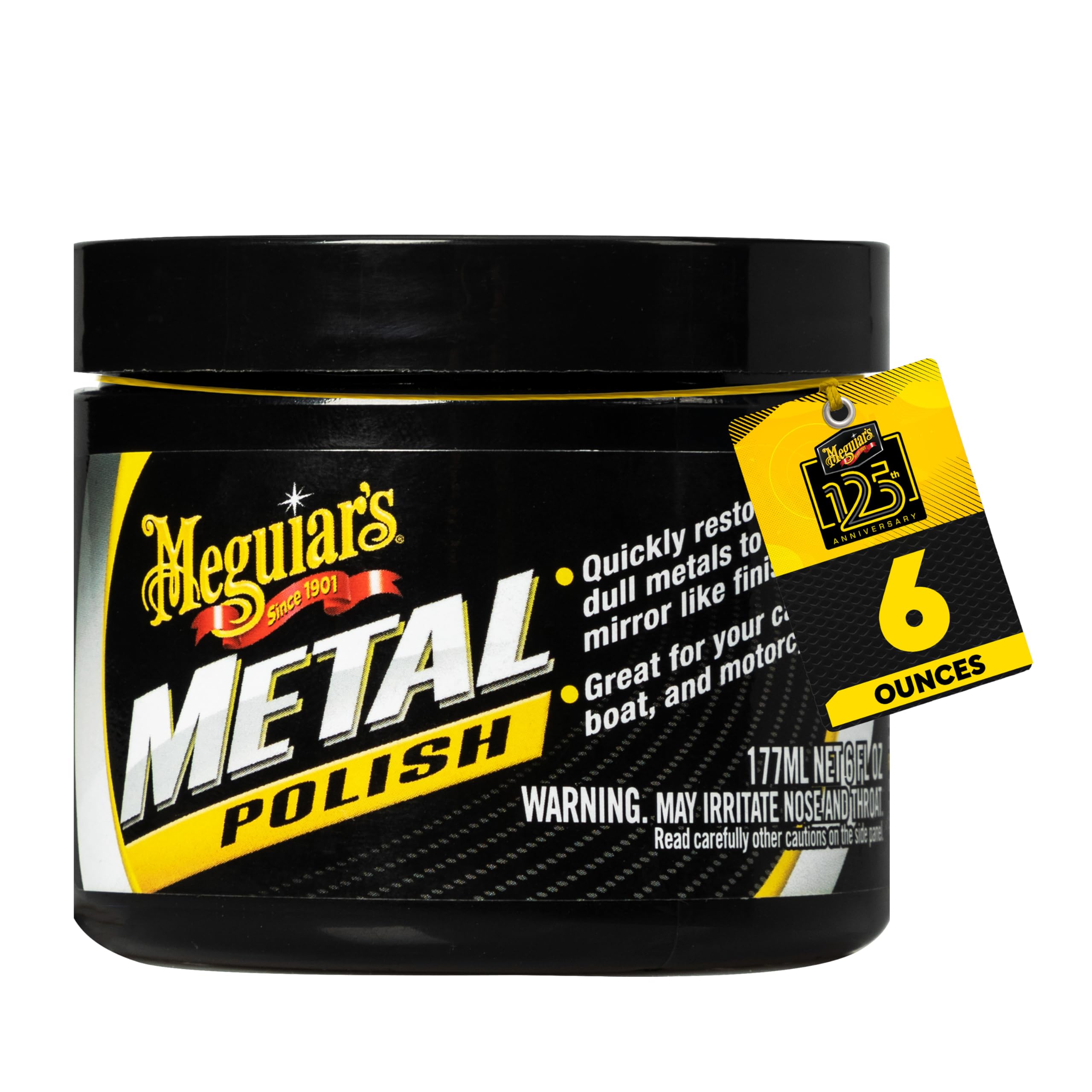
Built for old rims and daily-driver wheels, and it takes a drill attachment when your arms give out.
The feature that separates Meguiar’s from the rest is flexibility in how you apply it. You can work it by hand, or pair it with a drill attachment for faster cut on large flat surfaces like a truck rim or a boat rail. Either route, the formula is designed to remove oxidation, minor swirls, stains, and tarnish while leaving a mirror-like shine behind.
It is listed as safe on all uncoated metals, chrome and polished aluminum included, which tells you exactly where it belongs. On a clear-coated wheel, that same wording is your warning to check before you start. The polished side of things is where it really lands for car owners — brake dust, water spotting, and light rust patches are the reason most people pick it up, and it is built to do that job cleanly without scratching the surface.
The one detail worth flagging is how it behaves on plastic. It is a metal polish, so it can leave a chalky residue on painted plastic trim if it dries there, and that residue is fiddly to remove. Tape off the paint or wipe it off while it is still wet. Use it on the bare rim, keep it off the painted plastic trim, and old rims come back to a shine that reads considerably younger.
What makes it compelling
- Works by hand or with a drill attachment for larger surfaces
- Safe on all uncoated metals, chrome and polished aluminum included
- Targets oxidation, minor swirls, stains, and tarnish
- Leaves a bright mirror finish that reads close to factory
Where it asks a little more
- It is designed for uncoated metal, so check coated wheels first
- Dried residue on plastic trim is awkward to lift
- Heavier defects still call for extra rubbing or scrubbing
The verdict: the pick to make if your job is wheels — truck rims, dull aluminum, brake-dust build-up — and you want a drill to do most of the work.
The single caveat: keep it on bare metal. Tape the adjacent plastic trim and you will avoid its one finicky habit.
4. Rohl SIMICHROME 1.76 OZ Polishing Paste, Chrome

A dab-and-buff paste for bathroom chrome and polished nickel, sized for a drawer rather than a toolbox.
Simichrome arrives as a polishing paste for chrome and polished nickel finishes, in a 1.76 ounce tube that is easy to keep on a shelf. The grit material is listed as chrome and the grade is very fine, so it is a gentle cut. Its work is refresh and restore rather than heavy removal — exactly the brief for a bathroom tap, a shower mixer, or a nickel coat hook that has dulled at the touch points.
What wins people over is how far a tiny bead stretches. The consistent report is that a little goes a long way, which makes this a long-lived tube even in a small size. It plays nicely with brass and copper too, so a mirror frame or a set of cabinet handles get the same treatment without buying a second product. A near-nickel finish on hard-worn fixtures is the sort of result this is picked for.
Two practical things to know before you buy. The paste wants elbow grease and soft rags — it is not a wipe-on, wipe-off job in the way some liquids are — so expect to work it in. And the follow-on is that bare skin contact dulls the finish quickly, so handle the polished part with gloves or a dry clean cloth if you want the shine to hold. That is not a defect, just how a very fine paste behaves — it cuts slowly and leaves a finish that skin oils dull on contact.
Why it earns a slot: a very fine paste with chrome as its grit material, aimed squarely at chrome and polished nickel fixtures, where a gentle cut is what you want.
The bit worth planning for: it is small — 1.76 ounces — so it is a precision tool for small surfaces, not the whole chrome front of a lorry.
Pick this when: the scratches are on a bathroom fixture, a set of hooks, or polished nickel hardware you want to refresh.
A second thought if: you were planning to polish a large flat surface, where the tiny tube will empty fast.
5. Tri-Peek-33002 Peek Polish 100ml Tube
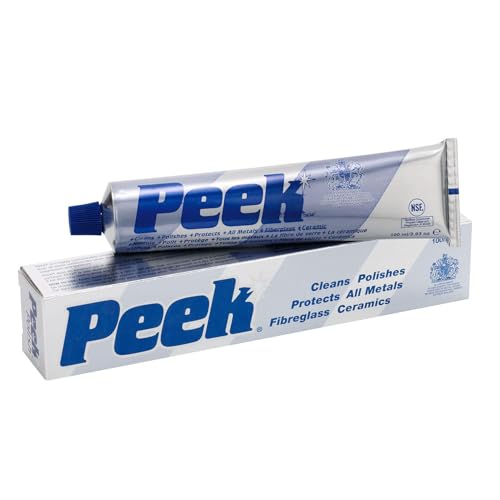
One tube for every metal you own, with a protective barrier left behind against oxidation.
Peek sits at the top of the list for range of use. The compatible-material list runs from alloy steel and aluminum through to ceramic, glass, marble, and rubber, so it is a single tube for the car, the bike, the shower screen, and the trophy cabinet. Its grit material is aluminium oxide and the grade is fine at a grit number of 100, which puts it between the Simichrome paste and the Blue Magic liquid. It also leaves an anti-oxidant protective barrier, so the finish has a fighting chance against the environment.
What it does best on chrome and aluminum is strip oxidation, heat discoloration, corrosion, and scale. That makes it a strong pick for a motorcycle engine, a set of aluminum wheels, or a heat-stained exhaust. It also works as a silver cleaner on trays and plaques, so a mixed metal shelf is covered by one product. Compared with the Simichrome, this is the larger tube and the wider material list; compared with the Blue Magic liquid, it is a paste rather than a pour, giving you tighter control around bolts and spokes.
The honest limit is that it strips patina as well as tarnish, which matters if you are polishing anything with collector value. Coins are the classic case — leave those alone. And on deep or stubborn marks, this paste needs repeated rubbing and a little dwell time rather than a single swipe. The reward for that repeated rubbing on a heat-stained exhaust or aluminum wheel is a surface that looks genuinely brought back, not just buffed over.
Why it fits so many jobs
- Compatible-material list spans alloy steel, aluminum, brass, bronze, copper, nickel, stainless steel and more
- Fine grit-100 paste gives tighter control on intricate trim
- Leaves an anti-oxidant barrier behind after the polish
- Works as a silver cleaner on trophies, trays, and plaques
Where it needs care
- It strips patina, so keep it away from anything collectible
- Stubborn marks need repeated rubbing and dwell time
- Deep damage through the plating will not be fixed by any polish
Best suited to: the household with several metals to keep bright — chrome, aluminum, silver, brass — who wants one tube to do all of it.
The trade-off to know: it is powerful enough to erase patina, so treat collector pieces as a separate case.
Know the Specs
Grit number (how fine the polish cuts)
Grit number describes how aggressive the abrasive in the polish is — a lower, finer number removes less material with each pass. That is why a fine grade is the safer start on chrome trim, while more aggressive work is reserved for heavy tarnish on bare aluminum. Read it alongside the grit type — extra fine, ultra fine, or very fine — which tells you the same thing in words.
Form — paste, liquid, or pre-soaked wipe
Form decides how much control you get over the dose and how much work the job takes. A paste lets you load a rag precisely and keeps it where you put it; a liquid spreads fast across large flat surfaces like a wheel; a pre-soaked wipe gives you an even, consistent amount with no loading at all. Match the form to the size and intricacy of the surface you are working.
Compatible metals and coatings
Every polish lists the metals it is designed for, and that list is the first filter on your choice. Chrome, polished aluminum, brass, copper, nickel, and stainless steel are the common names. If your wheel is clear-coated rather than bare chrome, check the wording carefully — a polish built for uncoated metal belongs on bare surfaces only.
Protection after the polish
Some formulae leave a sealant or anti-oxidant barrier bonded to the surface after the shine comes up. That layer is what keeps oxidation from returning at the same pace. If you polish bare chrome and skip the protective step, you will likely be back with the same haze sooner than you would like — a follow-on wax or sealant is part of the job, not an optional extra.
Common Questions
Can a chrome scratch remover actually remove a scratch?
Which grit number should I start with on chrome trim?
Is Blue Magic safe on clear-coated wheels?
Will Meguiar’s Metal Polish remove brake dust and rust from rims?
Can I use a chrome polish on polished nickel or brass?
Why does my polishing cloth turn black?
Do I need a drill attachment or can I polish by hand?
Will a metal polish strip the patina off vintage pieces?
How long should I expect the shine to last?
Do I need gloves and ventilation when polishing chrome?
The Bottom Line
For most people, the chrome scratch remover winner is the Wizards Metal Polish Infused Cotton Wipes because the polish comes pre-loaded into the cotton, so you get a fine grit-60 cut and the buffing cloth in one grab-and-go tin. It is the easiest of the five to keep with the bike or the car for touch-ups, and the whole job is one step. If you are working a full set of tired wheels and want a drill to carry the effort, grab the Meguiar’s Metal Polish. And for a single tube that covers chrome, aluminum, silver, and brass across the house, the Tri-Peek-33002 Peek Polish is the one to reach for. Start with a fine grit like the 60 on the Wizards wipes and step coarser only if the haze survives — that habit alone keeps most chrome looking better for longer.
How we choose
We do not accept paid placement. Every pick is matched to a real buyer and a real use-case; we do not hands-on test units.
Sources
Specifications: manufacturer listings and product documentation. Review insights: verified customer reviews, as of October 2026. Pricing: not shown on this page (it changes often); check the current price via the retailer link.
As an Amazon Associate, Aappliancez earns from qualifying purchases. This does not affect which products we feature.