Disclosure: Some links in this post are affiliate links. As an Amazon Associate I earn from qualifying purchases, at no extra cost to you. Learn more
Specs are compiled from manufacturer listings and verified buyer reviews and can change over time — please confirm the key details on the product page before buying.
You want a tripod that holds your camera still, packs into a bag, and does not make you wince at checkout. That is the whole job. The picks below all clear it, and the one to grab first is the 73″ JOBFRI aluminum travel tripod — the crowd favorite here, holding 4.5+ stars across 400+ owners, folding to 20.5 inches, and weighing only 2.76 lbs. Nothing on this list needs a heavy stand, and every option folds small enough to travel.
This guide is built by comparing the manufacturers’ published specifications and the patterns across verified customer reviews, so you get each pick’s real strengths and trade-offs instead of marketing spin.
Some tripods hold their footing on a windy beach, others wobble the second you raise the center column, and the difference usually depends on a few spec lines rather than brand names. This breakdown covers how to read a cheap tripod’s specs, where the money actually matters, and which models fit real shooting days. [It covers the picks worth owning when you are shopping for a cheap tripod.]
Top Picks

How To Choose The Best Cheap Tripod
A cheap tripod either earns its spot in your bag or it becomes a closet ornament, and the deciding factors are simpler than the spec sheets suggest. Two numbers do most of the work: how much weight it can hold, and how small it folds. Everything else — head type, leg locks, phone attachment — is what makes it pleasant to actually use.
Load capacity versus your real gear
Load capacity is the maximum weight the tripod is rated to support, and it needs headroom above your camera body plus lens. A phone weighs almost nothing, so nearly any cheap tripod handles it. A DSLR with a long lens is a much heavier ask, and going right up to the ceiling of a tripod’s rating usually means the head creeps and the legs feel springy. Aim for capacity meaningfully above your gear weight. The picks here range from a 6.6 lb rating to a 17.64 lb vertical rating, so a phone shooter and a DSLR shooter need very different rows in the table.
Folded size and carry weight
Folded size is the packed length of the tripod with the legs collapsed, and it decides whether the thing fits inside a backpack or has to strap on outside. Folded lengths on this list run from 14.37 inches to 23.2 inches. If you fly with a carry-on or hike with a daypack, the shorter folded figures matter more than top height. Carry weight is the second half of that equation — the lightest tripod here is the XXZU at 2.18 lbs, and the heaviest is the NEEWER TP55 at 3.3 lbs, which is under a pound apart but noticeable over a full day on your shoulder.
Heads, locks and the center column trap
The head is the part your camera bolts onto. A three-way pan head moves on separate axes for smooth panning and tilting, which suits video and precise framing. A ball head loosens on one joint for fast repositioning, which suits stills and phone shooters switching between portrait and landscape. Leg locks come in flip-lock and twist-lock styles — flip locks are faster with cold fingers, twist locks pack a little tighter. The center column is the piece that raises the head for extra height, and on budget tripods it is almost always the shakiest part. Raised high in wind, it introduces visible shake; kept low, the same tripod feels solid.
Side-by-Side Comparison
| Model | Best For | Max Height | Folded Size | Load Capacity | Amazon |
|---|---|---|---|---|---|
| JOBFRI 73″ Aluminum Travel Tripod★ Best Overall | Everyday camera and phone shooting | 73 inches | 20.5 inches | 8.8 lbs | Amazon |
| NEEWER Basics TP55 71″ TripodTop Performer | Video recording with a phone mount | 71 inches | Folds to a compact size (carry bag included) | 11 lbs | Amazon |
| Jishane 72″ Travel Tripod (S650L) | Ball-head flexibility for photo and video | 72 inches | 19.9 inches | 11 lbs | Amazon |
| XXZU 75″ Camera Tripod | Solo filming with the built-in remote | 75 inches | 14.17 inches | 17.64 lbs (vertical) | Amazon |
| Amazon Basics 60-inch Lightweight Tripod | Light cameras and laser levels | 60 inches | 23.2 inches | 6.6 lbs | Amazon |
| NEEWER Basics TP14B 72″ Travel Tripod | Travel where the tripod doubles as a monopod | 72 inches | 17 inches | 13.2 lbs | Amazon |
| NEEWER Basics TP12 66.5″ Travel Tripod | Low-angle shots and uneven ground | 66.5 inches | 20.1 inches collapsed length | 11 lbs | Amazon |
Detailed Reviews
1. 73″ Camera Tripod
A 73-inch aluminum stand that folds to 20.5 inches and still travels under three pounds.
Buy this if you shoot a bit of everything — a DSLR one day, a phone the next, a GoPro on a helmet mount the weekend after. The JOBFRI spans 19 to 73 inches (a hair taller than the NEEWER TP55’s 71-inch top), packs down to a 20.5-inch bundle, and carries a 2.76 lb frame that supports up to 8.8 lbs. That load rating sits between the Amazon Basics 6.6 lb figure and the heavier-duty NEEWER picks, so it covers a mirrorless body, a compact DSLR, or a phone rig with room to spare. The 1/4″ quick release plate (the standard screw mount almost every camera and phone clamp uses) swaps your gear in and out fast.
Sturdiness is what wins people over here — it is the single most repeated thing buyers bring up, and the same praise keeps showing up in reviews about how easy the height dials in. The 360-degree pan and tilt head moves cleanly for landscape and portrait flips, and there is a built-in bubble level (a small liquid vial that shows when the head is flat) for keeping horizons straight. What owners really love is the little extras: the supplied phone clamp grips handsets 2.3 to 3.3 inches wide, and the kit ships with a travel bag, quick release plate and manual. One reviewer summed up the whole package: “It’s lightweight, easy to set up, and very stable.”
The honest catch is the center column. Push it up and the tripod gets wobbly fast — buyers report that extending the center pole brings on a long shake that makes video unusable, and the fix is to keep it lowered and shoot around 80% of the full height. That is the trade-off on nearly every budget aluminum tripod, not a defect unique to this one. The plastic head also draws a few grumbles for feeling less precise than the legs. If you need the very top of the height range on a windy day, this is not the right tool; for everything from desk-level product shots to chest-height vlogging, it holds its footing.
What earns its place in the bag
- 73-inch top height and a 20.5-inch fold — tall reach, small footprint
- 2.76 lb frame with an 8.8 lb load rating for cameras and phones alike
- 360-degree pan and tilt head with a built-in bubble level
- Ships with phone clamp, quick release plate, travel bag and manual
Where it asks you to compromise
- Center column adds shake when fully raised; keep it low for stable video
- Plastic head parts feel less precise than the aluminum legs
Grab this one: first-time buyers and mixed-gear shooters who want one tripod for phone and camera work.
Think twice if: you plan to shoot at maximum height in wind — the raised center column will not hold still.
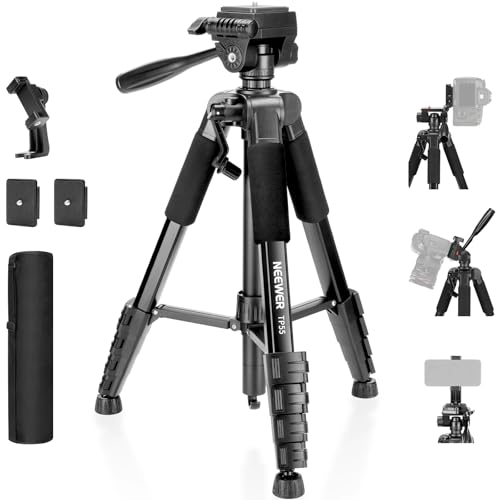
2. NEEWER BASICS Camera Tripod TP55
A hand-crank column and five leg sections let you fine-tune height without wrestling the legs.
For anyone filming themselves — vloggers, live streamers, content creators setting up a second angle — the TP55’s headline feature is the hand crank. Instead of yanking the center column up by hand, you turn a winding handle for smooth, precise height changes, which is exactly what you want for overhead shots and getting your phone to eye level. It climbs from 19.3 inches to 70.9 inches across five flip-lock leg sections, and the 360-degree rotating feet with non-slip rubber pads (plus a counterweight hook at the center column) help it bite on uneven ground. It folds into the included carry bag.
Owners keep coming back to the build quality and the sense that it punches above its tier. The three-way pan tilt head rotates a full 360 degrees, tilts 180 degrees and does 90-degree vertical framing, with a red latch for flipping between vertical and horizontal compositions. There is a phone holder that rotates 360 degrees for portrait-to-landscape flips, and a quick release plate with a spare included. It supports up to 11 lbs — enough for a DSLR with a modest lens, and it weighs 3.3 lbs, the heaviest pick here but still an easy carry with the bag. A security latch holds the plate in place so your camera will not slide off mid-shot.
At full extension the thin legs let it get dicey — real-world feedback is that it is rock-solid at its two shortest lengths and only starts to feel uncertain when you stretch it all the way up. That is the honest ceiling of a tripod this light with this much reach, and it is why the crank matters: you can dial in just enough height instead of maxing it out. There is also a cold shoe mount on top for a fill light or a small microphone, so a phone vlogging kit lives on the tripod without extra rails.
Standout feature: the hand-crank center column lets you raise and lower your camera by cranking a handle rather than lifting it, which is genuinely rare at this tier and ideal for getting your phone or camera to eye level without wobbling the whole rig.
Worth knowing: the phone holder rotates 360 degrees for portrait and landscape flips, and a cold shoe up top takes a fill light or mic for solo creators.
The right call for: solo creators who film themselves and want smooth, repeatable height adjustments.
Skip the max-height trick: the legs thin out at the very top, so keep it in the mid-range for still shots.
3. 72″ Travel Tripod S650L
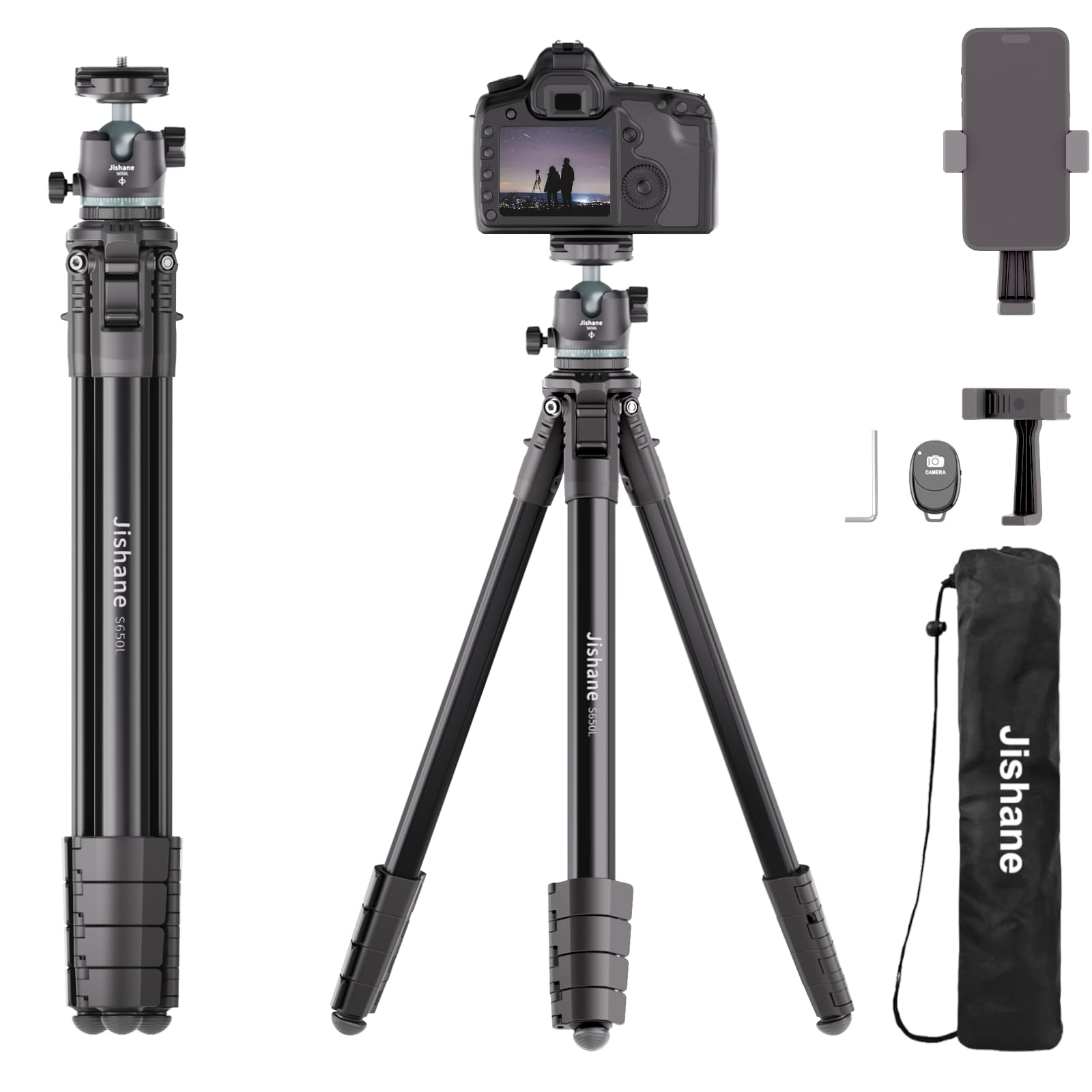
A reversible center column and ball head that drop to ground level or rise to eye height.
The reverse-column trick is the reason to pick the Jishane S650L over a plain pan-head tripod. Flipping the center column upside down lets you shoot from basically floor level — for macro work, product shots, or that low dramatic angle — then swing it back up to a full 72 inches for portraits and interviews. The ball head delivers smooth 360-degree panoramic rotation plus 90-degree vertical shooting, so flipping from a horizontal photo to a vertical video is a single loosened joint, not a fight with three separate knobs.
It folds to 19.9 inches and the aluminum frame weighs 2.7 lb, which is a shade lighter than the JOBFRI above at 2.76 lb and about half a pound lighter than the NEEWER TP55 at 3.3 lbs. That 19.9-inch folded size is the same as its minimum height, so it packs into a backpack or a carry-on with room left. Rated to support up to 11 lbs, it takes a DSLR or a phone with a clamp, and the included phone holder grips handsets from 2.36 to 3.9 inches wide — a slightly wider phone range than the JOBFRI’s 2.3 to 3.3 inches. A bubble level and quick release plate help you frame fast, and the standard 1/4″ screw fits Canon, Nikon, Sony and Fujifilm bodies.
The kit is where this one pulls ahead of the pack. It arrives with the tripod, phone holder, a wireless remote for shooting without touching the camera, a carry bag, a quick-release plate and an adjustment wrench. The remote alone justifies the set for anyone doing self-portraits or group shots. The trade-off is that the same lightweight build that makes it travel-friendly means it will not tolerate a heavy telephoto lens or a hard knock the way a heavier metal tripod would — this is a companion for everyday and travel shooting, not a studio workhorse.
The winning detail: the reversible center column is what separates this from every pan-head pick on the list — low-angle macro and floor-level product shots are on the table here, not just eye-level framing.
Complete kit angle: a wireless remote, quick-release plate and adjustment wrench come in the box, so you are not hunting down accessories.
Choose this when: you shoot both low-angle and eye-level and want a ball head plus a remote in the bag.
Look elsewhere if: your setup includes a heavy telephoto lens — this lean frame is built for everyday and travel loads.
4. XXZU 75″ Camera Tripod

A 14.17-inch fold makes this the most packable tripod here, and the remote seals it for solo shoots.
If packability is your number-one worry, start here. The XXZU collapses to 14.17 inches — shorter than the Jishane’s 19.9 inches, the JOBFRI’s 20.5 inches and even the NEEWER TP14B’s 17 inches — and it weighs just 2.18 lbs, the lightest tripod on this list. Slide it into a side pocket or a small daypack and it disappears. Then it extends to a towering 75 inches, the tallest maximum height in this comparison, with flip locks that let you dial in any height and leveling vials on both the ball head and the center column for keeping your horizon dead straight.
The detachable center column is the clever bit. It unscrews to work as a monopod or a selfie stick up to 43.9 inches, which trims your kit down to a single tool for travel and street shooting. Three-level angle adjustment on the legs lets them spread almost flat for a minimum height of 15.35 inches, and each leg adjusts independently in both angle and length — so it sits level on stairs, rocky trails and sloped ground that would tip a fixed-angle tripod. It holds phone, DSLR, projector, webcam or ring light via the 1/4″ screw and phone holder, and it supports up to 17.64 lbs vertically.
The remote is what makes solo filming painless. A built-in remote with a 10-meter control range fires the shutter from across the room, so self-portraits, group photos and hands-free video do not need a helper or a sprint back to the camera. Owners call the remote the feature that changes how they shoot. The recurring concern is the mount: the magnetic phone holder grips firmly, but a few people note parts can work loose, so check your phone is seated before you step away. For the load it carries and the space it saves, that is a small ask.
The travel case
- Folds to 14.17 inches and weighs 2.18 lbs — the packable one
- Reaches 75 inches, the tallest tip height here
- Center column detaches into a monopod or 43.9-inch selfie stick
- Built-in remote with 10m range for solo and group shots
- Three-level leg angle spreads flat to 15.35 inches for low shots
The fine print
- Magnetic phone mount grips well but parts can work loose over time
- The very light build will not suit heavy pro gear
Tuck this in your bag: travelers, hikers and solo shooters who prize a tiny folded footprint and hands-free remote control.
Do not expect: studio-grade mass — the featherweight build is for everyday cameras and phones.
5. Amazon Basics 60-inch DSLR Tripod

The default starter tripod: no frills, folds small, and does not ask you to think too hard.
For a first timer who just needs a camera to hold still, this is the plainest answer on the list. It extends from 23.2 inches to 60 inches when the center post is fully raised, weighs 2.7 lbs, and packs down to a 23.2-inch folded size with a carrying case included. The head is a three-way design with two built-in bubble view levels for tilt and swivel, and a quick-release mounting plate swaps your camera between shots in seconds. It is rated for a recommended max load of 6.6 lbs — the lowest rating here, which is exactly the point: match it to light gear and it behaves.
Owners describe it the same way every time: easy to set up, compact, and a solid budget buy. Smooth operation and adjustable legs come up again and again, and one buyer put it plainly — “For the price, you cannot beat this tripod.” It is the pick for compact cameras, webcams, small camcorders, and even laser levels, where one owner reports it works great. The included carry bag and the fast leg locks make it a grab-and-go option for casual photography and vlogging.
Know what it is not. That 6.6 lb recommendation is a soft ceiling — it will not carry a full DSLR with a big telephoto, and the plastic head feels light compared to the metal competitors here. There is also a height limit: it tops out at 60 inches, so taller shooters will find it low. The durability question mark is real but not damning; these are built for occasional use, not daily pro abuse. Treat it as a budget-friendly, light-duty stand and it delivers exactly what it promises.
Where it makes sense: compact cameras, webcams, small camcorders, external flashes, mics and laser levels — the stuff under the 6.6 lb recommended load.
The honest limit: it will not hold a heavy DSLR and telephoto, and the 60-inch top height is on the shorter side.
Ideal for: beginners and light-gear shooters who want the simplest, most no-nonsense tripod available.
Not the one for: heavy camera-and-lens setups or anyone who needs to shoot above 60 inches.
6. NEEWER Basics TP14B Travel Tripod
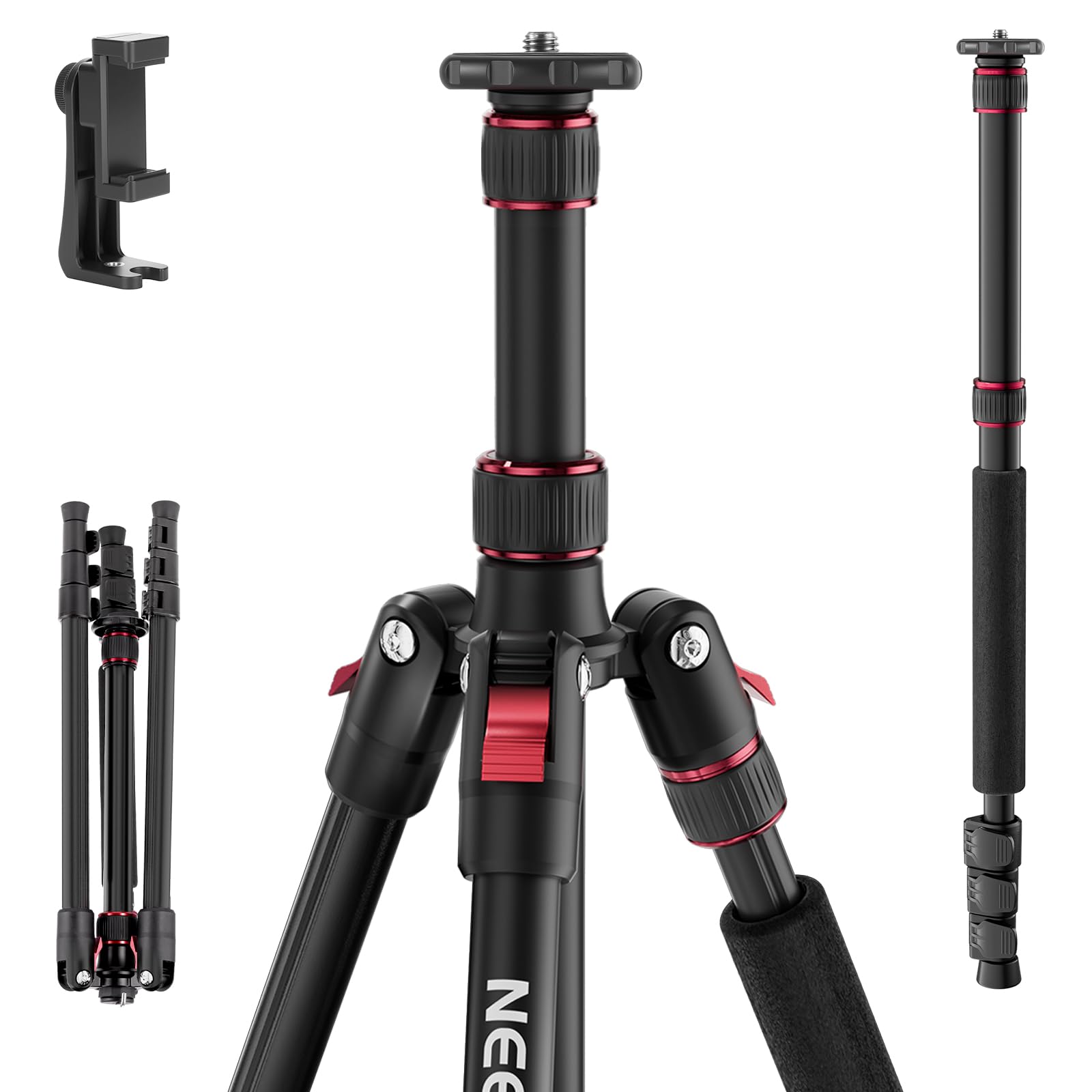
Folds to 17 inches, flips into a monopod, and still holds 13.2 lbs on an Arca-style head.
Two things sell the TP14B: it packs small and it does double duty. It reverse-folds to 17 inches — shorter than the Jishane’s 19.9 inches and the JOBFRI’s 20.5 inches — and the center column detaches so the whole thing converts into a monopod for walk-and-talk video and quicker handheld work. It adjusts from 22.8 inches up to 52 inches on the legs, and the two-section center column improve it to a full 72 inches for eye-level framing, with a 360-degree ball head that pans, tilts 90 degrees and includes a 360-degree leveling scale. A weight hook and non-slip feet keep it planted when the ground is soft or breezy.
The Arca-type quick release plate uses the 1/4″ screw that fits Sony, Canon and Nikon bodies and camcorders, so swapping gear is a single lever. It carries up to 13.2 lbs — more headroom than the JOBFRI’s 8.8 lbs or the Jishane’s 11 lbs, which matters if you shoot a modest DSLR plus a light lens. Owners keep returning to how much range they get for the price, and call out the ball head’s smoothness for making angle changes quick. It comes with the phone holder mount, and there are three leg-angle positions for leveling on uneven ground.
The one thing to weigh is mass. At 2.9 lbs it is on the lighter side for the load it claims, and opinions split on whether that is a plus or a minus — light to carry, but light enough that a stiff breeze or a heavy lens can move it. The high center column, as with any tripod here, is the wobbliest position. For travel and content shoots where you are moving around, the low weight wins; for a fixed studio setup in a drafty room, add weight to the hook.
Why it earns premium positioning: a 72-inch reach that folds to 17 inches, plus monopod conversion, on an Arca-style ball head rated for 13.2 lbs.
The trade-off to weigh: at 2.9 lbs it is light for the load it carries, so a windy day or a heavy lens needs the weight hook put to use.
Worth it for: traveling shooters who want one tool that works as tripod and monopod and still packs to 17 inches.
Second-guess it if: you shoot in steady wind with a heavy lens — the light frame wants extra weight on the hook.
7. NEEWER Basics Travel Tripod TP12
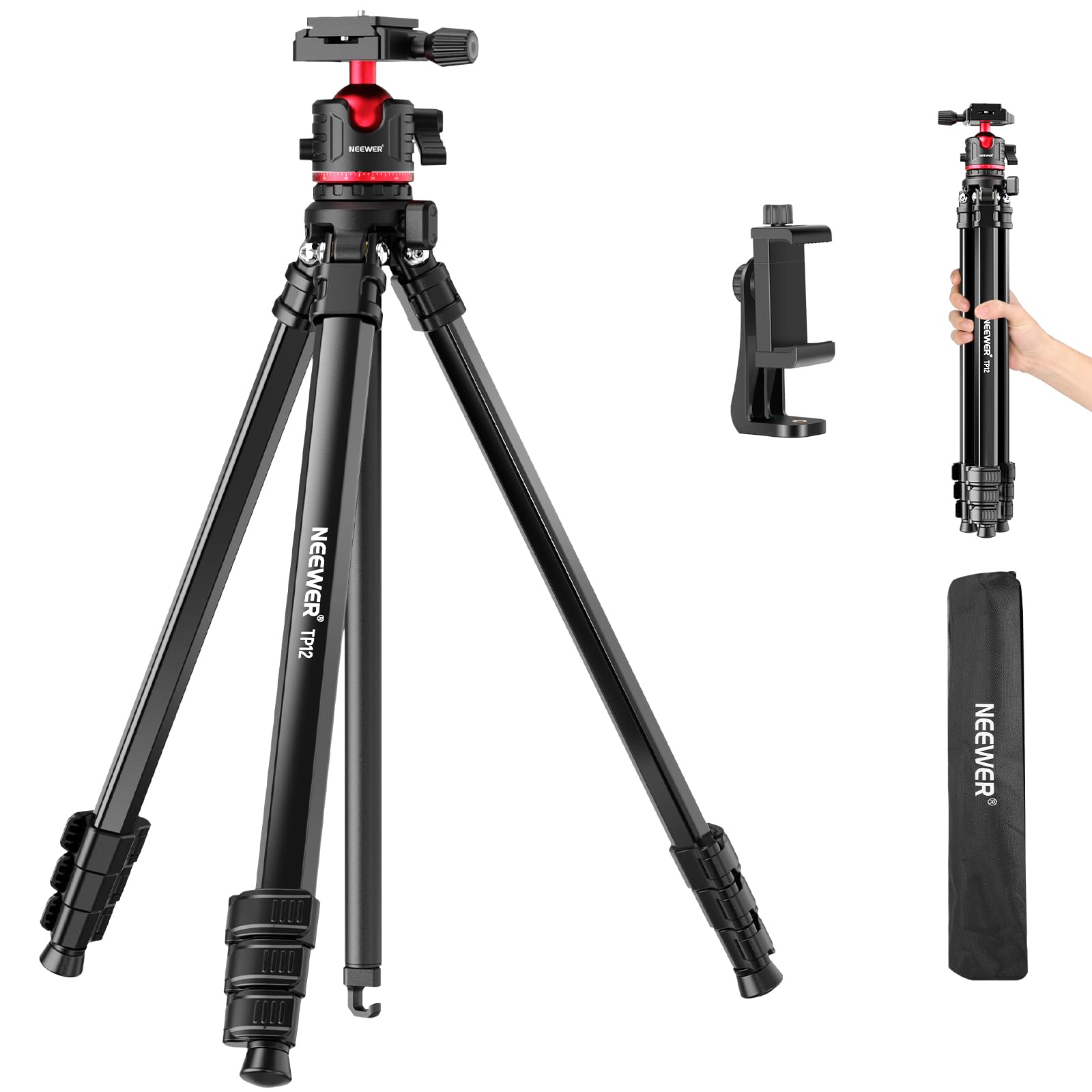
A low-profile ball head and Arca compatibility built for steady low-angle and uneven-ground work.
The TP12 is the pick when your shots live close to the ground. It handles low-angle and uneven-ground setups especially well, and the low-profile panoramic ball head — with a 40mm scaled pan base (a measured rotating ring that lets you repeat the same pan angle shot to shot) and a U-shaped groove for smooth panoramas and 90-degree vertical shots — is what makes that possible. The ball head detaches too, so the tripod can serve as a stand, a monopod or a slider base via a 3/8″ thread, and there is a QR clamp on a 1/4″ thread for accessories.
It climbs from 20.1 inches to 52.8 inches and up to 66.5 inches, supports up to 11 lbs, and weighs 2.9 lbs. Folded it depends on a 2.4-inch diameter, which makes it easy to slip into a pack or carry into the woods. The Arca-type dual compatibility is a real advantage: the quick release system accepts PD backpack strap clips and other Arca-type plates, and the 1/4″ screw fits Sony, Canon and Nikon DSLRs, mirrorless bodies, camcorders, binoculars, sliders and smartphones. A universal phone holder rotates 360 degrees for portrait and landscape modes.
Owners keep highlighting adjustability and portability — light enough to carry into the woods, versatile enough for photography and video on the same trip. The honest note is stability, which draws mixed reactions; like the rest of the lightweight field, it holds firm with a modest load and gets less settled when pushed. If you shoot mostly at eye level or need the absolute tallest reach in the group, the taller picks above make more sense. If your style is close-to-the-ground and shoulders-a-backpack, this is the one built for it.
Built for this: low-angle and uneven-ground shooting, thanks to the low-profile 40mm scaled pan base and U-shaped groove.
Gear flexibility: Arca-type QR accepts PD strap clips and other plates, and the 1/4″ screw covers DSLR, mirrorless, camcorder, binocular and phone.
Pick this if: your best shots come from down low and you want Arca-type compatibility across your gear.
skip it if: you need maximum height for event or interview work — 66.5 inches tops out shorter than the taller picks here.
Know the Specs
Load Capacity Explained
Load capacity (sometimes listed as max load) is the heaviest weight the tripod is rated to hold, camera and lens combined. Ratings here stretch from 6.6 lbs up to 17.64 lbs vertical, so the gap between a phone shooter and a DSLR shooter is wide. A smart move is to keep your gear meaningfully under the ceiling rather than right at it — that is where the head starts to creep and the legs feel springy. Note that some ratings are measured vertically (straight down the center) versus at an angle; a tripod rated 17.64 lbs vertical often drops to a lower angled figure, so check which number applies to how you actually shoot.
Ball Head vs Three-Way Pan Head
A ball head loosens on a single joint so you can reposition the camera in one motion, which suits fast switching and phone shooters flipping between portrait and landscape. A three-way pan head has separate controls for pan, tilt and side-to-side, giving smoother, more controlled movement for video pans and precise framing. Neither is better — a ball head wins for speed and freedom, a pan head wins for measured, repeatable moves. Several picks here ship with a bubble level or leveling scale to help you keep horizons flat, which matters more the higher you raise the tripod.
Common Questions
Will a cheap tripod actually hold my DSLR safely?
Why does my tripod shake when I raise the center column?
Is a ball head better than a three-way pan head for video?
Can these tripods hold a phone without a separate mount?
How small do these tripods pack down for travel?
What is the difference between a tripod and a monopod for filming?
Do I need an Arca-type quick release plate?
Can a cheap tripod hold a heavy camera in wind?
Will these tripods work with both cameras and phones?
How long will a budget tripod last?
The Bottom Line
For most people, the cheap tripod to own is the JOBFRI 73″ Aluminum Travel Tripod because it stretches from 19 to 73 inches, folds to 20.5 inches, weighs 2.76 lbs, and carries an 8.8 lb load for phones and cameras alike. If you film yourself and want a hand-crank column for smooth height changes, reach for the NEEWER TP55. And for travelers who need the smallest possible pack, the XXZU 75″ folding to 14.17 inches with a built-in remote is the one to grab. Whichever you choose, match the load rating to your gear and keep that center column low — those two habits are what keep a budget tripod steady.
How we choose
We do not accept paid placement. Every pick is matched to a real buyer and a real use-case; we do not hands-on test units.
Sources
Specifications: manufacturer listings and product documentation. Review insights: verified customer reviews, as of October 2026. Pricing: not shown on this page (it changes often); check the current price via the retailer link.
As an Amazon Associate, Aappliancez earns from qualifying purchases. This does not affect which products we feature.