Disclosure: Some links in this post are affiliate links. As an Amazon Associate I earn from qualifying purchases, at no extra cost to you. Learn more
Specs are compiled from manufacturer listings and verified buyer reviews and can change over time — please confirm the key details on the product page before buying.
Most people shopping for budget smart glasses get burned by the same thing: the numbers on the box don’t match what happens on your face after a week. A “7-hour” battery that dies during a commute, a camera that captures your chin instead of the view, or a pair that never quite connects to your phone. The honest answer is that cheap smart glasses still buy you real function — hands-free photos, open-ear audio, voice assistants — but only if you know which specs actually matter and which ones are marketing decoration. This guide separates the two, pick by pick.
This guide is built by comparing the manufacturers’ published specifications and the patterns across verified customer reviews, so you get each pick’s real strengths and trade-offs instead of marketing spin.
You don’t need to spend big to get useful wearable tech, but you do need to read the fine print. Camera resolution is the headline, battery capacity in milliamp-hours (mAh — the size of the fuel tank) is the reality check, and frame weight decides whether you’ll actually wear them past week one. That’s exactly what this guide unpacks, so you can find the best cheap smart glasses without a return label.
Top Picks

How To Choose The Best Cheap Smart Glasses
Cheap smart glasses sit on a narrow shelf. You’re getting a camera, a pair of open-ear speakers, and a Bluetooth link to your phone squeezed into a frame that still has to look like normal eyewear. The trick is knowing which parts of that stack actually govern whether you’ll enjoy them. Three things decide it every time: the camera, the battery, and the frame itself.
The camera is two numbers, not one
You’ll see “4K” and “8MP” on the same box, and they measure different things. The 8MP figure describes the sensor — the chip that captures the image — while 4K describes the resolution of the video that sensor records. A bigger sensor usually means sharper stills and better low-light performance; the video resolution tells you how much detail ends up in each clip. Add EIS (electronic image stabilization, a software system that smooths out your walking or riding motion) and you get footage that doesn’t shake itself to pieces. Budget glasses can genuinely hit 4K, so read both numbers before you buy.
Battery capacity in mAh tells you the real story
A milliamp-hour, or mAh, is the size of the battery’s fuel tank. Higher mAh generally means longer runtime between charges. The 290mAh figure shows up repeatedly in this price range, and how it’s spent matters: that capacity can cover a full day of music or less than an hour of continuous video. Multiply the way you’ll actually use them — short clips here, background music there — against the rated numbers before you commit.
The frame is what you’ll feel first
Material and weight decide whether glasses stay on your face past the honeymoon phase. TR90 is a flexible, lightweight plastic that flexes rather than cracks; propionate is a plant-based plastic used for traditional eyewear. A frame around 35g (a little over an ounce) disappears on your face. Heavy frames with wires and batteries inside can dig into your nose and temples during long sessions.
Side-by-Side Comparison
| Model | Best For | Camera | Battery Capacity | Connectivity | Amazon |
|---|---|---|---|---|---|
| Meta x Ray-Ban Wayfarer★ Best Overall | Best all-round daily pair | 12 MP | — | Bluetooth | Amazon |
| Meta Ray-Ban SkylerSleekest Style | Sleek everyday style | — | — | Bluetooth | Amazon |
| EarlySincere AI Smart GlassesTranslation Powerhouse | Travel and translation | 8 MP / 4K UHD | 290 mAh | Bluetooth 5.4 | Amazon |
| BooaBei AI Smart Glasses | Business meeting help | 8 MP / 4K HD | 290 mAh | Bluetooth 5.3 | Amazon |
| GetD AI Glasses | Translating and listening | — | 115 mAh | Bluetooth 5.4 | Amazon |
| MSCGLYXGS AI Smart Glasses | First-person video | 8 MP / 4K HD | 290 mAh | Bluetooth 5.3 + WiFi | Amazon |
| Next-Gen Camera Glasses 4K | POV action recording | 18 MP / 4K 2160P | 800 mAh | USB | Amazon |
| Lucyd Armor Smart Safety Glasses | Hands-free audio at work | — | — | Bluetooth | Amazon |
Detailed Reviews
1. Meta x Ray-Ban Wayfarer
The pair that still looks like sunglasses when the tech is switched off.
If you want the safest bet in budget-adjacent smart glasses, this is it — a genuine Ray-Ban Wayfarer frame with a 12 MP camera and a five-microphone array built into the arms. The picture quality is the part people rave about, with sharp, detailed photos and the clearest video in this lineup. Audio arrives through discreet open-ear speakers that sit just above your ear canal, so you hear the music without walling off traffic, coworkers, or conversation. Pairing runs over Bluetooth, and you control capture and playback with taps on the frame — no digging for your phone required.
What wins people over above all is the quality of the thing itself. It shares the classic Wayfarer look, feels sturdy in the hand, and the matte finish keeps the plastic from looking cheap. The polarized gradient graphite lens handles glare and bright sun well, and at 15cm of temple length with a 22mm bridge, the shape suits a wide range of face widths. Real-time translation between French, Italian, Spanish, German, Portuguese, and English works without Wi-Fi, and the Meta AI assistant handles hands-free questions when you activate it.
Where it wobbles is endurance. Buyers report the battery holding somewhere around three to four hours of active use, with the charging case carrying it through the day. Frame durability is the bigger fit note — the plastic can crack with rough handling, so think of these as eyewear first and gadget second, not a piece of gear you toss in a backpack loose. Connectivity also has its quirks: the assistant is at its most useful in the US, and a minority of owners hit Bluetooth dropouts on iOS.
Where it earns its spot
- 12 MP photos and sharp video, the most-consistent image quality in this lineup
- Open-ear speakers keep you aware of what’s happening around you
- Five-mic array for hands-free calls that actually sound like calls
- Real, recognizable Ray-Ban frame — no “tech glasses” giveaway
What you should know
- Battery runs short — a few hours of active use before the case takes over
- Frame plastic rewards gentle handling rather than rough treatment
- Some owners see the AI assistant work less reliably outside the US
Go for these if: you want one pair that covers your commute, your music, your calls, and your photos without looking like you’re wearing a computer.
Think twice if: you plan multi-hour recording sessions — the runtimerun-time is designed for short bursts, not all-day capture.
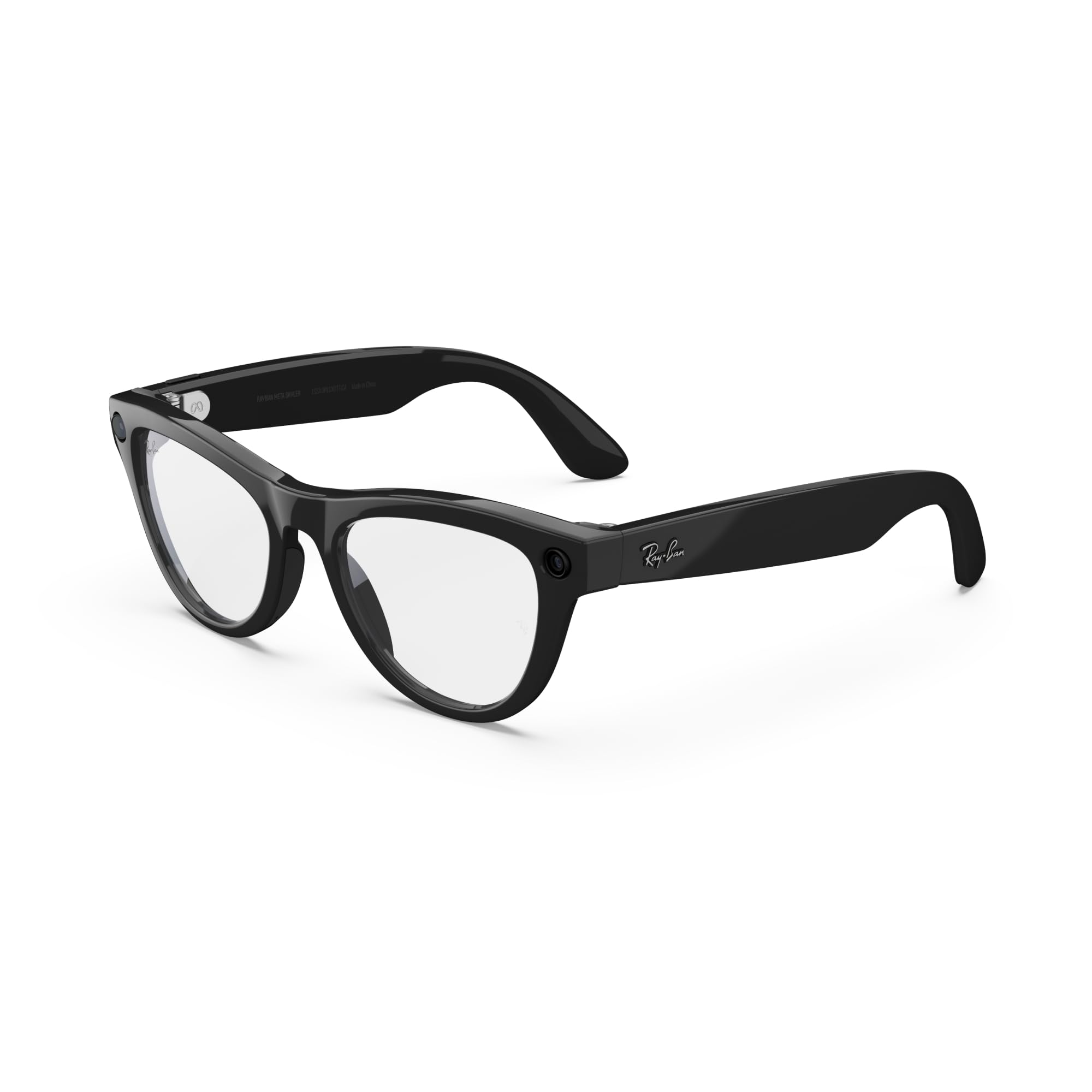
2. Meta Ray-Ban Glasses, Skyler
The lighter frame in the Meta family, aimed at people who want the tech to disappear entirely.
Skyler is the slimmer, softer silhouette compared to the Wayfarer above. Same Meta ecosystem — the camera, the open-ear speakers, the phone pairing — but in a shape aimed at people who want their glasses to read as fashion first. The transition lenses darken in sunlight and clear indoors, which is genuinely handy if you don’t want to swap frames. If you’d rather look like a person wearing nice sunglasses than a person wearing a gadget, this is the pick.
The camera delivers the same photos-and-video experience Meta owners talk about, with clean, clear results in decent light. Audio through the open-ear speakers surprises people who expect the sound to be thin. Frame that’s built on a September 2026 release cycle means you’re getting a more recent generation of the Meta build than the Wayfarer’s first-gen internals.
Two honest fit notes. Skyler runs smaller than the Wayfarer, and some wearers find it too narrow across the temples — if you have a wider head, try before you commit. Battery behaviour is also inconsistent in the wild, ranging from all-day around-the-neck use down to three-hour sessions when you’re pushing the camera. Neither point is a defect; both are sizing realities to match against your face and your habits.
Frame-first thinking: the Skyler is the pair you reach for when you don’t want to think about wearing tech. The look is discreet, the transition lenses save you a frame swap, and the Meta AI features sit quietly in the background until you want them.
The size caveat: treat Skyler as a specific fit, not a universal one. If the Wayfarer above felt comfortable at 15cm temple length, sizing down to the Skyler’s slimmer profile is a real change — measure your face or try in-store before buying.
Built for: shoppers who want a genuine design win over maximum features, and who already live inside the Meta app ecosystem.
Not the call if: you have a broader face or want the maximum frame real estate for a camera and heavier components.
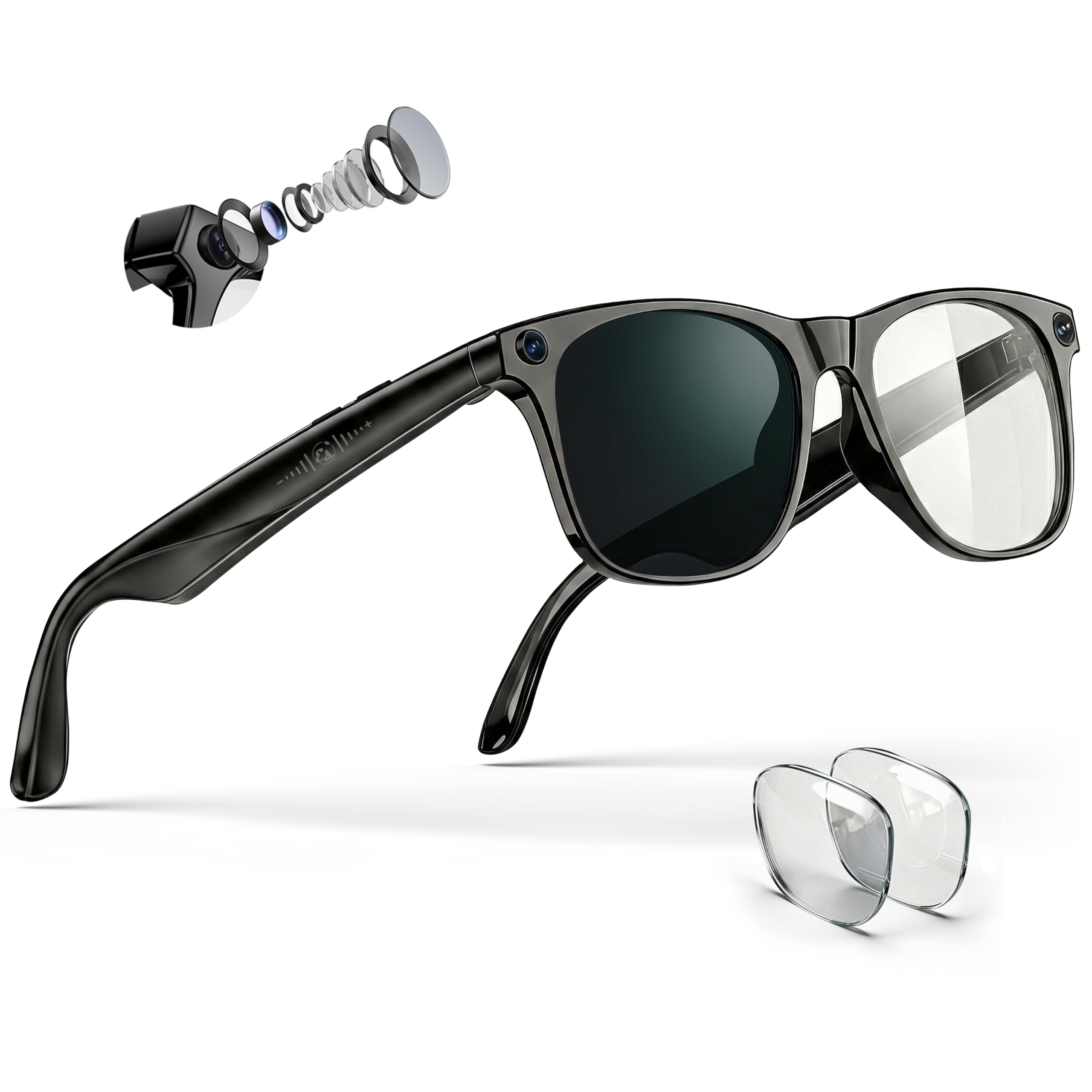
3. EarlySincere AI Smart Glasses with 4K Camera & ChatGPT
An 8 MP sensor with EIS stabilization stuffed into a TR90 frame — designed for people who travel and want to record what they see.
The spec sheet here is the loudest in the budget tier: an 8 MP camera recording 4K UHD video, EIS (electronic image stabilization, a software system that cancels out your hand shake) so footage stays smooth while you walk or ride, and 290mAh of battery behind it all. Translation runs across 100+ languages with a 0.1-second response across three modes — face-to-face, simultaneous interpretation, and meeting minutes. If you’ve ever wanted a pair of glasses that could work as a live translator, this is the budget path.
Connectivity is the newer Bluetooth 5.4 standard for a stable 10-meter link, which is useful when you want to route audio to a laptop for a Zoom call or a TV for private listening. Build is TR90 plastic with ABS, rated IP65 for dust and water resistance — meaning it handles splashes and light rain, not full submersion. Two pairs of lenses ship in the box: photochromic (the kind that darken in sunlight) and blue-light blocking, and both swap out with the frame’s modular design. Playtime is 7 hours of music or 4 hours of calls, with a full recharge in about 2 hours.
The honest catch is polish. Owners describe the app as working well and still photos as clear, but video quality is where opinions split — some find it softer than the 4K label implies. Set expectations on that front: 4K describes resolution, not necessarily pro-grade clarity at this price point. Weigh that against what you get — the modular lenses, the 100+ language support, and the EIS stabilization all sit at a level above most budget competitors.
The traveler’s trade: if you’re crossing time zones and language barriers, no other pair on this list handles translation with as much range — 100+ languages, three modes, no Wi-Fi dependency.
Reality check on video: the 4K label here describes output resolution, and real-world clips can look less sharp than the number suggests. Treat the camera as a solid everyday recorder rather than a cinematic rig.
Pick this if: you’re a frequent traveler, remote worker, or anyone who lives in a second language and wants a translator on your face.
Look elsewhere if: you mainly want crisp video for your feed — the stills are the stronger half of this camera.
4. BooaBei AI Smart Glasses with Camera, 8MP 4K HD
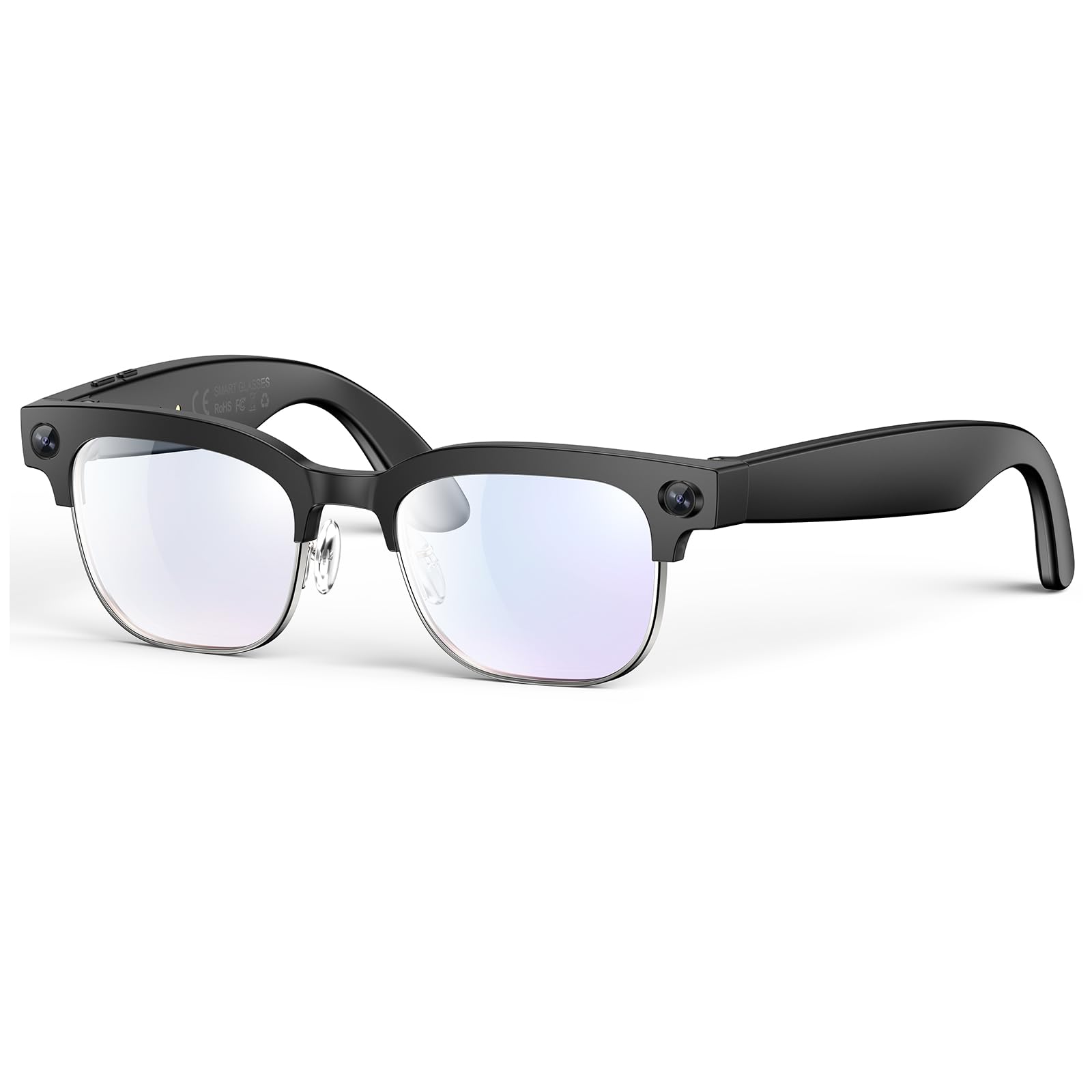
Built for the desk as much as the trail, with AI transcription aimed at meetings.
BooaBei’s pitch is different from the rest of the list. Instead of chasing the camera crown, these glasses sell themselves as an AI workspace tool — 133 languages of real-time translation, live meeting transcripts, AI voice wake-up for hands-free questions, and photo recognition that identifies objects and reads them back to you. The camera is there too: an 8 MP sensor with EIS stabilization recording 4K HD video, at 35g in a TR90 frame so it doesn’t feel like a box on your nose.
The 290mAh battery is rated for over 12 hours of music playback, and Bluetooth 5.3 holds the link at 15-18 meters. Recharge takes 40 minutes — the fastest here. IP67 dust and water resistance is the highest rating here, so rain, sweat, and dust are covered during workouts and outdoor sessions. Lenses are user-swappable at any optician, so if you already wear prescription glasses you can convert this into your everyday pair.
The honest note is reliability. The review pattern here skews mixed — a small number of owners mention the glasses failing after a couple of months of use, and the overall rating sits lower than the picks above. That doesn’t make them bad, it makes them a pair to buy with the warranty conversation clearly in mind: the product page promises a 30-day return window and a 3-year warranty, and if reliability bites, you’ll want that paper trail.
What stands out
- IP67 rating — the toughest water and dust protection on this list
- 40-minute recharge, the quickest in the lineup
- 133-language translation and live meeting transcripts
- 35g TR90 frame with user-swappable lenses at any optician
Where to be cautious
- Reliability is the highest-volume topic in buyer feedback, and it’s mixed rather than glowing
- 3-year warranty is a genuine safety net, but you may need to use it
- Rating sits below the Meta and next-gen camera picks in this article
Fits: remote workers and frequent meeting-goers who want translation, transcription, and hands-free AI without carrying a second device.
Skip if: you want the most reliable long-term pair — bank that 3-year warranty if you buy, and don’t rely on these as your only pair of glasses.
5. GetD AI Glasses, Powered by ChatGPT
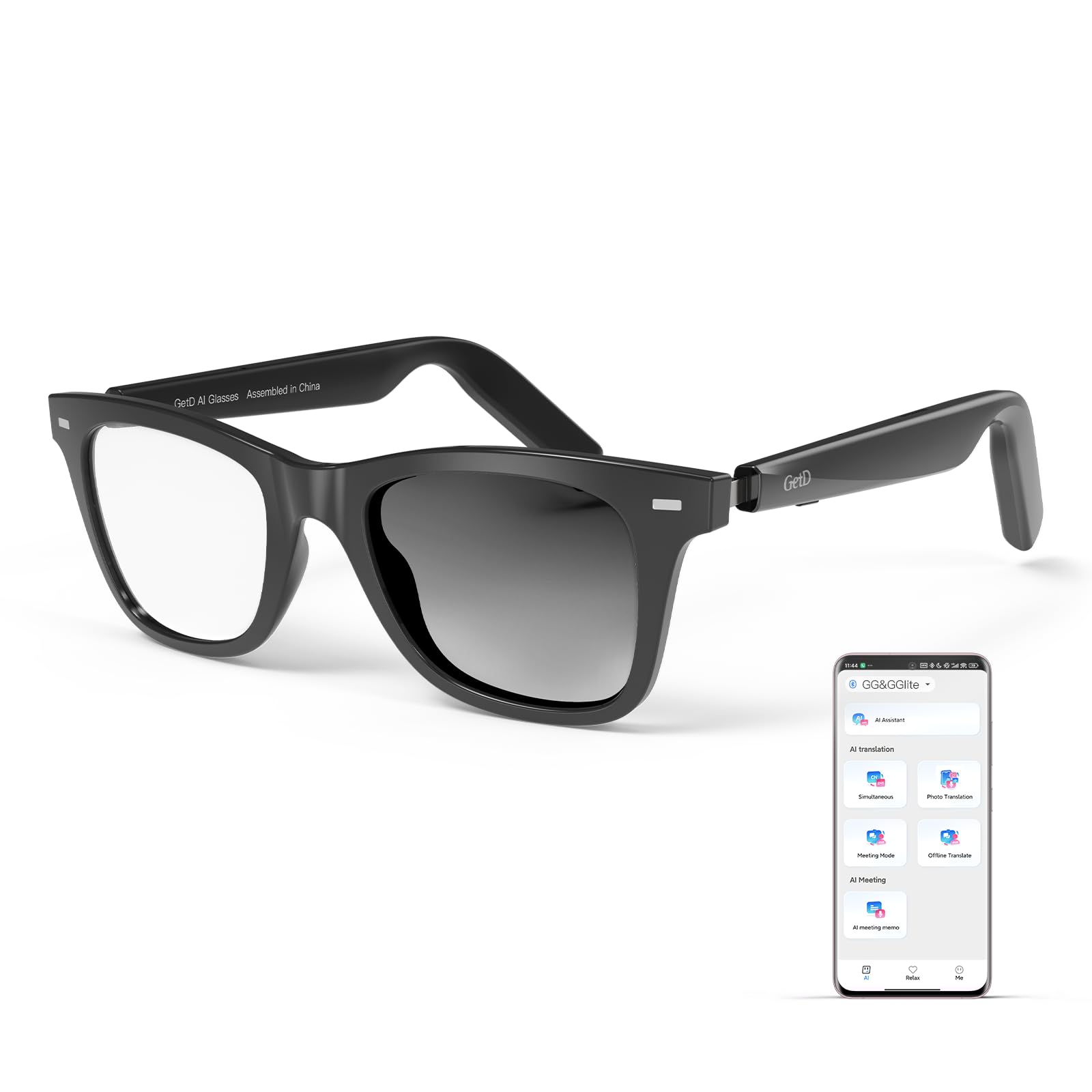
A pair of music glasses that sneaks in translation and voice notes without shouting about it.
GetD frames the whole product around three jobs: a Bluetooth audio pair you can wear all day, an AI translator with 145-language bidirection-al support across 170 countries, and a proper sunglasses lens with 100% UV protection. The audio side is the strongest of the three — a directional open-ear design with 2 beamforming noise-reduction microphones, running over Bluetooth 5.4 for a stable iOS and Android link. If your primary motivation for smart glasses is “I want my commute to have a soundtrack without blocking the world out,” this is a real contender.
The 115mAh battery (split across two cells, one per arm) is rated for 15 days of standby, 11 hours of music, and 9 hours of calls at half volume — the longest audio runtime here. A 10-minute top-up is rated for one hour of use, and charging is magnetic. The frame is TR90, and the lenses are photochromic and compatible with prescription fitting.
There’s one important thing buyers should understand about the “AI translation” label here: it works by passing your phone back and forth rather than doing everything on the glasses themselves. That trips up some buyers who expected a fully independent device. Volume leakage at high levels and a rare charger failure in one arm show up in the feedback too. None of it is disqualifying, but the honest picture is a strong audio companion with translation as a secondary feature, not the other way round.
The everyday audio angle: think of GetD first as the best Bluetooth audio glasses on this list — long listening hours, two microphones for calls, and a lightweight TR90 frame that owners say practically disappears on your face.
The translation reality: the app handles the translating, and the glasses handle the listening. That’s still useful — just not the standalone Star Trek universal translator some listings imply.
Buy these if: you want audio and calls first, with translation and photochromic lenses riding along as a bonus.
Not the right pick if: you need a fully self-contained translator or you record a lot of video — there’s no camera on this pair.
6. MSCGLYXGS AI Smart Glasses, 8MP HD Video Recording

File-syncing without cables is the standout here — WiFi dual-transfer sends your clips straight to your phone.
The camera records 4K HD video on an 8 MP sensor with built-in anti-shake, multi-frame noise reduction, and HDR processing. It captures 32-megapixel stills, which is the sharpest photo output on this list — no other pick on the page announces 32MP photos. The lenses change color to adjust for indoor and outdoor lighting, which owners describe as genuinely convenient, and the camera sits discreetly inside a lightweight, three-point ergonomic frame. If you want to shoot as you go and worry about the frame staying put, this is the pick that talks about stabilization and fit in the same breath.
The feature most buyers underestimate is the sync. Bluetooth 5.3 handles the wireless link, while WiFi dual-transfer syncs photos and videos to your phone automatically — no cable, no card reader. The 290mAh battery is rated for 7 hours of audio or about 1 hour of video, recharges in roughly an hour, and runs ChatGPT-based image recognition, translation, and voice transcription.
Two honest notes. Battery life in buyer feedback is a split decision — some describe all-day use, others find it shorter than expected once video is in the mix. And sound quality is described as decent by some owners but glitchy by others, with long hair sometimes triggering the touch sensors by accident. Neither is a defect so much as a “know before you buy” — this pair wants buyers who’ll keep recordings short and learn the touch zones.
What wins people over
- 32 MP stills — the highest still-photo spec on this page
- WiFi auto-sync clears the biggest gripes with budget camera glasses (no manual exporting)
- ENB noise reduction on calls keeps conversations clear in the wind
- Colour-changing lenses handle indoor and outdoor light in one frame
Watch out for
- Video recording drains the 290mAh battery quickly — expect short bursts, not long sessions
- Sound quality is a split decision in buyer feedback
- Touch controls can be triggered by long hair resting on the temple
Built for: creators and travelers who want file transfer to just happen, and who care about photo quality as much as video.
Better to pass if: you rely on continuous multi-hour recording or in-ear-grade sound for long podcasts.
7. Next-Gen Camera Glasses 4K, 18MP Photos, 256GB TF Support
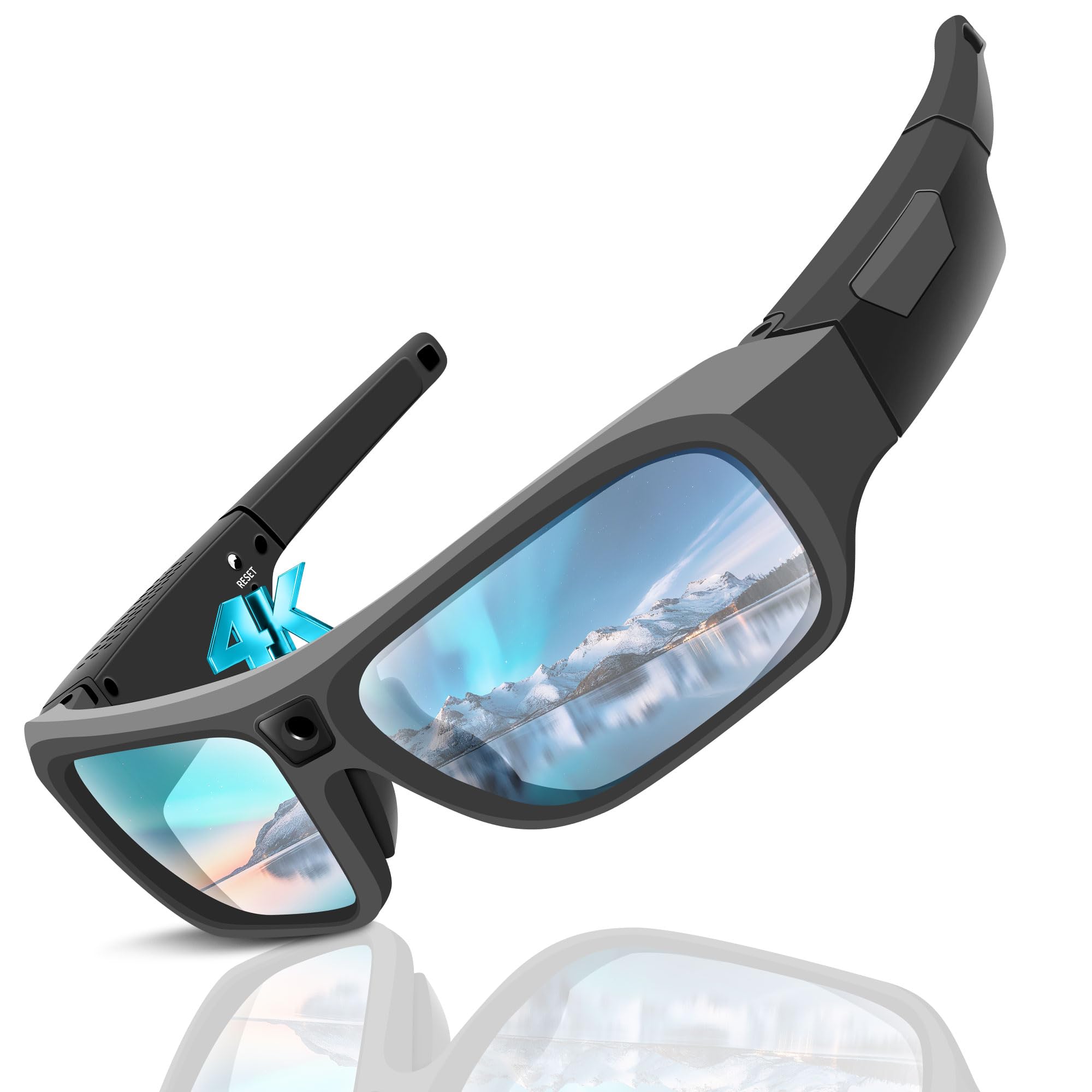
A no-AI, no-fuss POV camera in sunglasses form — built for hunters, hikers, and anyone who wants to press one button and record.
This is the simplest pair on the list, in the best possible way. One button for video, one button for photos. No AI assistant, no calls, no music, no Bluetooth handshake to figure out. If you’ve been put off by the setup complexity of other smart glasses, that’s exactly the use case here: press, record, move on. The 800 mAh battery is the biggest here — no other pick comes close — and it’s rated for 100 minutes of continuous capture. Video records in 4K (2160P) and photos come out at 18MP, the highest photo resolution for any pair on this list that also records video.
The 256GB TF card slot means storage isn’t a limiting factor — but note the TF card isn’t included, so factor that into your buy. The loop feature saves clips in 1 to 6 minute chunks and auto-overwrites the oldest file when the card fills, so you don’t have to sweat about hitting a full SD. Lenses are UV400 polarized, the frame is ABS with rubber arms for grip, and file transfer is a straight USB cable to your computer — no app, no pairing, no subscription. In the feedback, buyers specifically call out the simplicity: hunters and anglers using them for hands-free POV capture, and reviewers highlighting the one-touch control.
Two things to know. The battery splits from buyer feedback — some find it drains faster than the 100-minute rated figure suggests during continuous capture, others find it fine for short sessions. And the camera placement sits high on the frame, which some wearers say cuts off lower parts of the scene. Neither is a defect — they’re design choices that suit a specific shooter, not a universal one.
The pure-camera angle: no AI, no calls, no app — just press once and record. If you’ve been frustrated by fiddly setups on other smart glasses, the simplicity here is the feature.
The build note: ABS and rubber are fine for regular use but not designed for extremes. Treat the frame like a piece of outdoor gear rather than a bumper-protected action camera.
The one to reach for if: you shoot POV outdoors, want big battery and storage headroom, and value a two-button interface over an AI assistant.
Not your pair if: you want music, calls, or translation — this is a camera-only tool with a specific job.
8. Lucyd Armor Smart Safety Glasses, TR90, ANSI Z87.1
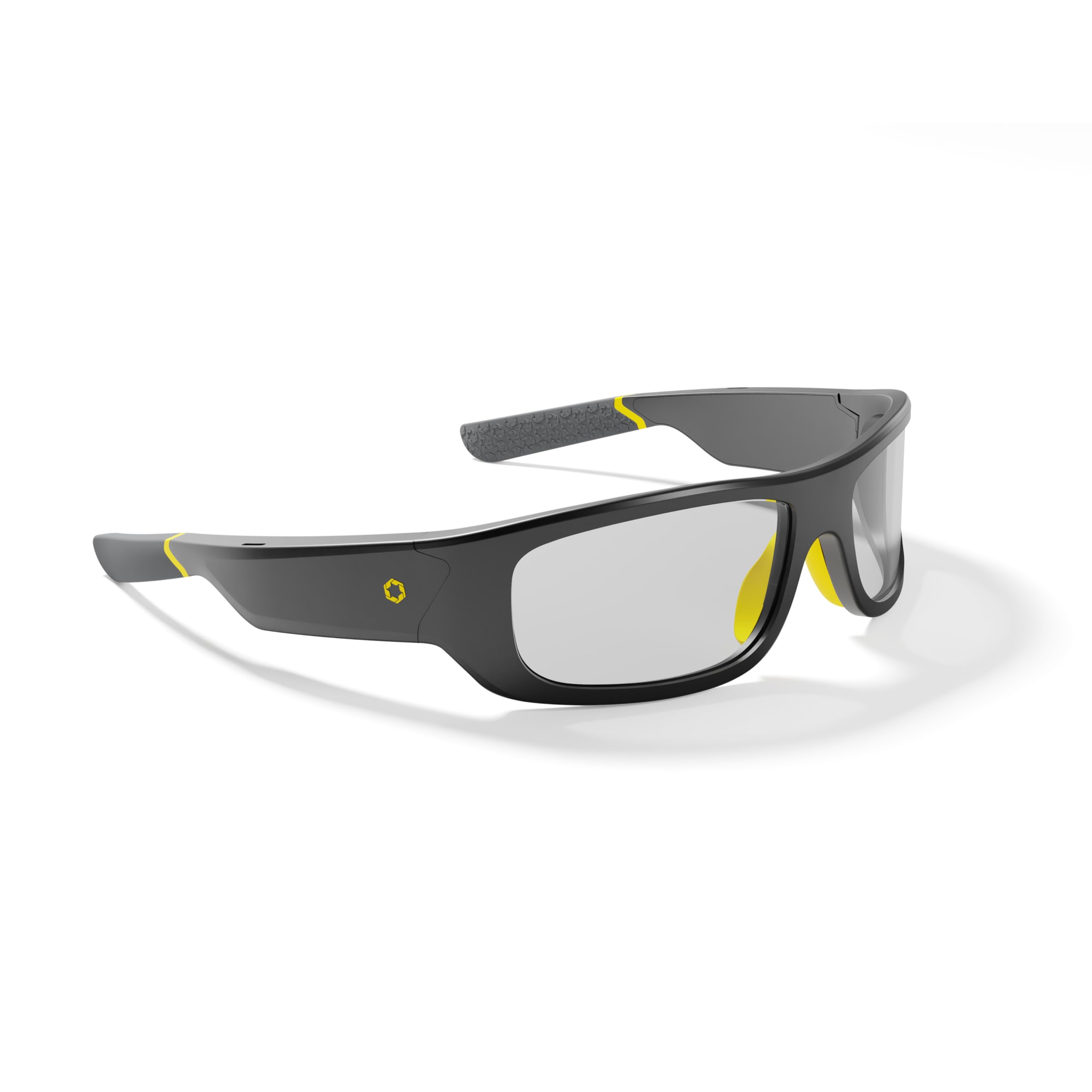
The only pick here that doubles as actual eye protection — built for jobsites, workshops, and workshops masquerading as garages.
Everything else on this list is a lifestyle pair. Lucyd Armor is different: it carries an ANSI Z87.1 rating, which is the standard safety-glasses spec — meaning it’s built to take impacts that ordinary sunglasses aren’t. Not just a marketing label on the temple either; that’s the reason it’s on this article at all. Drop an ordinary smart frame on a garage floor and you’re shopping for replacement; this pair is designed as protective eyewear first, audio device second.
The frame is TR90, the same flexible lightweight plastic used across the best pairs in this article — springy rather than brittle. Light-adaptive lenses darken and clear on their own, so you’re covered indoors and out without a lens swap. Open-ear speakers sit above the ear canal, and an integrated microphone handles calls. Batteries and connectivity run over Bluetooth to your phone, so music, calls, and voice assistant duties all go through your usual phone setup.
The honesty note is audio. Sound quality is genuinely mixed in buyer feedback — some describe it as great with solid transition lens performance, while others flag distortion at high volume and, in a rare case, failure of the right speaker. That doesn’t take away from the reason to buy this pair, which is the impact protection. If your job demands Z87.1 glasses anyway, the audio is a bonus, not the point. If your main use is music, look at the Meta pairs instead.
The reason it earns its slot
- ANSI Z87.1 impact rating — the only verified safety-grade pick on this page
- TR90 frame flexes rather than cracks under knocks
- Light-adaptive lenses swap between indoor and outdoor without a change
- Works for both jobsite duty and casual wear
Where expectations need calibrating
- Sound quality draws a mixed reception — some hear crisp audio, others hear distortion at high volume
- One rare report of a speaker failing
- Not a camera pair — no photo or video capture here
The pick for: tradespeople, hobbyists, and anyone whose day involves flying debris, plus anyone who wants safety glasses that don’t look like safety glasses.
Not the pick for: audiophiles chasing the best sound — the ANSI Z87.1 frame is the story here, and the audio is designed to be serviceable, not remarkable.
Know the Specs
Camera megapixels (MP) vs. video resolution (4K, 2160P)
MP tells you how much detail the sensor can capture in a still photo. 4K (also written 2160P) tells you how much detail ends up in each frame of video. A camera can be 8MP and still record 4K by scaling the sensor output — that’s why cheap smart glasses can advertise 4K while their stills look sharper than their clips. If photo quality matters most, weigh the MP figure first; if video quality matters most, look for EIS stabilization and anti-shake in the feature list.
Battery capacity in mAh and what it actually buys you
Milliamp-hours (mAh) measure how much energy the battery holds — bigger is more runtime, all things equal. But “all things equal” rarely applies: a 290mAh cell running a low-energy Bluetooth 5.3 or 5.4 chipset can outlast a bigger battery paired with a hungrier system. Continuous video recording drains batteries far faster than music playback. Read the capacity alongside the rated hours for the specific activity you’ll actually do.
Frame materials: TR90, propionate, ABS, and rubber
TR90 is a flexible plastic that bends slightly before it cracks — the top choice for lightweight frames that see regular use. Propionate is a plant-based plastic used in traditional eyewear, respected for a classic look and feel. ABS is a stiffer plastic common on lower-cost camera frames; it’s fine but less forgiving on knocks. Rubber arm grips help glasses stay put during movement. Whichever you pick, the frame material drives how long you’ll actually keep wearing them.
IP ratings and what the numbers mean
An IP rating is a two-digit code. The first digit describes dust protection (0 to 6) and the second describes water resistance (0 to 8). IP67 means full protection from dust and safe during brief immersion. IP65 means dust-protected and splashes or light rain are fine — but not swimming. IP54 means limited dust protection and splash resistance only. Pick the rating that matches your exposure, and treat a higher rating as a real durability advantage, not a marketing line.
Common Questions
Will budget smart glasses work with my iPhone or Android phone?
How long does the battery really last on a cheap smart camera pair?
Can I get prescription lenses fitted into smart glasses?
Is 8MP enough, or do I need a higher-megapixel camera?
Do I need Wi-Fi to translate languages with smart glasses?
Are IP65, IP67, and IP54 water ratings enough for rain and sweat?
What is the difference between ANSI Z87.1 glasses and regular smart glasses?
Can I wear cheap smart glasses all day comfortably?
Do budget smart glasses record video secretly?
How do I transfer photos and video from smart glasses to my phone?
The Bottom Line
For most people, the safest pick among these cheap smart glasses is the Meta x Ray-Ban Wayfarer — it’s the only pair here that combines 12 MP photos, five-mic audio, real Ray-Ban build quality, and a full Meta ecosystem in one frame. If translation and travel are your priority, the EarlySincere AI Smart Glasses pack 100+ languages, modular lenses, and 4K recording into a TR90 frame. Want pure POV capture with the biggest battery on the list? The Next-Gen Camera Glasses 4K with 800mAh and 256GB card support is the one to grab. And if your job demands ANSI Z87.1 eye protection, the Lucyd Armor Smart Safety Glasses are the only verified safety-grade pair here — buy them for the frame, enjoy the audio as a bonus.
The one honest nudge: buy the pair whose headline feature matches your most common daily use, not the one with the longest spec sheet. A pair that fits your face and your actual routine beats a pair with three features you’ll never touch.
How we choose
We do not accept paid placement. Every pick is matched to a real buyer and a real use-case; we do not hands-on test units.
Sources
Specifications: manufacturer listings and product documentation. Review insights: verified customer reviews, as of October 2026. Pricing: not shown on this page (it changes often); check the current price via the retailer link.
As an Amazon Associate, Aappliancez earns from qualifying purchases. This does not affect which products we feature.