Disclosure: Some links in this post are affiliate links. As an Amazon Associate I earn from qualifying purchases, at no extra cost to you. Learn more
Specs are compiled from manufacturer listings and verified buyer reviews and can change over time — please confirm the key details on the product page before buying.
Buying a cheap phone with eSIM is mostly a compatibility puzzle, not a spec contest. Plenty of budget handsets are perfectly good, yet only a handful actually let you activate a carrier profile digitally — and some that claim eSIM only allow it in one country. So before you compare cameras or battery sizes, you need to know which of these phones will actually accept your plan. That is exactly what this list sorts out for you.
This guide is built by comparing the manufacturers’ published specifications and the patterns across verified customer reviews, so you get each pick’s real strengths and trade-offs instead of marketing spin.
You’ll see what each phone’s eSIM setup really allows, where the carrier roadblocks sit, and which handset suits your plan. Here is the honest shortlist of the cheap phone with esim crowd.
Top Picks


How To Choose The Best Cheap Phone With eSIM
The hard part of this category is not finding a fast phone for less — it is finding one whose eSIM will actually activate on your network. Everything else, from the screen to the battery, is a normal budget-phone trade-off. Start with the carrier question and work backwards.
Check eSIM support before you fall for the specs
An eSIM is a digital SIM profile your carrier downloads to the phone instead of a plastic card. On budget handsets that capability is often limited by region. One model on this list states plainly that it supports eSIM in Japan only, while another lists one physical Nano-SIM alongside one eSIM. Read that line carefully — it is the whole buying decision.
Understand the SIM slot you are getting
Some budget phones give you a dedicated microSD slot and a separate SIM tray. Others use a shared or hybrid slot, so adding a memory card means giving up a second SIM line. If you want two active numbers plus expandable storage, that hybrid design is a real limitation you should know about up front.
Budget for the battery and charging speed
Battery capacity in milliamp-hours (mAh) tells you how much charge the phone holds, and charging wattage tells you how fast it refills. The pick here with the biggest cell holds 6800mAh, while a fast-charging rival moves at 50W. A big tank plus slow charging can be worse for a busy day than a smaller one that tops up quickly.
Watch for international-model quirks
Several phones here are international versions sold for less. They often work best when you swap in a SIM you already have rather than opening a brand-new line. Some carriers will not recognize a foreign IMEI — the phone’s unique ID number — so confirm with your provider before you buy.
Side-by-Side Comparison
| Model | Best For | Battery | Storage / RAM | Display | Amazon |
|---|---|---|---|---|---|
| Nothing Phone (3a)★ Best Overall | Overall balance | 5000mAh, 50W | 128GB / 8GB | 6.77″ 120Hz AMOLED | Amazon |
| Samsung Galaxy A26 5GStorage Leader | Storage and updates | 5000mAh, 25W | 256GB / 8GB | 6.7″ 120Hz AMOLED | Amazon |
| TCL 60 XE NXTPAPER 5GEye-Friendly Pick | Eye-friendly reading | 5010mAh, 18W | 128GB / 8GB | 6.8″ 120Hz | Amazon |
| Xiaomi Redmi Note 14 | Bright AMOLED on a budget | 5500mAh | 256GB / 8GB | 6.67″ 120Hz AMOLED | Amazon |
| NUU B40 5G | Big screen and second display | 5000mAh | 256GB / 8GB | 6.7″ 120Hz AMOLED | Amazon |
| Motorola Moto G86 Power | eSIM plus a huge battery | 6720mAh | 256GB / 8GB | 6.67″ 120Hz OLED | Amazon |
| Apple iPhone 12 (Renewed) | iPhone experience on a budget | 2815mAh | 64GB | 2532 x 1170 pixels | Amazon |
| Samsung Galaxy A16 5G | Cheap big-screen Samsung | 5000mAh | 128GB | 6.7″ 90Hz AMOLED | Amazon |
| Huness 14 PM | Lowest-cost big battery | 6800mAh | 512GB / 16GB | 6.82″ HD+ | Amazon |
Detailed Reviews
1. Nothing Phone (3a) Android Smartphone, 8+128GB, Black
Half an hour at the wall and you’re back to nearly a full tank.
The 50W charging is what keeps this budget phone from feeling like one. The 5000mAh battery refills at 50W, a fast-charging rate that beats the Samsung Galaxy A26’s 25W — double the wattage on paper. As owners put it: “Buyers report a full 0-to-100% charge in under an hour at 50W.” Skip the overnight panic; a short top-up carries you through.
The screen is a 6.77″ AMOLED (a display panel that lights each pixel individually for deep blacks) running at 120Hz, meaning it redraws 120 times a second so scrolling and games feel fluid. It hits 3000 nits of peak brightness, a measure of how hard the screen pushes light — enough to stay readable in direct sun. Cameras run to a 50MP main sensor plus a 50MP telephoto lens with 30x zoom for distant subjects.
Now the catch, and it matters more here than on any other pick: the maker states eSIM works in Japan only, and US carriers require a physical Nano-SIM. A Snapdragon 7s Gen 3 processor (a 4nm chip, meaning very compact circuitry that sips power) keeps everything quick. But if digital activation is your whole reason for shopping, read that compatibility line before you commit.
What buyers keep praising
- 50W charging refills the 5000mAh cell fast — a quick top-up covers a day.
- 6.77″ 120Hz AMOLED at 3000 nits peak stays legible in sunlight.
- 50MP main plus 50MP telephoto with 30x zoom for far-away shots.
- Snapdragon 7s Gen 3 on a 4nm process keeps multitasking smooth.
Where it holds you back
- eSIM is limited to Japan only; US use needs a physical Nano-SIM.
- Verizon is not recommended and needs manual IMEI registration.
- No silicon case in the box, which several unboxing clips imply.
Fits you if: you want the fastest-refilling budget phone on this list and can live with a physical SIM in the US.
Look elsewhere if: digital activation on a US carrier is non-negotiable — the Moto G86 Power handles that better.
2. Samsung Galaxy A26 5G 256GB
Double the storage of the Nothing, and an IP67 rating for rainy days.
Where this Samsung pulls ahead of the Nothing Phone (3a) is room to keep things — 256GB of storage against the Nothing’s 128GB, and 8GB of RAM alongside. Phone quality is what wins people over here; the phrase “better than my A16” keeps surfacing in owner write-ups. An IP67 rating means it survives a dunk in shallow water and dust, so a spilled drink is not the end of the phone.
The 6.7″ Super AMOLED screen runs at 120Hz, and the Exynos 1280 chip (a 5nm processor) keeps everyday apps moving. You get up to six major Android upgrades, which is a long runway for a budget handset. A 25W charger is bundled, though the listing admits it is a generic accessory, not a Samsung-branded one.
Here is the honesty part. This is an international model, and new activations are only supported on T-Mobile in the US — most carriers will not recognize a foreign IMEI as compatible. Owners confirm it works as a SIM swap on an existing plan, not as a fresh line. The front camera is 13MP against the Nothing’s 32MP, so selfie detail takes a knock. Know that trade before you buy.
The long-game value: 256GB of storage plus up to six Android upgrades means this phone keeps earning its keep for years, which is rare in this price bracket.
The activation hurdle: check with your carrier that an existing SIM will swap in cleanly, because a brand-new line on this international model is not supported.
Reach for this if: you have a working SIM to move over and want maximum storage and update life.
Pass it by if: you need to open a completely new line — that path is closed on this model.
3. TCL 60 XE NXTPAPER 5G
A phone screen that reads like matte paper instead of a mirror.
The drawing card here is the 6.8″ NXTPAPER 3.0 display, a glare-free panel with a paper-like surface that takes the mirror sheen off a normal phone. A dedicated button cycles four modes: Standard, Ink Paper for reading, Color Paper for comics and photos, and Max Ink, which leans more paper-like while helping save battery.
Inside sits a MediaTek Dimensity 6300 processor with 8GB of RAM and 8GB of virtual RAM, which the phone borrows from storage when it needs extra headroom. Storage is 128GB and expandable up to 2TB with a card. The 5010mAh battery charges at 18W and supports reverse charging, so it can share a little power with other gear. Rear camera is 50MP, front is 32MP.
Owners flag two honest limits. Touch sensitivity is lower than a glass screen — taps can register as swipes — and reliability feedback is mixed overall, with some units behaving better than others. The Max Ink mode also suits reading and eye comfort more than punchy video. For all-day reading, the matte NXTPAPER panel is the one to own; for the sharpest glassy panel, look at the Xiaomi above.
Who this screen is built for: readers and light-sensitive eyes benefit most from the matte surface and the Ink Paper modes, and the mode button makes switching instant.
The trade you accept: a paper-like surface dulls some of the touch feel, so tap-and-swipe navigation takes a little getting used to.
The read on it: the best pick here for reading-heavy days and sensitive eyes.
The caveat: touch response trails a glass panel, and reliability is mixed across units.
4. Xiaomi Redmi Note 14 4G LTE 256GB

A 120Hz AMOLED that hits 1800 nits, plus a 108MP camera.
At this price, the 6.67″ 120Hz AMOLED at 1800 nits is the standout spec. The 6.67″ AMOLED runs at 120Hz and reaches 1800 nits peak brightness, with Gorilla Glass 5 protection and a low-blue-light certification from TÜV Rheinland. That brightness means the display stays clear outdoors instead of washing out. Storage is 256GB with 8GB of RAM, plenty for photos and apps.
The 5500mAh battery tops up over about 3 hours, and the 108MP main camera uses a large sensor to gather light — handy for evening shots. It is a 4G phone, not 5G, running on a Helio G99-Ultra chip. The maker is blunt about networks: in the US it works on T-Mobile and networks running on it, and needs a SIM you have already activated before it will work.
What you give up is the newest network standard. If 5G is not a must and your carrier runs on T-Mobile’s network, the display and battery here are the ones to beat in the mid tier. Camera quality lands as good rather than great in owner reports, so set your expectations to match the price.
Where it earns its spot
- 6.67″ AMOLED at 1800 nits peak stays visible in sunlight.
- 256GB storage and 8GB RAM keep apps and photos comfortable.
- 5500mAh battery and a 108MP main camera for the money.
- Gorilla Glass 5 and TÜV Rheinland low-blue-light certification.
What it asks of you
- 4G only — no 5G here.
- US use is limited to T-Mobile and its network, on an already-active SIM.
- Camera quality is good, not class-leading.
Best matched to: T-Mobile-network users who value display brightness and battery over 5G.
Think twice if: your plan needs 5G or a brand-new line opened in the US.
5. NUU B40 5G
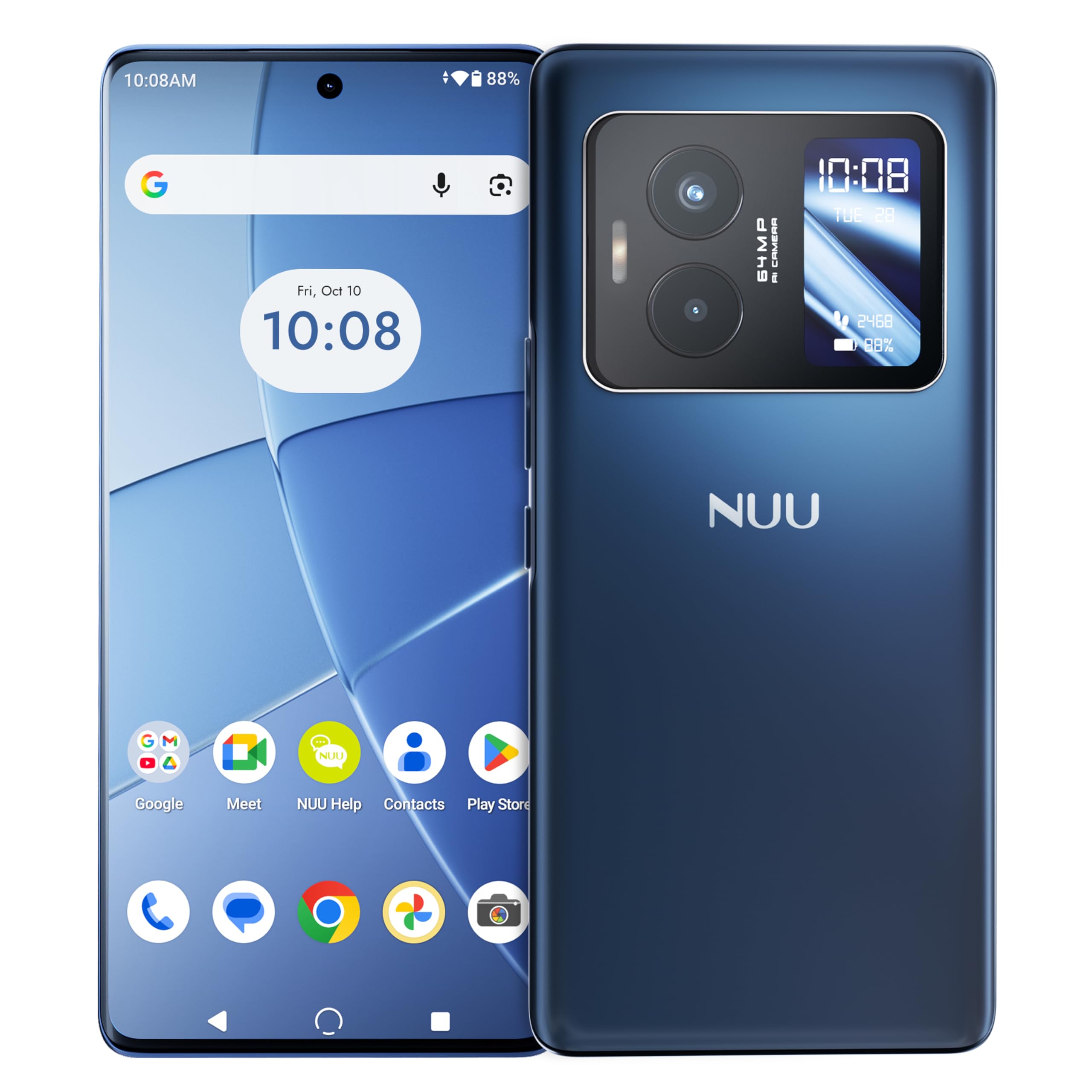
A second 1.6″ screen on the back for quick glances.
The NUU B40 adds a 1.6″ rear Vista Display so alerts land without waking the main screen — a small, always-on panel for busy days. The main screen is a 6.7″ FHD+ AMOLED at 120Hz, and performance is what earns credit here, with 8GB of RAM and 256GB of storage driving a snappy feel. A 5000mAh battery backs the whole thing up alongside Android 15.
Cameras are a 64MP rear sensor with AI enhancement and a 16MP front lens, so video calls and shots hold up for the money. Build and finish draw praise more than any single spec — attractive and well-made is the recurring read. The phone works from the start on T-Mobile, Mint, and Metro.
The honest note: the rear screen is described as more eye candy than daily tool, with limited pages and settings. Storage is a fixed 256GB with no card slot, so plan for that. It is a good phone wearing a novelty second screen — if you love the idea, it delivers; if you expected deep utility there, temper that.
What the second screen gives: quick notifications from a 1.6″ panel while the 6.7″ 120Hz AMOLED stays dark, which saves battery on long days.
The follow-up question: whether that rear panel does enough to matter — owners treat it as a nice extra rather than a core feature.
A match for: T-Mobile users who like a big AMOLED screen and enjoy the dual-display twist.
A poor fit for: anyone who needs expandable storage — there is no card slot.
6. Motorola Moto G86 Power 5G
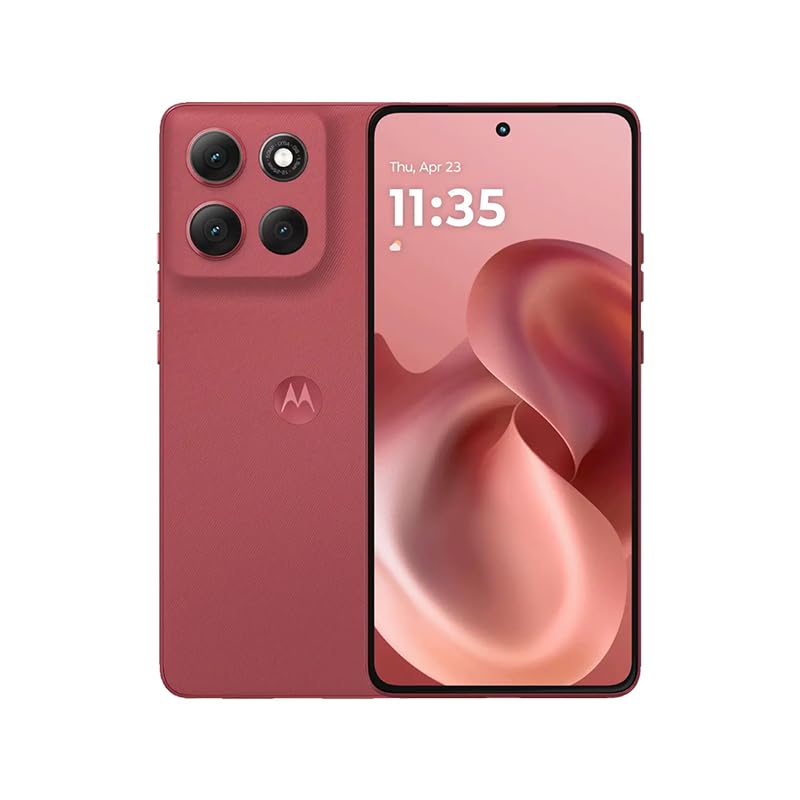
The one here that names eSIM right in its SIM setup.
Look at the SIM spec and it is plain: this Motorola takes one physical Nano-SIM plus one eSIM, so you can run a digital line alongside a real one. It does not take two physical SIMs, and eSIM activation still depends on your carrier supporting it. For a phone with eSIM in the name of the hunt, this is the model that fits the brief most directly.
The battery is enormous — 6720mAh — and owners describe it as lasting two days on average use. The 6.67″ P-OLED screen (a panel type with rich blacks and 1B colors) runs at 120Hz at a 446 ppi density, so text looks crisp. Storage is 256GB with a dedicated microSDXC slot, which means a memory card does not cost you a SIM. A Dimensity 7300 chip keeps it on Android 15.
There is a real catch, and it is about networks. The maker says it will not work on CDMA networks including Verizon, and one owner reports T-Mobile reception is reduced and E911 does not work. Inside the US it is a runner for GSM carriers; outside the US it works on any carrier worldwide. Quality and value draw praise, but check your network first.
The standout number: 6720mAh is the largest battery in this lineup short of the Huness, and it pairs with a 6.67″ 120Hz P-OLED screen and a dedicated microSDXC slot.
Why you check your carrier: CDMA networks like Verizon are off the table, and E911 is reported not to work on T-Mobile in one case — a serious point to confirm.
Pick this for: GSM-carrier users who actually want a working eSIM plus two-day battery life.
Steer away if: you are on Verizon or need guaranteed E911 over T-Mobile.
7. Apple iPhone 12, 64GB, Black – open up (Renewed)

An iPhone name with a refurbished price and an honest battery caveat.
If you want the iPhone experience without flagship money, a renewed iPhone 12 is the doorway. It arrives fully open up for any carrier and has passed a diagnostic test, with minimal cosmetic marks that the listing says vanish at arm’s length. Quality is what the crowd speaks to loudest — 3,100 mentions — and value trails close behind. The 5G, 4G LTE support and included charging cable cover the basics.
Battery is the number to watch. This phone holds a 2815mAh cell and is guaranteed to arrive with at least 80% of its original battery capacity, which is the refurbishment floor, not a promise of like-new. Owners mention landing units in the mid-80s to 90%. Durability feedback splits — the build holds up, but a small share of units fail early, so buy from a seller with a real return path.
Storage here is 64GB, which fills fast if you shoot video, and the battery-rated average use sits at 8 hours. Face ID, not a fingerprint reader, handles open up. Buy it if you mostly stream and cloud-sync; skip it if you need a full day of heavy use.
What you are actually buying: a fully open up iPhone 12 with a 2815mAh battery guaranteed to hold at least 80% capacity, tested and cleared of prior user data.
The storage squeeze: 64GB is tight for video, and there is no memory-card slot on any iPhone to bail you out.
Suited to: iOS fans and light streamers who want a tested iPhone on a tight budget.
Not for you if: you need a full day of heavy use out of a 64GB phone.
8. Samsung Galaxy A16 5G Dual SIM (128GB) 6.7″ 90Hz AMOLED

A 385 ppi AMOLED Samsung, with one hard line: no eSIM.
Here is the fact that decides this phone for this list: the maker states plainly that it does not support eSIM. If digital activation is the reason you are shopping, this one is out before it starts. What it does offer is a 6.7″ Super AMOLED at 90Hz with 385 ppi density and 800 nits brightness, so text and photos look sharp and bright for a budget handset. The 5000mAh battery and fingerprint open up cover everyday basics.
Reliability is where feedback splits. Some owners run it smoothly for a long haul, others describe lag and glitches; the durable build and long battery get separate praise. A 50MP main camera with a 2MP macro rounds out the rear, and the phone is sold as an international model for GSM networks. It will not take Cricket, Spectrum, or Xfinity, so check your MVNO.
Compared with the TCL above, this screen is 90Hz against the TCL’s 120Hz — smoother on the TCL. The A16’s case is that it is a cheap path into a bright Samsung screen, provided a physical SIM is fine for you. If a physical SIM is fine, the 6.7″ 90Hz AMOLED makes it a straightforward big-screen buy.
Where it shines: a 6.7″ AMOLED at 800 nits and 385 ppi gives sharp, bright everyday viewing for a low-tier Samsung.
The deal-decider: no eSIM support and no Cricket, Spectrum, or Xfinity — confirm your carrier first.
For you if: a physical SIM and a bright big screen are all you need.
Look past it if: eSIM or those listed MVNOs are on your checklist.
9. Huness 14 PM Smartphone, 6800mAh, 6.82″ HD Screen, 16+512GB
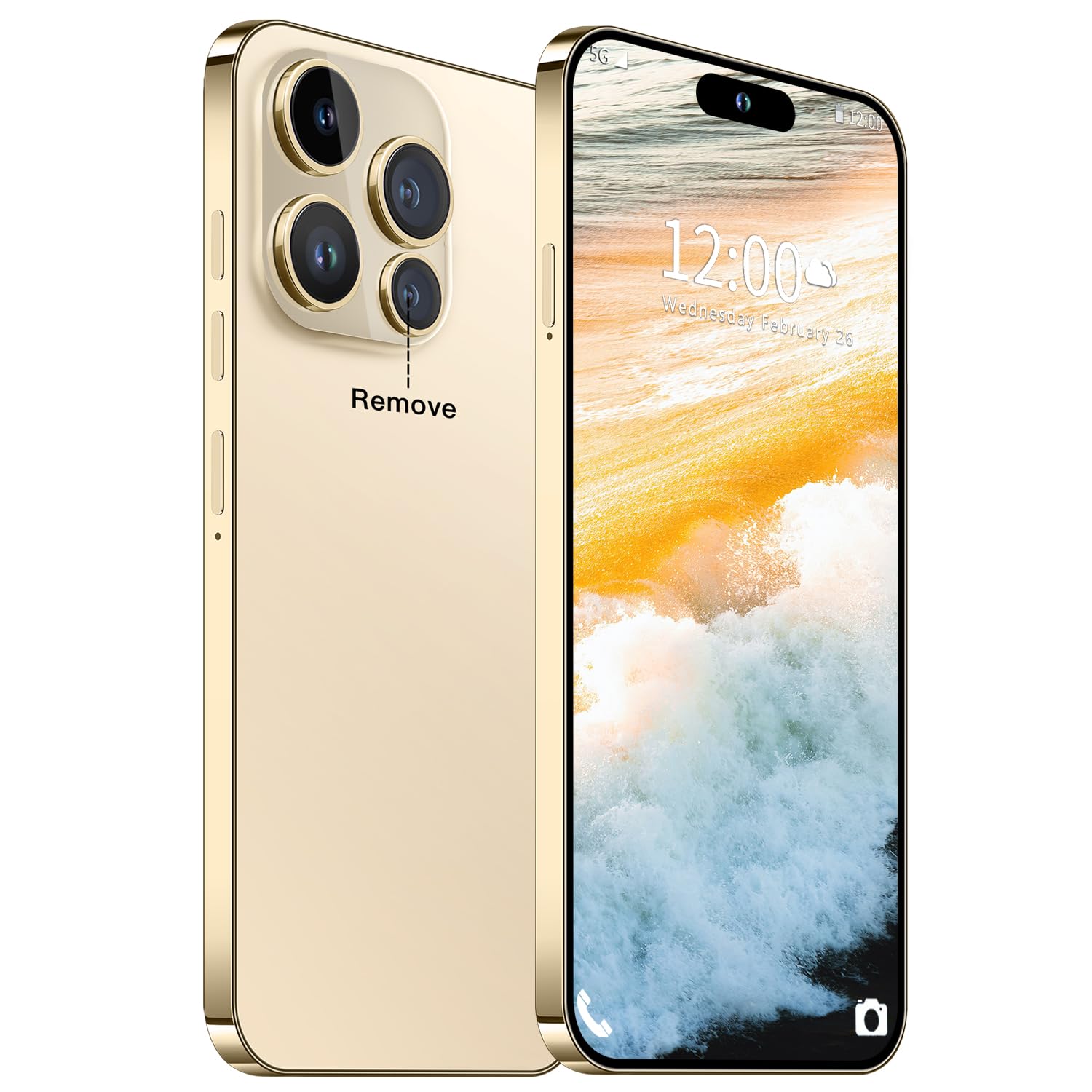
The biggest battery and the biggest storage claim in the lineup.
On paper this is a lot of phone: a 6800mAh battery, 16GB of RAM with 512GB of storage, and a 6.82″ HD+ screen at 570 ppi density. The main camera is listed at 108MP with a 48MP front, and the phone runs Android 14 with face and fingerprint open up. For buyers chasing screen size and a long-lasting battery on a budget, the numbers land.
The buyer feedback is the part to weigh carefully. The genuine review signal is thin and mixed — some units satisfy, while others report the phone simply dying after a couple of days. It ships with a case, screen protector, earphones, and adapter in the box, which is more included gear than most of this list. Treat the 6800mAh and 512GB specs as a value gamble, not a reliability guarantee.
Nothing in its data confirms eSIM support, so it should not be your pick if digital activation is the goal. It suits a spare or big-screen media handset where the 6800mAh battery matters most. Keep your return window open until you have run it hard for a week.
The spec bait: 6800mAh is the largest battery here, and 512GB plus 16GB RAM dwarfs the rest of the list.
What to verify fast: reliability is inconsistent across units, and there is no stated eSIM support — test it early and keep your return path.
Try it as: a low-cost big-battery, big-screen spare where longevity matters more than polish.
Skip it as: your eSIM-first daily driver — that role belongs higher up this list.
Know the Specs
eSIM vs physical Nano-SIM
An eSIM is a digital SIM profile downloaded to your phone instead of a plastic card. On budget handsets it is often region-limited — one pick here restricts eSIM to Japan, another says it does not support eSIM at all, and the Moto G86 Power lists one Nano-SIM plus one eSIM. Always match that line to your carrier before buying.
Battery capacity and charging wattage
Battery capacity is measured in milliamp-hours (mAh) and shows how much charge the phone holds. Charging wattage shows how quickly it refills — a 50W charger moves faster than a 25W one. A larger cell generally lasts longer between charges, while higher wattage means shorter plug-in time.
Display type, refresh rate, and brightness
AMOLED and OLED panels light each pixel individually for deep blacks. Refresh rate in Hz shows how many times a second the screen redraws — 120Hz feels smoother than 90Hz. Brightness in nits shows how hard the screen pushes light, which affects how usable it is under the sun.
Storage, RAM, and expandable slots
Storage in gigabytes holds apps, photos, and videos; RAM in gigabytes is the short-term memory that keeps apps running smoothly. A microSDXC slot lets you add storage with a card. Watch out for hybrid or shared slots, where a card can cost you a second SIM line.
Common Questions
Which cheap phones here actually support eSIM?
Why does eSIM work in one country but not another?
Can I use a foreign international model on a US carrier?
What is a hybrid SIM slot and why does it matter?
Do these phones work on Verizon?
Is a 4G phone still worth buying?
How much battery capacity should I look for?
Is a renewed iPhone a safe budget buy?
What does an IP67 rating mean on a budget phone?
How important is refresh rate on a budget phone?
The Bottom Line
The best all-around choice for most buyers is the Nothing Phone (3a), because its 50W charging and 6.77″ 120Hz AMOLED at 3000 nits deliver a screen and refill speed that make a low-cost phone feel anything but budget. If a real eSIM line is your whole reason for shopping, grab the Motorola Moto G86 Power for its Nano-SIM plus eSIM setup and 6720mAh battery. And if you simply want the most storage and update life for the money, the Samsung Galaxy A26 5G with 256GB and up to six Android upgrades is the one to reach for.
How we choose
We do not accept paid placement. Every pick is matched to a real buyer and a real use-case; we do not hands-on test units.
Sources
Specifications: manufacturer listings and product documentation. Review insights: verified customer reviews, as of October 2026. Pricing: not shown on this page (it changes often); check the current price via the retailer link.
As an Amazon Associate, Aappliancez earns from qualifying purchases. This does not affect which products we feature.