Disclosure: Some links in this post are affiliate links. As an Amazon Associate I earn from qualifying purchases, at no extra cost to you. Learn more
Specs are compiled from manufacturer listings and verified buyer reviews and can change over time — please confirm the key details on the product page before buying.
You want a fountain pen that writes well without feeling like you gambled a paycheck on it. A cheap fountain pen can still give you a smooth line, a comfortable grip, and a nib (the metal tip that lays down the ink) that behaves on ordinary paper. The five picks below cover every kind of beginner, from the person who just wants to sign a card to the sketcher chasing variable line width. Three things separate a good cheap fountain pen from a bad one: how the nib spreads ink on the page, whether the seal keeps the feed (the channel that carries ink to the nib) from drying out between uses, and how much ink the pen physically holds.
This guide is built by comparing the manufacturers’ published specifications and the patterns across verified customer reviews, so you get each pick’s real strengths and trade-offs instead of marketing spin.
A disposable six-pack and a piston-filler made from turned resin can sit on the same shelf and suit completely different people. This breakdown covers nib angles, retractable mechanisms, converter capacity, and the honest shortcomings nobody puts on the box. Below you will find the picks that earn their place among the best cheap fountain pen options.
Top Picks

How To Choose The Best Cheap Fountain Pen
Most first-time fountain pen buyers assume the pen body matters most. It doesn’t. The nib touches the paper, and the filling system decides how often you have to think about ink — those two things shape your whole experience, and everything else is feel.
Nib size and what it does on paper
Nib size (the width of the writing tip, measured in millimeters) sets how much ink lands on the page. A fine nib lays down a thin, controlled line — usually somewhere around 0.5 millimeters — and behaves better on cheap office paper because less ink means less bleed. If you grip near the nib, note that some pens have a step where the barrel meets the grip section, and high grippers can feel that edge.
The filling system decides your upkeep
Disposable fountain pens come filled and sealed, so you toss one when it runs dry. Cartridge pens let you snap in a fresh ink cartridge in seconds. A piston filler draws ink straight from a bottle using a built-in mechanism, so you refill less often — but you also need a bottle, which is more setup than a beginner may want. A converter sits between the two: it’s a small refillable reservoir that fits where a cartridge would.
Cap seal and drying out
Ink is mostly water, and water evaporates. A pen left uncapped, or a retractable pen with a weak shutter, dries out and hard-starts — that scratchy, skipping first stroke. Snap caps, screw caps, and retractable designs all try to slow that evaporation, and how well they do it is the single biggest reliability difference between two pens that look identical on a shelf.
Side-by-Side Comparison
| Model | Best For | Nib Size | Ink System | Body Material | Amazon |
|---|---|---|---|---|---|
| ZEBRA Fuente★ Best Overall | Writers who want zero maintenance | 0.6 millimeters | Disposable | — | Amazon |
| Sailor Fude De MannenBest for Sketching | Sketching and calligraphy | 55° fude angle | Cartridge or converter | Plastic | Amazon |
| Jinhao 10 Press | One-hand daily note taking | Fine, 0.5 millimeters | Converter | Metal | Amazon |
| PILOT Metropolitan | Beginners and bullet journaling | Fine | Cartridge or converter | Brass | Amazon |
| Asvine P20 | Bottle-ink enthusiasts | Extra fine | Piston | Acrylic resin | Amazon |
Detailed Reviews
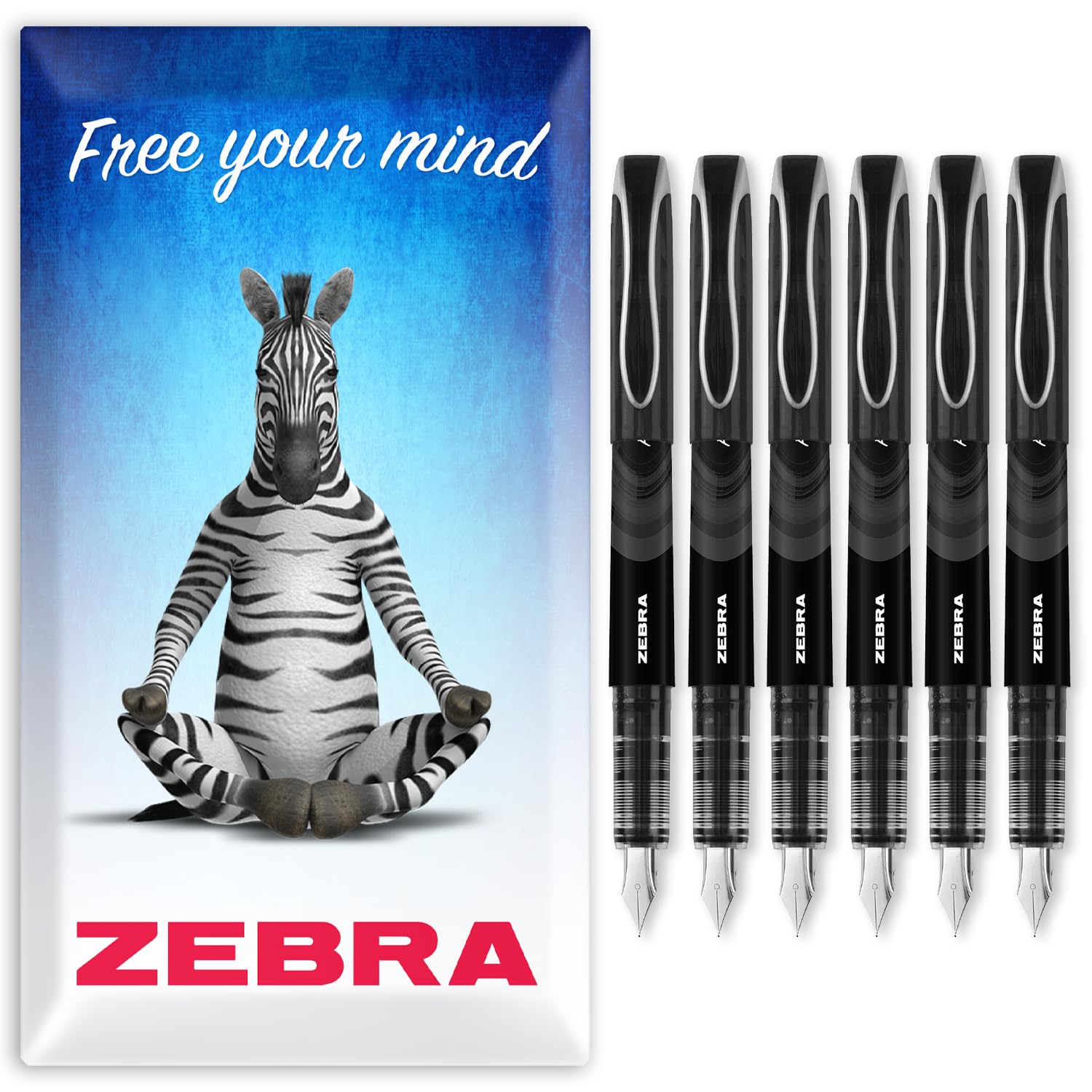
1. ZEBRA Fuente Disposable Fountain Pen, Pack of 6
Six pens, no bottles, no cleaning — a starter kit for anyone who has never owned a fountain pen.
The writing itself is what wins people over. Buyers consistently describe these as pens that put ink down nicely the moment you uncap one, and that is the whole point of a disposable fountain pen: the fill, the feed, and the nib all arrive matched and ready. At 0.6 millimeters, the tip is a medium-fine line that suits everyday handwriting — notes, cards, forms — without laying down so much ink that cheap office paper feathers (ink bleeding into fuzzy edges).
The value story is strong too, and it’s the one aspect reviewers bring up second most. Six pens in envelope gift packaging works out to a genuinely low cost per pen, so you can try fountain pens without buying a bottle of ink, a converter (a refillable ink reservoir), and a cleaning routine on day one. The finish is sleek and round-bodied with a simple grip and ambidextrous hand orientation (shaped to work the same in either hand), so left- and right-handed writers get the same experience.
The catch is consistency. Reliability, ink flow, and leak-resistance all draw mixed feedback — some units write perfectly, and a few arrive running dry or weeping into the cap. For a disposable, that’s the honest trade: you accept a small variance rate in exchange for never having to maintain anything. Hand these out to a class, keep a few in a drawer, and the odds are firmly in your favor. This is the crowd favorite here at 4.5+ stars across 900+ ratings, and it earns the top spot on that combination of writing quality and cost per pen.
What earns the top spot
- Writes well straight out of the packaging with no filling or priming
- Six pens in gift packaging means a very low cost per pen
- 0.6 millimeter tip suits everyday handwriting on ordinary paper
- Ambidextrous round body works for left- and right-handed writers
What to expect long term
- Reliability and ink flow split opinion — most units are fine, a few run dry or leak
- Disposable means no refilling, so the body goes in the bin when the ink runs out
- Not the pen to choose if you want to pick your own ink color later
Made for: the first-timer, the gift-giver, or the office drawer that needs pens people can just grab and use.
Think twice if: you want to choose your own ink and refill from a bottle — that’s the next pick on this list.
2. Sailor Fude De Mannen Calligraphy Fountain Pen, Bamboo Green
One bent nib covers hairline to broad strokes without swapping pens.
The number that defines this pen is 55 degrees. That’s the angle of the bent fude nib on this Bamboo Green model, and it’s the reason you can draw anything from a hairline to a broad, fast-drying stroke by simply tilting the pen. Roll your wrist and the line width changes mid-stroke — that’s the whole appeal, and it’s a trick no straight-nib pen can copy. The tip is far wider than the Zebra’s 0.6 millimeters, and that’s deliberate: this is a drawing and lettering tool, not a note-taking pen.
Build quality wins people over here, and value comes right behind it. Owners describe a solid green body paired with a gold-toned steel nib that flows smoothly with no hard starts (no scratchy first strokes), and the fun factor comes up again and again — the review pages sum it up as about as much fun as a fountain pen can be. The barrel is long, which helps you make free, sweeping strokes, and it’s light in the hand. It ships with two Sailor black cartridges, fits a spare cartridge inside the barrel, and accepts an international converter (a refillable reservoir that fits many brands) if you’d rather draw from a bottle.
Two honest limits. First, it’s not a handwriting pen — the fude tip is built for drawing and calligraphy, and normal script feels wrong on it. Second, the nib is sensitive, and a small number of buyers report trouble with it early on. Worth knowing: only the green model carries the 55-degree nib, so if you want the full line-width range, pick this color specifically. And the body is plastic, not metal, despite the polished look.
Where it beats the competition: the Fude De Mannen delivers genuine line variation that no straight-nib pen on this list can match, and at 4.5+ stars across 2,300+ ratings it has the deepest track record of any pick here.
The honest catch: that 55-degree nib is a specialist tool — reach for it to sketch, letter, or doodle, and keep a fine nib around for actual writing.
Grab it if: you sketch, letter, or want to experiment with variable line widths without buying a brush.
Look elsewhere for: everyday handwriting — for journaling and notes, move down to the Jinhao 10 or the Pilot Metropolitan.
3. Jinhao 10 Press Fountain Pen
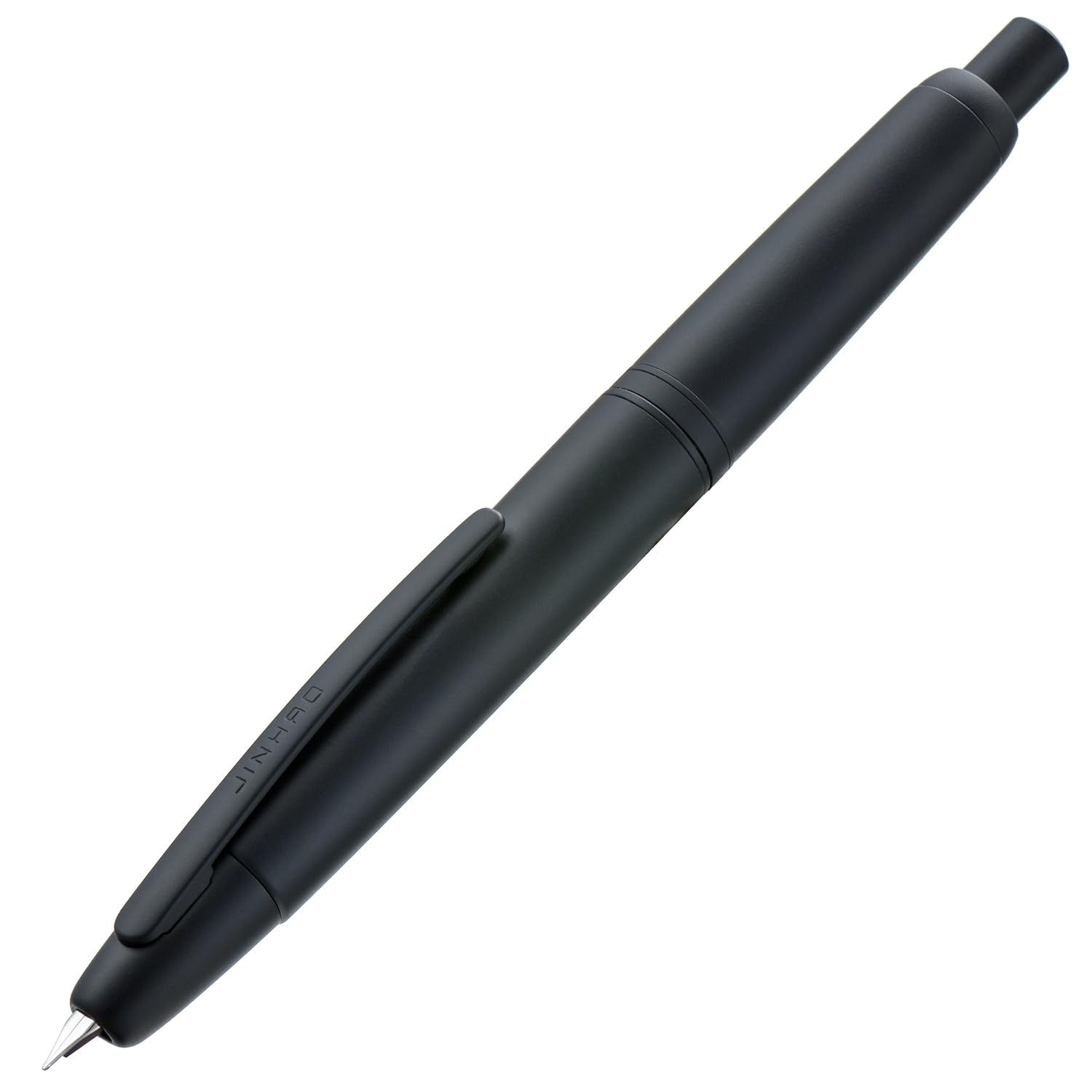
A click-to-write fountain pen that behaves like a ballpoint until you look at the line.
Press the button, the nib extends, and you write — no cap to lose, no uncapping one-handed. That’s what makes this the most practical pick for standing meetings and quick signatures. The body is metal at 13 millimeters in diameter, and the built-in shutter at the nib opening seals the tip when it’s retracted so ink doesn’t dry or leak while the pen rides in your pocket. The fine nib lays a 0.5-millimeter line, finer than the Zebra’s 0.6-millimeter disposable tip.
Owners rave about the build. It feels substantial in the hand with a satisfying click and no scratchy sensation, and the press button’s internal spring keeps the nib locked in place while you write rather than wobbling. Fit and finish lands right in line with much pricier pens — one owner reports 4 to 7 days of continuous writing on a single fill. It arrives in a metal and paper box with a converter included, so it’s gift-ready out of the packaging and you can refill from a bottle straight away. It takes Pilot cartridges too, though a Pilot cartridge fits without the protective cap.
Ink drying is the recurring gripe, and it’s the one thing to weigh. Hard starts after sitting are the most-discussed complaint, and the tiny converter holds very little ink, so this pen rewards frequent use over long storage. A few units arrive outright defective and get returned. Handled as a daily-carried pen rather than a drawer pen, it’s excellent — just don’t expect it to wake up perfectly after two weeks untouched.
Why it leads on convenience
- Retractable nib with a shutter that seals the tip against drying and leaking
- Metal body at 13 millimeters gives a substantial, stable feel in hand
- 0.5 millimeter fine nib on a converter that ships in the box
- Works with Pilot cartridges as well as bottle ink
The honest trade-offs
- Ink drying after sitting is the most-discussed complaint — frequent use keeps it happy
- The included converter holds very little ink compared with a piston filler
- A small share of units arrive defective and get sent back
Perfect for: anyone who wants fountain pen line quality with ballpoint convenience in their pocket every day.
Better to skip if: the pen will sit in a drawer for weeks between uses — the seal works best on a pen that gets carried.
4. PILOT Metropolitan Fountain Pen

The pen people keep recommending to their friends, made of brass and built to feel costlier than it is.
Solid brass in a gold finish is the giveaway feature. Where the Jinhao is metal and the Fude De Mannen is plastic, the Metropolitan’s brass barrel gives it a weight and presence that makes it look and feel like a step up — owners describe it as stylish and expensive-looking, and it holds a sturdy clip ready for a shirt pocket. The fine nib is the other reason it turns up on so many beginner lists: it writes a controlled line that behaves even on poor office paper, since less ink on the page means less feathering (ink bleeding into fuzzy edges).
It’s a forgiving pen to learn on, and that’s the point. It’s easy to swap the nib, and it takes both cartridges and a converter, so you can start simple and graduate to bottle ink whenever you like. One cartridge yields roughly 15 A4 journal pages — about 3,750 words. A long-time user who journaled with one daily reports it still writing like new.
Two small annoyances are worth flagging. The included converter holds little ink, so if you plan to write daily from a bottle, you’ll refill fairly often. And there’s a slight step where the barrel meets the grip section that can press on people who grip high near the nib. Neither is a reason to pass — they’re the kind of quirks you notice once and then stop noticing. Beginners who want a fountain pen that just works should shortlist this one hard.
The short version: brass construction, a fine nib that handles cheap paper, and both cartridge and converter compatibility make this the safest first fountain pen on the list.
Where it nips at the leaders: it writes more smoothly on ordinary paper than the Fude De Mannen’s specialist nib allows — but the converter’s small capacity means refilling more often than the Asvine piston.
Best matched to: the first-timer who wants a pen that feels serious in the hand and costs nothing to try.
Consider alternatives if: you grip right up against the nib and dislike a hard edge under your fingers — the Asvine’s tapered section is smoother there.
5. Asvine P20 Piston Fountain Pen

A piston-filler you refill from the bottle, wrapped in turned amber resin and topped with an extra fine nib.
That’s the practical payoff for anyone who writes in long sessions and hates stopping to refill. There’s a transparent ink window in the barrel so you can see your supply without unscrewing anything, and the extra fine nib keeps the line tight and economical, stretching each fill further. The acrylic section tapers with a no-slip grip for long writing stretches, and it’s light in the hand.
Quality is the headline, followed closely by how it writes. Reviewers describe the hand-polished stainless steel nib as smooth straight from the start with no tuning needed and a touch of shading, and the turned acrylic shows no molding lines. It’s a handsome pen — the amber resin gets described as a mix of lavender, burnt orange, and deep blue depending on the light — and it arrives with a storage case. It carries a functional roller clip, and the cap posts securely without making the pen top-heavy.
Where it asks for patience: the piston is a process, and more than one buyer reports fumbling the fill the first time because the instructions came on a shared leaflet. There’s also real unit-to-unit variance on the piston — one buyer had a second pen fail to draw ink at all and returned it. The lid takes a firm turn to unscrew, and the manufacturer advises avoiding shimmer inks. If you want to skip the piston learning curve entirely, the Jinhao’s converter is simpler to top up mid-week.
Why the ink capacity wins: pairing a piston fill with an extra fine nib means fewer refills than any converter pen on this list, and the clear ink window tells you exactly when to reach for the bottle.
The starter tip: the fill takes practice the first time or two — watch for the piston drawing properly, and the pen settles into a dependable daily rhythm after that.
Choose it if: you write in long sessions and want to stop thinking about ink — the piston holds far more than a cartridge, so you refill from a bottle far less often.
Think twice if: you want zero setup rituals — a cartridge pen or a disposable skips the whole filling dance.
Know the Specs
Nib size, explained
Nib size is the physical width of the writing tip, and it changes everything about how a pen feels on paper. A fine nib — like the Pilot Metropolitan’s or the Jinhao’s 0.5-millimeter tip — lays a narrow line that stays crisp on cheap office paper because it delivers less ink per stroke. A medium-fine tip such as the Zebra’s 0.6 millimeters sits between fine and medium: still controlled, but with a slightly more generous flow. Wider tips feel smoother but bleed more on thin paper, while the Sailor’s 55-degree fude nib is a bent design that swings from hairline to broad depending on your writing angle. Match nib size to your paper and your handwriting.
Filling systems, explained
A filling system is simply how the ink gets into the pen. Disposable pens arrive pre-filled and sealed — nothing to learn, nothing to clean, but you throw the whole pen away when it’s empty. Cartridge pens accept a sealed ink tube you snap in, which is the fastest refill and why the Sailor ships with two. A converter is a small refillable reservoir that slots where a cartridge would, letting you draw from a bottle — good flexibility, but the reservoir is small, which is why the Jinhao and Pilot both refill often. A piston filler like the Asvine P20 builds the refill mechanism into the barrel itself and holds far more ink than a cartridge or converter, at the cost of a slightly fiddly fill from a bottle.
Common Questions
Will a cheap fountain pen work on regular notebook paper?
How long does a fountain pen refill last?
What is a fude nib and is it good for handwriting?
Do I need a converter or can I just use cartridges?
Why does my fountain pen hard start after sitting?
Is the Pilot Metropolitan better than the Jinhao 10?
Can I use bottled ink in a disposable fountain pen?
How should I store a fountain pen so it does not dry out?
Is extra fine better than fine for everyday writing?
What causes a fountain pen to leak into the cap?
The Bottom Line
For most people, the cheap fountain pen winner is the ZEBRA Fuente six-pack — it writes well straight from the packaging and asks nothing of you in return, which is exactly what a first fountain pen should do. If you sketch or letter, the Sailor Fude De Mannen earns its place with the 55-degree nib that no straight tip can imitate. Writers who want one-hand convenience should reach for the Jinhao 10 Press, and if you’d rather draw ink from a bottle and refill less often, the Asvine P20 is the piston-filler to get.
How we choose
We do not accept paid placement. Every pick is matched to a real buyer and a real use-case; we do not hands-on test units.
Sources
Specifications: manufacturer listings and product documentation. Review insights: verified customer reviews, as of October 2026. Pricing: not shown on this page (it changes often); check the current price via the retailer link.
As an Amazon Associate, Aappliancez earns from qualifying purchases. This does not affect which products we feature.